- Product Description Description
- Table of Contents TOC
- List of Table & Figure LOT
- Get Free Sample PDF Sample PDF
Market Size, 2025
$3.66 BnMarket Estimate, 2026
$4.11 BnMarket Forecast, 2034
$10.42 BnCAGR, 2026–2034
12.32%Global Surfboard Market Size
The global surfboard market reached USD 3.66 billion in 2025 and is expected to grow to USD 4.11 billion in 2026 and USD 10.42 billion by 2034, at a CAGR of 12.32% from 2026 to 2034.

Surfboard is crafted for wave riding, primarily constructed from polyurethane, epoxy, or sustainable composite materials. The culture of surfing has evolved beyond traditional coastal hubs, with inland populations accessing the sport through wave pools and artificial surf lagoons. Besides, the proliferation of adaptive surfing programs has broadened demographic inclusion. These developments underscore a transformation in the surfboard market from a niche craftsmanship industry into a globally interconnected sector influenced by athletic, recreational, and environmental dynamics.
MARKET DRIVERS
Coastal Tourism Expansion Driving Surfboard Demand
The global expansion of coastal tourism, which directly amplifies demand for surf equipment, is a pivotal driver of the surfboard market. As coastal regions in Southeast Asia, Latin America, and West Africa develop tourism infrastructure, surf-based recreational activities gain prominence. Like, international tourist arrivals to coastal destinations increased between 2010 and 2019, with surfing emerging as a key experiential offering. Countries like Indonesia and Costa Rica have reported year-on-year growth in surf tourism. This influx translates into higher rental demand and first-time surfboard purchases, particularly in surf camps and resorts. Furthermore, the rise of “surf and stay” packages has led to partnerships between local shapers and hospitality providers, stimulating regional production. The integration of surfing into mainstream vacation culture, coupled with social media exposure of iconic surf destinations, continues to attract new participants, reinforcing sustained demand for surfboards across beginner and intermediate segments.
Rising Youth and Women Participation in Surfing
The increasing participation of youth and women in competitive and recreational surfing, reshaping market demand, is another significant driver. Since the inclusion of surfing in the Olympic Games in 2020, youth engagement has surged. Women now constitute a notable sahre of new surfers globally, a shift catalyzed by high-profile athletes like Carissa Moore and Stephanie Gilmore. This demographic evolution has prompted manufacturers to design lightweight, durable, and gender-inclusive surfboard models tailored to varying skill levels. The growing presence of women in surf schools and competitions has also driven demand for custom shortboards and soft-top beginner boards, reinforcing product diversification and expanding the consumer base beyond traditional male-dominated segments.
MARKET RESTRAINTS
Environmental Regulations on Manufacturing Materials
Environmental regulations on surfboard manufacturing materials present a major restraint on market growth. Traditional surfboards rely heavily on polyurethane foam and polyester resin, both petroleum-based and classified as hazardous materials under environmental safety standards. Compliance costs can b expensive per facility, disproportionately affecting small-scale artisans. Moreover, the European Union’s REACH regulations restrict the import of surfboards containing non-compliant chemicals, limiting export potential. These constraints hinder production scalability and innovation, particularly among independent shapers who lack the capital to transition to eco-certified materials or closed-loop manufacturing systems.
Geopolitical Disruptions in Raw Material Supply Chains
Geopolitical disruptions in raw material supply chains significantly impede surfboard production efficiency. Epoxy resins and expanded polystyrene (EPS) foam, critical components in modern surfboard construction, are predominantly sourced from chemical manufacturing hubs in China, South Korea, and Germany. Additionally, the Russia-Ukraine conflict disrupted benzene and propylene derivatives, essential for foam core production, causing a price spike in EPS between 2021 and 2023. These supply chain instabilities increase lead times and production costs, limiting the ability of manufacturers to meet seasonal demand peaks, particularly in the pre-summer months when retail orders surge.
MARKET OPPORTUNITIES
Adoption of Sustainable Surfboard Materials
The emergence of sustainable surfboard materials presents a transformative opportunity for market differentiation and long-term viability. Innovations in bio-based foams, such as those derived from sugarcane or algae, are gaining traction among eco-conscious consumers. Also, algae-based polyurethane foam reduces carbon emissions compared to petroleum-based alternatives. Companies have adopted Entropy Resins, which utilize waste pine sap, achieving a reduction in embodied energy per board. This trend aligns with broader environmental stewardship movements within coastal communities, enabling brands to command premium pricing while fostering brand loyalty. The integration of circular economy principles, including recyclable cores and modular designs, further positions sustainability as a core market differentiator.
Growth of Artificial Wave Technology
The proliferation of artificial wave technology is unlocking new geographic and demographic opportunities for the surfboard market. Facilities like Kelly Slater’s Surf Ranch and Citywave systems in Germany generate consistent, controllable waves, enabling inland populations to engage in surfing year-round. These installations serve as training hubs, driving demand for specialized shortboards optimized for high-performance wave riding. Wave pools also standardize learning conditions, accelerating skill acquisition and increasing retention rates among beginners. This infrastructure expansion fosters a new class of surfers who transition from artificial to ocean environments, sustaining demand for both entry-level and performance-grade surfboards, thereby broadening the market’s geographic and socioeconomic reach.
MARKET CHALLENGES
Decline of Artisanal Craftsmanship
The erosion of artisanal craftsmanship due to industrialization and mass production is a critical challenge facing the surfboard market. Traditional hand-shaping, a skill requiring years of apprenticeship, is being displaced by computer-controlled shaping machines that prioritize speed and uniformity. Also, the number of independent surfboard shapers in the U.S. has declined since 2010. This shift undermines product uniqueness and cultural authenticity, alienating purist consumers who value bespoke designs. Moreover, machine-produced boards often lack the nuanced flex and responsiveness of hand-shaped counterparts, affecting performance. The loss of craftsmanship also diminishes regional design diversity, such as the Hawaiian longboard or Malibu egg, replacing it with homogenized models optimized for global retail chains. Preserving this heritage while accommodating scalability remains a complex challenge for the industry.
Impact of Climate Change on Surf Breaks
Climate change-induced coastal degradation poses a growing challenge to the surfboard market by threatening natural surf breaks. Rising sea levels, intensified storm patterns, and beach erosion are altering wave formation dynamics at renowned surf destinations. According to the Intergovernmental Panel on Climate Change, global sea levels have risen by an average of 3.7 millimeters per year since 2006, accelerating coastal habitat loss. These environmental shifts reduce surfing frequency and discourage investment in surf tourism infrastructure, indirectly dampening surfboard demand. As climate instability intensifies, the long-term viability of surf ecosystems and the market dependent on them faces increasing uncertainty.
REPORT COVERAGE
| REPORT METRIC | DETAILS |
| Market Size Available | 2025 to 2034 |
| Base Year | 2025 |
| Forecast Period | 2026 to 2034 |
| Segments Covered | By Product, End User Region. |
| Various Analyses Covered | Global, Regional and Country-Level Analysis, Segment-Level Analysis, Drivers, Restraints, Opportunities, Challenges; PESTLE Analysis; Porter’s Five Forces Analysis, Competitive Landscape, Analyst Overview of Investment Opportunities |
| Countries Covered | U.S, Canada, Mexico, UK, France, Spain, Germany, Italy, Russia, Sweden, Denmark, Switzerland, Netherlands, Turkey, Czech Republic, India, China, Japan, South Korea, Australia, New Zealand, Thailand, Malaysia, Vietnam, Philippines, Indonesia, Singapore, Brazil, Argentina, Chile, KSA, UAE, Israel, rest of GCC countries, South Africa, Ethiopia, Kenya, Egypt, Sudan and Other Countries |
| Market Leaders Profiled | Quiksilver, Hobie, Rusty Surfboards, Xanadu Surfboards, Haydenshapes, The Board Works Surf, Firewire Surfboards, Surftech, McTavish Surfboards, Keeper Sports and True North Gear |
SEGMENTAL ANALYSIS
By Product Insights
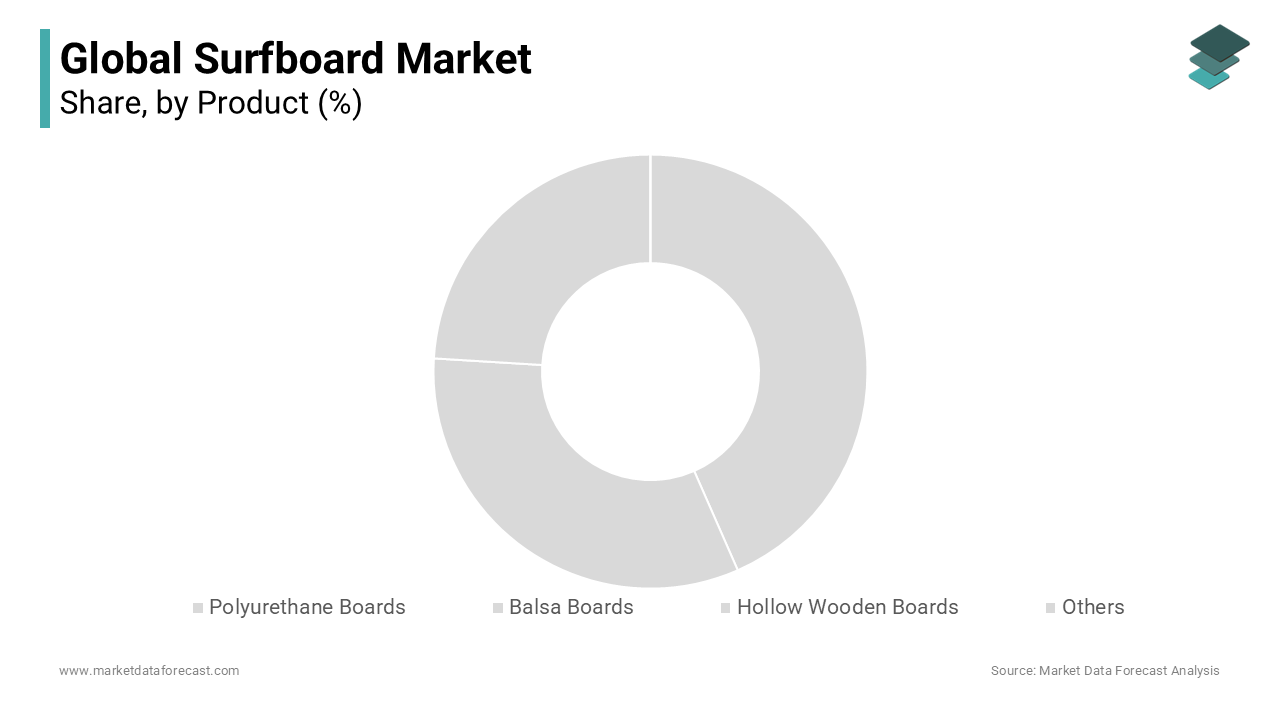
The polyurethane (PU) boards segment was largest product in the surfboard market which held a 62.5% of the global share in 2024. This dominance is credited to the material’s long-standing acceptance among shapers and surfers for its optimal weight, flexibility, and ease of shaping. PU boards are favored for their responsiveness in varied wave conditions, making them the default choice for both recreational and professional surfers. Furthermore, the widespread availability of PU blank suppliers like US Blanks and Clark Foam ensures consistent production scalability. Despite environmental concerns, the entrenched infrastructure and lower production costs continue to reinforce PU’s market position, particularly in mass-market retail and rental fleets.
The hollow wooden boards segment is the fastest-growing and is projected to expand at a CAGR of 9.4% from 2025 to 2033. This surge is driven by rising consumer demand for eco-conscious, handcrafted surfboards that merge aesthetic appeal with environmental responsibility. Also, sustainably harvested paulownia and redwood used in hollow wooden construction, positioning them as carbon-negative products. A further catalyst is the premiumization trend in surfing culture. These boards are increasingly adopted by environmentally aware urban professionals and collectors, particularly in North America and Western Europe. Moreover, advancements in vacuum-bagging and epoxy sealing have improved durability and water resistance, overcoming historical performance limitations and broadening their appeal beyond novelty status.
By End User Insights
The entertainment segment was the dominant end-user by accounting for 55.3% of global surfboard demand in 2024. This dominance is fueled by the commercialization of surfing as a leisure experience rather than a competitive sport, particularly in coastal tourism economies. Surf schools, rental outlets, and guided surf vacations constitute a significant portion of this segment. Destinations such as Bali, Gold Coast, and Costa Rica report that generally first-time surfers engage through guided entertainment packages, where soft-top polyethylene boards are standard due to safety and durability. The integration of surfing into wellness and adventure tourism has further amplified demand. This experiential model prioritizes accessibility over performance, making entertainment the cornerstone of surfboard consumption.
The sport competition segment is fastest-growing end-user segment and is anticipated to grow at a CAGR of 8.7% between 2025 and 2033. This acceleration is primarily driven by the inclusion of surfing in the Olympic Games, which has institutionalized competitive pathways and increased funding for elite training programs. Since Tokyo 2020, over 65 national Olympic committees have established formal surf development squads, leading to an increase in demand for high-performance shortboards. Professional surfers typically use 8 to 12 boards per season, each tailored to specific wave conditions, amplifying per-athlete consumption. Additionally, the rise of regional qualifying leagues has expanded the competitive base.
REGIONAL ANALYSIS
North America surfboard market Insights
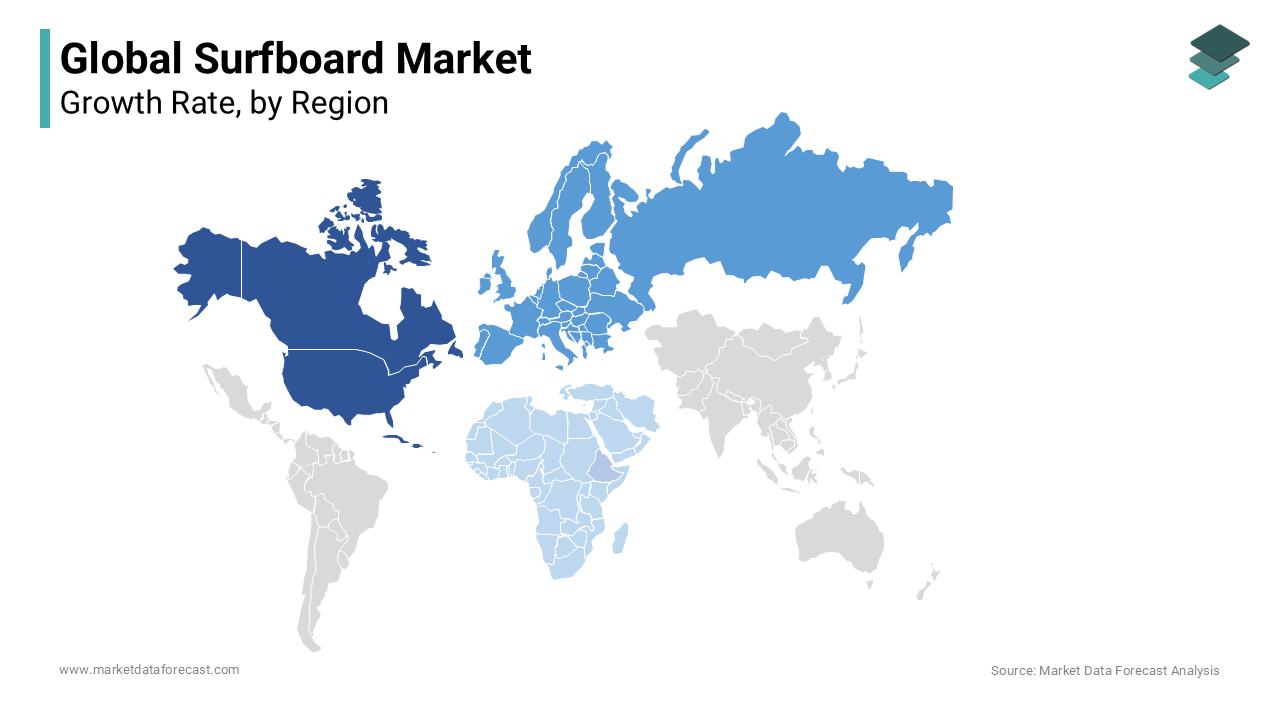
North America commanded a leading position in the global surfboard market by holding 34.6% of total share in 2024. The region’s dominance is anchored in the U.S., where California is the hub of country’s surfboard production, representing more than half of national output. A deeply rooted surf culture, supported by hundreds of active surf schools and surf competitions per year, sustains consistent demand across both recreational and professional tiers. As per the Outdoor Foundation, an estimated 2.8 million Americans participated in surfing in 2023, with youth engagement rising due to school-based surf programs in Hawaii and Southern California. The presence of major manufacturers like Lost Surfboards and Firewire, combined with robust e-commerce distribution, ensures product innovation and accessibility. Furthermore, the proliferation of wave pools such as Kelly Slater’s Surf Ranch in Lemoore has created new testing grounds for performance boards, reinforcing North America’s role as a trendsetter in design and technology.
Europe Surfboard Market Insights
Europe holds a significant market sharewith France, Portugal, and the UK emerging as key contributors, according to the European Surfing Federation. The region has witnessed a structural shift in surf participation, with inland populations increasingly accessing the sport through artificial wave facilities. Portugal, in particular, has become a premier surf tourism destination. This influx has spurred demand for rental fleets and locally produced eco-friendly boards. Additionally, government-backed initiatives program have integrated surfing into youth sports development.
Asia Pacific Surfboard Market Insights
Asia Pacific accounts for a notable share of the global surfboard market, with Indonesia and Australia serving as pivotal hubs. Australia, despite its relatively small population, contributes disproportionately to surfboard innovation and consumption. The country’s extensive coastline and high per capita surf participation, nearly 1.1 million Australians surfed at least once in 2023, underpin steady demand. Indonesia has seen arise in domestic surfboard production since 2020, driven by the growth of local shapers catering to both tourists and residents. The region’s appeal is further enhanced by low manufacturing costs and proximity to resin and foam suppliers in Southeast Asia. With surf tourism rebounding post-pandemic, infrastructure development and rising middle-class engagement are accelerating market expansion.
Latin America Surfboard Market Insights
Latin America is an emerging region of the global market, with Brazil and Chile leading regional growth. Brazil is the largest national market in the region. The country’s success in international competitions, including Olympic qualification, has elevated national interest and spurred investment in surf academies and local manufacturing. Chile has developed a niche in high-performance board imports. The rise of surf camps in coastal towns like Punta de Lobos and Florianópolis has also increased demand for durable, entry-level boards. As per the Latin American Surf Alliance, the number of registered surf schools in the region grew between 2020 and 2023, indicating a structural shift toward organized, scalable surf education and equipment use.
Middle East and Africa Surfboard Market Insights
The Middle East and Africa collectively exhibit emerging potential, particularly in South Africa and the UAE. South Africa remains the continent’s surf epicenter. Events like the Ballito Pro attract international attention and stimulate local equipment sales. In the UAE, the development of indoor surf parks such as Surf Beach at Yas Island has introduced the sport to a non-coastal population. These facilities rely on rental fleets of soft-top and epoxy boards, creating a new consumption model.
KEY MARKET PLAYERS
Companies playing a prominent role in the global surfboard market include Quiksilver, Hobie, Rusty Surfboards, Xanadu Surfboards, Haydenshapes, The Board Works Surf, Firewire Surfboards, Surftech, McTavish Surfboards, Keeper Sports and True North Gear.
TOP LEADING PLAYERS IN THE MARKET
Firewire Surfboards
Firewire Surfboards has emerged as a design and innovation leader in the Asia Pacific surfboard market, leveraging advanced materials and sustainable manufacturing techniques. The company established a regional distribution hub in Gold Coast, Australia, in 2022 to streamline supply across Oceania and Southeast Asia. Firewire introduced its Timbertek and Parabolic Rail technologies, which enhance durability and performance, gaining adoption among professional surfers in Australia and Indonesia. Firewire also launched a series of pop-up retail and shaping labs in Bali and Byron Bay, enhancing direct consumer engagement. These initiatives reflect its strategy to blend performance engineering with environmental responsibility, positioning the brand at the forefront of premium surfboard adoption in the region.
Channel Islands Surfboards
Channel Islands Surfboards, founded in California, has significantly influenced surfboard design trends across the Asia Pacific through collaborations with elite surfers and regional distributors. The company expanded its footprint in Australia and Japan by aligning with high-end surf retailers and performance academies, emphasizing its high-performance shortboard models. The brand also invested in digital shaping templates accessible to local shapers in New Zealand and Hawaii, enabling consistent replication of its models. By integrating digital manufacturing with traditional craftsmanship, Channel Islands has reinforced its reputation for precision and innovation. Its growing presence in competitive surfing circuits across the region has further solidified its credibility among performance-driven consumers.
Lost Surfboards
Lost Surfboards, one of the most recognized names in modern surfboard design, has deepened its engagement in the Asia Pacific market through strategic retail partnerships and localized product offerings. The brand, known for its high-performance shortboards, collaborated with surf schools in Hawaii and Bali in 2022 to supply durable, beginner-to-intermediate models tailored to tropical conditions. The company also adopted eco-resin options across its Asia Pacific distribution lines, responding to rising environmental consciousness among consumers. By balancing mass appeal with performance credibility, Lost has maintained strong visibility in both rental fleets and private ownership segments. Its emphasis on adaptive design and regional marketing has enabled sustained relevance in a competitive and culturally diverse market
TOP STRATEGIES USED BY KEY MARKET PARTICIPANTS
Key players in the surfboard market are deploying product innovation, sustainability integration, and strategic partnerships to consolidate their positions. Companies are investing in advanced materials such as recycled EPS foam, bio-based resins, and lightweight composites to improve performance while reducing environmental impact. Digital shaping and 3D scanning technologies are being adopted to standardize production and enable custom replication across global facilities. Brands are forming alliances with national surfing federations, Olympic training programs, and surf tourism operators to increase visibility and product placement. E-commerce expansion and direct-to-consumer models are being prioritized to bypass traditional retail margins and enhance customer engagement. Additionally, experiential marketing through surf camps, pop-up studios, and athlete endorsements is being leveraged to build brand loyalty and drive premiumization across both recreational and competitive segments.
COMPETITION OVERVIEW
The competition in the surfboard market is intensifying as global brands and regional artisans vie for dominance across performance, sustainability, and accessibility segments. While established manufacturers leverage scale and innovation, boutique shapers differentiate through craftsmanship and localized design. The entry of wave pool operators and surf academies has shifted demand toward durable, standardized boards, favoring brands with consistent quality control. At the same time, consumer preference for eco-friendly materials has prompted both large and small players to adopt sustainable production methods. Competitive dynamics are further shaped by digital transformation, with AI-driven shaping, online customization, and direct sales platforms altering traditional distribution models. The Asia Pacific region, in particular, has become a battleground for brand influence, where cultural relevance and environmental responsibility are as critical as performance. This multifaceted competition fosters continuous innovation but also raises barriers for smaller entities lacking technical or financial resources.
RECENT MARKET DEVELOPMENTS
- In March 2025, Firewire Surfboards launched its Carbon Flex Technology in the Asia Pacific region, enhancing board responsiveness and durability, targeting performance surfers in Australia and Indonesia to strengthen its premium market presence.
- In August 2025, Channel Islands Surfboards partnered with the Australian Institute of Surf Studies to co-develop curriculum-integrated surfboards for training programs, increasing brand integration in formal surf education across the Asia Pacific.
- In January 2025, Lost Surfboards introduced a bio-resin-exclusive product line for the Southeast Asian market, aligning with regional environmental standards and appealing to eco-conscious consumers in Bali and Phuket.
- In November 2025, Firewire Surfboards opened a shaping and retail experience center in Byron Bay, Australia, enabling real-time customer customization and reinforcing direct engagement with end users.
- In June 2025, Lost Surfboards collaborated with the Bali Surf Tourism Board to supply 500 soft-top boards for certified surf schools, expanding its footprint in the recreational and beginner segments across Indonesia.
MARKET SEGMENTATION
This research report on the surfboard market has been segmented and sub-segmented into the following categories.
By Product
- Polyurethane Boards
- Balsa Boards
- Hollow Wooden Boards
- Others
By End User
- Entertainment
- Sport Competition
- Others
By Region
- North America
- Europe
- Asia Pacific
- Latin America
- Middle East & Africa