- Product Description Description
- Table of Contents TOC
- List of Table & Figure LOT
- Get Free Sample PDF Sample PDF
Market Size, 2025
$33.30 BnMarket Estimate, 2026
$36.03 BnMarket Forecast, 2034
$67.74 BnCAGR, 2026–2034
8.21%Global Surveillance Radars Market Size
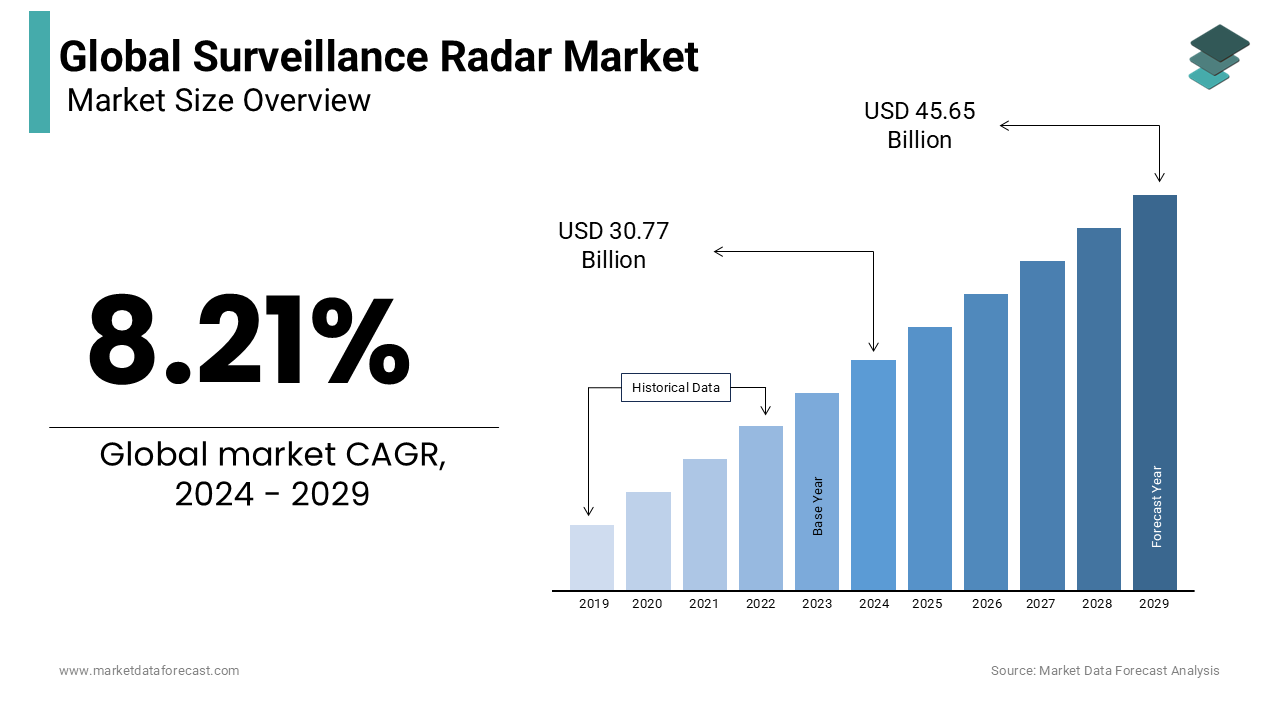
The global surveillance radars market was valued at USD 33.30 billion in 2025 and is anticipated to reach USD 36.03 billion in 2026 to reach USD 67.74 billion by 2034, growing at a CAGR of 8.21% during the forecast period from 2026 to 2034.
Surveillance radar systems are specialized electromagnetic sensing technologies designed to detect, track, and classify airborne, maritime, and terrestrial targets for defense, security, and critical infrastructure protection purposes. Unlike navigation or weather radars, surveillance radars prioritize long-range detection, high-resolution tracking, and resistance to electronic countermeasures. Modern systems increasingly leverage solid-state transmitters, active electronically scanned arrays, and advanced signal processing to operate in complex electromagnetic environments. As per sources, major international airports globally rely on primary and secondary surveillance radar for air traffic control, with many now integrating multistatic and passive radar enhancements. According to research, numerous countries operate ground-based air defense radar networks covering strategic borders and urban centers. Coastal nations have expanded maritime surveillance radar coverage to monitor extensive exclusive economic zones, as per a study. These deployments reflect a growing reliance on persistent wide-area awareness in an era of asymmetric threats and unmanned aerial incursions.
MARKET DRIVERS
Escalating Geopolitical Tensions and Border Security Imperatives
Heightened military posturing and territorial disputes are compelling nations to modernize and expand their radar surveillance infrastructure, which contributes to the growth of the surveillance radar market. The ongoing conflict in Eastern Europe has prompted NATO members to accelerate the deployment of ground-based air defense radars along the eastern flank. According to the Stockholm International Peace Research Institute (SIPRI), total European military expenditure saw a surge in 2023. The increase was largely driven by a rise in Ukrainian spending and a rise in Russian spending. Similarly, in the Indo-Pacific region, maritime territorial disputes are a primary driver for military modernization. Countries like Japan and the Philippines are actively investing in sophisticated coastal surveillance technologies, including high-resolution X-band radar systems. Across Asia, the rapid pace of radar deployment reflects heightened geopolitical tensions. Think tanks and defense analysts emphasize a substantial increase in the commissioning of new radar installations across the continent to monitor contested airspace and waters. These systems provide persistent domain awareness where satellite coverage is intermittent or delayed. For instance, the Indian Ministry of Defence has overseen the development of the Integrated Air Command and Control System (IACCS), which effectively links numerous radar stations and other sensors nationwide. Such investments underscore surveillance radar’s role as a foundational layer of national situational awareness in volatile security environments.
Proliferation of Unmanned Aerial Systems and Low Observable Threats
The dramatic increase in commercial and military drone usage has exposed critical gaps in traditional air defense, which is among the key factors boosting the expansion of the surveillance radar market. This proliferation is driving demand for specialized radar capable of detecting small radar cross-section targets. According to research, the number of drones used for general civilian activities has grown considerably, and these same devices are sometimes used by hostile actors for unauthorized surveillance and attacks on important facilities. Conventional radar systems frequently struggle to identify very small objects, but modern surveillance technologies operating on higher frequencies are capable of detecting small drones even at significant distances. A majority of allied nations have incorporated specialized radar systems for drone detection at their military bases and major airports. Major international airports have adopted new passive radar systems that track unauthorized drones by analyzing existing radio and digital signals in the environment. This technological adaptation reflects a strategic shift toward layered, multi-sensor surveillance architectures where radar remains indispensable for all-weather and day-night detection of emerging aerial threats.
MARKET RESTRAINTS
High Acquisition and Lifecycle Maintenance Costs
These radar systems entail substantial capital outlays and sustained operational expenses that constrain widespread deployment, particularly in developing nations, and thereby restrain the growth of the surveillance radar market. A modern solid-state S-band air surveillance radar can cost millions of dollars per unit, excluding installation, integration, and training, as per studies. Maintenance agreements typically involve ongoing costs for software updates, necessary component replacement, and system calibration. These expenses are prohibitive for countries with limited defense budgets. As per sources, many nations dedicate a relatively small percentage of their economic output to defense, which presents challenges for sustaining advanced surveillance and radar networks. Even in developed economies, budget reallocations toward cyber and space domains have delayed radar modernization. Upgrades and replacement programs for existing radar systems can encounter delays and increased costs, sometimes pushing back their operational timelines. Such financial barriers limit radar coverage to high-priority zones, leaving vast territories unmonitored and increasing vulnerability to undetected incursions.
Electromagnetic Spectrum Congestion and Interference Vulnerabilities
The growing density of wireless communications, 5G networks, and civilian radar systems is degrading the operational effectiveness of surveillance radars through spectrum interference and false target generation, which poses a major obstacle to the global surveillance radar market. Commercial wireless data use is trending upward, which increases demand for access to the spectrum shared with military radar systems. The proximity of certain wireless base stations and radar installations in cities can lead to interference, occasionally diminishing the effective range of surveillance radars, as per research. Apart from these, adversaries increasingly employ digital radio frequency memory jammers that replay distorted radar signals to create ghost targets. As per studies, electronic warfare incidents against its ground-based radars rose over the years. Mitigation requires costly upgrades to frequency agile transceivers and AI-driven signal discrimination algorithms. Reliable target discrimination for surveillance radars will remain challenged in congested electromagnetic environments until a harmonized spectrum policy addresses both defense and commercial needs.
MARKET OPPORTUNITIES
Integration with Multi-Domain Command and Control Systems
Modern warfare and security operations increasingly rely on fused sensor data from land, sea, air, space, and cyber domains, which provides new opportunities for the surveillance radar market. This creates a strategic opportunity for these radars to serve as foundational inputs to integrated battle management networks. The U.S. Department of Defense emphasises real-time data sharing across platforms, requiring radars to output standardized tracks compatible with cloud-based analytics. In NATO, Member states are upgrading existing radar systems using open architecture processors to allow for seamless integration with allied command systems. A ground-based radar system has been introduced in Europe with built-in compatibility for common data link networks, facilitating immediate information sharing with aircraft and defensive systems. In 2023, France deployed the Ground Master 400 radar with native Link 16 and NATO STANAG 5516 compatibility, allowing instantaneous track dissemination to fighter jets and missile batteries. Similarly, Israel’s IAI has embedded its ELM 2084 radar with AI-driven threat correlation engines that auto-prioritize targets for interceptors. This evolution transforms surveillance radar from a standalone sensor into a dynamic node in a networked kill chain, significantly enhancing its operational value and justifying continued investment.
Expansion of Critical Infrastructure Protection Requirements
The rising threat of physical and cyber-attacks on energy grids, transportation hubs, and industrial facilities is driving non-military adoption of surveillance radar for perimeter security, which is likely to promote fresh opportunities for the expansion of the surveillance radar market. According to research, there has been an increase in the number of cyber-physical incidents recorded that target power infrastructure globally. Surveillance radars now monitor exclusion zones around nuclear plants, LNG terminals, and dams, detecting intruders at ranges of several kilometers regardless of lighting or weather. The U.S. Nuclear Regulatory Commission (NRC) requires comprehensive physical protection programs and reliable, all-weather intrusion detection systems for the protected and vital areas of nuclear facilities. Surveillance systems capable of tracking speedboats over significant distances have been installed in coastal oil terminals in the Eastern Province. Operators of essential services in the European Union are working to implement more advanced perimeter monitoring systems. This regulatory push is creating a robust commercial market for compact, high-resolution surveillance radars beyond traditional defense applications.
MARKET CHALLENGES
Technological Obsolescence Due to Rapid Advancements in Electronic Warfare
These radars face accelerated obsolescence as adversarial electronic warfare capabilities evolve faster than procurement cycles can accommodate, which acts as a key obstacle to the surveillance radar market. Modern digital jammers can analyze and spoof radar waveforms in microseconds, rendering conventional pulse Doppler systems ineffective. According to studies, a notable share of legacy radar systems in service today lack the waveform agility to counter next-generation jamming. Upgrading these platforms often requires complete transmitter and receiver replacement rather than modular updates. Meanwhile, nations like China and Russia are fielding low-probability-of-intercept radars that operate intermittently and across wide bandwidths, complicating detection by adversary surveillance systems. This cat-and-mouse dynamic forces continuous reinvestment, straining defense budgets and shortening asset lifespans.
Limited Skilled Workforce for System Operation and Maintenance
The complexity of modern surveillance radar systems demands highly trained personnel for operation, calibration, and cyber-secure maintenance, yet a global shortage of qualified radar engineers is impeding deployment and readiness. This ultimately slows down the expansion of the surveillance radar market. The skills gap leads to extended downtime. Furthermore, the shift toward software-defined and AI-enhanced radars requires expertise in machine learning and cybersecurity, competencies rarely found in traditional radar schools. Advanced radar systems will fail to reach their full potential without substantial funding for technical training and simulations, which leads to major deficiencies in national surveillance.
REPORT COVERAGE
| REPORT METRIC | DETAILS |
| Market Size Available | 2025 to 2034 |
| Base Year | 2025 |
| Forecast Period | 2026 to 2034 |
| CAGR | 8.21% |
| Segments Covered | By Type, Platform, Application, Component, Dimension, Frequency, & Region |
| Various Analyses Covered | Global, Regional & Country Level Analysis, Segment-Level Analysis, DROC, PESTLE Analysis, Porter’s Five Forces Analysis, Competitive Landscape, Analyst Overview on Investment Opportunities |
| Regions Covered | North America, Europe, APAC, Latin America, Middle East & Africa |
| Market Leaders Profiled | Lockheed Martin (US), L3Harris (US), Raytheon (US), Griffon (US), ISA (Israel), Elbit Systems (Israel), BAE Systems (UK), Saab (Sweden), Leonardo (Italy), Aselsan (Turkey) |
SEGMENTAL ANALYSIS
By Type Insights
The long-range surveillance radar segment remains the prominent segment in the surveillance radar market and held a 48.7% share in 2024. The prominence of the long-range surveillance radar segment is credited to its important role in national air defense, early warning, and strategic domain awareness. Long-range radars are indispensable for detecting high-speed threats at distances exceeding five hundred kilometers, providing vital reaction time for missile defense systems. The U.S. Space Force operates the Solid State Phased Array Radar System (SSPARS) network, which includes the AN/FPS-132 Upgraded Early Warning Radars (UEWRs). Similarly, Russia’s Voronezh class radars monitor airspace across Eurasia with extensive detection ranges. Countries globally have increasingly invested in long-range radar upgrades to counter emerging high-speed and hypersonic threats. India’s Swordfish radar, developed under its Ballistic Missile Defense Program, has a validated long-range capability, enabling coverage of regional launch corridors. This strategic necessity ensures sustained procurement and modernization of long-range systems globally. Long-range radars form the backbone of integrated air command and control systems that fuse data from multiple sensors for unified situational awareness. Such interoperability enhances collective defense and justifies continued investment in long-range surveillance infrastructure as a force multiplier.
The short-range surveillance radar segment is predicted to witness the highest CAGR of 11.6% from 2025 to 2033, owing to urban security needs and drone threat proliferation. The exponential increase in unauthorized drone incursions near airports, military bases, and critical infrastructure has triggered mass adoption of short-range radars optimized for small radar cross-section targets. U.S. aviation authorities observe frequent reports of unauthorized drone activity near airports. Security agencies are increasingly deploying specialized radar systems at key aviation hubs to improve the detection capabilities for small and unauthorized drones. Government bodies are expanding the mandatory use of short-range radar systems to enhance security coverage around critical infrastructure, such as nuclear facilities. Modern drone detection technologies increasingly utilize specific high-frequency radar bands, which provide enhanced resolution necessary to effectively identify very small aerial objects. Rapid urbanization has intensified demand for compact, low-power surveillance radars that integrate into smart city security ecosystems. Cities have embedded short-range Doppler radars into streetlight poles to monitor pedestrian flow and detect suspicious loitering, with data fused into centralized command centers. These systems cost under two hundred thousand dollars per unit and require minimal maintenance, making them scalable for dense urban environments where long-range radars are impractical.
By Platform Insights
In 2024, the ground-based platforms segment maintained the largest share of 61.8% of the surveillance radar market. The dominance of the ground-based platforms segment is credited to persistent coverage, cost efficiency, and ease of integration into fixed defense architectures. Ground radars provide uninterrupted 24/7 surveillance over vast territories without the operational limitations of airborne or space assets. The U.S. Air Force maintains an extensive network for continuous airspace monitoring across North America, spanning vast geographical areas. India utilizes a comprehensive, integrated system that links numerous ground radar stations to cover its entire land and maritime borders effectively. Unlike airborne platforms that require refueling and crew rotation, ground radars offer indefensible persistence, which makes them the cornerstone of sovereign air domain awareness. Ground-based systems incur significantly lower operating expenses compared to airborne or space alternatives. Maintenance is also more predictable. This reliability, combined with decades of operational validation, makes ground radar the default choice for baseline surveillance, especially for nations with constrained defense budgets.
The airborne surveillance radar segment is estimated to register the fastest CAGR of 13.2% over the forecast period, owing to the demand for mobile, high-altitude situational awareness. Airborne radars provide on-demand coverage over oceans, mountainous terrain, and conflict zones where ground infrastructure is absent or vulnerable. The U.S. Navy's E-2D Advanced Hawkeye, equipped with advanced radar, enhances a carrier strike group's ability to detect and track potential air threats, including stealth aircraft and cruise missiles, at significant ranges, contributing to enhanced maritime domain awareness and defense. NATO routinely deploys Airborne Warning and Control System (AWACS) aircraft, such as the E-3 Sentry, to monitor its eastern flank, particularly in response to regional conflicts like the war in Ukraine. These deployments enhance collective defense and provide persistent, real-time air surveillance, tracking numerous air movements to maintain comprehensive situational awareness across the operational area. This mobility allows rapid redeployment to emerging hotspots, offering unmatched responsiveness compared to fixed ground sites. Next-generation airborne radars are evolving into networked sensor nodes that share data with stealth fighters and unmanned platforms. This convergence of surveillance, command, and strike functions is redefining airborne radar as a central enabler of distributed warfare, accelerating investment across allied air forces.
By Application Insights
The military applications segment dominated the surveillance radar market and occupied a substantial share in 2024. The leading position of the military applications segment is attributed to radar’s foundational role in modern warfare and force protection. Surveillance radar is the first layer in layered defense architectures that protect nations from aerial threats. The U.S. Missile Defense Agency operates a comprehensive global network of ground and sea-based radars that continuously detect and track numerous potential missile launches and space objects. Israel’s Iron Dome system relies on the EL/M-2084 ground-based radar to detect and classify incoming rockets, achieving a consistently high interception success rate in applicable conflicts. Similarly, South Korea’s Green Pine radar provides crucial early warning against regional short-range ballistic missiles, operating with an extensive detection range. Missile defense systems need constant radar surveillance to get the cueing data they require for an effective engagement. Modern militaries require real-time ground and air surveillance to coordinate land, air, sea, space, and cyber operations. NATO’s Alliance Future Surveillance and Control program aims to replace legacy AWACS with a distributed radar network by 2030, emphasizing radar’s centrality in future warfare. This operational dependency ensures sustained military investment regardless of budget fluctuations.
The homeland security segment is anticipated to witness the fastest CAGR of 14.1% from 2024 to 2033 because of border protection and critical infrastructure mandates. Nations are deploying ground-based surveillance radars along land and maritime borders to detect unauthorized movement. Similarly, the European Border and Coast Guard Agency intensified surveillance and cooperation with third countries, but migrant boat arrivals in the Mediterranean Sea increased substantially in 2023, according to Frontex data. These systems operate autonomously in all weather, providing persistent coverage where cameras and patrols are ineffective. Regulatory mandates are driving radar deployment around power plants, ports, and airports. In the United States, civilian nuclear facilities must use all-weather intrusion detection, a standard often fulfilled by K-band and Doppler radars. Simultaneously, the European Union's NIS2 Directive is creating a predictable pipeline of homeland security radar contracts by mandating similar robust protections for essential services across member nations by 2025. This regulatory pressure is evidenced by real-world implementations, such as the Port of Rotterdam using X-band maritime surveillance radars to successfully monitor vessel activity across its harbor.
By Component Insights
The digital signal processors segment led the surveillance radar market and captured a 31.7% share in 2024. Factors such as the shift toward software-defined and AI-enhanced radar architectures have mainly contributed to the expansion of the digital signal processors segment. Modern surveillance radars rely on high-performance digital signal processors to execute complex algorithms for moving target indication, synthetic aperture imaging, and electronic countermeasures. The U.S. Navy's SPY-6 radar leverages advanced digital signal processing and a scalable architecture to track numerous targets simultaneously and manage environmental interference. Research into AI-driven signal processors, such as work at MIT Lincoln Laboratory, focuses on enhancing target detection and reducing false alarm rates in complex operational scenarios. This computational power is essential for detecting low-observable drones and stealth aircraft amid electromagnetic noise, making the processor the brain of next-generation radar. Digital signal processors allow radars to dynamically adapt waveforms and operating parameters based on real-time threat assessment. The Hensoldt TRML-4D is a software-defined radar system with multiple operational modes, including air surveillance and counter-battery functions, providing rapid reaction times for a variety of threats. The need for single platforms to handle multiple missions has made the signal processor a key factor in improving radar performance and adaptability.
The amplifiers segment is likely to experience the fastest CAGR of 13.8% during the forecast period due to the transition to solid-state and gallium nitride-based transmitters. Legacy radars used traveling wave tubes, but modern systems increasingly adopt solid-state amplifiers for higher reliability and lower maintenance. Gallium nitride amplifiers offer more power density than gallium arsenide, enabling smaller, more efficient radar arrays. This technology shift is accelerating amplifier demand across all radar classes. Naval and airborne radars require amplifiers that deliver high output with minimal power consumption and heat generation. In airborne applications, reduced heat load allows longer mission durations without cooling system overhauls. According to sources, solid-state amplifiers increase radar mean time between failures, a critical metric for expeditionary operations.
REGIONAL ANALYSIS
North America Market Analysis
North America led the global surveillance radar market by capturing a 36.6% share in 2024. The United States dominates regional activity through sustained defense investment and technological leadership. The U.S. Air Force and Navy operate the world’s most extensive radar networks, including the Space Fence and Sea-Based X-band Radar. In addition, the U.S. allocated funds to radar modernization under the National Defense Authorization Act. Canada complements this with upgrades along the Arctic by replacing legacy radars with solid-state systems capable of detecting cruise missiles. These enhancements will extend coverage to most of the northern approaches in the coming years. Mexico is also expanding short-range radar coverage along its southern border to combat drug trafficking, with many sites commissioned. This tri-national commitment ensures North America remains the innovation and deployment epicenter of global surveillance radar.
Asia Pacific Market Analysis
Asia Pacific was the next-biggest surveillance market by occupying a 28.4% share in 2024. China and India are the primary drivers, engaged in a regional radar arms race fueled by territorial disputes. China is enhancing its air defense capabilities with advanced very high frequency (VHF) radar systems designed to counter stealth aircraft threats. India operates the Swordfish long-range radar and is integrating Israeli and Russian systems into a unified air picture covering the Himalayas and the Indian Ocean. Japan is strategically installing advanced radar systems on its remote islands to improve the monitoring and surveillance of airspace over the East China Sea. Australia is in the process of modernizing and expanding its extensive over-the-horizon radar network to enhance its maritime domain awareness and surveillance capabilities. So, Asia Pacific’s radar investments are both defensive and assertive, which reflects the region’s strategic volatility.
Europe Market Analysis
Europe maintains a noteworthy position in the global surveillance radar market. The growth of these radars in Europe is credited to advanced industrial capabilities and multinational cooperation. Germany, France, and Italy lead in radar manufacturing through companies like Hensoldt, Thales, and Leonardo. NATO’s Air Command and Control System integrates radar data from all twenty-seven European allies, creating a seamless surveillance umbrella from the Baltic to the Black Sea. Finland joined NATO in 2023, while Sweden joined in 2024, leading to enhanced NATO coordination and a strengthened security posture in the Arctic and Baltic regions. The expansion of the alliance in the High North facilitates greater coordination and military power among the Nordic and Baltic states. The Finnish Defence Forces are integrating their modern air defense capabilities and forces into NATO's operational planning and structure, contributing to the alliance's overall readiness and deterrence. Eastern European nations, including Poland and Romania, are enhancing their missile defense capabilities through the acquisition and deployment of advanced U.S. radar systems as part of strengthening NATO's eastern flank and collective defense. Simultaneously, the European Union funds civil radar projects for border control under Frontex, blending military and homeland security applications in a uniquely integrated approach.
Middle East and Africa Market Analysis
The Middle East and Africa region is a lucrative surveillance market. Gulf Cooperation Council states lead in high-end acquisitions, while North Africa focuses on border surveillance. Saudi Arabia is actively enhancing its integrated air and missile defense system with advanced Western technology, including the activation of the THAAD missile defense, to counter regional threats. The United Arab Emirates has bolstered its coastal surveillance capabilities in key maritime areas like the Strait of Hormuz to monitor potential threats from small vessels. In Africa, Egypt and Algeria have modernized Soviet era radar networks with Chinese and Russian systems to secure the Mediterranean and Saharan borders. Counter-terrorism efforts in the Sahel region, coordinated through various African Union initiatives and international partners, are increasingly challenged by the spread of weapons and the use of improvised explosive devices by non-state armed groups. Abundant oil revenues and persistent security threats make this region a high-growth, high-value market for advanced surveillance radar.
Latin America Market Analysis
Latin America is steadily growing in the surveillance radar market. Brazil and Chile are the most active adopters, driven by airspace sovereignty and drug interdiction needs. Brazil continues to leverage the SIVAM surveillance system, incorporating ground and airborne radar technology to monitor expansive areas of the Amazon for illegal activities like mining and deforestation. Chile has been reinforcing its northern border surveillance capabilities by deploying additional long-range radar systems to enhance the detection of illicit aircraft from neighboring countries. Colombia has deployed short-range radars around major cities to counter drone threats to government facilities. Across the Latin American region, there is an observable trend towards increased investment in advanced surveillance technologies, including radar, to address security concerns and monitor vast territories effectively. Hence, the focus on practical and cost-effective systems positions Latin America as a steady growth market for mid-tier surveillance radar solutions.
COMPETITIVE LANDSCAPE
The surveillance radar market features intense competition among a handful of established defense primes and specialized electronics firms. Dominated by companies like Lockheed Martin, Raytheon,n and Thales, the landscape is characterized by high technological barriers and long development cycles. Competition centers on performance parameters such as detection range,nge resolution, electronic countermeasures resilience, rather than price. National security considerations often favor domestic suppliers, yet multinational programs like NATO’s Air Command and Control System encourage cross-border collaboration. Emerging players from Israel, South Korea, and China are challenging incumbents with agile development and cost-competitive solutions, particularly in short-range and counter-drone segments. Intellectual property around signal processing algorithms and antenna design serves as a key differentiator. As threats evolve toward stealth and swarm tactics, the race to deliver cognitive multi-domain radars is intensifying, driving continuous innovation and strategic consolidation across the sector.
KEY MARKET PLAYERS
A few of the market players in the global surveillance radars market are
- Lockheed Martin (US)
- L3Harris (US)
- Thales Group
- Raytheon (US)
- Griffon (US)
- ISA (Israel)
- Elbit Systems (Israel)
- BAE Systems (UK)
- Saab (Sweden)
- Leonardo (Italy)
- Aselsan (Turkey)
Top Players In The Market
- Lockheed Martin is a leading developer of advanced surveillance radar systems for air and missile defense applications. The company designs and integrates high-power ground-based and sea-based radars such as the AN/TPY 4 and SPY 7, which form critical components of national defense architectures. In recent years, Lockheed Martin has focused on solid-state radar technology and open architecture frameworks to enhance interoperability with allied systems. Its investment in digital engineering and AI-enabled signal processing continues to reinforce its position as a technology pioneer in long-range and multi-mission radar solutions globally.
- Thales Group is a major European defense electronics company with a strong portfolio of ground-based and naval surveillance radars. Its Ground Master and NS series radars are deployed across more than forty countries for air defense and maritime domain awareness. Thales emphasizes modular design and software-defined functionality to enable rapid upgrades and multi-role operations. Thales also collaborates with European Union agencies on border surveillance programs, integrating radar data into civil security command centers. These efforts underscore its dual focus on military and homeland security applications across global markets.
- Raytheon, now operating under RTX, is renowned for its cutting-edge airborne and ground-based surveillance radar systems, including the SPY 6 family and AN/TPY 2. These radars are integral to U.S. and allied missile defense and air traffic control networks. Raytheon has accelerated development of galliumnitride-based solid-state transmitters to improve power efficiency and reliability. Raytheon also partners with international customers to localize radar maintenance and training, strengthening long-term operational support and deepening its global footprint in strategic defense markets.
Top Strategies Used By The Key Market Participants
Key players in the surveillance radar market prioritize the adoption of solid-state and gallium nitride amplifier technology to enhance reliability and reduce lifecycle costs. They invest heavily in artificial intelligence and machine learning algorithms to improve target discrimination in cluttered environments. Strategic partnerships with allied governments and defense integrators facilitate co-development and technology transfer agreements. Companies also pursue open architecture designs to ensure interoperability with existing command and control systems across NATO and partner nations. Additionally, they expand service offerings to include predictive maintenance and cybersecurity hardening for radar networks to secure long-term revenue streams beyond hardware sales.
MARKET SEGMENTATION
This research report on the global surveillance radars market has been segmented and sub-segmented into the following categories.
By Type
- Short-Range
- Medium-Range
- Long-Range
By Platform
- Airborne
- Ground
- Naval
- Space.
By Application
-
Commercial
- Military
- Homeland Security
- Others
By Component
-
Antennas
- Transmitters
- Receivers
- Amplifiers
- Duplexers
- Digital Signal Processor
- Others.
By Dimension
-
2D
- 3D
- 4D
By Frequency
- HF
- UHF & VHF
- L, S, C, X, Ku, Ka
- Multi-bands
By Region
-
North America
- Europe
- Asia Pacific
- Latin America
- The Middle East and Africa