- Product Description Description
- Table of Contents TOC
- List of Table & Figure LOT
- Get Free Sample PDF Sample PDF
Market Size, 2025
$2.57 BnMarket Estimate, 2026
$2.81 BnMarket Forecast, 2034
$5.72 BnCAGR, 2026–2034
9.3%Global Switchgear Monitoring Market Size, Growth, Trends & Forecast (2026–2034)
The global switchgear monitoring market size was valued at USD 2.57 billion in 2025, is estimated at USD 2.81 billion in 2026, and is projected to reach USD 5.72 billion by 2034, expanding at a compound annual growth rate (CAGR) of 9.30% from 2026 to 2034. Market progress is primarily propelled by the escalating demand to upgrade aging power grids, rising investments in smart grid infrastructure, and the critical need to maximize electrical asset reliability while minimizing unplanned downtime.
Key Executive Metrics (At-a-Glance)
- 2025 Base Valuation: USD 2.57 Billion
- 2026 Current Valuation: USD 2.81 Billion
- 2034 Forecast Valuation: USD 5.72 Billion
- Compound Annual Growth Rate (CAGR): 9.30% (2026–2034)
- Dominant Type Segment: Gas-Insulated Switchgear (GIS) (leading via high demand for monitoring high-voltage assets to avoid unexpected outages)
- Fastest-Growing Type Segment: Air-Insulated Switchgear (AIS) monitoring solutions
- Dominant Voltage Segment: High-Voltage (driven by the vital requirement to secure city-wide or regional power transmission)
- Dominant Monitoring Segment: Temperature Monitoring (led by its capability to provide early detection of overheating and prevent equipment failure)
- Dominant Regional Market: Asia-Pacific (supported by massive transmission & distribution investments, renewable integration, and Chinese grid expansion)
- Fastest-Growing Regional Market: Asia-Pacific (surging through rapid smart grid developments and urbanization)
Core Market Drivers
- Grid Modernization & Asset Protection: Escalating global focus on upgrading legacy power networks with digital safety systems to eliminate catastrophic blackouts.
- Smart Grid Integration: Deployment of two-way communication technologies enabling automated equipment monitoring and enhanced system resilience.
Primary Market Restraints & Challenges
- Economic Disruptions & Investment Lulls: Reductions in capital expenditure during macroeconomic slow-downs and health crises impacting large-scale infrastructure overhauls.
Global Switchgear Monitoring Market Segmentation Breakdown
| Segment Category | Leading Sub-Segment | Fastest-Growing Sub-Segment |
|---|---|---|
| By Type | Gas-Insulated Switchgear (GIS) | Air-Insulated Switchgear (AIS) |
| By Voltage | High-Voltage | Medium-Voltage |
| By Component | Hardware | Software Solutions |
| By Monitoring | Temperature | Partial Discharge (PD) |
| By End User | Utilities | Industries |
| By Region | Asia-Pacific | Asia-Pacific |
Major Industry Players Profiled
Key global technology leaders driving innovation in power network safety include ABB, Eaton, Schneider Electric, Siemens, Emerson, Fortive, Mitsubishi Electric Corporation, Senseor, Trafag AG, and KONCAR-Electrical Engineering Institute, Inc.
 Download Free Sample Report
Global Switchgear Monitoring Market Size
The size of the global switchgear monitoring market was worth USD 2.57 billion in 2025. The global market is anticipated to grow at a CAGR of 9.3% from 2026 to 2034 and be worth USD 5.72 billion by 2034, up from USD 2.81 billion in 2026.
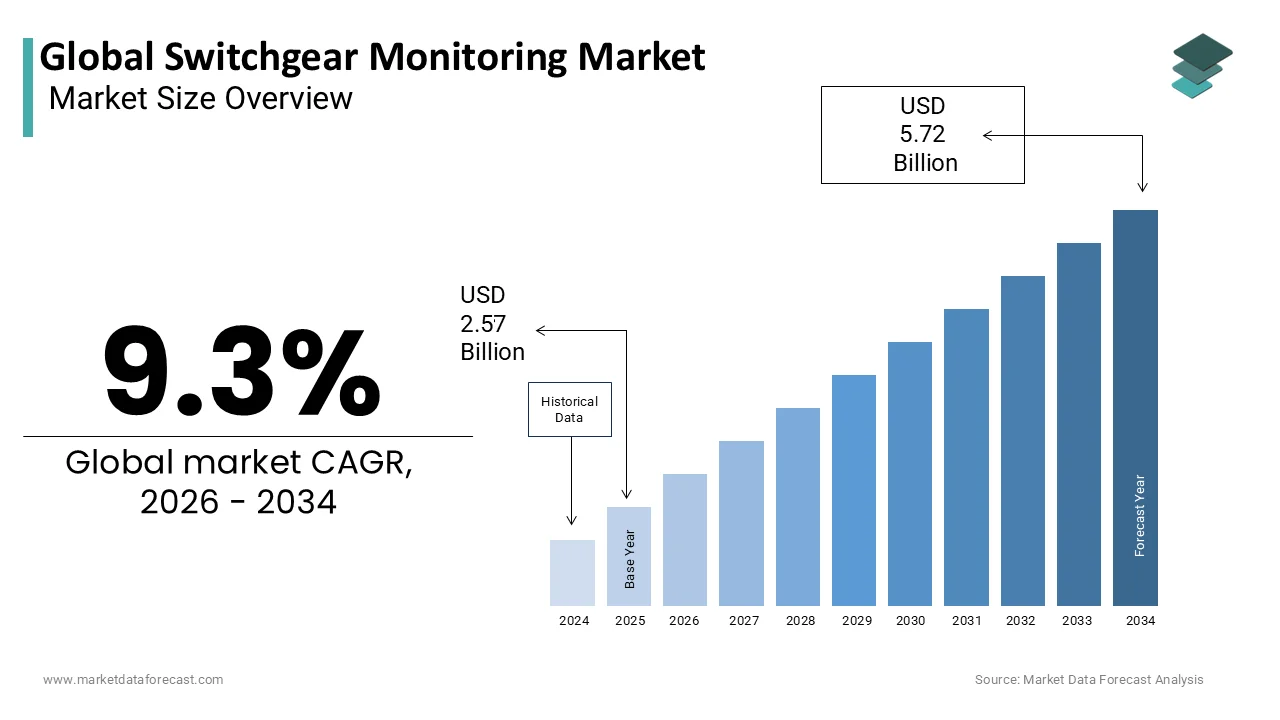
The switchgear monitoring market covers advanced diagnostic systems designed to track the operational health and performance of electrical switchgear assets in real time. These solutions utilize sensors and digital analytics to detect anomalies such as partial discharge, temperature fluctuations, and mechanical wear before they lead to catastrophic failures. As per the U.S. Energy Information Administration, electricity transmission and distribution losses in the United States averaged approximately 5% of the electricity transmitted and distributed in recent years,s and this indicates the critical need for efficient grid management tools. This statistic underscores the importance of monitoring technologies that minimize energy waste and enhance system reliability. The high frequency of grid disturbances drives the adoption of predictive monitoring solutions to prevent unplanned outages. By integrating intelligent monitoring capabilities, utility providers and industrial facilities can extend asset lifespan and ensure continuous power delivery. The market focuses on delivering actionable insights through cloud-based platforms and edge computing devices. This technological evolution supports the transition toward smarter and more resilient electrical networks globally.
MARKET DRIVERS
Increasing Grid Modernization and Smart Grid Initiatives
The accelerating pace of grid modernization and smart grid initiatives majorly drives the switchgear monitoring market by necessitating real-time visibility into network performance. Utilities worldwide are upgrading legacy infrastructure to accommodate renewable energy sources and bidirectional power flows, which require sophisticated monitoring capabilities. As per the International Renewable Energy Agency, global investment in power grids reached a record $359 billion in 2024, up 14% on the average of 2022 and 2023, reflecting a strong commitment to enhancing grid resilience and efficiency. This substantial capital expenditure directly supports the deployment of advanced monitoring sensors and digital substations. As per the U.S. Department of Energy, the Bipartisan Infrastructure Law funds grid resilience and smart grid grants and demonstration projects and is fostering widespread adoption of digital monitoring technologies. These funding initiatives encourage utilities to replace manual inspection routines with automated condition-based monitoring systems. The integration of Internet of Things devices allows for continuous data collection and remote diagnostics, reducing the need for physical site visits. Consequently, the demand for switchgear monitoring solutions grows as operators seek to optimize asset utilization and prevent costly downtime in increasingly complex power networks.
Rising Demand for Predictive Maintenance in Industrial Facilities
Growing emphasis on predictive maintenance in industrial sectors is another major factor propelling the global switchgear monitoring market expansion by shifting focus from reactive repairs to proactive asset management. Manufacturing plants, data centers,s and commercial buildings rely on uninterrupted power supply, making switchgear reliability a critical operational priority. According to Siemens, unplanned downtime costs the world's 500 biggest companies about $1.4 trillion a year, equal to 11% of their revenues, creating a strong financial incentive for preventive measures. This high cost of failure motivates facility managers to invest in monitoring systems that provide early warnings of potential equipment issues. According to the National Institute of Standards and Technology, poor power quality and equipment failures contribute to significant productivity losses across various industrial segments, emphasizing the need for robust monitoring solutions. By detecting signs of insulation degradation or contact wear early, organizations can schedule maintenance during planned outages rather than experiencing unexpected breakdowns. The adoption of artificial intelligence algorithms further enhances predictive accuracy by analyzing historical performance data. This trend ensures that switchgear monitoring becomes an integral component of overall facility management strategies, driving consistent market growth.
MARKET RESTRAINTS
High Initial Implementation Costs
Substantial initial implementation costs are a significant restraint for the global switchgear monitoring market by creating financial barriers for small and medium-sized enterprises and budget-constrained utilities. Installing comprehensive monitoring systems requires significant investment in sensors, communication infrastructure, and software platforms, which may deter potential adopters. This high capital expenditure forces many organizations to delay or scale back their digital transformation initiatives. As per the U.S. Small Business Administration, limited access to capital remains a primary challenge for smaller industrial firms, making it difficult for them to justify large upfront investments in non-essential technologies. The perceived long return on investment period further complicates decision-making processes for financial stakeholders. Additionally, the need for specialized engineering expertise to design and integrate these systems adds to the overall project cost. Consequently, price-sensitive customers may opt for basic protection schemes instead of advanced monitoring solutions, limiting market penetration in certain segments.
Complexity of Integration with Legacy Infrastructure
The technical complexity of integrating modern monitoring solutions with existing legacy switchgear infrastructure is further hindering global market growth by increasing deployment time and risk. Many electrical networks operate with equipment that was installed decades ago and lacks standard digital interfaces or communication protocols. As per the Institute of Electrical and Electronics Engineers, interoperability issues between new digital devices and older analog systems remain a significant challenge for grid modernization efforts worldwide. This lack of compatibility often requires custom engineering solutions and extensive retrofitting work, which can disrupt normal operations. As per the National Rural Electric Cooperative Association, many rural utilities still rely on electromechanical relays and manual switching mechanisms that are not easily adaptable to digital monitoring frameworks. The difficulty in extracting reliable data from aged components reduces the effectiveness of predictive analytics models. Furthermore, the absence of standardized data formats complicates the aggregation of information from multiple vendors. These technical hurdles increase project timelines and costs, discouraging some operators from pursuing comprehensive monitoring upgrades despite the potential benefits.
MARKET OPPORTUNITIES
Expansion of Renewable Energy Integration
The rapid expansion of renewable energy integration is a lucrative opportunity for the switchgear monitoring market by increasing the complexity and variability of power distribution networks. Solar and wind farms introduce fluctuating voltage levels and reverse power flows that stress traditional switchgear components, necessitating advanced monitoring to maintain stability. As per the International Renewable Energy Agency, global renewable capacity additions reached a record 582 gigawatts in 2024, significantly altering the operational dynamics of electrical grids. This massive influx of distributed generation requires real-time monitoring to manage load balancing and prevent equipment overload. As per the U.S. Energy Information Administration, renewable sources accounted for approximately 21% of total U.S. electricity generation in 2023, a figure expected to grow steadily in coming years. The intermittent nature of these sources demands frequent switching operations, which accelerates mechanical wear on circuit breakers and contacts. Monitoring systems equipped with thermal and partial discharge sensors can detect early signs of stress caused by these dynamic conditions. Utilities and independent power producers increasingly recognize the value of such insights to ensure grid reliability. This trend creates a robust demand for specialized monitoring solutions tailored to renewable energy applications.
Adoption of Digital Twin Technology
Growing adoption of digital twin technology is another major opportunity for the switchgear monitoring market by enabling virtual simulation and optimization of physical assets. Digital twins create accurate virtual replicas of switchgear systems that update in real time using data from embedded sensors, allowing operators to test scenarios and predict failures with high precision. This widespread adoption encourages the installation of comprehensive monitoring suites to feed accurate information into digital models. As per the National Institute of Standards and Technology, digital twin frameworks rely on continuous data streams to maintain synchronization between physical and virtual environments, highlighting the need for robust sensor networks. The ability to simulate maintenance actions and operational changes virtually reduces risk and improves decision-making accuracy. Energy providers leverage these capabilities to optimize asset lifecycle management and reduce operational costs. The synergy between digital twins and switchgear monitoring fosters innovation in predictive analytics and remote control functionalities.
MARKET CHALLENGES
Cybersecurity Vulnerabilities in Connected Systems
Rising connectivity of switchgear monitoring systems is a significant cybersecurity challenge, exposing critical infrastructure to potential cyber-attacks and data breaches. As monitoring devices become more integrated with corporate networks and cloud platforms, they create additional entry points for malicious actors seeking to disrupt power supplies. As per the U.S. Cybersecurity and Infrastructure Security Agency, the energy sector remains one of the most targeted industries for cyber threats, with numerous incidents reported annually involving operational technology systems. This heightened threat landscape requires stringent security measures that can be complex and costly to implement effectively. As per the North American Electric Reliability Corporation, cybersecurity standards for bulk power systems continue to evolve, placing additional compliance burdens on utilities and equipment manufacturers. The need to encrypt data transmissions and secure remote access points adds layers of complexity to system architecture. Any successful breach could lead to unauthorized control of switchgear operations, resulting in widespread outages or equipment damage. Manufacturers must balance ease of use with robust security protocols, which can slow down product development and increase costs.
Shortage of Skilled Technical Workforce
A shortage of skilled technical workforce is further challenging the global switchgear monitoring market growth by limiting the ability of organizations to properly install, configure, and maintain advanced monitoring systems. Effective utilization of these technologies requires personnel with expertise in both electrical engineering and data analytics, a combination that is currently in short supply. This mismatch makes it difficult for companies to find qualified staff who can interpret complex monitoring data and take appropriate corrective actions. According to The Manufacturing Institute, 65% of manufacturers cite attracting and retaining talent as their primary business challenge, indicating a broader labor market constraint. The lack of trained professionals leads to underutilization of monitoring features and increased reliance on external consultants. Training existing staff requires significant time and resources, delaying the realization of benefits from new installations. This workforce limitation acts as a bottleneck for widespread adoption and effective operation of switchgear monitoring solutions.
REPORT COVERAGE
| REPORT METRIC | DETAILS |
| Market Size Available | 2025 to 2034 |
| Base Year | 2025 |
| Forecast Period | 2026 to 2034 |
| Segments Covered | By Product, Type, Consumption, Distribution Channel and Region |
| Various Analyses Covered | Global, Regional & Country-Level Analysis, Segment-Level Analysis, DROC, PESTLE Analysis, Porter’s Five Forces Analysis, Competitive Landscape, Analyst Overview on Investment Opportunities |
| Regions Covered | North America, Europe, APAC, Latin America, Middle East & Africa |
| Market Leaders Profiled | ABB (Switzerland), Eaton (Ireland), Schneider Electric (France), Siemens (Germany), Emerson (US), Fortive (France), Mitsubishi Electric Corporation (Japan), Senseor (France), Trafag AG (Switzerland), KONCAR-Electrical Engineering Institute, Inc. (Croatia) |
SEGMENTAL ANALYSIS
By Type Insights
The gas insulated switchgear segment accounted for the dominant share of the global market in 2025. The dominance of the gas-insulated switchgear segment in the global market is attributed to its widespread adoption in urban substations and high-density power distribution networks. The compact design of GIS requires precise monitoring to detect internal faults such as partial discharge and gas leakage, which are not visible externally. As per the International Electrotechnical Commission, GIS installations account for a significant portion of new substation projects in densely populated areas where space constraints favor compact equipment. This prevalence drives demand for specialized sensors capable of operating within sealed sulfur hexafluoride environments. As per the U.S. Energy Information Administration, transmission and distribution infrastructure investments continue to prioritize reliability in critical urban centers, supporting the deployment of advanced monitoring systems for GIS assets. The high cost of GIS equipment further justifies the investment in continuous condition monitoring to prevent expensive failures. Utilities rely on acoustic and electrical sensors to monitor insulation integrity and mechanical operation of disconnectors. The complexity of GIS maintenance necessitates digital solutions that provide real-time health assessments without requiring physical entry into the gas compartment. This operational requirement ensures that GIS remains the primary driver for sophisticated monitoring technology adoption globally.
However, the air-insulated switchgear segment is estimated to record the fastest CAGR in the global market over the forecast period owing to the extensive retrofitting of aging outdoor substations and cost-sensitive expansion projects. Many existing electrical networks rely on AIS technology, creating a vast installed base that requires modernization to meet current reliability standards. As per the Institute of Electrical and Electronics Engineers, the majority of global transmission substations still utilize air-insulated designs, presenting a massive opportunity for monitoring upgrades. The integration of wireless sensors and Internet of Things devices allows for non-intrusive monitoring of AIS components such as circuit breakers and busbars. As per the National Rural Electric Cooperative Association, rural utilities are increasingly adopting remote monitoring solutions to reduce travel costs and improve response times for widely dispersed AIS assets. This trend accelerates the adoption of modular monitoring kits that can be easily installed on legacy equipment. The lower initial cost of AIS compared to GIS makes it attractive for developing regions where grid expansion is rapid. Manufacturers focus on developing robust sensors that withstand harsh outdoor environmental conditions. The ease of installation and scalability of AIS monitoring solutions drives their rapid uptake among diverse utility providers.
By Voltage Insights
The high voltage segment dominated the market by capturing the highest share of the global market in 2025 because these assets form the backbone of national transmission grids and require the highest levels of reliability and safety. Failures in high voltage switchgear can cause widespread blackouts and significant economic damage, making continuous monitoring essential for grid stability. As per the North American Electric Reliability Corporation, the bulk electric system includes facilities operated at 100 kilovolts or higher, which are critical for interregional power transfer. The critical nature of these assets drives utilities to invest heavily in advanced diagnostic tools such as dissolved gas analysis and partial discharge detection. According to the International Energy Agency, global electricity transmission networks are expanding to connect remote renewable energy sources, increasing the operational stress on high-voltage equipment. This expansion necessitates real-time monitoring to manage load fluctuations and prevent thermal overloading. High-voltage switchgear often involves complex mechanical operations that benefit from predictive maintenance strategies. The high capital value of these assets justifies the cost of sophisticated monitoring systems that extend equipment lifespan. Regulatory requirements for grid reliability further mandate the use of continuous monitoring technologies in high-voltage applications.
On the other side, the medium voltage segment is estimated to grow at a promising CAGR in the global market over the forecast period owing to the rapid industrialization and the spread of distributed energy resources. Medium voltage switchgear is extensively used in manufacturing plants, commercial buildings, and local distribution networks where power quality and continuity are vital for operations. As per the U.S. Bureau of Labor Statistics, the manufacturing sector accounts for a substantial portion of industrial activity, creating strong demand for reliable medium voltage protection and monitoring. The rise of microgrids and solar installations at the distribution level increases the complexity of medium voltage networks, requiring smart monitoring solutions. As per the International Renewable Energy Agency, distributed renewable capacity additions are accelerating globally, placing new demands on medium voltage infrastructure management. Facilities managers seek affordable monitoring options that provide early warnings of insulation failure or contact wear. The availability of compact and cost-effective sensor packages makes monitoring accessible to a broader range of industrial users. Digital transformation initiatives in factories drive the adoption of integrated monitoring platforms that connect medium voltage switchgear data with overall facility management systems. This convergence of operational technology and information technology fuels rapid growth in this segment.
By End-user Insights
The utilities segment led the market with the largest share of the global market in 2025. The growth of the utilities segment in the global market is mainly attributed to their responsibility for maintaining large-scale transmission and distribution networks. These organizations manage thousands of switchgear assets across vast geographic areas, making manual inspection impractical and inefficient. As per the Edison Electric Institute, investor-owned utilities serve the majority of U.S. electricity customers and manage extensive infrastructure that requires constant oversight. This massive asset base drives consistent demand for centralized monitoring platforms that aggregate data from multiple substations. As per the U.S. Department of Energy, federal funding for grid modernization encourages utilities to adopt digital technologies that enhance resilience against extreme weather events. Utilities prioritize monitoring solutions that offer predictive analytics to schedule maintenance before failures occur. Regulatory mandates for reliability indices further compel utilities to invest in advanced monitoring capabilities. The transition toward smart grids enables utilities to integrate switchgear data with other network parameters for holistic grid management. Long-term service contracts with monitoring vendors ensure steady revenue streams and ongoing technological updates. The critical role of utilities in public service ensures sustained investment in switchgear health monitoring technologies.
On the other hand, the industrial segment is expected to exhibit a notable CAGR in the global market during the forecast period as manufacturers increasingly prioritize operational efficiency and uptime. Industrial facilities such as steel mills, chemical plants, and automotive factories rely on uninterrupted power to maintain production schedules and protect sensitive equipment. As per the National Association of Manufacturers, the manufacturing sector contributes significantly to the national economy and faces intense pressure to minimize downtime costs. This economic imperative drives industries to adopt condition-based monitoring for their medium- and high-voltage switchgear. As per the U.S. Census Bureau, industrial production indexes show steady growth in key manufacturing sectors, leading to increased investment in facility infrastructure upgrades. Industries benefit from monitoring systems that integrate with existing industrial automation platforms for seamless data visibility. The need to comply with safety regulations and insurance requirements also promotes the adoption of formal monitoring programs. Industrial users appreciate the ability to correlate switchgear performance with production metrics to optimize energy usage. The growing awareness of predictive maintenance benefits among plant engineers accelerates the uptake of monitoring solutions in this dynamic segment.
COUNTRY LEVEL ANALYSIS
U.S. Switchgear Monitoring Market Analysis
The U.S. held the dominant share of the global market in 2025 and is likely to remain the leading market for switchgear monitoring over the next few years due to its aging electrical infrastructure and strong regulatory focus on grid reliability. The country's extensive network of transmission and distribution assets requires continuous upgrades to prevent failures and accommodate renewable energy integration. As per the U.S. Department of Energy, the Bipartisan Infrastructure Law provides billions of dollars in funding for grid resilience and modernization projects across the nation. This financial support accelerates the deployment of advanced monitoring technologies in both urban and rural substations. According to the North American Electric Reliability Corporation, the bulk power system faces increasing risks from extreme weather and cyber threats, necessitating enhanced situational awareness through digital monitoring. Utility companies in the U.S. are early adopters of predictive analytics and Internet of Things solutions for switchgear management. The presence of major technology providers and research institutions fosters innovation in sensor design and data processing algorithms. Industrial facilities also contribute to market growth by investing in power quality monitoring to protect sensitive manufacturing processes. The mature regulatory environment and high awareness of asset management benefits sustain strong demand for monitoring solutions.
China Switchgear Monitoring Market Analysis
China is likely to stay a major growth engine for switchgear monitoring over the next few years, backed by massive ongoing investments in ultra-high voltage transmission networks and smart grid development. The country's rapid industrialization and urbanization create continuous demand for reliable power distribution infrastructure equipped with digital monitoring capabilities. According to the State Grid Corporation of China, the company operates the world's largest ultra-high voltage grid, which relies heavily on advanced monitoring systems for safe operation. This scale of infrastructure drives substantial procurement of sensors and diagnostic software for switchgear assets. According to the International Energy Agency, China leads global investment in electricity grid infrastructure, which is focusing on digitalization and efficiency improvements. The government's push for smart city initiatives encourages the adoption of intelligent monitoring solutions in commercial and residential distribution networks. Local manufacturers are increasingly competitive in producing cost-effective monitoring devices that meet international standards. The integration of renewable energy sources in remote regions requires robust monitoring to manage long-distance transmission challenges. China's commitment to carbon neutrality further supports the expansion of efficient and monitored electrical networks.
Germany Switchgear Monitoring Market Analysis
Germany is likely to remain a leading, engineering-driven market for switchgear monitoring in Europe over the next few years, shaped by its energy transition goals. The country's ambitious Energiewende policy drives the integration of renewable energy sources, which requires flexible and monitored grid infrastructure. As per the Federal Ministry for Economic Affairs and Climate Action, Germany continues to invest heavily in grid expansion to accommodate wind and solar power generation. This transition necessitates advanced monitoring solutions to manage variable power flows and maintain grid stability. As per the International Electrotechnical Commission, German standards for electrical equipment safety and reliability influence global best practices in switchgear monitoring. Industrial manufacturers in Germany prioritize predictive maintenance to ensure high productivity and compliance with strict environmental regulations. The presence of leading automation and engineering firms facilitates the development of innovative monitoring technologies. Utilities collaborate with technology providers to pilot digital substation concepts that enhance operational efficiency. The focus on sustainability and resource efficiency drives the adoption of monitoring systems that extend asset lifespans and reduce waste.
India Switchgear Monitoring Market Analysis
India is likely to be one of the fastest-expanding markets for switchgear monitoring over the next few years, driven by government initiatives to strengthen the national power grid and reduce transmission losses. The country's ongoing efforts to achieve universal electrification and integrate renewable energy sources create significant demand for modern monitoring solutions. As per the Ministry of Power, India has set ambitious targets for renewable energy capacity, which requires robust grid infrastructure to handle intermittent generation. This expansion drives the installation of monitored switchgear in new substations and the retrofitting of existing assets. As per the Central Electricity Authority, transmission and distribution losses remain a key focus area for improvement through better monitoring and management practices. State electricity boards are increasingly adopting digital technologies to enhance operational efficiency and reduce theft. The growing industrial sector also contributes to market growth by demanding reliable power supply for manufacturing operations. Local manufacturers are partnering with global technology firms to develop affordable monitoring solutions suited for Indian conditions. The push toward smart meters and digital grids creates a favorable ecosystem for switchgear monitoring adoption.
Brazil Switchgear Monitoring Market Analysis
Brazil is likely to see steady growth in switchgear monitoring over the next few years, supported by its vast hydroelectric generation and extensive transmission network. The country's reliance on long-distance power transmission from remote hydro plants to urban centers necessitates reliable monitoring of high-voltage switchgear. As per the Brazilian Energy Research Office, the national electricity matrix is predominantly renewable, which requires careful grid management to ensure stability. This operational context drives utilities to invest in monitoring technologies that detect early signs of equipment stress. As per the National Electric Energy Agency, regulatory frameworks encourage investment in grid modernization to improve service quality and reduce outage frequencies. Industrial consumers in the mining and agriculture sectors also drive demand for monitored switchgear to protect critical operations. The tropical climate poses unique challenges for outdoor equipment, which monitoring systems help mitigate through temperature and humidity tracking. Local distributors partner with international manufacturers to provide tailored solutions for the Brazilian market. The focus on reducing operational costs and improving reliability sustains steady growth in monitoring adoption.
COMPETITIVE LANDSCAPE
Established industrial conglomerates and specialized technology providers vie for dominance in the switchgear monitoring market. Key participants compete on the basis of technological innovation, data accuracy, and integration capabilities with existing grid infrastructure. The market exhibits a moderate level of consolidation as major players acquire niche firms to enhance their digital portfolios. Competition centers on developing proprietary algorithms that offer superior predictive analytics and fault detection accuracy. Companies invest substantially in research and development to create sensors that are robust, cost-effective, and easy to install. Strategic collaborations with utility providers and system integrators help firms gain access to large-scale deployment opportunities. Manufacturers also focus on cybersecurity features to address growing concerns about data privacy and network safety. The threat of new entrants remains limited due to high technical barriers and stringent regulatory requirements. Price competition is less intense than in commodity markets because customers prioritize reliability and long-term service support. Continuous innovation in Internet of Things connectivity and cloud computing serves as a primary differentiator. Firms must balance advanced functionality with ease of use to capture broader market segments.
KEY MARKET PLAYERS
Some of the companies that are playing a dominant role in the Global Switchgear Monitoring Market include
- ABB
- Eaton
- Schneider Electric
- Siemens
- Emerson
- Fortive
- Mitsubishi Electric Corporation
- Senseor
- Trafag AG
- KONCAR-Electrical Engineering Institute, Inc.
TOP LEADING PLAYERS IN THE MARKET
- Siemens AG holds a prominent position in the switchgear monitoring market through its comprehensive digital grid solutions and advanced sensor technologies. The company integrates intelligent monitoring capabilities directly into its primary switchgear equipment to provide seamless data collection and analysis. Recent initiatives include the expansion of its Spectrum Power platform, which offers real-time condition monitoring and predictive analytics for substations. This integration allows utilities to visualize asset health and optimize maintenance schedules effectively. Siemens invests heavily in research and development to enhance partial discharge detection and thermal monitoring accuracy. Their strategic partnerships with software firms enable the deployment of artificial intelligence algorithms for fault prediction. The corporation emphasizes cybersecurity to protect critical infrastructure data from potential threats. Siemens' global service network ensures that customers receive timely support and regular software updates. These efforts strengthen customer trust and drive adoption of their holistic monitoring ecosystems across various voltage levels.
- ABB Ltd adds significant value to the switchgear monitoring market by leveraging its expertise in electrification and automation technologies. The company offers a wide range of digital sensors and cloud-based platforms that monitor switchgear performance continuously. ABB's recent actions include the launch of enhanced Ability digital solutions, which provide remote diagnostics and asset management capabilities. These tools help operators detect anomalies such as insulation degradation and mechanical wear before they cause failures. The brand focuses on interoperability, allowing its monitoring systems to integrate with third-party devices and legacy infrastructure. ABB collaborates with utility providers to pilot smart substation projects that demonstrate the value of predictive maintenance. Their commitment to sustainability drives the development of eco-friendly monitoring solutions that reduce energy consumption. The company's extensive training programs ensure that clients can maximize the benefits of their digital offerings. ABB's strong presence in industrial sectors also supports market growth through customized monitoring applications.
- Schneider Electric SE pushes innovation in the switchgear monitoring market through its focus on energy management and automation efficiency. The company provides integrated monitoring solutions that combine hardware sensors with powerful software analytics for comprehensive asset visibility. Schneider Electric's recent initiatives include the enhancement of its EcoStruxure platform, which enables real-time monitoring of medium- and high-voltage switchgear. This platform facilitates predictive maintenance by analysing historical data and identifying potential risks early. The brand prioritizes user-friendly interfaces that allow operators to make informed decisions quickly. Schneider Electric engages in strategic acquisitions to expand its digital portfolio and enhance technical capabilities. Their emphasis on open standards ensures compatibility with diverse electrical systems and third-party applications. The company also supports customers with detailed consulting services to optimize monitoring strategies. Schneider Electric's global reach and strong brand reputation facilitate widespread adoption of its monitoring technologies in both utility and industrial sectors.
TOP STRATEGIES USED BY KEY MARKET PARTICIPANTS
Leading participants in the switchgear monitoring market use several strategies to reinforce their position. First, companies focus on product integration by embedding monitoring sensors directly into new switchgear units during manufacturing. This approach ensures seamless data collection and reduces installation complexity for end users. Second, manufacturers invest in software development to create advanced analytics platforms that provide actionable insights from raw sensor data. These platforms often utilize machine learning to improve prediction accuracy over time. Third, firms pursue strategic partnerships with utility companies and engineering consultants to pilot innovative monitoring solutions in real-world environments. These collaborations validate technology performance and build customer confidence. Fourth, participants expand their global service networks to offer localized support and maintenance services. This accessibility enhances customer satisfaction and encourages long-term contracts. Fifth, companies emphasize cybersecurity compliance to meet regulatory standards and protect critical infrastructure data. This focus addresses a key concern for utility operators and industrial facility managers.
GLOBAL SWITCHGEAR MONITORING MARKET NEWS
- In September 2024, Siemens AG agreed to acquire Trayer Engineering Corporation, a California-based maker of medium voltage secondary distribution switchgear for outdoor and below-ground applications. This acquisition is anticipated to broaden its grid modernization portfolio and strengthen the switchgear monitoring market.
MARKET SEGMENTATION
This research report on the global switchgear monitoring market has been segmented and sub-segmented based on type, voltage, component, monitoring, end-user, and region.
By Type
- GIS
- AIS
By Voltage
- High
- Medium
By Component
- Hardware
- Software
- Services
By Monitoring
- Temperature
- PD
- Gas
- Others
By End User
- Utilities
- Industries
- Commercial
By Region
- North America
- Europe
- Asia Pacific
- Latin America
- Middle East & Africa