- Product Description Description
- Table of Contents TOC
- List of Table & Figure LOT
- Get Free Sample PDF Sample PDF
Market Size, 2025
$27.81 BnMarket Estimate, 2026
$30.35 BnMarket Forecast, 2034
$61 BnCAGR, 2026–2034
9.12%Executive Summary: Telecom System Integration Market
- Market Scope: Comprehensive global telecom system integration market analysis covering telecommunications infrastructure evolution, cloud-native network adoption, 5G deployments, and legacy system unification with digital platforms.
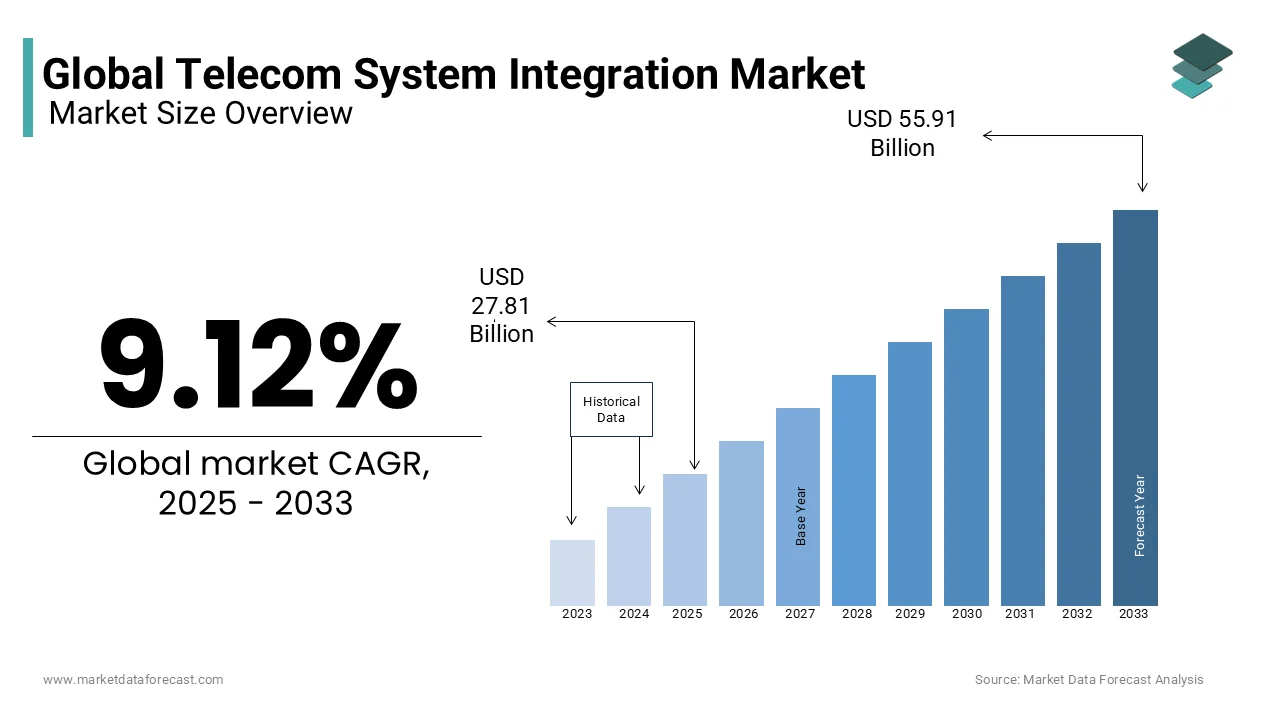
- Market Valuation: Valued at USD 27.81 billion (2025), estimated at USD 30.35 billion (2026), and projected to reach USD 61.00 billion by 2034, registering a robust CAGR of 9.12% (2026–2034).
- Primary Growth Drivers: Streamlined network management, enhanced customer experience, operational efficiency demands, and operator digital transformation initiatives. Key challenges include high implementation costs, lengthy deployment timelines, and integration complexities across heterogeneous environments.
Key Market Segment Metrics (2026–2034)
| Category | Leading Segment (Position) | Fastest-Growing Segment |
|---|---|---|
| By Application, Deployment & Region | Network Management segment (accounted for largest market share in 2025) & On-Premises deployment segment (dominated due to existing infrastructure reliance) & North America (led global market in 2025) | Cloud-native integration services, digital services portfolios, and next-gen OSS/BSS platforms |
| By Regional Leadership | North America (supported by major technology providers and advanced telecommunications infrastructure) | Asia-Pacific (witnessing fast growth driven by digital infrastructure investments, network expansions, and tech adoption in China, India, and Japan) |
Major Market Players & Market Structure
Market Structure: Highly competitive global telecommunications and IT services landscape featuring leading technology vendors and system integrators driving network modernization, cloud integration, and managed services partnerships.
Key Companies: IBM, Cisco Systems, Ericsson, Tata Consultancy Services (TCS), Nokia Networks, Hewlett-Packard (HP), Fujitsu, Tech Mahindra, Capgemini, Huawei, Deloitte, Wipro, Infosys, DXC Technology, Accenture, Cognizant, HCL, Oracle Corporation, Amdocs, CGI, Optiva, Sigma Systems, Jitterbit, FireEye, Computer Sciences Corporation (CSC), Stixis Technologies, Syntel, and Ingram Micro India.
Global Telecom System Integration Market Size
The global telecom systems integration market was valued at USD 27.81 billion in 2025. The global market is estimated to grow from USD 30.35 billion in 2026 to USD 61 billion by 2034, growing at a CAGR of 9.12% from 2026 to 2034.
Telecom system integration constitutes the specialized engineering discipline of unifying disparate hardware, software, and network protocols into cohesive operational ecosystems that enable seamless communication services. This domain has evolved beyond traditional network assembly to encompass complex orchestration of virtualized functions, cloud native architectures, and multi-vendor environments essential for modern connectivity. As per sources, mobile operators worldwide are investing approximately 1.5 trillion dollars in capital expenditure up to 2030 to build out advanced network infrastructure. As per the European Telecommunications Standards Institute, global telecom networks are deploying virtualized network functions to migrate infrastructure toward cloud-based distributed systems. Furthermore, according to studies, communications service providers are launching commercial networks to scale cross-industry 5G monetization opportunities. This market is defined not merely by technical assembly but by its strategic role in translating vendor innovations into commercially viable services across heterogeneous technology stacks where interoperability failures directly impact revenue realization and customer experience quality.
MARKET DRIVERS
Network Virtualization and Cloud Native Transformation Demands
The transition from proprietary hardware appliances to software-defined, cloud-native architectures is driving the growth of the telecom system integration market. This shift creates unprecedented demand for specialized integration services that traditional telecom vendors cannot fulfill independently. As per the European Telecommunications Standards Institute, telecom operators are migrating core networks toward software-defined architectures to support cloud-native deployment patterns. Unlike monolithic systems where vendors provided turnkey solutions, cloud native deployments require integrating containers, microservices, orchestration platforms, and underlying infrastructure from multiple suppliers, creating combinatorial complexity. As per the International Telecommunication Union, communication service providers face continuous engineering barriers while decoupling physical infrastructure dependencies from multi-vendor management platforms. Open RAN initiatives further fragment the stack, requiring integrators to validate interoperability among radio units, distributed units, and centralized units from different manufacturers. This architectural disaggregation transforms system integration from commoditized installation into a high-value engineering discipline where success depends on deep expertise in Kubernetes, service mesh technologies, and telco-specific standards. Operators lacking internal capabilities must engage specialized integrators, accelerating market growth through structural dependency rather than discretionary spending decisions.
Enterprise Private Network and Edge Computing Expansion
Proliferation of private 5G networks and edge computing deployments across industrial sectors generates substantial integration demand distinct from public carrier networks, which propels the telecom system integration market. As per studies, private wireless enterprise spending is scaling systematically across heavy industrial sectors to support high-performance edge computing applications. These environments integrate telecommunications infrastructure with operational technology systems like SCADA, PLCs, and robotics, creating convergence challenges unfamiliar to traditional telco integrators. As per the Federal Communications Commission, industrial Internet of Things deployments encounter system friction from cybersecurity alignment gaps and siloed corporate decision-making structures. Each deployment is highly customized to specific facility layouts, workflow requirements, and regulatory constraints, preventing the standardization that characterizes public network rollouts. System integrators must possess dual competencies in telecommunications and industrial automation, bridging cultural and technical divides between previously separate domains. This vertical specialization creates premium pricing opportunities and recurring service relationships, as enterprises lack internal resources to maintain these hybrid environments, ensuring sustained demand growth independent of public carrier investment cycles.
MARKET RESTRAINTS
Chronic Shortage of Multi-Domain Technical Talent
Severe scarcity of professionals possessing combined expertise in telecommunications, cloud computing, and software development fundamentally constrains the capacity of the telecom system integration market. This trend persists despite robust demand signals. As per Korn Ferry, the global technology, media, and telecommunications sector faces a projected deficit of 4.3 million skilled tech workers by 2030. Modern integration requires fluency in legacy SS7 protocols alongside contemporary Kubernetes orchestration, Python scripting, and DevOps practices, creating rare hybrid profiles that educational institutions have not produced at scale. As per the Uptime Institute, data center operators report significant difficulty retaining critical technical staff due to intense recruitment competition from industry rivals. Training the existing workforce requires 18 to 24 months of hands-on experience with live networks due to complexity that classroom instruction cannot replicate. This talent bottleneck forces integrators to decline projects or extend delivery timelines, undermining client confidence and revenue predictability. Market academia partnerships must address curriculum gaps, and retention strategies need to improve. Until then, human capital constraints will cap market growth regardless of technological opportunity or budget availability, creating a persistent supply-demand imbalance.
Vendor Lock-In and Proprietary Interface Barriers
Persistent proprietary interfaces and incomplete standards compliance among equipment vendors create integration friction that inflates costs and extends project timelines beyond commercial viability, and ultimately limits the growth of the telecom system integration market. As per TM Forum, global communication service providers are systematically integrating Open APIs into their corporate digital transformation frameworks to scale zero-integration software capabilities. Vendors strategically maintain interface opacity to preserve aftermarket service revenue and discourage multi-vendor deployments that reduce their account control. According to the European Telecommunications Standards Institute, network integration frameworks utilize standardized multi-vendor interfaces to lower operational deployment complexity across cloud-native telecom infrastructures. Even when standards exist, optional clauses and vendor-specific extensions create implementation variations requiring extensive validation. Legal disputes over interface documentation access further delay resolutions. This ecosystem fragmentation contradicts industry rhetoric about openness while perpetuating dependency on incumbent vendors who benefit from integration complexity. Genuine industry collaboration or regulatory intervention must enforce true interoperability. Otherwise, proprietary barriers will continue suppressing market efficiency and limiting competitive dynamics among integrators.
MARKET OPPORTUNITIES
AI-Driven Network Automation Integration Services
Integration of artificial intelligence and machine learning capabilities into telecom operations provides a transformative opportunity for system integrators to deliver measurable operational efficiencies beyond traditional connectivity, which is anticipated to accelerate the growth of the telecom system integration market. However, as per the GSM Association, global communication service providers face extensive translation hurdles when moving automation projects from trial environments into standard daily operations. Integrators positioned to bridge the gap between AI platform vendors and telecom operational support systems capture high-value engagements requiring data pipeline construction, model training infrastructure setup, and closed-loop control integration. According to the International Telecommunication Union, communication service providers are testing generative AI systems to automate complex configuration workflows and increase total network resiliency. Emerging use cases include intent-based networking where natural language policies translate automatically into configuration changes across multi-vendor environments. This evolution transforms integrators from infrastructure installers to intelligence enablers commanding premium rates for outcomes rather than hours. Early movers establishing reference implementations gain defensible expertise advantages as AI becomes table stakes for competitive network operations.
Sovereign Cloud and Data Residency Compliance Integration
Geopolitical tensions and data sovereignty regulations pave the way for the expansion of the telecom system integration market. This creates specialized integration niches serving government and regulated industries requiring domestically controlled infrastructure. As per the United Nations Conference on Trade and Development, international regulatory structures mandate data localization parameters across more than 130 nations, requiring businesses to operate distinct geographic facilities. These projects require integrators to navigate complex certification processes, implement air-gapped architectures, and validate supply chain provenance, excluding foreign components deemed high risk. According to the European Commission, worldwide market investment directed toward sovereign cloud frameworks is tracking toward a valuation of over 250 billion dollars by 2027. Integration involves unique challenges including domestic cryptography implementation, personnel vetting procedures, and audit trail construction satisfying national security requirements. Few global integrators possess the necessary clearances and local partnerships, creating a protected market segment with limited competition. Governments increasingly view sovereign integration capability as a strategic national asset, providing funding and preferential procurement to domestic firms. This confluence of regulatory mandate and national security priority creates durable opportunity insulated from commercial market cyclicality.
MARKET CHALLENGES
Legacy System Modernization without Service Disruption
Integrating modern cloud-native platforms with decades-old legacy infrastructure while maintaining uninterrupted service delivery is an existential operational challenge for system integrators in the global telecom system integration market. As per Accenture, communication service providers struggle with legacy network infrastructure, which accounts for 56% of their total IT operational costs. Legacy systems often lack documentation, run on unsupported operating systems, and employ obsolete protocols, making reverse engineering risky and time-consuming. As per the International Telecommunication Union, telecommunications network operators face infrastructural operational strain, with roughly half of global organizations reporting that existing networks cannot support active AI workloads. Parallel running periods extending several months double infrastructure costs during transition, straining already constrained budgets. Testing methodologies validated for greenfield deployments fail when applied to brownfield environments with undocumented dependencies and accumulated technical debt. Integrators must develop proprietary tools and methodologies for safe legacy extraction while guaranteeing service level agreements that carry significant financial penalties for breaches. This high-stakes environment limits participation to established players with deep institutional knowledge while creating a barrier to entry for innovative newcomers lacking track records.
Cybersecurity Integration Across Expanding Attack Surfaces
Convergence of IT and OT networks combined with proliferation of connected devices exponentially expands attack surfaces that traditional perimeter security models cannot adequately protect, and thereby constrains the expansion of the global telecom system integration market. As per Palo Alto Networks, global enterprise IT organizations encounter heightened security system friction, with over 40% of entities reporting a sharp surge in attacks targeting programmatic application interfaces. Zero trust architecture implementation requires rearchitecting authentication, authorization, and encryption across every integration point rather than bolting security onto completed designs. According to the European Union Agency for Cybersecurity, regional telecommunications systems encounter structural systemic vulnerabilities across critical communication infrastructures due to evolving software supply-chain threats. Validating security posture across multi-vendor environments requires continuous automated testing capabilities most integrators lack, forcing reliance on manual audits that miss transient vulnerabilities. Regulatory frameworks like EU NIS2 impose personal liability on executives for inadequate security integration, raising stakes beyond contractual obligations. This threat landscape transformation demands security expertise integration throughout the project lifecycle rather than as a final validation step, creating skills gaps and cost escalation that many traditional integrators cannot absorb without fundamental business model restructuring.
REPORT COVERAGE
| REPORT METRIC | DETAILS |
| Market Size Available | 2025 to 2034 |
| Base Year | 2025 |
| Forecast Period | 2026 to 2034 |
| Segments Covered | By Application, Deployment Type, and Region. |
| Various Analyses Covered | Global, Regional, and Country-Level Analysis, Segment-Level Analysis, Drivers, Restraints, Opportunities, Challenges; PESTLE Analysis; Porter’s Five Forces Analysis, Competitive Landscape, Analyst Overview of Investment Opportunities |
| Regions Covered |
|
| Market Leaders Profiled | IBM, Cisco Systems Inc., Ericsson, Tata Consultancy Services Limited, Nokia Networks, Hewlett-Packard, Fujitsu Ltd., Tech Mahindra, Capgemini SE, Huawei, Deloitte Touche Tohmatsu Limited, Wipro, Anchor Technologies Inc., Infosys, FireEye Inc., DXC Technology, Accenture, Cognizant, Jitterbit Inc., HCL, CGI Inc., Syntel, Sigma Systems, Stixis Technologies, Amdocs Inc., Computer Sciences Corporation, Oracle Corporation, Optiva Inc., Ingram Micro India Pvt. Ltd., and Others. |
SEGMENTAL ANALYSIS
By Application Insights
The Business Support Systems (BSS) segment dominated the telecom system integration market and accounted for a substantial share in 2025. Factors such as its direct linkage to operator revenue streams and financial viability have contributed to its dominance. Moreover, this segment particularly includes Billing and Revenue Management. As per McKinsey & Company, telecommunications operators are deploying automated network resource controls to mitigate revenue leakage risks and optimize internal operating expenditures. According to the International Telecommunication Union, telecommunications service providers are establishing advanced dynamic product pricing architectures to manage micro-billing requirements for cloud-based Internet of Things applications. As per TM Forum, communications service providers are integrating Open Digital Architecture frameworks to migrate legacy systems into cloud-native operational environments. Failed billing integrations directly impact cash flow and regulatory compliance, making operators willing to pay premiums for proven expertise. Unlike network management, where outages are visible, billing defects accumulate silently, creating existential financial risk. This revenue criticality ensures BSS integration maintains budget priority even during capital constraints because it protects existing income while enabling new revenue streams, unlike cost center functions that face discretionary cuts during downturns.

Government regulations mandating transparent billing, number portability, and consumer data protection create non-discretionary integration demand independent of commercial considerations. According to the Federal Communications Commission, regional communication operators encounter heavy administrative penalties for failing to adequately protect consumer digital account data from unauthorized access vectors. As per the European Commission, regional network operators must adhere to strict roaming data caps and retail tariff transparency rules across cross-border digital infrastructures. According to the GSM Association, African telecommunications administrations enforce mandatory identity validation controls for mobile subscriptions to anchor regional security networks. Data privacy regulations like GDPR and CCPA impose requirements for subscriber consent management and data deletion capabilities embedded within billing workflows. These obligations apply universally regardless of operator size or profitability, creating a baseline demand floor. Regulatory change cycles often outpace internal development capacity, forcing reliance on specialized integrators familiar with jurisdiction-specific requirements. This compliance-driven demand insulates BSS integration from economic cyclicality, ensuring sustained market leadership through legal mandate rather than voluntary investment decisions alone.
The digital services segment is likely to experience the highest CAGR of 19.4% during the forecast period, owing to operators' transformation from connectivity providers to digital platform enablers serving enterprise customers. As per the GSM Association, programmable communications platform capabilities are projected to scale into a multi-billion dollar market opportunity for digital network operators. Integrating these APIs with operator core networks requires specialized middleware connecting modern RESTful interfaces with legacy signaling systems, creating high-value engagement opportunities. According to the International Telecommunication Union, network application programming interfaces are scaling across enterprise sectors to drive localized service agility and infrastructure modernization. As per the GSM Association, the open-source CAMARA initiative has consolidated commitments from more than 70 major mobile network operators globally to formalize unified network exposure interfaces. Each enterprise customer demands custom integration with CRM, ERP, and workflow systems, multiplying project volumes beyond standardized consumer offerings. This shift toward platform business models transforms integration from infrastructure deployment to revenue-generating capability, commanding premium pricing tied to business outcomes rather than technical deliverables, ensuring accelerated growth continues as operators pursue diversification strategies.
Integration of artificial intelligence and machine learning into customer service channels drives rapid digital services adoption as operators seek to reduce costs while improving satisfaction metrics. According to the GSM Association, international communication service providers utilize cloud-based automation tools to process millions of customer service queries monthly without manual intervention. Implementing conversational AI requires integrating natural language processing engines with billing systems, network diagnostics, and subscriber databases, creating complex multi-system orchestration challenges. As per the GSM Association, enterprise communication channels are transforming into interactive multi-functional applications that consolidate marketing and digital payment services inside a single conversation interface. Personalization engines require unified customer data platforms aggregating information from dozens of siloed systems, enabling contextual recommendations and proactive issue resolution. These initiatives directly impact net promoter scores and churn rates, providing measurable ROI justifying accelerated investment. Unlike infrastructure projects with multi-year payback periods, digital experience improvements demonstrate quarterly results aligning with executive performance metrics and ensuring sustained budget allocation independent of broader capital expenditure cycles.
By Deployment Type Insights
The on-premises segment led the telecom system integration market and captured a significant share in 2025. This leading position of the segment was attributed to stringent data residency regulations and national security mandates prohibiting sensitive telecom data from residing in public cloud infrastructure. As per the European Union Agency for Cybersecurity, regional telecom regulators enforce comprehensive framework directives to govern network security reporting and protect subscriber authentication infrastructures. According to the Department of Telecommunications, the Government of India has instituted the Principal Telecom Services Rules to transition the national communication ecosystem into a digital-first authorization regime. As per the GSM Association, public sector communication operators are integrating automated network tools to accelerate system efficiency and minimize structural computing deficits. National security agencies maintain classified communications networks requiring air-gapped on-premises architectures with specialized integration protocols excluding commercial cloud components. These legal and security imperatives create a non-negotiable demand floor independent of technological preferences or economic efficiency arguments. Operators serving government, military, and critical infrastructure sectors must maintain on-premises capabilities regardless of cloud migration trends elsewhere. This regulatory backstop ensures on-premises integration retains majority share through structural mandates rather than competitive merit alone.
Massive historical investments in proprietary hardware and customized software create powerful inertia favoring on-premises integration over cloud migration due to sunk cost fallacy and transition risks. According to the GSM Association, Tier 1 network operators are stabilizing annual capital expenditure budgets while systematically repurposing older legacy assets to align with long-term 5G standalone architecture roadmaps. Legacy BSS OSS systems often contain decades of accumulated business logic encoded in obsolete programming languages with incomplete documentation, making cloud migration technically perilous and expensive. As per the International Telecommunication Union, complex core software migrations require standardized operational testing frameworks to handle distributed dependency maps across disparate network layers. Operational teams possess deep institutional knowledge of on-premises systems but lack cloud native skills, creating retraining costs and productivity losses during transition. Board-level risk aversion intensifies after high-profile migration failures at peer organizations receiving significant media coverage. This combination of financial, technical, and organizational barriers creates path dependency, sustaining on-premises dominance despite cloud advantages because rational actors avoid unacceptable downside risks even when upside potential exists.
The cloud segment is expected to exhibit a noteworthy CAGR of 21.8% between 2026 and 2034. This swift expansion of the segment is driven by operator preference for operational expenditure models that align costs with actual usage rather than committed capital investments. According to the GSM Association, global mobile communication service providers are shifting cloud infrastructure strategies toward resource utilization optimization to combat intense monetization pressures. As per the European Telecommunications Standards Institute, operators deploy network function virtualization architectures to maximize hardware utilization and achieve flexible multi-tenant load balancing across cloud environments. Pay-as-you-go consumption models reduce upfront integration costs compared to traditional licensing, accelerating proof of concept cycles and innovation experimentation. This financial flexibility proves particularly valuable for emerging markets and greenfield operators lacking balance sheet strength for large capital programs. Cloud economics transform integration from capital-intensive projects to iterative service consumption, enabling faster time to market and reducing stranded asset risk, ensuring sustained high growth as financial pressures persist.
Technological maturation of cloud native network functions eliminates historical performance concerns that previously restricted cloud adoption to non-critical workloads. As per the European Telecommunications Standards Institute, production deployments of virtualized core components utilize high-availability framework modules to sustain reliable communication continuity across software-driven infrastructures. Kubernetes orchestration platforms now support telco-specific extensions enabling deterministic latency and resource isolation required for 5G core and edge computing use cases. According to the European Telecommunications Standards Institute, containerized network functions undergo explicit performance evaluations to verify standard execution throughput on off-the-shelf processor architectures. Open source projects like the CNCF Telco Working Group accelerate standards convergence, reducing integration complexity and vendor dependency. The technological validation removes final barriers to cloud adoption for mission-critical functions, unlocking massive integration demand as operators decommission legacy platforms confident in cloud native alternatives delivering equivalent or superior performance with greater agility.
REGIONAL ANALYSIS
North America Telecom System Integration Market Analysis
North America was the prominent region in the global telecom system integration market and held a 34.7% share in 2025. This prominence of the North American region was propelled by advanced 5G deployment maturity and aggressive digital transformation initiatives among Tier 1 operators. As per the GSM Association, mobile network providers in North America have targeted long-term infrastructure investment capital toward 5G standalone architecture upgrades to advance network slicing capabilities. According to the National Telecommunications and Information Administration, the United States has deployed federal grant money through the Public Wireless Supply Chain Innovation Fund to advance open radio access network deployment across regional communication landscapes. As per the GSM Association, regional telecommunications operators across North America are scaling up mobile core network software upgrades to transition towards cloud-native, microservices-based infrastructure frameworks. Strong enterprise private 5G adoption in manufacturing and logistics sectors creates additional integration demand distinct from public carrier networks. A mature cybersecurity regulatory framework, including CISA directives, mandates secure integration practices, increasing compliance-driven spending. This combination of technological leadership, government support, and enterprise digitization sustains North American dominance through structural advantages, reinforcing incumbent integrator positions while attracting continued innovation investment.

Europe Telecom System Integration Market Analysis
Europe was positioned second in the global telecom system integration market and captured a share of 28.1% in 2025. This growth of the European market was fuelled by regulatory harmonization efforts and a strong emphasis on digital sovereignty shaping integration approaches. According to the European Commission, composite 5G telecommunications coverage reached 81% of the total European Union population during 2023. As per the European Commission, multinational funding frameworks deploy public and private credit lines to strengthen localized technological research and build resilient industrial engineering facilities across the region. According to the European Commission, European communication service providers face compressed profit margins while maintaining steady annual infrastructure capital investments to expand regional fiber-to-the-home and 5G network densities. As per the European Data Protection Board, regional data protection authorities have issued cumulative administrative penalties surpassing 4 billion euros since the introduction of regional privacy rules. Strong labor protections and works council involvement extend integration project timelines but also ensure thorough testing and stakeholder alignment, reducing post-deployment failures. This regulatory density creates predictable demand patterns favoring integrators with established European compliance expertise and local presence, distinguishing the competitive landscape from less regulated regions.
Asia Pacific Telecom System Integration Market Analysis
Asia Pacific expands rapidly in the global market due to massive subscriber bases and government-led digital economy initiatives across diverse development stages. As per the GSM Association, global mobile operators are investing over 200 billion dollars in capital expenditures across Asia Pacific up to 2030 to construct next-generation communication networks. According to the Ministry of Industry and Information Technology, Chinese telecommunications operators have established nationwide 5G infrastructure coverage encompassing all prefecture-level cities across the country. Japan and South Korea lead global adoption of network slicing and edge computing, creating sophisticated integration requirements for enterprise services. Government initiatives like Thailand 4.0 and Indonesia Making Indonesia 4.0 allocate public funding for digital infrastructure integration, bridging urban-rural divides. This convergence of demographic scale, state-directed investment, and technological ambition propels Asia Pacific toward eventual market leadership through sheer volume and velocity of transformation unmatched elsewhere globally.
Latin America Telecom System Integration Market Analysis
Latin America grew steadily in the global market due to financial inclusion initiatives and nearshoring-induced infrastructure modernization. According to the CAF Development Bank of Latin America, multilateral financial institutions are deploying 10 billion dollars in regional infrastructure development funds to strengthen cross-border physical connectivity. As per the Central Bank of Brazil, the national instant payment network processed nearly 42 billion electronic retail transactions in a single calendar year, surpassing credit and debit volumes. Mexico’s nearshoring boom attracts manufacturing investment, bringing operational technology online and requiring IT OT integration previously absent from telecom scope. Limited local expertise drives reliance on international integrators with LATAM operations or partnerships with regional firms navigating regulatory and cultural complexities. Economic volatility constrains budgets but also increases motivation for cloud-based integration models, reducing capital intensity. This transitional dynamic creates opportunity for flexible consumption aligned with regional economic realities while addressing genuine modernization imperatives.
Middle East and Africa Telecom System Integration Market Analysis
The Middle East and Africa region is predicted to expand notably in the global market from 2026 to 2034 due to extreme heterogeneity between advanced Gulf states pursuing smart city visions and developing African nations focusing on basic connectivity expansion. As per the International Monetary Fund, regional governments throughout the Gulf Cooperation Council are executing broad national economic diversification programs to advance localized digital public administration. According to the Independent Communications Authority of South Africa, the first high-demand national wireless spectrum auction successfully generated over 14.4 billion rand for the national fiscus. African Union’s Digital Transformation Framework promotes cross-border infrastructure integration, reducing roaming costs and fostering regional digital trade. Oil and gas sector concentration in Gulf states creates high-value enterprise integration opportunities for industrial IoT and private networks. Tourism-dependent economies prioritize hospitality sector connectivity, enhancing guest experiences through integrated WiFi and entertainment platforms. This diversity requires segmented strategies balancing premium offerings for sovereign wealth-funded mega projects with affordable solutions for emerging markets navigating different development stages and resource constraints.
COMPETITIVE LANDSCAPE
Competition in the telecom system integration market is characterized by capability differentiation and ecosystem positioning rather than price competition alone. Established global integrators compete primarily through breadth of service offerings, geographic coverage, and deep operator relationships built over decades of engagement. Specialized boutique firms differentiate through narrow domain expertise in emerging areas like Open RAN, private networks, or AI-driven automation, where focused knowledge outweighs generalist scale. Regional players leverage local regulatory familiarity, cultural alignment, and cost advantages, winning contracts requiring domestic presence or sovereign compliance. New entrants face substantial barriers, including certification requirements, reference case expectations, and lengthy vendor approval processes favoring incumbents with proven track records. Consolidation trends accelerate as operators reduce supplier bases, seeking single partners capable of delivering end-to-end transformation rather than managing multiple point vendors. Innovation velocity increasingly determines competitive advantage as technology cycles compress, requiring continuous learning and adaptation. This dynamic rewards organizations balancing operational excellence with strategic foresight while penalizing those relying solely on legacy relationships without evolving capabilities to match changing architectural paradigms and business model transformations reshaping the telecommunications industry globally.
KEY MARKET PLAYERS
The leading companies operating in the global telecom system integration market include:
- IBM
- Cisco Systems Inc.
- Ericsson
- Tata Consultancy Services Limited
- Nokia Networks
- Hewlett-Packard
- Fujitsu Ltd.
- Tech Mahindra
- Capgemini SE
- Huawei
- Deloitte Touche Tohmatsu Limited
- Wipro
- Anchor Technologies Inc.
- Infosys
- FireEye Inc.
- DXC Technology
- Accenture
- Cognizant
- Jitterbit Inc.
- HCL
- CGI Inc.
- Syntel
- Sigma Systems
- Stixis Technologies
- Amdocs Inc.
- Computer Sciences Corporation
- Oracle Corporation
- Optiva Inc.
- Ingram Micro India Pvt. Ltd.
TOP PLAYERS IN THE MARKET
- Accenture contributes globally through end-to-end telecom transformation services spanning strategy consulting, technology implementation, and managed operations across all major markets. The company recently expanded its 5G and edge computing integration capabilities through strategic acquisitions of specialized firms, strengthening cloud native expertise. Accenture partners with hyperscale cloud providers to deliver sovereign cloud solutions addressing data residency requirements for government and regulated sectors. Its AI Refinery platform enables operators to integrate artificial intelligence into network operations and customer experience workflows, accelerating automation adoption. By combining deep industry knowledge with cross-sector digital transformation experience, Accenture helps operators navigate complex multi-vendor environments while delivering measurable business outcomes beyond technical deployment, ensuring sustained relevance as clients pursue diversification strategies beyond traditional connectivity revenue streams.
- IBM Consulting leverages decades of telecommunications domain expertise combined with hybrid cloud and AI technologies to deliver integrated transformation solutions globally. The company recently launched telco-specific AI models trained on network operations data, enabling predictive maintenance and autonomous optimization integrated with existing OSS BSS systems. IBM’s partnership ecosystem includes all major network equipment vendors and cloud providers, ensuring interoperability validation across heterogeneous environments. Its consulting practice emphasizes sustainable IT integration, helping operators reduce energy consumption through intelligent resource orchestration aligning with ESG mandates. Recent investments in Open RAN integration labs provide operators with neutral testing environments, reducing vendor lock-in risks. By positioning integration as an enabler of operational efficiency and sustainability rather than mere technology deployment, IBM addresses board-level priorities while maintaining technical credibility through proven methodologies and global delivery scale that smaller specialists cannot match.
- Tech Mahindra maintains a strong global presence in telecom system integration through deep relationships with leading operators and a comprehensive service portfolio spanning network engineering, digital platforms, and managed services. The company recently established dedicated 5G innovation centers in multiple regions, providing operators with pre-integrated solutions, reducing deployment timelines and integration risks. Strategic partnerships with chipset vendors and device manufacturers enable end-to-end validation from silicon to application layer. By leveraging offshore delivery centers for cost-efficient execution while maintaining onshore advisory presence, Tech Mahindra balances quality and affordability, appealing to operators facing margin pressures during capital-intensive 5G rollout phases, ensuring competitive positioning across diverse market segments.
TOP STRATEGIES USED BY KEY MARKET PARTICIPANTS
Key participants prioritize vertical specialization, developing industry-specific integration frameworks and pre-built accelerators that reduce delivery timelines and differentiate offerings from generic IT services. Companies invest heavily in building proprietary intellectual property, including automation tools, testing platforms, and reference architectures that create defensible competitive advantages beyond labor arbitrage. Leading firms pursue strategic acquisitions targeting niche capabilities in cloud native networking, cybersecurity, and AI integration, filling skill gaps faster than organic development allows. Market leaders establish innovation labs and co-creation centers with operators, enabling joint solution development and early access to emerging technologies, fostering long-term partnerships. Participants increasingly adopt outcome-based pricing models tying compensation to business metrics rather than hours worked, aligning incentives and demonstrating value confidence. Strategic alliances with hyperscalers, network equipment vendors, and software platforms ensure interoperability validation and preferred partner status, expanding addressable opportunities. These multifaceted strategies collectively strengthen competitive positioning through capability depth, ecosystem integration, and commercial innovation rather than scale alone.
MARKET SEGMENTATION
This research report on the global telecom system integration market has been segmented and sub-segmented based on application, deployment and region.
By Application
- BSS
- Network Management
- OSS
- Digital Services
By Deployment Type
- Cloud
- On-Premises
By Region
- North America
- The United States
- Canada
- Rest of North America
- Europe
- The United Kingdom
- Spain
- Germany
- Italy
- France
- Rest of Europe
- Asia Pacific
- India
- Japan
- China
- Australia
- Singapore
- Malaysia
- South Korea
- New Zealand
- Southeast Asia
- Latin America
- Brazil
- Argentina
- Mexico
- Rest of LATAM
- The Middle East and Africa
- Saudi Arabia
- UAE
- Lebanon
- Jordan
- Cyprus