- Product Description Description
- Table of Contents TOC
- List of Table & Figure LOT
- Get Free Sample PDF Sample PDF
Market Size, 2025
$4.11 BnMarket Estimate, 2026
$4.34 BnMarket Forecast, 2034
$6.71 BnCAGR, 2026–2034
5.6%Executive Summary: Global Termite Control Market
- Market Scope: Comprehensive global analysis of the termite control market, evaluating preventive and eradication methods (chemical, physical, biological, and botanical treatments) targeting subterranean, drywood, and dampwood termites across residential, commercial, and agricultural sectors.
- Market Valuation: Valued at USD 4.11 billion in 2025, estimated at USD 4.34 billion in 2026, and projected to reach USD 6.71 billion by 2034, registering a steady CAGR of 5.6% from 2026 to 2034.
- Primary Growth Drivers: Climate change impacts driving pest proliferation, rising public awareness regarding structural health and property hygiene, higher disposable incomes, and supportive government regulations.
Key Global Termite Control Market Metrics (2026–2034)
| Market Category | Leading Segment Focus | Fastest-Growing / Key Segment Dynamics |
|---|---|---|
| By Type | Subterranean Termites (accounted for the largest market share due to heavy demand for pre- and post-construction treatments in residential and industrial structures) | Drywood & Dampwood Termites (vital specialized treatment segments addressing localized infestations and high-moisture environments) |
| By Control Method | Chemical Control Method (dominated the segment anchored by strong demand for pyrethroids due to their high efficacy and broad termite compatibility) | Biological, Botanical & Physical Methods (expanding eco-friendly alternatives driven by environmental safety and stringent chemical approvals) |
| By Application | Residential & Commercial/Industrial (primary end-user segments requiring continuous structural protection and maintenance) | Agriculture and Livestock Farms (emerging application areas for comprehensive ecosystem pest management) |
| By Region | North America & Europe (established markets backed by rigorous building protection standards and professional pest control networks) | Asia-Pacific, Latin America & MEA (high-growth regions driven by rapid urbanization, construction booms, and tropical climates) |
Major Global Market Players & Industry Structure
Market Structure: A competitive global landscape comprising multinational chemical corporations, specialized pest control formulation developers, and international service providers competing on product safety, regulatory approval velocity, and innovative application techniques.
Key Companies: BASF SE (Germany), The Dow Chemical Company (U.S.), Bayer CropScience AG (Germany), Syngenta AG (Switzerland), Sumitomo Chemical Co. (Japan), FMC Corporation (U.S.), Nufarm Limited (Australia), United Phosphorus Limited (India), Rentokil Initial plc. (U.K.), ADAMA Agricultural Solutions Ltd. (Israel), and Ensystex (U.S.).
 Download Free Sample Report
Global Termite Control Market Size
The global termite control market was valued at USD 4.11 billion in 2025 and is anticipated to reach USD 4.34 billion in 2026 to reach USD 6.71 billion by 2034, growing at a CAGR of 5.6% from 2026 to 2034.
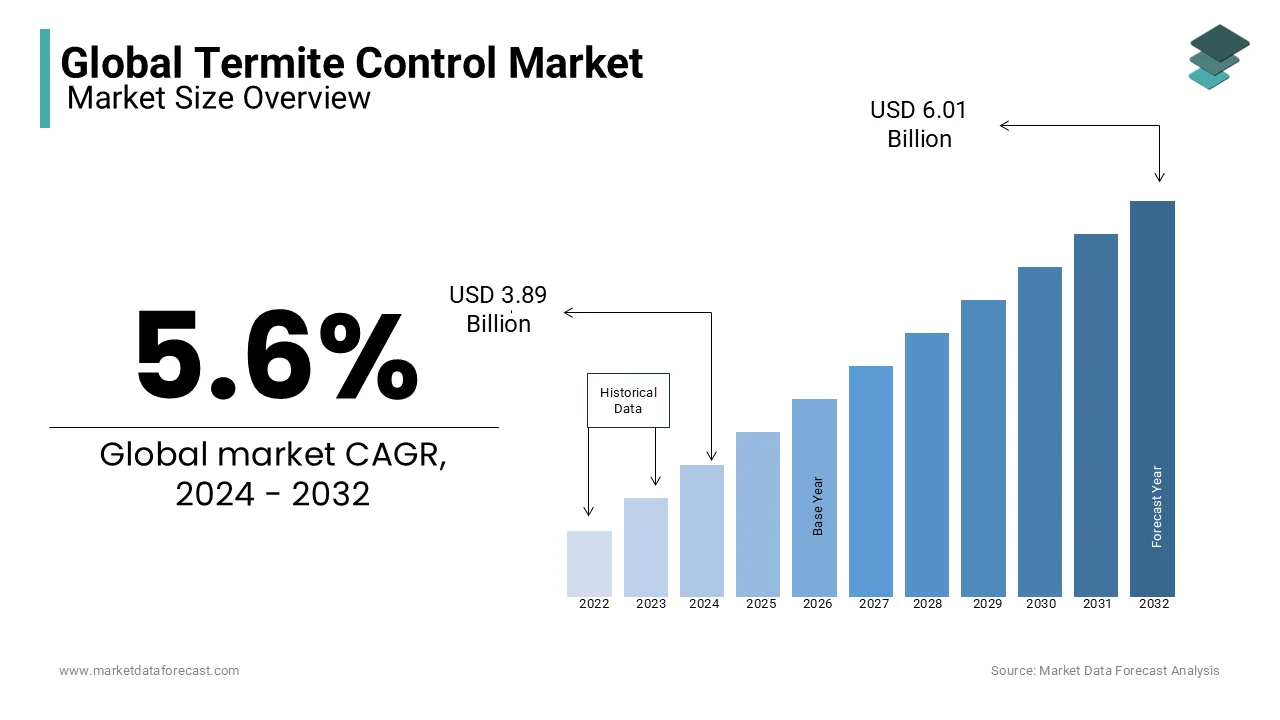
Termites are damaging to humans, livestock, and the environment. Hence, various preventive and control measures to control the proliferation of termites have been driving the growth of this market globally.
MARKET DRIVERS AND RESTRAINTS
The market is driven by various factors like climate change, growth in public awareness, and government regulations on public and environmental health. There has been a rise in the disposable income earned by people, which further drives the market as people are focusing on improving their health and hygiene standards. The lack of skilled technicians offering innovative solutions for termite control and the delayed regulatory approval process for chemical applications in residential and commercial areas are considered restraining factors for the market.
REPORT COVERAGE
| REPORT METRIC | DETAILS |
| Market Size Available | 2025 to 2034 |
| Base Year | 2025 |
| Forecast Period | 2026 to 2034 |
| CAGR | 5.6% |
| Segments Covered | By Type, Control Method, Application, and Region |
| Various Analyses Covered | Global, Regional & Country Level Analysis, Segment-Level Analysis, DROC, PESTLE Analysis, Porter’s Five Forces Analysis, Competitive Landscape, Analyst Overview of Investment Opportunities |
| Regions Covered | North America, Europe, APAC, Latin America, Middle East & Africa |
| Market Leaders Profiled | BASF SE (Germany), The Dow Chemical Company (U.S.), Bayer CropScience AG (Germany), Syngenta AG (Switzerland), Sumitomo Chemical Co. (Japan), FMC Corporation (U.S.), Nufarm Limited (Australia), United Phosphorus Limited (India), Rentokil Initial plc. (U.K.), ADAMA Agricultural Solutions Ltd. (Israel), Nippon Soda (Japan), Control Solution plc. (U.S.), Ensystex (U.S.). |
SEGMENTAL ANALYSIS
By Type Insights
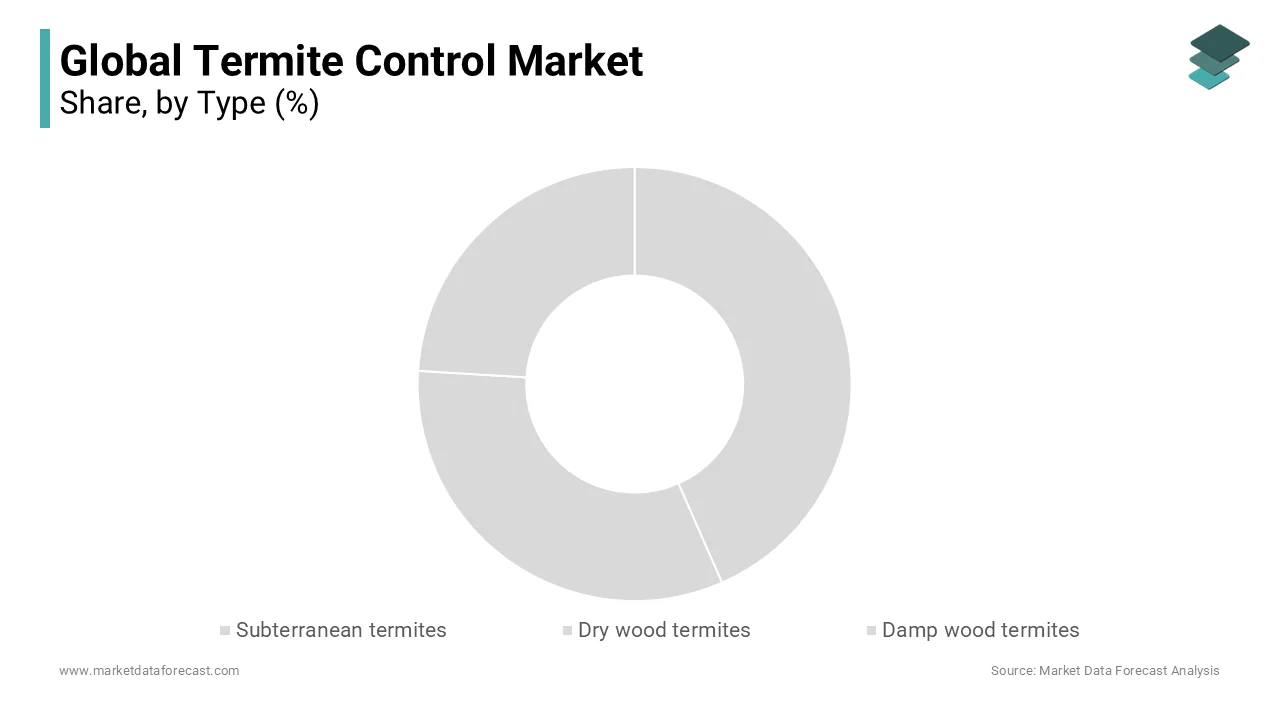
Subterranean termites accounted for the largest market share across all the types of termites, owing to the higher demand in industrial and residential sectors for pre- & post-construction treatment and wooden house treatment, respectively, for these termites.
By Control Method Insights
The chemical control method dominated the segment due to the significant demand for pyrethroids for their application rate and compatibility with a variety of termites.
KEY MARKET PLAYERS
Some of the market players dominate the global termite control market.
- BASF SE (Germany)
- The Dow Chemical Company (U.S.)
- Bayer CropScience AG (Germany)
- Syngenta AG (Switzerland)
- Sumitomo Chemical Co. (Japan)
- FMC Corporation (U.S.)
- Nufarm Limited (Australia)
- United Phosphorus Limited (India)
- Rentokil Initial plc. (U.K.)
- ADAMA Agricultural Solutions Ltd. (Israel)
- Nippon Soda (Japan)
- Control Solution PLC. (U.S.)
- Ensystex (U.S.)
MARKET SEGMENTATION
This research report on the global termite control market is segmented and sub-segmented based on the Type, Control Method, Application, and Region.
By Type
- Subterranean termites
- Dry wood termites
- Damp wood termites
By Control Method
- Chemical control method
- Physical and mechanical control method
- Biological control method
- Botanical
- Other control method
By Application
- Commercial and industrial
- Residential
- Agriculture and livestock farms
By Region
- North America
- Europe
- Asia-Pacific
- Latin America
- The Middle East and Africa
- Rest of the World