- Product Description Description
- Table of Contents TOC
- List of Table & Figure LOT
- Get Free Sample PDF Sample PDF
Market Size, 2025
$4,870.00 MnMarket Estimate, 2026
$5,610.00 MnMarket Forecast, 2034
$17.55 BnCAGR, 2026–2034
15.32%Global Text-to-Speech Market Size, Growth, Trends & Forecast (2026–2034)
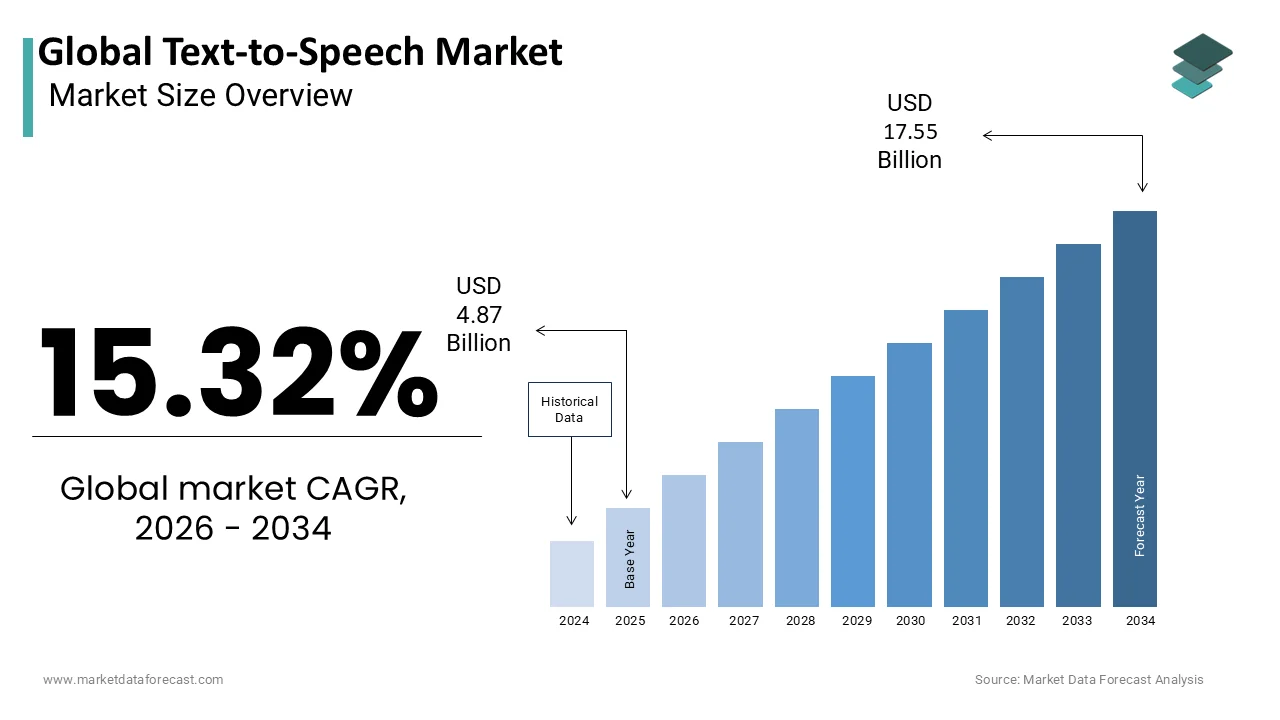
The global text-to-speech (TTS) market size was valued at USD 4,870 million in 2025, is anticipated to reach USD 5,610 million in 2026, and is projected to expand up to USD 17.55 billion by 2034, registering a compound annual growth rate (CAGR) of 15.32% during the forecast period from 2026 to 2034. Growth is driven by the soaring demand for mobile devices, increasing accessibility mandates for individuals with learning or visual impairments, and rapid integration of AI-driven neural voices across digital platforms.
Key Executive Metrics (At-a-Glance)
- 2025 Base Valuation: USD 4,870 Million
- 2026 Current Valuation: USD 5,610 Million
- 2034 Forecast Valuation: USD 17.55 Billion
- Compound Annual Growth Rate (CAGR): 15.32% (2026–2034)
- Dominant Voice Type Segment: Neural and Custom Voice (Led market share due to highly realistic, human-like voice synthesis and emotional expressiveness)
- Fastest-Growing Deployment Segment: Cloud-Based (Expands rapidly owing to high scalability, cost efficiency, and seamless API integration)
- Dominant Region: North America (Maintains the largest market share backed by advanced digital infrastructure and high smartphone penetration)
- Fastest-Growing Region: Asia-Pacific (Propelled by widespread adoption of AI, IoT devices, smart speakers, and localized voice applications)
Core Market Drivers
- Proliferation of Mobile & Smart Devices: High consumer reliance on smartphones, tablets, and home automation systems integrated with built-in voice assistants.
- Assistive Tech & Inclusive Education: Rising government spending and regulatory backing to make digital content audible for aging populations and people with visual or learning difficulties.
Primary Market Restraints & Challenges
- Pronunciation & Natural Variation Complexities: Technical challenges associated with capturing exact contextual pronunciation, cadence, and voice modulation across varied dialects.
- Privacy & Security Concerns: Growing data privacy apprehensions regarding cloud-hosted voice data storage and processing.
Global Text-to-Speech Market Segmentation Breakdown
| Segment Category | Key Sub-Segments / Details |
|---|---|
| By Offering | Software, Services |
| By Deployment Mode | On-Premises, Cloud-Based |
| By Voice Type | Neural and Custom Voice, Non-Neural Voice |
| By Region | North America, Europe, Asia-Pacific, Latin America, Middle East & Africa |
Major Industry Players Profiled
Key technology leaders driving market innovation include Amazon, Natural Soft, Word Talk, Panopreter, Zabaware, Linguae, iSpeech, Acapela Group, Well Source, and ReadSpeaker.
 Download Free Sample Report
Global Text-to-Speech Market Size
The Global Text-to-Speech Market was worth USD 4,870 million in 2025 and is anticipated to reach a valuation of USD 17.55 billion by 2034 from USD 5,610 million in 2026. It is predicted to register a CAGR of 15.32% From 2026 to 2034.
MARKET SCENARIO
Text-To-Speech (TTS) is a service that identifies natural language and turns it into audible speech, including intonation and cadence. Written material will be accessible to people with a learning impairment, a language issue, or a visual problem. This technology makes it easy to communicate with people all around the world. The number of persons with learning disabilities is increasing, and making internet material audible broadens the user population. Speech synthesis has long been a popular assistive technology tool, with a wide range of applications in this sector. It allows persons with a wide range of impairments to overcome obstacles in their surroundings. The longest use has been the use of screen readers for persons with visual difficulties. The employment of software to generate an audio output in the form of a spoken voice is known as text-to-speech (TTS). A text-to-speech engine is a software used by applications to convert text on the page into an audio output of the spoken voice. For audio output of machine translation results, TTS engines are required.
Text-to-speech is a fantastic technology that converts written material from any website, mobile app, e-book, online document, or e-learning tool into audio. People with a learning handicap, a language impediment, or a visual problem can easily read printed text. The number of people who have a learning disability or problem is on the rise, and making internet material audible expands the user base. The percentage of the population over 60 years old has steadily risen, indicating an increased risk of eyesight loss. Text-to-speech technology is quite valuable for those with low eyesight, since it allows them to fully comprehend the information. In recent years, this factor has driven the text-to-speech business. The need for text-to-speech technology is expected to rise in the near future, thanks to advancements in the production of digital content and the rising use of hand-held devices, as well as increased internet penetration.
MARKET DRIVERS
The text-to-speech market is growing because of the rising demand for mobile devices, increased government spending on education for differently abled students, the elderly population's reliance on technology, and an increase in the number of people with various learning difficulties or learning styles.
Mobile phones have progressed from simple telephones to powerful personal computers that allow users to perform things like browse the internet, take photographs, translate languages, navigate, and manage entertainment and multimedia material. As the desire for automation and convenience develops, text-to-speech technology is becoming increasingly prevalent. Text-to-speech systems may eliminate the need to read long user guides or manuals by giving users audible reminders and audio instructions for operations.
MARKET RESTRAINTS
Due to the difficulty of exact pronunciation and voice alteration, text-to-speech technology is likely to be limited in its usage in many applications. The Text-To-Speech Market has certain obstacles, which may impede its growth. On mobile devices, text-to-speech technology is automatically installed, providing easier access to audio material. Audio is easier to comprehend. People prefer to listen to audiobooks, PDF files, and internet content since they are easier for them to comprehend.
REPORT COVERAGE
| REPORT METRIC | DETAILS |
| Market Size Available | 2025 – 2034 |
| Base Year | 2025 |
| Forecast Period | 2026 - 2034 |
| Segments Covered | By Offering, Deployment Mode, Voice Type, and Region |
|
Various Analyses Covered | Global, Regional, & Country Level Analysis; Segment-Level Analysis, DROC, PESTLE Analysis, Porter’s Five Forces Analysis, Competitive Landscape, Analyst Overview of Investment Opportunities |
| Regions Covered | North America, Europe, APAC, Latin America, Middle East & Africa |
|
Market Leaders Profiled | Amazon, Natural Soft, Word Talk, Panopreter, Zab aware, Linguae, I Speech, A Capela, Well Source, Read Speaker. and Others. |
REGIONAL ANALYSIS
North America is expected to have the dominant share in the Global Text-to-Speech Market during the forecast period. North America led the worldwide Text-To-Speech market, owing to the increased usage of modern electronic devices such as smartphones, tablets, smart TVs, and other similar devices. In the United States, the smartphone sector has the greatest penetration rate.
Asia-Pacific is expected to witness rapid growth in the Global Text-to-Speech Market during the forecast period. Speech recognition solutions with text-to-speech are gaining ground in APAC, thanks to the region's expanding adoption of AI, analytics, and IoT devices. As a result of this favourable business climate, voice-activated technology is seen as being accepted in Asian economies such as India, China, Indonesia, Australia, Japan, and Singapore. Countries are implementing a variety of favourable regulations to boost AI adoption among businesses in order to improve industry performance and consumer satisfaction. This has resulted in the widespread usage of Intelligent Virtual Assistants (IVAs), chatbots, and smart speakers in people's daily lives. Text-to-speech systems have been installed at airports and ATMs in Japan and China. Singapore, Hong Kong, Indonesia, and Malaysia, for example, are looking forward to incorporating new technology into their enterprises.
MARKET KEY PLAYERS
Companies playing a prominent role in the global text-to-speech market include Amazon, Natural Soft, Word Talk, Panopreter, Zab aware, Linguae, iSpeech, A Capela. Well Source, Read Speaker, and Others.
RECENT HAPPENINGS IN THE MARKET
-
Tobi’s eye-tracking technology is coming to the iPad with the TD Pilot cover, which transforms Apple's tablet into a powerful all-in-one tool for individuals with physical disabilities. Users who have TD Pilot may use their sight to open and operate apps, write swiftly, and talk with a synthetic voice.
-
XPeng, a Chinese smart EV manufacturer, has enhanced its auto-grade voice assistant with MMicrosoft'sproprietary neural voice capabilities based on Azure AI's Neural Text-to-Speech (TTS).
SEGMENTAL ANALYSIS
By Offering
- Software.
- Services.
By Deployment Mode
- On-Premises.
- Cloud-Based.
By Voice Type
- Neural and Custom Voice.
- Non-Neural Voice.