- Product Description Description
- Table of Contents TOC
- List of Table & Figure LOT
- Get Free Sample PDF Sample PDF
Market Size, 2025
$18.86 BnMarket Estimate, 2026
$22.53 BnMarket Forecast, 2034
$93.37 BnCAGR, 2026–2034
19.45%Global Voice Recognition System Market Size, Growth, Trends & Forecast (2026–2034)
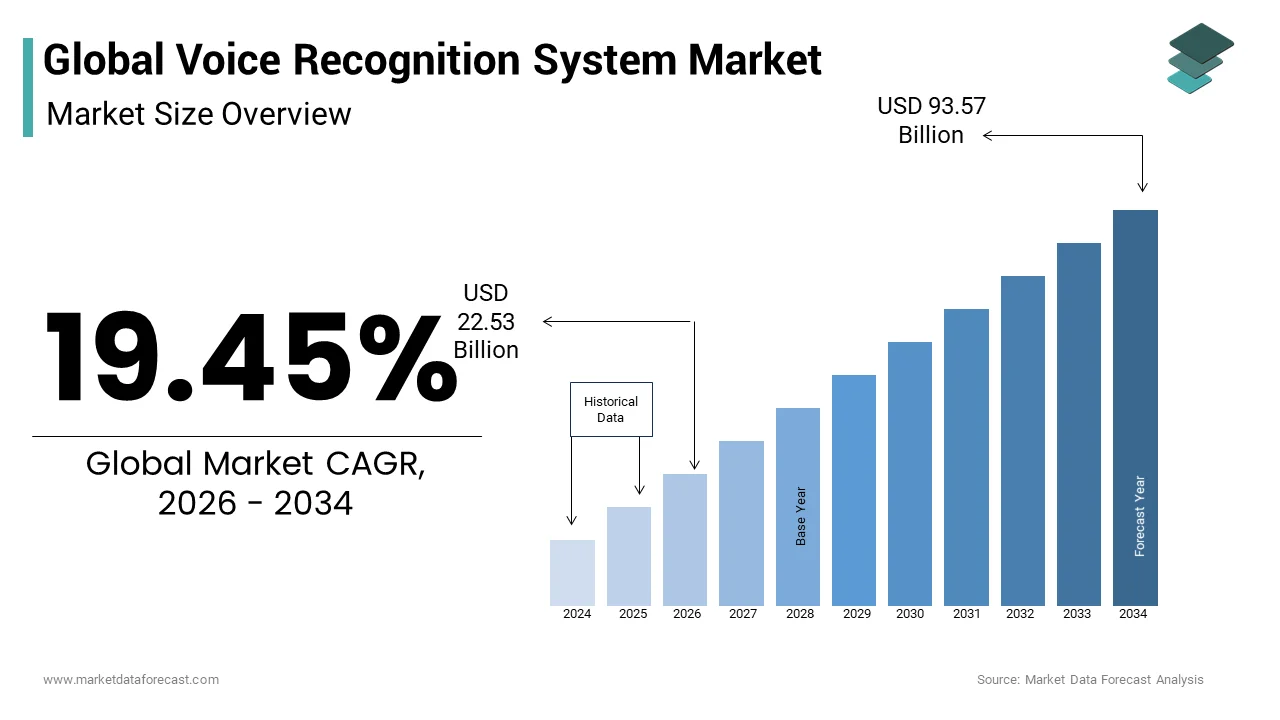
The global voice recognition system market size was valued at USD 18.86 billion in 2025, is anticipated to reach a valuation of USD 22.53 billion in 2026, and is expected to hit USD 93.37 billion by 2034, growing at a compound annual growth rate (CAGR) of 19.45% during the forecast period from 2026 to 2034. Growth is heavily driven by the integration of voice assistants in smart consumer electronics, rapid adoption of voice biometrics for secure authentication, and specialized healthcare clinical documentation.
Key Executive Metrics (At-a-Glance)
- 2025 Base Valuation: USD 18.86 billion
- 2026 Current Valuation: USD 22.53 billion
- 2034 Forecast Valuation: USD 93.37 billion
- Compound Annual Growth Rate (CAGR): 19.45% (2026–2034)
- Dominant Technology Segment: Embedded technology (holding 53.8% of the market share in 2025)
- Fastest-Growing Technology Segment: Hybrid technology (growing at a CAGR of 14.6%)
- Dominant Application Segment: Non-AI segment (holding 32.1% share in 2025 for legacy enterprise and rule-based tasks)
- Fastest-Growing Application Segment: AI-based segment (projected at a CAGR of 17.2%, scaling toward USD 97.43 billion by 2034)
- Dominant End-User Tier Segment: Luxury tier / Luxury vehicles (holding a prominent share in 2025 due to premium digital amenities)
- Fastest-Growing End-User Tier Segment: Economy tier / Economy vehicles (witnessing a CAGR of 14.32% via democratized mass-market adoption)
- Dominant Region: North America (holding 41.2% market share in 2025)
- Fastest-Growing Region: Asia Pacific (driven by massive smartphone adoption and explosive connected vehicle growth in China and India)
Core Market Drivers
- Hands-Free Convenience: Surging integration of voice assistants in smart consumer electronics for touchless digital navigation.
- Biometric Security: Rapid adoption of voice biometrics within banking and financial platforms to prevent identity fraud.
Primary Market Restraints & Challenges
- Acoustic & Accent Barriers: Severe performance vulnerability to ambient background noise and persistent inaccuracies in recognizing diverse regional accents.
Global Voice Recognition System Market Segmentation Breakdown
| Segment Category | Leading Sub-Segment | Fastest-Growing Sub-Segment |
|---|---|---|
| By Technology | Embedded (53.8% share in 2025) | Hybrid (CAGR of 14.6%) |
| By Application | Non-AI (32.1% share in 2025) | AI-Based (CAGR of 17.2% from 2026–2034) |
| By Fuel Type | Not explicitly specified (Includes BEV, ICE, Others/Hybrid) | Not explicitly specified |
| By End User Tier | Luxury Vehicles / Tier | Economy Vehicles / Tier (CAGR of 14.32%) |
| By Region | North America (41.2% share in 2025) | Asia Pacific (Driven by smartphone and connected vehicle expansion) |
Major Industry Players Profiled
Key tech giants and automotive supply leaders shaping the market include Nuance Communications (US), Microsoft (US), Alphabet / Google (US), Harman (US), Apple (US), alongside automotive OEMs such as BMW (Germany), Daimler (Germany), and Ford (US).
 Download Free Sample Report
Global Voice Recognition System Market
The global voice recognition system market size was valued at USD 18.86 billion in 2025 and is anticipated to reach a valuation of USD 22.53 billion in 2026 and USD 93.37 billion by 2034, growing at a CAGR of 19.45% from 2026 to 2034.
MARKET OVERVIEW
The voice recognition system is an advanced acoustic processing software, natural language algorithms, and automated speech-to-text hardware architectures designed to convert spoken human communication into machine-readable data, across diverse digital ecosystems. This foundational technology relies heavily on deep neural networks to decode complex vocal patterns, accents, and specialized vocabularies in real-time environments. As per data regarding consumer technology habits, over 157 million individuals actively utilize voice-activated digital assistants across North America alone, establishing vocal interfaces as a primary mode of human-computer interaction. Enterprise sectors increasingly deploy sophisticated speech architectures to automate customer service operations, streamline medical transcription workflows, and secure digital banking platforms through vocal biometrics. Furthermore, ongoing developments in cloud computing infrastructure enable seamless scaling for multi-user voice applications, driving continuous adoption across global telecommunication, automotive, and smart home manufacturing industries.
MARKET DRIVERS
Surging Integration of Voice Assistants in Smart Consumer Electronics
The pervasive consumer preference for hands-free device control and touchless digital navigation I propelling the growth of the voice recognition system market. This rapid adoption directly correlates with consumer demand for frictionless user experiences that eliminate manual typing across complex interface menus. Furthermore, the voice AI usage expanded exponentially over recent operational cycles due to real-world production deployments handling millions of daily customer queries. Consequently, consumer electronics manufacturers continuously embed sophisticated acoustic engines into television sets, kitchen appliances, and mobile phones to maintain competitive differentiation. This widespread everyday exposure successfully habituates billions of global users to voice-driven navigation, creating an immediate, high-volume demand stream for advanced natural language processing toolkits.
Rapid Adoption of Voice Biometrics for Secure Authentication
The escalating cybersecurity threat within financial institutions and digital commerce platforms accelerates the deployment of voice recognition software as a secure, frictionless biometric authentication layer. The rapid adoption of voice biometrics for secure authentication is additionally accelerating the growth of the voice recognition system market. According to the research, banking and financial organizations increasingly implement speech-based verification to combat identity fraud and streamline customer login procedures. This security-driven demand links directly to the unique physiological characteristics of human vocal tracts, which provide an unforgeable acoustic signature for individual account holders. Additionally, the artificial intelligence-based voice technologies hold over 72% of the overall value, driven by deep learning models capable of distinguishing subtle vocal nuances against spoofing attacks. Therefore, security architects across corporate IT and government sectors prioritize voice identification protocols over traditional password pins. This enterprise transition protects sensitive databases while offering end users a rapid, memory-free verification method during remote telephone banking and digital identity check operations.
MARKET RESTRAINTS
Acute Vulnerability to Ambient Acoustic Noise Interference
The severe performance degradation of speech recognition software when operating in loud, unstructured real-world environments is creating new opportunities for the growth of the voice recognition system market. According to the research, background white noise, cross-talk, and environmental chatter drastically increase word error rates across standard acoustic engines. This acoustic limitation directly restricts market expansion by causing system failures in high-traffic public spaces, busy manufacturing floors, and crowded emergency dispatch centers. Furthermore, industry evaluations from PRNewswire indicate that ambient acoustic disruption remains a primary barrier preventing reliable consumer adoption in open-plan corporate offices and automotive cabins. Consequently, enterprises hesitate to replace manual control systems with voice-only alternatives in safety-critical industrial settings where audio distortion could cause severe command misinterpretations. Software developers must invest heavily in complex noise cancellation algorithms and hardware beamforming microphones to mitigate these environmental barriers, driving up research expenditures.
Persistent Inaccuracies in Recognizing Diverse Regional Accents
The failure of traditional speech recognition models to accurately process non-standard dialects, heavy regional accents, and speech impediments severely limits the global inclusivity and reliability of voice systems. According to the study, word error rates spike significantly when algorithms encounter unfamiliar phonetic variations or uncommon linguistic structures. This regional bias directly restricts market penetration in multicultural societies and developing geographic territories where numerous dialects coexist within a single national boundary. Additionally, the insufficient localized training data prevents speech systems from achieving equitable comprehension rates across diverse demographic cohorts. Therefore, corporate buyers reject voice automation tools that alienate segments of their customer base due to poor accent handling.
MARKET OPPORTUNITIES
Expansion of Specialized Clinical Documentation in Healthcare
The mounting administrative burden placed on medical professionals opens lucrative commercial avenues for deploying specialized voice recognition software within hospital electronic health record workflows. The expansion of specialized clinical documentation in healthcare is solely attributed in creating new opportunities for growth of the voice recognition system market. According to the study, the integration of ambient voice AI inside clinical environments significantly reduces physician burnout by automating patient chart documentation. This high-growth opportunity links directly to the intense daily requirement of doctors to log detailed diagnostic notes, prescriptions, and surgical histories without spending hours typing manually. Furthermore, industry projections published by Mordor Intelligence demonstrate that healthcare vertical automation is expanding at a rapid pace as hospitals seek to optimize administrative throughput and patient data accuracy. Consequently, software vendors focus engineering efforts on developing proprietary medical vocabularies that recognize complex pharmacological terms and anatomical jargon flawlessly.
Integration of Advanced Voice Control in Automotive Infotainment
The rapid evolution of connected and autonomous vehicles for embedding voice recognition systems directly into modern vehicular dashboard architectures. This factor is also gearing up the growth of the voice recognition system market. The major car manufacturers increasingly rely on natural language processing to let drivers manage navigation, climate settings, and entertainment hands-free. This automotive integration opportunity stems directly from stringent global safety regulations penalizing driver distraction and smartphone manipulation behind the wheel. Additionally, the embedded artificial intelligence voice units are becoming a standard expectation for next-generation electric and connected vehicle fleets. Therefore, software engineering firms form strategic tier-one supplier alliances with automotive brands to deliver low-latency, offline-capable voice control modules. This vehicular expansion channel secures massive multi-year procurement contracts, diversifying revenue streams away from traditional consumer electronics and enterprise office productivity sectors.
MARKET CHALLENGES
Heightened Consumer Concerns Regarding Data Privacy and Security
The continuous transmission and cloud-based storage of sensitive vocal recordings trigger widespread consumer apprehension and stringent regulatory scrutiny regarding data ownership and surveillance risks. This is one of the major challenges for the growth of the voice recognition system market. According to survey, user anxiety concerning voice data collection surged dramatically as remote work and online interactions expanded. This security challenge directly threatens market growth because voice assistants constantly capture ambient household audio, raising fears of unauthorized corporate eavesdropping or malicious data breaches. Furthermore, privacy frameworks like regional data protection laws impose heavy financial penalties on companies mismanaging biometric voice templates. Consequently, enterprises must allocate substantial capital toward end-to-end encryption, local edge-processing architectures, and transparent consent protocols to maintain consumer trust. Failure to adequately protect vocal data assets can result in catastrophic brand damage and immediate market rejection of connected voice-enabled hardware.
Prohibitive Costs and Complexity of Collecting Diverse Training Data
The immense data hunger of modern deep learning models creates a formidable financial and logistical hurdle for independent technology developers attempting to build competitive voice recognition software. According to the study, acquiring clean, annotated audio datasets covering rare dialects and specialized jargon requires ongoing expenditures that can easily exceed tens of thousands of dollars monthly. This data acquisition challenge links directly to the fact that artificial intelligence algorithms require millions of hours of diverse human speech to achieve acceptable commercial accuracy thresholds. Additionally, smaller software vendors struggle to compete against tech conglomerates capable of harvesting massive proprietary voice databases from global consumer devices.
REPORT COVERAGE
| REPORT METRIC | DETAILS |
| Market Size Available | 2025 to 2034 |
| Base Year | 2025 |
| Forecast Period | 2026 to 2034 |
| CAGR | 19.45% |
| Segments Covered | By Technology (Volume only), Application (Value only), Fuel Type, End User, and Region. |
| Various Analyses Covered | Global, Regional, & Country Level Analysis; Segment-Level Analysis; DROC; PESTLE Analysis; Porter’s Five Forces Analysis; Competitive Landscape; Analyst Overview of Investment Opportunities |
| Regions Covered | North America, Europe, APAC, Latin America, Middle East & Africa |
| Market Leaders Profiled | Nuance (US), Microsoft (US), Alphabet (US), Harman (US), and Apple (US). The voice recognition systems are supplied to automotive OEMs such as BMW (Germany), Daimler (Germany), Ford (US), and Others. |
SEGMENTAL ANALYSIS
By Technology Insights
The embedded technology segment held 53.8% of the voice recognition system market share in 2025 due to its localized processing capabilities and independence from constant internet connectivity. According to the study, embedded voice architectures are deployed across more than 51% of connected hardware devices to ensure instantaneous command execution without network latency. This market leadership is driven by the critical demand for privacy and offline reliability in consumer electronics, automotive cockpits, and industrial automation equipment. Furthermore, the embedded speech engines reduce response times by 40% compared to cloud-dependent alternatives by making them vital for safety-critical environments. Device manufacturers favor embedded software because it eliminates recurring cloud hosting fees, while protecting user data from external server breaches. As edge computing hardware becomes increasingly powerful, embedded systems continue to anchor high-volume deployments across global manufacturing supply chains. Furthermore, continuous advancements in low-power semiconductor design allow hardware developers to integrate complex neural processing units directly onto microchips, enabling sophisticated voice command parsing on battery-operated IoT gadgets without draining energy resources.
The hybrid technology segment is likely to grow at a fastest CAGR of 14.6% during the forecast period. According to survey, hybrid speech frameworks capture an expanding share of enterprise applications by seamlessly combining local edge processing with cloud-based deep neural networks. This rapid expansion is driven by consumer demand for complex natural language understanding that requires massive cloud computing power alongside immediate local execution for basic commands. Additionally, year-over-year increase in commercial deployments utilizing hybrid architectures to optimize bandwidth and processing efficiency. The ability of hybrid systems to function offline for basic tasks while leveraging cloud intelligence for complex queries provides an unmatched user experience. Consequently, software developers across smart home and automotive sectors aggressively integrate hybrid configurations to satisfy modern consumer expectations. Moreover, telecommunication enterprises actively upgrade network infrastructure to support dual-path data transmission, ensuring that hybrid voice systems dynamically route computational workloads based on real-time internet availability and query complexity.
By Application Insights
The non-AI segment was accounted in holding 32.1% of the voice recognition system market share in 2025 by capturing traditional rule-based and template-matching applications across legacy enterprise telephony and basic dictation tools. According to the research, rule-based speech frameworks account for a significant baseline portion of enterprise deployments because they require minimal computational overhead and predictable financial investment. Organizations favor non-AI systems for routine, structured tasks where predictable keyword matching prevents the unpredictable variations associated with autonomous machine learning models. Although artificial intelligence gains momentum, the sheer cost-effectiveness and reliability of non-AI frameworks in structured environments preserve their substantial market volume. Furthermore, small and medium enterprises with limited information technology budgets frequently choose deterministic speech tools to automate basic customer inquiries without incurring expensive cloud subscription fees or requiring specialized data science talent for maintenance.
The AI-based segment is likely to grow at a fastest CAGR of 17.2% from 2026 to 2034 with the learning algorithms revolutionize human-computer interaction. As per the reports, the integration of artificial intelligence within voice architectures is projected to scale the global sector toward 97.43 billion dollars by 2034. This exceptional growth rate is fueled by the demand for self-learning natural language processing models that adapt to individual user vocal patterns and contextual nuances. Enterprises across healthcare, finance, and retail increasingly adopt AI speech models to automate complex data entry and deliver hyper-personalized customer engagement. This ongoing technological shift solidifies artificial intelligence as the primary engine for future market expansion. Furthermore, venture capital funding directed toward generative voice startups accelerates the creation of contextual voice agents capable of handling multi-turn conversations and emotional subtext, pushing the boundaries of automated customer service.
By End-User Insights
The luxury end-user tier segment held a prominent share of the voice recognition system market in 2025 with the high consumer spending power and the mandatory inclusion of premium digital amenities in high-end products. Manufacturers target this segment first because high profit margins allow for rapid R&D recovery and the incorporation of cutting-edge acoustic hardware. Consequently, the luxury tier remains the primary incubator for advanced voice recognition capabilities before they trickle down to broader consumer markets. Moreover, luxury automotive brands deploy custom acoustic isolation combined with multi-zone voice capture arrays to ensure flawless speech recognition even at high cruising speeds, setting a benchmark for premium user experience. This relentless pursuit of exclusivity and technological superiority ensures that the luxury tier maintains its commanding share of total market expenditure.
The economy end-user tier segment is likely to witness a fastest CAGR of 14.32% during the forecast period, as voice technology becomes democratized across affordable consumer goods. As per the study, the rapid reduction of component manufacturing costs has enabled mass-market adoption of voice-controlled features in budget-friendly automobiles and entry-level smartphones. This rapid growth rate is fueled by rising middle-class disposable incomes in developing economies and an insatiable consumer demand for connected convenience features at accessible price points. As per the study, 38% surge in sales of budget smart home devices equipped with basic speech control functions over past operational cycles. Manufacturers focus heavily on this tier to capture massive volume sales across densely populated emerging regions. As software optimization reduces the need for expensive hardware components, the economy segment continues to experience unprecedented expansion rates. Furthermore, white-label voice software providers collaborate with budget electronics manufacturers to deliver lightweight speech models that run efficiently on low-cost processors, opening new revenue streams in price-sensitive areas. This widespread democratization transforms voice control from an elite luxury feature into an expected standard across all consumer electronics categories.
REGIONAL ANALYSIS
North America Market Analysis
North America was the top performer in the global voice recognition system market by holding 41.2% of share in 2025 with the advanced technological ecosystem and high consumer saturation. Major technology conglomerates including Microsoft, Google, Apple, and Amazon driving continuous software innovation. This prominent regional position directly correlates with high smartphone penetration rates and the widespread household density of IoT-connected voice assistants across the United States and Canada. Robust venture capital investments and proactive enterprise adoption ensure that North America remains the primary benchmark for advanced voice technology deployment. Furthermore, regional regulatory bodies foster a progressive environment for artificial intelligence development while establishing clear compliance standards, giving enterprises the legal certainty required to invest heavily in large-scale voice automation initiatives.
Europe Market Analysis
Europe voice recognition system market was ranked second by holding 18.2% of the share in 2025 with a strong focus on data privacy compliance and industrial automation. According to the study, heavily shaped by stringent data protection frameworks that mandate strict user consent for biometric voice data collection. This structured market status directly correlates with the rapid adoption of voice recognition within European automotive manufacturing plants and specialized enterprise software solutions. Therefore, European software developers prioritize edge-processed, privacy-compliant acoustic architectures that process voice data locally without transmitting recordings to external cloud servers. Government-backed research initiatives further encourage the development of multi-lingual speech models capable of accurately recognizing dozens of distinct European regional dialects. Furthermore, collaborative European research consortia fund projects aimed at developing sovereign artificial intelligence models, reducing reliance on foreign technology providers and ensuring regional data security. This unique regulatory and industrial landscape allows Europe to carve out a specialized market niche centered around ultra-secure, privacy-first voice recognition deployments.
Asia Pacific Market Analysis
Asia Pacific voice recognition system market growth is expected to witness a fastest CAGR throughout the forecast period with the massive smartphone adoption and explosive growth in connected vehicle sales across China and India. Furthermore, the regional middle-class expansion has driven a 40% surge in smart home appliance purchases over recent years. Consequently, domestic technology giants invest heavily in proprietary natural language engines tailored to complex tonal languages like Mandarin, Japanese, and Hindi. This localized linguistic precision allows the Asia Pacific region to capture an increasing share of global market revenue. Moreover, government-led digital infrastructure programs across developing nations rapidly expand high-speed mobile broadband access, bringing millions of new users into the digital voice ecosystem.
Latin America Market Analysis
Latin America voice recognition systems market growth is driven by the progressive telecommunications modernization and rising urban adoption of mobile voice-activated applications. The growing deployment of voice-based customer service automation within regional banking and telecommunication enterprises. Therefore, international software vendors actively collaborate with local telecom operators to deploy Spanish and Portuguese voice recognition tools tailored to regional dialects. While infrastructural hurdles persist in rural territories, urban economic growth positions Latin America as a high-potential frontier for future voice technology expansion. Furthermore, telecommunication operators invest heavily in cloud infrastructure upgrades to support low-latency voice applications, enhancing the reliability of automated customer interaction channels.
Middle East and Africa Market Analysis
The Middle East and Africa voice recognition system market growth is likely to grow with the ambitious national digital transformation strategies and massive smart city infrastructure investments. The government-backed smart city projects in the Gulf Cooperation Council countries accelerate the integration of voice-controlled IoT systems. Consequently, global technology providers establish regional data centers to deliver low-latency cloud-based voice recognition services tailored to Arabic and regional African dialects. Although linguistic diversity and varied economic stability present adoption challenges across sub-Saharan territories, government digitization initiatives continue to unlock steady market opportunities throughout the broader region. Moreover, strategic public-private partnerships focus on developing local artificial intelligence talent pools, ensuring that regional enterprises can customize voice technologies to meet specific cultural and linguistic requirements.
COMPETITIVE LANDSCAPE
The competitive landscape of the global voice recognition system market is characterized by intense rivalry among massive technology conglomerates and agile artificial intelligence software developers striving for superior acoustic accuracy and natural language comprehension. Market participants continuously vie for industry leadership by introducing generative conversational agents, multi-modal emotion recognition tools, and ultra-low-latency speech models that redefine standard human-computer interactions. Strategic market positioning heavily relies on algorithm reliability, robustness against ambient acoustic interference, and the ability to process complex regional dialects without frustrating end users. Persistent cybersecurity threats, stringent global data privacy regulations, and the high financial cost of gathering clean training datasets compel companies to continuously optimize their machine learning pipelines and accelerate hardware acceleration investments. Furthermore, open-source artificial intelligence initiatives and specialized boutique vendors frequently challenge traditional industry giants by offering flexible, customizable voice tools tailored to specific industry verticals.
KEY MARKET PLAYERS
These are some of the major key market players involved in the global voice recognition system market.
- Nuance (US)
- Microsoft (US)
- Alphabet (US)
- Harman (US)
- Apple (US)
- BMW (Germany)
- Daimler (Germany)
- Ford (US)
Top Players In The Market
- Nuance Communications delivers advanced conversational artificial intelligence and clinical speech recognition solutions tailored for healthcare providers, financial institutions, and customer service contact centers worldwide. The enterprise contributes substantially to the sector by providing automated speech tools that convert unstructured voice data into actionable text documentation. To strengthen its competitive standing, the organization continuously expands its cloud-based healthcare intelligence platforms and integrates deep learning voice biometrics into enterprise security networks. Furthermore, the company collaborates extensively with global software developers to embed voice recognition capabilities into multi-channel operating systems. Through these operational enhancements, the firm secures its position as a primary innovator in professional speech technology applications.
- Google provides powerful speech recognition engines, natural language processing tools, and multi-lingual voice assistants utilized across billions of mobile devices, consumer electronics, and automotive dashboards globally. The enterprise contributes deeply to the market by advancing deep neural network architectures that drastically reduce word error rates in noisy acoustic environments. To reinforce its market posture, the organization prioritizes continuous algorithmic upgrades and deploys real-time cloud computing infrastructure to support low-latency voice applications. Additionally, the firm focuses on expanding language models to cover dozens of regional dialects, ensuring high accessibility for diverse demographic user groups.
- Apple delivers integrated voice recognition software and proprietary natural language processing frameworks embedded directly across its extensive ecosystem of smartphones, tablets, smart speakers, and wearable devices. The enterprise contributes significantly to the industry by pioneering edge-processed voice commands that prioritize user privacy and operate independently of external cloud servers. Moreover, the firm actively pursues rigorous security protocols and on-device machine learning techniques to safeguard confidential voice biometric templates.
Top Strategies Used by Key Market Participants
Key market participants operating within the voice recognition system industry deploy sophisticated computational and commercial strategies designed to secure a competitive advantage amidst rapidly shifting consumer expectations and advanced artificial intelligence breakthroughs. Major technology corporations heavily prioritize strategic mergers, corporate acquisitions, and technology buyouts to absorb specialized natural language processing startups and expand their proprietary software portfolios. Organizations routinely establish robust research partnerships with academic institutions and specialized medical networks to collect diverse acoustic datasets and train highly accurate acoustic models. Furthermore, leading entities execute aggressive ecosystem integration strategies, embedding voice recognition toolkits directly into mobile operating systems, smart home appliances, and connected automotive platforms. Companies also focus intensely on data privacy and local edge processing capabilities, transitioning from cloud-dependent architectures to secure on-device neural engines that protect user confidentiality.
MARKET SEGMENTATION
This research report on the global voice recognition system market is segmented and sub-segmented into the following categories.
By Technology Insights
- Embedded
- Hybrid
By Application Insights
- AI
- Non-AI
By Fuel Insights
- BEV
- ICE
- Others (Hybrid)
By End User Insights
- Economy Vehicles
- Mid-Priced Vehicles
- Luxury Vehicles.
By Region
- North America
- Europe
- Asia Pacific
- Latin America
- Middle East and Africa