- Product Description Description
- Table of Contents TOC
- List of Table & Figure LOT
- Get Free Sample PDF Sample PDF
Market Size, 2025
$172 MnMarket Estimate, 2026
$196 MnMarket Forecast, 2034
$566 MnCAGR, 2026–2034
14.12%Global Thermally Conductive Plastics Market Size, Growth, Trends & Forecast (2026–2034)
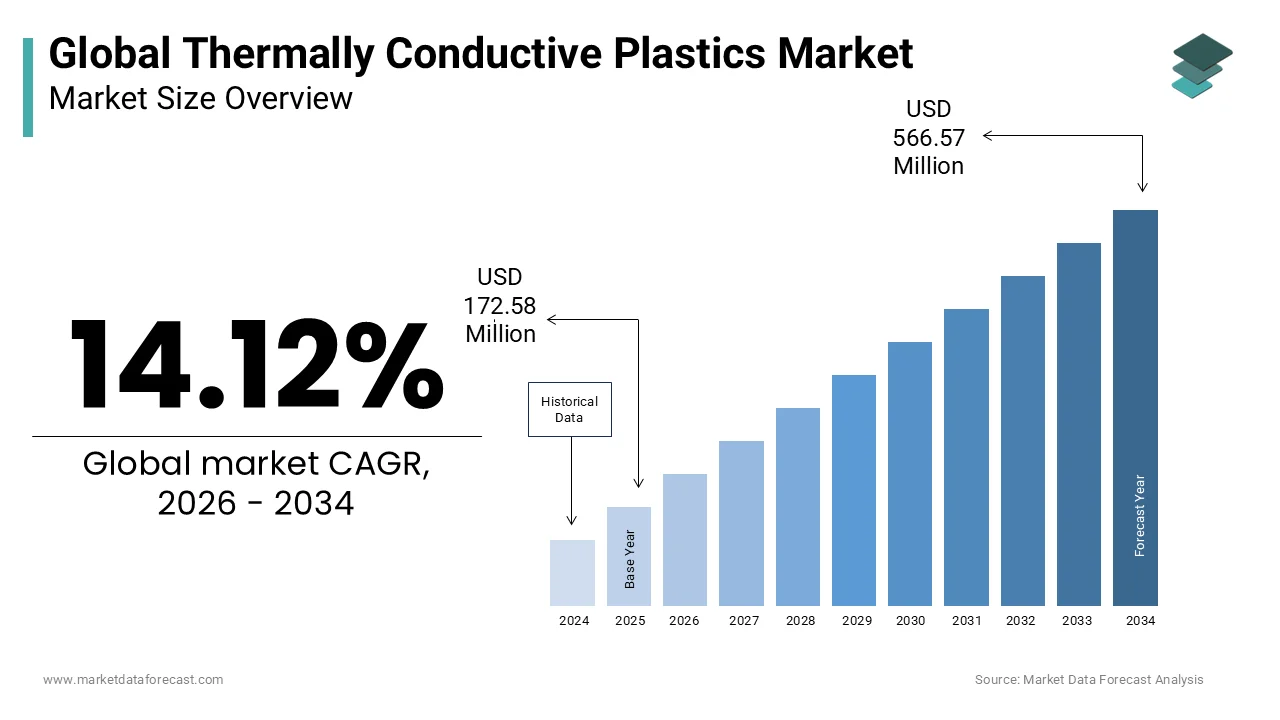
The global thermally conductive plastics market size was valued at USD 172.58 million in 2025, is anticipated to reach USD 196.95 million in 2026, and is projected to scale up to USD 566.57 million by 2034, registering a compound annual growth rate (CAGR) of 14.12% during the forecast period from 2026 to 2034. Driven by the surging demand for metal and ceramic replacement in lightweight applications, rapid expansion in vehicle electrification, and increasing utilization across electrical and electronics manufacturing, the industry continues to expand steadily worldwide.
Key Executive Metrics (At-a-Glance)
- 2025 Base Valuation: USD 172.58 Million
- 2026 Current Valuation: USD 196.95 Million
- 2034 Forecast Valuation: USD 566.57 Million
- Compound Annual Growth Rate (CAGR): 14.12% (2026–2034)
- Dominant Resin Type Segment: Polyamide / PA (holding major market share due to excellent mechanical stiffness, impact strength, and heat resistance)
- Fastest-Growing Resin Type Segment: Polycarbonate / PC (driven by enhanced design freedom and rising electronic housing requirements)
- Dominant End-User Segment: Electrical and Electronics (holding major market share due to extensive heat-dissipation needs in modern devices)
- Fastest-Growing End-User Segment: Automotive (propelled by vehicle weight reduction, EV component manufacturing, and performance optimization)
- Dominant Region: Asia-Pacific (holding foremost market share owing to widespread industrialization and electronics production hubs in China, India, and Japan)
- Fastest-Growing Region: Asia-Pacific (expanding rapidly due to booming manufacturing sectors and rising consumer disposable incomes)
Core Market Drivers
- Automotive Weight Reduction: Increasing adoption of lightweight, cost-effective engineered thermoplastics to replace heavy metals, lower vehicle weight, and improve fuel/energy efficiency.
- Electronics & Electrical Expansion: Surging demand for heat-dissipating components in modern electrical devices, communication hardware, and power systems.
- Aerospace & Healthcare Innovations: Escalating adoption of high-performance aerospace-grade polymers (such as PEEK, PEI, and PPSU) to maximize mechanical performance and reduce component costs.
Primary Market Restraints & Challenges
- Inherent Thermal Insulating Properties: Base plastics are naturally poor thermal conductors, requiring complex, specialized compounding procedures and high expertise levels to integrate additives like specialty graphite fibers successfully.
Global Thermally Conductive Plastics Market Segmentation Breakdown
| Segment Category | Leading Sub-Segment (2025 Base) | Fastest-Growing Sub-Segment (2026–2034) |
|---|---|---|
| By Resin Type | Polyamide / PA (dominant volume leader with superior mechanical properties) | Polycarbonate (fastest-growing due to electronic and automotive design demands) |
| By End User | Electrical and Electronics (dominant sector for thermal management parts) | Automotive (fastest-growing category fueled by light-weighting and EV trends) |
| By Region | Asia-Pacific & North America (major production and consumption powerhouses) | Asia-Pacific (fastest-growing regional market driven by industrial and manufacturing hubs) |
Major Industry Players Profiled
Key enterprises shaping the competitive global thermally conductive plastics market include Arkema Group, SABIC Group, Celanese Corporation, Saint-Gobain, BASF SE, Royal DSM, Kaneka Corporation, PolyOne Corporation, RTP Company, and Covestro AG.
Global Thermally Conductive Plastics Market Size
The global thermally conductive plastics market size was valued at USD 172.58 million in 2025, and is anticipated to reach USD 566.57 million by 2034 from USD 196.95 million in 2026, at a CAGR of 14.12%.
Plastics with heat conductivity are known as thermally conductive plastics. The capacity of a substance to conduct or transport heat is known as thermal conductivity. Engineering plastics are strong thermal insulators, and since they're so common, adding thermal conductivity to them makes them useful in a variety of appliances. It is used to replace metals, ceramics, and other polymers due to its low cost and flexibility, as well as the fact that it may be utilized in a number of shapes. Because of their great heat resistance and low melt viscosities, crystalline engineering resins are used to make Thermally Conductive Plastics. The much more thermally conductive additions employed are specialty graphite fibers. Electric and electrical gadgets frequently employ thermally conductive plastics.
MARKET DRIVERS
The market for thermally conductive polymers is being pushed by an increase in the manufacturing and sale of automobiles, which utilize these plastics because of their low cost of production. The demand for this industry has been boosted by the increasing use of thermally conductive polymers in electronics and electrical device production facilities. The market has also grown due to an increase in demand for lightweight, cost-effective materials in the healthcare and aerospace industries. Due to its outstanding mechanical features like stiffness as well as impact strength, it is in a growing market in the industrial, automotive, and building and construction industries. In the automobile industry, thermally conductive polymers reduce vehicle weight, improve overall vehicle performance, give design freedom, and hence lower total costs. The thermally conductive plastic industry has been fueled by growing automobile sales as a result of higher disposable income and increased consumer expenditure. The usage of thermally conductive polymers in the electronics and aerospace sectors decreases the total cost and weight of components and equipment. polyphenyl sulfone (PPSU), polyetheretherketone (PEEK), polyetherimide (PEI), and polyether ketone (PEKK) are aerospace-grade polymers that give a dependable and cost-effective approaches to decreasing weight. Researchers and key companies have increased their research and development operations for the creation of new goods, creating a big possibility for this market to flourish. The inclusion of specific additives in the launch of new thermally conductive goods might generate a big potential for the thermally conductive plastics industry to flourish.
MARKET RESTRAINTS
Plastics have poor thermal conductivity, which is a commercial constraint since strong thermal conductivity is required in several industries wherein greater machinery is employed. A sophisticated procedure is required to create Thermally Conductive Plastics, which necessitates the highest degree of skill. As a result, it is hard to create this at a high level of quality, which is a disadvantage or limits the advantage.
REPORT COVERAGE
| REPORT METRIC | DETAILS |
| Market Size Available | 2025 to 2034 |
| Base Year | 2025 |
| Forecast Period | 2026 to 2034 |
| CAGR | 14.12% |
| Segments Covered | By Resin Type, End User, and Region |
| Various Analyses Covered | Global, Regional, & Country Level Analysis; Segment-Level Analysis; DROC, PESTLE Analysis; Porter’s Five Forces Analysis; Competitive Landscape; Analyst Overview of Investment Opportunities |
| Regions Covered | North America, Europe, Asia Pacific, Latin America, and Middle East, and Africa |
| Market Leaders Profiled | Arkema Group, SABIC Group, Celanese Corporation, Saint-Gobain, BASF SE, Royal DSM, Kaneka Corporation, PolyOne Corporation, RTP Company, and Covestro AG. |
REGIONAL ANALYSIS
The Asia Pacific holds the foremost immense amount of share within the worldwide Thermally Conductive Plastics market owing to the countries that are helping within the growth of the market are India, China, Japan, Malaysia, Singapore, and lots of other APAC region countries which are expected to witness considerable expansion within the Thermally Conductive Plastics market.
North American region holds the foremost important amount of market share within the worldwide Thermally Conductive Plastics market, because of the key companies which are in use. The North American region is booming the market in these areas. The expansion and development during this region are being held by the countries slightly rather like the U.S., Canada, and México.
The Europe region holds a big amount of share the worldwide Thermally Conductive Plastics market. The country's Thermally Conductive Plastics business will like rising consumption levels, yet as European customers increased purchasing of this resource. The growing demand to provide the following experience is broadening the market. Netherlands, Italy, Germany, France, the UK, and plenty of other European countries are said to account for the majority of the market share in Europe.
KEY MARKET PLAYERS
The key players in the global thermally conductive plastics market Arkema Group, SABIC Group, Celanese Corporation, Saint-Gobain, BASF SE, Royal DSM, Kaneka Corporation, PolyOne Corporation, RTP Company, and Covestro AG.
RECENT HAPPENINGS IN THE MARKET
- 31st May 2022: In a roughly $1 billion agreement, Saint-Gobain will buy Kaycan, a Canadian manufacturer and distributor of building products. The $928 million cash deal was disclosed by the French building materials behemoth, which has its North American headquarters in Malvern. By the end of the year, the deal should be completed.
- 8th March 2021: BASF is extending its Ultramid Advanced polyphthalamide (PPA) line with carbon-fiber-reinforced grades with fills of 20, 30, and 40%. The following are some of the advantages of these new materials: They're exceedingly light, can safely replace aluminum and magnesium without sacrificing stiffness or strength, and are electrically conductive.
MARKET SEGMENTATION
This research report on the global thermally conductive plastics market has been segmented and sub-segmented based on type, end-user, and region.
By Resin Type
-
Polyamide (PA)
-
Polybutylene Terephthalate (PBT)
-
Polycarbonate
-
Polyphenylene Sulphide (PPS)
-
Polyetherimide (PEI)
-
Others
By End User
-
Automotive
-
Industrial
-
Electrical and Electronics
-
Aerospace
-
Others
By Region
-
North America
-
Europe
-
Asia Pacific
-
Latin America
-
The Middle East and Africa