Global Engineering Plastics Market Size, Share, Trends & Growth Forecast Report - Segmented By Type (Polycarbonate, Fluoropolymers, Poly Vinyl Chloride (PVC), Polyethylene Terephthalate (PET), Polyamide, and, ABS), Application (Automotive, Transportation, Electrical, Electronics, Industrial Machinery, Packaging, and Consumer Appliances), and Region (North America, Europe, Asia Pacific, Latin America, Middle east and Africa) – Industry Analysis (2026 to 2034)
Market Size, 2025
$121 BnMarket Estimate, 2026
$128 BnMarket Forecast, 2034
$210 BnCAGR, 2026–2034
6.30%Global Engineering Plastics Market Size
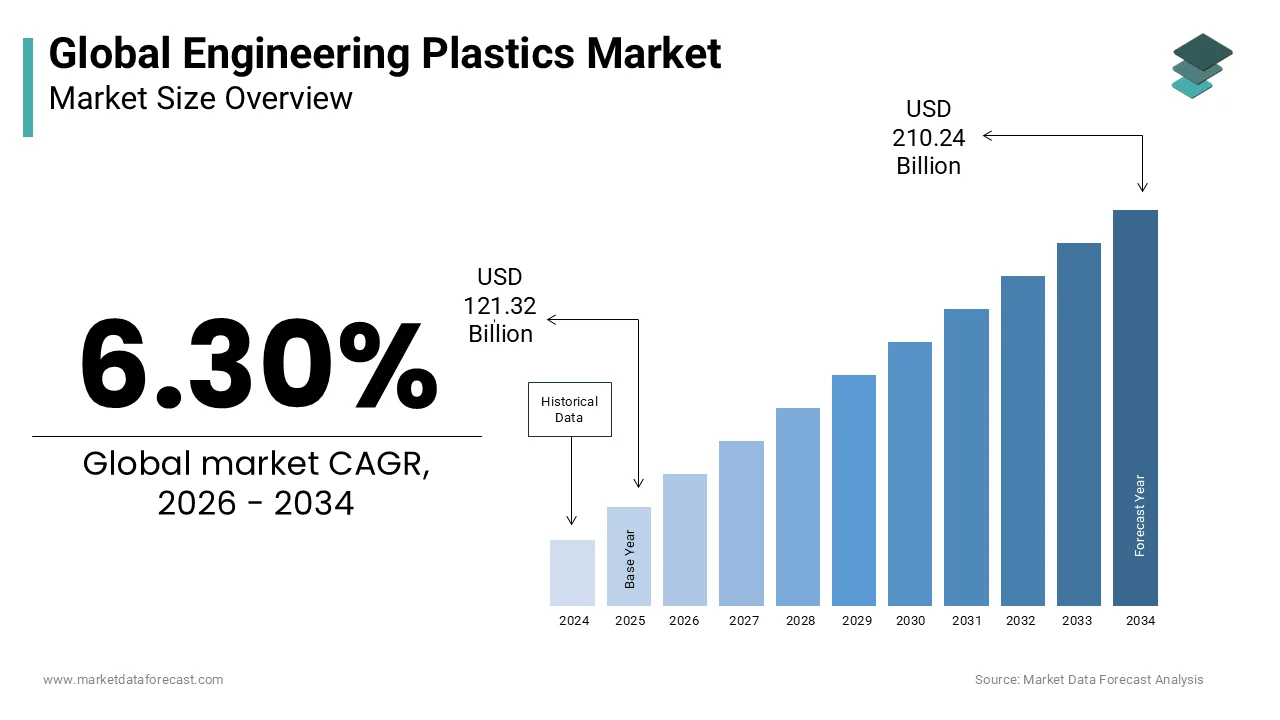
The global engineering plastics market size was valued at USD 121.32 billion in 2025 and is expected to reach USD 210.24 billion by 2034 from USD 128.96 billion in 2026. The market is projected to grow at a CAGR of 6.30%.
Engineering plastics refers to the high-performance polymer materials, including polyamides, polycarbonates, PBT, PPS, and PEEK, engineered to replace metals in mechanically and thermally demanding applications. Millions of metric tons of engineering plastics were consumed for use in automotive drivetrains, aerospace interiors, medical implants, and industrial robotics. According to research, polyamide components in electric vehicle inverters withstand thermal cycles exceeding notable temperature for large number of operational hours without creep deformation, a threshold unattainable by standard thermoplastics.
MARKET DRIVERS
Electrification of Mobility and Lightweighting Mandates
The global shift toward electric vehicles is intensifying demand for thermally stable, electrically insulative polymers that reduce weight without compromising safety, which contributes to the growth of the engineering plastics market. As per the International Energy Agency’s 2025 Global EV Outlook, EV production surpassed 14 million units in 2023, requiring 38% more engineering plastics per vehicle than internal combustion counterparts, primarily for battery housings, motor end caps, and power electronics. Also, BMW Group’s engineering team reported in 2023 that substituting aluminum busbars with glass-fiber-enhanced PPS in its iX model cut component weight by 42% while maintaining dielectric strength above 25 kV/mm.
Miniaturization and Performance Demands in Electronics
The relentless scaling of semiconductors and consumer electronics necessitates polymers capable of withstanding reflow soldering, EMI shielding, and micro-scale precision molding also accelerates the expansion of the engineering plastics market. The global use of high-performance liquid crystal polymers in components for advanced communication and computing systems is rising due to their durability and compatibility with silicon. As per research, leading electronics manufacturers have adopted reinforced polymer materials to withstand extreme soldering temperatures without deformation.
MARKET RESTRAINTS
Volatility in Feedstock Pricing and Supply Chain Fragility
Engineering plastics rely heavily on petrochemical intermediates, caprolactam for PA6, bisphenol-A for PC, and p-xylene for PBT, whose prices are subject to geopolitical disruptions and crude oil fluctuations that restrains the growth of the engineering plastics market. Shortages in key raw materials have led to significant cost increases for certain polymer types, affecting production stability, as per research. Also, according to study, delays in monomer supply have caused manufacturing interruptions by impacting industries reliant on just-in-time delivery models. In addition, inconsistent availability of essential feedstocks has limited domestic production capacity, pushing manufacturers to adapt designs or manage higher costs to maintain supply continuity.
Regulatory Burden on Persistent Polymers and Additives
Regulatory scrutiny over endocrine-disrupting additives and non-biodegradable polymer backbones is constraining formulation flexibility is a further limiting the engineering plastics market growth. Europe is moving toward phasing out specific flame retardants unless they meet environmental safety criteria. California has placed restrictions on common chemical synergists used in halogenated systems by prompting costly reformulations for electronics producers.
MARKET OPPORTUNITIES
Bio-Based and Circular Engineering Polymers
The emergence of drop-in bio-sourced monomers and closed-loop recycling technologies is unlocking sustainable premium segments, which in turn provides major opportunities for the engineering plastics market. Arkema’s Rilsan polyamide range is certified by TÜV Rheinland for 100% renewable carbon content. Arkema confirmed this certification for its Rilsan PA11, a polyamide made entirely from renewable castor seeds, with TÜV Rheinland as the certifying body. Besides, India’s CSIR-NCL developed an enzymatic depolymerization process in 2025 to recover pure caprolactam from post-industrial PA6 waste.
Smart Functionalization for Industry 4.0 Integration
Embedding sensing, self-healing, or conductive properties into engineering plastics is creating value beyond mechanical substitution also offers key prospects for the engineering plastics market. As per study, certain composite materials can be designed to offer high levels of conductivity, making them suitable for use in molded parts that can also perform sensing or shielding functions. Moreover, according to research, some pilot projects have shown that adding conductive or responsive additives into plastic housings can help them detect structural changes, potentially reducing equipment downtime. Furthermore, another development, as per study, involves creating alloys that can regain their original shape when exposed to controlled heating, which makes them useful in applications that require precise recovery after deformation.
MARKET CHALLENGES
Technical Barriers in High-Temperature Recycling
Degradation during mechanical recycling due to chain scission under thermal stress, which limits circularity is challenging the growth of the engineering plastics market. According to study, some polymers can lose significant mechanical strength after reprocessing because of changes in their molecular structure. As per research, certain high-performance plastics may also experience reduced structural order during recycling, making them less suitable for demanding applications unless additional processing steps are taken. Further observation is that only a small portion of post-consumer engineering plastics is recycled back into equivalent-grade products, with much of the material diverted to lower-value uses or disposal due to limitations in available large-scale recycling technologies.
Regional Disparity in Processing Capabilities and Standards
Asia’s rapid adoption of engineering plastics is hampered by inconsistent quality control, tooling limitations, and lack of standardized testing protocols, which impedes the expansion of the engineering plastics market. Some manufacturing facilities may not have the necessary machinery to handle advanced materials, which can result in higher rejection rates for certain products, according to study. Also, updates to testing requirements have been made in some countries, but compliance among producers remains limited, which creates delays in obtaining necessary certifications, as per research.
REPORT COVERAGE
| REPORT METRIC | DETAILS |
| Market Size Available | 2025 to 2034 |
| Base Year | 2025 |
| Forecast Period | 2026 to 2034 |
| CAGR | 6.3% |
| Segments Covered | By Type, Application, and Region |
| Various Analyses Covered | Global, Regional & Country Level Analysis, Segment-Level Analysis, DROC, PESTLE Analysis, Porter’s Five Forces Analysis, Competitive Landscape, Analyst Overview on Investment Opportunities |
| Regions Covered | North America, Europe, Asia Pacific, Latin America, and Middle East & Africa |
| Market Leaders Profiled | BASF SE, SABIC, Plastico SPS, Zamil Plastic, Solvay, DuPont, Constantia Flexibles GmbH, and others |
SEGMENTAL ANALYSIS
By Type Insights
The polyamide segment held 32.9% of the global engineering plastics market share in 2025. The unmatched mechanical resilience under thermal and chemical stress, which is vital in under-the-hood automotive and industrial gear applications drives the growth of the polyamide segment in the global market. As per research, substituting metal parts with fiber-reinforced polyamide can help reduce part weight while maintaining performance in demanding conditions. According to study, the rising adoption of electric vehicle technologies has further driven the demand for advanced polyamide materials used in powertrain applications. Besides, India saw a YoY surge in PA consumption for two-wheeler fuel systems and is driven by Bharat Stage VI emission compliance requiring chemically inert polymers.
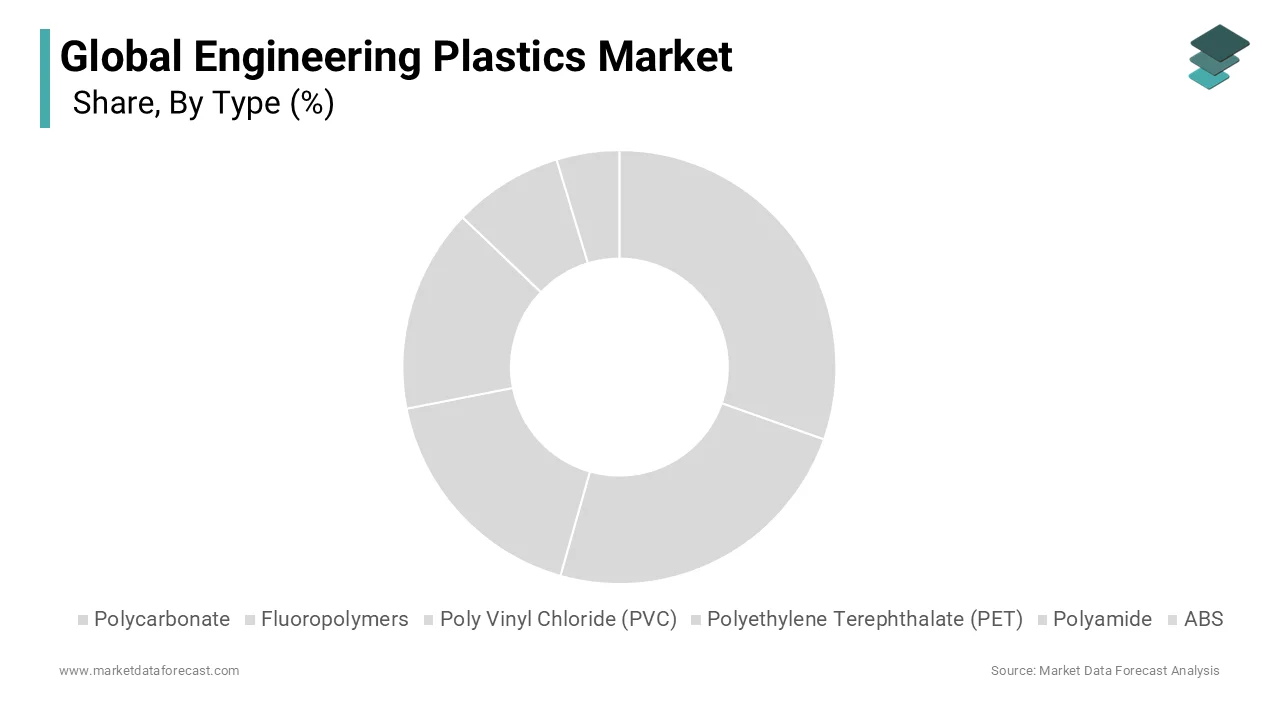
The fluoropolymers segment is likely to experience the fastest CAGR of 8.9% from 2026 to 2034. The rapid growth of the fluoropolymers segment is fueled by extreme-environment applications in semiconductor manufacturing, hydrogen infrastructure, and aerospace. Certain fluoropolymer materials are increasingly used in semiconductor equipment to handle corrosive processing conditions, according to study. These materials also play a critical role in hydrogen infrastructure by preventing leakage and ensuring long operational lifespans, as per study. In addition, as per research, is that specialized fluoropolymer coatings are being used in space systems to withstand long-term radiation exposure by boosting demand in the aerospace sector.
By Application Insights
The automotive and transportation applications segment maintained its prominence in the engineering plastics market by occupying 39% of share in 2025. As per research, the use of engineering plastics in electric vehicles can improve efficiency and extend driving range, encouraging manufacturers to adopt specialized materials for structural and battery-related components. According to study, automakers are increasingly incorporating lightweight plastics into newer vehicle platforms to reduce dependence on traditional metals. Apart from these safety-compliant plastic formulations are now widely used in electric vehicle charging systems to ensure durability and fire resistance.
On the other hand, the electronics segment is on the rise and is expected to be the fastest growing segment in the global market by witnessing a CAGR of 10.3% during the forecast period. Miniaturization, 5G rollout, and AI server expansion are key factors accelerating the dominance of the electronics segment in the global market. Advanced chip designs now depend on high-performance substrate materials that maintain dimensional stability under demanding manufacturing conditions, according to research. Moreover, as per study, the development of new packaging technologies using specialized resins is rising in response to the increasing demand for high-speed AI processors.
REGIONAL ANALYSIS
Asia Pacific Market Analysis
Asia Pacific was the leading region in the engineering plastics market in 2025 by capturing 46.8% of share in 2025. The growth of the Asia Pacific in the global market is propelled by the electronics manufacturing, automotive electrification, and industrial automation. In China, the demand for advanced plastics continues to grow rapidly with strong utilization across electric vehicle and consumer electronics sectors. The rising need for high-performance materials in India in automotive components reflects the country’s ongoing focus on cleaner mobility initiatives.
Europe Market Analysis
Europe engineering plastics market held 25.2% of share in 2025 with the technological prowess in high-performance and sustainable engineering polymers, which is supported by automotive premiumization and circular economy mandates. Germany remains a major contributor to the region’s plastic consumption, with strong demand across industrial and electric vehicle applications, according to research. Also, in Germany, manufacturers are increasingly incorporating recycled and bio-based materials in production to align with European sustainability standards. As per research, in France, the adoption of advanced polymers in aerospace has surged due to the shift toward next-generation, hydrogen-powered aircraft designs.
North America Market Analysis
North America expanded consistently in the engineering plastics market by leveraging advanced material science and defense-driven demand to sustain premium polymer adoption despite manufacturing offshoring. According to study, automakers are increasingly integrating flame-retardant engineering plastics to comply with strict safety and flammability regulations. Moreover, as per research, new composite materials in Canada are proving reliable in extreme pressure and temperature conditions by supporting the development of hydrogen-powered transport systems.
Latin America Market Analysis
Latin America holds notable potential in the engineering plastics market. The growth of the Latin America is propelled by automotive nearshoring and industrial modernization. Mexico’s automotive sector is expanding as manufacturers shift production closer to major export markets, as per research. Brazil has seen rising demand for specialized medical-grade polymers following new healthcare material sourcing rules, according to study. In addition, Colombia is investing in polymer compounding capabilities to strengthen self-sufficiency and reduce reliance on imports, as per research.
Middle East & Africa Market Analysis
The Middle East & Africa region is anticipated to grow in the engineering plastics market over the forecast period due to infrastructure megaprojects and localized manufacturing ambitions. Saudi Arabia’s major developments have driven strong use of advanced polymers suited for extreme environmental conditions, according to study. Furthermore, South Africa has boosted adoption of durable, chemical-resistant plastics in mining applications to meet updated industry safety requirements, as per research.
COMPETITIVE LANDSCAPE
KEY MARKET PLAYERS
These are some of the market players that are dominating the global engineering plastics market.
- BASF SE
- SABIC
- Plastico SPS
- Zamil Plastic
- Solvay
- DuPont
- Constantia Flexibles GmbH
TOP STRATEGIES USED BY KEY MARKET PLAYERS
Leading players localize high-heat and flame-retardant formulations to meet regional safety standards, invest in chemical recycling infrastructure for circular compliance, co-engineer application-specific grades with Tier 1 manufacturers, deploy digital twin platforms for rapid prototyping, and embed sustainability credentials via ISCC and TÜV certifications to capture premium ESG-driven procurement budgets across Asia Pacific
COMPETITION OVERVIEW
Competition in the Asia Pacific engineering plastics market is intensifying beyond price, pivoting toward application mastery, regulatory fluency, and circularity enablement. Players differentiate through co-development labs embedded within OEM ecosystems, proprietary stabilization technologies for extreme environments, and traceable bio-based or recycled content certifications. Regional fragmentation demands hyperlocal compliance, from China’s GB standards to India’s AIS norms, which forces multinationals to decentralize R&D. Startups challenge incumbents with enzymatic recycling and AI-driven formulation, while Japanese and Korean compounders dominate high-purity electronics grades.
TOP PLAYERS IN THE MARKET
- BASF anchors its Asia Pacific engineering plastics dominance through localized innovation and sustainability integration. The company co-developed heat-stabilized PBT grades with Tier 1 suppliers for 800V power electronics, validated under thermal aging standards. BASF also established a polymer application lab to accelerate material certification for two-wheeler fuel systems. Its digital platform enables real-time formulation adjustments for regional humidity and processing constraints, which reduces customer validation cycles.
- SABIC drives Asia Pacific growth via high-performance thermoplastics tailored for semiconductor and 5G infrastructure. The company expanded its PC/ABS compounding line to supply flame-retardant grades meeting automotive fire safety norms. SABIC’s collaboration yielded bio-based PC with ISCC-certified renewable content, adopted by LG Electronics for premium TV bezels. Its workshops in Vietnam and Thailand train molders in disassembly-friendly part geometry, which enhances regional recyclability.
- Covestro strengthens its Asia Pacific footprint by aligning engineering thermoplastics with electrification and lightweighting megatrends. The company upgraded its facility to produce UV-stabilized PC for ASEAN solar inverter enclosures, and is validated under IEC 60068-2-5. Covestro partnered to co-engineer PA6-based structural battery trays meeting crash standards. Its program certifies local recyclers in post-industrial PC recovery by feeding closed-loop supply chains for consumer electronics OEMs.
MARKET SEGMENTATION
This research report on the global engineering plastic market has been segmented and sub-segmented based on type, application, and region.
By Type
- Polycarbonate
- Fluoropolymers
- Poly Vinyl Chloride (PVC)
- Polyethylene Terephthalate (PET)
- Polyamide
- ABS
By Application
- Automotive and Transportation
- Electrical and Electronics
- Industrial Machinery
- Packaging
- Consumer Appliances
By Region
- North America
- Europe
- Asia Pacific
- Latin America
- The Middle East and Africa
Frequently Asked Questions
1. What is the Engineering Plastics Market?
The engineering plastics market covers high-performance polymer materials with superior mechanical, thermal, and chemical properties.
2. What are the major types of engineering plastics?
Key types include polycarbonate (PC), polyamide (PA), acrylonitrile butadiene styrene (ABS), polyoxymethylene (POM), polyphenylene oxide (PPO), and polyethylene terephthalate (PET).
3. What factors are driving the engineering plastics market?
Rising demand for lightweight materials in automotive and aerospace industries, growing electrical and electronics production.
4. Which industry uses engineering plastics the most?
The automotive industry is the largest consumer, using engineering plastics for lightweight components that enhance fuel efficiency and performance.
5. What are the advantages of using engineering plastics over metals?
They offer lightweight, corrosion resistance, high impact strength, design flexibility, and lower manufacturing costs compared to traditional metals.
6. Which region dominates the global engineering plastics market?
Asia-Pacific leads the global market, primarily due to rapid industrialization, expanding automotive manufacturing, and robust electronics production in China, Japan, and South Korea.
7. Which region is expected to grow fastest?
North America is expected to register strong growth, driven by technological innovation, electric vehicle adoption, and sustainable material development.
8. What challenges does the engineering plastics market face?
Challenges include fluctuating raw material prices, environmental concerns regarding plastic disposal, and competition from bioplastics and composites.
9. Who are the key players in the engineering plastics market?
Major companies include BASF SE, SABIC, Covestro AG, DuPont, Solvay, Celanese Corporation, Mitsubishi Engineering Plastics, and Evonik Industries AG.
10. What is the future outlook for the engineering plastics market?
The market is projected to grow steadily, supported by lightweighting trends, electric vehicle expansion, and advancements in sustainable polymer technologies.
Related Reports
Access the study in MULTIPLE FORMATS
Purchase options starting from
$ 2500
Didn’t find what you’re looking for?
TALK TO OUR ANALYST TEAM
Need something within your budget?
NO WORRIES! WE GOT YOU COVERED!
Call us on: +1 888 702 9696 (U.S Toll Free)
Write to us: sales@marketdataforecast.com