- Product Description Description
- Table of Contents TOC
- List of Table & Figure LOT
- Get Free Sample PDF Sample PDF
Market Size, 2025
$20.09 BnMarket Estimate, 2026
$21.15 BnMarket Forecast, 2034
$31.95 BnCAGR, 2026–2034
5.29%Global PET Preforms Market Report Summary
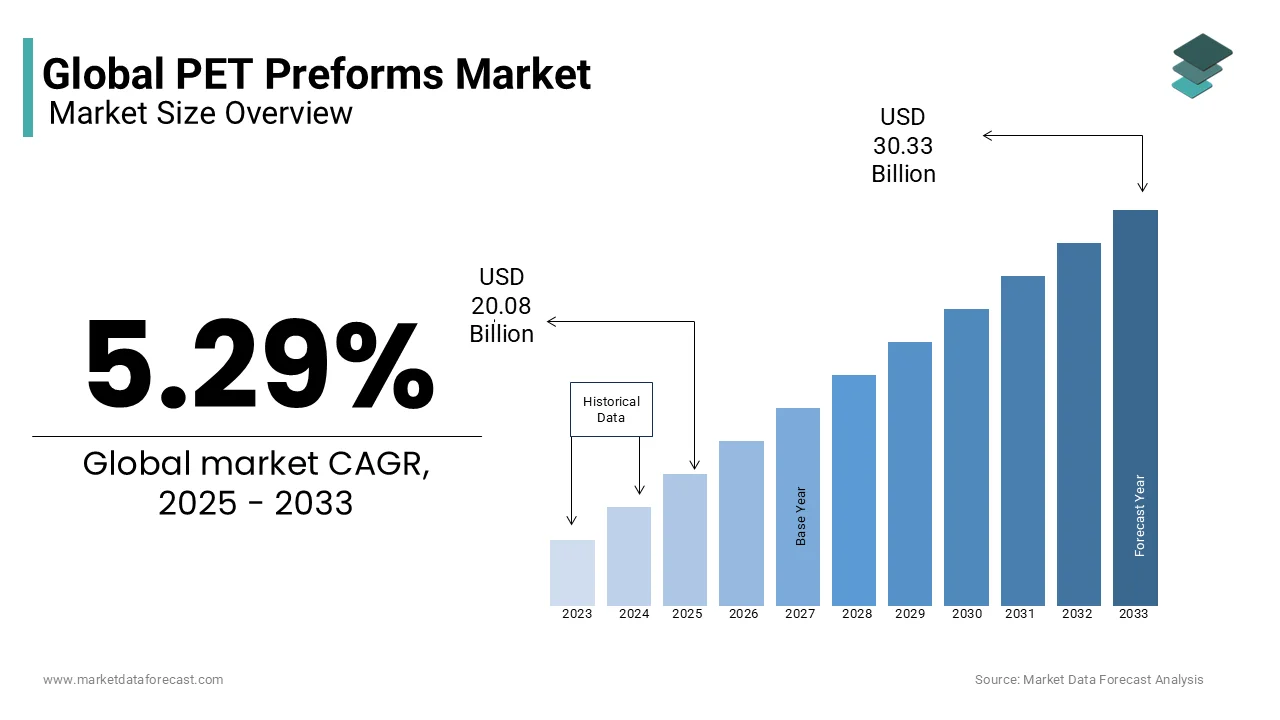
The global PET preforms market was valued at USD 20.09 billion in 2025, is estimated to reach USD 21.15 billion in 2026, and is projected to reach USD 31.95 billion by 2034, growing at a CAGR of 5.29% during the forecast period. Market growth is driven by increasing demand for packaged beverages, particularly bottled water and carbonated drinks, along with the rising adoption of lightweight and recyclable packaging solutions. PET preforms are widely used due to their durability, cost effectiveness, and compatibility with high volume production processes. In addition, growing environmental awareness and advancements in recycling technologies are supporting the shift toward sustainable PET packaging globally.
Key Market Trends
- Rising demand for bottled beverages is driving significant growth in PET preforms consumption.
- Increasing focus on lightweight and cost efficient packaging solutions is boosting adoption across industries.
- Growing emphasis on recyclability and sustainable packaging is encouraging the use of PET materials.
- Expansion of food and beverage industry is supporting consistent market demand.
- Technological advancements in preform design and manufacturing are improving efficiency and reducing material usage.
Segmental Insights
- Based on neck size, the Type 3 segment was the largest and held 42.3% of the global PET preforms market share in 2025. This dominance is attributed to its widespread use in beverage packaging, offering compatibility with standard bottling systems and efficient sealing performance.
- Based on application, the bottled water segment accounted for 48.4% of the PET preforms market share in 2025. The segment’s growth is driven by increasing consumption of packaged drinking water and rising demand for safe and convenient hydration solutions.
Regional Insights
- The global PET preforms market is witnessing strong growth across regions, supported by expanding beverage consumption and packaging demand.
- Asia Pacific was the leading region, accounting for 38.2% of the global PET preforms market share in 2025, driven by large population base, rapid urbanization, and strong growth in the food and beverage industry.
Competitive Landscape
The global PET preforms market is moderately competitive, with key players focusing on capacity expansion, product innovation, and sustainability initiatives to strengthen their market position. Companies are investing in advanced manufacturing technologies and recyclable materials to meet evolving industry requirements. Prominent players in the global PET preforms market include Retal Industries Ltd Cyprus, Plastipak Holdings Inc US, RESILUX NV Belgium, ALPLA Werke Alwin Lehner GmbH and Co KG Austria, Zhuhai Zhongfu Enterprise Co Limited China, Société Générale des Techniques France, Indorama Ventures Public Company Limited Thailand, KOKSAN Pet Packaging Industry Co Turkey, Taiwan Hon Chuan Enterprise Co Ltd Taiwan, and Rawasy Al Khaleej Plastic Ind UAE.
Global PET Preforms Market Size
The global PET preforms market size was valued at USD 20.09 billion in 2025, and the global market size is expected to reach USD 31.95 billion by 2034 from USD 21.15 billion in 2026. The market is growing at a CAGR of 5.29% during the forecast period.
The global PET preforms is injection-molded plastic test-tube-shaped intermediates that serve as the essential precursor for blow-molded polyethylene terephthalate containers. These preforms are the nexus in the packaging supply chain, determining the final bottle's weight, structural integrity, barrier properties, and aesthetic clarity before being reheated and stretched into their final form. The current scenario reflects a paradigm shift towards circular economy models, where the definition of a viable preform now strictly includes the capacity to incorporate post-consumer recycled (PCR) material without compromising performance. Manufacturers are increasingly adopting hot-set molding technologies and multi-layer co-injection processes to meet stringent sustainability mandates while maintaining production efficiency.
MARKET DRIVERS
Exponential Growth in the Bottled Water and Soft Drink Sectors
The surging global demand for bottled water and soft drinks, driven by increasing health consciousness, urbanization, and inadequate public water infrastructure in developing regions is bolstering the growth of PET performs market. Consumers worldwide are shifting away from sugary carbonated soft drinks towards healthier hydration options, which is leading to a sustained double-digit growth in bottled water consumption that directly correlates with preform volume requirements. The trend is exacerbated by rapid urbanization, where busy lifestyles and on-the-go consumption patterns necessitate convenient, single-serve packaging solutions that only PET preforms can economically provide at scale. The expansion of retail networks and the proliferation of convenience stores in emerging economies, which has made packaged beverages accessible to billions of new consumers. Statistics from the International Council of Shopping Centers indicate that the number of convenience store outlets in Southeast Asia and Africa grew in 2024, creating millions of new points of sale for PET-packaged drinks. Furthermore, the perception of bottled water as a safe and reliable source of hydration in regions with compromised tap water quality sustains inelastic demand regardless of economic fluctuations.
Technological Advancements in Recycling and Circular Economy
The rapid advancement in recycling technologies, specifically super-clean decontamination processes by enabling the safe and widespread use of post-consumer recycled (rPET) content in food-grade applications is escalating the growth of PET performs market. Innovations such as solid-state polycondensation and vacuum extrusion allow manufacturers to remove contaminants and restore the intrinsic viscosity of recycled PET, meeting rigorous food safety standards that previously limited rPET use to non-food sectors. The technological leap allows major brands to meet ambitious sustainability targets, such as incorporating or more recycled content in their bottles, which is driving demand for preforms capable of processing high-viscosity rPET blends. The second critical driver is the development of mono-material structures and compatible additives that ensure rPET performs identically to virgin resin in terms of clarity and strength, removing historical barriers to adoption. Furthermore, regulatory incentives and tax breaks for using recycled materials are encouraging bottlers to switch to rPET-based preforms by creating a premium market segment.
MARKET RESTRAINTS
Volatility in Raw Material Prices and Supply Chain Disruptions
The inherent volatility in crude oil prices and the costs of purified terephthalic acid (PTA) and monoethylene glycol (MEG) by creating unpredictable cost structures for manufacturers is degrading the growth of the PET performs market. Since PET is a petroleum-derived polymer, its production costs are inextricably linked to global energy markets, which are susceptible to geopolitical tensions, OPEC decisions, and supply chain bottlenecks. This volatility forces manufacturers to either absorb the increased costs, eroding profitability, or pass them on to bottlers, risking demand destruction in price-sensitive segments like bottled water. Furthermore, the dependency on a limited number of global PTA suppliers creates a concentrated supply risk, where any disruption at a major plant can cause regional shortages and price gouging.
Stringent Environmental Regulations and Plastic Bans
The intensifying legislative pressure and the implementation of outright bans on single-use plastics in various jurisdictions by creating uncertainty and limiting access in certain regions is additionally hindering the growth of PET performs market. While PET is recyclable, it is often categorized alongside non-recyclable single-use plastics in broad regulatory sweeps, leading to prohibitions on specific formats like small water bottles or flavored milk containers in cities and countries aiming for zero-waste goals. According to policy tracking from the United Nations Environment Programme, over 100 countries have introduced some form of single-use plastic ban or levy by 2024, with several targeting PET beverage containers specifically. This regulatory fragmentation forces manufacturers to navigate a complex web of conflicting rules, increasing compliance costs and necessitating frequent product line adjustments. The imposition of hefty taxes on virgin plastic usage, which, while intended to promote recycling, can initially inflate production costs if sufficient food-grade rPET supply is unavailable. Furthermore, the negative public perception of plastic, fueled by media coverage of ocean pollution, has led some major retailers and brands to voluntarily phase out PET packaging in favor of alternative materials, reducing demand.
MARKET OPPORTUNITIES
Expansion into Emerging Markets and Untapped Applications
The untapped potential in emerging countries to diversify its revenue streams beyond saturated Western economies is creating new opportunities for the growth of PET performs market. Rapid population growth, rising disposable incomes, and the expansion of modern retail infrastructure in countries like India, Indonesia, Nigeria, and Vietnam are driving a surge in demand for packaged beverages and personal care products. According to economic data from the World Bank, the middle-class population in these regions is projected to add 200 million new consumers by 2027, creating a vast new customer base for affordable, safe, and convenient packaging solutions. This demographic shift drives demand for PET preforms as the preferred material due to its cost-effectiveness and durability compared to glass. The ongoing urbanization and improvement in cold chain logistics, which facilitates the distribution of perishable goods in PET packaging by expanding the application scope beyond water to include juices, dairy, and edible oils. Furthermore, the lack of established alternative packaging infrastructures in these regions gives PET a first-mover advantage, allowing manufacturers to establish long-term supply contracts and brand loyalty.
Innovation in Bio-Based and Chemically Recycled PET
The development and commercialization of bio-based PET (Bio-PET) derived from renewable feedstocks, such as sugarcane ethanol to decouple from fossil fuels and appeal to eco-conscious consumers and brands is greatly impacting the growth of PET performs market. Bio-PET possesses identical chemical and physical properties to conventional PET by allowing it to be used in existing recycling streams and manufacturing equipment without modification, facilitating a seamless transition. According to sustainability reports from the Bioplastics Council, the production capacity for Bio-PET is expected to triple by 2026 as major chemical companies invest in biorefineries, driven by corporate commitments to carbon neutrality. This innovation allows brands to claim a reduced carbon footprint for their packaging, as Bio-PET can reduce greenhouse gas emissions, when compared to virgin fossil-based PET. The growing regulatory support and consumer preference for bio-based materials, which are perceived as more sustainable and natural will also boost the growth of the market. Furthermore, partnerships between beverage giants and agricultural producers are securing long-term supplies of bio-feedstocks, stabilizing costs and ensuring scalability.
MARKET CHALLENGES
Intense Competition from Alternative Packaging Materials
The intense competition from alternative packaging materials, particularly aluminum and glass is certainly to pose as a major challenge for the growth of PET preforms market. Aluminum cans are increasingly favored for ready-to-drink beverages due to their infinite recyclability, higher recycling rates, and superior barrier properties, while glass is preferred for premium spirits and juices due to its inertness and luxury image. The shift is driven by consumer misconceptions that aluminum is inherently more environmentally friendly than PET, despite lifecycle assessments showing comparable impacts when recycling rates are considered. The regulatory bias in some regions where aluminum is prioritized in deposit return schemes due to its higher scrap value, inadvertently disadvantaging PET. Furthermore, the aesthetic trend towards opaque and metallic finishes in branding favors aluminum, limiting the design space for transparent PET.
Infrastructure Gaps in Collection and Recycling Systems
The inadequacy of global recycling infrastructure in developing nations and even parts of the developed world by undermining the viability of the circular economy model is additionally degrading the growth of PET performs market. Without efficient collection, sorting, and processing facilities, PET bottles end up in landfills or the environment, failing to re-enter the supply chain as valuable rPET feedstock and damaging the material's reputation. This infrastructure gap creates a vicious cycle where the scarcity of rPET drives up costs, discouraging brands from using recycled content, which in turn reduces the economic incentive to build recycling facilities. The lack of standardized collection systems, such as Deposit Return Schemes (DRS), in many countries by leading to low capture rates and contaminated waste streams that are expensive to clean. Furthermore, the high capital expenditure required to build modern sorting and washing plants deters investment in regions with unstable policy environments.
REPORT COVERAGE
| REPORT METRIC | DETAILS |
| Market Size Available | 2025 to 2034 |
| Base Year | 2025 |
| Forecast Period | 2026 to 2034 |
| CAGR | 5.29% |
| Segments Covered | By Neck Size, Application, and Region. |
| Various Analyses Covered | Global, Regional & Country Level Analysis, Segment-Level Analysis, DROC, PESTLE Analysis, Porter’s Five Forces Analysis, Competitive Landscape, Analyst Overview of Investment Opportunities |
| Regions Covered | North America, Europe, Asia Pacific, Latin America, Middle East & Africa. |
| Market Leaders Profiled | Retal Industries Ltd. (Cyprus), Plastipak Holdings, Inc. (US), RESILUX NV (Belgium), ALPLA Werke Alwin Lehner GmbH & Co KG (Austria), Zhuhai Zhongfu Enterprise Co. Limited (China), Societe Generale des Techniques (France), Indorama Ventures Public Company Limited (Thailand), KOKSAN Pet Packaging Industry Co. (Turkey), Taiwan Hon Chuan Enterprise Co., Ltd (Taiwan), and Rawasy Al Khaleej Plastic Ind. (UAE), and Others. |
SEGMENTAL ANALYSIS
By Neck Size Insights
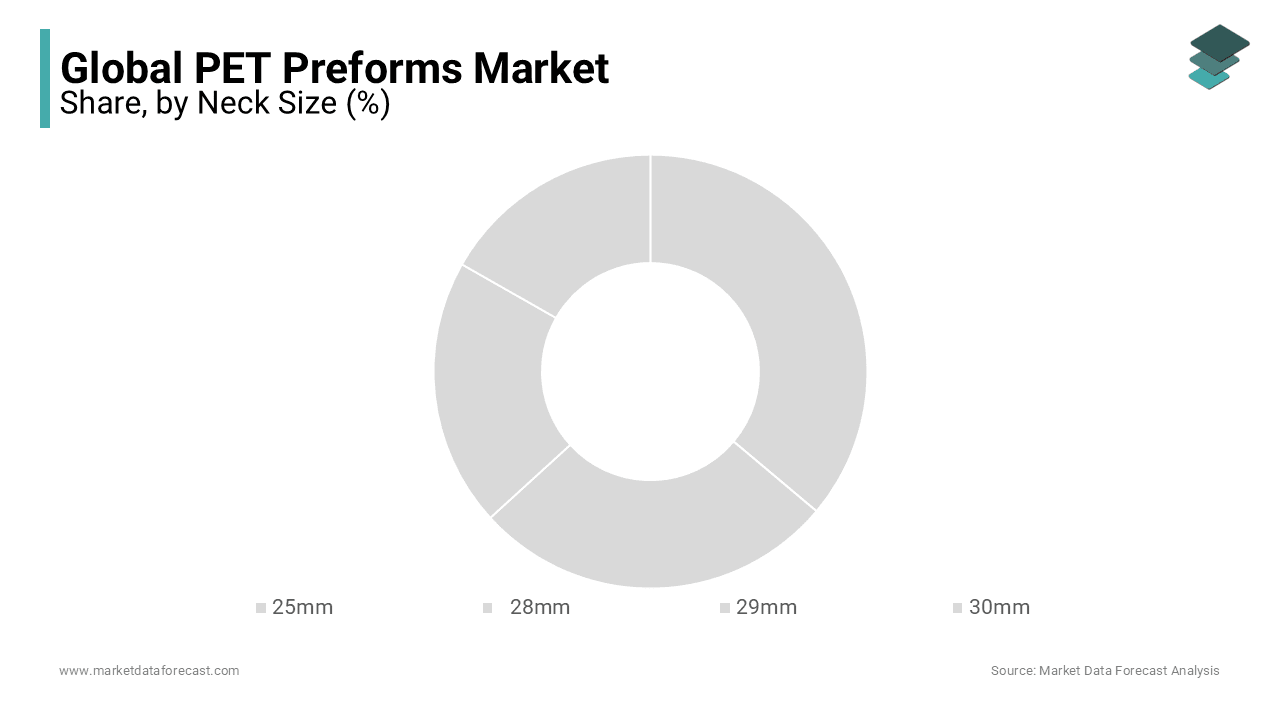
The Type 3 segment was the largest by holding 42.3% of the global PET preforms market share in 2025 with the universal adoption of these neck standards by major beverage conglomerates, which ensures compatibility with high-speed filling lines and capping machinery across the globe. The primary driving factor is the sheer volume of carbonated soft drink production, where the 30mm neck provides the necessary pressure resistance to contain carbonation while maintaining a lightweight profile. The versatility of the 38mm sport cap finish, which has become the standard for active lifestyle hydration products and large-format water bottles, driving significant volume in the sports and fitness sectors. Statistics from packaging equipment manufacturers indicate that 90% of new blow-molding machines installed in 2024 were optimized for Type 3 preforms, reflecting the entrenched infrastructure supporting this segment. Furthermore, the economies of scale achieved in producing these standardized preforms result in lower unit costs, making them the most economical choice for high-volume applications.
The type 5 segment is projected to witness a fastest CAGR of 8.5% throughout the forecast period owing to the shifting consumer preference towards convenient, ready-to-eat food formats and the substitution of glass and metal containers with lightweight PET alternatives in the food sector. The foremost driving factor is the booming demand for PET jars in the nut butter, confectionery, and dairy industries, where wide mouths facilitate easy filling, scooping, and consumption, enhancing user experience. The innovation in barrier technologies that allow wide-mouth PET containers to safely store sensitive products like sauces, dressings, and pharmaceuticals, expanding the application scope beyond dry goods. Additionally, the rise of e-commerce grocery shopping favors lightweight, shatter-proof packaging that reduces shipping costs and damage rates, further boosting demand for Type 5 preforms.
By Application Insights
The bottled water application segment was accounted in holding 48.4% of the PET preforms market share in 2025 with the fundamental shift in global hydration habits, where bottled water has surpassed carbonated soft drinks as the most consumed packaged beverage category, driving massive volumes of single-serve and multi-serve containers. The escalating concern over tap water quality and availability in both developing and developed nations, compelling consumers to rely on packaged water as a daily staple. The aggressive lightweighting initiatives undertaken by water brands to reduce plastic usage and carbon footprints, which has led to the proliferation of ultra-light preforms weighing less than 8 grams for 500ml bottles. Furthermore, the expansion of premium and flavored water segments, which often use distinct bottle shapes requiring specialized preforms, adds value and variety to this core application.
The edible oil application segment is swiftly emerging at an anticipated CAGR of 9.2% over the forecast period owing to the rising global consumption of processed foods, the urbanization of diets in emerging markets, and the strategic replacement of loose oil sales with branded, packaged solutions for safety and quality assurance. The superior barrier properties of modern PET preforms treated with nano-coatings or multi-layer structures, which effectively prevent oxygen ingress and protect the oil from oxidation and rancidity by extending shelf life significantly. Additionally, the lightweight nature of PET offers substantial logistics advantages for heavy liquids like oil, reducing fuel consumption and transportation costs compared to glass alternatives.
REGIONAL ANALYSIS
Asia Pacific PET Preforms Market Analysis
Asia Pacific PET preforms market was accounted in holding 38.2% of the share in 2025 with its massive population, rapid industrialization, and exploding demand for packaged beverages and foods. The rapid urbanization and the rise of the middle class in South and Southeast Asia, where increasing disposable incomes are shifting consumption patterns from loose commodities to branded, packaged goods in the bottled water and edible oil sectors. The robust expansion of local manufacturing capabilities, with major global and regional players investing heavily in integrated resin-to-preform facilities to serve the domestic market efficiently. Furthermore, the region's dominance in the global textile industry provides a synergistic supply chain for PET resin, ensuring stable raw material availability.
North America PET Preforms Market Analysis
North America PET performs market was ranked second by holding 24.3% of share in 2025 with its highly mature recycling infrastructure, stringent sustainability mandates, and a strong focus on lightweighting and advanced barrier technologies. The aggressive implementation of state-level legislation, particularly in California and the Northeast, which mandates minimum recycled content thresholds and Deposit Return Schemes (DRS), driving a premium market for food-grade rPET preforms. The dominance of major global beverage and food corporations headquartered in the region, which set global trends in packaging design and sustainability goals, such as achieving 100% recyclable or reusable packaging. Additionally, the thriving craft beverage sector, including craft beer and kombucha, drives demand for specialized, high-clarity preforms that offer superior aesthetic appeal.
Europe PET Preforms Market Analysis
Europe PET performs market growth is likely to grow with the world's most stringent environmental regulations, a deep cultural commitment to sustainability, and a highly developed collection infrastructure. The mandatory requirement for PET bottles to contain at least 25% recycled content by 2025 and 30% by 2030, which has created a structural deficit in food-grade rPET supply and spurred massive investments in advanced recycling facilities. The widespread adoption of Deposit Return Schemes across nearly all EU member states, which has achieved collection rates exceeding 85% in countries like Germany and Norway by ensuring a high-quality stream of recyclable material. The strong consumer preference for eco-labeled products pushes brands to adopt mono-material structures and lightweight designs to minimize environmental impact.
Latin America PET Preforms Market Analysis
Latin America PET performs market growth is likely to grow with the transition from informal to formal packaging. The rapid penetration of modern retail formats and the essential role of packaged water in regions where tap water safety is a concern by making PET the material of choice for affordability and safety. The modernization of the edible oil and dairy sectors, where regulatory bodies are increasingly mandating packaged solutions to ensure food safety, shifting market share from loose sales to PET bottles. Additionally, the region's abundant access to sugarcane feedstocks is fostering the development of bio-based PET initiatives, positioning Latin America as a potential hub for green preforms.
Middle East and Africa PET Preforms Market Analysis
The Middle East and Africa PET performs market is driven by extreme climatic conditions necessitating high water consumption, rapid population growth, and ongoing investments in packaging infrastructure. The demographic boom and urbanization across Sub-Saharan Africa and the Gulf Cooperation Council (GCC) countries, where expanding cities require robust supply chains for packaged beverages and food items. As per data from the United Nations Department of Economic and Social Affairs, the population in Africa is projected to double by 2050 by creating a massive future market for affordable PET packaging solutions. Statistics from investment promotion agencies show that new PET processing plants commissioned in the region increased by 20% in 2024. Furthermore, the rise of modern retail chains and convenience stores is formalizing the distribution of packaged goods, replacing traditional loose sales with branded PET products.
COMPETITIVE LANDSCAPE
The competition in the PET preforms market is intensely fierce characterized by a rivalry between global integrated giants and specialized regional manufacturers vying for dominance through cost leadership and innovation. Major players leverage their massive scale and vertical integration to offer competitive pricing and secure raw material supplies while smaller firms focus on niche applications and customized service. The landscape sees frequent launches of sustainable products featuring high recycled content and bio-based materials as companies race to meet evolving environmental regulations and consumer preferences. Competitive pressure is heightened by the volatility of raw material prices which forces manufacturers to constantly optimize operations and hedge against cost fluctuations. Sustainability has emerged as a battleground where firms compete to prove their circular economy credentials through advanced recycling technologies and carbon neutral commitments.
KEY MARKET PLAYERS
Some of the notable key players in the Europe PET preforms market are
- Retal Industries Ltd. (Cyprus)
- Plastipak Holdings, Inc. (US)
- RESILUX NV (Belgium)
- ALPLA Werke Alwin Lehner GmbH and Co KG (Austria)
- Zhuhai Zhongfu Enterprise Co. Limited (China)
- Société Générale des Techniques (France)
- Indorama Ventures Public Company Limited (Thailand)
- KOKSAN Pet Packaging Industry Co. (Turkey)
- Taiwan Hon Chuan Enterprise Co., Ltd (Taiwan)
- Rawasy Al Khaleej Plastic Ind. (UAE)
Top Players in the Market
- Indorama Ventures Public Company Limited stands as a global leader in the PET preforms market by operating an extensive integrated supply chain that spans from raw materials to finished packaging solutions. The company contributes significantly to the international sector by driving innovations in recycling technologies and expanding its portfolio of sustainable rPET products. Recently, Indorama Ventures has strengthened its position by acquiring strategic assets in North America and Europe to enhance local production capabilities and reduce logistics costs. They have also invested heavily in advanced chemical recycling facilities to meet growing demand for food-grade recycled content. These strategic moves ensure they remain a preferred partner for major beverage brands seeking reliable and eco-friendly packaging. Their continuous focus on circular economy principles allows them to set industry benchmarks for sustainability and operational efficiency worldwide.
- Resilux NV operates as a prominent European manufacturer renowned for producing high-quality PET preforms and bottles that serve diverse industries including beverages and personal care. Their global contribution involves pioneering lightweighting technologies and developing specialized barrier solutions that extend product shelf life while reducing material usage. They have also launched new lines of preforms made from 100% recycled materials to align with stringent environmental regulations. Furthermore, Resilux has enhanced its research and development efforts to create smart packaging features that improve consumer engagement.
- Alpla Werke Alwin Lehner GmbH and Co KG maintains a formidable presence in the PET preforms market through its vast global network of production sites and deep expertise in custom packaging design. The company contributes to the global market by offering comprehensive end-to-end solutions that integrate preform manufacturing with blow molding and filling services. Recent actions to strengthen their position include significant investments in digitalization and automation to optimize production efficiency and reduce energy consumption across all facilities. They have also formed strategic partnerships with leading brand owners to develop unique bottle shapes and functional features that differentiate products on shelves. Additionally, Alpla has committed to achieving climate neutrality by expanding its use of renewable energy sources and increasing the share of recycled materials in its products.
Top Strategies Used by Key Market Participants
Key players in the PET preforms market primarily employ strategies focused on vertical integration and sustainability to control costs and meet regulatory demands. Companies are heavily investing in recycling infrastructure to secure supplies of food-grade rPET and reduce dependence on virgin fossil-based resins. Another major strategy involves geographic expansion through acquisitions and greenfield projects to establish local production hubs near key customers and minimize logistics expenses. Brands are also prioritizing innovation in lightweighting and barrier technologies to offer superior performance while reducing material consumption. Additionally, participants utilize long-term contracts with major beverage producers to ensure stable revenue streams and foster collaborative development of custom packaging solutions.
MARKET SEGMENTATION
This research report on the global PET preforms market has been segmented and sub-segmented based on neck size, application, and region.
By Neck Size
- 25mm
- 28mm
- 29mm
- 30mm
By Application
- Carbonated drinks
- Bottled water
- Other drinks
- Edible oil
- Food items
By Region
- North America
- Europe
- Asia Pacific
- Latin America
- Middle East & Africa