- Product Description Description
- Table of Contents TOC
- List of Table & Figure LOT
- Get Free Sample PDF Sample PDF
Market Size, 2025
$71.91 BnMarket Estimate, 2026
$72.21 BnMarket Forecast, 2034
$138.38 BnCAGR, 2026–2034
5.84%Executive Summary: Global Tractor Implements Market Analysis & Growth Forecast (2026-2034)
- Market Scope: Comprehensive industry evaluation encompassing power types, drive mechanisms, application phases (tillage, harvesting, sowing, etc.), regional landscapes across North America, Europe, Asia-Pacific, Latin America, and Middle East & Africa, and core market growth catalysts.
- Market Valuation: Valued at USD 71.91 billion in 2025, estimated at USD 72.21 billion in 2026, and projected to reach USD 138.38 billion by 2034, registering a compound annual growth rate (CAGR) of 5.84% from 2026 to 2034.
- Primary Growth Drivers: Escalating agricultural mechanization in developing economies, rapid adoption of precision farming/GPS-guided technologies, and government financing schemes targeting smallholder productivity.
Key Global Tractor Implements Market Segment Metrics (2026-2034)
| Category | Leading Segment (Position) | Fastest-Growing / High-Impact Segment |
|---|---|---|
| By Power | Powered Implements (held 58.3% of the market in 2025 due to direct PTO/hydraulic integration and efficiency) | Unpowered Implements (growing with rising focus on affordable, low-maintenance mechanization for smallholders) |
| By Drive | 2-Wheel Drive (dominant in 2025 due to affordability, fuel efficiency, and suitability for small or flat terrain farms) | 4-Wheel Drive (expanding at a 7.6% CAGR, driven by heavy-duty commercial agribusiness and challenging terrains) |
| By Phase | Tillage (largest share at 36.3% in 2025, foundational for global crop cycles and soil preparation) | Harvesting and Threshing (emerging with an 8.9% CAGR propelled by labor shortages and high post-harvest speed demands) |
| By Region | Asia-Pacific (led the market with 38.3% share in 2025, backed by robust tractor registries in India and China) | North America (projected to hit the highest CAGR due to early integration of IoT, telematics, and precision farming) |
Major Global Tractor Implements Market Players & Industry Structure
Market Structure: Highly competitive and fragmented ecosystem combining global machinery leaders with regional and local manufacturers competing via smart tech integration, localized manufacturing, and flexible financing partnerships.
Key Companies: Deere and Company, CNH Industrial, Kubota Corporation, CLAAS, Mahindra and Mahindra, Tractor and Farm Equipment Limited (TAFE), JCB, SDF Group, Actuant, Kuhn Group, and Alamo Group.
Global Tractor Implements Market Size
The global tractor implements market was valued at USD 71.91 billion in 2025 and is anticipated to reach a valuation of USD 72.21 billion in 2026 and USD 138.38 billion by 2034, growing at a CAGR of 5.84%, from 2026 to 2034.
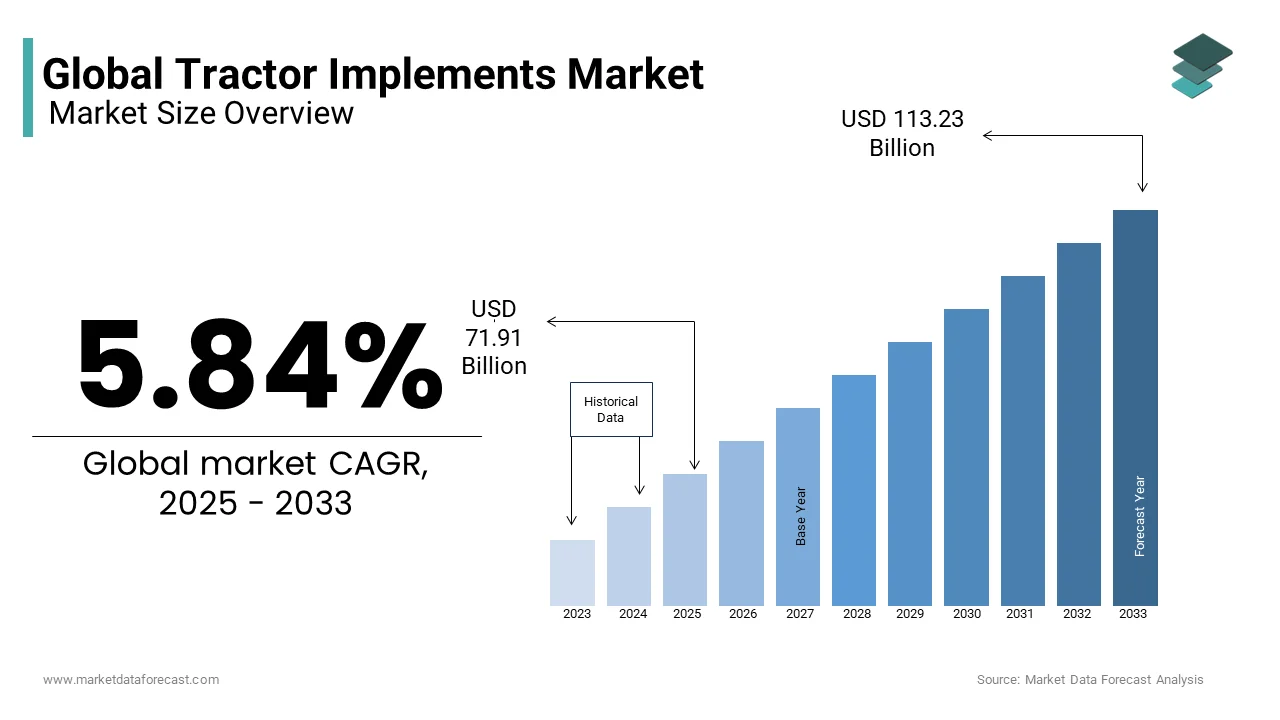
The tractor implements include plows, harrows, seeders, cultivators, mowers, balers, loaders, and sprayers, among others. These tools enable farmers to perform essential tasks such as soil preparation, planting, harvesting, and crop maintenance with greater efficiency and precision. As per the Food and Agriculture Organization (FAO), over 500 million smallholder farms worldwide contribute significantly to global food production, many of which are transitioning from manual labor to tractor-based solutions to improve productivity. In addition, technological advancements such as GPS-guided implements, smart attachments, and automated systems are reshaping the market landscape. According to the International Food Policy Research Institute (IFPRI), adoption of precision farming techniques has increased by nearly 12% annually in developing regions over the past five years.
MARKET DRIVERS
Rising Agricultural Mechanization in Developing Economies
The growing shift toward agricultural mechanization in developing countries is fuelling the growth of the Tractor Implements Market. As per the Food and Agriculture Organization (FAO), nearly 60% of agricultural labor in Asia, Africa, and Latin America is still performed manually or with rudimentary tools. However, rapid rural transformation, coupled with declining availability of farm labor, is prompting farmers to adopt mechanized solutions to boost efficiency and reduce dependency on human effort. Governments in countries like India, Nigeria, and Brazil have launched targeted initiatives to promote tractor usage and implement financing schemes to make farm machinery more accessible. The Indian Ministry of Agriculture, for instance, introduced the Sub-Mission on Agricultural Mechanization (SMAM) to subsidize the purchase of tractor implements for small and marginal farmers.
Advancements in Precision Farming and Smart Agriculture Technologies
The integration of precision farming and smart agriculture technologies into farm equipment is fuelling the growth of the Tractor Implements Market. According to the International Food Policy Research Institute (IFPRI), precision agriculture adoption has grown by approximately 14% annually in emerging markets, which is driven by the need for sustainable and efficient farming practices. Modern tractor implements now feature GPS guidance, auto-steering systems, and sensor-based attachments that enable real-time monitoring and precise application of inputs such as fertilizers, pesticides, and irrigation water. These technologies help optimize resource use, minimize waste, and increase overall yield, which is making them highly attractive to both large-scale commercial farms and smallholder producers. For example, the United States Department of Agriculture (USDA) notes that GPS-enabled implements can improve field efficiency by up to 20%, reducing overlap and ensuring uniform coverage.
MARKET RESTRAINTS
High Initial Investment and Limited Access to Credit
The high initial cost of advanced implements and limited access to credit for small and medium-sized farmers are restraining the growth of the Tractor Implements Market. According to the World Bank, nearly 70% of smallholder farmers in sub-Saharan Africa and South Asia lack access to formal financial services, which is making it difficult for them to procure modern farming equipment. Additionally, the complexity of financing options and lack of awareness about available support programs further discourage adoption. As reported by the International Fund for Agricultural Development (IFAD), only 12% of small-scale farmers in Southeast Asia utilized tractor implements due to financial constraints.
Lack of Technical Expertise and After-Sales Support
The lack of technical expertise and after-sales support in many rural areas is ascribed to limiting the growth of the Tractor Implements Market. Advanced implements require proper installation, operation, and regular maintenance to function optimally. As per the International Labour Organization (ILO), only 30% of agricultural workers in sub-Saharan Africa receive formal training in mechanized farming techniques. Furthermore, poor infrastructure and logistical limitations in remote farming areas make it challenging for manufacturers to establish service networks.
MARKET OPPORTUNITIES
Expansion of Digital Farming and IoT-Enabled Implements
The expansion of digital farming and IoT-enabled implements that offer real-time data collection and performance optimization is creating new opportunities for the growth of the Tractor Implements Market. According to the International Telecommunication Union (ITU), internet penetration in rural areas has improved significantly over the past decade, enabling wider adoption of connected farm equipment. Companies such as John Deere and CNH Industrial have introduced smart implements that integrate with mobile apps and farm management software by allowing users to monitor fuel consumption, field coverage, and maintenance schedules remotely. In addition, precision seeding, variable rate application, and autonomous guidance systems are gaining traction, particularly among large-scale commercial farms.
Growing Demand for Multi-Functional and Attachable Implements
The rising demand for multi-functional and attachable implements that allow farmers to perform multiple tasks using a single tractor is additionally to further fuel the growth of the Tractor Implements Market. This trend is particularly beneficial for small and medium-scale farmers who seek cost-effective and versatile solutions to maximize productivity without investing in multiple machines. According to the International Maize and Wheat Improvement Center (CIMMYT), multi-tasking implements such as front-end loaders combined with rotary tillers or dual-purpose harvesters have gained popularity in Asia and Africa due to their ability to streamline operations and reduce labor dependency. Manufacturers are responding to this demand by developing modular and interchangeable implements that can be easily adapted for different applications. Moreover, these adaptable implements align well with conservation agriculture practices such as minimum tillage and cover cropping, which aim to preserve soil health and reduce environmental impact.
MARKET CHALLENGES
Regulatory and Environmental Compliance Pressures
The increasing pressure to comply with evolving regulatory and environmental standards is. Governments worldwide are implementing stricter emissions norms, safety regulations, and sustainability mandates that impact the design, manufacturing, and usage of agricultural equipment.
As per the European Environment Agency (EEA), off-road machinery, including tractors and their implement, is subject to Tier IV emission standards in many developed regions, which requires manufacturers to incorporate cleaner and more energy-efficient technologies. In developing countries, regulatory frameworks are becoming more stringent as part of climate action commitments under the Paris Agreement. According to the United Nations Environment Programme (UNEP), several African and Asian nations have begun enforcing eco-labeling and energy efficiency certifications for farm machinery, which is influencing purchasing decisions and market dynamics. Adapting to these requirements demands continuous innovation and investment, which makes it imperative for industry players to balance regulatory compliance with affordability and accessibility.
Supply Chain Disruptions and Component Shortages
The ongoing disruptions in global supply chains and shortages of components such as semiconductors, steel, and electronic sensors are directly restricting the growth of the Tractor Implements Market. According to the World Trade Organization (WTO), global freight rates remained volatile in 2023 by impacting the timely delivery of tractor implements to key agricultural markets. Additionally, semiconductor shortages have affected the production of electronically controlled and smart implements, slowing down the adoption of advanced features.
REPORT COVERAGE
| REPORT METRIC | DETAILS |
| Market Size Available | 2025 to 2034 |
| Base Year | 2025 |
| Forecast Period | 2026 to 2034 |
| CAGR | 5.84% |
| Segments Covered | By Power, Drive, Phase, and Region |
| Various Analyses Covered | Global, Regional & Country Level Analysis, Segment-Level Analysis, DROC, PESTLE Analysis, Porter’s Five Forces Analysis, Competitive Landscape, Analyst Overview on Investment Opportunities |
| Regions Covered | North America, Europe, APAC, Latin America, Middle East & Africa |
| Market Leaders Profiled | CLAAS (Germany), Deere and Company (US), Kubota Corporation (Japan), Mahindra and Mahindra (India), Tractor and Farm Equipment Limited (India), JCB (UK), CNH Industrial (US), SDF Group (Italy), Actuant (US), Kuhn Group (France), and Alamo Group (US) and Others. |
SEGMENTAL ANALYSIS
By Phase Insights
The tillage segment was the largest by capturing 36.3% the share in 2025, owing to its fundamental role in agricultural cycles across both large-scale commercial farms and smallholder operations. According to the Food and Agriculture Organization (FAO), nearly 70% of global farmland requires mechanical tillage before planting, making it one of the most universally adopted farming activities. Additionally, evolving farm practices such as conservation tillage and minimum-till techniques have spurred demand for specialized implements like chisel plows and no-till drills. As per the International Maize and Wheat Improvement Center (CIMMYT), these methods have been adopted on over 200 million hectares globally, with growing uptake in South America and Sub-Saharan Africa.
The harvesting and threshing segment is swiftly emerging with a CAGR of 8.9% from 2025 to 2033, owing to the rising labor costs, the need for faster post-harvest processing, and increasing adoption of combine harvesters and grain threshers across diverse crops. The shift toward time-sensitive harvesting practices in staple crops like wheat, rice, maize, and soybean is accelerating the growth of the segment. According to the United States Department of Agriculture (USDA), manual harvesting accounts for up to 30% of production costs in many developing countries, prompting farmers to invest in mechanized alternatives.
By Drive Insights
The 2-wheel drive tractor segment dominated the Tractor Implements Market share in 2025. The prevalence of 2-wheel drive tractors is largely attributed to their affordability, fuel efficiency, and ease of operation in flat or mildly undulating terrain. According to the International Labour Organization (ILO), over 80% of farms in Southeast Asia operate on less than five hectares, making compact 2-wheel drive tractors more suitable than heavier 4-wheel models. Moreover, government subsidy programs in countries like India and Indonesia have significantly boosted sales of 2-wheel drive machines. Additionally, these tractors are often preferred in horticulture, orchard farming, and vegetable cultivation where maneuverability and low ground pressure are crucial.
The 4-wheel drive tractor segment is likely to grow with an anticipated CAGR of 7.6% throughout the forecast period, with the increasing adoption of heavy-duty tractors in large-scale commercial farming, construction-linked agriculture, and challenging terrains such as mountainous and wetland areas. The rising demand for high-powered machinery capable of handling advanced implements such as precision seeders, sprayers, and combine harvesters is expected to fuel the growth of the Tractor Implements Market. In emerging markets like Brazil and Argentina, where agribusiness is highly mechanized, the shift toward 4-wheel drive models has accelerated due to their ability to work efficiently in muddy fields and uneven landscapes.
By Power insights
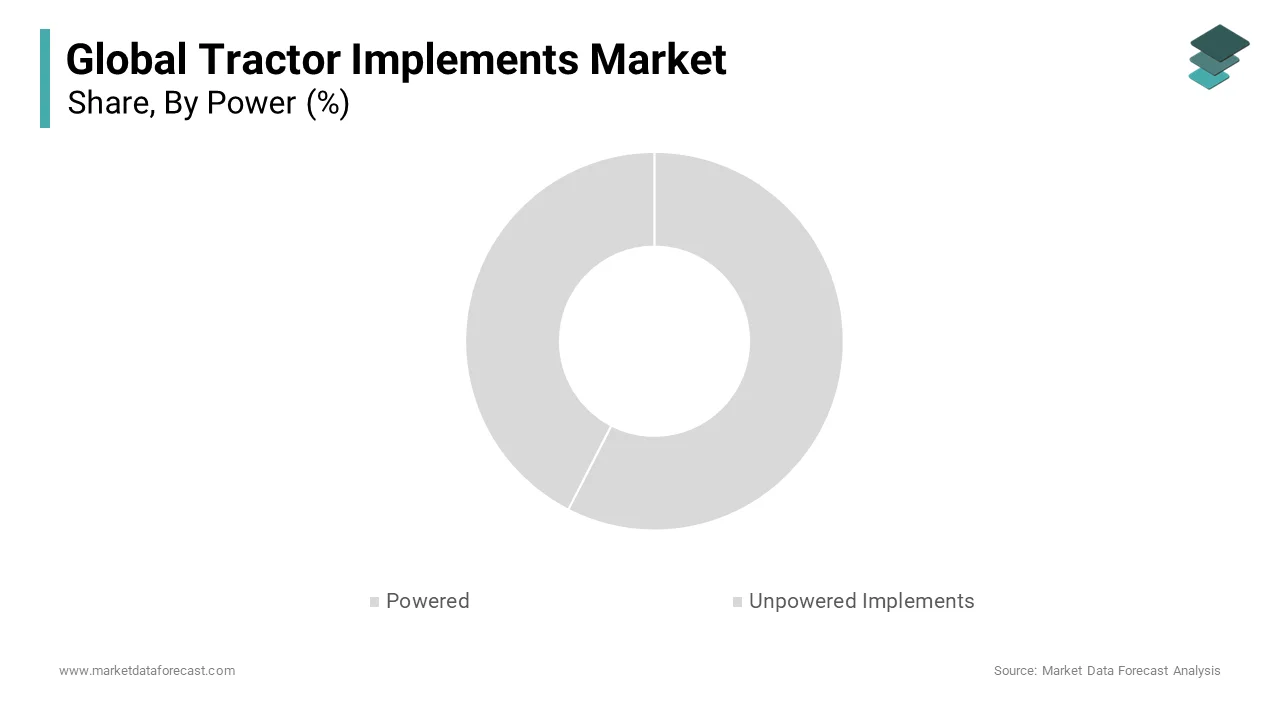
The powered tractor implements segment held 58.3% of the tractor implements market share in 2025. These implements derive power directly from the tractor’s power take-off (PTO) system or hydraulic mechanisms, enabling efficient performance in tasks such as mowing, spraying, seeding, and harvesting.
The dominance of powered implements is primarily driven by their superior efficiency, precision, and integration with modern tractor technology. Moreover, the integration of smart features such as automatic depth control and real-time monitoring has further strengthened the appeal of powered implements. As per the United Nations Food and Agriculture Organization (FAO), the adoption of electronically controlled implements has risen sharply in Asia and Latin America, where governments are promoting digital agriculture initiatives.
The unpowered tractor implements segment is likely to grow with an anticipated CAGR of 6.4% from 2025 to 2033, with the increasing focus on affordable mechanization in developing economies. According to the International Fund for Agricultural Development (IFAD), nearly 500 million smallholder farmers globally rely on cost-effective solutions to improve productivity without significant capital investment. In countries like Ethiopia and Bangladesh, unpowered implements are being distributed through subsidized programs to promote sustainable farming practices. Additionally, unpowered implements are easier to maintain and repair, making them ideal for regions with limited access to technical support and spare parts.
REGIONAL ANALYSIS
Asia-Pacific
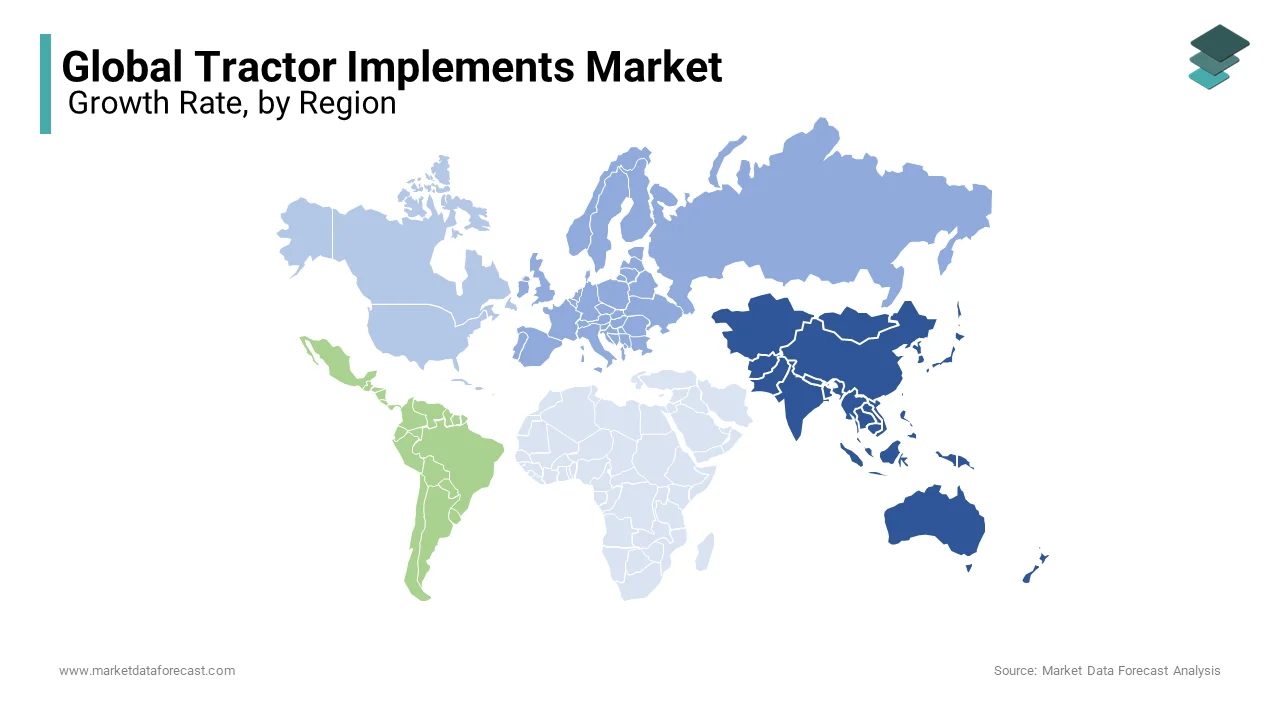
Asia-Pacific outperformed in the global Tractor Implements Market with 38.3% of the share in 2025. India plays a central role in this growth, as per the Indian Ministry of Agriculture, which reported over 1.2 million tractor registrations in fiscal year 2023. Government initiatives such as the Sub-Mission on Agricultural Mechanization (SMAM) have played a crucial role in promoting implement adoption among small and marginal farmers. Additionally, China's push for smart agriculture and mechanized harvesting has led to increased demand for advanced implements, especially in grain-producing provinces. Japan and South Korea, though smaller in scale, contribute to innovation in precision implements and robotic attachments.
Europe
Europe was positioned second with 22.3% of the global Tractor Implements Market share in 2025. Germany, France, and Italy lead in both manufacturing and consumption, benefiting from well-established distribution networks and a strong presence of leading brands such as Claas, AGCO, and CNH Industrial. Eastern European countries like Poland and Romania are also witnessing growth due to EU funding programs aimed at modernizing farms.
North America
North America Tractor Implements Market growth is likely to hit the highest CAGR by the end of the forecast period, with the early adoption of high-tech and precision farming solutions. The United States and Canada represent the core markets, where large-scale commercial farming operations rely heavily on GPS-guided, automated, and IoT-enabled implements.
According to the Association of Equipment Manufacturers (AEM), U.S. farm equipment sales—including tractor implements rose by 7.2% in 2023, reflecting strong farmer confidence and investment in smart technologies. Major players like John Deere, Case IH, and Kubota have introduced next-generation implements with telematics, variable rate application, and autonomous guidance capabilities.
Latin America
Latin America Tractor Implements Market growth is driven by expanding agribusiness and increasing mechanization in countries like Brazil, Argentina, and Mexico. The region’s reliance on export-oriented crops such as soybeans, corn, and sugarcane has intensified demand for high-efficiency tractor implements.
Middle East and Africa
The Middle East and Africa Tractor Implements Market has been growing steadily over the past few years and is expected to have the same growth opportunities throughout the forecast period. In the Gulf Cooperation Council (GCC) countries, mechanization is driven by large-scale agro-industrial projects. The Saudi Arabian Ministry of Environment reported a 12% increase in tractor implement imports in 2023, supported by Vision 2030’s focus on food self-sufficiency.
KEY MARKET PLAYERS
The significant players in the tractor implement market are CLAAS (Germany), Deere and Company (US), Kubota Corporation (Japan), Mahindra and Mahindra (India), Tractor and Farm Equipment Limited (India), JCB (UK), CNH Industrial (US), SDF Group (Italy), Actuant (US), Kuhn Group (France), and Alamo Group (US).
Top Players In The Market
Several global companies play a pivotal role in shaping the Tractor Implements Market, offering innovative, durable, and adaptable solutions for diverse agricultural needs. Among them, three key players stand out due to their technological expertise, extensive product portfolios, and strong market presence.
John Deere is a leading name in agricultural machinery and implements, known for its high-performance, precision-engineered attachments that enhance tractor functionality across farming operations. The company’s focus on smart implements integrated with GPS and automation has set industry benchmarks, particularly in North America and Europe.
CNH Industrial offers a comprehensive range of tractor implements under its Case IH and New Holland brands, catering to both large-scale commercial farms and smallholder operations. CNH is recognized for its versatile, durable, and easy-to-maintain implements tailored to meet regional farming requirements across emerging and developed markets.
Kubota Corporation plays a major role in advancing compact and mid-sized tractor implements suited for small farms and specialty crops. Kubota emphasizes fuel-efficient, ergonomic, and multi-functional implement designs that support sustainable agriculture practices with a strong presence in Asia, North America, and an expanding influence in Africa and Latin America.
Top Strategies Used by Key Market Participants
Key players in the Tractor Implements Market employ several strategic initiatives to reinforce their competitive position and expand market reach. One of the most prominent strategies is product innovation and digital integration, where companies continuously develop advanced implements incorporating GPS guidance, sensor-based monitoring, and automated functionalities to align with the growing trend of smart and precision farming.
The expanding regional presence through localized manufacturing and distribution networks allows firms to offer faster service, cost-effective pricing, and region-specific implementation designs. These localized operations enhance customer trust and ensure quicker deployment of products tailored to local farming conditions.
The strategic partnerships and collaborations with governments, financial institutions, and agritech startups play a vital role in strengthening market access. Manufacturers can accelerate adoption among small and medium farmers who rely on financing and training support to transition from manual to mechanized farming by engaging in joint ventures, subsidy-linked programs, and technology-sharing agreements.
COMPETITIVE LANDSCAPE
The Tractor Implements Market is highly competitive and fragmented, featuring a mix of global giants, regional manufacturers, and numerous local players offering specialized solutions. Innovation remains a key differentiator as companies strive to introduce smarter, more efficient, and versatile implements that cater to evolving agricultural practices. While multinational corporations dominate in terms of technology and scale, regional and local firms are gaining traction by offering cost-effective and adaptable options suited to smallholder farming systems.
Market participants are increasingly focusing on sustainability, digital integration, and after-sales service excellence to maintain a strong foothold. Strategic moves such as mergers, acquisitions, and localized manufacturing are common as companies aim to strengthen their distribution networks and technical expertise across various applications. Additionally, the expansion of e-commerce platforms for farm equipment and the rise of rental and leasing models are reshaping how implements are accessed and deployed.
RECENT HAPPENINGS IN THE MARKET
- In March 2024, John Deere launched a new line of AI-integrated seeding implements designed to optimize seed placement and improve yield efficiency. This initiative marked a significant step toward enhancing precision agriculture capabilities for large-scale commercial farms.
- In February 2024, CNH Industrial expanded its regional service network in Brazil by opening a dedicated implement assembly facility in São Paulo that aimed at accelerating delivery timelines and providing customized solutions for South American agribusinesses.
- In January 2024, Kubota introduced a modular range of multi-tasking tractor attachments specifically designed for small farms in Southeast Asia by enabling farmers to perform multiple operations using a single implement setup.
- In May 2024, AGCO Corporation announced a partnership with an Indian fintech firm to launch an implement financing program, which is making it easier for smallholder farmers to access modern tractor attachments through affordable credit options.
- In June 2024, Mahindra & Mahindra unveiled a new series of lightweight, fuel-efficient implements tailored for 2-wheel drive tractors by targeting rural markets in Africa and Latin America, where affordability and ease of use are decision factors.
MARKET SEGMENTATION
This research report on the global tractor implements market is segmented and sub-segmented into the following categories.
By Power
- Powered
- Unpowered Implements
By Drive
- 2-wheel drive
- 4-wheel drive tractors
By Phase
- Irrigation And Crop Protection
- Sowing And Planting
- Harvesting
- Threshing
By Region
- North America
- Europe
- Asia Pacific
- Latin America
- Middle East and Africa