- Product Description Description
- Table of Contents TOC
- List of Table & Figure LOT
- Get Free Sample PDF Sample PDF
Market Size, 2025
$101.27 BnMarket Estimate, 2026
$106.54 BnMarket Forecast, 2034
$159.82 BnCAGR, 2026–2034
5.2%Executive Summary: Global Agricultural Tractors Market
- Market Scope: Comprehensive market evaluation of the global agricultural tractors sector, analyzing equipment types (orchard tractors, raw-crops tractors), engine power segments (below 40HP up to above 250HP), drive types (2WD, 4WD), and regional performance across Asia-Pacific, Europe, North America, Latin America, and the Middle East & Africa.
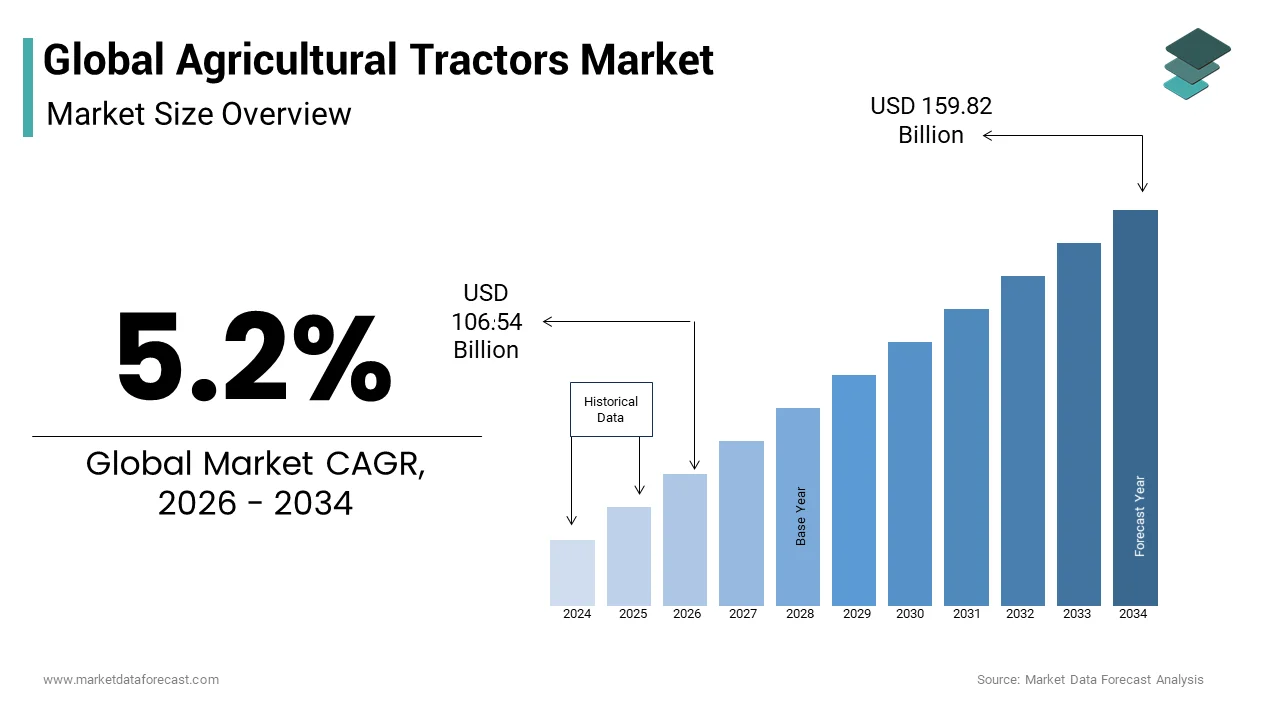
- Market Valuation: Valued at USD 101.27 billion in 2025, reaching USD 106.54 billion in 2026, and projected to expand up to USD 159.82 billion by 2034, registering a steady CAGR of 5.2% throughout the forecast period (2026–2034).
- Primary Growth Drivers: Escalating global demand for food products, rising mechanization across developing and developed agricultural industries, government funding/subsidies lowering credit rates, and technological breakthroughs like autonomous/self-driving tractors and intelligent farming integrations.
Key Market Segment Metrics
| Category | Leading Segment (Base Year Position) | Fastest-Growing / High-Impact Segment |
|---|---|---|
| By Type, Power, & Drive | Raw or Line Crop Tractors, Below 40 HP Tractors (high volume in emerging markets for small farms & low labor costs), & Four-Wheel Drive (4WD) Systems | Advanced 4WD & Precision-Enabled Tractors (high-impact growth due to superior traction, reduced slippage on undulated terrain, and heavy hauling stability) |
| By Region | Asia-Pacific (leading regional volume share at over 65%, propelled by robust domestic production and high sales in India and China) | Europe & North America (stable high-value growth driven by large farm sizes, stringent safety/lighting regulatory standards, and high-tech fleet modernization) |
Major Market Players & Market Structure
Market Structure: Highly consolidated global marketplace featuring major agricultural machinery conglomerates investing heavily in precision farming technologies, enhanced operator visibility, emissions control, and smart tractor integrations.
Key Companies: Deere and Company, Mahindra Group, Kubota Corporation, Yanmar, Massey Ferguson, Farmtac, Valtra Tractor, and CNH Industrial N.V.
Global Agricultural Tractors Market Size
The global agricultural tractors market size was valued at USD 101.27 billion in 2025 and is anticipated to reach USD 106.54 billion by 2026 to reach USD 159.82 billion by 2034, growing at a CAGR of 5.2% during the forecast period from 2026 to 2034.
Current Scenario Of The Agricultural Tractors Market
This growth is because of the rising demand for food products and increases in machinery in the agricultural industry. Tractors are vehicles designed to travel at low speeds while providing high torque. This high torque of the tractor allows heavy agricultural implements to be pulled behind it. They are also known for delivering power like that of a small truck. Tractors usually have two wheels. An old farm tractor is a simple open-top car.
Such as pulling or pushing agricultural equipment or trailers, plowing, investigating, harassing, planting, and spraying pesticides. The market for agricultural tractors is driven by factors such as increased demand for production and growth in the adoption of intelligent farming.
MARKET DRIVERS
The agricultural tractor market is a power-driven vehicle specially designed for agricultural activities such as pulling or pushing agricultural machinery or trailers for farming, plowing, scraping, threshing, planting, and spraying pesticides. Currently, tractors are also known as farm vehicles as they provide power and mechanization for agricultural purposes. The worldwide agriculture tractor market is also being boosted by government programs for funding and aiding farmers with lower credit rates. As a result, farm cash receipts, or profit and revenue earned from farming, rise, making tractors more affordable, which is expected to stimulate demand for agricultural tractors. For example, the Indian government and state governments have launched several programs to alleviate the situation of farmers.
Furthermore, due to technological breakthroughs altering farming and agricultural processes, the industry is also gaining traction. Agricultural tractors with self-driving capabilities, for example, are projected to boost productivity and efficiency in the industry. Therefore, these are the significant factors anticipated to fuel the global agricultural tractors market growth in the upcoming years.
MARKET RESTRAINTS
The main obstacles to the growth of the global agricultural tractors market are the high cost of tractors and the various import taxes imposed by governments. The increased initial investment to buy a tractor isbeing madee in developing countries like India, China, Indonesia, Brazil, etc. Moreover, farmers with higher debt are the primary factor that hinders the growth of global agricultural markets. The High costs are also increased by various governments, which discourages farmers from buying tractors. Furthermore, a lack of awareness among farmers in developing countries about the increased benefits of tractors is expected to slow market growth. In addition, more use and availability of rental tractors are expected to reduce the purchase of new tractors, hindering market growth in the global agricultural tractor market.
Impact of COVID-19 on the Agricultural Tractors Market
The COVID-19 impact has influenced the global agricultural tractor market, resulting in lower tractor sales worldwide due to the lockdown. The tractor business has seen a sharp decline in the pandemic, and the most affected Company is the supplier network due to the disruption in the procurement industry. The market for agricultural tractors is a dynamic industry, which is currently being disrupted due to the unavailability of workers due to the spread of the coronavirus. This hampered the production and installation of agricultural tractors in the affected countries. The disruption due to the outbreak of COVID-19 is evident in the agricultural tractor market, which has created uncertainty in dealing with the demand for a network of tractor manufacturers. The rise of machinery and government programs and the increase in the number of middle-class farmers tend to be responsible for the agricultural tractor market growth after the pandemic. Innovation in terms of performance, levels of pollution control, and increased demand for accurate agricultural equipment are expected to create opportunities for growth in the agricultural tractor market post-COVID-19.
REPORT COVERAGE
| REPORT METRIC | DETAILS |
| Market Size Available | 2025 to 2034 |
| Base Year | 2025 |
| Forecast Period | 2026 to 2034 |
| CAGR | 5.2% |
| Segments Covered | By Type, Engine Power, Drive Type,e and By Region |
| Various Analyses Covered | Global, Regional & Country Level Analysis, Segment-Level Analysis, DROC, PESTLE Analysis, Porter’s Five Forces Analysis, Competitive Landscape, Analyst Overview on Investment Opportunities |
| Regions Covered | North America, Europe, APAC, Latin America, Middle East & Africa |
| Market Leaders Profiled | Deere and Company, Mahindra Group, Kubota Corporation, Yanmar, Massey Ferguson, Farmtac, Valtra Tractor, CNH Industrial NV |
SEGMENTAL ANALYSIS
By Type Insights
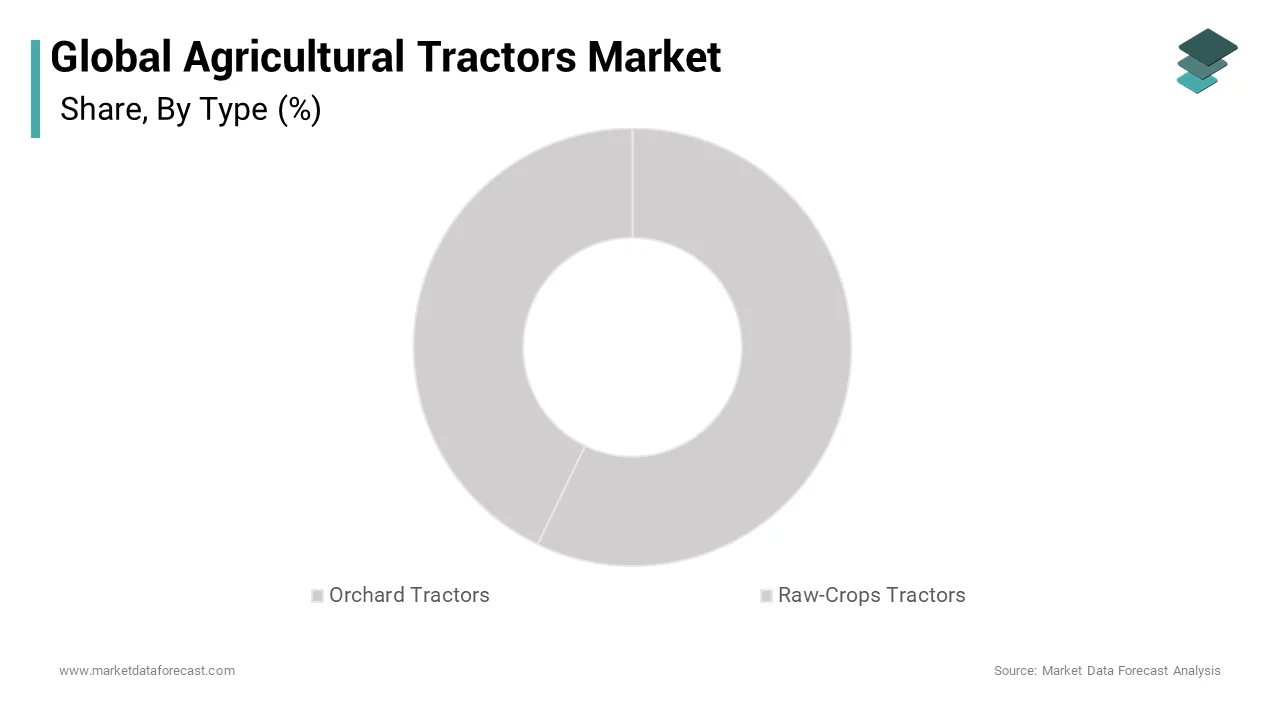
Raw or Line crop tractor segments are the most significant parts of agricultural tractors on the world market. As a result, many market players spend money on research and development to produce cutting machines and maintain a stable market position. In 2020, Deere & Company introduced a new 8 Family Tractor line-up featuring 8R wheelbarrows, 8RT two-track tractors, and the first four industrial tractors. Those new tractors usually come equipped with the latest agricultural technology, equipped with precision and allow customers to opt for the machine configuration, options, and horsepower to best suit their performance.
By Engine Power Insights
Tractors below 40 H.P. are mainly used for plowing. In developing countries, the need for low H.P. tractors is high due to ordinary farmers' waste and expensive labor costs. Most probably, Farmers prefer small and customized tractors for agricultural purposes because of the size of the small farms. Moreover, with an engine capacity of no more than 1,500 ccs, those tractors sit in a small space and can be used with great flexibility. The ease of customization enables them to be more experimental in testing. Therefore, manufacturers are more likely to try new things and technologies at this stage before moving on to more powerful ones. Those tractors are integrated, weigh less than 4,000 lbs, and use less than 40 PTO HP to make attachments. At all times, all these high-yielding, cost-effective, and easy-to-use tractors are used by schools, parks, landscaping, cemeteries, and recreational farmers. Low-horsepower tractors work efficiently in soft soil conditions, mainly in river basins. In addition, the low fuel consumption of small tractors helps to empower small and unsuitable farmers. Like India, the governments of emerging economies are promoting farm machinery by subsidizing the purchase of machinery and sponsoring bulk purchases by previous agencies.
By Drive Type Insights
Based on the drive type, the four-wheel drive is anticipated to have a significant global agricultural tractor market share during 2022 - 2027. In 4WD tractors, the transmission supplies power to all four wheels, resulting in less slippage and improved performance. Front wheels "assist" rear wheels in pulling the tractor forward in 4WD tractors, giving the rear wheels improved traction and reducing slippage. For undulated terrain and slopes, 4WD tractors are ideal. It's particularly effective for wet terrain puddling because it eliminates the need for cage wheels, which can harm roadways. In addition, it has a heavier front axle, which improves hauling stability and reduces front lifting while transporting heavy loads. Because the weight is spread between the front and rear axle components, a 4WD transmission system has a longer life.
REGIONAL ANALYSIS
Asia Pacific Market Analysis
The Asia Pacific holds the largest share at over 65% in terms of volume. This is due to the increasing demand for tractors in countries such as China and India. In India, tractors play a vital role in increasing agricultural production in the country. The country's annual sales of agricultural tractors range from 600 thousand units to more than 700 thousand units. In addition, Deere & Company has announced that most of its tractors used in America are made in India. The company exports 30% of its tractors to India. Therefore, the demand for agricultural tractors is expected to grow in the region from 2020 to 2027.
Europe Market Analysis
Europe is estimated to have seen significant growth in terms of volume during climate change. This growth is mainly due to the large farms in various European countries, such as the U.K., Denmark, Hungary, the Netherlands, and Spain. European farms account for about 38% of the world's total. In addition, according to the European Agricultural Machinery Industry Association, all tractors introduced on 1 January 2018 have been authorized to be equipped with lighting signals and brakes. Such power-related technological requirements are expected to stimulate market growth. In addition, large companies such as CLAAS KGaA mbH and CNH Industrial N.V. in this area are expected to impact market growth positively.
COMPETITIVE LANDSPACE
The global agricultural tractor market will be integrated with major players participating in the market by 2020. The primary key players are Deere and Company, Kubota Corporation, CNH Industrial N.V., AGVCO Corporation, and CLAAS KGaA mbH.
KEY MARKET PLAYERS
The global agricultural tractors market is dominated by a few of the key players operating in the market are
- Deere and Company
- Mahindra Group
- Kubota Corporation
- Yanmar
- Massey Ferguson
- Farmtac
- Valtra Tractor
- CNH Industrial NV.
RECENT MARKET NEWS
- Deere and Company announced that it is going to enlarge the special scraper tractors. Moreover, the newly designed tractors improve the rear visibility of the operator.
- On 12 October 2021, Mahindra introduced three new tractors named Yuvo Tech+. These have a power capacity of 35-42 H.P. and also have a warranty of 6 years.
MARKET SEGMENTATION
This research report on the global agricultural tractors market has been segmented and sub-segmented based on Type, Engine Power, Drive Type, and Region.
By Type
- Orchard Tractors
- Raw-Crops Tractors
By Engine Power
- Below 40HP
- 40HP-120HP
- 121HP-180HP
- 181HP-250HP
- Above 250HP
By Drive Type
- Two Wheel (2WD)
- Four-wheel (4WD)
By Region
- North America
- Europe
- Asia Pacific
- Latin America
- Middle East and Africa