- Product Description Description
- Table of Contents TOC
- List of Table & Figure LOT
- Get Free Sample PDF Sample PDF
Market Size, 2025
$1.56 BnMarket Estimate, 2026
$1.63 BnMarket Forecast, 2034
$2.34 BnCAGR, 2026–2034
4.65%Executive Summary: Global Turbine Oil Market
- Market Scope: Global analysis of the turbine oil sector, detailing mineral and synthetic oil types, applications across steam, gas, wind, and hydroelectric turbines, and regional market profiles.
- Market Valuation: Valued at USD 1.56 billion in 2025, reaching USD 1.63 billion in 2026, and projected to expand to USD 2.34 billion by 2034, growing at a robust CAGR of 4.65% from 2026 to 2034.
- Primary Growth Drivers: Escalating global demand for electricity, expansion of power generation infrastructure, proliferation of wind farms, and higher thermal stress designs requiring advanced synthetic and bio-based lubricant formulations.
Key Market Segment Metrics
| Category | Leading Segment (Base Position) | Fastest-Growing / High-Growth Segment |
|---|---|---|
| By Type | Mineral Oil-Based (dominated in 2025 due to high availability, cost-effectiveness, and proven oxidation control properties) | Synthetic Oil-Based (projected at high growth driven by superior thermal stability, extended drain intervals, and high horsepower demands) |
| By Application | Steam & Gas Turbines (captured the major market share in 2025, supported by massive utility-scale power generation requirements) | Wind Turbines (experiencing a high CAGR fueled by global investments in renewable energy and green power transition policies) |
| By Region | Asia-Pacific (market leader in 2025, backed by soaring energy demand, industrialization, and rapid turbine installations in China and India) | North America & Europe (fastest-growing regional hubs propelled by renewable wind farm proliferation and eco-friendly bio-based lubricant adoption) |
Major Market Players & Industry Landscape
Market Structure: Highly competitive landscape characterized by major petrochemical enterprises and lubricant manufacturers collaborating with OEMs to develop high-performance, varnish-resistant formulations.
Key Companies: Lukoil Lubricants Company, Chevron USA Inc., Royal Dutch Shell Plc., FUCHS Lubritech GmbH, Exxon Mobil Corporation, and Klüber Lubrication NA LP.
 Download Free Sample Report
Global Turbine Oil Market Size
The global turbine oil market was estimated at USD 1.56 billion in 2025 and is anticipated to reach a valuation of USD 2.34 billion by 2034 from USD 1.63 billion in 2026, growing at a CAGR of 4.65% during the forecast period 2026 to 2034.
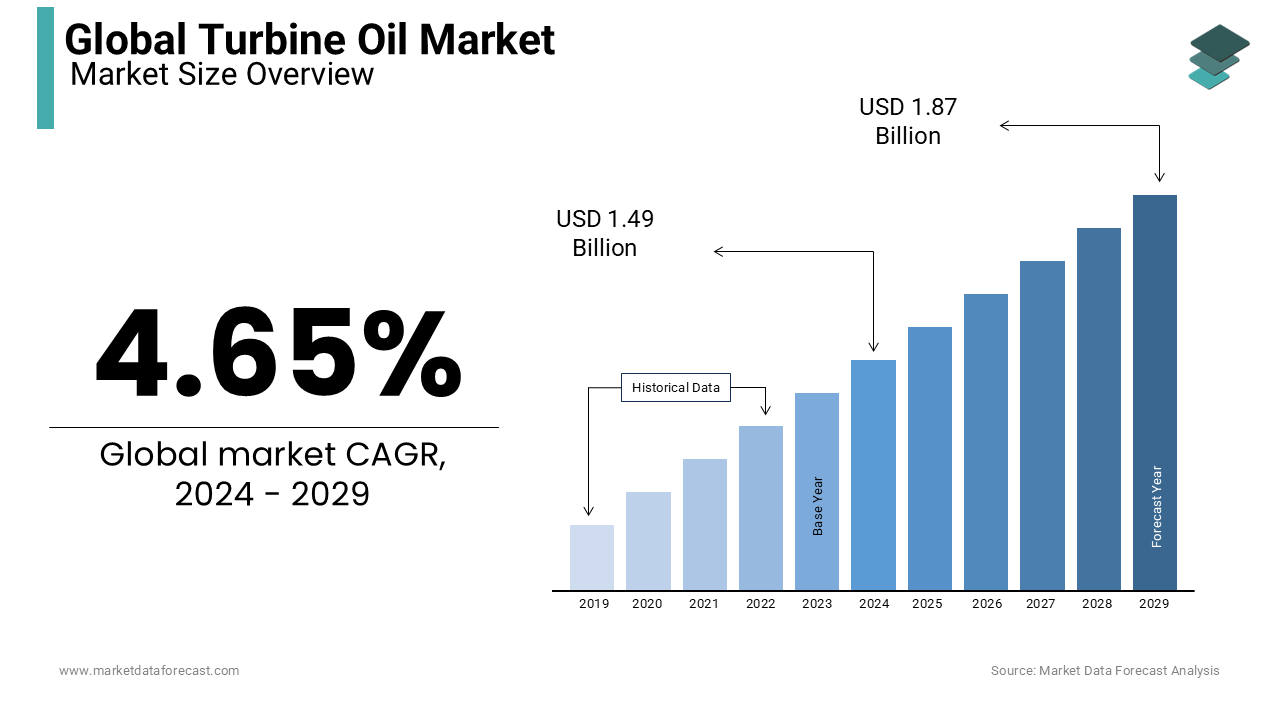
The Turbine Oil Market is showing strong expansion due to improving economies and escalated call for energy in developing and developed nations of the world. Conventional Turbine Oils are the most widely employed mineral-based lubricating oils, helping to remove external contamination and oxidation control products. With the recent expansion of bio-based turbine oils, relatively faster expansion is predicted, particularly in North America and Europe.
Turbine oil was primarily designed for use in turbines, but with the development of chemical techniques, it has now become an oil that inhibits rust and oxidation, providing long life with the use of conventional filters. Maintenance professionals are challenged to implement tactics that improve equipment performance over long service periods, like high temperatures, and water contamination. Turbine oil is a high-quality mineral oil with excellent water-separating ability. Turbine oil formulations are a blend of base oil (97%), corrosion inhibitors, rust and oxidation inhibitors, antifoam, and demulsifiers. Turbine oils are high-quality oils with excellent water separation properties. These oils are primarily employed as lubricants for turbine applications like steam, hydroelectric, and gas applications.
Aviation has the largest market size in the turbine oil end-user segment in the world, followed by the automotive end-use segment. India's civil aviation industry is on a high expansion trajectory. Market call for turbine oils clearly indicates that India will become the third-largest aviation market by 2020 and the largest by 2030. Higher horsepower designs, resulting in higher thermal stresses on lubricants, have been a general trend over the years. Resistance to thermal degradation is one of the vital properties concentrated for modern gas turbine oil lubricants. For exceptional oil life and deposit control and resistance to thermal and chemical degradation, as well as balance, manufacturers use specific additives that maximize the benefits of synthetic base oils.
MARKET DRIVERS
To provide exceptional performance in evolving turbine equipment designs, lubricant manufacturers continually work with OEMs to ensure highly calibrated product offerings.
In product development, the evolution of designs and operating conditions are key element in the application of lubricant technology that is predicted to provide the performance that users call for. The escalated call for electricity around the world has led to an augmented need to install new gas, steam, and hydroelectric turbines. This is the main factor driving the global turbine oil market. The rising call for electricity around the world has led to an improved need to install new gas, steam, and hydroelectric turbines. It is the leading factor in the turbine oil business.
MARKET RESTRAINTS
Restrictions, like rising hardware and software costs, could become critical impediments to market expansion. The shortage of capacity in the placement of VR solutions and the lack of skills of healthcare professionals to adapt to new technologies will also hamper market expansion.
MARKET OPPORTUNITIES
The escalating use of turbine oils in hydraulic turbines, rotary air compressors, steam turbines, and hydro and gas turbines has created an escalated call for turbine oils.
Oil replacement and maintenance of aging turbines and industrial machinery are also predicted to generate a significant call for turbine oils during the foreseen period. The automotive and aviation industry is a major consumer of turbine oils, whose expansion is predicted to increase during the foreseen period. The proliferation of wind farms and the installation of steam and hydroelectric turbines to meet the growing call for electricity around the world has created substantial opportunities for the turbine oil industries. Growing investments in the wind energy sector and favorable government initiatives to achieve sustainable development goals are predicted to stimulate expansion in the turbine oil industry during the outlook period.
MARKET CHALLENGES
The main challenge gas turbine lubricant manufacturers face is delivering long-lasting performance while exposed to high temperatures.
The challenge that prevailed in the contemporary phase of the gas turbine lubricant formulators market can only be changed by machines with exceptional thermal stability and oxidation resistance to operate under severe operating conditions.
REPORT COVERAGE
| REPORT METRIC | DETAILS |
| Market Size Available | 2025 to 2034 |
| Base Year | 2025 |
| Forecast Period | 2026 to 2034 |
| Segments Covered | By Type, Application, and Region. |
| Various Analyses Covered | Global, Regional, & Country Level Analysis; Segment-Level Analysis, Drivers, Restraints, Opportunities, Challenges, PESTLE Analysis, Porter’s Five Forces Analysis, Competitive Landscape, Analyst Overview of Investment Opportunities |
| Regions Covered | North America, Europe, Asia Pacific, Latin America, Middle East, and Africa |
| Key Market Players | Lukoil Lubricants Company, Chevron USA Inc., RoyalDutch Shell Plc., FUCHS Lubritech GmbH, Exxon Mobil Corporation, Shell India, Eastern Petroleum Pvt. Ltd., Klüber Lubrication NA LP, Penrite Oil Company, and Paras Lubricants Limited and Others. |
SEGMENTAL ANALYSIS
By Type Insights
The mineral oil segment dominated the turbine oil market in 2025. Mineral oil-based lubricants are made from crude oil and are readily available and affordable compared to other types of lubricants.
By Application Insights
The wind turbine segment is predicted to grow at a high CAGR during the foreseen period due to escalated investment in wind power and favorable government policies and initiatives.
REGIONAL ANALYSIS
The Asia Pacific region dominated the worldwide turbine oil market in 2025 and is likely to grow at a significant CAGR.
A strong call for power generation in China, Japan, India, and Southeast Asia would eventually increase the number of steam and wind turbine installations. According to the Worldwide Wind Energy Council (GWEC), about 104,934 wind turbines were in service in China at the end of 2016. North America and Europe are also predicted to see significant expansion during the outlook period due to the growing call for ecological bioproducts based on turbine oils. According to the Worldwide Wind Energy Council (GWEC), approximately 52,343 wind turbines were operating in the United States at the end of 2016. Nevertheless, the Latin America region is foreseen to develop in a considerable manner in the turbine oil business over the outlook period.
KEY MARKET PLAYERS
Companies playing a prominent role in the global turbine oil market include
- Lukoil Lubricants Company
- Chevron USA Inc.
- Royal Dutch Shell Plc.
- FUCHS Lubritech GmbH
- Exxon Mobil Corporation
- Shell India
- Eastern Petroleum Pvt. Ltd.
- Klüber Lubrication NA LP
- Penrite Oil Company
- Paras Lubricants Limited
-
Others
RECENT MARKET HAPPENINGS
-
Fluitec International has introduced Infinity Fluids' new turbine oil (TO), the first of its type in the industry. By effectively removing by-products from varnish production, Fluitec has created a "pure" turbine oil that can dramatically extend the life of the application.
MARKET SEGMENTATION
This global turbine oil market research report has been segmented and sub-segmented based on type, application, and region.
By Type
- Mineral Oil-Based
- Synthetic Oil-Based
By Application
- Steam Turbines
- Gas Turbines
- Wind Turbines
- Hydroelectric Turbines
By Region
- North America
- Europe
- Asia Pacific
- Latin America
- Middle East & Africa