- Product Description Description
- Table of Contents TOC
- List of Table & Figure LOT
- Get Free Sample PDF Sample PDF
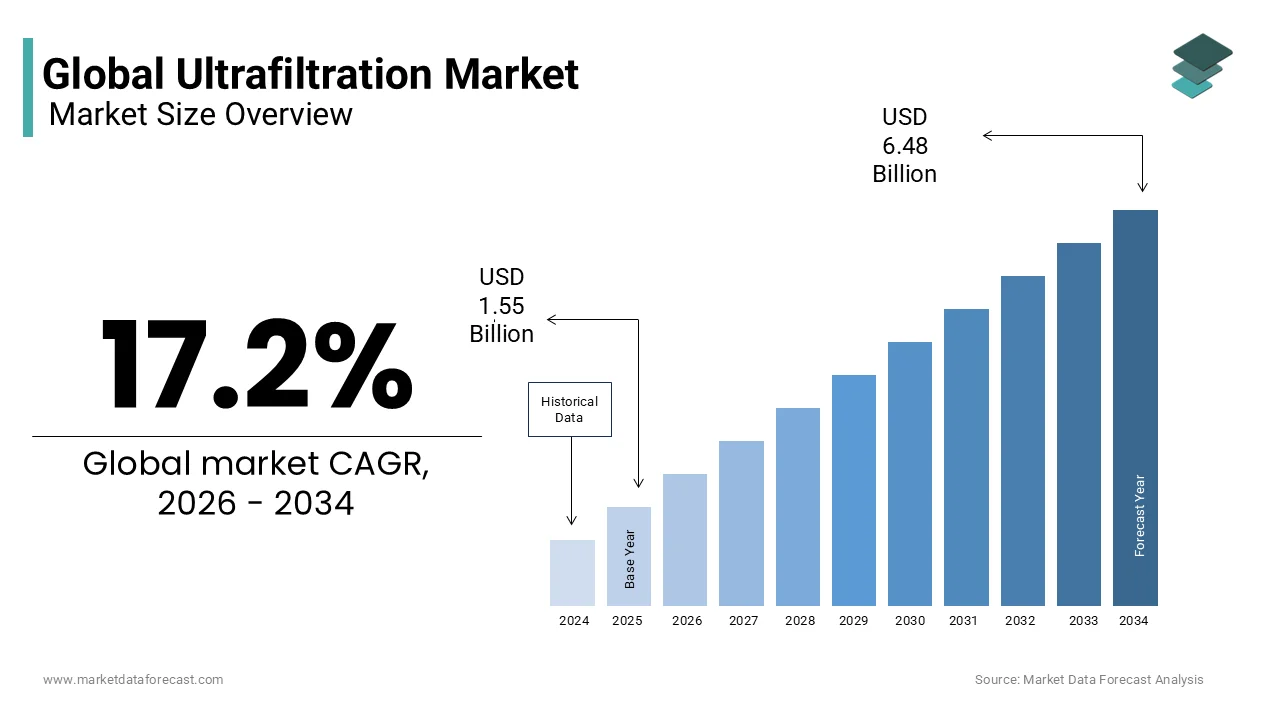
Market Size, 2025
$1.55 BnMarket Estimate, 2026
$1.82 BnMarket Forecast, 2034
$6.48 BnCAGR, 2026–2034
17.2%Executive Summary: Global Ultrafiltration Market
- Market Scope: Comprehensive global evaluation covering membrane types (polymeric and ceramic ultrafiltration), application sectors (municipal treatment and industrial treatment), and major geographic regions worldwide.
- Market Valuation: Valued at USD 1.55 billion in 2025, estimated at USD 1.82 billion in 2026, and projected to reach USD 6.48 billion by 2034, registering an accelerated compound annual growth rate (CAGR) of 17.2%.
- Primary Growth Drivers: Escalating global demand for water and wastewater treatment due to population growth, rising awareness of waterborne diseases, strict environmental regulations, and the expanding need for ultrapure water across food, beverage, and healthcare sectors.
Key Market Segment Metrics (2026–2034)
| Category | Leading Segment Focus | Fastest-Growing / Key Structural Trends |
|---|---|---|
| By Type | Polymeric Ultrafiltration (captures the baseline majority of market demand due to versatility and cost-effective large-scale deployment) | Ceramic Ultrafiltration (rising rapidly as a fast-growing sector driven by high porosity, superior permeability, and exceptional mechanical strength) |
| By Application | Municipal Treatment (leads the industry applications, heavily utilized for public drinking water purification and large-scale sanitation) | Industrial Treatment (expanding rapidly as factories, pharmaceuticals, and agri-food businesses adopt rigorous water recycling and reuse loops) |
| By Region | Asia-Pacific (dominates as the largest global market, propelled by rapid industrialization, high pollution concerns, and government investments in China, India, and Japan) | North America & Europe (mature markets driven by strict drinking water safety mandates, high purity standards, and proactive infrastructure upgrades) |
Major Market Players & Market Structure
Market Structure: A competitive and technology-driven landscape defined by strategic product launches (such as advanced hollow-fiber modules and integrated UF-RO systems), high capital intensity, and specialized membrane engineering.
Key Companies: DowDuPont Inc., Hyflux Ltd., Inge GmbH, Toray Industries, Inc., GE Water & Process Technologies, Hydranautics, Pentair plc, SUEZ, WesTech Engineering, Inc., Koch Membrane Systems, Evoqua Water Technologies LLC, Pall Corporation, and Dynatec Systems, Inc.
Global Ultrafiltration Market Size
The global ultrafiltration market size was valued at USD 1.55 billion in 2025 and is expected to reach USD 6.48 billion by 2034 from USD 1.82 billion in 2026. The market is projected to grow at a CAGR of 17.2%.
Ultrafiltration represents a critical, pressure-driven membrane separation process that effectively removes suspended solids, bacteria, viruses, and high-molecular-weight substances from liquid streams. This technology operates on the principle of size exclusion, using semipermeable membranes with pore sizes typically ranging from 0.01 to 0.1 micrometres. The global water crisis intensifies the necessity for advanced purification methods. According to the United Nations World Water Development Report, 2 billion people currently lack access to safely managed drinking water services. This scarcity drives municipalities and industries to adopt ultrafiltration systems for reliable water treatment and reuse. According to the World Health Organization, contaminated water causes approximately 485,000 diarrheal deaths annually, highlighting the urgent need for robust filtration technologies. Ultrafiltration serves as an essential barrier in producing potable water and treating wastewater for industrial applications. Its ability to operate without chemical additives aligns with growing environmental sustainability goals across various sectors. The pharmaceutical and food and beverage industries increasingly rely on this technology for product clarification and sterilization due to its gentle processing characteristics. As regulatory standards for water quality become more stringent globally, the adoption of ultrafiltration continues to expand. This technology bridges the gap between conventional filtration and reverse osmosis, offering a balance of efficiency and operational cost-effectiveness for diverse separation needs.
MARKET DRIVERS
Stringent Environmental Regulations and Water Quality Standards
Strict governmental regulations mandating high purity levels in discharged wastewater and potable water directly favor the expansion of the global ultrafiltration market by necessitating advanced treatment solutions. Regulatory bodies worldwide are tightening limits on contaminants such as pathogens, heavy metals, and organic pollutants in industrial effluents. The European Union Urban Wastewater Treatment Directive requires member states to upgrade treatment facilities to remove microplastics and pharmaceutical residues, which ultrafiltration membranes effectively capture. This legislative framework compels industries to invest in high-efficiency filtration technologies to avoid penalties and ensure compliance. The United States Environmental Protection Agency sets rigorous standards under the Safe Drinking Water Act, which mandates the removal of specific microbial contaminants from public water supplies. Ultrafiltration provides a physical barrier that consistently meets these requirements without relying heavily on chemical disinfection. According to the Organisation for Economic Co-operation and Development, global investment in water infrastructure must double by 2030 to meet sustainable development goals. This financial commitment supports the deployment of modern filtration systems in municipal and industrial settings. Furthermore, the push toward zero liquid discharge policies in manufacturing sectors drives the adoption of ultrafiltration as a pre-treatment step for reverse osmosis. These regulatory pressures create a sustained demand for reliable and compliant water treatment technologies, thereby accelerating market growth.
Growing Demand for Biopharmaceutical Production and Purification
The rapid expansion of the biopharmaceutical industry significantly favors the global ultrafiltration market, as these processes require precise separation and concentration of proteins, antibodies, and vaccines. Ultrafiltration is indispensable in downstream processing for purifying biological products while maintaining their structural integrity and activity. According to Grand View Research, the global biopharma sector is projected to grow at a compound annual growth rate of 8% driven by the increasing prevalence of chronic diseases. This growth translates to higher demand for scalable and efficient purification technologies that can handle complex biological mixtures. The World Health Organization emphasizes the need for increased vaccine production capacity, particularly in developing regions, to combat infectious diseases. Ultrafiltration systems enable manufacturers to concentrate viral vectors and antigens efficiently, ensuring consistent product quality. Additionally, the rise of biosimilars requires cost-effective manufacturing processes, where ultrafiltration plays a crucial role in reducing production time and waste. The United States Food and Drug Administration guidelines stress the importance of robust purification steps to ensure patient safety and product efficacy. As more biologics receive regulatory approval, the need for specialized filtration equipment increases. Companies are investing in single-use ultrafiltration technologies to enhance flexibility and reduce cross-contamination risks. This trend supports market expansion by aligning technological capabilities with industry needs for speed and reliability.
MARKET RESTRAINTS
High Capital Investment and Operational Maintenance Costs
The substantial initial capital expenditure required for installing ultrafiltration systems is a significant restraint on market adoption, particularly for small and medium-sized enterprises. These systems involve expensive membrane modules, high-pressure pumps, and sophisticated control units, which collectively drive up installation costs. According to the American Water Works Association, upgrading municipal water treatment plants with advanced membrane technologies can increase capital costs by 30 to 50% compared to conventional sand filtration. This financial burden discourages budget-constrained entities from adopting ultrafiltration despite its long-term benefits. Additionally, operational costs associated with membrane cleaning, replacement, and energy consumption add to the total cost of ownership. Membranes have a limited lifespan and require periodic replacement, which can be costly depending on the application severity. According to the International Desalination Association, energy consumption accounts for up to 40% of the operational costs in membrane-based water treatment facilities. High-pressure requirements for certain applications further escalate electricity bills, making the technology less attractive in regions with expensive power. Small-scale industrial users often find it difficult to justify the return on investment within a short timeframe. The lack of standardized pricing for membrane replacements also creates uncertainty in budget planning. Until financing options become more accessible or technology costs decrease, the high entry barrier will continue to limit widespread adoption, especially in developing economies.
Membrane Fouling and Performance Degradation Issues
Membrane fouling presents a persistent technical challenge that restrains the global ultrafiltration market by reducing system efficiency and increasing maintenance frequency. Fouling occurs when particles, colloids, or organic matter accumulate on the membrane surface or within its pores, leading to flux decline and increased transmembrane pressure. According to the National Renewable Energy Laboratory, fouling can reduce membrane permeability by up to 60% if not properly managed, requiring frequent chemical cleaning cycles. This performance degradation shortens membrane lifespan and increases operational downtime, affecting overall productivity. Complex feed waters containing high levels of suspended solids or organic load exacerbate fouling issues, making pretreatment essential but costly. According to the Water Research Foundation, inadequate pretreatment is the primary cause of premature membrane failure in industrial applications. Chemical cleaning agents used to restore flux can damage membrane materials over time, leading to earlier replacement needs. This cycle of cleaning and replacement increases operational complexity and costs. Furthermore, the disposal of chemical cleaning waste poses environmental concerns, requiring additional treatment steps. Industries with variable feed water quality struggle to maintain consistent performance, leading to unpredictable output. The lack of universal antifouling coatings that work effectively across all applications limits technological solutions. Until more robust and fouling-resistant membranes are developed at scale, this technical limitation will continue to hinder broader market acceptance and user confidence.
MARKET OPPORTUNITIES
Integration with Digital Monitoring and Predictive Analytics
The integration of ultrafiltration systems with digital monitoring platforms is a major opportunity for market expansion by enabling predictive maintenance and real-time optimization. Smart sensors and internet-of-things devices allow operators to track membrane performance, pressure differentials, and flux rates continuously. According to the International Data Corporation, global spending on internet-of-things solutions in industrial manufacturing will reach 500 billion USD by 2025, driven by the need for operational efficiency. This technological convergence allows ultrafiltration systems to adjust operating parameters automatically based on real-time data, preventing fouling and optimizing energy use. Machine learning algorithms can analyze historical performance data to predict membrane failure before it occurs, reducing unplanned downtime. According to the McKinsey Global Institute, predictive maintenance can reduce maintenance costs by 10 to 40% and extend asset life by 20%. This potential for cost savings makes ultrafiltration systems more attractive to facility managers seeking to maximize return on investment. Cloud-based dashboards provide remote visibility into system health, enabling centralized management of multiple facilities. Manufacturers that offer integrated digital solutions can differentiate themselves in a competitive market. The ability to demonstrate tangible efficiency gains through data analytics enhances customer trust and loyalty. As Industry 4.0 principles gain traction, the demand for smart filtration solutions will surge, creating new revenue streams for technology providers.
Expansion in Emerging Markets with Infrastructure Development
The rapid urbanization and infrastructure development in emerging markets offer a substantial opportunity for the Ultrafiltration Market through new municipal and industrial water treatment projects. Countries in Asia-Pacific, Latin America, and Africa are investing heavily in water security initiatives to address growing population demands. According to the Asian Development Bank, the region requires 1.7 trillion USD in annual infrastructure investment to support sustainable growth, including water and sanitation facilities. This massive capital inflow creates demand for compact and efficient filtration technologies like ultrafiltration that can be deployed quickly. Governments in these regions are increasingly adopting decentralized water treatment solutions to serve remote communities where large-scale plants are impractical. Ultrafiltration units offer modular scalability, making them ideal for such applications. According to the African Development Bank, improving access to clean water could boost regional GDP by 2.5% annually through improved health and productivity. International aid organizations and non-governmental organizations frequently fund water projects in these areas, preferring reliable and low-maintenance technologies. Local manufacturing partnerships can reduce costs and improve supply chain resilience, making ultrafiltration more accessible. As regulatory frameworks mature in these economies, the adoption of advanced treatment methods will accelerate. Companies that establish a strong local presence and offer tailored solutions will capture significant market share in these high-growth regions.
MARKET CHALLENGES
Competition from Alternative Filtration Technologies
The presence of established alternative filtration technologies such as reverse osmosis, nanofiltration, and conventional sand filtration is a significant challenge to the Ultrafiltration Market by offering different cost-benefit profiles. Reverse osmosis provides higher rejection rates for dissolved salts and smaller molecules, making it preferable for desalination and high-purity applications. According to the International Desalination Association, reverse osmosis accounts for over 60% of global desalination capacity due to its ability to produce potable water from seawater. This dominance in specific segments limits the addressable market for ultrafiltration, which cannot remove dissolved ions. Conventional sand filtration remains popular in municipal applications due to its lower capital cost and simplicity, despite requiring more land area. According to the American Water Works Association, many older utilities prefer retrofitting existing sand filters rather than investing in new membrane systems. Nanofiltration offers a middle ground between ultrafiltration and reverse osmosis, appealing to industries needing partial demineralization. The availability of these alternatives forces ultrafiltration providers to constantly justify their value proposition regarding specific contaminant removal capabilities. Customers often conduct detailed techno-economic analyses comparing multiple technologies, which can delay procurement decisions. The lack of clear differentiation in marketing messages sometimes confuses buyers about the optimal choice for their specific needs. Until ultrafiltration technology demonstrates clear superiority in total cost of ownership for broader applications, it will face stiff competition from these entrenched alternatives.
Supply Chain Disruptions for Specialized Membrane Materials
Supply chain vulnerabilities for specialized polymer materials used in manufacturing ultrafiltration membranes create a major challenge by causing production delays and price volatility. Membranes are typically made from polysulfone, polyethersulfone, or polyvinylidene fluoride, which are derived from petrochemical feedstocks. According to the International Monetary Fund, global commodity prices experienced volatility of up to 40% in recent years due to geopolitical tensions and logistical bottlenecks. Such instability affects the availability and cost of raw materials, leading to inconsistent pricing for end-users. The semiconductor shortage also impacted the production of electronic components used in membrane module housings and control systems. According to the Semiconductor Industry Association, lead times for certain chips extended beyond 50 weeks during peak shortage periods, affecting HVAC and filtration equipment manufacturers. Geopolitical trade restrictions can further disrupt the flow of critical materials between major manufacturing hubs. Manufacturers struggle to maintain adequate inventory levels without incurring excessive holding costs. This uncertainty hampers strategic planning and ability to meet delivery commitments. Customers facing project delays may seek alternative suppliers or technologies, undermining long-term relationships. Diversifying sourcing strategies is difficult due to the specialized nature of membrane-grade polymers. Until supply chains become more resilient and localized, the industry will remain vulnerable to external shocks that undermine growth momentum and customer confidence.
REPORT COVERAGE
| REPORT METRIC | DETAILS |
| Market Size Available | 2025 to 2034 |
| Base Year | 2025 |
| Forecast Period | 2026 to 2034 |
| CAGR | 17.2% |
| Segments Covered | By Type, Module, Application, and Region |
| Various Analyses Covered | Global, Regional & Country Level Analysis, Segment-Level Analysis, DROC, PESTLE Analysis, Porter’s Five Forces Analysis, Competitive Landscape, Analyst Overview on Investment Opportunities |
| Regions Covered | North America, Europe, Asia Pacific, Latin America, and Middle East & Africa |
| Market Leaders Profiled | DowDuPont Inc., Hyflux Ltd., Inge GmbH, Toray Industries, Inc., GE Water & Process Technologies, Hydranautics, Pentair plc, SUEZ, WesTech Engineering, Inc, Koch Membrane Systems, Evoqua Water Technologies LLC, Pall Corporation, and Dynatec Systems, Inc. |
SEGMENTAL ANALYSIS
By Type Insights
The polymeric membranes segment occupied the major share of the global ultrafiltration market in 2025 due to their lower production costs and versatility in various applications. Materials such as polysulfone, polyethersulfone, and polyvinylidene fluoride are widely available and easier to process into hollow fiber or flat sheet configurations. According to the American Chemical Society, polymeric membrane production costs are approximately 40 to 60% lower than ceramic alternatives, making them accessible for large-scale municipal and industrial projects. This economic advantage allows utilities and manufacturers to deploy extensive filtration networks without prohibitive capital expenditure. Furthermore, polymeric membranes offer a wide range of pore sizes and surface modifications to suit specific separation needs. According to the International Water Association, over 80% of municipal water treatment plants globally utilize polymeric membranes due to their proven reliability and ease of replacement. Their lightweight nature reduces shipping and installation costs, which is crucial for remote or decentralized systems. Continuous advancements in polymer chemistry have improved their resistance to chlorine and organic fouling, extending their operational lifespan. The ability to manufacture these membranes in high volumes ensures consistent supply and competitive pricing. As demand for affordable water treatment solutions grows in developing regions, polymeric membranes remain the preferred choice. Their compatibility with existing infrastructure and simpler cleaning protocols further solidify their leading position in the global market.
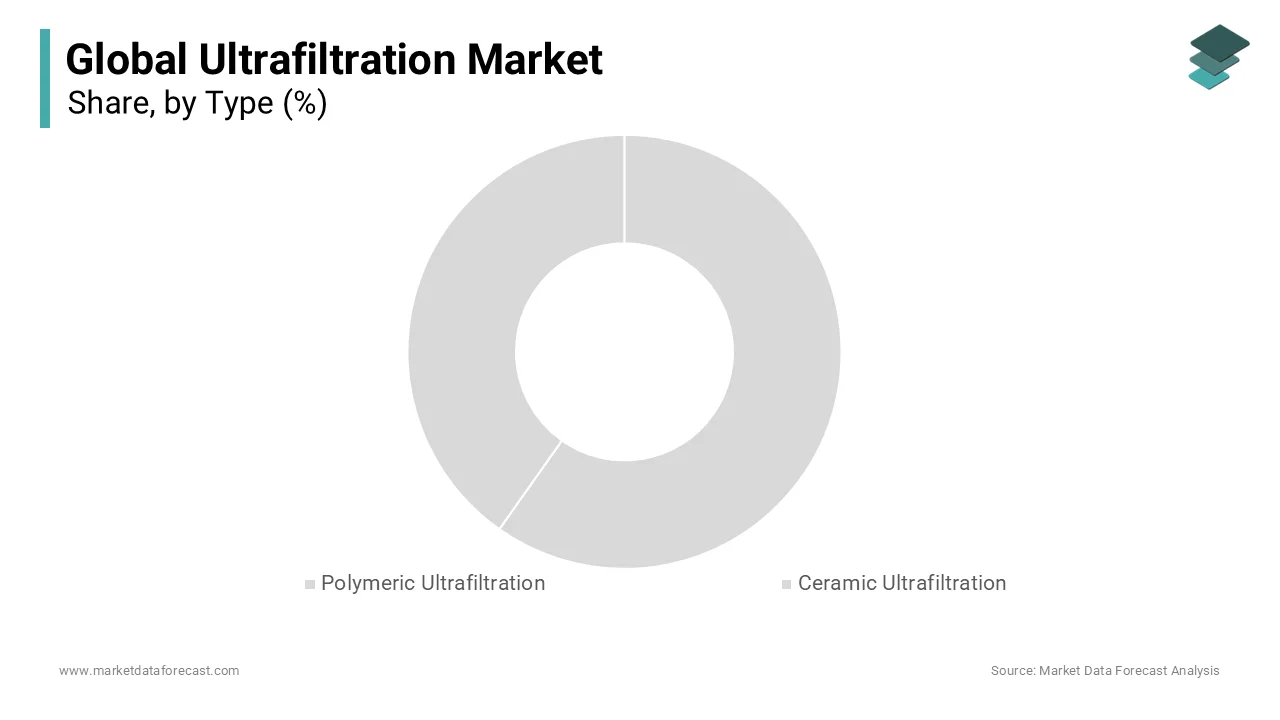
On the other end, the ceramic membranes segment is experiencing the fastest growth and is estimated to showcase a CAGR of 10.2% over the forecast period in the global market owing to their superior durability and ability to withstand harsh operating conditions. Made from materials like alumina, zirconia, and titania, these membranes offer exceptional chemical, thermal, and mechanical stability. According to the European Ceramic Society, ceramic membranes can operate at temperatures up to 300 degrees Celsius and withstand aggressive cleaning agents that would degrade polymeric counterparts. This robustness makes them ideal for demanding industrial applications such as petrochemical processing and high-temperature food sterilization. The longer lifespan of ceramic membranes reduces the frequency of replacement, lowering long-term operational costs despite higher initial investment. According to the United States Department of Energy, ceramic membranes can last up to 10 years compared to 3 to 5 years for polymeric options in aggressive environments. Industries focusing on zero liquid discharge and high-purity requirements increasingly adopt ceramic technology to ensure consistent performance. Advances in manufacturing techniques have reduced the cost of ceramic membranes, making them more competitive. The growing emphasis on sustainability also favors ceramics, as they are inert and recyclable. As industries seek to minimize downtime and maintenance disruptions, the demand for resilient ceramic ultrafiltration solutions continues to accelerate.
By Module Insights
The hollow fiber segment led the market with the highest share of the global market in 2025 due to their high packing density and efficient use of space, which maximizes filtration surface area within a compact footprint. This design allows for higher throughput rates compared to flat sheet or spiral wound configurations, making them suitable for large-volume applications. According to the American Water Works Association, hollow fiber modules can provide up to 50% more surface area per unit volume than other module types, enhancing system efficiency. This spatial efficiency is particularly valuable in urban municipal plants and industrial facilities where space is limited. The modular nature of hollow fiber systems allows for easy scalability, enabling operators to add capacity as demand increases without major structural changes. According to the International Desalination Association, hollow fiber configurations are preferred in over 70% of new municipal ultrafiltration installations due to their ease of backwashing and maintenance. Their ability to handle high suspended solid loads with periodic air scouring reduces fouling risks. Lower energy consumption per unit of treated water further enhances their appeal. The widespread availability of hollow fiber modules from multiple manufacturers ensures competitive pricing and supply security. As urbanization drives the need for compact and high-capacity water treatment solutions, hollow fiber modules remain the standard choice for most applications.
On the other side, the flat sheet segment is emerging as the fastest-growing segment and is predicted to record a CAGR of 9.4% over the forecast period owing to their simplicity in cleaning and customization for specialized applications. Unlike hollow fibers, flat sheets are less prone to irreversible fouling and can be cleaned more effectively using physical and chemical methods. According to the Water Environment Federation, flat sheet modules reduce cleaning chemical usage by up to 30% compared to hollow fiber systems due to better access to membrane surfaces. This operational advantage lowers maintenance costs and environmental impact, appealing to sustainability-focused industries. Flat sheet configurations allow for easier inspection and replacement of individual sheets, reducing downtime during maintenance. They are particularly favored in the food and beverage industry, where product changeovers require thorough cleaning to prevent cross-contamination. According to the Institute of Food Technologists, flat sheet ultrafiltration is preferred for clarifying juices and dairy products due to its gentle handling and hygiene benefits. Advances in spacer geometry have improved flow distribution and reduced concentration polarization, enhancing performance. The ability to customize module size and channel height makes flat sheets versatile for pilot testing and small-scale production. As industries prioritize hygiene and operational flexibility, the adoption of flat sheet ultrafiltration modules continues to rise.
By Application Insights
The municipal water treatment segment held the dominant share of the global market in 2025. The leading position of municipal water treatment segment in the global market can be credited to strict public health regulations and the need to replace aging infrastructure. Governments worldwide are mandating higher standards for drinking water quality to protect populations from waterborne diseases. The World Health Organization states that 2 billion people lack access to safely managed drinking water services, driving massive investment in municipal treatment facilities. Ultrafiltration provides a reliable physical barrier against pathogens such as cryptosporidium and giardia, which are resistant to conventional chlorination. The United States Environmental Protection Agency requires public water systems to meet stringent microbial criteria, which ultrafiltration consistently achieves. Municipalities are increasingly adopting ultrafiltration as a primary treatment step to reduce reliance on chemical disinfectants and improve taste and odor. According to the American Water Works Association, over 60% of new municipal water plants in North America incorporate membrane technologies. Urbanization and population growth increase pressure on existing water resources, necessitating efficient treatment solutions. Ultrafiltration enables the reuse of treated wastewater for non-potable purposes, conserving fresh water supplies. Government funding and international aid programs support the deployment of these systems in developing regions. As cities expand, the demand for scalable and reliable municipal water treatment technologies ensures the continued dominance of this segment.
However, the industrial food and beverages segment is the fastest-growing application and is anticipated to showcase a CAGR of 11.4% over the forecast period owing to the growing need for product clarification, concentration, and sterilization without heat damage. Ultrafiltration preserves sensory qualities such as flavor, color, and nutritional value, which are critical for premium food products. According to the Institute of Food Technologists, ultrafiltration can reduce energy consumption in juice concentration by up to 50% compared to thermal evaporation methods. This efficiency gain lowers production costs and carbon footprints, appealing to sustainability-conscious manufacturers. The technology is widely used in dairy processing for whey protein concentration and milk standardization, improving yield and product consistency. According to the Food and Agriculture Organization, global dairy production is expected to grow by 1.8% annually, increasing demand for efficient processing technologies. Ultrafiltration also extends shelf life by removing spoilage microorganisms without altering product characteristics. Consumer preference for natural and minimally processed foods drives adoption of membrane technologies over chemical additives. Regulatory requirements for food safety further encourage the use of sterile filtration methods. As the global middle class expands, demand for processed and packaged foods rises, supporting rapid growth in this segment. Manufacturers investing in ultrafiltration gain competitive advantages through improved product quality and operational efficiency.
REGIONAL ANALYSIS
North America Ultrafiltration Market Analysis
North America held the highest share of the global market in 2025 and is likely to experience steady and mature market expansion driven by advanced infrastructure replacement and strict compliance mandates over the next few years. The United States and Canada have well-established water treatment industries that prioritize high-quality standards and technological innovation. The United States Environmental Protection Agency enforces rigorous Safe Drinking Water Act standards, which mandate the removal of specific contaminants requiring advanced filtration solutions. Ultrafiltration is widely adopted in municipal and industrial sectors to comply with these regulations. According to the American Water Works Association, billions of dollars are invested annually in upgrading water infrastructure across the region. The presence of major membrane manufacturers and research institutions fosters continuous technological advancement. High awareness of water scarcity issues in states like California drives the adoption of water reuse technologies, where ultrafiltration plays a key role. The pharmaceutical and biotechnology industries in the region also contribute significantly to demand due to strict purity requirements. Government incentives for sustainable water management practices further support market growth. The mature market focuses on optimization and digital integration of existing systems. As regulatory pressures intensify and infrastructure ages, the demand for reliable and efficient ultrafiltration solutions remains strong in North America.
Europe Ultrafiltration Market Analysis
Europe is poised for accelerated growth and widespread modernization driven by ambitious green policies and stringent zero pollution mandates over the next few years. The European Union Green Deal aims to achieve climate neutrality by 2050, prompting significant investments in sustainable water management. According to the European Commission, the region aims to reuse 60% of treated wastewater by 2030, driving the adoption of advanced filtration technologies. Ultrafiltration is essential for meeting these reuse targets by ensuring high-quality effluent. Countries such as Germany, France, and the Netherlands lead in implementing membrane technologies due to strict discharge limits. According to the European Water Association, over 70% of new wastewater treatment projects in Western Europe incorporate membrane processes. The region benefits from a strong focus on research and development leading to innovative membrane materials and designs. Consumer awareness regarding water quality and environmental impact is high, driving demand for household and industrial solutions. The pharmaceutical industry in Europe also contributes to market growth due to stringent Good Manufacturing Practice guidelines. As the EU tightens regulations on microplastics and pharmaceutical residues, ultrafiltration becomes increasingly vital. The mature market continues to evolve through digitalization and energy efficiency improvements.
Asia Pacific Ultrafiltration Market Analysis
Asia Pacific is projected to witness the fastest regional market acceleration driven by rapid industrialization, urban expansion, and heavy government water security investments over the next few years. China, India, and Southeast Asian nations are investing heavily in water infrastructure to address pollution and scarcity issues. According to the Asian Development Bank, the region requires 1.7 trillion USD in annual infrastructure investment, including water and sanitation facilities. This massive capital inflow creates substantial demand for efficient and scalable filtration technologies. Governments are implementing stricter environmental regulations to combat industrial pollution, driving adoption in manufacturing sectors. The Chinese Ministry of Ecology and Environment has set ambitious targets for wastewater treatment and reuse, promoting membrane technology deployment. Rising disposable incomes increase demand for packaged food and beverages, boosting industrial applications. The presence of local manufacturing hubs reduces costs and improves supply chain accessibility. International collaborations and technology transfers accelerate the adoption of best practices. As populations grow and water stress intensifies, the need for reliable treatment solutions becomes critical. The region offers significant growth potential for both municipal and industrial ultrafiltration applications.
Latin America Ultrafiltration Market Analysis
Latin America is anticipated to experience steady developmental progress supported by increasing municipal sanitation investments and industrial modernization initiatives over the next few years. Brazil, Mexico, and Chile are leading adopters as they seek to modernize water infrastructure and address contamination issues. According to the Inter-American Development Bank, access to safe drinking water remains a challenge in many parts of the region, prompting investment in treatment technologies. Ultrafiltration offers a reliable solution for removing pathogens from contaminated sources. Industrial sectors such as mining and agriculture are increasingly adopting water reuse systems to conserve resources and comply with environmental standards. The Brazilian Association of Technical Standards has updated regulations to promote better water quality, encouraging the use of advanced filtration. Economic recovery and foreign investment in commercial real estate also drive demand for modern building services, including water treatment. However, market growth is occasionally hindered by economic volatility and limited financing options. Despite these challenges, the long-term trend toward urbanization and regulatory compliance supports market expansion. As awareness of water scarcity grows, the adoption of efficient treatment technologies is expected to increase steadily.
Middle East and Africa Ultrafiltration Market Analysis
The Middle East and Africa region is expected to record substantial demand expansion driven by severe water scarcity adaptation and mega-scale desalination projects over the next few years. Countries in the Gulf Cooperation Council, such as Saudi Arabia and the United Arab Emirates, rely heavily on desalination and wastewater reuse to meet water demands. According to the International Energy Agency, cooling and water treatment account for significant energy consumption in the region, making efficiency critical. Ultrafiltration serves as a crucial pretreatment for reverse osmosis in desalination plants, protecting membranes from fouling. The Saudi Green Initiative and UAE Net Zero 2050 strategic initiative drive the adoption of sustainable water management practices. Large-scale projects such as new cities and industrial zones require state-of-the-art water treatment solutions. In Africa, major cities like Johannesburg and Cairo are developing modern water infrastructure to support economic growth. According to the African Development Bank, there is an urgent need for resilient water systems to cope with climate change impacts. As governments prioritize water security and sustainability, the demand for ultrafiltration technology continues to rise. International partnerships and funding support this trajectory.
COMPETITIVE LANDSCAPE
The competition in the ultrafiltration market is characterized by intense rivalry among established multinational corporations and specialized regional manufacturers. Major players differentiate themselves through technological innovation superior product quality and comprehensive after sales support services. The market features a mix of global brands with extensive distribution networks and niche providers offering customized solutions for specific applications. Price competition remains significant particularly in price sensitive emerging economies where initial cost often dictates purchasing decisions. However leading companies increasingly compete on value added services such as energy audits system integration and digital monitoring platforms. The entry of new competitors with innovative membrane materials disrupts traditional market dynamics and forces incumbents to accelerate their research efforts. Intellectual property protection and patent filings are critical strategies used by top firms to safeguard their technological advantages. Collaborative ventures between membrane manufacturers and engineering firms are becoming common to create holistic water treatment solutions. Regulatory compliance serves as both a barrier to entry and a competitive differentiator as stricter environmental codes favor advanced ultrafiltration systems. Customer loyalty is driven by reliability ease of maintenance and proven performance records. The fragmented nature of the market in certain regions allows local players to thrive by offering personalized service and faster response times. Overall the competitive landscape encourages continuous innovation and improvement in system efficiency and user experience.
KEY MARKET PLAYERS
The major key players in the global ultrafiltration market are
- DowDuPont Inc
- Hyflux Ltd
- Inge GmbH
- Toray Industries, Inc
- GE Water & Process Technologies
- Hydranautics
- Pentair plc
- SUEZ
- WesTech Engineering, Inc
- Koch Membrane Systems
- Evoqua Water Technologies LLC
- Pall Corporation
- Dynatec Systems, Inc.
Top Players in the Market
- Veolia Environnement SA contributes significantly to the ultrafiltration market by providing comprehensive water treatment solutions for municipal and industrial clients worldwide. The company integrates advanced membrane technologies into its smart water management platforms to enhance efficiency and sustainability. Veolia recently expanded its digital offerings with Aquadvanced software which optimizes ultrafiltration plant operations through real time data analytics. This innovation allows operators to reduce energy consumption and extend membrane life effectively. The company actively engages in large scale public private partnerships to upgrade aging infrastructure in major cities. By focusing on circular economy principles Veolia promotes water reuse and resource recovery projects that rely heavily on ultrafiltration. Their global presence enables them to deliver localized solutions while leveraging international expertise. Recent investments in research and development have led to more durable and fouling resistant membrane materials. This strategic focus on technological integration and sustainability strengthens their position as a leader in the global water technology sector.
- Suez Group plays a vital role in the ultrafiltration market by offering innovative membrane solutions tailored for complex water challenges. The company specializes in high performance hollow fiber and flat sheet membranes designed for diverse applications including desalination and wastewater reuse. Suez recently launched new ZeeWeed membrane modules that offer higher flux rates and improved resistance to contaminants. These advancements help clients achieve greater throughput and lower operational costs. The company emphasizes sustainable practices by developing eco friendly cleaning protocols that minimize chemical usage. Suez collaborates with industrial partners to create customized filtration systems for specific process needs. Their commitment to digital transformation includes deploying artificial intelligence tools for predictive maintenance and performance monitoring. This approach ensures reliable operation and reduces unplanned downtime for critical facilities. By expanding its service network and technical support capabilities Suez enhances customer satisfaction and loyalty. Their continuous innovation in membrane science and system design reinforces their reputation as a key player in the industry.
- DuPont de Nemours Inc maintains a strong presence in the ultrafiltration market through its extensive portfolio of high quality membrane products. The company leverages its material science expertise to develop durable polymeric and ceramic membranes for demanding applications. DuPont recently introduced enhanced FilmTec ultrafiltration elements that provide superior rejection rates and longer service life. These products are widely used in pharmaceutical food and beverage and municipal water treatment sectors. The company focuses on sustainability by designing membranes that require less energy and water during operation. DuPont actively supports customers with technical training and application engineering services to ensure optimal system performance. Their global manufacturing footprint ensures consistent supply and rapid delivery to key markets. Recent collaborations with technology providers have integrated smart sensors into membrane housings for better process control. This combination of product innovation and customer support helps DuPont maintain its competitive edge. The company continues to invest in research to address emerging challenges such as microplastic removal and resource recovery.
Top Strategies Used by Key Market Participants
Key players in the ultrafiltration market primarily focus on technological innovation and strategic partnerships to maintain competitive advantage. Companies invest heavily in research and development to create more durable and efficient membrane materials that resist fouling and chemical degradation. Integrating digital technologies such as internet of things sensors and artificial intelligence into filtration systems allows manufacturers to offer predictive maintenance and real time optimization features. This technological advancement appeals to facility managers seeking to reduce operational costs and improve reliability. Strategic collaborations with engineering firms and municipal authorities enable seamless integration of ultrafiltration systems into large scale infrastructure projects. Manufacturers also emphasize expanding their service networks to provide comprehensive installation and maintenance support. This approach addresses the skilled labor shortage and ensures optimal system performance throughout its lifecycle. Additionally companies pursue geographic expansion into emerging markets where urbanization and water scarcity drive demand. By offering customized solutions tailored to local regulatory frameworks participants strengthen their market presence. Continuous improvement in supply chain resilience helps mitigate risks associated with raw material volatility and logistical disruptions.
MARKET SEGMENTATION
This research report on the global ultrafiltration market has been segmented and sub-segmented based on type, module, application, and region.
By Type
- Polymeric Ultrafiltration
- Ceramic Ultrafiltration
By Module
- High Fiber
By Application
- Municipal Treatment
- Industrial Treatment
By Region
- North America
- Europe
- Asia Pacific
- Latin America
- Middle east and Africa