- Product Description Description
- Table of Contents TOC
- List of Table & Figure LOT
- Get Free Sample PDF Sample PDF
Market Size, 2025
$910 MnMarket Estimate, 2026
$951 MnMarket Forecast, 2034
$1,353 MnCAGR, 2026–2034
4.50%Global Permeate Market Size, Growth, Trends & Forecast (2026–2034)
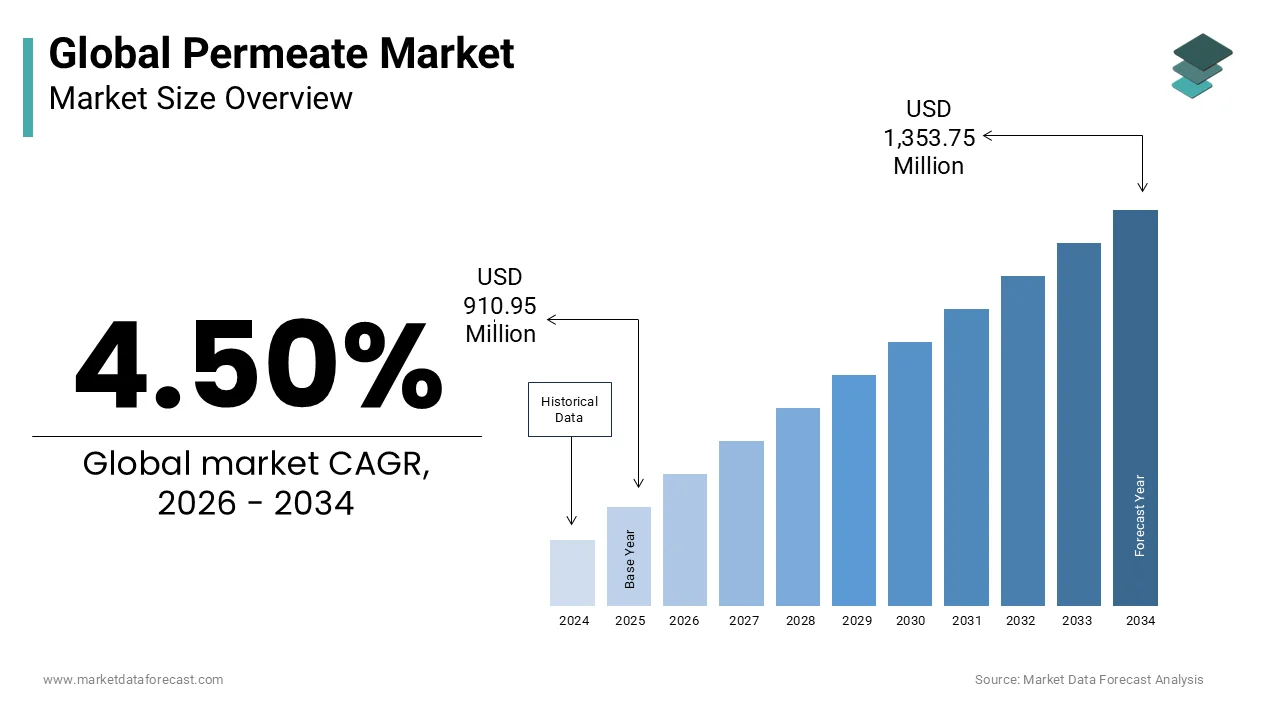
The global permeate market size was valued at USD 910.95 million in 2025, reached USD 951.94 million in 2026, and is projected to scale up to USD 1,353.75 million by 2034, registering a compound annual growth rate (CAGR) of 4.50% during the forecast period from 2026 to 2034. Driven by rising applications in milk standardization, functional flavor enhancements, and expanding adoption across the animal feed and food processing sectors, the market continues to experience steady upward momentum globally.
Key Executive Metrics (At-a-Glance)
- 2025 Base Valuation: USD 910.95 Million
- 2026 Current Valuation: USD 951.94 Million
- 2034 Forecast Valuation: USD 1,353.75 Million
- Compound Annual Growth Rate (CAGR): 4.50% (2026–2034)
- Dominant Regional Market: North America (accounting for 35% of the worldwide market share, backed by extensive R&D investments and leading export volumes)
- Key Growth Segments: Whey permeate product type and Dairy Foods / Animal Feed application sectors
Core Market Drivers & Growth Triggers
- Functional Food & Bakery Appeal: Cost-effective enrichment providing caramelized aromas, texture preservation, and enhanced flavor profiles in baked goods and soups.
- Meat & Sodium Reduction: Utilization of permeate as a partial replacement for sodium chloride in meat brines to lower sodium content while retaining tenderness and shelf life.
Primary Market Restraints & Challenges
- High Lactose Concentration: Elevated lactose content (65–85%) can cause unwanted digestive reactions, limiting widespread incorporation in specific food and beverage formulations.
- Market Volatility: Supply-chain constraints and processing costs associated with dairy byproduct management.
Global Permeate Market Segmentation Breakdown
| Segment Category | Largest Segment / Leader | Fastest-Growing Segment |
|---|---|---|
| By Product Type | Whey Permeate (Dominates volume share owing to large-scale cheese manufacturing byproducts and widespread commercial availability) | Milk Permeate (Gaining rapid traction due to targeted functional benefits in specialized beverages and clean-label formulations) |
| By Application | Dairy Foods & Animal Feed (Captures the highest consumption volume through large-scale nutritional integration) | Beverages & Confectionery (Expands fastest driven by low-lactose electrolytic drinks and texturizing agent demands) |
| By Region | North America (Holds the leading regional market share with robust R&D and export frameworks) | Asia-Pacific (Fastest-growing hub fueled by rising milk consumption, urbanization, and expanding food processing industries) |
Major Industry Players Profiled
Key corporations shaping the global permeate market include American Dairy Products Institute, Fonterra Co-Operative Group, Nestle S.A., Arla Foods Ingredients Inc., Silwan International General Trading LLC, La Belle Inc., and Volac International Limited.
Global Permeate Market Size
The global permeate market size was valued at USD 910.95 million in 2025, and the market size is expected to reach USD 1,353.75 million by 2034 from USD 951.94 million in 2026. The market is growing at a CAGR of 4.50% throughout the forecast period.
Permeate is one of the food products that does not contain fats or proteins. It is a dairy ingredient with a high lactose content, which includes lactose, minerals, and vitamins in large quantities. Milk permeate offers several functional and nutritional benefits thanks to its presence in dairy products, meats, cakes, soups, dry mixes, confectionery, and beverages. This milk permeate is an inexpensive ingredient that provides a golden appearance and additional flavor benefits, such as a pleasant, caramelized aroma for baked goods. This characteristic leads to increasing demand in the global permeate market. The mixture of milk permeates with soup appeals to soup consumers with a better appearance and aroma, as this product helps maintain the flavor and texture of the soup. In confectionery, this permeate is mainly preferred for the elimination of softness, while offering crystallization characteristics. The feed industry's adoption rate of permeate is high compared to all previous applications. Consequently, increased demand from the animal feed industry further contributes to revenue growth in the permeate market.
The world market for permeate is gaining ground, thanks to its application in the standardization of milk, preserving the flavor and maintaining nutritional value. In the food industry, permeate is used to improve the taste and texture of food products. Low lactose permeate is now used as an electrolytic drink. Growth in the milk industry is expected to stimulate the global permeate market during the forecast period. According to Food and Agricultural Outlook, world milk consumption was registered at 811 million tons in 2017, which is supposed to increase by 22% to reach 1,168 million tons in 2030.
In recent years, permeate has emerged in the Partial replacement of sodium chloride for meat brine and poultry to reduce the sodium content. Brining meat products is essential to increase shelf life, improve taste and maintain tenderness during cooking. Increased meat consumption is also assumed to spur growth in the global permeate market. According to the Food and Agriculture Organization of the United Nations, world meat consumption per capita was around 30.8 kg in 2016, which is expected to reach 35.4 kg in 2026. Permeate often contains a high percentage of lactose (65-85%) and is known to cause unwanted effects on body weight and the digestive system. High lactose content in permeate could reduce its use in food and beverages, which could hinder the growth of the global permeate business.
REPORT COVERAGE
| REPORT METRIC | DETAILS |
| Market Size Available | 2025 to 2034 |
| Base Year | 2025 |
| Forecast Period | 2026 to 2034 |
| CAGR | 4.50% |
| Segments Covered | By Product Type, Application, and Region |
| Various Analyses Covered | Global, Regional and Country Level Analysis; Segment-Level Analysis; DROC; PESTLE Analysis; Porter’s Five Forces Analysis; Competitive Landscape; Analyst Overview of Investment Opportunities |
| Regions Covered | North America, Europe, APAC, Latin America, Middle East & Africa |
| Market Leaders Profiled | American dairy product institute, Fonterra Co-Operative Group, Nestle S.A, Arla Foods Ingredients Inc, Silwan International General Trading LLC, La Belle Inc, Volac International Limited. |
REGIONAL ANALYSIS
North America's regional share was observed at 35% in the worldwide permeate market in 2023. US suppliers are investing more in milk and whey research and development compared to production. This investment is primarily aimed at revealing the unique functional, nutritional, and sensory benefits of whey and milk permeate. It also elevates permeate as an inexpensive and flavor-enhancing ingredient in end-user industries such as animal feed and FNB. Furthermore, the potential visibility of significant growth in permeate production in the United States has enabled a stable and quality supply of permeate from the country.
According to the International Trade Center, the United States is the number one exporter of modified (permeate) serum in the world. In 2018, the United States recorded an export value of $ 528.8 million for whey and modified whey. In addition, this country owned 17.4% of world exports of permeate and whey. Therefore, this export value means the increasing trade value of permeate in the United States.
KEY MARKET PLAYERS
Key Players In Permeate Market are American dairy product institute, Fonterra Co-Operative Group, Nestle S.A, Arla Foods Ingredients Inc, Silwan International General Trading LLC, La Belle Inc, Volac International Limited.
RECENT HAPPENINGS IN THE MARKET
- lanbia Nutritionals, Dairy Farmers of America (DFA), and Select Milk Producers Inc. decided to start their new joint venture "Big Whey and Cheese Production Plant" in Michigan. The production process is estimated to begin in the fourth quarter of 2020, which costs $ 470 million. Additionally, these companies have entered into an agreement with ProLiant Dairy Ingredients to treat whey permeate. ProLiant plans to invest $ 85 million to build an adjacent facility to process the whey permeate from this joint venture. As a result, this joint venture enables growth in the size of the permeate market.
- In Ireland, Glanbia Ingredients coordinates with AgriChemWhey, which is a project of the European Commission. This project has been primarily funded by the Bio-based Industries Joint Technology Initiative in collaboration with an EU research consortium, engineering and business interests. The main objective of which is to develop technology that turns dairy product flows for transformation into high-value commercial products. The goal is to form a $ 41.2 million integrated biorefinery that will process 25,000 tons per year of whey permeate and whey pearl lactose into polylactic acid, L-lactic acid, minerals for human nutrition, and bio-based fertilizers at the beginning. Therefore, the 2018 Bio-Based Industries Joint Technology Initiative supports the increase in permeate production, driving the growth of the permeate market.
- In 2018 Milk Specialties received the "Exporter of the Year" award for its performance in supplying nutritional solutions. This vital title was awarded by Dairy Foods magazine, USDEC, which also sponsored it. Milk Specialties mainly exports more than 70% of its carbohydrate activity, which includes permeate and lactose. Therefore, this award reflects business growth in the global permeate market.
MARKET SEGMENTATION
This research report on the global permeate market has been segmented and sub-segmented based on Product Type, Application, & region.
By Product Type
- Whey
- Milk
By Application
- Soups and Sauces
- Dairy Foods
- Beverages
- Meat
By Region
- North America
- Europe
- The Asia Pacific
- Latin America
- Middle East and Africa