- Product Description Description
- Table of Contents TOC
- List of Table & Figure LOT
- Get Free Sample PDF Sample PDF
Market Size, 2025
$10.22 BnMarket Estimate, 2026
$11.09 BnMarket Forecast, 2034
$21.30 BnCAGR, 2026–2034
8.5%Global Ultrapure Water Market Size, Growth, Trends & Forecast (2026–2034)
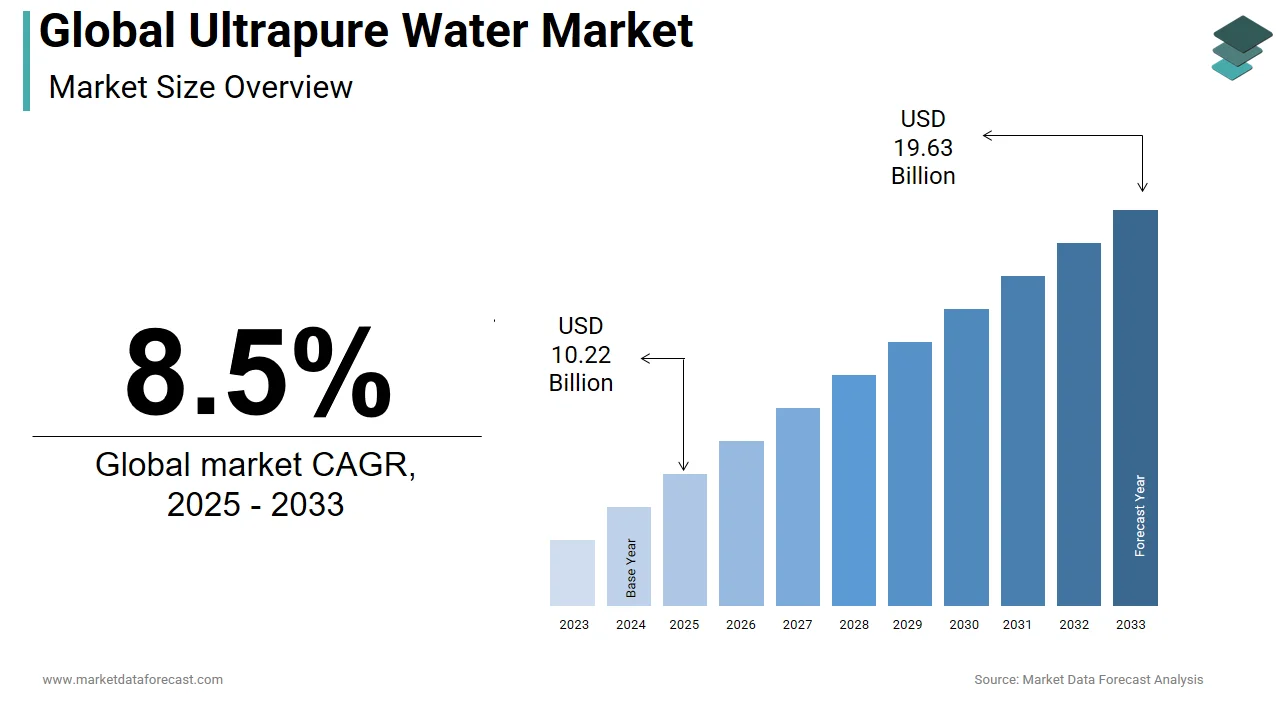
The global ultrapure water market size was valued at USD 10.22 billion in 2025, is anticipated to reach USD 11.09 billion in 2026, and is projected to scale up to USD 21.30 billion by 2034, registering a compound annual growth rate (CAGR) of 8.5% during the forecast period from 2026 to 2034. Driven by increasing demand for semiconductor cleaning and wafer fabrication, stringent cleanroom requirements in molecular science, and extensive adoption across pharmaceuticals and power generation, the ultrapure water industry continues to expand rapidly worldwide.
Key Executive Metrics (At-a-Glance)
- 2025 Base Valuation: USD 10.22 Billion
- 2026 Current Valuation: USD 11.09 Billion
- 2034 Forecast Valuation: USD 21.30 Billion
- Compound Annual Growth Rate (CAGR): 8.5% (2026–2034)
- Dominant Application Segment: Washing Fluid (holding a major revenue share for removing fine impurities across semiconductor and pharmaceutical plants)
- Dominant End-User Segment: Electronics & Semiconductors (supported by massive water consumption for silicon wafer fabrication and microchip production)
- Dominant Technology / Equipment Segment: Polish/Polishing Stage & Electrodeionization (EDI) Systems (critical for achieving ultimate purity standards despite high equipment complexity)
- Dominant Region: Asia-Pacific (leading regional market share backed by expansive semiconductor fabrication hubs in China, Taiwan, and South Korea)
Core Market Drivers
- Semiconductor & Microchip Growth: Soaring manufacturing volumes requiring pristine water to prevent microcircuit contamination and failure.
- Cleanroom & Sterilization Practices: Intensifying focus on contamination control within pharmaceutical, biotechnology, and molecular science industries.
- Energy & Power Generation Needs: Rising utilization of ultrapure water in supercritical and subcritical boilers across coal-fired and gas-turbine power plants.
Primary Market Restraints & Challenges
- Advanced Nanotechnology Standards & Investment Gaps: High technological benchmarks, dominant mature player barriers, product piracy risks, and occasional capital shortages in industrial projects.
Global Ultrapure Water Market Segmentation Breakdown
| Segment Category | Leading Sub-Segment (2025 Base) | Fastest-Growing Sub-Segment (2026–2034) |
|---|---|---|
| By Application | Semiconductors (major revenue driver for wafer washing and micro-device processing) | Washing Fluid Applications (propelled by increasing particulate removal standards in flat panel and biotech sectors) |
| By End-User Industry | Electronics & Semiconductors (dominant sector utilizing billions of liters annually for chip production) | Pharmaceutical & Biotechnology (fastest-growing sector due to strict sterilization and clean steam requirements) |
| By Region | Asia-Pacific (dominant regional market backed by high-concentration semiconductor fabs in East Asia) | Middle East & Africa / Latin America (registering lucrative growth fueled by industrial diversification and infrastructure investments) |
Major Industry Players Profiled
Key enterprises shaping the competitive global ultrapure water market include Ovivo Inc., Microdyn-Nadir, PALL Corporation, Pentair PLC, Koch Membrane Systems, Evoqua Water Technologies, Asahi Kasei, Hydranautics, Veolia Environment S.A., Aquatech, and Kurita Water Industries Ltd..
 Download Free Sample Report
Global Ultrapure Water Market Size
The global ultrapure water market was worth USD 10.22 billion in 2025. The global market is predicted to reach USD 11.09 billion in 2026 and USD 21.30 billion by 2034, growing at a CAGR of 8.5% during the forecast period.
The market is currently based on the focus on semiconductor components to innovate clean steams and sterilization dominating its application within the end-use industry like gas turbine power and pharmaceuticals. The ultrapure water generation process removes contaminants from the water by employing a series of unit operations to get pure water. Various contaminants include organic or inorganic compounds, dissolved or particulate matter, and various forms of dissolved gasses that may be reactive or inert. To obtain highly pure water, it is treated in multiple stages, mostly three. Within the pre-treatment stage, the primary stage of purified water is produced. Within the next stage, that is, the first stage, the water is further purified. Electro deionization is used in the last stage, which is also called the polishing stage. This stage is the costliest due to the employment of highly specialized and complicated equipment.
There is an increase in demand for ultrapure water for cleaning small and minute electronic appliances like wafers and semiconductors, which will eventually drive the market growth of ultrapure water during the forecast period. The application of ultrapure water segregated into two components, washing fluids, and processing feed, which persists in various industries, is uplifting the market growth. Accelerating the need for cleanroom practices for essential equipment within the molecular science industry will help the market growth potential during the outlook period.
MARKET DRIVERS
Increasing demand for ultrapure water within the semiconductor industry is a key factor driving the expansion of the global ultrapure water market.
Additionally, ultrapure water is also utilized in pharmaceuticals, semiconductors, supercritical boilers, and subcritical boilers within the energy generation industry, and research laboratories are another factor supporting the expansion of the worldwide market. Moreover, increasing the utilization of cleanroom practices to cut back contamination is a factor expected to fuel the expansion of the target market in the near future.
The semiconductor industry is one of the world's largest in terms of value for the ultrapure water market. It is a business that demands the purest form of water. One single 8-inch silicon wafer is the basis for about 100 chips. This can require water up to 7,500 liters for production, out of which almost two-thirds should be for the ultrapure water market.
Ultrapure water is used as a cleaning agent in semiconductor plants, so one of the most important things is that the water shouldn’t contain any dissolved impurities that might precipitate or particles that might settle on circuits and cause microchip failure. Hence, due to the growing applications within the semiconductor industry, especially within the Asia-Pacific and North American regions, the demand for ultra-pure water is predicted to extend over the forecast period.
During market growth, factors like the unending dominance of mature players and makers and high chances of product piracy may act as restraints for market growth. To beat the hindering measures, the stimulating demand of the ultrapure water from the nanoscience’s industry and germinating investment within the wafers washing amidst the emerging economies will work as a chance to keep up the market growth equilibrium.
MARKET RESTRAINTS
However, high standards and requirements set by advancing nanotechnology will hamper the expansion of the global ultrapure water market. The growing demand for ultrapure water for wafer washing, including the growing production of wafers in emerging economies, can create high revenue opportunities for market players. The lack of investments in several nations has restricted some industrial projects, creating global ultrapure water market issues.
REPORT COVERAGE
| REPORT METRIC | DETAILS |
| Market Size Available | 2025 to 2034 |
| Base Year | 2025 |
| Forecast Period | 2026 to 2034 |
| CAGR | 8.5% |
| Segments Covered | By Application, End User Industry, Technology, Equipment, and Region |
|
Various Analyses Covered | Global, Regional & Country Level Analysis, Segment-Level Analysis, DROC, PESTLE Analysis, Porter’s Five Forces Analysis, Competitive Landscape, Analyst Overview on Investment Opportunities |
| Regions Covered | North America, Europe, APAC, Latin America, Middle East & Africa |
|
Market Leaders Profiled | Ovivo Inc., Microdyn-Nadir, PALL Corporation, Sterling Berkfeld, Pentair PLC, Koch Membrane Systems, Evoqua Water Technologies, Neto Denco, Asahi Kasei, Hyrdranautics, Veolia Environment S.A., Aquatech, Alamo Water Refiners Inc., GE Water and Process Technologies Inc., Dow Water & Process Solutions, Kurita Water Industries Ltd and Others. |
SEGMENTAL ANALYSIS
By Application Insights
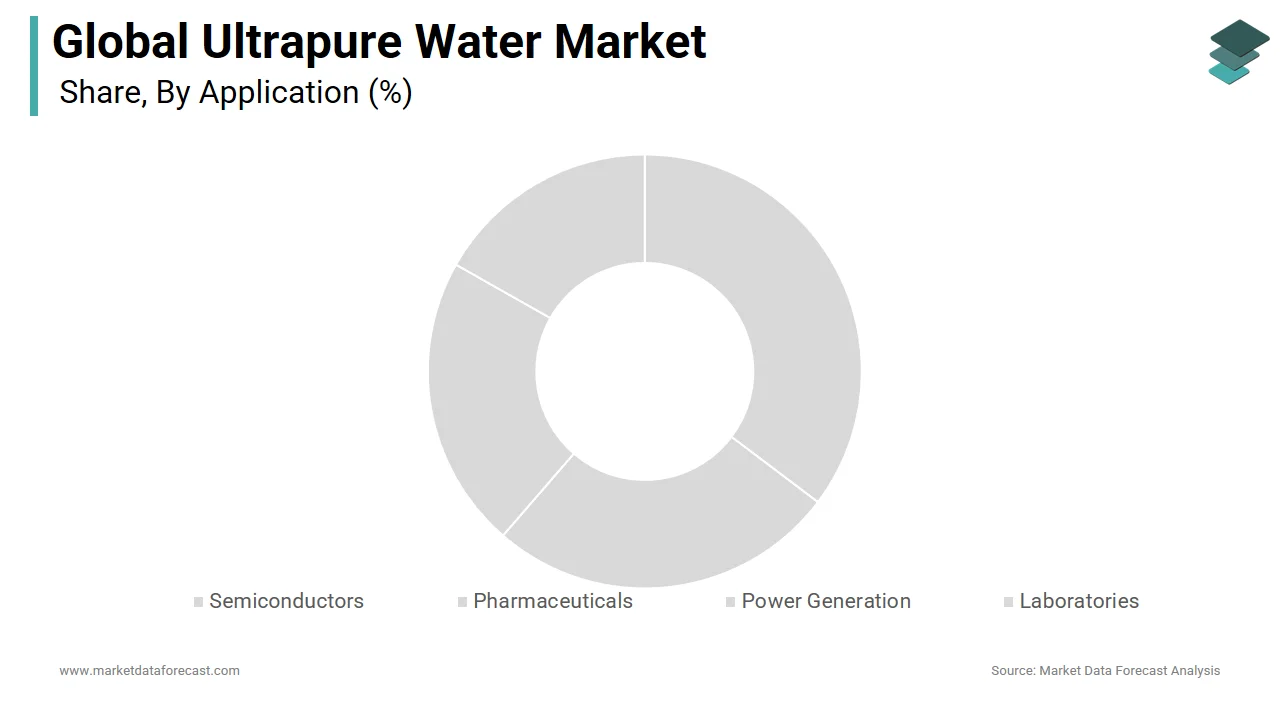
Among the application segments, the washing fluid segment accounts for a big share of revenue and is predicted to register lucrative growth soon. Washing fluid is one of the most important applications of ultrapure water. Ultrapure water is employed as washing fluids in various industries, such as pharmaceutical, flat panel, and semiconductor. Moreover, it is used for removing small particles and impurities in various industries, which is another factor supporting the expansion of the washing fluid segment.
By End User Insights
Among the end-user segments, the semiconductor sector is predicted to account for major revenue over the outlook period. In the semiconductor industry, using ultrapure water for wafer fabrication may be a driving factor for the growth of this segment.
REGIONAL ANALYSIS
Currently, the Asia Pacific market accounts for a significant share in terms of revenue and is anticipated to register high growth over the forecast period. The growing industry and increasing demand for ultrapure water within the semiconductor industry, especially in countries like China, Taiwan, South Korea, etc., are factors supporting the expansion of the target market in this region. Besides, increasing the installation of coal-fired power plants in countries within the Asia Pacific is another factor driving the expansion of the ultrapure market.
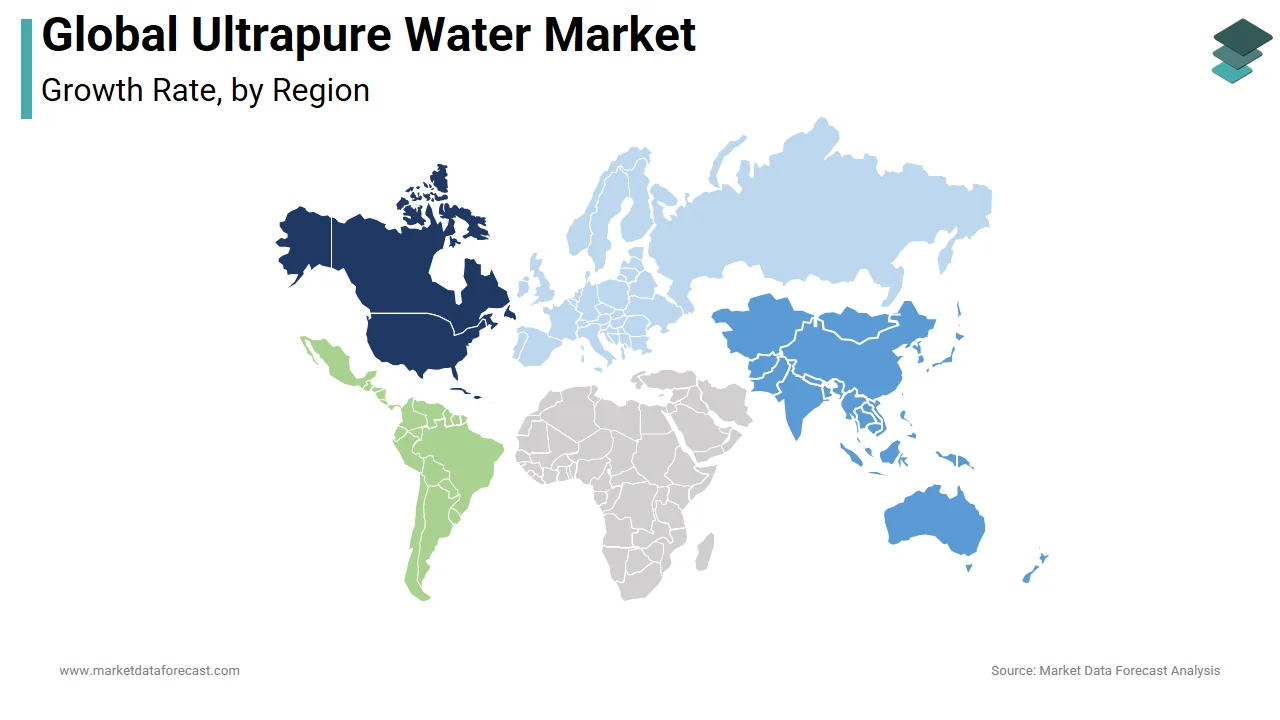
The market in North America accounted for the second-highest share in terms of revenue and is predicted to keep up its position within the near future, followed by Europe. The increasing number of gas-turbine power plants and coal-fired power plants is a factor anticipated to propel the expansion of the target market in Europe. The market in the Middle East & Africa and Latin America is anticipated to register lucrative growth in terms of revenue over the foreseen period.
KEY MARKET PLAYERS
Some of the major players operating in the ultrapure water market include Siemens Water Technologies, Ovivo Inc., Microdyn-Nadir, PALL Corporation, Sterling Berkfeld, Pentair PLC, Koch Membrane Systems, Evoqua Water Technologies, Neto Denco, Asahi Kasei, Hyrdranautics, Veolia Environment S.A., Aquatech, Alamo Water Refiners Inc., GE Water and Process Technologies Inc., Dow Water & Process Solutions, Kurita Water Industries Ltd., and others.
RECENT MARKET DEVELOPMENTS
- In October 2019, Evoqua Water Technologies LLC was selected by environmental technology company CleanBay Renewables Inc. (CleanBay) for its Westover, Maryland bio-refinery, which provides mission-critical water treatment solutions. Evoqua is an industry leader and became CleanBay's key partner.
MARKET SEGMENTATION
This research report on the global ultrapure water market has been segmented and sub-segmented based on the application, end user Industry, Technology, Equipment, and region.
By Application
- Semiconductors
- Pharmaceuticals
- Power Generation
- Laboratories
- Others
By End-Use Industry
- Electronics & Semiconductors
- Pharmaceutical & Biotechnology
- Power Generation
- Food & Beverage
- Others
By Technology
- Reverse Osmosis (RO)
- Ultrafiltration (UF)
- Electrodeionization (EDI)
- Ion Exchange
- UV Oxidation
- Others
By Equipment
- Filtration Units
- Degasifiers
- Electro Deionization Systems
- Others
By Region
- North America
- The United States
- Canada
- Rest of North America
- Europe
- The United Kingdom
- Spain
- Germany
- Italy
- France
- Rest of Europe
- The Asia Pacific
- India
- Japan
- China
- Australia
- Singapore
- Malaysia
- South Korea
- New Zealand
- Southeast Asia
- Latin America
- Brazil
- Argentina
- Mexico
- Rest of LATAM
- The Middle East and Africa
- Saudi Arabia
- UAE
- Lebanon
- Jordan
- Cyprus