- Product Description Description
- Table of Contents TOC
- List of Table & Figure LOT
- Get Free Sample PDF Sample PDF
Market Size, 2025
$2.21 BnMarket Estimate, 2026
$2.33 BnMarket Forecast, 2034
$3.55 BnCAGR, 2026–2034
5.4%Executive Summary: U.K. Boiler Market
- Market Scope: Comprehensive analysis of the U.K. heating sector, detailing hot water and steam systems, residential and commercial applications, regulatory decarbonization mandates, and manufacturer landscapes.
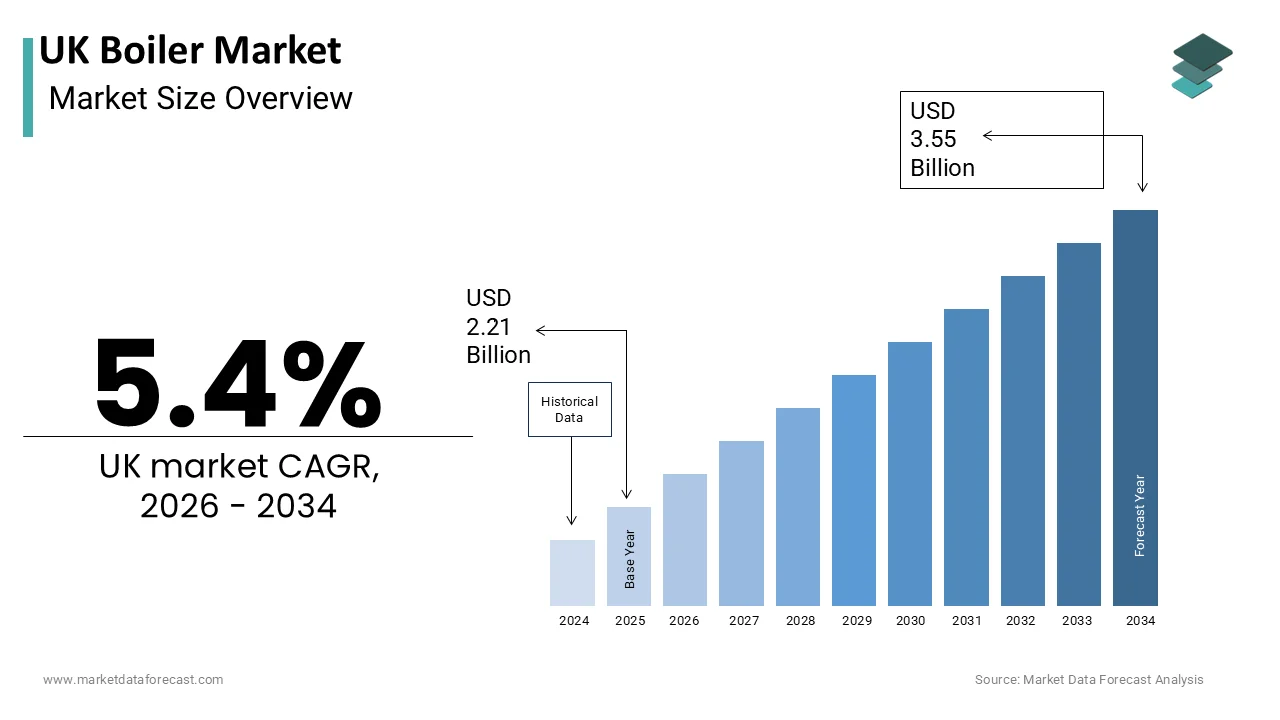
- Market Valuation: Valued at USD 2.21 billion in 2025, reaching USD 2.33 billion in 2026, and projected to expand to USD 3.55 billion by 2034, growing at a robust CAGR of 5.4% from 2026 to 2034.
- Primary Growth Drivers: Stringent government regulations and net-zero targets driving replacement demand, alongside rising energy costs and increased consumer focus on heating efficiency.
Key Market Segment Metrics
| Category | Leading Segment (Base Position) | Fastest-Growing / High-Growth Segment |
|---|---|---|
| By Product Type | Hot Water Boilers (dominated in 2025, driven by extensive wet central heating infrastructure across residential homes) | Steam Water Boilers (anticipated at a 5.4% CAGR, fueled by increasing process heating demands in industrial applications) |
| By End-User Industry | Residential (occupied the major share in 2025, backed by high homeownership rates and predictable replacement cycles) | Commercial (growing at a 4.4% CAGR, propelled by facility upgrades and post-pandemic recovery in hospitality and retail) |
| By Country | United Kingdom (market leader with a 100% share, functioning as a key testing ground for low-carbon heating technologies) | United Kingdom (key regional market expanding via smart controls, hydrogen blending, and hybrid heating innovations) |
Major Market Players & Industry Landscape
Market Structure: Intense and competitive environment characterized by established global manufacturers and a fragmented network of local installers navigating stringent net-zero compliance.
Key Companies: Worcester Bosch, Vaillant Group, Baxi Heating UK Ltd., Ideal Heating Ltd., Viessmann Group, Ariston Holding N.V., Ferroli S.p.A., Alpha Heating Innovation, Glow-worm (Vaillant Group), Navien Inc., Grant Engineering (UK) Ltd., and A.O. Smith Corporation.
 Download Free Sample Report
UK Boiler Market Size
The U.K. Boiler Market is projected to grow from USD 2.21 billion in 2025 to USD 2.33 billion in 2026 and reach USD 3.55 billion by 2034, registering a CAGR of 5.4% during the forecast period from 2026 to 2034.
Boilers represent a critical component of the residential and commercial infrastructure of the UK, primarily focused on the provision of central heating and hot water solutions. This sector is currently undergoing a significant structural transformation driven by stringent environmental regulations and the urgent need to decarbonize the built environment. The market encompasses the manufacture, distribution, installation, and maintenance of gas, oil, electric, and hybrid heating systems. According to the Department for Energy Security and Net Zero, approximately 85% of homes in Great Britain rely on gas boilers for their primary heating needs, which indicates the deeply entrenched nature of this technology. However, the legislative landscape is shifting rapidly with the Future Homes Standard mandating that new builds must not use fossil fuel heating systems from 2025 onwards. This regulatory pivot is forcing manufacturers and installers to adapt their business models toward low-carbon alternatives such as heat pumps and hydrogen-ready boilers. The aging housing stock in the UK, with millions of properties having inefficient heating systems, presents a substantial retrofit opportunity. Consumer awareness regarding energy efficiency and rising utility costs further influences purchasing decisions. The industry is characterized by a mix of established global manufacturers and a fragmented network of local installers. Supply chain dynamics are increasingly influenced by the availability of skilled labor and raw materials. This complex ecosystem requires stakeholders to navigate technical innovation, regulatory compliance, and changing consumer preferences while ensuring reliable and affordable heating solutions for the population.
MARKET DRIVERS
Stringent Government Regulations and Net Zero Targets Drive Replacement Demand
The implementation of stringent government regulations and the commitment to net zero emissions are majorly driving the expansion of the UK boiler market by mandating the phase-out of high-carbon heating systems. The UK government has set legally binding targets to reduce greenhouse gas emissions, which directly impact the heating sector, responsible for a significant portion of domestic carbon output. According to the Committee on Climate Change, heating accounts for approximately 14% of the UK’s total greenhouse gas emissions, necessitating urgent intervention. Policies such as the ban on new gas boiler installations in off-grid homes and the upcoming restrictions on new build properties are accelerating the replacement cycle. Homeowners are increasingly motivated to upgrade to compliant systems such as condensing boilers or hybrid units to avoid future penalties and ensure property value retention. The Boiler Upgrade Scheme provides financial incentives for switching to low-carbon technologies, stimulating demand for modern, efficient units. These regulatory pressures create a predictable pipeline of work for manufacturers and installers as older non-compliant units reach the end of their life. The clarity of the legislative roadmap allows businesses to plan long-term investments in compliant technologies. This driver ensures sustained demand for high-efficiency boilers that meet current and future environmental standards. As enforcement mechanisms strengthen, the urgency for compliance will continue to propel market activity and technological adoption across the residential and commercial sectors.
Rising Energy Costs and Consumer Focus on Efficiency Stimulate Upgrades
Escalating energy costs and an increased consumer focus on operational efficiency are further fuelling the expansion of the UK boiler market as households seek to reduce utility bills. The volatility in global energy markets has led to substantial increases in gas and electricity prices, prompting consumers to prioritize high-efficiency heating solutions. According to Ofgem, the energy price cap has seen significant adjustments in recent years, causing financial strain for many households and businesses. This economic pressure drives the replacement of old, inefficient boilers with modern condensing models that offer superior thermal performance and lower running costs. Consumers are increasingly aware that upgrading to an A-rated boiler can result in noticeable savings on annual energy bills. The desire for energy independence and cost predictability encourages investment in smart heating controls and zoned systems that optimize usage. Retailers and installers capitalize on this trend by highlighting the long-term financial benefits of efficient boilers in their marketing campaigns. The payback period for upgrading becomes more attractive as energy prices remain elevated. This driver is reinforced by government advice and consumer advocacy groups promoting energy-saving measures. As households become more budget-conscious, the demand for cost-effective and efficient heating solutions will continue to grow. This economic imperative ensures that efficiency remains a key decision factor for buyers in the UK boiler market.
MARKET RESTRAINTS
High Initial Installation Costs and Economic Uncertainty Restrain Adoption
The high initial capital costs associated with new boiler installations and broader economic uncertainty are major restraints on the UK boiler market by limiting consumer spending power. Replacing a boiler involves significant upfront expenditure, including the cost of the unit, labor, and potential system upgrades, which can amount to several thousand pounds. For instance, many homeowners delay necessary replacements due to financial constraints, particularly during periods of economic instability. The cost-of-living crisis has reduced disposable income for many households, leading to the prioritization of essential expenses over home improvements. Rising interest rates further exacerbate this issue by increasing the cost of financing options, such as loans or credit cards. Small and medium-sized enterprises also face challenges in affording new commercial heating systems amidst tight profit margins. The lack of affordable financing schemes for standard boiler replacements discourages prompt action until systems fail. This reactive approach leads to emergency replacements rather than planned upgrades, which can be more disruptive and costly. Economic unpredictability makes it difficult for consumers to commit to large expenditures. Manufacturers and installers struggle to stimulate demand when price sensitivity is high. Until economic conditions stabilize or more accessible funding options become available, the high cost barrier will continue to suppress market growth and slow the transition to newer technologies.
Shortage of Skilled Labor and Installation Capacity Constraints
A persistent shortage of skilled labor and installation capacity constraints is another significant restraint on the UK boiler market,y delaying projects and increasing service costs. The heating industry faces a chronic deficit of qualified Gas Safe-registered engineers capable of installing and maintaining modern boiler systems. According to industry bodies, the aging workforce and insufficient training pipelines have created a bottleneck in service delivery. This scarcity leads to longer wait times for customers seeking installations or repairs, which can deter potential buyers. The limited availability of skilled technicians drives up labor costs, as companies compete for talent, further increasing the total cost of ownership for consumers. Complex installations involving system upgrades or integration with renewable technologies require specialized skills that are in short supply. The regulatory requirement for certified professionals means that unqualified labor cannot be used to alleviate the shortage. This constraint hampers the ability of the market to scale up in response to increased demand driven by regulatory changes. Training new engineers takes time and resources, which smaller firms may struggle to provide. The reliance on a limited pool of experts creates vulnerability to disruptions, such as illness or seasonal demand spikes. Until the skills gap is addressed through enhanced vocational training and recruitment initiatives, the market will remain constrained by its human capital limitations.
MARKET OPPORTUNITIES
Integration of Hydrogen Ready Boilers and Hybrid Systems
The development and integration of hydrogen-ready boilers and hybrid heating systems present substantial opportunities for the UK boiler market to bridge the gap between fossil fuels and net-zero goals. As the national grid explores hydrogen blending and pure hydrogen networks, there is growing interest in appliances that can transition seamlessly. According to the Health and Safety Executive, trials are underway to assess the safety and feasibility of hydrogen heating in domestic settings. Manufacturers have the opportunity to lead this transition by producing boilers that are compatible with hydrogen blends or can be converted easily. Hybrid systems that combine gas boilers with heat pumps offer a practical solution for improving efficiency without requiring a complete infrastructure overhaul. These systems allow homeowners to benefit from lower carbon heating while retaining the reliability of gas during peak demand. Government support for hydrogen infrastructure development could create a new market segment for compatible appliances. Early movers in this space can establish brand leadership and influence industry standards. The opportunity extends to servicing and maintenance contracts for these advanced systems, which require specialized knowledge. By positioning themselves at the forefront of low-carbon innovation, companies can secure long-term relevance. This technological evolution offers a pathway for the existing boiler industry to adapt and thrive in a decarbonizing economy.
Expansion of Smart Heating Controls and Digital Connectivity
The expansion of smart heating controls and digital connectivity offers significant opportunities for the UK boiler market. Consumers are increasingly seeking intelligent solutions that allow remote monitoring and optimization of their heating systems via smartphones and tablets. According to tech industry analysis, the adoption of Internet of Things devices in homes is rising, with heating controls being a key application. Smart thermostats and boiler interfaces enable users to adjust temperatures, schedule heating, and track energy usage in real time, leading to greater efficiency and comfort. Manufacturers can integrate these features into new boiler models, creating added value and justifying premium pricing. Partnerships with software developers and energy providers can enhance functionality through data analytics and automated adjustments. The ability to diagnose issues remotely reduces service call-outs and improves customer satisfaction. Subscription-based services for monitoring and maintenance provide recurring revenue streams for companies. Smart connectivity aligns with the broader trend toward home automation and energy management. As consumers become more tech-savvy, the demand for connected heating solutions will increase. This opportunity allows brands to differentiate themselves in a crowded market by offering superior user experiences and operational insights. Embracing digital transformation positions companies to meet evolving consumer expectations and drive sustainable growth.
MARKET CHALLENGES
Supply Chain Volatility and Raw Material Price Fluctuations
Volatility in global supply chains and fluctuations in raw material prices pose a major challenge to the UK boiler market by impacting manufacturing costs and availability. Key components, such as copper, steel, and electronic chips, are subject to global market dynamics and geopolitical tensions. According to industry reports, disruptions in sourcing have led to extended lead times and increased production costs for manufacturers. The reliance on international suppliers makes the market vulnerable to trade barriers and logistical bottlenecks. Post-Brexitt customs procedures add complexity and cost to importing parts from Europe, affecting inventory management. Manufacturers struggle to maintain stable pricing for retailers and consumers when input costs are unpredictable. Hedging strategies provide some protection but cannot fully mitigate long-term risks. The scarcity of certain materials can delay product launches and fulfillment of orders, damaging brand reputation. Smaller manufacturers with less bargaining power are particularly affected by these pressures. The need to diversify supply sources requires significant investment and time to establish reliable partnerships. This challenge necessitates agile operational strategies and robust risk management frameworks. Without stable supply chains, the competitiveness and profitability of the UK boiler market remain under threat from external economic forces.
Complex Regulatory Compliance and Evolving Safety Standards
The complexity of regulatory compliance and evolving safety standards is further challenging the UK boiler market growth by increasing administrative burdens and development costs. Manufacturers must adhere to strict regulations regarding emissions, efficiency, and safety, set by bodies such as the Health and Safety Executive and the Department for Energy Security and Net Zero. According to legal experts, navigating the post Brexit regulatory landscape requires careful attention to both UK-specific rules and international standards for export markets. Compliance testing and certification processes are rigorous and time-consuming, delaying product launches. Changes in legislation, such as new efficiency mandates or safety protocols, require frequent redesigns and engineering adjustments. The cost of maintaining compliance teams and conducting regular audits adds to operational overheads. Non-compliance can result in hefty fines, product recalls, and reputational damage. The diversity of regulations across different regions complicates the production of standardized models, forcing manufacturers to create multiple variants. Keeping pace with evolving requirements for low-carbon technologies adds further complexity. Small and medium-sized enterprises often struggle with the administrative burden, limiting their ability to innovate. This regulatory maze requires continuous monitoring and adaptation, straining resources. Companies must balance innovation with compliance, ensuring that new features do not violate existing standards. This challenge demands robust legal and technical expertise to navigate successfully.
REPORT COVERAGE
| REPORT METRIC | DETAILS |
| Market Size Available | 2025 to 2034 |
| Base Year | 2025 |
| Forecast Period | 2026 to 2034 |
| Segments Covered | By Product Type, End-User Industry and Region. |
| Various Analyses Covered | Global, Regional and Country-Level Analysis, Segment-Level Analysis, Drivers, Restraints, Opportunities, Challenges; PESTLE Analysis; Porter’s Five Forces Analysis, Competitive Landscape, Analyst Overview of Investment Opportunities |
| Countries Covered | United Kingdom |
| Market Leaders Profiled | Worcester Bosch, Vaillant Group, Baxi Heating UK Ltd., Ideal Heating Ltd., Viessmann Group, Ariston Holding N.V., Ferroli S.p.A., Alpha Heating Innovation, Glow-worm (Vaillant Group), Navien Inc., Grant Engineering (UK) Ltd., A.O. Smith Corporation. |
SEGMENTAL ANALYSIS
By Product Type Insights
The hot water boilers segment dominated the market and accounted for the major share of the UK market in 2025 due to their widespread adoption in residential properties for space heating and domestic hot water supply. The vast majority of UK homes are equipped with wet central heating systems that rely on hot water circulation through radiators or underfloor heating pipes. According to the Department for Energy Security and Net Zero, approximately 85% of households in Great Britain use gas-fired hot water boilers as their primary heating source. This entrenched infrastructure ensures consistent demand for replacements and upgrades as older units reach the end of their operational life. The versatility of hot water boilers allows them to integrate seamlessly with existing pipework and radiator networks, minimizing installation complexity and cost. Consumers prefer these systems for their reliability and ability to provide consistent warmth throughout the property. The availability of high-efficiency condensing models further reinforces their dominance by meeting strict regulatory standards for energy performance. Retailers and installers are well versed in these systems, ensuring easy access to parts and service. The familiarity of homeowners with hot water heating creates a low barrier to adoption for new models. This segment benefits from the sheer volume of residential properties requiring heating solutions, making it the cornerstone of the UK boiler market.
On the other hand, the steam water boilers segment is estimated to grow at a healthy CAGR of 5.4% during the forecast period in the Umarketke,t owing to the increasing demand for process heating in industrial applications. Industries such as food and beverage, pharmaceuticals, and chemical manufacturing require precise and reliable steam generation for sterilization, cleaning, and processing tasks. According to industry analysis, the expansion of these sectors in the UK has led to higher investment in specialized steam boiler systems. Steam offers superior heat transfer properties compared to hot water, making it essential for high-temperature industrial processes. Manufacturers are developing advanced steam boilers with improved control systems and fuel flexibility to meet diverse operational needs. The shift toward natural gas and biomass fuels in industrial settings supports the adoption of modern steam generators that comply with environmental regulations. The need to continuously and efficiently produce drives companies to upgrade aging steam infrastructure with newer, more reliable units. This segment benefits from long-term contracts and recurring maintenance services, providing stable revenue streams for suppliers. As industrial output grows, the demand for efficient steam generation will continue to accelerate, outpacing other boiler types.
By End-User Industry Insights
The residential segment occupied the major share of the UK market in 2025 due to high homeownership rates and regular replacement cycles of aging heating systems. With millions of private households relying on individual boilers for heating and hot water, the volume of installations and replacements is substantial. According to the Office for National Statistics, the majority of UK dwellings are owner-occupied or privately rented, creating a large base of decision makers responsible for heating upgrades. The average lifespan of a boiler is between 10 and 15 years, leading to a predictable stream of replacement demand as older units fail or become inefficient. Homeowners are motivated to replace boilers to maintain comfort, reduce energy bills, and comply with safety regulations. The availability of financing options and government incentives facilitates these purchases. Retailers and installers target this segment extensively through marketing campaigns and local advertising. The fragmented nature of the residential market allows for a wide range of providers, from large national companies to local independent engineers. This diversity ensures competitive pricing and service availability across the country. The sheer scale of the housing stock ensures that the residential sector remains the largest contributor to boiler sales and installations in the UK.
On the other hand, the commercial segment is the fastest-growing segment in the UK boiler market and is predicted to expand at a CAGR of 4.4% during the forecast period, owing to the expansion in the hospitality and retail industries. Hotels, restaurants, and shopping centers require robust heating and hot water systems to ensure customer comfort and operational hygiene. According to industry data, the recovery and growth of the tourism and leisure sectors post-pandemic have led to increased investment in facility upgrades and new builds. Commercial boilers must handle higher loads and provide consistent performance during peak hours, making reliability paramount. Businesses are upgrading to high-efficiency condensing boilers to reduce operational costs and meet corporate sustainability targets. The complexity of commercial systems requires specialized design and installation services, creating opportunities for expert providers. Regulatory requirements for commercial buildings regarding energy performance certificates drive retrofitting activities. The trend toward open plan spaces and enhanced customer experiences increases the demand for zoned heating controls. As the commercial property market evolves, the need for modern,n efficient heating solutions continues to grow. This segment benefits from professional procurement processes and long-term maintenance contracts, ensuring sustained revenue for suppliers.
COUNTRY LEVEL ANALYSIS
UK Boiler Market Analysis
The UK is expected to undergo highly responsive structural changes in residential energy infrastructure and accelerated deployment of low-carbon alternative technologies over the next few years. As a leader in environmental policy, the UK has set ambitious net-zero targets that are reshaping the boiler industry. According to the Department for Energy Security and Net Zero, the government aims to phase out the installation of new natural gas boilers beyond 2035, driving significant innovation and investment in hybrid and hydrogen-ready technologies. The market status is dynamic with a mix of established global manufacturers and a fragmented network of local installers. Consumer awareness of energy efficiency is high due to rising utility costs and environmental concerns. The regulatory framework is stringent, with strict efficiency standards and safety requirements governing product design and installation. The aging housing stock presents a substantial retrofit opportunity for modern, high-efficiency boilers. The UK serves as a testing ground for new heating technologies such as hydrogen blending and smart controls. This combination of regulatory pressure, technological innovation, and consumer demand ensures that the UK remains a pivotal market for boiler manufacturers and service providers in Europe.
COMPETITIVE LANDSCAPE
The competition in the UK boiler market is intense and characterized by a mix of established global manufacturers and specialized domestic brands. Major players compete on product reliability, energy efficiency, and after-sales support to capture consumer trust. The market is highly regulated, requiring strict adherence to safety and environmental standards,s which acts as a barrier to entry for new competitors. Innovation in low carbon ttechnologies such as hydrogen-ready boilers and heat pump hybrids, is a key differentiator. Price competition is significant, particularly in the residential segment,t where consumers are sensitive to upfront costs. Brand reputation and installer recommendations play crucial roles in purchasing decisions. Companies invest heavily in marketing and training programs to build loyalty among professionals and end users. The shift toward smart heating solutions adds a technological dimension to competition. Manufacturers must balance cost efficiency with compliance and innovation to succeed. This dynamic environment requires continuous adaptation to regulatory changes and evolving consumer preferences for sustainable and connected heating systems.
KEY MARKET PLAYERS
Some of the companies that are playing a dominating role in the U.K. Boiler Market include
- Worcester Bosch
- Vaillant Group
- Baxi Heating UK Ltd.
- Ideal Heating Ltd.
- Viessmann Group
- Ariston Holding N.V.
- Ferroli S.p.A.
- Alpha Heating Innovation
- Glow-worm (Vaillant Group)
- Navien Inc.
- Grant Engineering (UK) Ltd.
- A.O. Smith Corporation
TOP LEADING PLAYERS IN THE MARKET
- Worcester Bosch Group is a leading manufacturer of heating and hot water products in the UK, known for its high-quality gas condensing boilers. The company contributes significantly to the market by providing reliable and efficient heating solutions for residential and commercial properties. Recent actions include expanding its range of hydrogen-ready boilers to support the national decarbonization strategy. Worcester Bosch strengthens its market position by investing heavily in engineering training programs through its accredited installer network. The company also focuses on customer service excellence and extended warranty offerings to build brand loyalty. By prioritizing innovation and sustainability, Worcester Bosch maintains its reputation as a trusted provider of home heating technology in the UK.
- Vaillant Group is a major international heating technology company with a strong presence in the UK market. The company offers a comprehensive portfolio of boilers, heat pumps, and renewable energy systems tailored to British homes. Recent actions involve launching advanced smart heating controls that integrate seamlessly with their boiler ranges for enhanced efficiency. Vaillant strengthens its market position by promoting hybrid systems that combine gas boilers with air source heat pumps. The company also emphasizes sustainable manufacturing practices and carbon-neutral operations. By focusing on digital connectivity and low-carbon technologies, Vaillant addresses evolving regulatory requirements and consumer preferences for eco-friendly heating solutions in the UK.
- Baxi Heating UK Limited is a prominent supplier of heating and hot water solutions serving both domestic and commercial sectors in the UK. The company provides a wide variety of boilers, including combisystems and regular mode,l s to meet diverse customer needs. Recent actions include developing compact and lightweight boilers designed for easier installation in smaller properties. Baxi strengthens its market position by enhancing its digital support tools for installers and homeowners. The company also participates in government initiatives to promote energy efficiency and skills development in the heating industry. By delivering innovative and accessible heating products, Baxi continues to play a vital role in keeping UK homes warm and comfortable.
TOP STRATEGIES USED BY KEY MARKET PARTICIPANTS
Key players in the UK boiler market employ several strategic approaches to maintain competitiveness and drive growth. Product innovation is central with companies developing hydrogen-ready and hybrid heating systems to meet net-zero targets. Digital integration through smart controls and remote monitoring enhances user experience and operational efficiency. Strategic partnerships with installer networks ensure high-quality service and customer satisfaction. Sustainability initiatives, including carbon-neutral manufacturing and recycling programs, are prioritized to align with environmental regulations. Training and certification programs for engineers help address skilled labor shortages. These combined strategies enable key participants to adapt to regulatory changes and consumer demands effectively.
MARKET SEGMENTATION
This research report on the UK boiler market is segmented and sub-segmented into the following categories.
By Product Type
- Hot Water Boilers
- Steam Water Boilers
By End-User Industry
- Residential
- Commercial
- Industrial
By Country
- United Kingdom