- Product Description Description
- Table of Contents TOC
- List of Table & Figure LOT
- Get Free Sample PDF Sample PDF
Market Size, 2025
$30.18 BnMarket Estimate, 2026
$32.29 BnMarket Forecast, 2034
$55.39 BnCAGR, 2026–2034
6.98%UK Commercial Insurance Market Report Summary
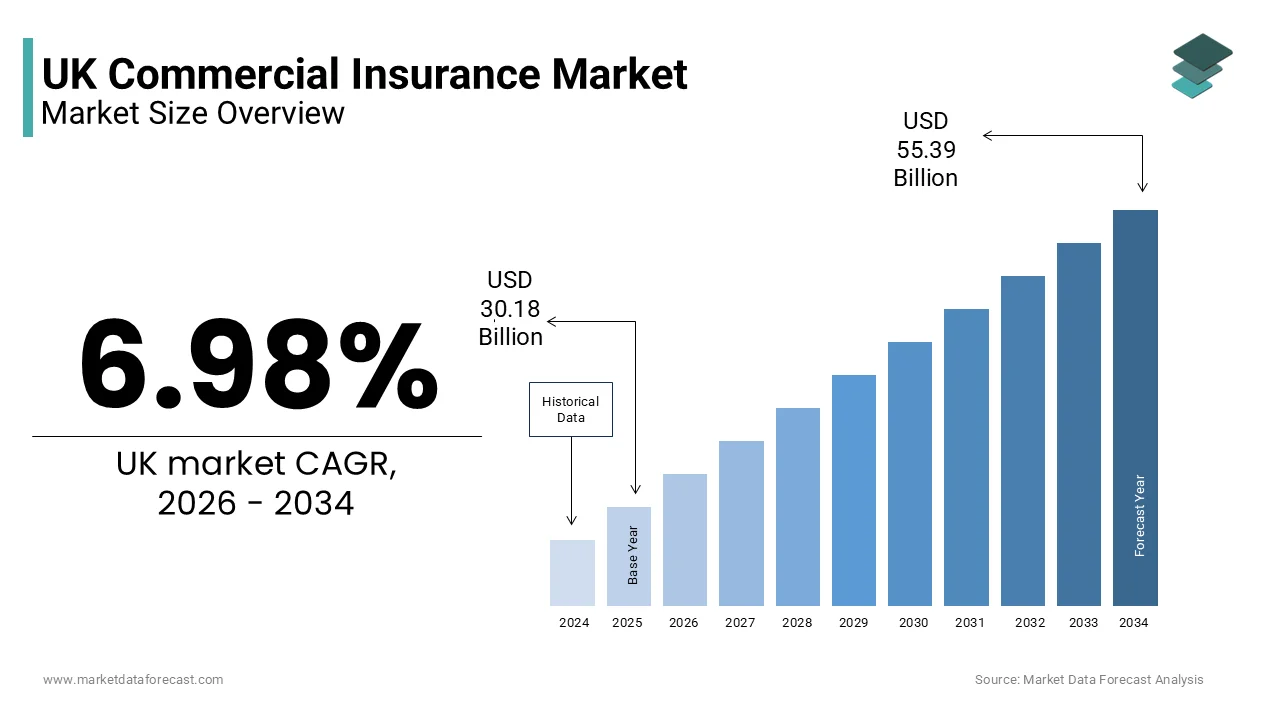
The UK commercial insurance market was valued at USD 30.18 billion in 2025, is estimated to reach USD 32.29 billion in 2026, and is projected to reach USD 55.39 billion by 2034, growing at a CAGR of 6.98% during the forecast period. Market growth is driven by increasing business risk awareness, rising regulatory compliance requirements, growing demand for cyber and liability coverage, and the expansion of commercial activities across multiple industries. Advancements in risk assessment technologies, digital insurance platforms, and customized coverage solutions are further supporting market growth across the United Kingdom.
Key Market Trends
- Growing demand for liability and cyber insurance coverage is driving market growth.
- Increasing awareness of business risk management is boosting market expansion.
- Rising adoption of digital insurance platforms and automated underwriting is supporting industry development.
- Expansion of specialized insurance products for emerging business risks is enhancing market opportunities.
- Growing focus on data analytics and predictive risk modeling is influencing market advancement.
Segmental Insights
- Based on type, the liability insurance segment accounted for 34.2% of the UK commercial insurance market share in 2025. This dominance is attributed to increasing legal obligations, rising litigation risks, and the need for businesses to protect against third party claims.
- Based on enterprise type, the large enterprises segment held 43.9% of the UK commercial insurance market share in 2025, driven by extensive operational risks, larger asset bases, and complex insurance requirements.
- Based on industry, the construction segment accounted for 44.3% of the UK commercial insurance market share in 2025, supported by high project values, workplace safety risks, and regulatory insurance requirements.
Regional Insights
The United Kingdom remains one of the most developed commercial insurance markets in Europe, supported by a mature financial services sector, strong regulatory framework, and increasing demand for comprehensive risk management solutions.
Competitive Landscape
The UK commercial insurance market is highly competitive, with insurers focusing on digital transformation, risk analytics, customized policy offerings, and customer experience enhancement to strengthen their market position. Companies continue to invest in advanced underwriting technologies, cyber risk solutions, and industry specific insurance products. Major players operating in the UK commercial insurance market include Aviva plc, AXA UK, Allianz UK, Zurich Insurance Group, RSA Insurance, Direct Line Group, Chubb, AIG, QBE Insurance Group, Hiscox, Travelers Europe, and Liberty Specialty Markets.
UK Commercial Insurance Market Size
The UK commercial insurance market size was valued at USD 30.18 billion in 2025, and is projected to reach USD 55.39 billion by 2034 from USD 32.29 billion in 2026, growing at a CAGR of 6.98%.
The commercial insurance is financial infrastructure segment designed to protect businesses against operational liabilities property damage and cyber threats. As per the Office for National Statistics, there were approximately 5.5 million private sector businesses operating in the UK in 2025 by creating a vast base of potential policyholders requiring diverse coverage solutions. The complexity of modern business operations has expanded the scope of commercial insurance beyond traditional fire and theft policies to include sophisticated covers for data breaches supply chain interruptions and executive liabilities. According to HM Revenue and Customs the corporate sector contributed 18% of total UK tax revenues in 2024 underscoring the economic significance of maintaining resilient business operations through adequate insurance protection. The integration of digital technologies has transformed underwriting processes enabling more accurate risk assessment through real time data analytics. Climate change considerations are increasingly influencing policy terms and pricing structures as insurers adjust to emerging environmental risks.
MARKET DRIVERS
Regulatory Compliance Mandates Driving Mandatory Coverage Adoption
The strict regulatory frameworks and legal requirements compel UK businesses to secure specific types of commercial insurance thereby creating a consistent baseline demand, across various industry sectors. The regulatory compliance mandates is driving mandatory coverage adoption that is boosting the growth of the United Kingdom commercial insurance market. Employers liability insurance is a statutory requirement for almost all employers in the UK ensuring that workers are compensated for work related injuries or illnesses. The Employers Liability Compulsory Insurance Act mandates that businesses hold at least 5 million pounds in coverage with approved insurers failing to comply facing substantial fines. Additionally, professional indemnity insurance is often required by regulatory bodies for sectors such as finance law and healthcare to protect against claims of negligence or malpractice. The Financial Conduct Authority requires authorized firms to maintain adequate professional indemnity cover to ensure consumer protection and market integrity. These legal obligations remove discretion from purchasing decisions making compliance a primary driver for market volume. Businesses must also adhere to contractually required insurance levels when bidding for public sector projects or working with large corporate clients. The complexity of these regulations necessitates specialized brokerage services and continuous policy reviews to ensure ongoing compliance. This regulatory pressure ensures a stable demand floor for commercial insurance products regardless of broader economic fluctuations.
Digital Transformation and Cyber Risk Exposure Increasing Demand
The rapid digitization of business operations has exponentially increased exposure to cyber threats driving unprecedented demand for cyber liability and data breach insurance policies, which is also fuelling the growth of the United Kingdom commercial insurance market. As UK companies migrate infrastructure to cloud platforms and rely on digital transactions, they become vulnerable to ransomware phishing attacks and data theft. According to the National Cyber Security Centre, UK businesses experienced an average of 72000 cyber attacks per week in 2025 with small and medium sized enterprises increasingly targeted due to perceived security gaps. Commercial insurance providers have responded by developing comprehensive cyber policies that cover not only financial losses but also costs associated with forensic investigations legal fees and customer notification. The General Data Protection Regulation imposes severe penalties for data mishandling making insurance a vital risk mitigation tool. Many organizations now view cyber insurance as essential rather than optional integrating it into their overall enterprise risk management strategies. The rising cost of cyber incidents including business interruption and reputational damage further justifies the investment in specialized coverage. Insurers are leveraging artificial intelligence to assess cyber hygiene and offer premium discounts for robust security practices.
MARKET RESTRAINTS
Economic Volatility Impacting Business Investment and Premium Affordability
The fluctuating economic conditions and inflationary pressures to invest in comprehensive commercial insurance coverage leading to potential underinsurance or policy cancellations is hindering the growth of the United Kingdom commercial insurance market. Rising operational costs force companies to prioritize immediate cash flow preservation over long term risk management expenditures. Small and medium sized businesses are particularly vulnerable as they lack the financial reserves to absorb significant premium increases. The Federation of Small Businesses reported that 38% of UK small businesses reduced external service expenditures in 2025 including insurance renewals due to rising costs. When premiums rise faster than revenue growth businesses may opt for higher deductibles or reduce coverage limits exposing themselves to greater financial risk. Economic uncertainty also leads to delayed expansion plans and reduced capital expenditure which indirectly lowers the need for new project specific insurance policies. Insurers face difficulty in pricing policies accurately amidst volatile inflation rates affecting claim costs for materials and labor.
Complex Claims Processes Deterring Customer Satisfaction and Retention
The intricate and prolonged claims handling procedures by frustrating policyholders and undermining trust in insurance products is additionally declining the growth of the United Kingdom commercial insurance market. Commercial claims often involve complex assessments requiring detailed documentation expert evaluations and lengthy investigations, which delay settlements and disrupt business operations. Businesses facing interruptions due to fire flood or cyberattacks require rapid financial support to resume operations yet bureaucratic hurdles often impede timely payouts. The lack of transparency in claims adjudication processes leads to perceptions of unfairness and erodes long term customer loyalty. Small businesses with limited administrative resources struggle to navigate the extensive paperwork and technical requirements imposed by insurers. This friction encourages some companies to self-insure or seek alternative risk financing mechanisms bypassing traditional insurance channels. Insurers investing in manual legacy systems face higher operational costs and slower processing times compared to digitally native competitors. The reputational damage from poor claims experiences spreads quickly through industry networks influencing procurement decisions for other businesses. Improving claims efficiency requires substantial technology investment and process reengineering, which many incumbent insurers hesitate to undertake due to legacy infrastructure constraints.
MARKET OPPORTUNITIES
Integration of Internet of Things for Proactive Risk Management
The adoption of Internet of Things devices to shift from reactive compensation to proactive risk prevention and personalized pricing models is solely to create new opportunities for the growth of the United Kingdom commercial insurance market. Sensors installed in commercial properties vehicles and machinery provide real time data on usage patterns environmental conditions and maintenance needs. According to the Department for Science Innovation and Technology IoT adoption among UK manufacturing firms increased by 30% in 2025 enabling granular monitoring of operational risks. Insurers can leverage this data to offer usage-based insurance policies where premiums reflect actual risk exposure rather than historical averages. For example, telematics in commercial fleets allow insurers to reward safe driving behaviors with lower premiums while identifying risky drivers for targeted training. Smart building sensors can detect water leaks or fire hazards early preventing costly damages and reducing claim frequencies. This data driven approach enhances underwriting accuracy and reduces loss ratios for insurers while providing value added services to clients. Businesses benefit from insights that improve operational efficiency and safety standards beyond mere financial protection. Partnerships with technology providers enable insurers to offer integrated risk management platforms that combine coverage with preventive tools. This evolution strengthens client relationships by positioning insurers as strategic partners in business resilience rather than just financial vendors.
Expansion Into Emerging Risks Such as Climate and Supply Chain Disruptions
The growing awareness of climate change impacts and global supply chain vulnerabilities to develop innovative products addressing these emerging commercial risks, which is another factor to elevate the growth of the United Kingdom commercial insurance market. Extreme weather events, such as flooding and storms are becoming more frequent and severe disrupting business operations and damaging assets. The UK experienced its wettest winter on record in 2024 leading to widespread flood damage and business interruptions. Traditional property policies often exclude certain climate related perils or impose restrictive sub limits creating coverage gaps. Insurers can develop specialized parametric insurance products that trigger automatic payouts based on predefined weather indices providing rapid liquidity for affected businesses. Similarly, the global supply chain disruptions caused by geopolitical tensions or pandemics, where the need for contingent business interruption coverage. Collaborating with climate scientists and logistics experts enables the creation of robust models for pricing these complex risks. This strategic focus aligns with corporate sustainability goals and regulatory expectations for climate resilience.
MARKET CHALLENGES
Talent Shortage in Specialized Underwriting and Actuarial Roles
The commercial insurance sector, where shortage of skilled professionals particularly in underwriting actuarial science and data analytics hindering its ability to innovate and manage complex risks effectively. The talent shortage in specialised underwriting and actuarial roles is one of the major challenge for the growth of the United Kingdom commercial insurance market. The technical complexity of modern commercial risks such as cyber threats and climate change requires specialized expertise that is scarce in the labor market. Competition from technology and financial services sectors for data scientists and analysts drives up salary costs and makes recruitment difficult for traditional insurers. The lack of diverse skill sets limits the industry capacity to develop advanced pricing models and digital customer interfaces. Training existing staff takes time and resources delaying the implementation of strategic initiatives. High turnover rates further disrupt team continuity and service quality. Addressing this challenge requires significant investment in graduate programs apprenticeships and continuous professional development. However, the perception of insurance as a traditional and slow moving industry deters tech savvy graduates.
Legacy Technology Infrastructure Impeding Digital Agility
The outdated core systems and fragmented IT architectures prevent many commercial insurers from achieving the digital agility required to meet modern customer expectations and operational efficiencies. The legacy technology infrastructure impeding digital agility is also to limit the growth of the united Kingdom commercial insurance market. Legacy platforms often lack integration capabilities making it difficult to implement new digital tools or access real time data. According to Deloitte, 70% of UK insurers identified legacy technology as a major barrier to digital transformation in 2024. These systems are costly to maintain and prone to errors slowing down policy administration and claims processing. The inability to seamlessly connect with third party data sources or insurtech partners limits innovation and product development speed. Customers accustomed to instant digital experiences in other sectors find manual processes and delayed responses frustrating leading to churn. Migrating to modern cloud based systems require substantial capital investment and carries operational risks that many insurers hesitate to undertake. The complexity of data migration from legacy formats often results in data quality issues that hinder analytics efforts. Regulatory reporting requirements also strain outdated systems increasing compliance costs and error risks. Insurers stuck with legacy infrastructure struggle to compete with agile digital natives who can launch products rapidly and offer superior user experiences.
REPORT COVERAGE
| REPORT METRIC | DETAILS |
| Market Size Available | 2025 to 2034 |
| Base Year | 2025 |
| Forecast Period | 2026 to 2034 |
| CAGR | 6.98% |
| Segments Covered | By Type, Enterprise Type, Industry, and Region. |
| Various Analyses Covered | Global, Regional and Country-Level Analysis, Segment-Level Analysis, Drivers, Restraints, Opportunities, Challenges; PESTLE Analysis; Porter’s Five Forces Analysis, Competitive Landscape, Analyst Overview of Investment Opportunities |
| Market Leaders Profiled | Aviva plc, AXA UK, Allianz UK, Zurich Insurance Group, RSA Insurance, Direct Line Group, Chubb, AIG, QBE Insurance Group, Hiscox, Travelers Europe, and Liberty Specialty Markets |
SEGMENTAL ANALYSIS
By Type Insights
The liability insurance segment was the largest by capturing 34.2% of the United Kingdom commercial insurance market share in 2025 owing to the stringent legal mandates and the increasing complexity of professional indemnity requirements across diverse business sectors. The Employers Liability Compulsory Insurance Act mandates that virtually all employers hold a minimum of 5 million pounds in coverage with non-compliance resulting in daily fines of 2500 pounds. This legal framework creates an inelastic demand base as businesses cannot operate legally without this specific coverage. Furthermore, the rise in workplace injury claims due to aging infrastructure and increased reporting awareness has led to higher sum insured limits. Insurers must continuously adjust premiums to reflect rising compensation awards and legal costs. The universal nature of this requirement across all industries from construction to retail ensures that liability insurance remains the most widely held commercial policy type.
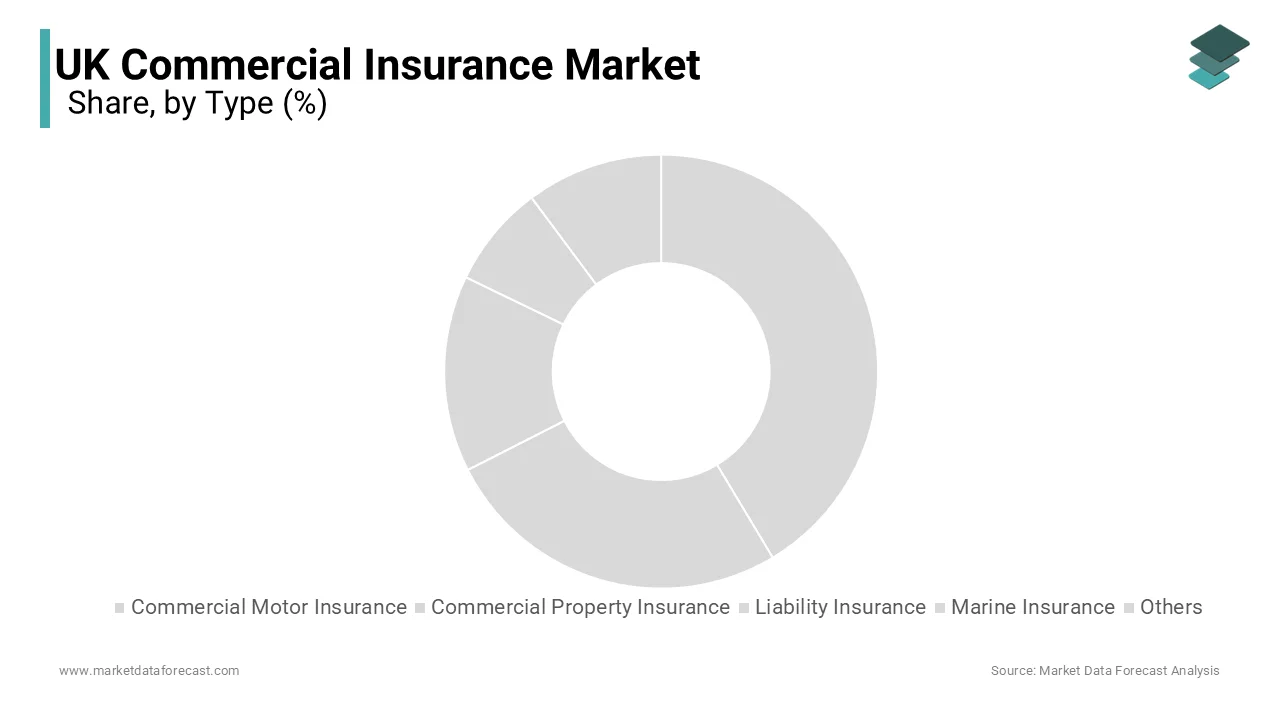
The commercial property insurance segment is projected to expand at a CAGR of 8.5% throughout the forecast period. Inflation in building materials and labor costs has further increased the expense of repairing or replacing damaged structures. Businesses must regularly update their sum insured levels to avoid underinsurance penalties which occur when payouts are reduced proportionally if coverage is insufficient. These dynamic forces regular policy reviews and premium adjustments. New commercial developments and refurbishments also generate fresh insurance needs as investors seek to protect their capital investments. The trend toward sustainable building practices involves expensive specialized materials that require specific coverage extensions. Insurers are adjusting valuations to reflect current replacement costs rather than historical purchase prices. This alignment with real world economic conditions ensures that property insurance premiums grow in tandem with asset values. The complexity of insuring mixed use developments and high rise buildings further contributes to premium density as these structures present unique risks requiring specialized underwriting expertise.
By Enterprise Type Insights
The large enterprises segment was the largest by holding 43.9% of the United Kingdom commercial insurance market share in 2025. Large corporations operate across multiple locations and jurisdictions creating intricate risk profiles that require sophisticated and layered insurance solutions. These companies own significant physical assets including factories offices and warehouses that require substantial property coverage. Their global supply chains expose them to international risks such as cargo loss and political instability necessitating marine and trade credit insurance. The complexity of their operations means that a single incident can have cascading effects across the entire organization making business interruption coverage critical. Large enterprises also face higher scrutiny from regulators and shareholders regarding risk management practices driving demand for directors and officers liability insurance. The Financial Reporting Council emphasized the importance of robust risk oversight in corporate governance codes prompting boards to invest in comprehensive insurance programs. These organizations often engage in mergers and acquisitions which require transactional liability coverage. The sheer volume of employees increases exposure to employment practices liability claims. Insurers provide dedicated account teams and customized policy wording to address these specific needs. The ability to bundle multiple covers into master programs offers administrative efficiency and cost savings for large clients.
The small and medium sized enterprises segment is expected to register a fastest CAGR of 9.2% from 2026 to 2034. The proliferation of digital insurance platforms and comparison websites has made commercial insurance more accessible and affordable for small and medium sized enterprises. Insurtech companies offer streamlined application processes using automated underwriting algorithms that provide instant quotes and policy issuance. This convenience appeals to busy business owners who lack time for traditional broker interactions. Digital platforms often offer modular policies allowing SMEs to select only the covers they need reducing costs. Mobile apps enable easy policy management and claims submission enhancing customer experience. Social media marketing targets specific industry niches raising awareness of available products. The lower acquisition costs for digital insurers allow them to offer competitive rates to price sensitive SMEs. This democratization of access has expanded the insured population among smaller businesses who previously may have operated without adequate coverage.
By Industry Insights
The construction industry segment was the largest by capturing 44.3% of the United Kingdom commercial insurance market share in 2025. Construction operations involve significant physical hazards including working at heights heavy lifting and exposure to hazardous materials creating a high frequency of accidents and property damage. This high-risk profile necessitates comprehensive employers liability and public liability insurance to cover potential claims from injured workers or third parties. Contractors all risks insurance is essential for protecting works in progress materials and plant equipment against fire theft and vandalism. The value of construction projects often runs into millions of pounds requiring substantial coverage limits. Delays caused by accidents can lead to significant financial losses driving demand for delay in start up coverage. The transient nature of construction sites makes them vulnerable to theft and damage requiring robust property protection. Subcontractors also require their own insurance policies adding to the overall market volume. Regulatory bodies enforce strict safety standards and insurance requirements for site access. The complexity of large infrastructure projects involves multiple stakeholders each requiring specific liability covers.
The IT and telecom segment is likely to grow at a fastest CAGR of 11.5% during the forecast period. The IT and telecom sector faces intense and sophisticated cyber threats including ransomware distributed denial of service attacks and data breaches driving urgent demand for cyber liability insurance. Service providers hold vast amounts of sensitive customer data making them prime targets for attackers. A single breach can result in massive regulatory fines under the General Data Protection Regulation and costly litigation. Cyber insurance policies cover forensic investigation costs legal fees customer notification and credit monitoring services. Business interruption coverage is important, as downtime can result in significant revenue loss and service level agreement penalties. The interconnected nature of telecom networks means that failures can have widespread impacts increasing liability exposure. Insurers are developing specialized products that cover cloud service failures and software errors. The rise of Internet of Things devices expands the attack surface requiring broader coverage scopes. Companies are investing in cyber insurance as part of their overall security strategy to transfer residual risk. The increasing sophistication of attacks means that traditional security measures are insufficient by making insurance a vital component of risk management.
COMPETITIVE LANDSCAPE
The United Kingdom commercial insurance market features intense competition among established global carriers domestic specialists and agile insurtech startups vying for diverse business clients. Large multinational insurers leverage their scale capital strength and broad product portfolios to serve complex corporate risks while niche players differentiate through specialized expertise in specific industries or risk types. Price competition remains fierce particularly in standardized segments such as commercial motor and property insurance prompting providers to compete on service quality and claims efficiency instead. The rise of digital direct channels has lowered barriers to entry allowing new entrants to target small and medium sized enterprises with user friendly platforms and transparent pricing. Incumbents respond by accelerating their digital transformation journeys and acquiring technology firms to enhance operational agility. Broker relationships remain vital for accessing larger commercial accounts creating a battleground for distribution influence. Regulatory compliance costs create additional pressure requiring efficient operational models to maintain profitability. Innovation in parametric insurance and data driven risk prevention tools offers avenues for differentiation.
KEY MARKET PLAYERS
Some of the companies that are playing a dominating role in the UK commercial insurance market are
- Aviva plc
- AXA UK
- Allianz UK
- Zurich Insurance Group
- RSA Insurance
- Direct Line Group
- Chubb
- AIG
- QBE Insurance Group
- Hiscox
- Travelers Europe
- Liberty Specialty Markets
Top Players in the Market
- Aviva plc stands as a leading general insurer in the United Kingdom providing comprehensive commercial insurance solutions to businesses across various sectors including small enterprises and large corporations. The company leverages its extensive distribution network and digital platforms to deliver tailored risk management services efficiently. Aviva recently strengthened its market position by investing heavily in artificial intelligence technologies to enhance underwriting accuracy and streamline claims processing for commercial clients. The organization launched innovative cyber insurance products designed to address the growing threat landscape faced by modern businesses. These strategic initiatives demonstrate the company’s commitment to operational excellence and customer centric innovation while supporting economic resilience through robust financial protection mechanisms for UK enterprises.
- AXA XL operates as a prominent provider of specialty commercial insurance and reinsurance solutions serving complex risks in industries, such as construction energy and technology within the UK. The company contributes significantly by offering bespoke coverage options that address unique operational challenges faced by mid-sized and large organizations. AXA XL recently enhanced its capabilities by expanding its cyber risk consulting services helping clients improve their security posture alongside traditional indemnity coverage. The firm also invested in sustainable insurance frameworks aligning its underwriting practices with environmental social and governance criteria. These actions reinforce its reputation for technical expertise and responsible business practices while deepening client relationships through value added risk mitigation support.
- Hiscox Ltd is a specialist insurer renowned for its focus on small business and professional indemnity coverage in the United Kingdom catering to niche markets and creative industries. The company distinguishes itself through agile service delivery and deep understanding of specific sector risks, such as technology media and telecommunications. Hiscox recently strengthened its position by upgrading its digital direct channels allowing small business owners to purchase and manage policies seamlessly online. The organization also expanded its professional indemnity offerings to cover emerging risks associated with remote work and digital consultancy.
Top Strategies Used by Key Market Participants
Key players in the United Kingdom commercial insurance market employ several strategic approaches to maintain competitive advantages and drive sustainable growth. Digital transformation remains a primary focus as companies invest in artificial intelligence and machine learning to automate underwriting processes and enhance risk assessment accuracy. Product innovation is critical with insurers developing specialized covers for emerging risks, such as cyber threats, climate change impacts, and supply chain disruptions. Strategic partnerships with insurtech firms enable traditional carriers to integrate advanced technologies and improve customer experiences through streamlined digital interfaces. Sustainability initiatives are increasingly central to corporate strategies as insurers align underwriting practices with environmental social and governance goals to attract conscientious clients. Talent acquisition and retention programs focus on recruiting skilled data scientists and actuaries to manage complex risk models.
MARKET SEGMENTATION
This research report on the UK commercial insurance market is segmented and sub-segmented into the following categories.
By Type
- Commercial Motor Insurance
- Commercial Property Insurance
- Liability Insurance
- Marine Insurance
- Others
By Enterprise Type
- Large Enterprises
- SMEs
- Small Sized Enterprises
By Industry
- Manufacturing
- Construction
- IT & Telecom
- Healthcare
- Energy & Utilities
- Transportation & Logistics
- Others