- Product Description Description
- Table of Contents TOC
- List of Table & Figure LOT
- Get Free Sample PDF Sample PDF
Market Size, 2025
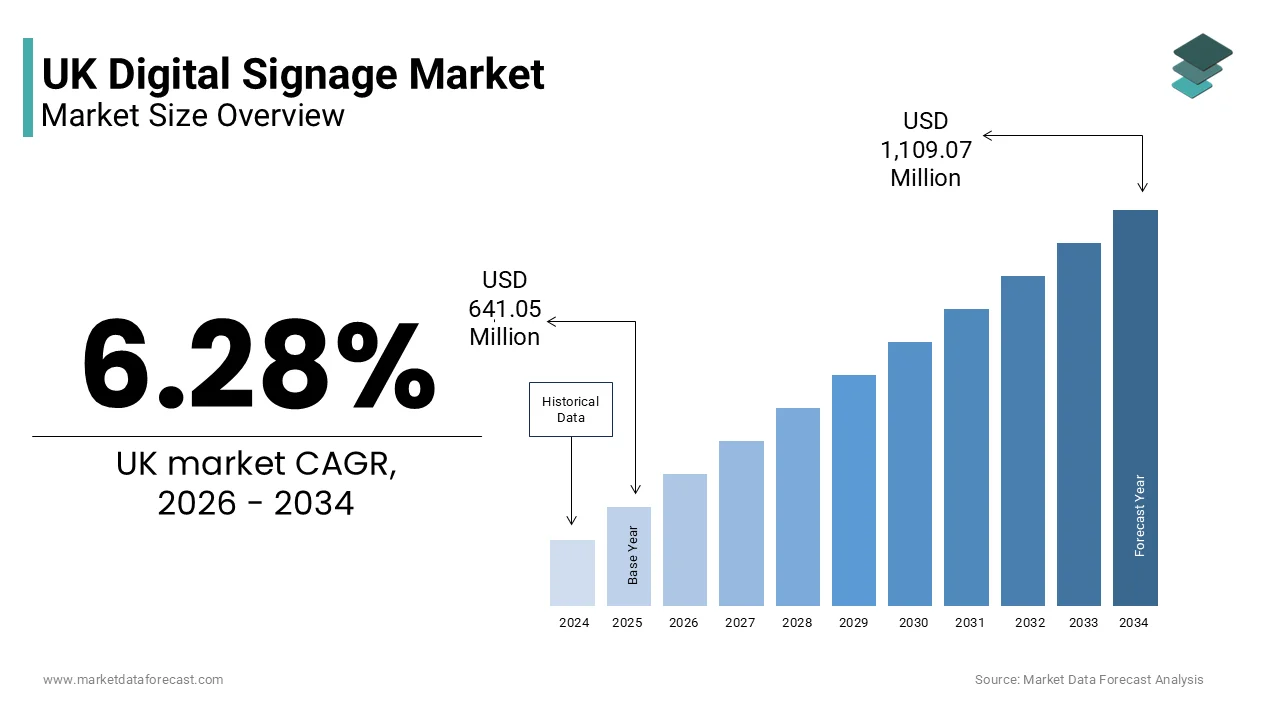
$641.05 MnMarket Estimate, 2026
$681.31 MnMarket Forecast, 2034
$1,109.07 MnCAGR, 2026–2034
6.28%UK Digital Signage Market Report Summary
The UK digital signage market was valued at USD 641.05 million in 2025, is estimated to reach USD 681.31 million in 2026, and is projected to reach USD 1,109.07 million by 2034, growing at a CAGR of 6.28% during the forecast period. Market growth is driven by increasing adoption of digital advertising solutions, rising demand for real-time customer engagement, growing investments in smart retail technologies, and the expansion of interactive display applications across multiple industries. Advancements in display technologies, cloud-based content management systems, and data-driven advertising strategies are further supporting market growth across the United Kingdom.
Key Market Trends
- Growing adoption of interactive and dynamic advertising displays is driving market growth.
- Increasing demand for real-time content management and customer engagement solutions is boosting market expansion.
- Rising investments in smart retail, transportation, and hospitality technologies are supporting industry development.
- Expansion of cloud-based digital signage platforms is enhancing market opportunities.
- Growing integration of artificial intelligence, analytics, and audience measurement tools is influencing market advancement.
Segmental Insights
- Based on component type, the hardware segment accounted for the largest share of the UK digital signage market in 2025. This dominance is attributed to increasing deployment of display screens, media players, kiosks, and advanced visual communication systems across commercial environments.
- Based on vertical, the commercial segment held the leading share of the UK digital signage market in 2025, driven by widespread adoption in retail stores, shopping centers, corporate offices, hospitality venues, and public spaces.
Regional Insights
- The United Kingdom accounted for the largest share of the European digital signage market in 2025 and is expected to maintain strong growth during the forecast period. High digital adoption rates, increasing investments in smart infrastructure, and growing demand for innovative customer communication platforms continue to support market expansion.
Competitive Landscape
The UK digital signage market is highly competitive, with companies focusing on display technology innovation, cloud-based content management solutions, interactive experiences, and integrated analytics capabilities to strengthen their market position. Market participants continue to invest in advanced display hardware, software platforms, and digital communication technologies. Major players operating in the UK digital signage market include Samsung Electronics Co., Ltd., LG Electronics Inc., Sharp NEC Display Solutions Ltd., Sony Group Corporation, Panasonic Holdings Corporation, PPDS (Philips Professional Display Solutions), Scala Digital Signage, BrightSign LLC, Signagelive, and Navori Labs.
UK Digital Signage Market Size
The UK digital signage market size was valued at USD 641.05 million in 2025, and is projected to reach USD 1,109.07 million by 2034 from USD 681.31 million in 2026, growing at a CAGR of 6.28%.
According to the Office for National Statistics, the service sector accounted for 81% of total UK economic output, creating a fertile ground for digital communication tools that enhance customer engagement and operational efficiency. As per Ofcom, adults in the UK now spend an average of four and a half hours online a day, indicating a high level of comfort and expectation for screen-based interactions in public and private spaces. The transition from static print media to dynamic digital displays is driven by the need for real-time content updates and targeted messaging capabilities. Regulatory frameworks governed by the Information Commissioners Office ensure strict adherence to data privacy standards, particularly for interactive and camera-enabled signage. The market operates at the intersection of hardware innovation, software intelligence, and creative content delivery, reflecting the nation's strong technological infrastructure and high broadband penetration rates. According to the World Bank, urbanization trends with over 83% of the population living in cities further concentrate demand for digital out-of-home advertising and smart city infrastructure integrations.
MARKET DRIVERS
Proliferation of Smart Retail Environments and Enhanced Customer Experience
The transformation of retail spaces into immersive digital ecosystems is fuelling the growth of the UK digital signage market as brands seek to differentiate themselves through personalized and interactive shopper experiences. Modern consumers expect seamless integration between online and offline channels, prompting retailers to deploy digital shelf labels, interactive kiosks, and large format video walls that provide product information, promotions, and inventory availability in real time. According to the British Retail Consortium, the retail sector contributes approximately 5% of the country’s Gross Domestic Product, capturing attention and guiding purchase decisions at the point of sale. Major high street retailers are investing heavily in flagship stores equipped with augmented reality mirrors and touch-screen catalogs that allow customers to visualize products and access extended ranges not physically present in store. According to Mintel, nearly 60% of both Gen Zs and Millennials rely on digital environments for transactions, checking prices, and finding products. The ability to update content instantly allows retailers to respond to weather conditions, time of day, or stock levels, maximizing relevance and sales potential. Furthermore, digital signage reduces the cost and waste associated with printing promotional materials, aligning with sustainability goals. The competitive retail landscape necessitates continuous innovation in visual merchandising, making digital signage an essential component of modern store design and customer retention strategies.
Expansion of Digital Out Of Home Advertising Networks
The robust growth of digital out-of-home advertising networks is further contributing to the expansion of the UK digital signage market as advertisers shift budgets from traditional static billboards to dynamic, high-impact digital displays. Digital out-of-home offers superior flexibility, allowing for dayparting, audience targeting, and real-time campaign adjustments, which deliver higher return on investment compared to conventional methods. According to the Institute of Practitioners in Advertising, its member agencies account for over 85% of the media spend in the UK, due to its measurability and engagement metrics. Transport hubs, such as London Underground stations and major airports, have extensively upgraded their infrastructure with high-resolution screens that reach millions of commuters daily. According to Global Media Insight, digital screens in transit areas achieve recall rates 48% higher than static posters because of their motion and brightness. Programmatic buying platforms enable advertisers to purchase inventory automatically based on data triggers, such as location, footfall, and even weather conditions, enhancing campaign precision. The Department for Transport supports modernization of transport infrastructure, which includes digital information systems that double as advertising spaces. This convergence of public utility and commercial revenue generation creates a sustainable model for network expansion. As urban mobility increases and attention spans shorten, digital out-of-home remains a powerful medium for brand visibility and message delivery in crowded urban environments.
MARKET RESTRAINTS
High Initial Capital Expenditure and Maintenance Costs
The substantial upfront investment required for hardware installation, software licensing and network infrastructure is primarily hindering the expansion of the UK digital signage market, particularly for small and medium-sized enterprises. High-quality, commercial-grade displays, media players, and mounting solutions command premium prices, while professional installation and integration services add to the initial financial burden. According to the Federation of Small Businesses, many independent retailers hesitate to adopt digital signage due to cash flow constraints and uncertainty regarding return on investment timelines. Unlike static signs, digital displays require ongoing maintenance, including software updates, hardware repairs, and electricity consumption, which contribute to a higher total cost of ownership. According to the Energy Saving Trust, commercial displays can account for a notable portion of a business energy bill, especially if older, less efficient models are used. Additionally, the rapid pace of technological obsolescence means that equipment may need replacement every five to seven years to remain compatible with new software features and resolution standards. This cycle of recurring expenditure discourages long-term commitment from budget-conscious organizations. While cloud-based content management systems have reduced some operational costs, the hardware component remains capital-intensive. Economic volatility and rising interest rates further exacerbate financing challenges, making it difficult for smaller players to compete with larger corporations that can absorb these costs more easily.
Complex Regulatory Compliance and Planning Permission Hurdles
Stringent regulatory requirements and complex planning permission processes impose significant barriers to the deployment of outdoor digital signage in the UK, which is further limiting market expansion in high-visibility locations. Local authorities enforce strict guidelines under the Town and Country Planning Act to prevent light pollution, traffic distraction, and visual clutter in residential and heritage areas. According to the Local Government Association, obtaining consent for new digital billboards can take several months, involving detailed environmental impact assessments and community consultations. Historic England often objects to installations near listed buildings or conservation areas, citing preservation of architectural integrity and character. According to the Outdoor Advertising Association of Great Britain, approximately 15% of proposed digital signage projects face delays or rejections due to regulatory non-compliance. Additionally, the General Data Protection Regulation imposes rigorous standards for any signage equipped with cameras or sensors that collect audience data, requiring explicit consent and transparent data handling practices. Failure to comply can result in substantial fines and reputational damage. The fragmented nature of local planning policies creates inconsistency and uncertainty for national networks seeking uniform rollout strategies. These administrative and legal complexities increase project timelines and costs, discouraging investors from pursuing ambitious outdoor digital signage initiatives in sensitive or highly regulated zones.
MARKET OPPORTUNITIES
Integration of Artificial Intelligence and Audience Analytics
The integration of artificial intelligence and advanced audience analytics is a prominent opportunity for the UK digital signage market to deliver hyper-personalized content and measurable engagement outcomes. AI-powered cameras and sensors can anonymously detect demographic attributes, such as age, gender, and dwell time, allowing displays to serve targeted advertisements in real time. According to Tech Nation, the UK is a global leader in artificial intelligence adoption, with significant investment in computer vision technologies applicable to digital signage. This capability enables advertisers to optimize campaign performance by serving relevant messages to specific audience segments, increasing click-through and conversion rates. According to Juniper Research, programmatic digital out-of-home advertising driven by AI analytics will grow substantially as brands seek accountable marketing spend. Retailers can use heat mapping data to understand customer movement patterns and adjust content placement for maximum visibility. Furthermore, predictive analytics can forecast peak traffic times, enabling dynamic pricing for advertising slots. The ability to measure actual viewership, rather than estimated impressions, provides a compelling value proposition for marketers. Privacy-compliant anonymization techniques ensure adherence to data protection laws while unlocking valuable insights. By leveraging AI, businesses can transform passive displays into intelligent communication hubs that interact meaningfully with audiences, driving higher engagement and revenue potential.
Adoption in Healthcare and Public Sector Information Systems
The increasing adoption of digital signage in healthcare facilities and public sector institutions offers substantial growth opportunities for the UK market expansion as these entities seek to improve communication efficiency and patient experience. Hospitals and clinics utilize digital displays for wayfinding, appointment reminders, health education, and emergency alerts, reducing administrative workload and enhancing patient satisfaction. According to the National Health Service, digital transformation initiatives prioritize patient-centered care, with technology playing a key role in streamlining operations and reducing waiting room anxiety. According to the Kings Fund, clear communication can reduce missed appointments by up to 20%, saving resources and improving clinical outcomes. Digital signage in government buildings, libraries, and educational institutions facilitates the dissemination of urgent public information, civic engagement campaigns, and event schedules. The post-pandemic emphasis on hygiene and social distancing has accelerated the deployment of touchless interactive kiosks for self-service check-ins and information retrieval. Public funding for smart city projects supports the installation of digital information points in transport hubs and community centers. These applications demonstrate the versatility of digital signage beyond commercial advertising, highlighting its role in public service delivery. As the public sector continues to modernize infrastructure, demand for robust, secure, and scalable digital signage solutions will continue to rise, providing a stable revenue stream for market participants.
MARKET CHALLENGES
Cybersecurity Vulnerabilities and Network Security Risks
The connectivity inherent in networked digital signage systems exposes them to significant cybersecurity vulnerabilities, which is one of the major challenges to the UK digital signage market expansion. Hackers can exploit weak passwords, unpatched software, or insecure networks to hijack displays and broadcast malicious or inappropriate content, causing reputational damage and public safety concerns. According to the National Cyber Security Centre, internet of things devices, including digital signage players are frequent targets for cyber-attacks due to often overlooked security protocols. According to the Verizon Data Breach Investigations Report, retail and hospitality sectors, which heavily rely on digital signage, are among the most targeted industries for data breaches. A compromised signage network can serve as an entry point for broader corporate network intrusions, threatening sensitive customer and operational data. Ensuring end-to-end encryption, regular firmware updates, and secure access controls requires specialized IT expertise and continuous monitoring, which many organizations lack. The complexity of managing distributed networks across multiple locations increases the attack surface and difficulty of maintaining consistent security standards. High-profile incidents of hacked billboards have raised awareness but also heightened liability concerns for advertisers and venue owners. Mitigating these risks demands significant investment in security infrastructure and staff training, creating a barrier to entry and ongoing operational challenge for market participants striving to protect their assets and brand integrity.
Content Creation Bottlenecks and Management Complexity
Creating engaging, high-quality content at scale and managing it across dispersed networks is further challenging the UK market growth. Many organizations struggle to produce fresh, visually appealing content that resonates with diverse audiences, leading to screen fatigue and diminished impact. According to the Content Marketing Institute, consistent content creation is cited as the top challenge for digital marketers, requiring dedicated resources and creative talent. Digital signage requires specific aspect ratios, resolutions, and duration formats differing from standard social media or web content, adding complexity to production workflows. Managing hundreds or thousands of screens across different locations involves coordinating schedules, ensuring playback reliability, and troubleshooting technical issues remotely. According to industry surveys, up to 40% of digital signage installations fail to achieve expected ROI due to poor content strategy and management inefficiencies. Small businesses often lack the in-house expertise to design effective campaigns, resulting in static or irrelevant displays that fail to engage viewers. The need for continuous innovation in visual storytelling demands ongoing investment in design tools and personnel. Without a robust content strategy, even the most advanced hardware fails to deliver value, making content management a critical operational hurdle for sustained success.
REPORT COVERAGE
| REPORT METRIC | DETAILS |
| Market Size Available | 2025 to 2034 |
| Base Year | 2025 |
| Forecast Period | 2026 to 2034 |
| CAGR | 6.28% |
| Segments Covered | By Component Type, Vertical, and Region. |
| Various Analyses Covered | Global, Regional and Country-Level Analysis, Segment-Level Analysis, Drivers, Restraints, Opportunities, Challenges; PESTLE Analysis; Porter’s Five Forces Analysis, Competitive Landscape, Analyst Overview of Investment Opportunities |
| Market Leaders Profiled | Samsung Electronics Co., Ltd., LG Electronics Inc., Sharp NEC Display Solutions Ltd., Sony Group Corporation, Panasonic Holdings Corporation, PPDS (Philips Professional Display Solutions), Scala Digital Signage, BrightSign LLC, Signagelive, and Navori Labs |
SEGMENTAL ANALYSIS
By Component Type Insights
The hardware segment dominated the market by holding the leading share of the UK market in 2025. The growth of the hardware segment in the UK market can be credited to the fundamental necessity of physical display infrastructure and media players to enable any visual communication strategy. The deployment of high-resolution LED, LCD, and OLED screens forms the backbone of digital out-of-home advertising, retail displays, and corporate information systems. According to the British Retail Consortium, over 90% of large-format retailers have upgraded their store fixtures with digital displays in the past five years, requiring substantial investment in commercial-grade monitors and mounting solutions. The durability and brightness requirements for outdoor installations in the UK’s variable weather conditions necessitate specialized, ruggedized hardware, which commands higher price points than consumer electronics. According to the Office for National Statistics, capital expenditure on information and communication technology equipment remains robust as businesses modernize their physical premises. The proliferation of 4K and 8K resolution screens enhances visual impact, driving replacement cycles for older, lower-resolution units. Additionally, the integration of interactive touch capabilities in kiosks and wayfinding stations requires advanced sensor hardware, further boosting segment value. Manufacturers continuously innovate with thinner bezels and energy-efficient panels to meet sustainability standards while maintaining performance. The sheer volume of screens required to cover transport hubs, shopping centers, and office buildings ensures that hardware remains the largest revenue generator in the component ecosystem, providing the tangible foundation for all digital signage applications.
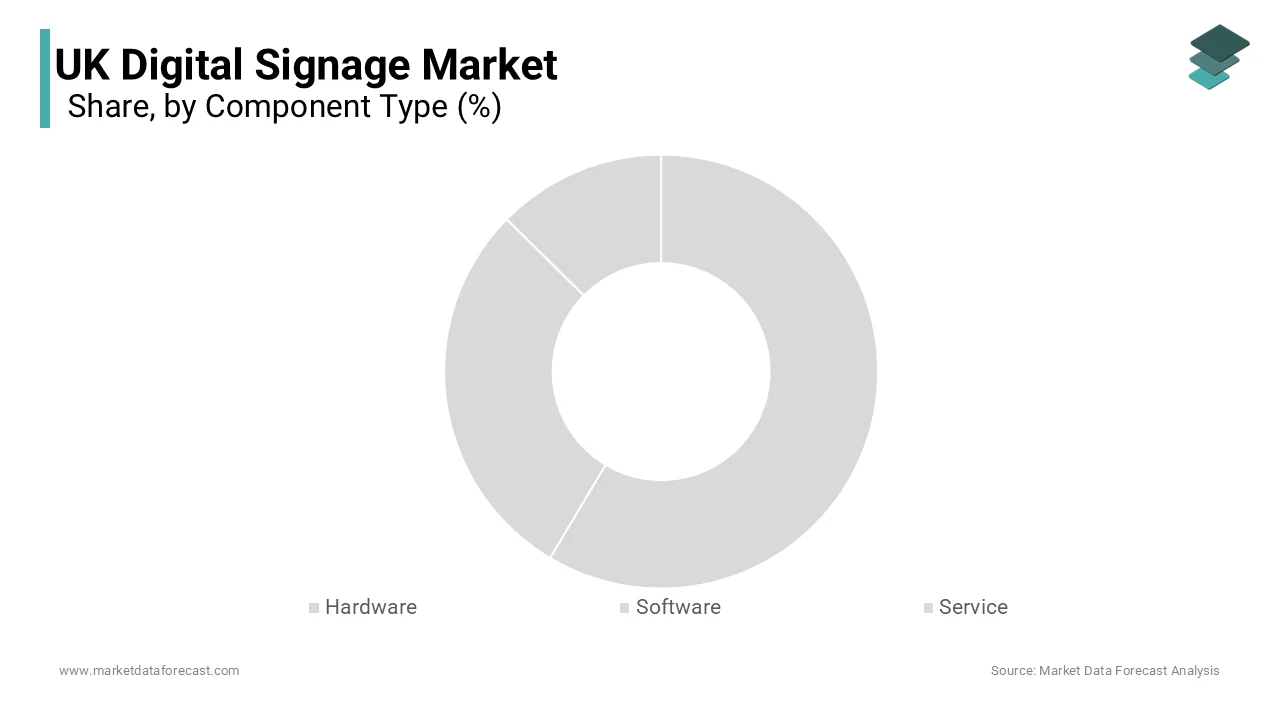
However, the software segment is estimated to register a CAGR of 13.4% during the forecast period in the UK market owing to the increasing complexity of content management and the demand for data-driven personalization. As networks expand across multiple locations, the need for centralized, cloud-based platforms that allow remote scheduling, monitoring, and analytics becomes critical for operational efficiency. According to Tech Nation, the UK is a global hub for software innovation, with significant venture capital flowing into artificial intelligence and internet of things solutions that enhance digital signage capabilities. Modern software suites integrate with customer relationship management systems and point-of-sale data to deliver dynamic content tailored to real-time audience demographics and behaviors. According to Gartner, by 2025 over 70% of digital signage deployments will utilize cloud-based content management systems due to their scalability and lower total cost of ownership compared to on-premise servers. The rise of programmatic advertising relies heavily on sophisticated software algorithms that automate ad buying and placement based on impression data. Furthermore, software enables seamless integration with mobile devices, allowing users to interact with displays via QR codes or near field communication. This shift from static playback to intelligent, interactive ecosystems drives rapid adoption of advanced software solutions, positioning this segment as the primary engine of future market growth and value creation.
By Vertical Insights
The commercial segment held the dominant position in the UK digital signage market by accounting for the leading share of the UK market in 2025. The growth of the commercial segment in the UK market is attributed to the aggressive adoption in retail, hospitality, and corporate environments where customer engagement and brand differentiation are paramount. Retailers utilize digital signage for dynamic pricing, promotional campaigns, and virtual try-on experiences to compete with e-commerce giants and enhance the in-store journey. According to the British Retail Consortium, over 90% of large-format retailers have upgraded their store fixtures with digital displays in the past five years, reflecting the industry commitment to experiential retail. The hospitality sector, including hotels, restaurants, and entertainment venues, employs digital menus, lobby displays, and event signage to improve service efficiency and upsell opportunities. According to Mintel, 60% of consumers are more likely to visit establishments that use digital displays for menu boards and promotions due to perceived modernity and clarity. Corporate offices leverage digital signage for internal communications, employee recognition, and wayfinding to foster culture and productivity in hybrid work settings. The high footfall in commercial areas ensures maximum visibility for advertisers, making it an attractive channel for marketing spends. The continuous renovation of shopping malls and high streets with digital infrastructure sustains demand. This widespread utilization across diverse commercial sub-sectors ensures that the commercial vertical remains the largest contributor to market revenue and installation volume.
On the other side, the infrastructure segment is predicted to showcase a CAGR of 12.5% during the forecast period in the UK market due to the government initiatives to modernize public transport and smart city infrastructure across the UK. Transport for London and other regional authorities are extensively upgrading stations, airports, and bus terminals with real-time information displays, digital ticketing kiosks, and emergency alert systems to improve passenger experience and operational safety. According to the Department for Transport, billions of pounds are invested annually in rail and road infrastructure improvements, which include digital communication networks as a core component. The expansion of high-speed rail projects and airport terminals creates new opportunities for large-scale digital signage deployments for wayfinding and advertising. According to the Office of Rail and Road, passenger numbers are recovering to pre-pandemic levels, increasing the value of digital advertising space in transit hubs. Smart city initiatives integrate digital signage with traffic management systems, environmental sensors, and public safety announcements, creating interconnected urban ecosystems. The need for accessible information for diverse populations drives the installation of audiovisual aids and interactive maps. Government funding for digital inclusion and connectivity supports these projects, ensuring steady growth. As urbanization continues and public transport usage rises, the infrastructure segment becomes increasingly vital for effective civic communication and commercial monetization.
COUNTRY LEVEL ANALYSIS
The UK had the largest share of the European market in 2025 and is poised for continued growth and clear cross-industry scaling in its digital media platforms over the coming years, characterized by high adoption rates, advanced technological infrastructure, and a strong regulatory framework for data privacy and advertising standards. The nation serves as a testing ground for innovative formats, such as programmatic digital out-of-home and interactive retail experiences, due to its dense urban population and sophisticated consumer base. According to the Office for National Statistics, the UK has one of the highest internet penetration rates globally at 98%, creating a digitally literate audience that expects seamless screen interactions in public spaces. London remains a global hub for digital advertising, with iconic locations like Piccadilly Circus setting benchmarks for high-impact visual communications. The Department for Culture Media and Sport supports creative industries, which drive content innovation for digital displays. According to the Outdoor Advertising Association of Great Britain, the UK accounts for approximately 25% of total European digital out-of-home revenue, highlighting its regional dominance. Strong broadband connectivity and 5G rollout facilitate real-time content updates and cloud-based management. The presence of major global technology firms and local integrators fosters a competitive ecosystem that drives quality and innovation. Regulatory clarity regarding planning permissions and data protection provides a stable environment for long-term investments. This combination of market size, technological readiness, and creative excellence positions the UK as the strategic leader shaping digital signage trends across the European region.
COMPETITIVE LANDSCAPE
The UK digital signage market features intense competition characterized by the presence of global hardware giants specialized software providers and agile local system integrators vying for client contracts. Established corporations leverage extensive distribution networks strong brand recognition and substantial research budgets to maintain dominance while niche players disrupt the status quo with customized software solutions and personalized service offerings. Competitive dynamics are shaped by the urgent need to address data security concerns prompting rapid adoption of encrypted communication protocols and secure cloud platforms across the industry. Technological advancement drives differentiation as companies race to integrate artificial intelligence and audience analytics into their ecosystems. Price sensitivity remains a factor although value added services such as content creation and maintenance allow differentiated products to command higher margins. Retail and transport sectors demand high reliability forcing manufacturers to prove durability through rigorous testing. Brand loyalty is increasingly tied to software usability and support quality rather than hardware specifications alone. Regulatory pressures regarding planning permissions and energy efficiency further intensify competitive pressures requiring continuous adaptation. Success depends on balancing innovation reliability and cost efficiency while maintaining strong partner relationships.
KEY MARKET PLAYERS
Some of the companies that are playing a dominating role in the UK digital signage market are
- Samsung Electronics Co., Ltd.
- LG Electronics Inc.
- Sharp NEC Display Solutions Ltd.
- Sony Group Corporation
- Panasonic Holdings Corporation
- PPDS (Philips Professional Display Solutions)
- Scala Digital Signage
- BrightSign LLC
- Signagelive
- Navori Labs
Top Players in the Market
- Samsung Electronics maintains a dominant presence in the UK through its comprehensive portfolio of high performance display technologies including LED video walls and interactive flat panels. The company actively invests in research and development to introduce energy efficient and visually stunning screens that cater to retail corporate and public sector needs. Recent actions include launching advanced cloud based content management platforms that simplify remote deployment and monitoring for businesses across the nation. Samsung collaborates with local system integrators to provide tailored solutions for complex installations in transport hubs and shopping centers. The brand emphasizes sustainability by using recycled materials in manufacturing and reducing power consumption. By focusing on innovation and reliability Samsung strengthens its reputation as a trusted technology partner. Their commitment to quality ensures sustained relevance and loyalty among professional users in the competitive UK digital signage landscape.
- LG Electronics contributes significantly to the UK market with its innovative OLED and LCD signage solutions known for superior picture quality and design flexibility. The company focuses on delivering immersive visual experiences for hospitality retail and entertainment venues through ultra thin and transparent displays. Recent efforts involve expanding its webOS based smart signage platform which offers enhanced security features and easier integration with third party applications. LG partners with creative agencies to showcase the potential of digital storytelling in flagship stores and experiential marketing campaigns. The company supports local distributors with comprehensive training programs to ensure proper installation and maintenance. By prioritizing aesthetic appeal and technical performance LG differentiates itself in the premium segment. Their strategic focus on user friendly software and durable hardware reinforces their position as a leading provider of cutting edge visual communication tools in the UK.
- Sharp Nec Display Solutions plays a pivotal role in the UK digital signage sector by providing robust and reliable display products designed for continuous operation in demanding environments. The company is renowned for its expertise in large venue installations such as stadiums conference centers and control rooms where uptime is critical. Recent actions include introducing new laser projection technologies and modular LED cabinets that offer greater brightness and longevity for outdoor applications. Sharp Nec enhances its service offerings with extended warranty packages and proactive maintenance support to minimize downtime for clients. The company collaborates with architectural firms to integrate seamless display solutions into modern building designs. By leveraging its strong engineering heritage Sharp Nec builds trust with professional installers and end users. Their dedication to durability and technical excellence ensures they remain a preferred choice for mission critical digital signage projects throughout the UK.
Top Strategies Used By Key Market Participants
Key players in the UK digital signage market employ several strategic approaches to maintain competitiveness and drive growth. Product innovation remains central as companies develop high resolution energy efficient and interactive displays to meet evolving consumer expectations. Software integration is prioritized with investments in cloud based content management systems that enable remote control and real time updates. Strategic partnerships with system integrators and creative agencies help deliver comprehensive turnkey solutions to clients. Sustainability initiatives focus on reducing carbon footprints through eco friendly manufacturing and recyclable materials. Customer support enhancements include extended warranties and technical training to ensure reliable operation. Digital marketing strategies leverage case studies and demonstrations to showcase successful deployments. These combined strategies allow market participants to navigate challenges and capitalize on opportunities in the dynamic UK landscape.
MARKET SEGMENTATION
This research report on the UK digital signage market is segmented and sub-segmented into the following categories.
By Component Type
- Hardware
- Software
- Service
By Vertical
- Commercial
- Institutional
- Infrastructure