- Product Description Description
- Table of Contents TOC
- List of Table & Figure LOT
- Get Free Sample PDF Sample PDF
Market Size, 2025
$3.32 BnMarket Estimate, 2026
$3.58 BnMarket Forecast, 2034
$6.55 BnCAGR, 2026–2034
7.85%UK Elevators and Escalators Market Report Summary
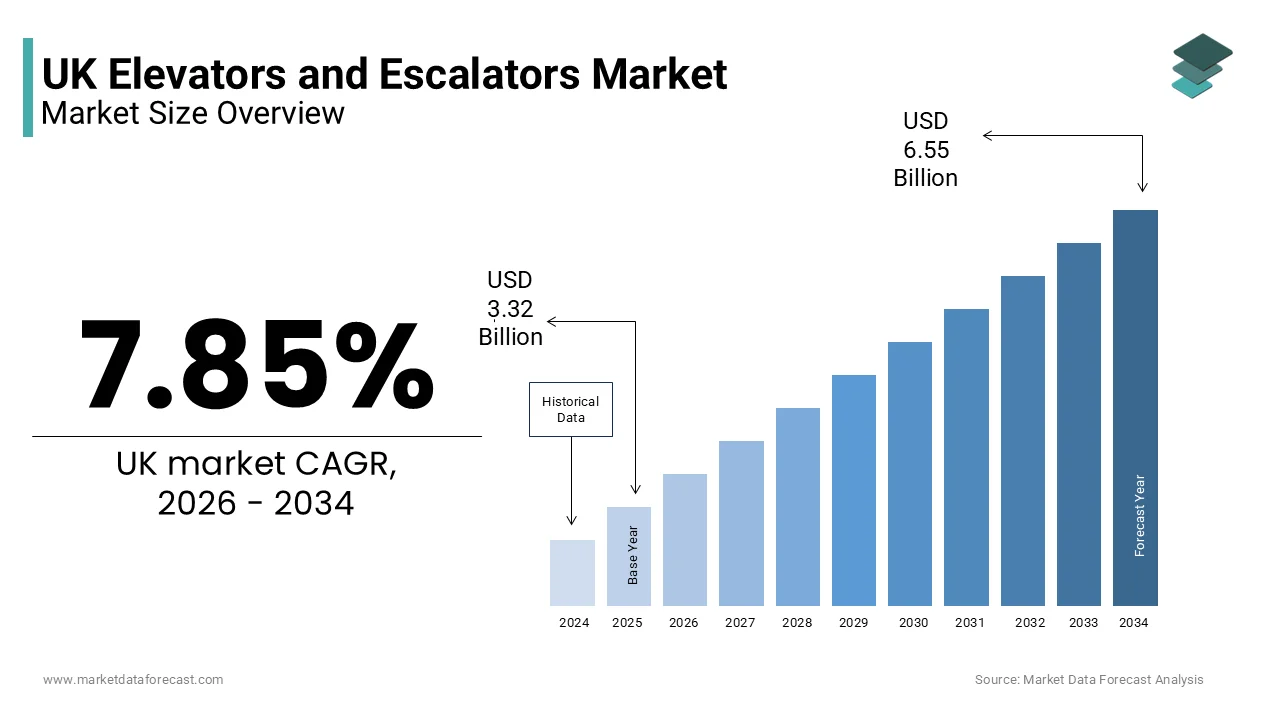
The UK elevators and escalators market was valued at USD 3.32 billion in 2025, is estimated to reach USD 3.58 billion in 2026, and is projected to reach USD 6.55 billion by 2034, growing at a CAGR of 7.85% during the forecast period from 2026 to 2034. The growth of the UK elevators and escalators market is driven by rapid urbanization, increasing investments in residential and commercial construction projects, and the modernization of aging building infrastructure. Rising demand for smart mobility solutions, energy-efficient vertical transportation systems, and improved accessibility in residential and public buildings is further supporting market expansion. Additionally, the growing adoption of advanced elevator technologies, including IoT-enabled monitoring and predictive maintenance systems, is enhancing operational efficiency and driving market growth.
Key Market Trends
-
Increasing construction of high-rise residential and commercial buildings is driving demand for elevators and escalators across the UK.
-
Growing focus on modernization and replacement of aging elevator infrastructure is creating significant market opportunities.
-
Rising adoption of smart elevators equipped with IoT, remote monitoring, and predictive maintenance capabilities.
-
Increasing emphasis on energy-efficient and sustainable vertical transportation systems to reduce operational costs and environmental impact.
-
Growing demand for accessibility solutions in residential, healthcare, and public infrastructure projects is supporting market growth.
Segmental Insights
-
Based on product, the elevators segment accounted for a significant share of the UK elevators and escalators market in 2025. The segment's dominance is attributed to rising installations in residential, commercial, and mixed-use developments, along with growing demand for advanced and energy-efficient elevator systems.
-
Based on business, the maintenance segment held the largest share of the UK elevators and escalators market in 2025. The segment's leadership is driven by the extensive installed base of elevators and escalators requiring regular servicing, safety inspections, repairs, and modernization.
-
Based on application, the residential segment dominated the market and accounted for 45.3% of the UK elevators and escalators market share in 2025. The segment's growth is supported by increasing residential construction activities, urban housing developments, and the rising need for accessibility solutions in multi-story residential buildings.
Regional Insights
-
The UK elevators and escalators market is witnessing strong growth due to urban development projects, infrastructure modernization, and increasing demand for advanced building mobility solutions.
-
England represents the largest market, supported by extensive residential and commercial construction activities, high-rise developments, and ongoing infrastructure investments.
-
Scotland is experiencing growing demand for elevator and escalator systems driven by urban redevelopment projects and modernization initiatives in public infrastructure.
-
Wales is witnessing increased adoption of vertical transportation solutions across residential and commercial construction projects.
-
Northern Ireland is emerging as a growing market due to investments in real estate development and the modernization of existing building infrastructure.
Competitive Landscape
The UK elevators and escalators market is highly competitive, with leading manufacturers focusing on technological innovation, energy efficiency, predictive maintenance solutions, and service network expansion. Companies are investing in smart mobility technologies, modernization services, and sustainable product development to strengthen their market presence and address evolving customer requirements. Key players operating in the UK elevators and escalators market include Otis Elevator Company, KONE Corporation, Schindler Group, TK Elevator, Mitsubishi Electric Corporation, Fujitec Co., Ltd., Orona Group, Stannah Group, Aritco Lift AB, and KLEEMANN Group.
UK Elevators and Escalators Market Size
The UK elevators and escalators market size was valued at USD 3.32 billion in 2025, and is projected to reach USD 6.55 billion by 2034 from USD 3.58 billion in 2026, growing at a CAGR of 7.85%.
The elevators and escalators are vertical transportation systems essential for modern infrastructure. This sector serves residential commercial and public sectors ensuring accessibility and efficient movement within multi story structures. As per data from the Office for National Statistics the construction sector contributes approximately 6% to the national gross domestic product providing a stable foundation for vertical transportation demand. The UK has over 250000 lifts in operation with nearly 70% being older than 20 years according to industry maintenance records. Urbanization trends continue to drive density in major cities like London and Manchester where high rise developments are prevalent. The Building Safety Act introduced stringent regulatory requirements for lift safety and maintenance accountability impacting operational protocols across the country. Energy efficiency regulations mandate upgrades to older systems prompting owners to invest in modern drives and regenerative technologies. The integration of Internet of Things sensors for predictive maintenance is becoming standard practice among leading service providers. Public transport hubs rely heavily on escalators with London Underground operating over 400 escalators that facilitate millions of daily journeys as per Transport for London statistics. The shift toward smart buildings necessitates interconnected vertical transportation solutions that optimize traffic flow and reduce waiting times.
MARKET DRIVERS
Rapid Urbanization and High Rise Residential Development
The acceleration of urbanization, particularly in metropolitan areas, such as London Birmingham and Manchester drives substantial demand for new elevator installations, which is solely propelling the growth of the United Kingdom elevators and escalators market. High rise residential projects are increasingly favored by developers to maximize land use efficiency in constrained city centers. These structures require multiple high speed elevators to ensure adequate vertical transportation capacity and resident convenience. Modern residential towers often incorporate destination control systems that group passengers traveling to similar floors enhancing efficiency and reducing energy consumption. The aesthetic integration of glass elevators and panoramic shafts has become a selling point for luxury apartments influencing architectural designs. The complexity of these installations requires advanced engineering solutions including machine room less designs that save space and reduce structural load. Developers prioritize reliability and speed to attract tenants creating a competitive environment for manufacturers to offer superior performance metrics.
Stringent Regulatory Compliance and Safety Standards
The implementation of rigorous safety regulations and compliance standards for both modernization and maintenance services is additionally leveraging the growth of the United Kingdom elevator market. The Building Safety Act 2022 introduced stricter accountability for building owners and managers regarding the safety of infrastructure, including lifts. This regulatory environment compels property owners to upgrade aging systems that no longer meet current safety codes. Approximately, 40% of existing lifts in the UK require significant modernization to comply with updated electromagnetic compatibility and energy efficiency directives as per industry compliance audits. The Lift Regulations 2016 mandate specific safety components, such as door locking devices and overspeed governors which older units may lack. Insurance providers increasingly require proof of compliant maintenance contracts leading to higher uptake of professional service agreements. Public sector buildings including hospitals and schools face additional scrutiny ensuring uninterrupted and safe access for vulnerable users. The emphasis on accessibility under the Equality Act 2010 requires lifts to accommodate wheelchair users and individuals with disabilities driving retrofitting projects. Manufacturers respond by offering compliance focused upgrade packages that include modern controllers and safety gears. This regulatory pressure creates a recurring revenue stream for service providers who specialize in bringing legacy systems up to code. The continuous evolution of safety standards ensures that the market remains dynamic with ongoing demand for technical expertise and certified components.
MARKET RESTRAINTS
High Initial Capital Investment and Installation Costs
The substantial upfront capital required for the purchase and installation of modern elevator and escalator systems for small and medium sized enterprises is hampering the growth of the United Kingdom elevators and escalators markets. The cost of installing a single high-speed elevator in a commercial building can exceed 100000 pounds depending on capacity and technological features, according to construction cost indices. For residential developers, operating on tight margins these expenses can impact project viability and profitability. The complexity of installation in existing buildings often requires structural modifications, such as reinforcing shafts or creating new openings, which adds to the overall expenditure. Small property owners may defer necessary replacements or opt for minimal repairs instead of comprehensive modernization due to budget constraints. The lengthy lead times for customized equipment tie up capital and delay project completion affecting cash flow. Financing options for vertical transportation upgrades are limited compared to other building systems making it difficult for some owners to secure funding. The total cost of ownership includes not only installation but also ongoing maintenance and energy consumption which deters price sensitive buyers. Economic uncertainty and inflationary pressures further discourage large scale capital investments in non-revenue generating infrastructure.
Supply Chain Disruptions and Material Volatility
The reliance on global supply chains for components, such as steel copper and electronic semiconductors to significant disruptions and price volatility, which is also restraining the growth of the United Kingdom elevators and escalators market. Geopolitical tensions and trade friction have led to extended lead times for imported parts with delays averaging 12 to 16 weeks for specialized controllers, according to research. The price of raw materials like steel fluctuated by up to 30% in recent years impacting manufacturing costs and final pricing strategies. Copper essential for motor windings and cabling has seen similar instability affecting production budgets. The shortage of semiconductor chips has delayed the delivery of smart elevator systems that rely on advanced microprocessors for operation and connectivity. Logistics challenges including port congestion and freight cost increases further compound these issues making just in time inventory management difficult. Manufacturers struggle to maintain consistent production schedules leading to project delays and contractual penalties. The dependency on single source suppliers for certain proprietary components increases vulnerability to supply shocks. These disruptions force companies to hold higher inventory levels tying up working capital and reducing operational flexibility. The unpredictability of material availability hampers long term planning and contract bidding accuracy.
MARKET OPPORTUNITIES
Integration of IoT and Predictive Maintenance Solutions
The integration of Internet of Things technology and predictive maintenance algorithms to enhance value and generate recurring revenue is likely to set up new opportunities for the growth of the United Kingdom elevators and escalators market. Smart sensors installed in elevators monitor parameters, such as vibration temperature and door operations in real time enabling early detection of potential faults. Service companies can transition from reactive repair models to proactive service contracts offering guaranteed uptime and performance metrics. Data analytics allow for optimization of maintenance schedules reducing unnecessary site visits and lowering operational costs for building owners. The ability to remotely diagnose issues minimizes technician travel time and accelerates resolution rates. Building managers benefit from dashboards that provide visibility into vertical transportation performance supporting data driven decision making. The growing demand for smart buildings aligns with this trend as investors seek assets with enhanced operational efficiency and tenant appeal. Manufacturers are developing open platform interfaces that allow third party integration fostering an ecosystem of connected services. Cybersecurity measures become a key differentiator as data protection becomes paramount for connected devices. This digital transformation positions service providers as strategic partners rather than mere vendors.
Modernization of Aging Infrastructure in Public Sector
The extensive aging infrastructure in the public sector, including hospitals schools and government buildings for modernization and retrofitting projects is additionally to amplify the growth of the United Kingdom elevators and escalators market. A significant proportion of public elevators were installed in the 1980s and 1990s and are now reaching the end of their operational life cycles according to asset management registers. Government initiatives aimed at improving public service delivery and accessibility drive funding for these upgrades. The need for compliance with current disability access standards mandates the installation of larger cabins audible announcements and tactile buttons. Hospitals require high capacity and reliable lifts for patient transport and emergency services creating demand for robust specialized systems. Schools benefit from modernized escalators and lifts that enhance safety and accommodate increased student mobility. Public transport hubs such as railway stations are undergoing refurbishment programs that include replacing outdated escalators with energy efficient models. The Department for Transport allocates billions for station improvements which includes vertical transportation enhancements. Energy efficiency grants support the replacement of old hydraulic lifts with machine room less traction systems that consume less power. Local councils are prioritizing inclusive design in public buildings driving demand for accessible solutions. The scale of the public estate ensures a steady pipeline of projects for manufacturers and installers. Partnerships with facility management companies enable comprehensive upgrade packages that include long term maintenance.
MARKET CHALLENGES
Shortage of Skilled Technical Workforce
The shortage of skilled technicians and engineers capable of installing and maintaining complex vertical transportation systems is lucratively to act as a challenge for the growth of the United Kingdom elevators and escalators market. The aging workforce is retiring faster than new entrants are being trained creating a skills gap that threatens service quality and response times. Training programs for lift engineers require several years of apprenticeship and certification, which discourages rapid entry into the profession. The technical complexity of modern systems involving electronics software and mechanics demands higher levels of expertise than traditional mechanical repairs. Competition for skilled labor from other engineering sectors exacerbates the shortage driving up wage costs and reducing profit margins. Geographic disparities mean that rural areas suffer more acute shortages than urban centers affecting service coverage. The lack of diversity in the workforce limits the talent pool with fewer women and young people entering the trade. Companies invest heavily in training but face retention challenges as experienced staff are poached by competitors. This labor constraint limits the capacity of firms to take on new installation projects and expand service contracts. Delays in maintenance and installation due to staff shortages can lead to customer dissatisfaction and contractual penalties.
Cybersecurity Risks in Connected Elevator Systems
The increasing connectivity of elevator and escalator systems through Internet of Things integration introduces significant cybersecurity risks that pose as a major challenge for the growth of the United Kingdom elevators and escalators market. Smart elevators are vulnerable to hacking attempts that could disrupt operations compromise passenger safety or steal sensitive data. Recent security assessments reveal that many connected lift systems lack robust encryption and authentication protocols making them susceptible to cyberattacks. A successful breach could allow malicious actors to control elevator movements trapping passengers or causing accidents. Building owners and facility managers are increasingly concerned about liability and reputational damage associated with cyber incidents. The lack of standardized cybersecurity regulations specifically for vertical transportation creates uncertainty regarding compliance requirements. Manufacturers must invest heavily in secure software development and regular patching to mitigate vulnerabilities. However, the fragmented nature of the installed base makes it difficult to ensure all units receive timely updates. Legacy systems retrofitted with smart modules may have inherent security weaknesses that are hard to address. Insurance premiums for cyber liability are rising reflecting the perceived risk exposure. Customers demand assurances of data privacy and system integrity before adopting connected solutions.
REPORT COVERAGE
| REPORT METRIC | DETAILS |
| Market Size Available | 2025 to 2034 |
| Base Year | 2025 |
| Forecast Period | 2026 to 2034 |
| CAGR | 7.85% |
| Segments Covered | By Product, Business, Application, and Region. |
| Various Analyses Covered | Global, Regional and Country-Level Analysis, Segment-Level Analysis, Drivers, Restraints, Opportunities, Challenges; PESTLE Analysis; Porter’s Five Forces Analysis, Competitive Landscape, Analyst Overview of Investment Opportunities |
| Market Leaders Profiled | Otis Elevator Company, KONE Corporation, Schindler Group, TK Elevator, Mitsubishi Electric Corporation, Fujitec Co., Ltd., Orona Group, Stannah Group, Aritco Lift AB, and KLEEMANN Group |
SEGMENTAL ANALYSIS
By Product Insights
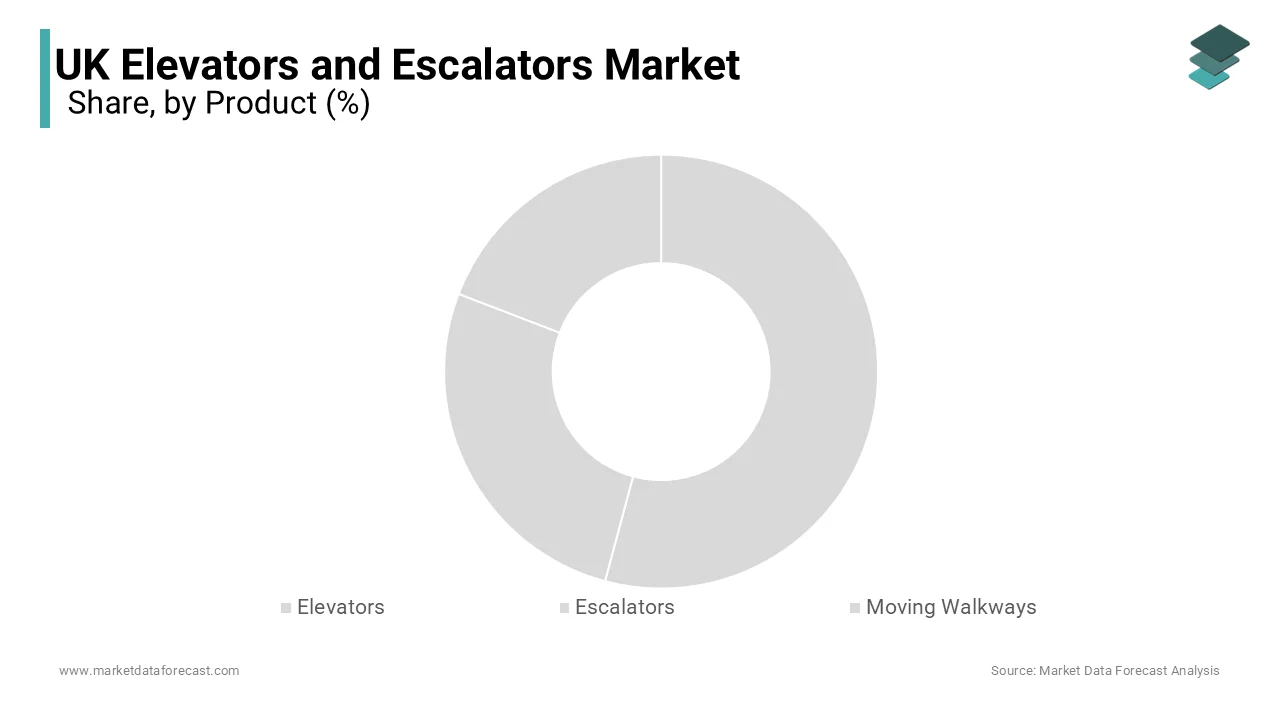
The elevators segment was accounted in holding a significant share of the United Kingdom elevators and escalators market in 2025. The growth of the segment is driven by the fundamental necessity of vertical mobility in multi-story residential and commercial structures, which form the backbone of UK urban infrastructure. The proliferation of high-rise buildings in major cities like London and Manchester has created an insatiable demand for passenger lifts that ensure efficient movement of occupants. Regulatory mandates under the Building Regulations Part M require accessible vertical transport in all new public and large residential buildings further promote the essential nature of elevators. The average residential tower in London contains at least two high speed elevators to manage peak hour traffic effectively as per architectural planning standards. Commercial office spaces prioritize elevator capacity and speed to enhance tenant productivity and building prestige. The replacement cycle for aging hydraulic and traction systems provides a consistent baseline demand independent of new construction fluctuations. Energy efficiency regulations compel building owners to upgrade to regenerative drive systems which reduces operational costs and carbon footprints. The versatility of elevator applications from low rise homes to super tall skyscrapers ensures broad market penetration across all building types.
The escalators segment is esteemed to grow at an anticipated CAGR of 4.8% from 2026 to 2034 with the extensive modernization programs in public transport hubs and expanding retail environments that require high capacity horizontal and inclined movement solutions. Transport for London has committed billions of pounds to station upgrades, including the replacement of aging escalators with energy efficient models to improve reliability and passenger flow. The average lifespan of an escalator is 20 to 25 years meaning a significant portion of the installed base in underground networks is due for replacement. Retail developers are incorporating escalators as central design elements in shopping malls to guide customer journey and maximize exposure to storefronts. The reopening and expansion of international terminals at airports, such as Heathrow and Gatwick have spurred demand for heavy duty escalators capable of handling luggage and high passenger volumes. Energy saving features such as start stop sensors and LED lighting are driving replacements as operators seek to reduce electricity costs. The aesthetic integration of glass balustrades and custom finishes appeals to premium retail brands seeking to enhance shopper experience. Public safety regulations mandate regular maintenance and upgrades to meet current standards creating a steady stream of service and replacement contracts. The focus on accessibility in public spaces also drives the installation of parallel lifts alongside escalators but the volume of escalator units remains higher due to their throughput capacity.
By Business Insights
The maintenance segment was the largest by accounting for a dominant share of the United Kingdom elevators and escalators market in 2025 with the large installed base of over 250000 lifts and thousands of escalators that require mandatory regular servicing to ensure safety and compliance. The Lift Regulations 2016 and Health and Safety Executive guidelines mandate thorough examinations every six months for passenger lifts creating a recurring and non-discretionary revenue stream. Building owners prioritize uptime and reliability making long term service contracts essential for operational continuity. The complexity of modern digital systems requires specialized technicians who can diagnose software and hardware issues remotely and onsite. Service contracts often include preventive maintenance parts replacement and emergency call outs which bundle value for customers. The aging infrastructure in the UK means that older units require more frequent interventions increasing service intensity and cost. Major manufacturers leverage their original equipment knowledge to secure exclusive maintenance agreements offering superior spare parts availability. The shift toward predictive maintenance using Internet of Things sensors allows providers to optimize visit schedules and reduce downtime enhancing customer satisfaction. Recession resistance characterizes this segment as maintenance cannot be deferred without legal and safety consequences.
The modernization segment is estimated to grow at a fastest CAGR of 5.5% during the forecast period with the urgent need to upgrade aging elevator systems that no longer meet current energy efficiency safety and accessibility standards. The Building Safety Act 2022 has heightened accountability for building owners prompting proactive upgrades to mitigate liability risks. Energy conservation measures are a primary driver as modern controllers and regenerative drives can reduce energy consumption by up to 40% compared to legacy systems. Accessibility requirements under the Equality Act 2010 necessitate retrofitting of cabins doors and controls to accommodate disabled users. Property owners seek to enhance asset value and tenant appeal through aesthetic upgrades such as new cabin interiors and landing fixtures. Government grants and green finance initiatives support energy efficient retrofits lowering the financial barrier for building managers. The cost of modernization is significantly lower than new installation making it an attractive option for budget constrained projects. Technological advancements allow for seamless integration of smart features into existing shafts without major structural changes.
By Application Insights
The residential application was the dominant segment by holding 45.3% of the United Kingdom elevators and escalators market share in 2025 owing to the government target to build 300000 new homes annually many of which are located in high density urban areas requiring vertical transport. Planning permissions for buildings over four stories typically mandate elevator installation to ensure accessibility for all residents including the elderly and disabled. The aging population in the UK increases demand for retirement complexes and assisted living facilities, which rely heavily on reliable vertical mobility. Social housing providers are investing in modern lifts to improve quality of life and comply with decency standards. The trend toward smaller household sizes has increased the number of housing units required further boosting installation volumes. Retrofitting lifts in existing low-rise blocks is gaining traction as leaseholders seek to improve property values and accessibility. Manufacturer offerings of compact machine room less lifts have simplified installation in tight residential shafts. The durability and low noise operation of residential lifts are key purchasing criteria for developers and housing associations.
The commercial application segment is likely to witness a fastest CAGR of 6.2% from 2026 to 2034 with the resurgence of office construction and major refurbishment projects in central business districts following the post pandemic recovery. Corporate tenants demand high performance vertical transportation systems that minimize wait times and enhance building prestige. The development of mixed-use complexes combining offices retail and leisure facilities requires sophisticated destination control systems to manage diverse traffic patterns. Sustainability certifications, such as BREEAM encourage the adoption of energy efficient elevators with regenerative drives and standby modes. The hospitality sector, including hotels and conference centers is expanding requiring elegant and reliable lifts for guest experience. Retail destinations are upgrading escalators and lifts to create seamless shopping experiences and improve accessibility. Smart building integration allows commercial elevators to interact with security and access control systems enhancing overall facility management.
COMPETITIVE LANDSCAPE
The competition in the United Kingdom elevators and escalators market is intense and characterized by the dominance of global multinational corporations alongside specialized regional service providers. Major players compete primarily on service quality technological innovation and reliability rather than price alone due to the critical nature of vertical transportation safety. Companies differentiate themselves through digital capabilities such as remote monitoring and predictive analytics which enhance operational efficiency for building owners. Regulatory compliance serves as a key competitive barrier with firms investing heavily in certification and safety standards to maintain trust. The shortage of skilled technicians creates a battleground for talent acquisition with leading firms offering superior training and career progression. Innovation in energy efficiency and sustainable materials aligns with government net zero targets giving environmentally focused companies a strategic advantage. Consolidation through acquisitions allows larger entities to expand their service footprint and technological portfolio. Customer retention is prioritized through personalized service agreements and rapid emergency response capabilities.
KEY MARKET PLAYERS
Some of the companies that are playing a dominating role in the UK elevators and escalators market are
- Otis Elevator Company
- KONE Corporation
- Schindler Group
- TK Elevator
- Mitsubishi Electric Corporation
- Fujitec Co., Ltd.
- Orona Group
- Stannah Group
- Aritco Lift AB
- KLEEMANN Group
Top Players in the Market
- Otis Elevator Company maintains a significant presence in the United Kingdom by providing comprehensive vertical transportation solutions for residential commercial and public infrastructure. The company contributes to the market growth through its extensive service network, which ensures high availability and safety for thousands of installed units. Recent actions to strengthen its position include the deployment of Otis ONE IoT platform across major UK portfolios enabling predictive maintenance and real time monitoring. This digital transformation enhances customer experience by reducing downtime and optimizing energy consumption. Otis has also invested in training programs for local technicians to address the skilled labor shortage and improve service quality. The company actively participates in modernization projects for aging infrastructure in London and other major cities ensuring compliance with current safety standards. Strategic partnerships with property developers facilitate the integration of advanced destination control systems in new high-rise buildings.
- KONE Corporation is a key player in the UK elevators and escalators market known for its focus on sustainable and people flow solutions. The company contributes significantly by offering energy efficient equipment that aligns with national net zero carbon targets. Recent actions to strengthen its market position include the expansion of its 24/7 connected services using artificial intelligence to predict maintenance needs accurately. KONE has launched new eco efficient elevator models specifically designed for the UK residential sector addressing the demand for compact and quiet operations. The company collaborates with architectural firms to integrate seamless mobility solutions in iconic British landmarks and transport hubs. KONE also emphasizes circular economy principles by refurbishing components and reducing waste during modernization projects. Its commitment to digital innovation and sustainability resonates with environmentally conscious clients and regulatory bodies. These efforts enhance brand loyalty and secure long term service contracts across diverse sectors.
- Schindler Group operates extensively in the United Kingdom delivering innovative mobility solutions for urban environments. Recent actions to strengthen its position include the implementation of Schindler Ahead digital ecosystem, which connects elevators to cloud based analytics for improved performance monitoring. Schindler has upgraded its manufacturing and assembly capabilities to support faster delivery times for new construction projects. The company focuses on modernizing legacy systems in healthcare and education sectors ensuring accessibility and reliability for vulnerable users. Schindler also engages in strategic collaborations with facility management companies to offer integrated service packages. Its emphasis on safety and operational efficiency helps building owners reduce lifecycle costs.
Major Strategies Used by Key Market Participants
Key players in the United Kingdom elevators and escalators market prioritize digital transformation by integrating Internet of Things sensors and artificial intelligence into their service offerings. Companies focus on predictive maintenance models to minimize downtime and enhance customer satisfaction through proactive interventions. Sustainability is a central strategy with manufacturers developing energy efficient drives and regenerative technologies to meet strict environmental regulations. Expansion of service networks ensures rapid response times and comprehensive coverage across urban and regional areas. Strategic partnerships with property developers and facility management firms secure long term contracts and steady revenue streams. Investment in workforce training addresses the skilled labor shortage and improves technical expertise among installation and maintenance teams. Modernization packages are tailored to upgrade aging infrastructure efficiently while complying with updated safety standards. Innovation in design and customization allows companies to differentiate their products in competitive bidding processes. These strategies collectively drive growth and resilience in a mature and regulated market environment.
MARKET SEGMENTATION
This research report on the UK elevators and escalators market is segmented and sub-segmented into the following categories.
By Product
- Elevators
- Escalators
- Moving Walkways
By Business
- New Equipment
- Maintenance
- Modernization
By Application
- Residential
- Commercial
- Industrial