- Product Description Description
- Table of Contents TOC
- List of Table & Figure LOT
- Get Free Sample PDF Sample PDF
Market Size, 2025
$357.55 BnMarket Estimate, 2026
$375.79 BnMarket Forecast, 2034
$559.45 BnCAGR, 2026–2034
5.1%UK Financial Services Market Size
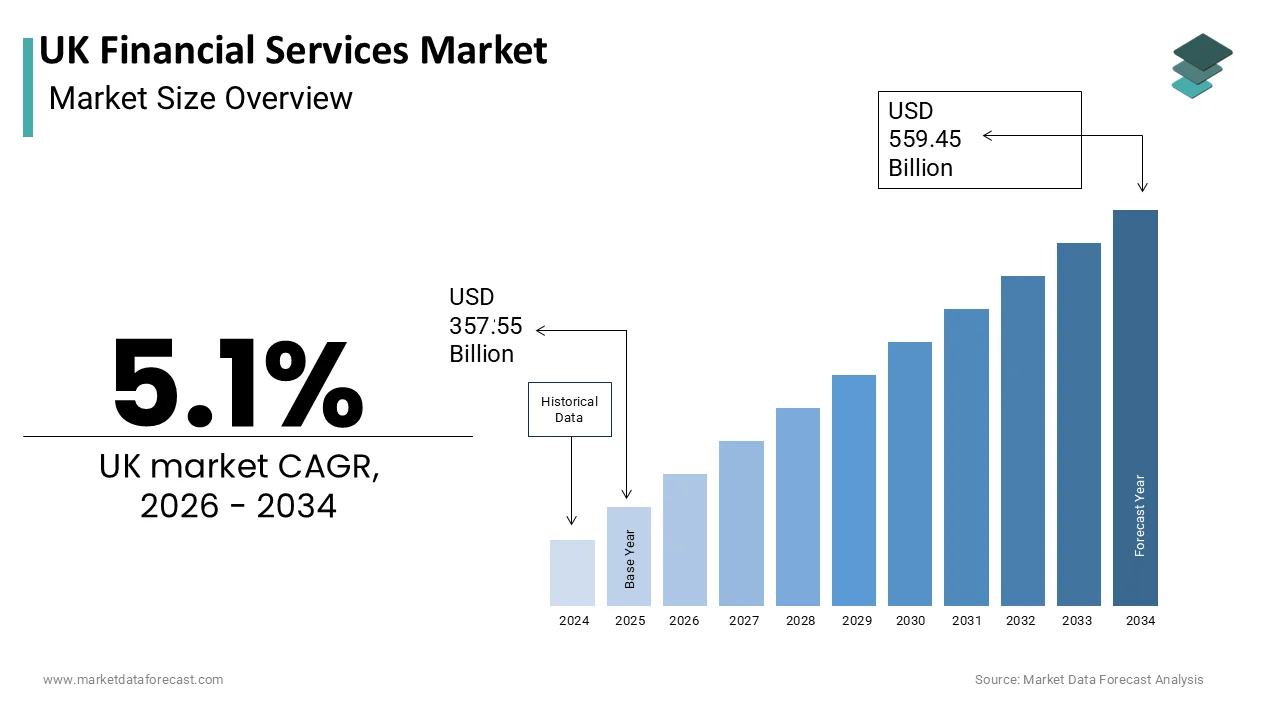
The U.K. Financial Services Market is projected to grow from USD 357.55 billion in 2025 to USD 375.79 billion in 2026 and reach USD 559.45 billion by 2034, registering a CAGR of 5.1% during the forecast period from 2026 to 2034.
The financial services are national economy functioning, as a global hub for banking insurance asset management and fintech innovation. According to the Office for National Statistics, the financial and insurance activities sector contributed 164 billion pounds to the United Kingdom gross domestic product in 2024 representing approximately 7.2% of total economic output. Regulatory frameworks established by the Prudential Regulation Authority and Financial Conduct Authority ensure stability consumer protection and market integrity while fostering an environment conducive to innovation.Digital transformation continues to reshape service delivery models with mobile banking contactless payments and algorithmic trading becoming standard practices. The government maintains a proactive stance through initiatives like the Edinburgh Reforms aiming to enhance competitiveness and attract global talent ensuring the sector remains resilient amid geopolitical uncertainties and technological disruptions.
MARKET DRIVERS
Accelerated Adoption of Digital Banking and Fintech Solutions
The rapid acceleration of digital banking and fintech adoption is one of the major factors propellinggrowth the United Kingdom financial services market. Consumers and businesses increasingly demand seamless instantaneous and personalized financial experiences driving traditional institutions to invest heavily in digital infrastructure while enabling agile challengers to capture significant market share. According to UK Finance data over 95% of adults in the United Kingdom now use online or mobile banking services reflecting near universal penetration of digital channels for routine transactions. The rise of open banking mandated by regulatory frameworks has further stimulated innovation by allowing third party providers secure access to customer data with consent thereby fostering competition and new product development. Contactless payment usage has surged with 78% of all face to face debit card transactions conducted via contactless methods in 2024 according to Payment Systems Regulator statistics. This shift reduces operational costs for banks by minimizing branch visits and paper based processes, while enhancing customer convenience.The integration of artificial intelligence for fraud detection customer service chatbots and personalized financial advice enhances user engagement and trust. These technological advancements create a virtuous cycle where improved user experience drives higher adoption rates, which in turn generates more data for further refinement of services ensuring sustained momentum in the digital financial services segment.
Expansion of Sustainable Finance and Green Investment Products
The expansion of sustainable finance and green investment products, as environmental social and governance considerations become central to investment decision making and corporate strategy. The expansion of sustainable finance and green investment products is attributed in levelling up the growth of the United Kingdom financial services market. Investors increasingly prioritize allocations that align with climate goals and ethical standards prompting asset managers banks and insurers to develop specialized products, such as green bonds sustainability linked loans and environmental impact funds. The United Kingdom government commitment to achieving net zero emissions by 2050 has created a supportive policy environment with mandatory climate related financial disclosures for large companies and financial institutions. This regulatory push ensures transparency and accountability encouraging capital flows toward low carbon technologies and renewable energy infrastructure. Insurance companies are also adapting by offering premiums discounts for eco-friendly buildings and vehicles, while excluding coverage for high carbon assets. This structural shift toward sustainability not only addresses climate risks but also opens new revenue streams for financial institutions capable of verifying measuring and reporting on environmental impacts thereby driving long term market evolution.
MARKET RESTRAINTS
Stringent Regulatory Compliance and Operational Costs
The stringent regulatory compliance requirements coupled with escalating operational costs is restraining the growth of the United Kingdom financial services market. Institutions must navigate a complex web of rules encompassing anti money laundering know your customer data protection capital adequacy and conduct standards, which require substantial investments in technology personnel and processes. The implementation of General Data Protection Regulation and subsequent updates has forced firms to overhaul data management systems ensuring privacy by design and rigorous consent mechanisms adding layers of administrative burden. The ongoing adaptation to post Brexit regulatory divergence requires maintaining dual compliance frameworks for European Union and United Kingdom operations increasing complexity for cross border firms. Smaller firms particularly struggle to absorb these fixed costs leading to market consolidation as they lack economies of scale. The constant evolution of regulatory expectations means that compliance is never a one-time project but a continuous resource drain diverting capital from innovation and customer acquisition initiatives thereby constraining overall market dynamism and competitive intensity.
Economic Volatility and Interest Rate Uncertainty
Economic volatility and persistent interest rate uncertainty constitute formidable is additionally declining the growth of the United Kingdom financial services market. Fluctuating macroeconomic conditions influenced by global geopolitical tensions inflationary pressures and supply chain disruptions create an unpredictable environment for financial planning and risk assessment. Businesses delay expansion plans due to uncertain demand and higher cost of capital resulting in lower loan demand for commercial real estate and equipment financing. Insurers face challenges in pricing policies accurately, as inflation drives up claim costs for property damage and vehicle repairs while investment returns on fixed income portfolios remain volatile. Asset managers struggle to deliver consistent returns amidst market turbulence leading to outflows from equity funds as investors seek safer havens. This cautious behavior restricts revenue growth for retail financial services providers who rely on transaction volumes and asset accumulation. The prolonged period of uncertainty forces institutions to maintain higher capital buffers and liquidity reserves further limiting their capacity for aggressive growth strategies or innovative product launches.
MARKET OPPORTUNITIES
Integration of Artificial Intelligence and Advanced Analytics
The integration of artificial intelligence and advanced analytics for value creation and efficiency enhancement is attributed in setting up new opportunities for the growth of the United Kingdom financial services market. These technologies enable institutions to process vast amounts of structured and unstructured data to uncover insights automate complex tasks and personalize customer interactions at scale. Machine learning algorithms enhance credit risk assessment by analyzing alternative data sources such as utility payments and social media behavior allowing lenders to serve previously underserved segments with greater accuracy. Fraud detection systems powered by real time anomaly identification reduce losses significantly with major banks reporting up to 30% improvement in detection speed as per Financial Crime Prevention Network case studies. Robotic process automation handles repetitive back office functions such as document verification and reconciliation freeing human employees for higher value advisory roles. Personalized wealth management platforms use predictive analytics to offer tailored investment advice based on individual risk profiles and life events democratizing access to financial planning. The United Kingdom government support for AI research through its national strategy provides a fertile ground for collaboration between academia and industry fostering innovation. As data privacy regulations evolve techniques such as federated learning allow model training without sharing raw data addressing security concerns. Embracing these technologies positions firms to offer superior customer experiences optimize resource allocation and maintain competitive advantage in an increasingly digital marketplace.
Growth of Embedded Finance and Banking as a Service
The rising embedded finance and banking as a service to expand their reach and revenue streams beyond traditional channels is another factor to escalate the growth of the United Kingdom financial services market. This model involves integrating financial products such as payments lending and insurance directly into non-financial platforms and customer journeys creating seamless experiences that meet users where they already engage. Insurance providers embed coverage into travel booking e commerce checkout and automotive purchase processes simplifying acquisition and enhancing relevance for consumers. Banking as a service platforms allow fintechs and brands to launch financial products using licensed infrastructure without building core banking systems from scratch accelerating time to market. This trend enables traditional banks to monetize their licenses and technology stacks by serving as underlying providers for diverse front end applications. It also fosters innovation by lowering entry barriers for niche players who can focus on user experience rather than regulatory compliance.
MARKET CHALLENGES
Cybersecurity Threats and Data Privacy Breaches
The cybersecurity threats and data privacy breaches, as digitalization expands the attack surface for malicious actors seeking to exploit vulnerabilities in interconnected systems is one of the challenges for the growth of the United Kingdom financial services market. Financial institutions hold vast quantities of sensitive personal and financial data making them prime targets for ransomware phishing and distributed denial of service attacks. According to National Cyber Security Centre statistics, the financial sector experienced 3500 significant cyber incidents in 2024 with average recovery costs exceeding 2 million pounds per incident. The sophistication of attacks has increased with state sponsored actors and organized crime groups employing advanced persistent threats that evade traditional detection methods. Data breaches not only result in direct financial losses but also severe reputational damage and regulatory penalties under General Data Protection Regulation provisions. Information Commissioner Office issued fines totaling 18 million pounds to financial firms for inadequate data protection measures in 2024 alone. The reliance on third party vendors and cloud services introduces additional supply chain risks requiring rigorous due diligence and continuous monitoring which strains internal security resources. Customer trust is fragile and even minor security lapses can lead to mass account closures and brand erosion. Implementing zero trust architectures multi factor authentication and employee training programs requires substantial ongoing investment. The evolving nature of threats means that defense strategies must constantly adapt creating a perpetual arms race that diverts resources from strategic initiatives and complicates operational resilience planning for financial institutions.
Talent Shortage and Skills Gap in Digital Competencies
The talent shortage and widening skills gap in digital competencies present enduring challenges, as the industry undergoes rapid technological transformation is additionally to hinder the growth of the United Kingdom financial services market. The shift toward digital banking artificial intelligence and blockchain requires professionals with hybrid skills combining financial expertise with technical proficiency in coding data science and cybersecurity which are scarce in the current labor market. Traditional finance graduates often lack programming knowledge, while technology specialists may not understand regulatory nuances or financial instruments creating a mismatch in candidate suitability. Competition for talent is intense not only from other financial institutions but also from big tech companies and fintech startups that offer attractive compensation packages and flexible work environments. This wage inflation increases operational costs and squeezes profit margins particularly for smaller firms unable to compete with larger rivals. Retention is equally challenging as employees seek continuous learning opportunities and career progression in fast evolving fields. Legacy organizational cultures in established banks sometimes resist agile working practices making them less appealing to younger digitally native workers. Addressing this gap requires significant investment in upskilling existing workforce apprenticeship programs and partnerships with universities but these initiatives take time to yield resultsUntil the skills pipeline improves institutions face delays in project delivery reduced innovation capacity and increased reliance on expensive external consultants hindering their ability to execute digital strategies effectively.
REPORT COVERAGE
| REPORT METRIC | DETAILS |
| Market Size Available | 2025 to 2034 |
| Base Year | 2025 |
| Forecast Period | 2026 to 2034 |
| Segments Covered | By Product Type, Application, End User Industry Vertical, and Region. |
| Various Analyses Covered | Global, Regional and Country-Level Analysis, Segment-Level Analysis, Drivers, Restraints, Opportunities, Challenges; PESTLE Analysis; Porter’s Five Forces Analysis, Competitive Landscape, Analyst Overview of Investment Opportunities |
| Countries Covered | United Kingdom |
| Market Leaders Profiled | HSBC Holdings plc, Barclays PLC, Lloyds Banking Group plc, NatWest Group plc, Standard Chartered PLC, Santander UK plc, Legal & General Group plc, Aviva plc, Prudential plc, London Stock Exchange Group plc (LSEG), Revolut Ltd., Monzo Bank Ltd. |
SEGMENTAL ANALYSIS
By Product Type Insights
The retail banking services segment was the largest by holding 34.2% of the United Kingdom financial services market share in 2025. The consolidation of major high street banks has created large entities with extensive branch networks and digital platforms that serve millions of customers efficiently. As per Office for National Statistics, household debt levels remain significant with outstanding consumer credit reaching 190 billion pounds indicating sustained reliance on retail banking products for consumption smoothing. The integration of everyday banking with mortgage provision creates cross selling opportunities that deepen customer relationships and increase lifetime value. Regulatory protections, such as the Financial Services Compensation Scheme guaranteeing up to 85000 pounds per depositor enhance public trust and encourage fund retention within the formal banking system. The shift toward fee free basic bank accounts ensures inclusion for vulnerable populations while premium packaged accounts generate fee income from affluent segments. Digital transformation has reduced the cost to serve allowing banks to maintain profitability despite low interest rate environments historically.

The fintech and digital only financial platforms segment is expected to grow at an anticipated CAGR of 14.2% throughout the forecast period owing to the ability of these platforms to leverage cloud native architectures artificial intelligence and big data analytics to offer superior user experiences lower fees and faster service delivery. Digital banks, such as Monzo Starling and Revolut have attracted millions of customers by offering intuitive mobile interfaces real time spending notifications and seamless international money transfers without the bureaucratic hurdles of traditional banks. These platforms excel in serving younger demographics and gig economy workers who value flexibility and transparency over legacy brand prestige. The regulatory sandbox environment provided by the Financial Conduct Authority allows fintechs to test innovative products such as buy now pay later schemes and crypto asset services with reduced compliance burdens during early stages. This supportive ecosystem encourages rapid experimentation and iteration enabling fintechs to capture niche markets quickly.
By Application Insights
The payments and money transfers segment was accounted in holding 44.3% of the United Kingdom financial services market share in 2025 due to the ubiquitous nature of transactional activity and the ongoing transition toward a cashless society. Every economic exchange requires a payment mechanism making this application the most frequently used financial service by both consumers and businesses. The widespread adoption of contactless technology has streamlined point of sale interactions with face to face debit card transactions conducted via contactless methods reducing friction and increasing transaction frequency. Real time payment systems, such as Faster Payments Service facilitate over 7 million instant transfers daily enabling immediate settlement for bills salaries and peer to peer transfers, as per Pay UK operational data. The rise of e commerce has further amplified demand for secure online payment gateways that support multiple currencies and fraud prevention protocols. The standardization of open banking APIs has also enabled initiation of payments directly from bank accounts bypassing card networks and reducing merchant fees. This efficiency drives merchant adoption and consumer preference. The role of payments in facilitating all other economic activities ensures this segment maintains its dominant position with continuous innovation in speed security and accessibility driving further usage growth.
The risk management and compliance segment is likely to grow at a fastest CAGR of 12.5% from 2026 to 2034, as institutions grapple with an increasingly complex regulatory environment and sophisticated cyber threats. The proliferation of rules surrounding anti money laundering know your customer data privacy and capital adequacy requires automated solutions that can monitor transactions screen customers and generate reports efficiently. The General Data Protection Regulation and subsequent United Kingdom data protection laws mandate rigorous data governance forcing firms to invest in tools that track data lineage and manage consent. Cybersecurity risks have escalated with ransomware attacks targeting financial infrastructure becoming more frequent and damaging necessitating advanced threat detection and response capabilities. The National Cyber Security Centre reports that the financial sector faces thousands of significant cyber incidents annually requiring continuous investment in security operations centers and artificial intelligence driven monitoring. Regulatory reporting requirements, such as those from the Prudential Regulation Authority demand accurate and timely submission of capital and liquidity metrics driving adoption of regulatory technology solutions. The convergence of financial crime compliance and cybersecurity into integrated risk platforms creates economies of scale for vendors and buyers.
By End User Industry Vertical Insights
The individual consumers segment was the largest by holding 32.1% of the United Kingdom financial services market share in 2025. The sheer volume of individual accounts and policies dwarfs corporate contracts in terms of unit count creating a massive aggregate market value. The democratization of financial services through digital channels has increased engagement with younger demographics who actively manage their finances via mobile apps. The demand for mortgage financing remains robust despite interest rate fluctuations with first time buyers and home movers driving substantial lending volumes. Insurance penetration is high with compulsory motor insurance and widespread home and life coverage ensuring steady premium income for insurers. The rise of personal finance management tools has empowered consumers to compare products and switch providers easily increasing competition but also overall market activity. Government initiatives such as auto enrollment in workplace pensions have expanded the customer base for asset managers ensuring long term inflows.
The SMEs and large enterprises segment is lucratively growing at a fastest CAGR of 10.8% from 2026 to 2034. Small and medium sized enterprises are digitizing their financial processes adopting cloud accounting integrated payment systems and automated lending platforms to improve efficiency and cash flow visibility. Large enterprises are investing heavily in treasury management systems foreign exchange hedging and supply chain finance solutions to navigate global volatility and optimize working capital. The access to finance remains a top priority with businesses seeking flexible credit lines and invoice factoring to bridge payment gaps. The complexity of corporate banking needs drives demand for specialized advisory services, including mergers and acquisitions support structured finance and sustainability linked loans. Corporate insurance needs are also evolving with cyber liability and business interruption coverage becoming essential leading to premium growth.
COMPETITIVE LANDSCAPE
The competition within the United Kingdom financial services market is intense and characterized by the coexistence of established traditional banks agile fintech startups and specialized niche providers. Incumbent institutions leverage their extensive branch networks brand recognition and large capital bases to retain loyal customers while investing heavily in digital platforms to counter the threat from challengers. Fintech companies disrupt traditional models by offering lower fees superior user interfaces and faster service delivery particularly in payments lending and wealth management sectors. Regulatory changes, such as open banking have lowered barriers to entry allowing new players to access customer data and create integrated financial ecosystems. Price competition remains fierce in mortgages and savings products prompting institutions to differentiate through value added services like financial planning tools and rewards programs. The rise of embedded finance further blurs industry boundaries as non-financial companies begin offering banking services directly within their platforms. Talent acquisition is another key battleground with firms competing for skilled professionals in data science cybersecurity and digital product development.
KEY MARKET PLAYERS
Some of the companies that are playing a dominating role in the U.K. Financial Services Market include
- HSBC Holdings plc
- Barclays PLC
- Lloyds Banking Group plc
- NatWest Group plc
- Standard Chartered PLC
- Santander UK plc
- Legal & General Group plc
- Aviva plc
- Prudential plc
- London Stock Exchange Group plc (LSEG)
- Revolut Ltd.
- Monzo Bank Ltd.
TOP LEADING PLAYERS IN THE MARKET
- HSBC Holdings plc maintains a significant presence in the United Kingdom financial services sector by leveraging its global network to facilitate international trade and cross border banking for corporate and retail clients. The bank focuses heavily on digital transformation initiatives to enhance customer experience through mobile applications and online platforms that offer seamless transaction capabilities. Recent strategic actions include substantial investments in wealth management services and sustainable finance products to align with environmental goals and attract socially conscious investors. HSBC has also strengthened its cybersecurity infrastructure to protect client data against evolving threats, while expanding its open banking partnerships to integrate with third party fintech solutions. These efforts aim to modernize legacy systems and improve operational efficiency ensuring the bank remains competitive in a rapidly changing digital landscape.
- Barclays plc plays a pivotal role in the United Kingdom financial services market by providing comprehensive retail banking corporate finance and investment banking services to a diverse client base. The institution has prioritized the development of its digital banking platform to offer personalized financial advice and automated savings tools that appeal to younger demographics. Recent initiatives involve expanding its credit card offerings with cashback rewards and travel benefits to increase consumer engagement and transaction volume. Barclays has also invested significantly in artificial intelligence technologies to streamline fraud detection and enhance customer service interactions through intelligent chatbots. The bank actively supports small and medium enterprises by offering tailored lending solutions and business advisory services to foster economic growth.
- Lloyds Banking Group serves as a cornerstone of the United Kingdom retail banking sector by providing essential financial services to millions of personal and business customers across the nation. The group has concentrated on simplifying its product range and improving digital accessibility to ensure inclusive banking for all segments of society including vulnerable customers. Recent actions include the closure of physical branches in favor of enhanced online support and community banking hubs that offer face to face assistance when needed. Lloyds has also expanded its mortgage portfolio by introducing flexible repayment options and competitive fixed rate deals to support home ownership amidst changing interest rate environments. The bank invests heavily in data analytics to better understand customer needs and offer proactive financial health insights.
TOP STRATEGIES USED BY KEY MARKET PARTICIPANTS
Key players in the United Kingdom financial services market predominantly employ digital transformation and strategic partnerships to enhance customer engagement and operational efficiency. Institutions invest heavily in artificial intelligence and machine learning technologies to automate routine tasks personalize user experiences and improve fraud detection capabilities. Developing robust mobile banking applications allows firms to offer seamless access to accounts payments and financial advice thereby meeting the expectations of digitally native consumers. Collaborations with fintech companies enable traditional banks to integrate innovative solutions such as open banking APIs and blockchain technology without developing these capabilities in house. Expanding into sustainable finance products including green bonds and environmental social and governance linked loans helps institutions align with regulatory requirements and attract ethically minded investors. Enhancing cybersecurity measures is another critical strategy to protect sensitive customer data and maintain trust in an era of increasing cyber threats. Personalization through data analytics allows firms to offer tailored product recommendations improving cross selling success rates and customer retention.
MARKET SEGMENTATION
This research report on the UK financial services market is segmented and sub-segmented into the following categories.
By Product Type
- Retail Banking Services
- Fintech & Digital-Only Financial Platforms
- Investment Banking
- Insurance Services
- Wealth & Asset Management
- Others
By Application
- Payments & Money Transfers
- Risk Management & Compliance
- Lending & Credit Services
- Investment Management
- Financial Advisory Services
- Others
By End User Industry Vertical
- Individual Consumers
- SMEs & Large Enterprises
- Government & Public Sector
- Financial Institutions
- Others
By Country
- United Kingdom