- Product Description Description
- Table of Contents TOC
- List of Table & Figure LOT
- Get Free Sample PDF Sample PDF
Market Size, 2025
$6,730.00 MnMarket Estimate, 2026
$7,100.00 MnMarket Forecast, 2034
$10.90 BnCAGR, 2026–2034
5.50%Executive Summary: UK Insulation Market
- Market Scope: Comprehensive analysis of the UK insulation sector, detailing materials, applications, and country-level dynamics.
- Market Valuation: Valued at USD 6,730 million in 2025, reaching USD 7,100 million in 2026, and projected to expand to USD 10.90 billion by 2034, growing at a steady CAGR of 5.50% from 2026 to 2034.
- Primary Growth Drivers: Stringent government efficiency mandates (e.g., Future Homes Standard, Energy Company Obligation), escalating household energy costs, and an urgent need to retrofit aging housing stock.
Key Market Segment Metrics
| Category | Leading Segment (Base Position) | Fastest-Growing / High-Growth Segment |
|---|---|---|
| By Material | Mineral Wools (holds the largest market share due to superior fire safety performance, non-combustibility, and acoustic properties) | Foamed Plastics (growing at a strong rate due to high thermal efficiency, R-values, and thinner profile requirements for compact urban retrofits) |
| By Application | Building and Construction (dominant sector driven by massive residential/commercial construction and mandatory thermal efficiency regulations) | Transportation (fastest-growing segment with a CAGR of 7.50%, driven by EV fleet electrification and aerospace thermal needs) |
| By Country | United Kingdom (mature market leader representing ~25% of the European market, driven by net-zero goals and extensive retrofit needs) | United Kingdom - Regional Retrofit Hubs (high-growth domestic areas scaling up insulation installations via government schemes) |
Major Market Players & Industry Landscape
Market Structure: A highly competitive landscape featuring major international building material corporations focusing on eco-friendly innovations, regulatory compliance, and thermal performance.
Key Companies: Kingspan Group plc, Saint-Gobain S.A. (Isover), Rockwool International A/S, Knauf Insulation Ltd., Owens Corning, Recticel NV/SA, Armacell International S.A., BASF SE, Johns Manville Corporation, URSA Insulation S.A., Superglass Insulation Ltd., and Celotex Ltd.
 Download Free Sample Report
UK Insulation Market Size
The UK Insulation Market is projected to grow from USD 6,730 million in 2025 to USD 7,100 million in 2026 and reach USD 10.90 billion by 2034, registering a CAGR of 5.50% during the forecast period from 2026 to 2034.

The UK housing stock is among the oldest in Europe, with approximately 20% of homes built before 1919, as per data from the Ministry of Housing, Communities and Local Government. These older properties often lack adequate thermal barriers, leading to significant heat loss and higher energy consumption. The government has identified that around 19 million homes require some form of insulation upgrade to meet modern energy standards. Furthermore, the construction industry contributes roughly 6% to the national gross domestic product, indicating a robust infrastructure for material adoption. According to the Office for National Statistics, the average household energy bill reached 2,500 pounds in recent years, driving urgent consumer interest in cost-saving measures. The regulatory landscape mandates stricter building codes, requiring new constructions to achieve near-zero energy status. This shift compels developers and homeowners to prioritize high-performance insulation solutions. The market is thus characterized by a transition from traditional materials like fiberglass to advanced options such as rigid foam boards and sustainable alternatives, including sheep wool and recycled cellulose, reflecting a growing emphasis on environmental responsibility and long-term operational savings.
MARKET DRIVERS
Stringent Government Energy Efficiency Mandates Drive Adoption
The implementation of rigorous government regulations is one of the major factors propelling the growth of the UK insulation market. The Future Homes Standard, set to be fully enforced by 2025, mandates that all new residential buildings produce 75% lower carbon emissions compared to those constructed under previous regulations. This legislative framework compels builders to integrate superior thermal envelopes, directly increasing the demand for high-performance insulation materials. According to the Department for Business, Energy and Industrial Strategy, the residential sector accounts for approximately 30% of the total energy consumption in the country, making it a critical target for emission reductions. The Energy Company Obligation scheme has already facilitated the installation of insulation measures in over 2.5 million households since its inception, demonstrating the tangible impact of policy-driven initiatives. Additionally, the minimum energy efficiency standards for rental properties require landlords to achieve an E rating or higher, affecting nearly 1 million private rented homes that currently fall below this threshold. According to the English Housing Survey, roughly 40% of homes in the private rented sector are rated D or below, creating a substantial retrofit market. These regulatory pressures ensure that insulation is not merely an optional upgrade but a compliance necessity, thereby sustaining consistent demand across both new construction and existing building renovation projects throughout the nation.
Rising Energy Costs Accelerate Consumer Investment in Thermal Solutions
Escalating energy prices have fundamentally altered consumer behavior, prompting a surge in voluntary insulation upgrades as homeowners seek to mitigate utility expenses, which is further contributing to the insulation market expansion in the UK. The volatility in global energy markets has led to record-high electricity and gas bills, with the price cap reaching unprecedented levels in recent years. According to Ofgem, the energy price cap for typical dual fuel customers rose to 2,500 pounds annually, forcing households to prioritize energy conservation measures. According to data from the National Energy Action charity, proper loft insulation can save an average household up to 225 pounds per year on heating costs, while cavity wall insulation can yield savings of approximately 155 pounds annually. These financial incentives drive significant market activity, particularly among middle-income demographics who are sensitive to operational costs. According to the Energy Saving Trust, nearly 60% of homeowners consider energy efficiency improvements when planning renovations, with insulation ranking as the top priority due to its rapid return on investment. Furthermore, the psychological impact of energy insecurity has heightened awareness regarding home thermal performance. According to surveys conducted by YouGov, over 70% of UK residents express concern about their ability to afford heating during the winter months. This anxiety translates into proactive spending on insulation products, ranging from DIY kits for attics to professional installation services for solid walls, thereby expanding the market base beyond regulatory compliance to include genuine consumer driven demand for economic resilience and comfort.
MARKET RESTRAINTS
High Initial Installation Costs Restrain Market Penetration
The substantial upfront financial outlay required for comprehensive insulation projects is impeding the expansion of the UK insulation market, particularly among low and middle-income households. While long-term savings are evident, the initial investment for materials and professional labor can be prohibitive. According to the Federation of Master Builders, the average cost for installing external wall insulation on a semi-detached house ranges from 8,000 to 12,000 pounds, depending on the property size and material choice. This expense is often beyond the immediate disposable income of many consumers, especially in the current economic climate characterized by inflationary pressures. According to the Construction Products Association, labor costs constitute nearly 40% of the total project expense, further inflating the price point. Although government grants exist, they often cover only a fraction of the total cost, leaving homeowners to finance the remainder. According to data from the Money Advice Service, 35% of UK adults have less than 1000 pounds in savings, limiting their capacity to undertake major home improvements without borrowing. High interest rates on personal loans and home equity releases also deter potential customers. According to the Bank of England, base rate increases have made credit more expensive, reducing the affordability of financed renovation projects. Consequently, many homeowners delay or abandon insulation plans, opting for cheaper, less effective short-term fixes instead. This financial constraint restricts the market growth to wealthier segments and those eligible for full subsidies, leaving a large portion of the housing stock without adequate thermal protection despite the clear long-term benefits.
Shortage of Skilled Labor Impedes Project Execution
A critical shortage of qualified installers poses a substantial challenge to the timely and effective deployment of insulation solutions across the UK, which is further hindering the UK market growth. The complexity of modern insulation materials, such as spray foam and rigid board systems, requires specialized training and certification to ensure correct application and safety compliance. According to the Construction Industry Training Board, the sector faces a deficit of approximately 25,000 skilled workers, with insulation specialists being among the most scarce trades. This labor gap leads to prolonged waiting times for customers, with some reporting delays of up to 6 months for professional installation services. According to the National Insulation Association, improper installation can reduce the effectiveness of insulation by up to 50%, underscoring the need for competent professionals. However, the aging workforce exacerbates the issue, as nearly 30% of current construction workers are aged 50 or above, as per data from the Office for National Statistics. Younger entrants to the trade are insufficient to replace retiring experts, creating a sustainability crisis in workforce availability. Additionally, the variability in quality among available installers undermines consumer confidence, with complaints about poor workmanship rising by 15% in recent years, according to the Citizens Advice Bureau. This reputational risk discourages potential customers from investing in insulation projects. The lack of standardized training programs and career pathways further hinders recruitment efforts, leaving the industry unable to scale up operations to meet the growing demand driven by regulatory and economic factors, thereby stifling market potential.
MARKET OPPORTUNITIES
Expansion of Retrofit Programs for Older Housing Stock Presents Significant Growth Potential
The vast inventory of aging residential properties in the UK offers a substantial opportunity for market expansion through targeted retrofit initiatives. Approximately 80% of the homes that will exist in 2050 have already been built, meaning that new construction alone cannot meet national carbon reduction targets. According to the Committee on Climate Change, retrofitting these existing structures is essential to achieving net-zero emissions by 2050. The government has launched various schemes, such as the Great British Insulation Scheme, which aims to upgrade 300,000 homes annually with improved thermal efficiency measures. This initiative creates a steady pipeline of demand for insulation manufacturers and installers. According to data from the Building Research Establishment, solid wall properties, which make up nearly 25% of the UK housing stock, are particularly inefficient and represent a lucrative segment for internal and external wall insulation solutions. According to analysis by the Energy Systems Catapult, the potential market value for retrofit insulation is estimated to exceed 5 billion pounds over the next decade. Furthermore, local authorities are increasingly partnering with private sector entities to deliver area-based retrofit programs, leveraging economies of scale to reduce costs and increase uptake. These collaborative efforts open new distribution channels and customer segments for industry players. The focus on fuel poverty alleviation also attracts social investment and charitable funding, diversifying the revenue streams available to market participants. By capitalizing on this extensive retrofit opportunity, companies can secure long-term contracts and establish brand loyalty in a market that is poised for sustained growth driven by structural housing needs rather than transient economic cycles.
Innovation in Sustainable and Bio-Based Materials Opens New Market Segments
The growing consumer preference for environmentally friendly products creates a promising avenue for the development and adoption of sustainable insulation materials, which is another significant opportunity for the UK insulation market. Traditional options like fiberglass and mineral wool, while effective, have significant embodied carbon footprints associated with their manufacturing processes. In contrast, bio-based alternatives such as sheep wool, hemp, cork, and recycled cellulose offer lower environmental impact and appealing sustainability credentials. According to the Green Building Council, the construction sector is responsible for 40% of global carbon emissions, driving demand for low-carbon building materials. According to data from Market Data Forecast, the market for natural insulation materials is projected to grow at a compound annual growth rate of 8% over the next five years. Consumers are increasingly willing to pay a premium for products that align with their ecological values, with surveys indicating that 65% of homeowners prefer sustainable options when available. Manufacturers are responding by innovating production techniques to enhance the performance and durability of these natural materials, making them competitive with conventional choices. For instance, treated hemp insulation now offers comparable thermal resistance to mineral wool while providing better moisture regulation and indoor air quality benefits. The Circular Economy Package introduced by the European Union, which influences UK standards, encourages the use of recycled content, further boosting the appeal of cellulose and denim-based insulation. This trend allows companies to differentiate their offerings and capture niche market segments that prioritize health and environmental stewardship, thereby expanding the overall market scope beyond traditional performance metrics to include holistic sustainability values.
MARKET CHALLENGES
Volatility in Raw Material Prices Disrupts Supply Chain Stability
Fluctuations in the costs of key raw materials present a persistent challenge to the UK insulation market, which is affecting profit margins and pricing strategies for manufacturers. Many insulation products rely on petrochemical derivatives, such as polystyrene and polyurethane, whose prices are closely linked to global oil markets. According to the International Energy Agency, crude oil prices experienced significant volatility in recent years, swinging from negative values during pandemic lows to over 100 dollars per barrel amid geopolitical tensions. This instability translates directly into unpredictable production costs for foam-based insulation materials. Additionally, the supply of glass and rock fibers, essential for mineral wool production, depends on energy-intensive melting processes that are sensitive to natural gas prices. According to the Confederation of British Industry, energy costs for manufacturing have increased by 50% in some sectors, forcing producers to pass these expenses onto customers. Such price hikes can dampen demand, particularly among price-sensitive consumers and small-scale contractors. Furthermore, logistical disruptions caused by global events have led to shortages of ancillary materials like adhesives and vapor barriers, delaying project completion times. According to the Logistics Manager Index, lead times for construction materials extended by an average of 4 weeks during peak disruption periods. These supply chain uncertainties make it difficult for companies to maintain consistent inventory levels and honor fixed price contracts, eroding trust with clients. The inability to predict costs accurately hampers long-term planning and investment in capacity expansion, constraining the market's ability to respond effectively to surging demand driven by regulatory and economic factors.
Complexity of Regulatory Compliance and Certification Processes Hinders Market Entry
Navigating the intricate web of building regulations and certification requirements further challenges the expansion of the UK insulation market. Products must comply with stringent standards such as British Standards and European Norms, which dictate performance criteria for thermal conductivity, fire safety, and durability. According to the British Board of Agrément, obtaining certification for a new insulation material can take between 6 and 12 months and cost upwards of 20,000 pounds, creating a high barrier to entry for innovative startups. The recent updates to Approved Document L of the Building Regulations, which focus on conservation of fuel and power, have introduced more rigorous testing protocols that require manufacturers to invest in advanced laboratory facilities. Failure to comply can result in legal penalties and project delays, as seen in several high-profile construction disputes where non-compliant materials were installed. The Fire Safety Act following the Grenfell Tower tragedy has further tightened regulations around combustible materials, restricting the use of certain foam insulations in high rise buildings. According to the Home Office, over 5,000 buildings have been identified as requiring cladding remediation, creating confusion and caution among specifiers regarding insulation choices. This regulatory complexity increases administrative burdens and compliance costs for businesses, slowing down the introduction of new products to the market. Small and medium-sized enterprises often lack the resources to manage these regulatory demands effectively, limiting competition and innovation. The uncertainty surrounding future regulatory changes also discourages long-term investment in research and development, as companies hesitate to commit resources to products that may become non-compliant due to shifting policy landscapes.
REPORT COVERAGE
| REPORT METRIC | DETAILS |
| Market Size Available | 2025 to 2034 |
| Base Year | 2025 |
| Forecast Period | 2026 to 2034 |
| Segments Covered | By Material, Application, and Region |
| Various Analyses Covered | Global, Regional and Country-Level Analysis, Segment-Level Analysis, Drivers, Restraints, Opportunities, Challenges; PESTLE Analysis; Porter’s Five Forces Analysis, Competitive Landscape, Analyst Overview of Investment Opportunities |
| Countries Covered | United Kingdom |
| Market Leaders Profiled | Kingspan Group plc, Saint-Gobain S.A. (Isover), Rockwool International A/S, Knauf Insulation Ltd., Owens Corning, Recticel NV/SA, Armacell International S.A., BASF SE, Johns Manville Corporation, URSA Insulation S.A., Superglass Insulation Ltd., Celotex Ltd. |
SEGMENTAL ANALYSIS
By Material Insights
The mineral wools segment dominated the market by holding the largest share of the UK market in 2025 due to their proven fire safety performance and acoustic properties. The construction industry heavily favors these materials because they are non-combustible and meet stringent building regulations regarding fire resistance. According to the British Board of Agrément, mineral wool products hold approximately 60% of the total insulation market share in the UK, driven by mandatory compliance with Approved Document B, which governs fire safety in buildings. The inherent ability of stone wool to withstand temperatures exceeding 1000 degrees Celsius makes it indispensable for high-rise residential and commercial projects where safety is paramount. Furthermore, the versatility of glass wool allows it to be used in a wide range of applications from loft insulation to cavity walls, catering to both new builds and retrofit projects. According to the Manufacturing Technology Centre, over 70% of new housing developments specify mineral wool as the primary thermal barrier due to its ease of installation and compatibility with standard timber and steel frames. This widespread adoption is reinforced by the material's recyclability, with major producers offering take-back schemes that align with circular economy goals. The established supply chain infrastructure ensures consistent availability and competitive pricing, making mineral wools the default choice for contractors and specifiers who prioritize reliability and regulatory adherence over novel but unproven alternatives.
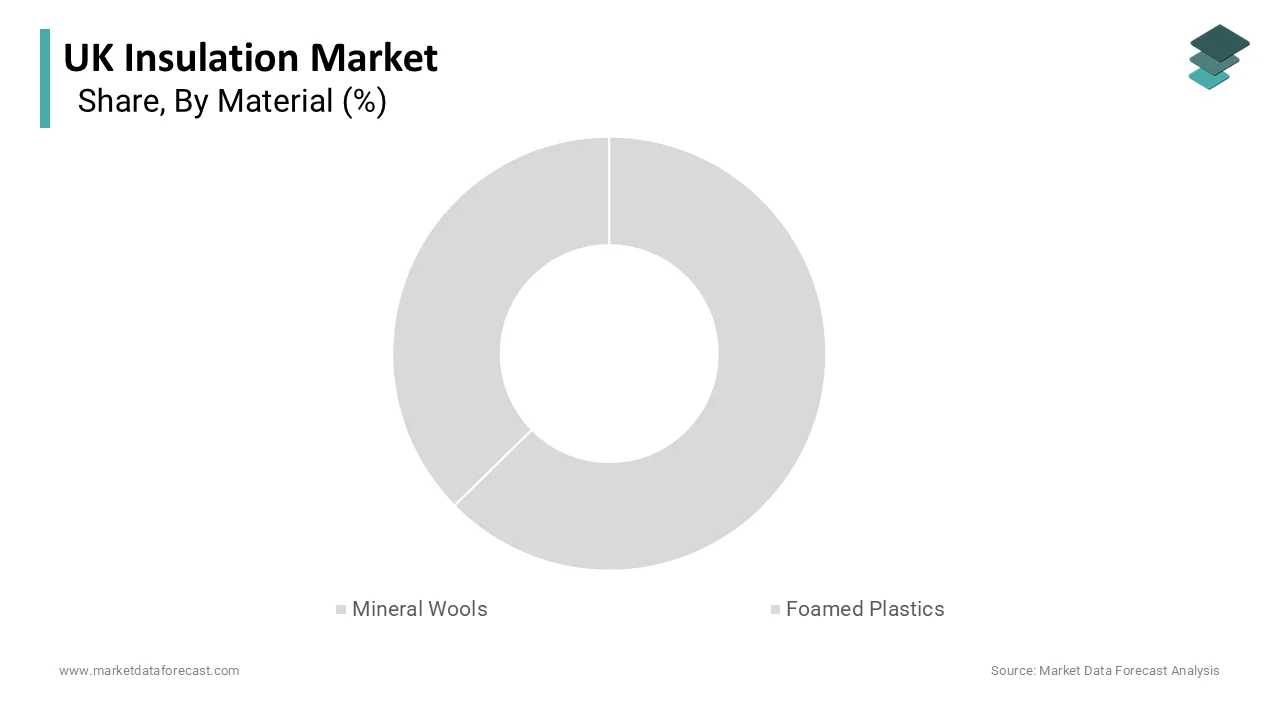
On the other side, the foamed plastics segment is estimated to showcase a promising CAGR of .4% during the forecast period, owing to the superior thermal efficiency of materials such as polyisocyanurate and extruded polystyrene, which offer higher R values per unit thickness compared to traditional mineral wools. As building designs become more compact and space efficient, the ability to achieve required thermal performance with thinner layers becomes increasingly valuable, particularly in urban renovation projects where internal floor space is at a premium. According to the Royal Institute of British Architects, the use of rigid foam boards has increased by 40% in recent years in retrofits of Victorian and Edwardian terraced houses, where preserving interior room dimensions is crucial. The automotive and transportation sectors also contribute to this growth, as lightweight foam insulation helps improve fuel efficiency and meet emission standards. According to the Society of Motor Manufacturers and Traders, electric vehicle production in the UK has risen by 25% annually, driving demand for advanced thermal management solutions that utilize foamed plastics for battery protection and cabin comfort. Additionally, advancements in blowing agents have reduced the global warming potential of these materials, addressing previous environmental concerns and making them more acceptable to sustainability-focused specifiers. This combination of technical superiority and evolving environmental credentials positions foamed plastics as the dynamic growth engine of the insulation market.
By Application Insights
The building and construction segment dominated the market by holding the highest share of the UK market in 2025. This overwhelming share is driven by the sheer volume of residential and commercial construction activities, coupled with mandatory regulatory requirements for energy efficiency in all new builds and major renovations. According to the Office for National Statistics, the construction industry contributes over 130 billion pounds to the UK economy annually, with housing projects representing the largest component. The government's commitment to building 300,000 new homes per year creates a consistent baseline demand for insulation materials, while the aging housing stock necessitates continuous retrofitting. According to the Committee on Climate Change, decarbonizing the built environment is essential for meeting net zero targets, prompting strict enforcement of building regulations that mandate high levels of thermal performance. Additionally, the commercial sector, including offices, retail spaces, and industrial warehouses, requires extensive insulation for climate control and operational cost reduction. According to data from the British Property Federation, commercial real estate owners are increasingly investing in green certifications such as BREEAM, which reward superior insulation standards with higher asset valuations. The integration of insulation into the core fabric of buildings ensures that it remains a non-negotiable element of construction, unlike optional finishes or fixtures. This structural necessity, combined with regulatory pressure and economic incentives, secures the building and construction segment as the undisputed leader in the insulation market landscape.
However, the transportation segment is emerging as the fastest-growing application area for insulation in the UK and is expected to showcase a CAGR of 7.5% during the forecast period, owing to the rapid electrification of the vehicle fleet and the increasing complexity of thermal management systems required for electric batteries and power electronics. According to the Society of Motor Manufacturers and Traders, electric vehicle sales in the UK have surpassed 20% of total new car registrations, creating a surging demand for specialized insulation materials that protect battery packs from extreme temperatures and ensure passenger comfort. Unlike internal combustion engines, electric vehicles require precise thermal regulation to maintain battery efficiency and longevity, necessitating advanced lightweight insulation solutions such as aerogels and specialized foams. The aerospace industry also contributes to this growth, with the UK being a global hub for aircraft manufacturing and maintenance. According to data from Aerospace UK, the sector is investing heavily in composite materials and thermal barriers to improve fuel efficiency and reduce noise pollution in next-generation aircraft. Additionally, the rail sector is upgrading rolling stock to meet higher comfort and energy efficiency standards, driving demand for acoustic and thermal insulation in trains. The combination of automotive electrification, aerospace innovation, and rail modernization creates a dynamic and high-value market for advanced insulation technologies that differ significantly from traditional building materials.
COUNTRY LEVEL ANALYSIS
UK Insulation Market Analysis
The UK led the market by holding the highest share of the European market in 2025 and is expected to experience steady transformation over the next few years due to aggressive policy interventions and a robust push to upgrade older housing infrastructure. The country stands as the largest and most mature insulation market in Europe, characterized by a strong regulatory framework and a significant backlog of retrofit opportunities. The country holds approximately 25% of the total European insulation market share, driven by its ambitious net-zero carbon targets and aging housing infrastructure. According to the Committee on Climate Change, the UK must upgrade 25 million homes to high energy efficiency standards by 2050 to meet its climate goals, creating a decades-long pipeline of demand for insulation products. The government has implemented various initiatives, such as the Great British Insulation Scheme and the Energy Company Obligation, to stimulate market activity, particularly in the social housing and low-income sectors. According to data from the Department for Business, Energy and Industrial Strategy, these programs have facilitated the installation of insulation measures in over 3 million homes since 2013, demonstrating the effectiveness of policy-driven interventions. The UK construction industry is also transforming sustainable practices, with increasing adoption of green building certifications and circular economy principles. According to the Waste and Resources Action Programme, the construction sector generates 60% of the UK's total waste, prompting greater emphasis on recyclable and bio-based insulation materials. Additionally, the country's robust manufacturing base supports domestic production of mineral wools and foam boards, reducing reliance on imports and ensuring supply chain resilience. The combination of regulatory pressure, financial incentives, and industrial capability positions the UK as a leader in the European insulation market, with continued growth expected as the nation progresses towards its decarbonization objectives.
COMPETITIVE LANDSCAPE
The competition in the UK insulation market is characterized by intense rivalry among established multinational corporations and specialized regional manufacturers. Market leaders differentiate themselves through technological innovation, product quality, and comprehensive service offerings rather than price alone. The shift towards sustainable construction practices has intensified the focus on eco-friendly materials and circular economy principles, prompting companies to invest in green technologies. Regulatory pressures regarding fire safety and energy efficiency create high barriers to entry, favoring incumbents with robust compliance frameworks and certification portfolios. Collaborative relationships with architects, contractors, and government agencies are crucial for securing specifications in major projects. The market also sees increasing consolidation, with larger entities acquiring niche players to expand their product ranges and geographic reach. Customer loyalty is driven by reliability, technical support, and brand reputation, making it challenging for new entrants to gain traction without significant investment. Overall, the competitive landscape demands continuous adaptation to regulatory changes and evolving consumer expectations to sustain market presence.
KEY MARKET PLAYERS
Some of the companies that are playing a dominating role in the UK Insulation Market include
- Kingspan Group plc
- Saint-Gobain S.A. (Isover)
- Rockwool International A/S
- Knauf Insulation Ltd.
- Owens Corning
- Recticel NV/SA
- Armacell International S.A.
- BASF SE
- Johns Manville Corporation
- URSA Insulation S.A.
- Superglass Insulation Ltd.
- Celotex Ltd.
TOP LEADING PLAYERS IN THE MARKET
- Kingspan Group operates as a global leader in high-performance insulation and building envelope solutions with significant influence in the UK. The company focuses on manufacturing rigid foam core panels that offer superior thermal efficiency for commercial and residential projects. Kingspan recently invested heavily in expanding its production facilities in England to meet rising demand for low-carbon construction materials. Their strategic emphasis on sustainability includes launching products with reduced embodied carbon and enhanced recyclability. By integrating digital tools for building design and energy modeling, Kingspan supports architects in achieving strict regulatory compliance. This holistic approach strengthens their reputation as an innovator in the sector while addressing the urgent need for energy-efficient building fabrics across the nation.
- Saint-Gobain Isover specializes in mineral wool insulation and provides comprehensive acoustic and thermal solutions for the UK construction industry. The company leverages its extensive research capabilities to develop lightweight and easy-to-install products that cater to both professional contractors and DIY enthusiasts. Saint-Gobain has recently enhanced its supply chain resilience by optimizing local distribution networks and investing in automated manufacturing technologies. Their commitment to circular economy principles is evident in initiatives that promote the recycling of glass wool waste. By offering technical training and support services to builders, Saint-Gobain ensures proper installation practices that maximize product performance. This customer-centric strategy reinforces their position as a trusted partner in delivering safe and sustainable insulation solutions.
- Rockwool Limited stands out as a premier manufacturer of stone wool insulation known for its exceptional fire resistance and durability. The company plays a critical role in enhancing building safety standards across the UK through its non-combustible material offerings. Rockwool has recently expanded its production capacity in the region to address the growing demand for high-rise residential and commercial projects. Their focus on innovation includes developing new product lines that combine thermal efficiency with acoustic comfort. Rockwool actively collaborates with industry bodies to shape building regulations and promote best practices in fire safety. By prioritizing environmental stewardship and resource efficiency, Rockwool demonstrates its dedication to creating healthier and safer living environments while maintaining a competitive edge in the market.
TOP STRATEGIES USED BY KEY MARKET PARTICIPANTS
Key players in the UK insulation market primarily employ product innovation and sustainability integration to maintain a competitive advantage. Companies invest heavily in research and development to create materials with lower embodied carbon and higher thermal performance. Strategic partnerships with construction firms and government bodies facilitate access to large-scale retrofit projects and new housing developments. Expansion of manufacturing capacity within the region helps reduce logistics costs and ensures timely delivery amid supply chain disruptions. Digital transformation initiatives enable better customer engagement through online design tools and technical support platforms. Additionally, firms focus on workforce training programs to address skilled labor shortages and ensure high-quality installation standards. These combined strategies allow market participants to adapt to evolving regulatory requirements and consumer preferences while driving long-term growth and operational efficiency in the sector.
MARKET SEGMENTATION
This research report on the UK insulation market is segmented and sub-segmented into the following categories.
By Material
- Mineral Wools
- Foamed Plastics
By Application
- Building and Construction
- Transportation
By Country
- United Kingdom