- Product Description Description
- Table of Contents TOC
- List of Table & Figure LOT
- Get Free Sample PDF Sample PDF
Market Size, 2025
$22.38 BnMarket Estimate, 2026
$23.79 BnMarket Forecast, 2034
$38.84 BnCAGR, 2026–2034
6.32%Executive Summary: Europe Insulation Market
- Market Scope: European market analysis covering product categories, end-use segments, and country-level landscapes.
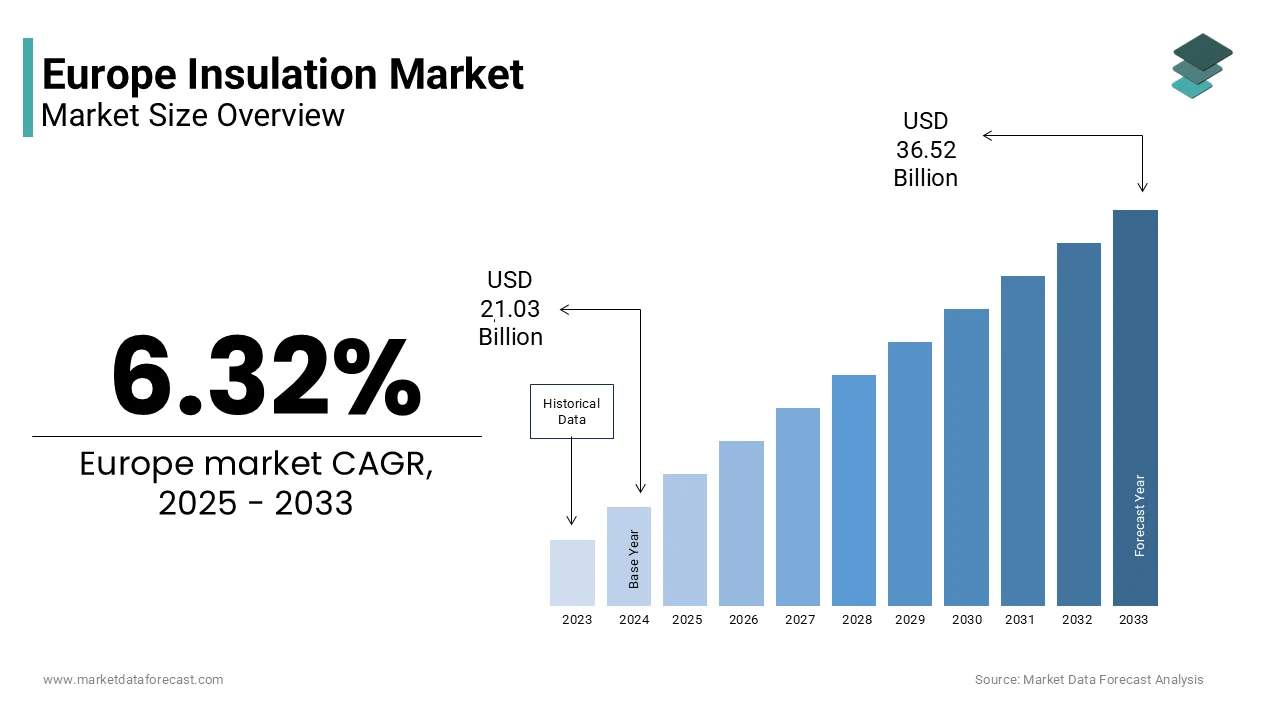
- Market Valuation: Valued at USD 22.38 billion (2025), estimated at USD 23.79 billion (2026), and projected to reach USD 38.84 billion by 2034, growing at a CAGR of 6.32% (2026–2034).
- Primary Growth Drivers: Aging regional building stock (>35% of EU structures built before 1970), intensive energy consumption (buildings accounting for ~40% of EU final energy, with heating representing ~65% of residential use), and policy push (the Renovation Wave targeting 35 million buildings by 2030).
Key Market Segment Metrics (2026–2034)
| Category | Leading Segment (2025 Position) | Fastest-Growing Segment |
|---|---|---|
| By Product | Mineral Wool (55.9% share) | Glass Wool (6.04% CAGR) |
| By End Use | Infrastructure (53.5% share) | Industrial (7.07% CAGR; cuts process heat losses by 20%–30%) |
| By Country | Germany (26.6% share; France as second-largest) | — |
Major Market Players & Market Structure
Market Structure: Highly competitive landscape featuring multinational manufacturers and regional specialists competing across residential, infrastructure, and industrial segments. Differentiation centers on thermal performance, fire resistance, circular production, embodied-carbon transparency, and bio-based binders.
Key Companies: Knauf Insulation, Rockwool International, Saint-Gobain ISOVER, Kingspan Group, Owens Corning, BASF SE, Johns Manville, and Armacell International.
Europe Insulation Market Size
The Europe insulation market size was valued at USD 22.38 billion in 2025 and is projected to reach USD 38.84 billion by 2034 from USD 23.79 billion in 2026, growing at a CAGR of 6.32%.
Thermal and acoustic insulation is engineered to reduce energy transfer and sound propagation in buildings and industrial systems. Over 35% of the European Union’s building stock was constructed before 1970, predating modern energy efficiency standards and creating a vast retrofitting imperative. Buildings account for approximately 40% of total final energy consumption in the EU with heating alone representing nearly 65% of residential energy European Environment Agency. In response, the revised Energy Performance of Buildings Directive mandates that all new constructions achieve nearly zero energy building status, while existing public buildings must undergo deep energy renovations. The European Commission’s Renovation Wave Strategy aims to double annual renovation rates by 2030, targeting 35 million buildings for upgrade. This policy backbone, coupled with rising natural gas prices following geopolitical disruptions, has intensified demand for high-performance insulation across residential, commercial and industrial sectors, which is transforming insulation from a passive material into a strategic enabler of energy sovereignty and climate resilience.
MARKET DRIVERS
Stringent Building Energy Efficiency Regulations
The growth of the European insulation market is primarily propelled by an evolving legislative framework that mandates significant improvements in building thermal performance. The Energy Performance of Buildings Directive, fully transposed into national laws across EU member states that requires all new buildings to meet nearly zero energy standards and compels regular energy audits for existing structures. According to the European Commission, this directive covers over 220 million buildings across the EU, establishing a structural demand baseline for insulation retrofits and new installations. The Renovation Wave initiative further amplifies this by setting a target to renovate 35 million buildings by 2030. National implementations reinforce this trend: France’s MaPrimeRénov scheme allocated 6.7 billion euros in 2023 to support household insulation upgrades, while Germany’s Federal Ministry for Economic Affairs and Climate Action reported that over 400,000 residential energy retrofits included external wall insulation in the same year. These policies are not merely aspirational, as non-compliance can result in restricted property sales or rental permissions, seen in the Netherlands, where homes with energy labels F or G face market restrictions. Consequently, builders and homeowners increasingly treat insulation as a non-negotiable component rather than an optional upgrade, ensuring sustained material uptake across mineral wool, EPS and newer aerogel composites.
Rising Energy Costs and Household Energy Security Concerns
Escalating energy prices across Europe have transformed insulation from a long-term sustainability measure into an immediate economic necessity for households and businesses alike, which is further boosting the regional market expansion. Following the 2022 energy crisis triggered by geopolitical tensions, the average household electricity price in the EU surged to 26.8 euro cents per kilowatt hour in 2023, as recorded by Eurostat. In response, consumer behaviour has shifted decisively toward energy conservation, with insulation emerging as a high-return investment. As per a 2025 survey by the European Consumer Organisation, 58% of homeowners in Germany, France and Italy planned attic or wall insulation within the next two years to reduce bills. Industrial facilities are similarly motivated, as according to the European Industrial Insulation Association, process insulation in manufacturing can reduce thermal energy losses by 20 to 30%. Moreover, national energy agencies such as France’s ADEME and Italy’s GSE now offer expedited subsidies for insulation, which recognises its role in national energy security. This convergence of economic urgency and policy support has created a self-reinforcing cycle where insulation adoption directly enhances household resilience and industrial competitiveness.
MARKET RESTRAINTS
Volatility in Raw Material Prices and Supply Chain Disruptions
The persistent pressure from fluctuating costs and availability of key raw materials, particularly petrochemical derivatives and mineral inputs, is primarily hindering the insulation market growth in Europe. Expanded polystyrene and polyurethane, which together constitute over 40% of the EU’s insulation volume, rely on benzene, toluene, neopentyl diisocyanate and polyols commodities whose prices are tightly coupled to crude oil and natural gas markets. The average price of TDI increased significantly in 2022 and remained above pre-crisis levels in 2023 due to constrained European aromatics production. Simultaneously, mineral wool producers contend with rising energy costs for melting basalt and slag as furnace energy consumption accounts for 60 to 70% of production costs, which is making operations vulnerable to electricity price spikes. Geopolitical disruptions have exacerbated this: the curtailment of Russian gas supplies reduced European polystyrene capacity utilisation to around 75% in 2023. These supply constraints not only inflate input costs but also delay project timelines, as contractors face allocation limits and extended lead times. Without stable feedstock access, insulation manufacturers struggle to honour fixed price contracts, which is eroding client confidence and dampening large-scale renovation momentum.
Technical and Regulatory Barriers to Bio-Based and Circular Insulation
Despite growing interest in sustainable alternatives, the adoption of bio-based and recyclable insulation materials in Europe is hindered by fragmented standards and performance validation gaps, which are also hindering the regional market expansion. Materials such as woofibreer, hemp and recycled textile insulation often lack harmonised European Technical Assessments under the Construction Products Regulation, preventing CE marking and cross-border trade. Fewer than 15% of bio-based insulation products have full ETA certification, compared to over 90% for mineral wool and EPS. Additionally, fire safety requirements under EN 13501 present significant hurdles. Many natural fibres achieve only class E or D without chemical flame retardants, which themselves face scrutiny under REACH. Building codes in countries like Sweden and Austria still restrict combustible insulation in multi-story residential buildings. Furthermore, recycling infrastructure remains underdeveloped; less than 8% of post-construction insulation waste is currently recovered, as separation from mixed demolition streams is technically complex. Until circularity is embedded in both regulation and logistics, these materials will remain niche despite their environmental promise.
MARKET OPPORTUNITIES
Integration of Digital Tools for Precision Retrofitting
The digitisation of building diagnostics and energy modelling is a promising opportunity for the European insulation market by enabling targeted and high-impact retrofits. Advanced thermal imaging drones, 3D laser scanning and AI-driven energy auditing platforms now allow contractors to identify exact heat loss zones rather than applying blanket insulation solutions. Digital twin adoption in building renovation has increased significantly between 2021 and 2023, which is improving insulation specification accuracy. National programs are integrating these tools as Germany’s digital Baukindergeld portal now requires thermographic evidence for subsidy claims, while France’s Diagnostic de Performance Énergétique incorporates infrared data to assign building energy labels. This precision approach reduces material waste, lowers installation costs and maximises energy savings per euro invested. Moreover, digital platforms facilitate compliance with the EU’s Level(s) framework for sustainable buildings, which mandates lifecycle carbon assessment. As BIM mandates expand under the revised Energy Performance of Buildings Directive, insulation suppliers are partnering with software firms to embed material databases directly into design tools, which is accelerating specification and procurement cycles while aligning with decarbonization metrics.
Growth in Industrial Process Insulation for Decarbonization
Beyond buildings, industrial process insulation is emerging as a high-potential segment driven by Europe’s industrial decarbonization commitments. High temperature insulation for pipelines, reactors and steam systems in sectors like chemicals, steel and cement can reduce thermal energy losses by 20 to 40%, directly lowering Scope 1 emissions. A 10% improvement in industrial insulation efficiency across the EU could save 18 million tons of CO2 annually, which is equivalent to removing 10 million cars from roads. The EU’s Carbon Border Adjustment Mechanism intensifies this imperative by penalising carbon-intensive imports, pushing domestic producers to optimise every energy input. Major industrial players are responding as BASF’s Ludwigshafen site invested 120 million euros in 2023 to reinsulate 350 kilometres of piping, while ArcelorMittal upgraded furnace insulation at its Ghent plant to meet EU Industrial Emissions Directive limits. New regulations, such as the Energy Efficiency Directive’s Article 8 mandate energy audits for large enterprises every four years, which invariably identify insulation gaps. As the EU allocates over 12 billion euros from the Innovation Fund to industrial decarbonization by 2027, process insulation is positioned as a low-cost, high-return intervention, which is creating demand for advanced calcium silicate, microporous and aerogel blankets resistant to temperatures above 600 degrees Celsius.
MARKET CHALLENGES
Skilled Labour Shortages in Building Retrofitting
A critical bottleneck constraining the European insulation market is the acute shortage of trained professionals capable of executing high-quality retrofits. The Renovation Wave Strategy’s success hinges on skilled installers, yet the European Federation of Building and Woodworkers estimates a deficit of over 300,000 construction workers across the EU by 2026, with insulation specialists among the most scarce. Improper installation can reduce system effectiveness by up to 50%, undermining energy savings and voiding warranties. According to a 2023 study by the Fraunhofer Institute, 38% of audited retrofits in Southern Europe exhibited significant installation flaws linked to insufficient training. Vocational education systems have not kept pace. In Italy and Spain, less than 15% of construction apprentices receive dedicated insulation training. Language barriers further complicate cross-border labour mobility, which is limiting the ability to deploy skilled crews to high-demand regions. Although the EU’s Pact for Skills has launched insulation training hubs in Poland and Romania, scaling remains slow. Without a coordinated workforce development strategy, even the most advanced insulation materials will fail to deliver their theoretical performance, which is stalling progress toward 2030 climate targets.
Regulatory Misalignment on Embodied Carbon Assessment
While operational energy reduction drives insulation demand, a growing challenge lies in the inconsistent accounting of embodied carbon across European building regulations, which is further challenging the regional market expansion. Insulation materials like polyurethane and EPS offer excellent thermal performance but carry high upstream emissions from petrochemical processing. After the 2017 Grenfell Tower tragedy, many EU member states tightened facade material requirements, which effectively restricts combustible insulation in residential high rises and boosts demand for mineral wool. Additionally, the material’s compatibility with circular economy principles enhances its appeal. Mineral wool produced in the EU commonly incorporates recycled slag from steelmaking, with companies like Rockwool using post-consumer content. The material also delivers consistent performance across Europe’s diverse climate zones without degrading over time. As per the European Commission’s Level(s) framework, mineral wool’s relatively low embodied carbon compared to synthetic foams supports its adoption in green public procurement projects.
REPORT COVERAGE
| REPORT METRIC | DETAILS |
| Market Size Available | 2025 to 2034 |
| Base Year | 2025 |
| Forecast Period | 2026 to 2034 |
| CAGR | 6.32% |
| Segments Covered | By Product, End Use, and Region |
| Various Analyses Covered | Global, Regional, & Country Level Analysis; Segment-Level Analysis; DROC, PESTLE Analysis; Porter’s Five Forces Analysis; Competitive Landscape; Analyst Overview of Investment Opportunities |
| Regions Covered | UK, France, Spain, Germany, Italy, Russia, Sweden, Denmark, Switzerland, Netherlands, Turkey, and the Czech Republic |
| Market Leaders Profiled | Knauf Insulation, Rockwool International, Saint-Gobain ISOVER, Kingspan Group, Owens Corning, BASF SE, Johns Manville, and Armacell International |
SEGMENTAL ANALYSIS
By Product Insights
The mineral wool segment occupied 55.9% of the regional market share in 2025. The dominance of the mineral wool segment in the European market is driven by its superior fire resistance, thermal stability, and acoustic performance compared to alternatives. Mineral wool is non-combustible and can withstand temperatures exceeding 1000 degrees Celsius, which is a critical attribute under the EU’s stringent fire safety regulations for multi-story buildings.
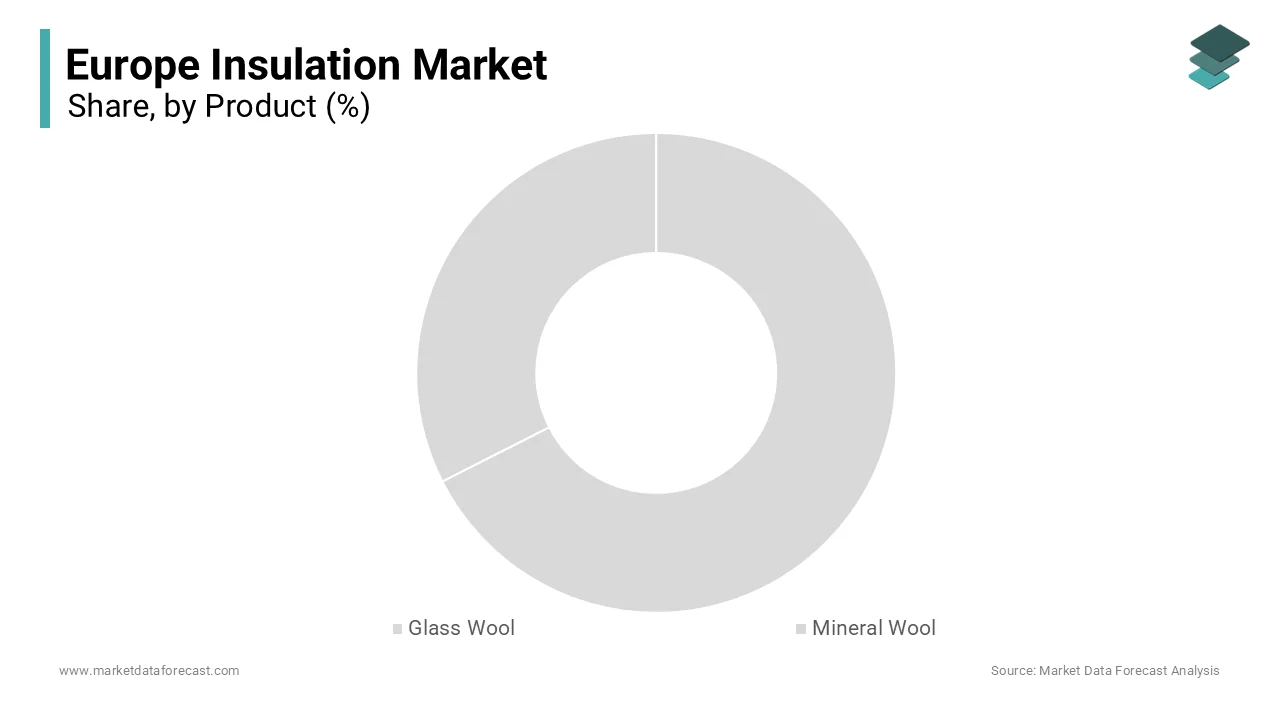
The glass wool segment is anticipated to register the fastest CAGR of 6.04% over the forecast period in the European market, owing to the significant advancements in manufacturing efficiency and expanding applications in light-density retrofit projects. Modern glass wool products now achieve thermal conductivity as low as 0.03 W per meter Kelvin, the 2017 Grenfell Tower rivalling higher cost alternatives. According to FEVE, over 76% of glass packaging in the EU was recycled in 2023, providing a stable supply of raw material and the average recycled content in glass packaging is around 52%, which is reflecting growing circularity in the sector. Glass wool’s lightweight nature and ease of installation make it ideal for attic and cavity wall retrofits in Europe’s vast pre1990 housing stock, representing a large addressable market. National subsidy schemes further fuel adoption: France’s MaPrimeRénov supports insulation measures and has driven retrofit demand. Additionally, innovations in formaldehyde-free binders have reduced historical indoor air quality concerns, broadening acceptance in residential projects across Germany and the Netherlands.
By End Use Insights
The infrastructure segment had 53.5% of the European insulation market share in 2025. The growth of the infrastructure segment in the European market is driven by the EU’s legislative focus on building decarbonization, which directly targets the built environment as the largest final energy consumer. The revised Energy Performance of Buildings Directive mandates that all new constructions must meet nearly zero energy standards and requires member states to renovate 3% of public building floor area annually. Eurostat data highlights continued growth in residential floor space in 2023, which indicates the need for modern thermal performance in new builds. Simultaneously, the Renovation Wave Strategy aims to upgrade 35 million buildings by 2030 with deep retrofits often requiring 15 to 20 centimetres of wall and roof insulation. National fiscal mechanisms amplify this: Italy’s Superbonus 110% scheme drove significant insulation installations between 2020 and 2023. Urban densification further increases demand, as compact cities like Vienna and Stockholm prioritise thermally efficient multi-family dwellings to meet local carbon budgets.
The industrial end-use segment is the fastest growing in the European insulation market with a CAGR of 7.07% over the forecast period, owing to the EU’s dual pressure of carbon pricing and energy security imperatives on heavy industry. Under the EU Emissions Trading System, industrial facilities face carbon allowances priced around 80 euros per ton in 2025, which is creating strong financial incentives to reduce thermal energy losses. The European Industrial Insulation Foundation estimates that proper insulation of pipes, boilers and reactors can cut process heat losses by 20 to 30%, which translates to substantial annual savings for large chemical or steel plants. Regulatory mandates reinforce this: the Energy Efficiency Directive’s Article 8 requires large enterprises to conduct energy audits every four years, with insulation consistently identified as a top cost-effective measure. Major investments are underway across European industrial sites to reduce fuel consumption and emissions through insulation upgrades. Simultaneously, the Carbon Border Adjustment Mechanism pressures producers to lower embedded emissions to avoid export tariffs, which further accelerates retrofits. As the EU allocates multibillion euros from its Innovation Fund to industrial decarbonization through 2027, high-temperature mineral and microporous insulation for processes above 500 degrees Celsius is seeing growing demand in Germany, Poland and the Benelux region.
REGIONAL ANALYSIS
Germany Market Analysis
Germany was the largest national market for insulation in Europe and captured 26.6% of the regional market share in 2025. The dominance of Germany in the European market is driven by its rigorous building code, the Energiewende energy transition policy, and a mature renovation subsidy ecosystem. The German Energy Saving Ordinance mandates low thermal transmittance requirements for retrofitted walls, making insulation non-optional for compliance. In 2023, the government disbursed substantial funding through its federal building efficiency program, which is supporting a large number of insulation projects ranging from attic upgrades to full facade overhauls. Germany’s industrial heartland also drives demand for high-performance process insulation under the National Action Plan on Energy Efficiency. According to the reports of the Fraunhofer Institute, industrial facilities account for a significant share of national insulation consumption, driven by CBAM compliance and gas price hedging. Urban renewal initiatives in cities like Berlin and Hamburg further integrate insulation into social housing upgrades, ensuring consistent demand despite macroeconomic headwinds.
France Market Analysis
France captured the second-largest share of the European insulation market in 2025. The growth of France in the European market is due to its ambitious MaPrimeRénov scheme, which has become the cornerstone of residential decarbonization policy. In 2023, the program funded extensive home energy retrofits with insulation featured in most cases, particularly in attics and basements. France’s AntiWaste Law for a Circular Economy strengthens requirements for circular materials in public construction, which is accelerating the adoption of wood fibre and recycled glass wool. The country’s nuclear-dominant electricity mix reduces heating emissions, but a large share of final energy use remains thermal, prompting urgent insulation retrofits. A majority of France’s dwellings were built before 1975, which lacks modern insulation. The government aims to renovate hundreds of thousands of homes annually by the mid-2020s and has expanded training programs for specialised insulation installers since 2021 through its France Relance initiative, ensuring workforce readiness for scaling.
Italy Market Analysis
Italy is anticipated to account for a notable share of the European market over the forecast period. Italy’s growth in the European market has been catalysed by the Superbonus fiscal incentive, which drove widespread deep energy retrofits across residential and small commercial buildings between 2020 and 2023. Although scaled back in 2025, the policy legacy endures with regional schemes like Lombardy’s Ecobonus maintaining momentum. Italy’s building stock is particularly inefficient; independent assessments highlight that a large share of dwellings were built before 1980 with limited insulation, underscoring the need for thermal upgrades. Rising natural gas dependency has intensified household urgency following the 2022 energy crisis, with natural gas accounting for roughly 40% of Italy’s overall energy mix. In 2023, residential gas consumption declined compared with 2022, reflecting efficiency measures and demand reduction. Additionally, Italy’s seismic retrofitting programs often integrate thermal upgrades, which create bundled renovation opportunities. The industrial sector in the Po Valley is also investing in pipe and furnace insulation to meet EU industrial emissions standards and reduce operational costs amid volatile energy markets.
United Kingdom Market Analysis
The United Kingdom occupied a notable share of the European market in 2025. Despite its post-Brexit regulatory divergence, the UK remains aligned with continental decarbonization goals through its legally binding net-zero by 2050 target. The country’s ageing housing stock creates one of Europe’s largest retrofit backlogs, with independent assessments indicating that millions of homes require insulation upgrades. The government’s Great British Insulation Scheme, launched in 2,023, aims to treat around 300,000 lower-income households by 2026, which focuses on cavity wall and loft insulation. Energy security concerns have further elevated insulation’s role; the UK relies heavily on natural gas imports, and reducing heating demand is now a national priority. The construction sector is adapting through Part L building regulations, which currently require new homes to produce around 31% less CO2 emissions than previous standards, ahead of the 2026 Future Homes Standard, which is driving advanced insulation use. Major housebuilders like Barratt and Taylor Wimpey now incorporate mineral wool or PIR boards as standard in new developments, which is ensuring a steady baseline demand.
Poland Market Analysis
Poland is estimated to grow at a healthy CAGR in the European insulation market over the forecast period. The country’s rapid ascent is fueled by a historic shift away from coal-based residential heating and EU cohesion funding for building modernisation. A large share of Polish households used solid fuels for heating in 2020, but national anti-smog resolutions now ban coal stoves in several regions, which is compelling homeowners to improve insulation before switching to heat pumps or gas. The National Fund for Environmental Protection has allocated billions of euros since 2022 for thermal retrofits with external wall insulation featured in most funded projects. Poland’s construction boom also drives demand as new buildings must comply with EU-aligned energy performance standards. Poland has among the highest residential energy intensities in the EU, which makes insulation upgrades both economically and environmentally critical. The industrial sector, particularly in chemicals and food processing, is also investing in pipe and tank insulation to meet EU industrial emissions benchmarks and reduce reliance on imported gas following the cessation of Russian pipeline deliveries in 2022.
COMPETITIVE LANDSCAPE
KEY MARKET PLAYERS
Some of the notable key players in the European insulation market are
- Knauf Insulation
- Rockwool International
- Saint-Gobain ISOVER
- Kingspan Group
- Owens Corning
- BASF SE
- Johns Manville
- Armacell International
TOP STRATEGIES USED BY THE KEY MARKET PLAYERS
Key players in the European insulation market prioritise regulatory alignment by actively shaping and adapting to evolving energy and fire safety codes across member states. They invest in circular manufacturing, integrating high levels of recycled content such as post-consumer glass and industrial slag to meet EU sustainability mandates. Companies are expanding production capacity in Central and Eastern Europe to serve growing retrofit demand and reduce logistics emissions. Strategic partnerships with national renovation programs enable direct access to subsidised residential projects. Innovation focuses on enhancing thermal performance while reducing embodied carbon through bio-based binders and low-temperature curing processes. Digitalisation efforts include BIM libraries, energy modelling, and installer training platforms to ensure correct application. Vertical integration secures raw material supply stability and reduces costs amid volatile energy markets. These strategies collectively reinforce market leadership while advancing Europe’s decarbonization objectives.
COMPETITION OVERVIEW
Competition in the European insulation market is characterised by a mix of multinational corporations and regional specialists vying for dominance across residential, industrial, and infrastructure segments. The market is highly regulated with performance standards for thermal conductivity fire resistance, and acoustic insulation varying by country, yet increasingly harmonised under EU directives. Leading players differentiate through sustainability credentials, embodied carbon transparency, and circular production models rather than price alone. Technological innovation in bio-based binders, ultra-thin aerogel composites, and digital specification tools has intensified product-level rivalry. National subsidy schemes create fragmented but high-volume demand channels requiring strong local distribution and installer networks. Small and medium enterprises compete in niche applications such as heritage building retrofit or high-temperature industrial insulation this case, customisation outweighs scale. Regulatory shifts, particularly around whole life carbon assessment under the Level(s) framework, are reshaping competitive dynamics, cs favouring firms with robust environmental data and lifecycle expertise. The entry barriers remain high due to capital intensity certification requirements and policy navigation complexity, ensuring stable but evolving competition among established players.
TOP PLAYERS IN THE MARKET
- Rockwool International is a global leader in stone wool insulation with extensive manufacturing and distribution networks across Europe. The company supplies high-performance thermal, acoustic, and fire-resilient insulation for residential, commercial and industrial applications. Rockwool has significantly advanced circular production methods using up to 40% recycled content in its stone wool products. In 2023, the company commissioned a carbon-neutral production facility in Sweden, powered entirely by renewable electricity. Rockwool also collaborates with European city planners and architects to integrate insulation into net-zero building designs and actively participates in EU policy dialogues on sustainable construction and energy efficiency standards.
- Knauf Insulation is a major European producer of glass wool and innovative bio-based insulation solutions with operations spanning over 20 countries. The company is known for its ECOSE Technology, which eliminates phenol formaldehyde and acrylic binders in favour of plant-derived alternatives. Knauf has intensified its focus on digital tools offering BIM-compatible product data to streamline specification in construction projects. In 2025, the company expanded its recycled glass procurement partnerships across France and Germany to secure feedstock for its circular manufacturing model. Knauf also supports national renovation programs through technical training for installers, ensuring proper application and performance validation in retrofit projects.
- Saint Gobain Isover is a prominent insulation division of the French multinational Saint Gobain offering a wide portfolio of glass wool and mineral wool products tailored for European climate and regulatory conditions. The company emphasises lifecycle carbon reduction and has achieved Environmental Product Declarations for its entire product range. In 2023, Isover launched its new high-density glass wool range optimised for deep energy retrofits in pre-1970 buildings. The company also co-developed a digital platform with French energy agencies to automate subsidy eligibility checks for insulation projects. Saint-Gobain Isover actively contributes to the EU Level(s) framework implementation by embedding whole life carbon metrics into its product development and client advisory services.
MARKET SEGMENTATION
This research report on the European insulation market has been segmented and sub-segmented based on categories.
By Product
- Glass Wool
- Mineral Wool
By End Use
- Infrastructure
- Industrial
- HVAC & OEM
By Country
- UK
- France
- Spain
- Germany
- Italy
- Russia
- Sweden
- Denmark
- Switzerland
- Netherlands
- Turkey
- Czech Republic
- Rest of Europe