Europe Vacuum Insulation Panel Market Research Report By Material (Metal Barrier Materials and Non-Metal Barrier Materials), Structure (Flat Vacuum Insulation Panels and Special Shaped Vacuum Panels), End-User (Construction, Pharmaceutical, and Others), and Country (Germany, France, United Kingdom, Italy, Sweden & Rest of Europe) – Industry Analysis on Size, Share, Trends, and Growth Forecast (2026 to 2034)
Market Size, 2025
$2.56 BnMarket Estimate, 2026
$2.67 BnMarket Forecast, 2034
$3.79 BnCAGR, 2026–2034
4.46%Europe Vacuum Insulation Panel Market Summary
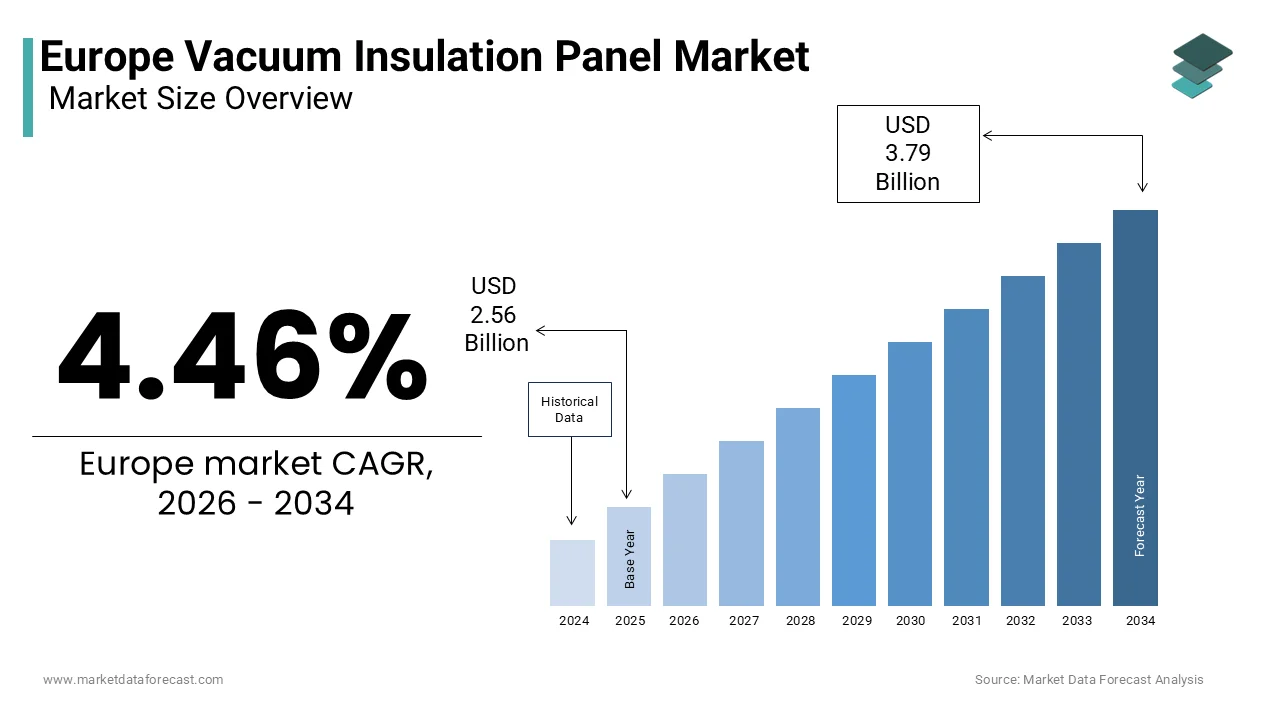
The Europe vacuum insulation panel market, valued at USD 2.56 billion in 2025, is projected to reach USD 3.79 billion by 2034, expanding at a CAGR of 4.46% driven by EU building energy efficiency mandates, deep retrofit programs, cold chain expansion, and rising adoption in space-constrained, high-performance applications.
Market Snapshot
- 2025 Market Size: USD 2.56 billion
- 2026 Estimate: USD 2.67 billion
- 2034 Forecast: USD 3.79 billion
- CAGR (2026–2034): 4.46%
- Base Year: 2025
- Forecast Period: 2026–2034
Quick Growth Drivers
- Strengthening EU building energy performance and renovation regulations
- High share of pre-1970 European building stock requiring deep retrofits
- Rising demand for space-efficient, ultra-low thermal conductivity insulation
- Expansion of refrigerated transport, cold storage, and pharmaceutical logistics
- Adoption in passive house standards and high-efficiency appliances
Principal Restraints
- High upfront cost compared to conventional insulation materials
- Limited installer familiarity and lack of standardized installation practices
- Mechanical fragility and sensitivity to puncture and compression
- Long-term durability and warranty concerns in large-scale construction
High-Value Opportunities
- Integration of VIPs into prefabricated and modular construction systems
- Growing use in premium refrigerators and energy-efficient household appliances
- Rising pharmaceutical and biologics cold-chain transport requirements
- Application in heritage building retrofits where space preservation is critical
Key Market Challenges
- Limited recycling infrastructure and complex end-of-life management
- Composite material structure constraining circular economy alignment
- Dependence on specialized raw materials such as fumed silica and barrier films
- Supply chain concentration increasing cost volatility and procurement risk
Fastest-Growing Segments
- Metal Barrier Materials: ~9.8% CAGR — high-temperature and industrial applications
- Special-Shaped Vacuum Panels: ~14.2% CAGR — heritage retrofits and precision logistics
- Pharmaceutical End Use: ~19.6% CAGR — biologics, vaccines, and advanced therapies
Regional Leadership & Dynamics
- Germany (27.5%) — aggressive energy policy, strong domestic manufacturing base
- United Kingdom — strict building codes and major pharmaceutical cold-chain hubs
- France — state-led renovation incentives and historic building preservation
- Italy — heritage retrofits and appliance manufacturing demand
- Sweden — cold-climate performance needs and sustainable construction leadership
What Wins Commercially
- Verified compliance with EN 16012 and passive house standards
- Integration-ready designs for modular construction and appliances
- High thermal performance with minimal thickness
- Reliable sealing, durability assurance, and installer support
- Alignment with EU decarbonization and renovation funding programs
Top Strategic Ask for Executives
Scale cost-efficient manufacturing, invest in recycling and circular material innovation, and embed vacuum insulation panels into modular construction, appliance design, and cold-chain systems to secure long-term growth in Europe’s energy transition.
Leading Players
Some of the companies that are playing a dominating role in the Europe vacuum insulation panel market include
- Evonik Industries AG
- Va-Q-Tec AG
- Kingspan Group Plc
- Recticel Group
- Panasonic Corporation
- LG Hausys Ltd.
- Porextherm Dämmstoffe GmbH
- Dow Inc.
- Saint-Gobain S.A.
- Microtherm (Promat)
Europe Vacuum Insulation Panel Market Size
The europe vacuum insulation panel market was valued at USD 2.56 billion in 2025, is estimated to reach USD 2.67 billion in 2026, and is projected to reach USD 3.79 billion by 2034, growing at a CAGR of 4.46% from 2026 to 2034.
Vacuum insulation panel refers to the high-performance thermal insulation systems consisting of a porous core sealed within an impermeable envelope under vacuum conditions. These panels deliver thermal conductivity as low as 0.004 W per meter Kelvin, significantly outperforming conventional materials like mineral wool or polyurethane foam. According to the European Commission’s Energy Efficiency Directive, a portion of the EU’s final energy consumption stems from buildings, making advanced insulation a strategic priority. As per Eurostat, a share of the European building stock was constructed before 19 0 with inadequate thermal envelopes contributing to excessive heating demand. The European Environment Agency notes that space heating accounts for a notable percentage of residential energy use, underscoring the urgency of deep energy retrofits. Vacuum insulation panels are increasingly specified in passive house standards, energy-efficient appliances, and cold chain logistics where space constraints and performance thresholds converge. The European Committee for Standardization has established EN 16012 to govern VIP durability and labeling, ensuring reliability across applications. This regulatory and environmental context positions vacuum insulation panels not as niche components but as vital enablers of Europe’s decarbonization and energy security objectives.
MARKET DRIVERS
Stringent Building Energy Performance Regulations Driving Retrofit Demand
European Union legislation mandates continuous improvement in building energyefficiencyy directly accelerating the adoption of high-performance insulation like vacuum panels, which accelerates the growth of the European vacuum insulation panel market. The European Union has strengthened its building efficiency regulations, requiring new housing to meet very high energy performance standards and promoting large-scale renovation of public properties, according to sources. Across member states, a substantial share of public buildings has recently undergone upgrades focused on improving insulation and thermal efficiency, as per research. Vacuum insulation panels are particularly valuable in historic or space-constrained structures where adding thick conventional insulation is impractical. This regulatory push transforms VIPs from optional upgrades into essential tools for meeting legally binding efficiency targets.
Expansion of Energy Efficient Cold Chain and Refrigerated Transport, growing demand for
Temperature-controlled logistics across the region are creating sustained demand for vacuum insulation panels in refrigerated applications. This fuels the expansion of the European vacuum insulation panel market. According to sources, a portion of food produced in the EU requires cold chain management from farm to retail to ensure safety and reduce spoilage. As per studies, refrigerated road freight transport volumes increased, driven by e-commerce grocery delivery and pharmaceutical logistics. Vacuum insulation panels reduce wall thickness in refrigerated vans and cold rooms compared to polyurethane while maintaining thermal performance, enabling greater payload capacity and fuel efficiency. This functional advantage secures VIPs a strategic role in Europe’s sustainable logistics transformation.
MARKET RESTRAINTS
High Initial Cost and Limited Cost Competitiveness Against Conventional Insulation
Elevated upfront costs compared to traditional materials are a major constraint on the growth of the European vacuum insulation market. According to research, the average installed cost of vacuum panels varies in euros per square meter, whereas mineral wool and expanded polystyrene cost per square meter. This price differential deters widespread use in residential retrofits where budget constraints dominate decision-making. Apart from the lack of standardized installation protocols, which increases labor expenses with specialized training required to avoid panel puncture during handling. The European Committee for Standardization acknowledges that inconsistent on-site performance due to improper sealing further undermines cost-benefit calculations. Until economies of scale and manufacturing innovations reduce unit prices, vacuum panels will remain confined to high-value applications where space savings justify premium expenditure.
Sensitivity to Mechanical Damage and Long-Term Durability Concerns
Inherently vulnerable to puncture compression and envelope degradation also limits the expansion of the European vacuum insulation panel market. This sensitivity compromises their thermal performance over time. According to sources, a breach of a vacuum insulation panel (VIP) seal would lead to a near-total loss of the insulation's effectiveness. The vacuum is what gives VIPs their high thermal resistance. Once the vacuum is lost, the panel's thermal conductivity increases dramatically, approaching that of the porous core material at atmospheric pressure. Furthermore, contractors often avoid VIPs' load-bearing high-traffic areas due to fragility concerns, preferring robust but less efficient alternatives. This durability uncertainty discourages specifiers in large-scale projects where long-term warranty liabilities are a priority, thereby restricting market penetration despite technical advantages.
MARKET OPPORTUNITIES
Integration into Prefabricated and Modular Construction Systems
Region’s shift toward off-site construction gives a key opportunity for the growth of the European vacuum insulation panels market. According to the European Modular Building Association, prefabricated construction accounted for 21 percent of new residential starts in the EU in 2023, up from 14 percent in 2019. These systems prioritize precision, lightweight components,s and rapid assembly, all of which align with VIP characteristics. Companies embed vacuum panels into structural insulated panels and facade cassettes during manufacturing, eliminating on-site handling risks. According to studies, modular passive house projects using integrated VIPs achieved faster on-site completion. Besides, the European Commission’s New European Bauhaus initiative funds pilot projects combining modular design with ultra-efficient insulation to demonstrate scalable decarbonization. This controlled environment mitigates durability concerns while maximizing thermal performance, making VIPs a natural fit for Europe’s industrialized construction future.
Adoption in High-Efficiency Domestic Appliances Driven by EcoDesign Standards
Stricter EU energy labeling and EcoDesign requirements for household refrigeration also provide new prospects for the expansion of the European vacuum insulation panel market. These requirements are compelling manufacturers to adopt vacuum insulation panels to meet efficiency thresholds. European regulations now require new refrigerators to meet strict energy efficiency standards, leading to the gradual removal of less efficient models from the market, according to sources. Across the region, millions of households continue to replace older appliances on a regular cycle, supporting continuous upgrades in the home appliance segment, as per research. Vacuum insulation panels are increasingly used in refrigerator construction to allow for slimmer designs and greater storage capacity without raising power consumption, according to sources. Several leading appliance manufacturers in Europe have integrated this technology into their high-end product lines to achieve top-tier energy ratings, as per research.
MARKET CHALLENGES
Complex End-of-Life Management and Recycling Infrastructure Gaps
Their composite structure of inorganic cores and metallized barrier films resists conventional recycling streams, which constrains the growth of the European vacuum insulation panel market. The European Commission’s Circular Economy Action Plan identifies VIPs as a priority waste stream requiring dedicated recovery solutions, but no large-scale recycling infrastructure exists. Also, separating the core from the envelope requires energy-intensive thermal or chemical processes, not economically viable at current volumes. This circularity gap contradicts net-zero ambitions and may trigger future regulatory restrictions unless scalable recycling technologies emerge. Until then, the environmental footprint of VIPs remains partially offset by operational energy savings but not fully closed.
Supply Chain Vulnerability and Dependence on Specialized Raw Materials
The production of these panels relies on a narrow set of high-purity raw materials and specialized barrier films, which creates supply chain fragility and obstructs the expansion of the European vacuum insulation panel market. According to research, fumed silica and aerogel cores depend on limited global suppliers, with a portion of high-quality fumed silica sourced from two multinational chemical companies. Furthermore, the metallized polymer films used for envelope sealing are dominated by Japanese and Korean manufacturers, with limited European alternatives. The European Commission’s Critical Raw Materials Act lists several VIP components as strategic but not yet secured through domestic production. This dependency increases price volatility and project risk, discouraging large-scale adoption in public infrastructure, where supply certainty is paramount. Diversifying material sourcing and developing alternative core compositions remain vital to ensuring resilient market growth.
REPORT COVERAGE
| REPORT METRIC | DETAILS |
| Market Size Available | 2025 to 2034 |
| Base Year | 2025 |
| Forecast Period | 2026 to 2034 |
| Segments Covered | By Material, Structure, End-User, and Region. |
| Various Analyses Covered | Global, Regional, and Country-Level Analysis, Segment-Level Analysis, Drivers, Restraints, Opportunities, Challenges; PESTLE Analysis; Porter’s Five Forces Analysis, Competitive Landscape, Analyst Overview of Investment Opportunities |
| Countries Covered | UK, France, Spain, Germany, Italy, Russia, Sweden, Denmark, Switzerland, Netherlands, Turkey, Czech Republic, and the Rest of Europe
|
| Market Leaders Profiled | Evonik Industries AG, Va-Q-Tec AG, Kingspan Group Plc, Recticel Group, Panasonic Corporation, LG Hausys Ltd., Porextherm Dämmstoffe GmbH, Dow Inc., Saint-Gobain S.A., Microtherm (Promat) |
SEGMENTAL ANALYSIS
By Material Insights
The non-metal barrier materials segment accounted for a substantial share of the European vacuum insulation panel market in 2025. Factors such as superior compatibility with building and appliance applications, where flexibility, weight, and corrosion resistance are important, contribute to the growth of the non-metal barrier materials segment. Non-metal envelopes resist galvanic corrosion and thermal bridging, making them ideal for humid or chemically active environments common in European retrofits. In addition, polymer-based barriers maintain integrity in contact with common construction materials. Apart from these, non-metal films enable seamless integration. This technical alignment with European building physics principles ensures sustained preference over metallic alternatives. The shift toward energy-efficient lightweight appliances and electric refrigerated vehicles favors non-metal vacuum panels.
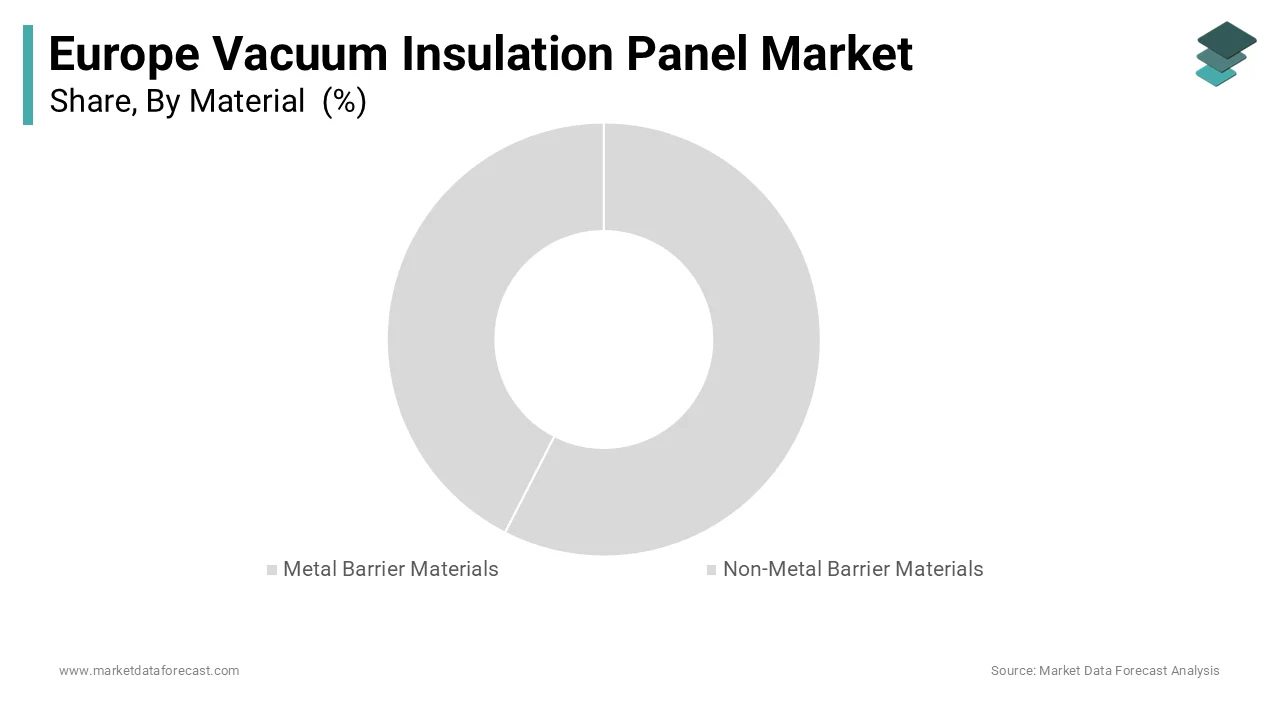
The metal barrier materials segment is on the rise and is expected to be the fastest-growing segment in the global market by witnessing a CAGR of 9.8% from 2026 to 2034. This growth is driven by niche industrial demands. Metal-clad vacuum panels are gaining traction in industrial settings requiring fire resistance and thermal stability above 200 degrees Celsius. Stainless steel or aluminum envelopes maintain vacuum integrity under extreme conditions, which makes them indispensable for refinery and district heating applications. BASF and Dow report that their European plants retrofitted high-temperature storage tanks. This specialized utility in energy-intensive sectors creates a resilient growth corridor insulated from residential market fluctuations. Moreover, Europe’s defense and aerospace sectors require vacuum panels that withstand vibration, radiation,,n and rapid pressure changes, conditions where metal envelopes outperform polymers. The European Space Agency’s Clean Space initiative mandates reusable high-durability insulation for payload protection, driving R and D investment. This mission essential demand ensures steady technological advancement and premium pricing, justifying the segment’s accelerated growth trajectory.
By Structure Insights
The flat vacuum insulation panels segment dominated the European market by capturing a significant share in 2025. The prominence of the flat vacuum insulation panels segment is because of standardization, compatibility, and cost efficiency across mass applications. Flat panels align with modular construction and mass production workflows where dimensional uniformity is essential. In addition, appliance manufacturers design refrigerator cavities around standardized flat panel dimensions to optimize internal volume. This industrial compatibility minimizes waste and labor costs, making flat panels the default choice for high-volume deployment. Flat geometry enables high-yield manufacturing and efficient stacking during transport. This efficiency translates to lower unit costs. Besides, flat panels occupy less transport volume per square meter of coverage than irregular shapes, reducing carbon emissions per delivery. These economic and environmental advantages strengthen flat panels as the backbone of Europe’s insulation strategy.
The special-shaped vacuum panels segment is expected to exhibit a noteworthy CAGR of 14.2% from 2025 to 2033 due to precision engineering demands. Historic preservation projects require insulation that conforms to curved walls, vaulted ceilings, or ornate facades without altering aesthetics. Companies offer 3D-scanned templating services to produce site-specific shapes with millimeter accuracy. This architectural sensitivity unlocks access to Europe’s vast cultural building stock. Pharmaceutical and biotech logistics demand containers with exact internal geometries to secure vials and sensors during transit. This shift from bulk to precision logistics creates a high-value niche where performance justifies premium pricing and complex fabrication.
By End-User Insights
The construction segment led the European vacuum insulation panel market by occupying 63.7% share in 2025. The dominance of the construction segment is attributed to regulatory mandates and deep energy retrofit programs. The European Union’s renovation initiatives aim to modernize millions of buildings by the end of the decade, with advanced insulation materials increasingly being used in high-efficiency retrofits, according to sources. Across the region, a large number of social housing units have undergone deep energy upgrades focused on improving insulation and lowering heat loss, as per research. In Germany, several government-supported renovation projects are incorporating vacuum insulation panels in building exteriors and roofs to meet strict energy standards without increasing structural size, according to sources. France also continues to encourage households to adopt high-performance insulation through national subsidy programs, as per research. These materials enable buildings to meet demanding energy performance criteria even in densely populated urban areas, according to sources. This policy-driven demand ensures construction remains the largest end user.
The pharmaceutical segment is predicted to witness the highest CAGR of 19.6% during the forecast period, owing to biologics and personalized medicine. Advanced therapies require strict 2 to 8 degrees Celsius or even cryogenic transport conditions over extended durations. VIP lined shippers maintain temperature for long hours or more without active cooling critical for rural or intercontinental delivery. Companies like World Courier and Marken now deploy VIP containers for CAR T cell therapy, which cost over 300,000,000 euros per dose, justifying premium packaging. This high-value low-volume model ensures robust growth irrespective of broader economic cycles. EU GDP Guidelines require passive containers to demonstrate thermal performance under real-world conditions. Vacuum-insulated packaging is recognized as one of the most reliable passive solutions for maintaining temperature stability during extended shipments, according to sources. In Germany, national health authorities have made the validation of such packaging mandatory for vaccine distribution following past issues with temperature control, as per research. Besides, European regulations promoting tamper-evident pharmaceutical packaging are further driving the use of composite insulated containers, according to sources.
COUNTRY LEVEL ANALYSIS
Germany Vacuum Insulation Panel Market Analysis
Germany outperformed other regions in the EEuropeanvacuum insulation panel market and captured a 27.5% share in 2025. The domination of Germany is primarily driven by aggressive energy policy and industrial prominence. The country’s Energiewende strategy mandates a reduction in building emissions by 2030, creating massive retrofit demand. Germany also hosts leading VIP manufacturers like Va-Q-Tec and Evonik, whose R and D centers drive material innovation. The Federal Ministry for Economic Affairs allocated funds to support insulation technology in industrial decarbonization. Besides, German appliance giants Bosch and Liebherr integrate VIPs into premium refrigerators to meet stringent EcoDesign standards. This combination of regulatory burden, manufacturing capacity, ty, and industrial application secures Germany’s dominant position.
France Vacuum Insulation Panel Market Analysis
France is moderately expanding in the European vacuum insulation panel market duestate-led renovation incentives and heritage building challenges. France continues to provide significant financial support for residential energy efficiency improvements, with advanced insulation materials qualifying for top-level incentives, according to sources. A large number of households have sought government assistance for insulation upgrades, with many city dwellers choosing vacuum insulation panels to preserve building facades, as per research. The country also maintains a strong focus on improving social housing efficiency through programs that promote the installation of high-performance insulation materials, according to sources. The country’s dense historic city centers, like Paris andLyonn require slim insulation solutions preserving architectural integrity. Policy-driven residential focus underpins France’s substantial market presence.
United Kingdom Vacuum Insulation Panel Market Analysis
The United Kingdom was the second largest region in the European vacuum insulation panel market due to stringent building regulations and pharmaceutical logistics. Stricter building standards in the United Kingdom are set to significantly reduce carbon emissions from new homes, encouraging the use of advanced insulation materials in compact urban projects, according to sources. Across the country, a growing number of households have benefited from government-backed insulation programs aimed at improving energy efficiency, as per research. The UK also hosts Europe’s largest concentration of pharmaceutical cold chain hubs, with companies like AstraZeneca and GSK requiring VIP shippers for global vaccine distribution. This dual strength in construction and life sciences sustains the UK’s notable market share despite Brexit-related trade complexities.
Italy Vacuum Insulation Panel Market Analysis
Italy is also a key region in the European vacuum insulation panel market, with its vast historic building stock and appliance manufacturing base. According to sources, Italy has prioritized the renovation of older buildings under its national energy incentive program, which previously supported the use of advanced insulation materials. As per research, many heritage restoration projects in major cities like Milan and Rome have adopted specially designed insulation panels to preserve intricate architectural details. Italy is also home to major white goods producers like Indesit and Smeg, which incorporate VIPs into premium refrigerators to achieve A+++ ratings. This blend of cultural preservation and industrial production creates a resilient demand stream for advanced insulation.
Sweden Vacuum Insulation Panel Market Analysis
Sweden is predicted to grow in the European vacuum insulation panel market from 2025 to 20,33 owing to its dominance in sustainable construction and cold climate performance requirements. Sweden’s harsh winters make thermal efficiency negotiable with VIPs, reducing heating demand in retrofits. Apart from these, the country pioneers circular construction with companies like Skanska developing VIP recycling protocols to align with national zero-waste goals. The Swedish Environmental Protection Agency included VIPs in its criteria for infrastructure projects. This forward-looking regulatory and environmental stance positions Sweden as a high-value Nordic market for advanced insulation technologies.
COMPETITIVE LANDSCAPE
The European vacuum insulation panel market features a concentrated yet dynamic competitive landscape dominated by technologically advanced European manufacturers with deep expertise in material science and building physics. Competition is not primarily price-based but centers on thermal performance, longevity, sus sustainabilityedentials, and application-specific engineering support. Firms differentiate through proprietary core formulations, edge sealing technologies, and integration capabilities with construction or logistics workflows. The high barrier to entry due to capital intensity, technical complexity, and regulatory compliance limits new entrants while favoring established players with decades of R and D investment. However, niche innovators are emerging in circularity and bio-based materials, creating insistence or force for continuous innovation. Collaboration with public agencies on renovation programs and alignment with EU decarbonization policies further shape competitive strategies.
KEY MARKET PLAYERS
Some of the companies that are playing a dominating role in the europe vacuum insulation panel market include
- Evonik Industries AG
- Va-Q-Tec AG
- Kingspan Group Plc
- Recticel Group
- Panasonic Corporation
- LG Hausys Ltd.
- Porextherm Dämmstoffe GmbH
- Dow Inc.
- Saint-Gobain S.A.
- Microtherm (Promat)
TOP LEADING PLAYERS IN THE MARKET
- Va-Q-Tec AG is a German technology leader specializing in vacuum insulation panels and thermal packaging solutions with a strong footprint across Europe and global logistics networks. The company supplies high-performance VIPs for pharmaceutical cold chain transport, construction, and industrial applications. It also partnered with major European pharmaceutical distributors to certify its containers under EU GDP guidelines, supporting its role in temperature-sensitive healthcare logistics.
- Kingspan Group is an Irish multinational building materials manufacturer that integrates vacuum insulation panels into its high-performance insulated panel systems for commercial and industrial construction. The company’s Kooltherm and QuadCore product lines utilize VIPs to achieve ultra-low U values in wall and roof assemblies. Kingspan has aligned its innovation with the EU Green Deal by reducing embodied carbon in its panels and enhancing recyclability. It also collaborated with European passive house certifiers to validate thermal performance data, ensuring compliance with stringent energy codes across member states.
- Porextherm Dämmstoffe GmbH is a German specialist in vacuum insulation panels for building applications with a focus on heritage retrofits and space-constrained urban developments. The company produces flat and custom-shaped VIPs using fumed silica cores and advanced barrier films engineered for long-term durability. It also expanded its digital design support platform, enabling architects to integrate VIPs into BIM models with precision.
TOP STRATEGIES USED BY THE KEY MARKET PARTICIPANTS
Key players in the European vacuum insulation panel market focus on vertical integration by controlling core material synthesis, barrier film lamination, and panel assembly to ensure quality and cost efficiency. They invest heavily in R and D to develop sustainable core alternatives, such as bio-based aerogels and recyclable envelope materials aligned with EU circular economy mandates. Strategic partnerships with construction firms, appliance manufacturers, and pharmaceutical logistics providers enable the development of application-specific solutions. Companies also pursue regulatory alignment by obtaining certifications under EN 16012 and passive house standards to build specifier confidence. Besides, they expand production capacity within Europe to shorten supply chains and reduce carbon footprint while offering digital tools for thermal simulation and BIM integration to accelerate adoption in design phases.
MARKET SEGMENTATION
This research report on the europe vacuum insulation panel market has been segmented and sub-segmented into the following categories:
By Material
- Metal Barrier Materials
- Non-Metal Barrier Materials
By Structure
- Flat Vacuum Insulation Panels
- Special Shaped Vacuum Panels
By End-User
- Construction
- Pharmaceutical
- Others
By Country
- Germany
- France
- United Kingdom
- Italy
- Sweden
- Rest of Europe
Frequently Asked Questions
1. What drives the growth of the Europe Vacuum Insulation Panel Market?
Rising energy efficiency rules, the EU Green Deal, and demand for sustainable buildings are key drivers. Their use in cold storage and appliances also boosts the market.
2. Which countries lead the Europe Vacuum Insulation Panel Market?
Germany, France, and the UK hold top market shares due to strong building codes and clean energy policies. These countries actively promote sustainable construction materials.
3. What materials dominate the Europe Vacuum Insulation Panel Market?
Silica-based vacuum insulation panels hold the largest share for their excellent thermal performance. They are preferred in construction, cold chains, and refrigeration.
4. Which industry sectors use vacuum insulation panels most in Europe?
The construction sector leads, followed by refrigeration and pharmaceuticals. These panels reduce heat transfer and energy costs in buildings and storage units.
5. How do government policies affect the Europe Vacuum Insulation Panel Market?
EU energy standards and carbon emission goals promote high-performance insulation panels.
Programs under the Energy Performance of Buildings Directive encourage VIP usage.
6. What are the main types of panels in the Europe Vacuum Insulation Panel Market?
Flat panels dominate, offering easy integration with existing systems. They are popular due to affordability and thermal stability.
7. What benefits do vacuum insulation panels offer in Europe’s construction sector?
They deliver superior insulation with thinner walls, ideal for urban buildings. This reduces heating costs while enhancing LEED and BREEAM certification potential.
8. What challenges face the Europe Vacuum Insulation Panel Market?
High production cost, installation complexity, and limited supplier base remain issues.
However, growing innovations are reducing these barriers gradually.
9. Which companies are major players in the Europe Vacuum Insulation Panel Market?
Va-Q-tec, Kingspan Group, and Panasonic are key providers of vacuum insulation solutions.
They focus on eco-friendly and long-lasting panel technologies.
10. How are vacuum insulation panels used in Europe’s cold chain industry?
Panels help maintain precise temperatures for food and pharmaceuticals. They improve energy savings in transport and storage systems.
Related Reports
Access the study in MULTIPLE FORMATS
Purchase options starting from
$ 2000
Didn’t find what you’re looking for?
TALK TO OUR ANALYST TEAM
Need something within your budget?
NO WORRIES! WE GOT YOU COVERED!
Call us on: +1 888 702 9696 (U.S Toll Free)
Write to us: sales@marketdataforecast.com