- Product Description Description
- Table of Contents TOC
- List of Table & Figure LOT
- Get Free Sample PDF Sample PDF
Market Size, 2025
$42.36 BnMarket Estimate, 2026
$45.00 BnMarket Forecast, 2034
$72.98 BnCAGR, 2026–2034
6.23%Asia Pacific Vacuum Insulated Switchgear Market Report Summary
The Asia Pacific vacuum insulated switchgear market was valued at USD 42.36 billion in 2025, is estimated to reach USD 45.00 billion in 2026, and is projected to reach USD 72.98 billion by 2034, growing at a CAGR of 6.23% during the forecast period from 2026 to 2034. The growth of the Asia Pacific vacuum insulated switchgear market is driven by rapid urbanization, rising demand for compact electrical infrastructure, and increasing pressure to replace SF₆-based switchgear with environmentally sustainable alternatives. Strong expansion of renewable energy projects, modernization of aging power grids, and large-scale metro and high-speed rail electrification programs are further supporting market growth. Moreover, stricter environmental regulations targeting greenhouse gas emissions and the rising adoption of digital substations are accelerating the shift toward vacuum-based, gas-free switchgear technologies across the region.
Key Market Trends
- Increasing replacement of SF₆-based switchgear with vacuum insulated alternatives due to environmental regulations and sustainability goals.
- Rising deployment of compact switchgear in underground substations, metro rail networks, and high-density urban infrastructure projects.
- Strong demand from renewable energy integration, particularly for solar, wind, and microgrid installations across emerging Asian economies.
- Growing adoption of digital and smart switchgear equipped with monitoring, automation, and IEC 61850 communication protocols.
- Expansion of localized manufacturing in China and India to reduce cost barriers and improve supply chain resilience.
Segmental Insights
- Based on voltage, the medium voltage segment dominated the Asia Pacific vacuum insulated switchgear market in 2025. The dominance of this segment is attributed to its extensive use in urban power distribution networks, industrial facilities, commercial buildings, and renewable energy interconnections. The rapid expansion of compact substations in densely populated cities has made medium voltage VISG a preferred solution due to its space efficiency and operational safety.
- Based on current, the alternating current (AC) segment held the largest share of the market in 2025. This leadership is driven by the widespread reliance on AC power across industrial manufacturing, data centers, utilities, and commercial infrastructure. Most power distribution systems in the region continue to operate on AC networks, sustaining strong demand for AC-compatible vacuum insulated switchgear.
- Based on application, the utility segment accounted for the largest share of the Asia Pacific vacuum insulated switchgear market in 2025. This dominance is supported by large-scale substation upgrades, grid modernization programs, and renewable energy integration initiatives led by national utilities across China, India, Japan, South Korea, and Australia.
Regional Insights
The Asia Pacific vacuum insulated switchgear market is witnessing strong growth across major economies due to infrastructure expansion, energy transition, and grid modernization efforts.
- China was the largest contributor, accounting for 38.3% of the regional market share in 2025. This leadership is driven by nationwide replacement of aging switchgear, aggressive renewable energy deployment, and strong domestic manufacturing capacity for vacuum interrupters and switchgear systems.
- Japan held the second-largest position with 19.2% market share in 2025, supported by stringent environmental policies, high adoption of SF₆-free technologies, and advanced innovation in high-voltage vacuum switchgear development.
- India is emerging as a high-growth market due to government-led power distribution reforms, expanding renewable capacity, urban electrification programs, and increasing localization of VISG manufacturing.
- South Korea continues to experience steady growth supported by advanced industrial infrastructure, metro electrification projects, and green certification policies favoring vacuum insulated technologies.
- Australia is witnessing rising adoption driven by renewable energy integration, underground substation deployment in major cities, and increasing focus on grid safety and resilience.
Competitive Landscape
The Asia Pacific vacuum insulated switchgear market is characterized by strong competition between global multinational manufacturers and emerging regional players. Market participants are competing based on technological innovation, environmental performance, digital integration, and lifecycle efficiency rather than price alone. Leading companies are focusing on developing SF₆-free product portfolios, expanding high-voltage vacuum capabilities, and integrating smart monitoring features to align with smart grid requirements. Localization of manufacturing, partnerships with utilities, and investments in R&D for digital substations and sustainable materials are key strategies shaping the competitive environment. Prominent players in the Asia Pacific vacuum insulated switchgear market include ABB, Bharat Heavy Electricals (BHEL), CG Power and Industrial Solutions, Eaton, Fuji Electric, General Electric (GE), HD Hyundai Electric, Hitachi, Hyosung Heavy Industries, Mitsubishi Electric, Schneider Electric, Siemens, Toshiba, and others.
Asia Pacific Vacuum Insulated Switchgear Market Size
The Asia Pacific Vacuum Insulated Switchgear Market size was valued at USD 42.36 billion in 2025 and is anticipated to reach USD 45.00 billion in 2026 from USD 72.98 billion by 2034, growing at a CAGR of 6.23% during the forecast period from 2026 to 2034.
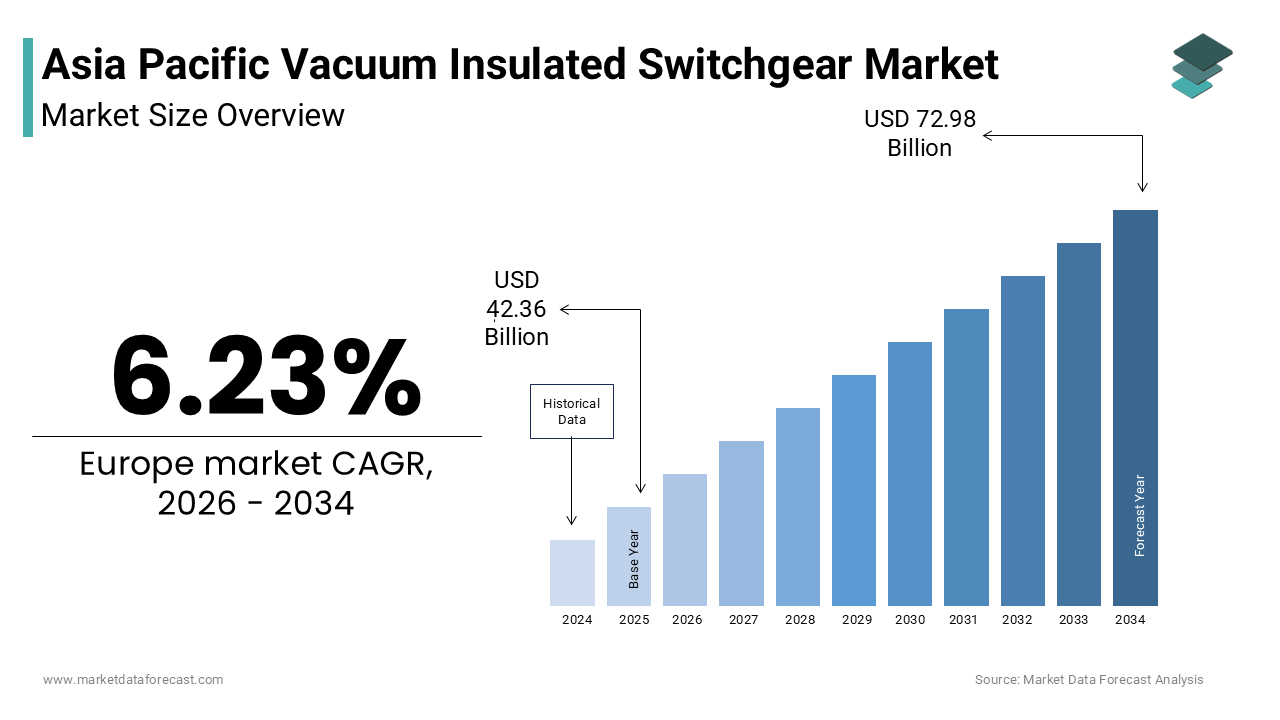
Vacuum insulated switchgear (VISG) represents a transformative advancement in electrical distribution systems, leveraging vacuum interruption technology within a sealed, gas-free enclosure to deliver compact, reliable, and environmentally sustainable switching solutions. Unlike conventional sulfur hexafluoride (SF₆)-based switchgear, VISG eliminates greenhouse gas emissions, aligning with stringent environmental regulations across the Asia Pacific region. The technology is increasingly deployed in urban substations, industrial complexes, and renewable energy integration hubs where space constraints and ecological compliance are crucial. As per the International Energy Agency, the Asia Pacific region accounted for over 60% of global new renewable power capacity additions in 2023, which is accelerating the need for resilient and compact switchgear infrastructure.
MARKET DRIVERS
Accelerated Urbanization and Space-Constrained Electrical Infrastructure
The relentless pace of urban expansion is fundamentally reshaping electrical infrastructure demands, which is accelerating the growth of the Asia Pacific variable frequency drives (VFDs) market. In megacities like Tokyo, Seoul, and Mumbai, where underground substations are increasingly deployed to free up surface land, VISG’s sealed, maintenance-light design ensures operational reliability in confined environments. The World Bank reports that between 2010 and 2023, the urban population in the Asia Pacific grew by over 300 million, placing unprecedented strain on existing power networks. In response, municipal utilities are prioritizing compact switchgear for metro rail electrification, data centers, and commercial high-rises. For instance, Singapore’s Land Transport Authority incorporated vacuum insulated switchgear in 90% of its new MRT substation projects between 2020 and 2023 to maximize space efficiency.
Regulatory Phase-Down of SF₆ and Environmental Compliance Mandates
The stringent environmental regulations targeting sulfur hexafluoride (SF₆) is a potent greenhouse gas with a global warming potential 23,500 times greater than CO₂ over a century, are driving a structural shift toward SF₆-free switchgear technologies across the Asia Pacific. As per the Intergovernmental Panel on Climate Change’s 2023 Emissions Atlas, electrical transmission and distribution equipment accounted for nearly 80% of global SF₆ emissions, prompting regional regulators to enforce stricter containment and reporting protocols. Japan’s Ministry of the Environment implemented a mandatory SF₆ emission tracking system in 2021, requiring utilities to report annual leakage rates, which averaged 2.3% per annum as per Japan Electric Power Information Center data. Similarly, South Korea’s Green Growth Act mandates a 30% reduction in SF₆ usage by 2030 compared to 2018 levels. In India, the Central Electricity Authority is piloting SF₆ phase-out programs in smart city projects, with vacuum insulated switchgear selected in 12 of 15 pilot substations due to zero emissions and lifecycle durability. Australia’s National Greenhouse and Energy Reporting Scheme has also intensified scrutiny on gas-insulated equipment, pushing network operators like AusNet and Energex to adopt vacuum-based alternatives.
MARKET RESTRAINTS
High Initial Capital Expenditure and Cost Sensitivity in Emerging Economies
The widespread adoption across developing economies in the Asia Pacific is hindered by elevated upfront costs. VISG systems typically entail a 20% to 35% higher initial investment compared to conventional air-insulated or SF₆-based switchgear, which is a significant barrier in cost-sensitive markets such as Indonesia, the Philippines, and Bangladesh. For national utilities operating under tight fiscal constraints, this differential complicates procurement decisions, particularly in rural electrification programs where budget efficiency is paramount. Moreover, the lack of localized manufacturing exacerbates cost issues; over 80% of VISG units in Southeast Asia are imported from Japan, Germany, or China, incurring additional tariffs and logistics expenses.
Limited Technical Expertise and After-Sales Support Infrastructure
The deployment of vacuum insulated switchgear in remote and semi-urban regions of the Asia Pacific is impeding the growth of the Asia Pacific Vacuum Insulated Switchgear Market. Unlike conventional switchgear, VISG requires precise handling of vacuum interrupters and hermetic sealing, with failure rates increasing significantly when installed by inadequately trained technicians. As per a 2023 assessment by the Asia-Pacific Electrical Engineering Consortium, only 38% of field engineers in India, Thailand, and the Philippines have received formal training on vacuum insulation technology, leading to suboptimal performance and reluctance among utilities to adopt the systems. The International Labour Organization notes that the region faces a deficit of over 120,000 qualified power systems technicians, a gap that disproportionately affects the adoption of high-tech electrical equipment. Furthermore, original equipment manufacturers often concentrate technical support in metropolitan hubs, leaving rural utilities without timely access to diagnostics or spare parts.
MARKET OPPORTUNITIES
Integration with Renewable Energy Microgrids and Distributed Generation Systems
The proliferation of decentralized renewable energy systems in microgrid and distributed generation applications is solely creating new opportunities for the growth of the Asia Pacific Vacuum Insulated Switchgear Market. As per the International Renewable Energy Agency, the region added over 150 GW of solar and wind capacity in 2023 alone, with a growing share deployed in off-grid and mini-grid configurations. These systems, particularly in archipelagic nations like Indonesia and the Philippines, demand compact, reliable, and low-maintenance switchgear capable of withstanding harsh environmental conditions. VISG’s sealed, corrosion-resistant design and absence of pressurized gases make it ideally suited for island microgrids where humidity, salt spray, and limited maintenance access are persistent challenges.
Expansion of High-Speed Rail and Metro Transit Electrification Projects
The ongoing expansion of electrified rail networks is also promoting new opportunities for the growth of the Asia Pacific Vacuum Insulated Switchgear Market. As per the International Union of Railways, the region accounted for 74% of global high-speed rail construction activity in 2023, with China, India, Japan, and Thailand leading major electrification initiatives. VISG’s footprint, which can be up to 60% smaller than traditional switchgear, enables seamless integration into constrained rail infrastructure. For example, India’s Dedicated Freight Corridor Corporation installed vacuum insulated switchgear in 85% of its 163 new traction substations between 2020 and 2023, which is citing reduced civil construction costs and faster commissioning.
MARKET CHALLENGES
Supply Chain Vulnerability for Components and Raw Materials
The manufacturing of vacuum insulated switchgear relies on specialized components such as vacuum interrupters, ceramic envelopes, and high-purity copper conductors, many of which are concentrated in a limited number of global suppliers, creating supply chain vulnerabilities for the Asia Pacific market. The 2022 semiconductor shortage, which affected power electronics globally, delayed VISG deliveries by up to six months in India and South Korea, according to the Asia-Pacific Electronics Manufacturing Council. Additionally, rare earth elements used in magnetic shielding and contact materials face procurement volatility; China controls over 85% of the global supply of neodymium, a key material in arc control mechanisms, as reported by the U.S. Geological Survey. In 2023, export curbs on gallium and germanium further strained component availability. Localization efforts remain limited; only Japan and South Korea possess full-scale VISG component manufacturing, while most ASEAN nations rely entirely on imports.
Technological Interoperability with Legacy Grid Infrastructure
The integration of vacuum insulated switchgear into existing power networks is also inhibiting the growth of the Asia Pacific Vacuum Insulated Switchgear Market. As per the Asia-Pacific Power Systems Modernization Survey conducted by the Electric Power Research Institute in 2023, over 45% of medium-voltage substations in India, Indonesia, and Vietnam are more than 25 years old, with outdated switchgear and non-standard communication protocols. VISG systems, which are often designed for digital substation environments with IEC 61850 compliance, face compatibility issues when interfaced with electromechanical relays and SCADA systems lacking Ethernet or GOOSE messaging capabilities. In Thailand, the Provincial Electricity Authority reported that 30% of VISG integration attempts between 2021 and 2023 required extensive retrofitting of control circuits, increasing project costs by 18% on average. Moreover, the absence of uniform grid codes across ASEAN nations complicates cross-border standardization.
REPORT COVERAGE
| REPORT METRIC | DETAILS |
| Market Size Available | 2025 to 2034 |
| Base Year | 2025 |
| Forecast Period | 2026 to 2034 |
| CAGR | 6.23% |
| Segments Covered | By Voltage, Current, Application and Country |
| Various Analyses Covered | Regional & Country Level Analysis, Segment-Level Analysis, DROC, PESTLE Analysis, Porter’s Five Forces Analysis, Competitive Landscape, Analyst Overview on Investment Opportunities |
| Countries Covered | India, China, Japan, South Korea, Australia, New Zealand, Thailand, Malaysia, Vietnam, the Philippines, Indonesia, Singapore, and the Rest of APAC. |
| Market Leaders Profiled | ABB, Bharat Heavy Electricals (BHEL), CG Power and Industrial Solutions, E + I Engineering, Eaton, Fuji Electric, General Electric (GE), HD Hyundai Electric, Hitachi, Hyosung Heavy Industries, Lucy Group, Mitsubishi Electric, Ormazabal, Schneider Electric, Siemens, Skema, and Toshiba |
SEGMENTAL ANALYSIS
By Voltage Insights
The medium voltage (MV) segment was the largest and held a prominent share of the Asia Pacific vacuum insulated switchgear market in 2025 with the urban power distribution networks, industrial facilities, and renewable energy interconnections sectors undergoing rapid expansion across the region. Unlike high-voltage systems, which are confined to transmission corridors, MV switchgear operates at the nexus of end-user connectivity by making it indispensable for localized power control and protection. The surge in medium voltage VISG adoption is directly linked to the continent-wide push for space-efficient electrical infrastructure in densely populated cities. As per the United Nations Department of Economic and Social Affairs, over 2.2 billion people in Asia Pacific are projected to live in urban areas by 2030, necessitating the deployment of compact substations within limited footprints. In Tokyo, for instance, 95% of new distribution substations installed between 2020 and 2023 utilized vacuum insulated switchgear due to their ability to operate safely in underground and indoor environments.
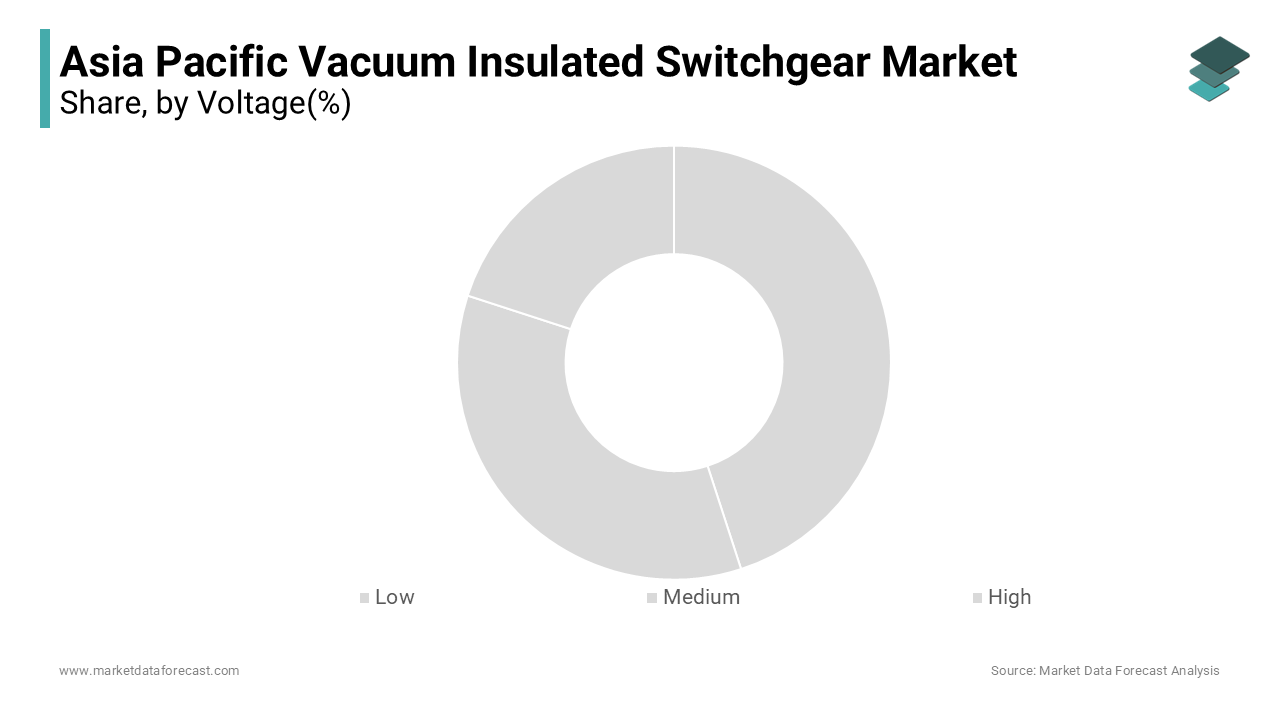
The high voltage (HV) segment is lucratively to grow lucratively with an expected CAGR of 12.4% from 2026 to 2034 with the construction of dedicated transmission corridors to evacuate power from remote renewable clusters. As per the International Hydropower Association, Southeast Asia plans to install over 30 GW of hydropower in the Mekong and Salween basins by 2030, locations often hundreds of kilometers from load centers. The Global Carbon Project notes that SF₆ accounts for 0.8% of China’s total F-gas emissions, prompting regulatory scrutiny. In India, the Green Energy Corridors Phase II project, backed by the World Bank, allocated USD 1.2 billion for SF₆-free switchgear in 145 kV substations, with vacuum technology selected for 40% of new units. The Asian Development Bank confirms that HV VISG installations in renewable zones grew by 18% year-on-year in 2023, reflecting a strategic pivot toward sustainable high-voltage solutions.
By Current Insights
The alternating current (AC) segment dominated the Asia Pacific vacuum insulated switchgear market share in 2025. The commercial and industrial sector’s reliance on AC power is prompting the growth of the segment. As per the International Labour Organization, the Asia Pacific hosts over 60% of global manufacturing activity, much of it powered by three-phase AC systems. Data centers, a rapidly growing load segment, predominantly use AC distribution despite internal DC conversion; in Australia, 96% of hyperscale facilities maintain 11 kV AC switchgear as per the Australian Data Centre Alliance. In South Korea, the Korea Electric Power Corporation (KEPCO) reported that industrial customers consumed 54% of total electricity in 2023, nearly all delivered via AC networks. Vacuum insulated switchgear is increasingly favored in these applications due to its reliability and compactness. For example, Foxconn’s Zhengzhou campus, one of the world’s largest iPhone assembly plants, uses AC-based VISG across its 33 kV internal grid to minimize downtime.
The direct current (DC) segment is projected to grow with an expected CAGR of 15.8% from 2026 to 2034 owing to the proliferation of HVDC transmission lines and electrified rail networks. As per the International Union of Railways, over 65% of new metro and high-speed rail projects in the region use 1.5 kV or 3 kV DC traction systems, requiring specialized switching equipment. In India, the Dedicated Freight Corridor Corporation operates a 1,520 km DC-powered freight line, installing DC vacuum contactors in all 89 traction substations. The Global HVDC Network reports that Asia Pacific accounted for 78% of global HVDC investments in 2023, with Japan and South Korea upgrading urban DC grids for resilience. This infrastructure momentum is creating a nascent but rapidly expanding market for DC-capable vacuum switchgear.
By Application Insights
The utility segment held a dominant share of the Asia Pacific vacuum insulated switchgear market in 2025. Utilities across the region are undertaking massive substation renewal programs to enhance reliability and accommodate the influx. Similarly, India’s Power Grid Corporation is upgrading 150 substations under its Revamped Distribution Sector Scheme, with VISG specified in 80% of new procurements. The integration of variable renewable sources necessitates advanced switching for grid stability, which is another factor prompting the growth of the Asia Pacific Vacuum Insulated Switchgear Market.
The commercial and industrial (C&I) segment is projected to grow at a CAGR of 13.7% from 2026 to 2034. The exponential growth of cloud computing and AI infrastructure is fueling demand for reliable, compact switchgear. These facilities require uninterrupted power and high short-circuit breaking capacity, making VISG ideal. Equinix’s SG5 data center in Singapore uses vacuum insulated switchgear across its 11 kV distribution network to minimize footprint and fire risk. The Uptime Institute notes that downtime costs for hyperscale centers exceed USD 9,000 per minute, driving investment in fail-safe equipment.
REGIONAL ANALYSIS
China Vacuum Insulated Switchgear Market Insights
China was the top performer of the Asia Pacific vacuum insulated switchgear market with 38.3% of the share in 2025. The State Grid Corporation and China Southern Grid are executing a nationwide program to replace aging switchgear, with vacuum technology favored for its environmental and spatial advantages. As per the National Energy Administration, over 120,000 MV switchgear units were replaced in 2023 alone, 70% of them with VISG. Moreover, China’s dominance in solar and wind manufacturing necessitates robust interconnection infrastructure; the National Renewable Energy Center reports that 85% of new 35 kV substations in Gansu and Ningxia use vacuum insulation. Domestic manufacturers like Xiamen Huli and Nader Vacuum Interrupter have achieved technological parity with global leaders, reducing import dependency. The Ministry of Industry and Information Technology notes that China produces over 60% of the world’s vacuum interrupters, enabling cost-effective scaling.
Japan Vacuum Insulated Switchgear Market Insights
Japan held second position by capturing 19.2% of the share in 2025. The country’s post-Fukushima energy strategy emphasized fire-safe, gas-free equipment, accelerating the shift from SF₆ to vacuum insulated systems. Tokyo Electric Power Company reported that 90% of its new urban substations now use VISG, citing superior performance in seismic and flood-prone zones. The Ministry of Economy, Trade and Industry mandates SF₆ emission reporting, pushing utilities toward alternatives. Additionally, Japan leads in high-voltage vacuum breaker development; Toshiba’s 72.5 kV unit, deployed in Chubu Electric’s network, achieved a 0.15% failure rate over five years, as verified by the Japan International Electrical Safety & Environment Technology Laboratories.
India Vacuum Insulated Switchgear Market Insights
India VISG market growth is fueled by large-scale government initiatives and industrial electrification. The Revamped Distribution Sector Scheme allocates USD 33 billion for distribution upgrades, mandating smart and compact equipment. Power Grid Corporation of India installed over 200 VISG units in 2023 across 33 kV and 66 kV substations. The Ministry of New and Renewable Energy reports that 40 GW of solar capacity is under construction, requiring new switching infrastructure. Indian manufacturers like Siemens India and CG Power are localizing VISG production, reducing costs. The World Bank notes that India’s urban electricity demand grew by 7.2% annually from 2018 to 2023, intensifying pressure on distribution networks.
South Korea Vacuum Insulated Switchgear Market Insights
South Korea VISG market growth is likely to grow with the advanced industrial automation and urban infrastructure renewal. KEPCO has integrated VISG into 75% of new metro substations in Seoul and Busan to enhance safety and reduce maintenance. The Ministry of Trade, Industry and Energy mandates green certification for new electrical equipment, favoring SF₆-free solutions. Samsung’s semiconductor complexes and Hyundai’s EV plants use VISG for uninterrupted power.
Australia Vacuum Insulated Switchgear Market Insights
Australia VISG market growth is likely to expand with the anchoring in renewable integration and urban network upgrades. TransGrid and AusNet are deploying VISG in new 22 kV and 33 kV substations to support solar and wind farms. The Clean Energy Regulator reports that renewabCOMPETITIVEuted 38% of generation in 2023, requiring advanced switching for grid stability. In Sydney and Melbourne, underground substations increasingly use vacuum insulation due to space and safety constraints.
COMPETITIVE LANDSCAPE
The competitive landscape of the Asia Pacific vacuum insulated switchgear market is characterized by technological differentiation, regional specialization, and strategic collaboration among global and domestic players. While multinational corporations such as Hitachi Energy, Siemens Energy, and Toshiba lead in innovation and high-end applications, regional manufacturers in China and India are gaining ground through cost-effective, localized production. The absence of a single dominant standard allows for diverse technological approaches, fostering innovation in voltage ratings, digital integration, and environmental performance. Competition is intensifying as utilities and industrial clients demand not only reliable equipment but also lifecycle sustainability and smart grid compatibility. Companies are differentiating themselves through advanced monitoring systems, zero-emission designs, and rapid deployment capabilities. The push for urban resilience and renewable integration has elevated the importance of compact, fire-safe switchgear, creating a battleground for technological superiority. Strategic R&D investments, particularly in extending vacuum interruption to higher voltages, are defining competitive edges.
KEY MARKET PLAYERS
- ABB
- Bharat Heavy Electricals (BHEL)
- CG Power and Industrial Solutions
- E + I Engineering
- Eaton
- Fuji Electric
- General Electric (GE)
- HD Hyundai Electric
- Hitachi
- Hyosung Heavy Industries
- Lucy Group
- Mitsubishi Electric
- Ormazabal
- Schneider Electric
- Siemens
- Skema
- Toshiba
Top Players in the Asia Pacific Vacuum Insulated Switchgear Market
Hitachi Energy
Hitachi Energy has established a formidable presence in the Asia Pacific vacuum insulated switchgear market through its focus on sustainable grid technologies and localized innovation. The company has deployed its EcoGIS and AirPlus solutions SF₆-free switchgear utilizing vacuum interruption—across urban substations in Tokyo, Seoul, and Melbourne, emphasizing compactness and environmental safety. In 2023, Hitachi launched a next-generation 40.5 kV vacuum insulated switchgear unit at its Singapore Technology Center, designed specifically for high-density cities and renewable integration. The company has deepened partnerships with utilities such as Singapore’s SP Group and Australia’s TransGrid, providing smart monitoring-enabled VISG units. It also expanded its manufacturing footprint in India and Thailand to reduce lead times and enhance service responsiveness. By integrating digital condition monitoring and lifecycle emission tracking, Hitachi Energy is positioning itself as a leader in decarbonized distribution infrastructure by aligning with regional regulatory shifts and urban electrification demands.
Siemens Energy
Siemens Energy is a pivotal player in the Asia Pacific vacuum insulated switchgear landscape, leveraging its global technology portfolio and regional adaptation strategies. The company’s blue GIS portfolio, which uses vacuum interrupters and clean air insulation, has been widely adopted in eco-sensitive zones across Japan, South Korea, and New Zealand. In 2023, Siemens commissioned its first fully digital substation in Sydney, featuring vacuum insulated switchgear with integrated IEC 61850 communication protocols, enhancing grid resilience and remote operation. The company has also strengthened its collaboration with Indian state utilities under the RDSS scheme, supplying compact VISG units for urban renewal projects. Siemens established a Digital Grid Competence Center in Bengaluru to accelerate R&D in smart distribution systems.
Toshiba Energy Systems & Solutions
Toshiba Energy Systems & Solutions has been a technological pioneer in vacuum insulation, particularly in high-voltage applications, and maintains a strong footprint across Japan, Southeast Asia, and Australia. The company commercialized one of the first 72.5 kV vacuum circuit breakers, marking a breakthrough in extending vacuum technology beyond medium voltage. Deployed in TEPCO’s upgraded substations, these units offer superior arc-quenching performance and eliminate SF₆ emissions. In 2023, Toshiba introduced a smart VISG system with embedded sensors and cloud-based diagnostics for Singapore’s smart grid pilot projects. The company has also partnered with Vietnam’s EVN to supply vacuum switchgear for rural electrification, emphasizing durability in tropical climates. By investing in local service networks and co-developing standards with ASEAN regulators, Toshiba is enhancing its operational agility.
Top Strategies Used by the Key Market Participants
Key players in the Asia Pacific vacuum insulated switchgear market are deploying a range of strategic initiatives to consolidate their positions. Product innovation remains central, with companies advancing vacuum interruption capabilities into higher voltage classes and integrating digital monitoring systems. Localization of manufacturing and service hubs is another strategy, enabling faster delivery and compliance with national content requirements. Firms are forming strategic alliances with utilities and industrial developers to co-design solutions for smart cities and renewable microgrids. Mergers and acquisitions are being leveraged to acquire niche technologies, particularly in sensor integration and grid automation. Additionally, companies are intensifying R&D investments in eco-efficient materials and gas-free insulation to align with regional decarbonization policies. Training programs for engineers and technicians are being expanded to address skill gaps and improve after-sales support.
RECENT MARKET DEVELOPMENTS
- In January 2023, Hitachi Energy launched its 40.5 kV EcoGIS vacuum insulated switchgear at its Singapore Technology Center, which is specifically engineered for urban substations and renewable integration in high-density cities across the Asia Pacific.
- In May 2023, Siemens Energy commissioned Australia’s first fully digital substation in Sydney, featuring its blue GIS switchgear with vacuum interruption and IEC 61850-based communication for real-time grid monitoring and control.
- In September 2023, Toshiba Energy Systems & Solutions deployed its 72.5 kV vacuum circuit breaker at Tokyo Electric Power Company’s upgraded substation by marking a commercial breakthrough in high-voltage vacuum insulation technology.
- In November 2023, CG Power and Industrial Solutions partnered with GE Grid Solutions to localize production of vacuum insulated switchgear in India by enhancing supply chain resilience and reducing delivery timelines for domestic utilities.
- In February 2025, Mitsubishi Electric announced the expansion of its vacuum interrupter manufacturing facility in Kyoto, which is increasing production capacity by 40% to meet rising demand from Southeast Asian utilities and industrial clients.
MARKET SEGMENTATION
This research report on the Asia Pacific Vacuum Insulated Switchgear Market is segmented and sub-segmented into the following categories.
By Voltage
- Low
- Medium
- High
By Current
- AC
- DC
By Application
- Residential
- Commercial & Industrial
- Utility
By Country
- India
- China
- Japan
- South Korea
- Australia
- New Zealand
- Thailand
- Malaysia
- Vietnam
- Philippines
- Indonesia
- Singapore
- Rest of APAC