- Product Description Description
- Table of Contents TOC
- List of Table & Figure LOT
- Get Free Sample PDF Sample PDF
Market Size, 2025
$908.79 MnMarket Estimate, 2026
$946.05 MnMarket Forecast, 2034
$1,304.73 MnCAGR, 2026–2034
4.1%UK Toothpaste Market Summary
Market Size & Growth
- The UK Toothpaste Market was valued at USD 908.79 million in 2025.
- Expected to reach USD 946.05 million in 2026 and USD 1,304.73 million by 2034.
- The market is projected to grow at a CAGR of 4.1% during the forecast period 2026 to 2034.
Key Market Segments
- By Toothpaste Type: Sensitivity Toothpaste, Herbal Toothpaste, Whitening Toothpaste, Children's Toothpaste, Medicated Toothpaste, Others.
- By Distribution Channel: Store-Based Retail Channels (Supermarkets, Convenience Stores, Pharmacies, Specialty Stores) and Non-Store-Based Distribution Channels (Online Retail, Direct-to-Consumer Platforms).
- Sensitivity Toothpaste held the largest share at 44.8% of the UK Toothpaste Market in 2025.
- Herbal Toothpaste is the fastest-growing segment, projected to register a CAGR of 9.5% during the forecast period 2026 to 2034.
- Non-Store-Based Distribution Channels are expected to grow at the fastest CAGR of 11.2% during the forecast period 2026 to 2034.
Key Drivers
- Approximately 45% of adults in England exhibit signs of moderate to severe periodontal disease, per the NHS Adult Dental Health Survey, driving demand for specialized toothpaste formulations.
- Growing consumer preference for natural and organic ingredients, particularly among consumers under 40 years who prefer products free from parabens and sulfates.
- NHS public health campaigns educating citizens on fluoride and brushing techniques have reinforced consistent toothpaste usage across the British population.
Key Players
Colgate-Palmolive Company, GlaxoSmithKline plc (Haleon plc), Procter and Gamble Co., Unilever PLC, Church and Dwight Co. Inc., Lion Corporation, The Himalaya Drug Company, Patanjali Ayurved Ltd., Dr. Organic Ltd., Kingfisher Natural Toothpaste, Ecodenta, Oral-B.
 Download Free Sample Report
UK Toothpaste Market Size
The UK Toothpaste Market is projected to grow from USD 908.79 million in 2025 to USD 946.05 million in 2026 and reach USD 1,304.73 million by 2034, registering a CAGR of 4.1% during the forecast period from 2026 to 2034.
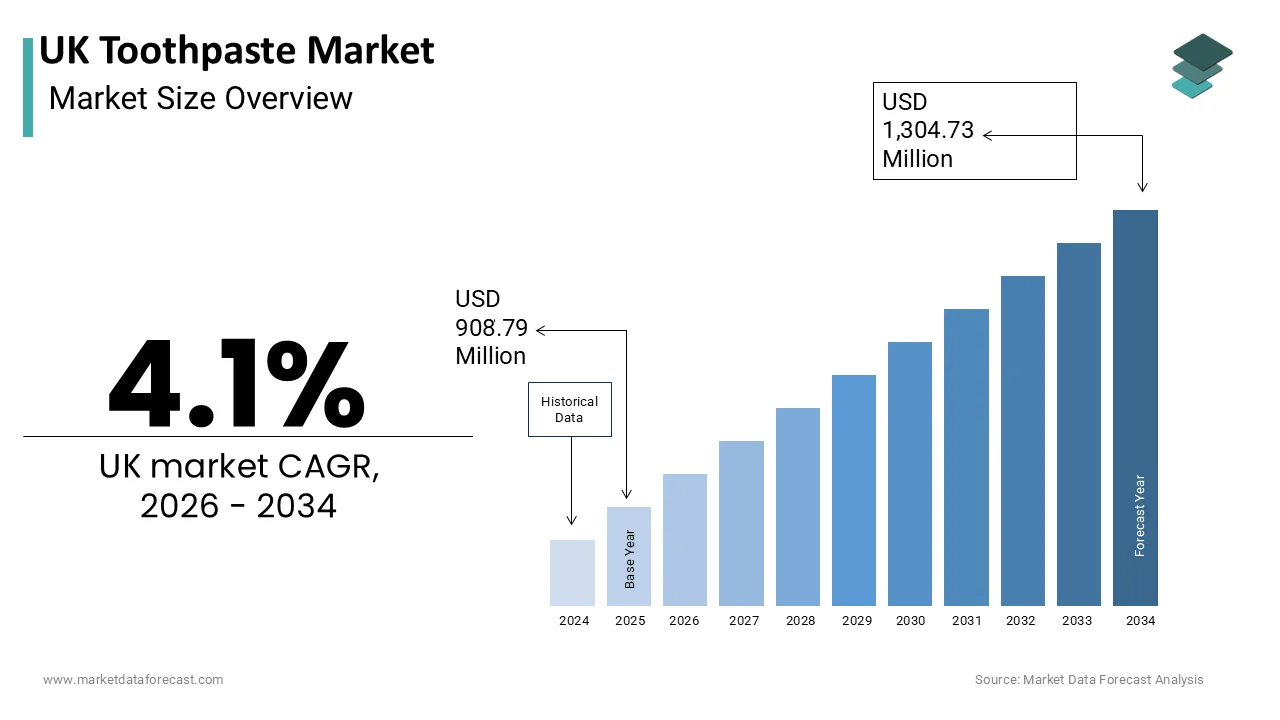
The toothpaste has high household penetration and consistent consumer engagement. Toothpaste serves as an essential daily hygiene product with nearly universal usage across the British population. The increasing health consciousness and a growing preference for products that offer multifunctional benefits beyond basic cavity prevention. Consumers in the United Kingdom demonstrate sophisticated purchasing behavior driven by awareness of well-being implications on overall well-being. The cultural emphasis on personal grooming and professional appearance further reinforces regular oral hygiene practices. Public health campaigns by the National Health Service have successfully educated citizens about the importance of fluoride and proper brushing techniques.
MARKET DRIVERS
Rising Prevalence Of Dental Disorders Drives Demand For Specialized Formulations
The increasing incidence of dental conditions for products targeting specific oral health issues is fuelling the growth of the United Kingdom toothpaste market. Gum disease affects a significant portion of the adult population, creating sustained demand for therapeutic toothpaste variants. According to the Adult Dental Health Survey conducted by the NHS, approximately 45% of adults in England exhibit signs of moderate to severe periodontal disease requiring ongoing management through specialized oral care products. This widespread prevalence encourages consumers to seek toothpaste formulations containing ingredients such as stannous fluoride or zinc citrate that actively combat gingivitis and plaque accumulation. This condition drives preference for desensitizing toothpaste brands that incorporate potassium nitrate or arginine technology to block pain signals. The aging demographic in the United Kingdom further amplifies this trend since older individuals are more susceptible to root exposure and enamel erosion. Public health initiatives emphasizing early intervention have heightened awareness about these conditions, prompting proactive consumer behavior.
Growing Consumer Preference For Natural And Organic Ingredients
The consumers increasingly prioritize natural and organic components in their personal care products, including toothpaste,e reflecting a broader shift toward clean label preferences, which is also levelling up the growth of the United Kingdom toothpaste market. This trend stems from heightened awareness regarding the potential adverse effects of synthetic chemicals, commonly found in conventional formulations. Consumers are actively seeking plant-based toothpaste options featu, ring plant based extracts, such as neem, tea tree oil, and charcoal, which are perceived as safer alternatives with additional therapeutic benefits. The millennial and Generation Z demographics drive this movement,nt with consumers under 40 years stating they prefer products free from parabens and sulfates. Retailers respond to this demand by expanding shelf space for private-label brands and introducing private-label organic options. Social media influence plays a crucial role in educating consumers about ingredient transparency and ethical sourcing practices. Certification bodies, such as COSMOS and Ecocert, provide credibility to natural claims, encouraging brand loyalty among environmentally conscious shoppers. This preference extends beyond individual health considerations to encompass environmental sustainability, such as cruelty-free, recyclable, and biodegradable packaging and cruelty-free testing policies. The convergence of health awareness and ecological responsibility creates a robust growth avenue for natural toothpaste manufacturers, who can authentically communicate their commitment to these values through third-party labeling and third-party verification.
MARKET RESTRAINTS
Stringent Regulatory Compliance Increases Production Costs
The rigorous regulatory frameworks governing ingredient safety labeling requirements and manufacturing standards are hindering the growth of the United Kingdom toothpaste market. Post Brexit adjustments have introduced additional complexity as manufacturers must navigate both retained EU regulations and new UK-specific guidelines established by the Office for Product Safety and Standards. Compliance with these evolving mandates necessitates substantial investment in quality control systems, documentation processes, and reformulation efforts when certain substances face restrictions. Manufacturers must maintain detailed product information files and conduct safety assessments for each toothpaste variant, which increases administrative burden and associated costs. The prohibition of specific antimicrobial agents and whitening compounds limits formulation flexibility, forcing companies to invest in research and development for alternative ingredients that meet efficacy and safety criteria. Small and medium-sized enterprises encounter particular difficulties in absorbing these compliance expenses as they lack the economies of scale enjoyed by multinational corporations. The requirement for clear allergen labeling and accurate claim substantiation further complicates product launches, extending time to market and increasing upfront expenditures. Additionally, the UK Cosmetics Regulation mandates notification through the Submit Cosmetic Product Notification portal before products can be placed on the market,t creating procedural delays.
Market Saturation Limits Growth Potential For Established Brands
Household penetration rates leave limited room for volume expansion among incumbent players, which is additionally hindering the growth of the United Kingdom toothpaste market. Nearly every home in the country already possesses toothpaste, making it challenging for brands to acquire new users through traditional marketing approaches. This reality forces companies to compete intensely for market share rather than growing the overall consumer base,e leading to aggressive pricing strategies and promotional discounts that erode profit margins. These store brands offer comparable budget-conscious rice points, attracting budget-conscious consumers, especially during periods of economic uncertainty when disposable income faces pressure. The dominance of established players creates high barriers to entry for new entrants, who struggle to differentiate themselves in a crowded marketplace. Innovation becomes essential, yet incremental improvements such as flavor variations or minor formula tweaks fail to generate significant consumer switching behavior.
MARKET OPPORTUNITIES
Expansion Into Premium And Luxury Oral Care Segments
The development of premium and luxury product lines that cater to affluent consumers seeking enhanced experiences and superior performance is setting up new opportunities for the growth of the United Kingdom toothpaste market. Consumers in this demographic value attributes, such as artisanal craftsmen, hip heritage brand stories,s and clinically proven efficacy supported by dental professional endorsements. Products incorporating precious compounds like gold particles, exotic diamond dust, or exotic botanical extracts appeal to shoppers viewing oral care as part of their self-care ritual rather than merely a functional necessity. The rise of boutique retailers and online platforms specializing in luxury personal care provides dedicated distribution channels that enhance brand prestige and exclusivity. Collaborations with celebrity dentists or influencers amplify visibility among target audiences who trust expert recommendations. Subscription models offering curated premium toothpaste selections create recurring revenue streams while fostering brand loyalty through personalized experiences. The integration of technology,y such as smart packaging with QR codes linking to educational content or virtual consultations, adds value beyond the physical product.
Integration Of Digital Health Technologies And Personalization
The emergence of digital health innovations with oral care products through personalized solutions tailored to individual needs is additionally enhancing the growth of the United Kingdom toothpaste market. Smart toothbrushes equipped with sensors and mobile applications generate detailed brushing data, enabling customized toothpaste recommendations based on user behavior and oral health metrics. Companies can leverage this data to formulate bespoke toothpas ,te blends addressing sp,,ecific co,ncerns such as enaml ,strength gum health or whitening intensity detDirect-to-consumergorithmic analysis. Direct-to-consumer AI-driven utilizes online quizzes and AI-driven diagnostics to match customers with optimal product trial and error satisfaction, and reduce and error purchases. Tele dentistry platforms facilitate remote consultations where professionals prescribe specialized toothpaste regimens, monitor, ed through app-based progress tracking, creating an integrated ecosystem of care. This approach fosters deeper consumer engagement and loyalty as users perceive tangible improvements in their oral health outcomes. Partnerships between toothpaste manufacturers and digital health startups accelerate the innovation cycle, bringing cutting-edge solutions to market rapidly. The collection of anonymized user data also informs product development, allowing brands to identify emerging trends and unmet needs proactively.
MARKET CHALLENGES
Intense Price Competition From Private Label Alternatives
The relentless pressure from private-label products offered by major retail chains, which undermines branded manufacturer profitability, is a challenging factor for the growth of the United Kingdom toothpaste market. Supermarkets have significantly improved the quality of their own brand toothpaste, while maintaining a cost-sensitive price point, ts attracting cost-sensitive consumers. These retailer brands benefit from eliminated marketing expenses, streamlined supply chains, and direct shelf placement advantage,s allowing them to undercut national brands by 20 to 40% on average. Branded manufacturers struggle to justify premium pricing when private label alternatives offer comparable fluoride protection and basic cleaning efficacy. The consolidation of retail power means that shelf space allocation increasingly favors high turnover private label items,s squeezing visibility for smaller branded players. Promotional activities by supermarkets further amplify this challenge as featured deals on store brands draw foot traffic away from branded aisles. Consumer loyalty diminishes in this environment as shoppers readily switch between options based on immediate price differentials rather than brand affinity.
Supply Chain Disruptions And Raw Material Volatility
The ongoing vulnerabilities from global supply chain instabilities and fluctuating raw material costs, which disrupt production, are, aredules inhibiting pricing strategiesUnitedso to inhibit the growth of thUniteded Kingdom toothpaste market. Key ingredients depend on international sourcing networks susceptible to geopolitical tensions, trade restrictions, and logistical hurdles. The reliance on imported packaging materials, particularly aluminum tubes and plastic caps, exposes manufacturers to currency exchange rate fluctuations and tariff uncertainties related to trade adjustments. Shortages of specific active ingredients caused by concentrated production in limited geographic regions create single points of failure that ripple through the entire supply network. Environmental regulations restricting certain chemical substances require rapid reformulation efforts, straining research and development resources while potentially compromising product consistency. Labor shortages in manufacturing facilities exacerbate these challenges,s reducing output capacity and extending lead times for retail replenishment. Climate change impacts on agricultural sources of natural ingredients used in organic toothpaste variants introduce additional unpredictability regarding quality and quantity. Companies must maintain larger inventory buffers, rs increasing working capital requirements and warehousing expenses. These cumulative pressures force difficult decisions between absorbing cost increases to protect market share or passing them to consumers, risking volume declines.
REPORT COVERAGE
| REPORT METRIC | DETAILS |
| Market Size Available | 2025 to 2034 |
| Base Year | 2025 |
| Forecast Period | 2026 to 2034 |
| Segments Covered | By Toothpaste Type, Distribution Channel, and Region |
| Various Analyses Covered | Global, Regional and Country-Level Analysis, Segment-Level Analysis, Drivers, Restraints, Opportunities, Challenges; PESTLE Analysis; Porter’s Five Forces Analysis, Competitive Landscape, Analyst Overview of Investment Opportunities |
| Countries Covered | United Kingdom |
| Market Leaders Profiled | Colgate-Palmolive Company, GlaxoSmithKline plc (Haleon plc), Procter & Gamble Co., Unilever PLC, Church & Dwight Co., Inc., Lion Corporation, The Himalaya Drug Company, Patanjali Ayurved Ltd., Dr. Organic Ltd., Kingfisher Natural Toothpaste, Ecodenta, Oral-B (Procter & Gamble Co.). |
SEGMENTAL ANALYSIS
By Toothpaste Type Insights
The sensitivity toothpaste segment was the largest by capturing 44.8% of the United Kingdom toothpaste market share in 2025, owing to the widespread prevalence of dentin hypersensitivity among the adult population. The aging population further amplifies this demand as individuals over 50 years are disproportionately affected by receding gums and exposed root surfaces. Clinical efficacy plays a crucial role in sustaining this leadership position since consumers rely on proven ingredients such as potassium nitrate and stannous fluoride that provide measurable relief. Dentists frequently recommend these specialized formulations, creating a strong professional endorsement loop that influences consumer purchasing decisions. The chronic nature of sensitivity ensures repeat purchases rather than one-time trials, establishing a stable revenue base for manufacturers. Additionally, increased awareness campaigns by oral health organizations have educated the public about the progressive nature of untreated sensitivity by encouraging early adoption of therapeutic products. The trust placed in established brands with long-standing clinical histories reinforces market dominance as consumers prioritize reliability over novelty when managing persistent pain.
The herbal toothpaste segment is projected to register the fastest CAGR, of 9.5%, throughout the forecast period, driven by the increasing awareness regarding synthetic additives and a desire for holistic health approaches that align with broader lifestyle choices. The influence of social media platforms and wellness influencers has accelerated education about the benefits associated with traditional botanicals, which possess inherent antimicrobial and anti-inflammatory properties. Younger demographics, particularly millennials and Generation Z, drive this trend as they prioritize transparency in ingredient sourcing and environmental sustainability. Certification labels from recognized bodies like the Soil Association provide the necessary credibility that converts interest into purchase behavior. Retailers support this growth by dedicating prominent shelf space to natural brands and expanding online assortments that cater to niche preferences. The long-term toothpaste is safer for long-term use without potential side effects for health-conscious families. Furthermore, innovations in flavor profiles using essential oils have improved the sensory experience, overcoming previous barriers related to taste.
By Distribution Channel Insights
The store-based retail channels segment held a significant share of the United Kingdom toothpaste market in 2025 due to entrenched shopping habits and immediate product availability. Supermarkets and hypermarkets serve as the primary touchpoints where consumers routinely purchase oral care items alongside weekly grocery essentials, leveraging convenience and basket-building strategies. The strategic placement of toothpaste in high-traffic aisles near pharmacy sections enhances visibility and encourages impulse buys driven by promotional displays and bundle offers. Established trust in physical stores for hygiene products remains strong among older demographics who value the ability to consult with in-store pharmacists for recommendations. The extensive network of convenience stores across urban and rural areas ensures ubiquitous access, reducing friction for last-minute purchases. Private label brands thrive in this environment as retailers optimize shelf space for their own higher margin products, creating a symbiotic relationship that reinforces store loyalty. Additionally, the immediate gratification of taking products home eliminates shipping wait times and costs associated with online orders. This channel benefits from economies of scale in logistics, cs allowing for competitive pricing that appeals to conscious households.
The non-store distribution channels segment is expected to witness the fastest CA, GR of 11.2% during the forecast period, with the digital adoption and changing consumer lifestyles. The convenience of home delivery subscription models and access to a wider variety of niche and premium brands not available in local stores. Subscription services offered by direct-to-consumer brands and major retailers automate replenishment, ensuring customers never run out of essential products while often providing cost savings through recurring order discounts. The ability to compare prices, read detailed reviews, and access comprehensive ingredidecision-making on, line empowers informed decision-making, especially for specialized products like whitening or sensitivity formulas. Mobile commerce applications facilitate seamless purchasing experiences with next-day delivery options, meeting the expectation for speed and efficiency. The pandemic accelerated this shift by normalizing online groc,ery and pharmacy shopping,g creating lasting behavioral changes among diverse age groups. Digital marketing strategies,s including targeted ads and influencer partners, help drive traffic to e-commerce sites, capturing younger audiences who prefer browsing on smartphones. Enhanced return policies and secure payment gateways have reduced perceived risks associated with online purchases.
COMPETITIVE LANDSCAPE
The competition within the United Kingdom toothpaste market is characterized by intense rivalry among established multinational corporations and agile niche brands vying for consumer attention in a saturated landscape. Major players leverage their extensive distribution networks and strong brand recognition to maintain dominance, while continuously innovating to prevent commoditization. The presence of powerful private label alternatives from major supermarket chains adds significant pressure, forcing branded manufacturers to justify premium pricing through superior efficacy or unique selling propositions. Competitive dynamics are further complicated by the rise of direct-to-consumer brands that utilize digital marketing and subscription models to bypass traditional retail barriers and build loyal communities. Companies compete not only on product performance but also on u sustainability credentials, ethical sourcing, ng and packaging innovations, which have become key differentiators for environmentally conscious shoppers. Price wars occasionally erupt during promotional periods, eroding margins but serving as necessary tactics to retain shelf space and volume.
KEY MARKET PLAYERS
Some of the companies that are playing a dominating role in the U.K. Toothpaste Market include
- Colgate-Palmolive Company
- GlaxoSmithKline plc (Haleon plc)
- Procter & Gamble Co.
- Unilever PLC
- Church & Dwight Co., Inc.
- Lion Corporation
- The Himalaya Drug Company
- Patanjali Ayurved Ltd.
- Dr. Organic Ltd.
- Kingfisher Natural Toothpaste
- Ecodenta
- Oral-B (Procter & Gamble Co.)
TOP LEADING PLAYERS IN THE MARKET
- Colgate Palmolive maintains a robust presence in the United Kingdom through its extensive portfolio of trusted oral care brands that cater to diverse consumer needs. The company focuses heavily on innovation by introducing advanced formulations that address specific dental concerns, such as enamel erosion and gum health. Recent initiatives include launching sustainable packaging solutions to align with environmental goals and enhancing digital engagement through educational campaigns. Colgate collaborates with dental professionals to reinforce clinical credibility and drives brand loyalty through consistent quality assurance. Their strategic emphasis on premium product lines helps capture value from discerning shoppers, while maintaining strong distribution networks across major retail chains and online platforms ens, uring widwide accessibilityr British households seeking reliable daily hygiene solutions.
- GlaxoSmithKline leverages its scientific heritage to dominate the therapeutic segment with flagship brands like Sensod,yne which are widely recommended by dentists across the United Kingdom. The company invests significantly in research and development to create clinically proven ingredients that provide tangible relief for sensitivity and other oral conditions. Recent actions involve expanding their natural ingredient offerings to meet growing consumer demand for cleaner labels while maintaining medical efficacy. GlaxoSmithKline strengthens its market position through strategic partnerships with healthcare providers and targeted marketing campaigns that emphasize professional endorsement. Their commitment to sustainability includes reducing plastic usage in tubes and promoting recycling programs, which resonates with environmentally conscious consumers and enhances brand reputation in the competitive UK landscape.
- Unilever contributes significantly to the United Kingdom toothpaste market through its popular Signal brand and other personal care integrations that appeal to mass market consumers. The company focuses on affordability and accessibil,itaccessibility its products are available in virtually every retail outlet across the country. Recent strategies include revitalizing brand imagery to attract younger demographics through vibrant marketing and social media engagement. Unilever emphasizes holistic oral wellness by connecting toothpaste usage with broader hygiene routines and lifestyle choices. Their investment in sustainable sourcing and biodegradable packaging reflects corporate responsibility goals that strengthen consumer trust.
TOP STRATEGIES USED BY KEY MARKET PARTICIPANTS
Key players in the United Kingdom toothpaste market employ several strategic approaches to maintain competitiveness and drive growth. Product innovation remains central as companies develop specialized formulations targeting specific oral health issues, such as sensitivity whitening and gum care, to differentiate their offerings. Sustainability initiatives aasncreasiadopttical with firms adopting eco-friendly reducing materials, and reducing carbon footprints to align with consumer values. Digital transformation enables commerce and consumer engagement through e-commerce platforms and subscription models that enhance convenience and loyalty. Strategic collaborations with dental professionals and health organizations build clinical credibility and trust among shoppers. Pricing strategies vary from premium positioning for advanced formulas to competitive pricing for mass market segments to capture diverse income groups. These combined strategies allow manufacturers to navigate market saturation and respond effectively to evolving consumer preferences and regulatory requirements in the dynamic UK environment.
MARKET SEGMENTATION
This research report on the UK toothpaste market is segmented and sub-segmented into the following categories.
By Toothpaste Type
- Sensitivity Toothpaste
- Herbal Toothpaste
- Whitening Toothpaste
- Children's Toothpaste
- Medicated Toothpaste
- Others
By Distribution Channel
- Store-Based Retail Channels
- Supermarkets & Hypermarkets
- Convenience Stores
- Pharmacies & Drug Stores
- Specialty Stores
- Non-Store-Based Distribution Channels
- Online Retail
- Direct-to-Consumer Platforms
By Country
- United Kingdom