UK Trade Finance Market Size, Share, Trends & Growth Forecast Report By Instrument Type, Service Provider, Trade Type, Enterprise Type, Industry, and Country – Industry Analysis and Forecast, 2026 to 2034
Market Size, 2025
$3.42 BnMarket Estimate, 2026
$3.56 BnMarket Forecast, 2034
$4.74 BnCAGR, 2026–2034
4.17%UK Trade Finance Market Report Summary
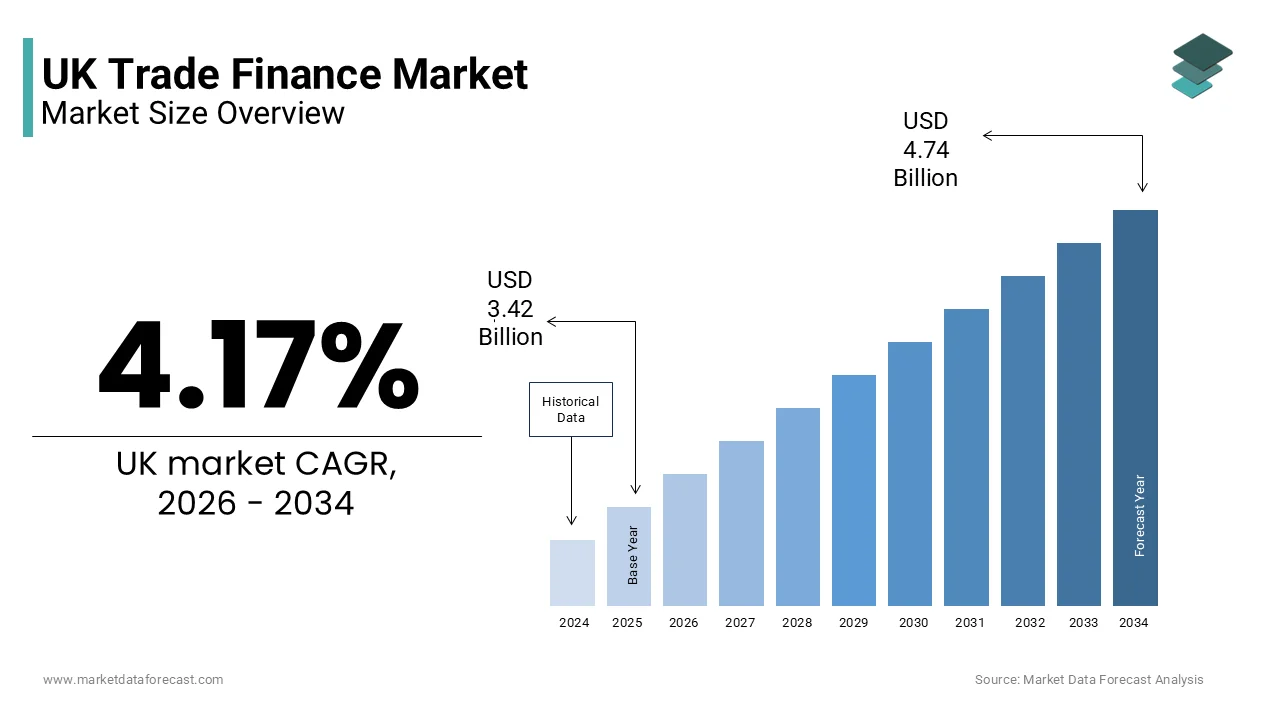
The UK trade finance market was valued at USD 3.42 billion in 2025, is estimated to reach USD 3.56 billion in 2026, and is projected to reach USD 4.74 billion by 2034, growing at a CAGR of 4.17% during the forecast period. Market growth is driven by increasing international trade activities, rising demand for working capital solutions, growing adoption of digital trade finance platforms, and the need to improve cash flow management across businesses. The market continues to benefit from advancements in fintech solutions, supply chain digitization, and growing demand for efficient trade transaction processing.
Key Market Trends
- Growing adoption of digital trade finance platforms is driving market growth.
- Increasing demand for working capital and liquidity management solutions is boosting market expansion.
- Rising integration of fintech technologies and automation tools is supporting industry development.
- Expansion of cross border trade activities is enhancing market opportunities.
- Growing focus on supply chain resilience and trade transaction transparency is influencing market advancement.
Segmental Insights
- Based on instrument type, the supply chain financing (SCF) segment accounted for 30.8% of the UK trade finance market share in 2025. This dominance is attributed to its ability to improve liquidity, optimize cash flow, and strengthen buyer supplier relationships across global supply chains.
- Based on service provider, the banks segment held 55.7% of the UK trade finance market share in 2025, supported by extensive international networks, established infrastructure, and comprehensive trade finance product portfolios.
- Based on enterprise type, the large enterprises segment accounted for 58.5% of the UK trade finance market share in 2025, driven by their substantial trade volumes and complex financing requirements.
- Based on industry, the manufacturing segment held 24.3% of the UK trade finance market share in 2025, reflecting the sector's strong dependence on international sourcing, exports, and supply chain financing solutions.
Regional Insights
- The United Kingdom accounted for 12.6% of the European trade finance market share in 2025 and maintained its position as one of the region's leading trade finance hubs. Strong financial infrastructure, a globally connected banking sector, and a well established international trade ecosystem continue to support market growth.
Competitive Landscape
The UK trade finance market is highly competitive, with financial institutions and fintech providers focusing on digitalization, automation, risk management capabilities, and customer centric financing solutions to strengthen their market position. Companies continue to invest in blockchain technologies, digital documentation platforms, and advanced trade processing systems.
Key companies operating in the UK trade finance market include Kriya Finance Limited, HSBC Holdings, Bibby Financial Services, Aldermore Bank, Barclays Bank, Novuna Business Finance, Lloyds Bank Commercial Finance, Close Brothers Invoice Finance, RBS Invoice Finance, Skipton Business Finance, Standard Chartered Bank, Ultimate Finance, and Touch Financial.
UK Trade Finance Market Size
The UK trade finance market size was valued at USD 3.42 billion in 2025, and is projected to reach USD 4.74 billion by 2034 from USD 3.56 billion in 2026, growing at a CAGR of 4.17%.
Trade finance refers to the financial instruments, banking services, and products that businesses use to facilitate buying and selling goods globally. This market covers instruments such as letters of credit bank guarantees and supply chain financing that ensure payment security and working capital liquidity for businesses engaged in global trade. The strategic importance of this market is underscored by the fact that the United Kingdom remains a top ten global trading nation. According to the Office for National Statistics (ONS), the UK’s total trade in goods and services reached £1.74 trillion over the 2024 period, a massive volume that cements its place as the 4th largest international trader in global rankings published by the World Trade Organization (WTO). The dominance of London as a global financial hub provides a robust ecosystem of banks insurers and fintech firms specializing in trade solutions. Regulatory frameworks established by the Financial Conduct Authority ensure transparency and stability in trade lending practices. The complexity of international regulations necessitates specialized expertise which UK institutions provide to clients navigating diverse legal jurisdictions. Digital transformation is reshaping traditional processes as blockchain and artificial intelligence technologies streamline documentation and reduce fraud risks. The post Brexit landscape has introduced new customs procedures increasing the demand for compliant trade finance products that address regulatory divergence. Small and medium sized enterprises constitute a significant portion of users seeking accessible financing options to expand their international footprint. Global supply chains are currently evolving towards resilience and nearshoring. To support this, trade finance adapts to facilitate shorter, more complex networks that ensure continuous cross-border flows of goods and capital.
MARKET DRIVERS
Expansion Of Global Supply Chain Networks and Export Growth
The expansion of global supply chain networks and sustained export growth are key drivers of the United Kingdom trade finance market. Businesses actively seek these trade finance solutions to secure funding and successfully manage extended cash conversion cycles. The Department for Business and Trade reveals that UK services exports reached a record £505.4 billion in 2024, far exceeding previous benchmarks, with growth heavily driven by the financial, professional, and technical services sectors. Manufacturing exports also remain robust with automotive and pharmaceutical sectors requiring substantial working capital to procure raw materials and manage inventory before receiving payment from overseas buyers. Trade finance instruments such as invoice discounting and factoring enable companies to unlock cash tied up in unpaid invoices improving liquidity and operational flexibility. The shift towards diversified sourcing strategies following recent global disruptions has led UK importers to engage with suppliers in emerging markets where payment risks are higher necessitating secure instruments like letters of credit. Large multinational corporations utilize supply chain finance programs to optimize working capital while supporting smaller suppliers in their networks ensuring stability across the value chain. The government’s Export Finance strategy targets specific growth areas, committing to providing £10 billion in clean growth finance by 2029 and supporting 1,000 SMEs annually. The expansion of UK businesses into new geographic regions exposes them to specific risks and currency fluctuations. To address these challenges, the demand for tailored trade finance solutions continues to drive market activity and product innovation.
Digital Transformation and Adoption of Blockchain Technology
Digital transformation and the rapid adoption of blockchain technology are propelling the United Kingdom trade finance market forward. This enhances efficiency transparency and security in transaction processing. Traditional trade finance relies heavily on paper based documentation which is prone to errors fraud and delays whereas digital platforms automate these processes reducing settlement times from weeks to days. The Marco Polo Network and other blockchain consortia involving major UK banks facilitate real time visibility of trade transactions enabling all parties to track status and verify authenticity instantly. Surveys, such as those by the International Chamber of Commerce (ICC) and FIS, indicate that approximately 50% of banks plan to increase investment in digital trade technology over the near term to improve operational efficiency and client service. Smart contracts execute payments automatically upon fulfillment of predefined conditions minimizing disputes and administrative burdens. The UK government’s support for fintech innovation through regulatory sandboxes allows companies to test new digital trade solutions in controlled environments accelerating market entry. Digital identities and electronic bills of lading reduce the risk of document forgery which accounts for significant losses in traditional trade finance. Integration with enterprise resource planning systems enables seamless data flow between corporate treasury functions and banking partners improving cash flow forecasting and decision making. As cyber security measures advance trust in digital platforms grows encouraging wider adoption among small and medium sized enterprises that previously found traditional trade finance too complex or costly. This technological shift not only reduces operational costs but also opens access to trade finance for underserved segments of the market.
MARKET RESTRAINTS
Stringent Regulatory Compliance And Anti Money Laundering Requirements
Stringent regulatory compliance and rigorous anti-money laundering requirements are major constraints to United Kingdom trade finance markets. This increases operational costs and processing times for financial institutions. The Financial Conduct Authority imposes strict guidelines on customer due diligence and transaction monitoring requiring banks to verify the legitimacy of every trade deal to prevent illicit activities. These checks often involve manual reviews of complex documentation leading to delays that frustrate clients and hinder business velocity. According to broader banking industry estimates, compliance and regulatory onboarding costs account for up to 20% of operational expenses, compressing margins and prompting several financial institutions to exit lower-margin or higher-risk trade finance segments. The complexity of navigating differing international sanctions regimes adds another layer of difficulty as institutions must ensure transactions do not violate restrictions imposed by the UK European Union or United States. False positives in screening systems generate substantial workloads for compliance teams reducing overall efficiency. Smaller banks struggle to invest in advanced screening technologies making them less competitive compared to larger players with dedicated resources. The threat of hefty fines for non compliance discourages innovation and risk taking leading to conservative lending practices that may exclude viable borrowers. Businesses face frustration when legitimate transactions are delayed or rejected due to overly cautious compliance protocols impacting their ability to seize timely market opportunities. The lack of standardized global compliance frameworks creates fragmentation requiring institutions to maintain multiple systems and procedures for different jurisdictions further complicating operations and increasing the burden on the trade finance ecosystem.
Economic Volatility and Currency Fluctuation Risks
Economic volatility and currency fluctuation risks hamper the growth of the United Kingdom trade finance market. This creates uncertainty around repayment capabilities and profit margins for international traders. Exchange rate movements can significantly erode the value of cross border payments affecting both importers and exporters who operate on thin margins. The Bank of England reports that sterling volatility against major currencies like the US dollar and euro remained elevated in recent years impacting the cost of hedging instruments used to mitigate these risks. High interest rates increase the cost of borrowing for trade finance facilities making them less attractive for businesses seeking working capital. Inflationary pressures raise the price of goods and logistics services requiring larger financing amounts for the same volume of trade which strains credit limits. Economic downturns in key trading partners reduce demand for UK exports leading to higher default risks that make lenders more cautious in extending credit. The uncertainty surrounding global geopolitical tensions disrupts supply chains and alters trade flows forcing companies to constantly adjust their financing strategies. Insurance premiums for trade credit rise during periods of instability further increasing the cost of doing business internationally. Small and medium sized enterprises are particularly vulnerable as they lack the sophisticated treasury functions needed to manage complex currency exposures effectively. This environment of uncertainty leads to tighter credit conditions and reduced appetite for risk among financial institutions limiting the availability of trade finance products and stifling growth potential for businesses reliant on international commerce.
MARKET OPPORTUNITIES
Integration Of Artificial Intelligence For Risk Assessment
The integration of artificial intelligence for risk assessment offers a major opportunity for the United Kingdom trade finance market. This enables more accurate and efficient evaluation of borrower creditworthiness and transaction risks. AI algorithms analyze vast amounts of structured and unstructured data including shipping records news feeds and financial statements to identify patterns and predict potential defaults with greater precision than traditional methods. This capability allows lenders to extend credit to small and medium sized enterprises that previously lacked sufficient credit history thereby expanding the addressable market. Financial technology research demonstrates that integrating AI-driven underwriting engines can reduce credit and risk decision-making times by 50% to 70%, simultaneously improving risk accuracy rates by automating document verification. Machine learning models continuously learn from new data adapting to changing market conditions and emerging risks in real time. Natural language processing tools automate the extraction of key information from trade documents reducing manual effort and error rates. Predictive analytics help banks anticipate cash flow needs of clients offering proactive financing solutions that strengthen customer relationships. The use of AI in fraud detection enhances security by identifying anomalous transactions that deviate from normal behavior patterns preventing financial losses. Regulatory bodies are increasingly accepting algorithmic explanations for credit decisions provided they are transparent and auditable encouraging wider adoption. Fintech partnerships allow traditional banks to leverage advanced AI capabilities without building proprietary systems from scratch accelerating deployment. As data quality improves and computational power increases, the scope for AI applications in trade finance will expand. This growth will drive innovation and competitiveness in the UK market.
Growth In Sustainable Trade Finance And Green Instruments
The growth in sustainable trade finance and green instruments provides major prospects for the United Kingdom trade finance market. This momentum is largely driven by businesses and investors increasingly prioritizing environmental, social, and governance (ESG) criteria. Green trade finance products link interest rates to sustainability performance metrics incentivizing companies to adopt eco friendly practices in their supply chains. The UK government’s Net Zero Strategy encourages financial institutions to develop products that support the transition to a low carbon economy creating new revenue streams. According to the London Stock Exchange Group issuance of sustainability linked bonds and loans has grown substantially with trade finance facilities increasingly incorporating environmental covenants. Importers and exporters seek financing for green technologies such as electric vehicles renewable energy equipment and sustainable packaging materials driving demand for specialized trade products. Banks that offer green trade finance enhance their brand reputation and attract environmentally conscious clients gaining a competitive edge. Verification of sustainability claims through digital certificates and blockchain ensures integrity and prevents greenwashing building trust among stakeholders. International standards such as the ICC Banking Commission guidelines for sustainable trade provide frameworks for structuring these products consistently. Collaboration with certification bodies enables accurate assessment of supplier compliance with environmental standards. As regulatory pressure mounts for climate related disclosures sustainable trade finance becomes a strategic imperative rather than a niche offering. The UK’s leadership in green finance positions its institutions to capture a large share of this emerging market segment driving long term growth and alignment with global sustainability goals.
MARKET CHALLENGES
Cybersecurity Threats and Data Privacy Concerns
Cybersecurity threats and data privacy concerns are impeding the expansion of the United Kingdom trade finance market. This is primarily because digitalization increases the attack surface for malicious actors. Trade finance platforms handle sensitive commercial and financial data making them attractive targets for cybercriminals seeking to commit fraud or steal intellectual property. The National Cyber Security Centre reports a rise in phishing attacks and ransomware incidents targeting financial institutions requiring constant vigilance and investment in defense mechanisms. A successful breach can result in significant financial losses reputational damage and regulatory penalties undermining client trust. The complexity of multi party trade transactions involving banks insurers logistics providers and buyers creates multiple entry points for vulnerabilities that hackers can exploit. Ensuring end to end encryption and secure authentication across all participants is technically challenging and costly. Data privacy regulations such as the UK General Data Protection Regulation impose strict requirements on how personal and corporate data is stored and shared limiting flexibility in system design. Cross border data transfers face additional legal hurdles complicating the operation of global trade networks. The shortage of skilled cybersecurity professionals exacerbates the problem leaving institutions understaffed to manage evolving threats. Continuous updates to security protocols are necessary to stay ahead of sophisticated attack vectors straining IT budgets. Balancing ease of use with robust security measures remains a delicate act as overly restrictive controls can hinder user adoption and operational efficiency in the fast paced trade finance environment.
Fragmentation Of Digital Standards and Interoperability Issues
Fragmentation of digital standards and interoperability issues remain serious challenges to the United Kingdom trade finance market. This hinders seamless connectivity between various platforms and stakeholders. Multiple blockchain networks and digital trade platforms operate using different protocols and data formats making it difficult for systems to communicate effectively. This lack of standardization forces users to maintain connections with several platforms increasing complexity and costs. The International Chamber of Commerce highlights that inconsistent digital trade rules across jurisdictions create barriers to widespread adoption of electronic documents. Banks and corporations struggle to integrate disparate systems with their existing enterprise resource planning software leading to data silos and inefficiencies. The absence of a universal digital identity framework complicates know your customer processes requiring repeated verification across different networks. Legal recognition of electronic signatures and documents varies by country creating uncertainty in cross border transactions. Efforts to establish common standards such as the Uniform Electronic Transferable Records Act are progressing slowly facing resistance from legacy interests and technical hurdles. Without interoperability the benefits of digitization such as speed and transparency are diluted as manual interventions remain necessary to bridge gaps between systems. Industry consortia are working towards harmonization but achieving consensus among diverse stakeholders including governments banks and technology providers is a lengthy process. The full potential of digital trade finance in the UK will remain constrained until robust, interoperable frameworks are established. Without these changes, fragmented ecosystems will continue to impede smooth and efficient global commerce.
REPORT COVERAGE
| REPORT METRIC | DETAILS |
| Market Size Available | 2025 to 2034 |
| Base Year | 2025 |
| Forecast Period | 2026 to 2034 |
| CAGR | 4.17% |
| Segments Covered | By Instrument Type, Service Provider, Trade Type, Enterprise Type, Industry, and Region. |
| Various Analyses Covered | Global, Regional and Country-Level Analysis, Segment-Level Analysis, Drivers, Restraints, Opportunities, Challenges; PESTLE Analysis; Porter’s Five Forces Analysis, Competitive Landscape, Analyst Overview of Investment Opportunities |
| Market Leaders Profiled | Kriya Finance Limited, HSBC Holdings, Bibby Financial Services, Aldermore Bank, Barclays Bank, Novuna Business Finance, Lloyds Bank Commercial Finance, Close Brothers Invoice Finance, RBS Invoice Finance (part of NatWest Group), Skipton Business Finance, Standard Chartered Bank, Ultimate Finance, and Touch Financial |
SEGMENTAL ANALYSIS
By Instrument Type Insights
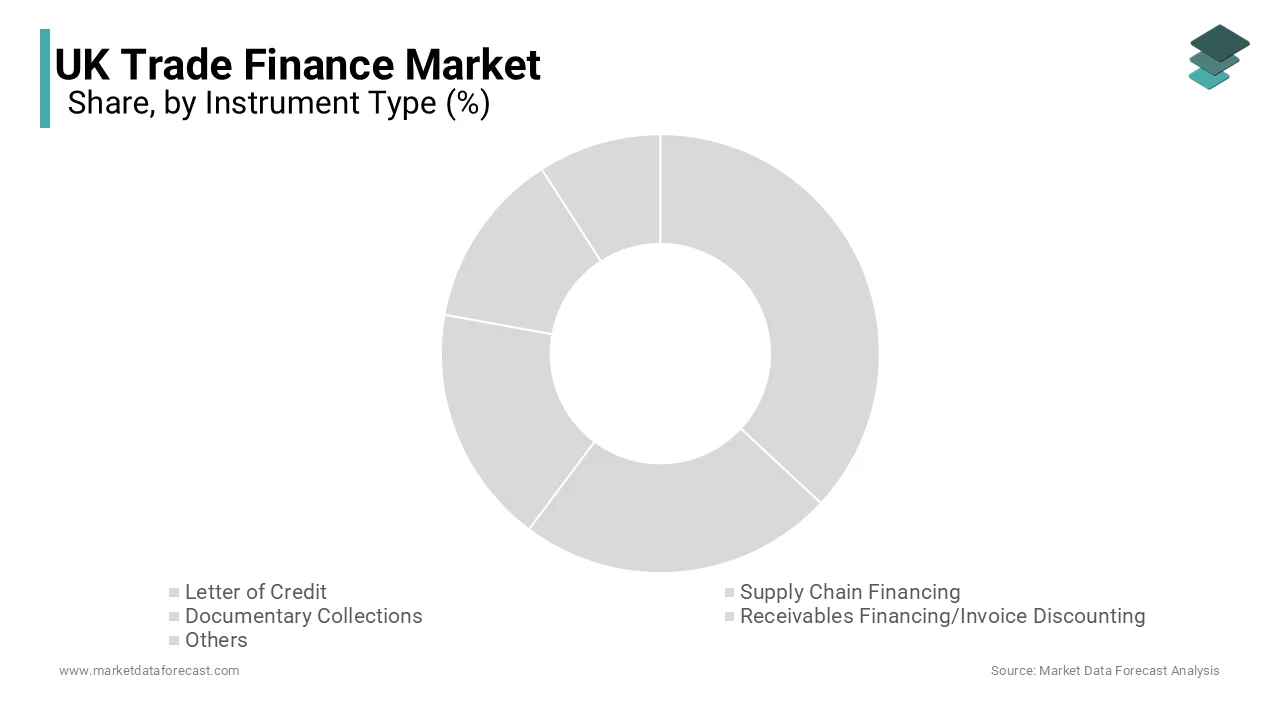
The supply chain financing (SCF) segment was the largest in the United Kingdom trade finance market and occupied a 30.8% share in 2025. Its ability to optimize working capital for both buyers and suppliers within complex global networks supports the prominence of this segment. This instrument allows large corporations to extend payment terms while ensuring their suppliers receive early payment at lower interest rates based on the buyer’s credit rating. The Department for Business and Trade highlights that supply chain finance programs have grown significantly as UK manufacturers seek to stabilize their supplier bases following recent global disruptions. Research confirms that supply chain finance volumes grew by nearly 14% annually, driven by large-cap buyers prioritizing liquidity optimization and vendor stability amidst shifting macroeconomic conditions. The collaborative nature of this instrument strengthens relationships between buyers and suppliers reducing the risk of supply chain breakdowns. Digital platforms facilitate seamless integration with enterprise resource planning systems enabling real time visibility of invoices and payment status. The scalability of supply chain finance makes it attractive for multinational corporations managing thousands of suppliers across different jurisdictions. Regulatory support for transparent lending practices encourages adoption as it provides clear audit trails for financial reporting. The cost efficiency compared to traditional borrowing options appeals to small and medium sized suppliers who often face higher financing costs independently. As sustainability becomes a priority some supply chain finance programs now offer preferential rates for suppliers meeting environmental criteria further driving uptake. This holistic approach to managing trade flows ensures that supply chain financing remains the cornerstone of modern trade finance strategies in the UK.
The receivables financing and invoice discounting segment is expected to exhibit a noteworthy CAGR of 14% over the forecast period owing to the increasing need for small and medium sized enterprises to unlock cash trapped in unpaid invoices to maintain operational liquidity. Traditional bank lending has become more restrictive prompting businesses to turn to alternative financing solutions that leverage their sales ledger as collateral. The rise of digital factoring platforms has streamlined the application process allowing companies to access funds within 24 hours compared to weeks for traditional loans. UK Finance shows that confidential invoice discounting dominates the asset-based lending landscape, comprising 85% of the total market share as over 40,000 UK businesses leverage it for flexible working capital. These instruments provide immediate cash flow improvements enabling businesses to invest in growth opportunities purchase inventory and meet payroll obligations without waiting for customer payments. The non recourse nature of some factoring arrangements transfers credit risk to the financier providing additional security for businesses dealing with new or risky customers. Integration with accounting software automates the reconciliation process reducing administrative burdens for finance teams. As e commerce continues to expand B2B transactions increasingly rely on quick turnover of receivables making this instrument essential for maintaining competitive agility in fast paced markets. The flexibility to select which invoices to finance offers tailored solutions that align with specific business cycles and cash flow needs.
By Service Provider Insights
The banks segment led the United Kingdom trade finance market and captured a 55.7% share in 2025 because of its established infrastructure extensive global networks and comprehensive range of financial products. Major UK banks such as HSBC Barclays and Standard Chartered possess deep expertise in handling complex cross border transactions offering letters of credit guarantees and structured trade finance solutions. The Financial Conduct Authority regulates these institutions ensuring high standards of compliance and security which builds trust among corporate clients. Banks benefit from long standing relationships with multinational corporations allowing them to offer integrated treasury services alongside trade finance. Various sources establishe that traditional high-street banks still process over 70% of total trade finance facilities in the UK, retaining market dominance through long-standing global correspondent networks and balance sheet scale. Their ability to provide large scale financing for major infrastructure projects and commodity trades sets them apart from smaller competitors. Investment in digital transformation enables banks to offer online platforms for document submission and tracking enhancing customer experience. The stability of bank balance sheets allows them to absorb risks associated with volatile markets providing reliability during economic downturns. Regulatory capital requirements ensure that banks maintain sufficient reserves to support lending activities fostering systemic stability. Collaborations with fintech firms allow banks to innovate while leveraging their existing client base. The comprehensive suite of services including foreign exchange hedging and insurance makes banks a one stop shop for international trade needs reinforcing their leadership in the sector.
The non bank financial institutions and fintech segment is predicted to witness the highest CAGR of 18.6% from 2026 to 2034. This quick surge of the segment is propelled by its ability to offer agile specialized solutions that address gaps left by traditional banks particularly for small and medium sized enterprises. Fintech platforms utilize artificial intelligence and blockchain technology to streamline processes reduce costs and improve accessibility for underserved segments. The Bank of England notes that alternative lenders have increased their market share in SME lending as they employ innovative risk assessment models that consider non traditional data sources. These institutions often provide faster approval times and more flexible terms appealing to businesses requiring quick access to capital. Digital native platforms offer user friendly interfaces that simplify complex trade finance procedures making them accessible to companies without dedicated treasury departments. Partnerships with logistics providers and e commerce marketplaces enable embedded finance solutions where trade credit is offered at the point of transaction. Regulatory sandboxes support innovation by allowing fintechs to test new products in controlled environments accelerating time to market. The focus on niche sectors such as green trade finance or specific geographic corridors allows these providers to differentiate themselves from generalist banks. The acceptance of non-bank providers continues to rise as digital literacy improves among business owners. Consequently, this trend is driving robust growth across this dynamic segment of the trade finance ecosystem.
By Enterprise Type Insights
The large enterprises segment held the majority share of 58.5% of the United Kingdom trade finance market in 2025. This supremacy of the segment was supported by enterprise type due to their substantial volume of international transactions and complex supply chain requirements. Multinational corporations headquartered in the UK engage in extensive import and export activities necessitating sophisticated trade finance instruments such as standby letters of credit and structured commodity finance. The Office for National Statistics (ONS) shows that large corporations disproportionately dominate cross-border commerce, accounting for nearly 80% of total UK international trade value. These entities possess the resources to negotiate favorable terms with banks and utilize advanced treasury management systems to optimize working capital. Their global presence requires coordination across multiple jurisdictions driving demand for standardized yet customizable trade finance solutions. Large enterprises often implement supply chain finance programs to support their extensive supplier networks enhancing stability and efficiency. The scale of their operations allows them to benefit from economies of scale in financing costs reducing the overall expense of trade activities. Regulatory compliance teams within large organizations ensure adherence to international sanctions and anti money laundering laws mitigating risks for financial partners. Their strong credit ratings enable access to diverse funding sources including capital markets and syndicated loans. The strategic importance of maintaining uninterrupted supply chains prompts large enterprises to invest heavily in robust trade finance frameworks ensuring resilience against global disruptions.
The small and medium enterprises segment is estimated to register the fastest CAGR of 16.4% during the forecast period due to government initiatives aimed at boosting exports and improving access to finance for smaller businesses. In addition, the Department for Business and Trade has launched various support schemes including export finance guarantees that encourage banks to lend to SMEs engaging in international trade. Digital platforms have lowered barriers to entry by simplifying application processes and reducing documentation requirements making trade finance more accessible to smaller players. SMEs are increasingly looking to diversify their supply chains and explore new markets driving demand for flexible financing options such as invoice discounting and trade credit insurance. The rise of e commerce has enabled many small businesses to reach global customers directly increasing their need for cross border payment solutions and working capital. Alternative lenders and fintechs cater specifically to this segment offering tailored products that address unique cash flow challenges. Awareness campaigns by industry bodies educate SMEs on the benefits of trade finance helping them overcome perceived complexity. As these businesses grow their trade finance needs evolve creating opportunities for providers to offer scalable solutions. The agility of SMEs allows them to capitalize on niche market opportunities quickly further driving their participation in international trade and corresponding finance demand.
By Industry Insights
The manufacturing segment dominated the United Kingdom trade finance market and accounted for a 24.3% share in 2025. This dominance of the segment was driven by its heavy reliance on imported raw materials and exported finished goods. The Office for National Statistics (ONS) clarifies that manufacturing drives nearly 80% of total UK physical goods exports, showcasing high demand for long-cycle trade finance across the automotive, aerospace, and pharmaceutical sectors. Trade finance instruments such as letters of credit and bank guarantees are essential for securing supplies from overseas vendors and ensuring payment from international buyers. The complexity of global supply chains in manufacturing necessitates robust risk mitigation tools to protect against delays and defaults. Major UK manufacturers utilize supply chain finance to optimize cash flow and strengthen relationships with key suppliers. The sector’s exposure to currency fluctuations drives demand for integrated foreign exchange and trade finance solutions. Government support for advanced manufacturing technologies encourages investment in equipment often financed through structured trade deals. The transition towards sustainable manufacturing practices creates opportunities for green trade finance products linked to environmental performance metrics. Regulatory compliance regarding origin rules and customs procedures adds complexity requiring specialized trade finance expertise. The strategic importance of the manufacturing sector to the UK economy ensures continued focus on facilitating its trade activities through efficient financial infrastructure. Manufacturers may adjust their trade finance strategies to support shorter but potentially more complex domestic and regional supply chains. This adaptation often occurs as reshoring trends gain momentum.
The retail and wholesale segment is anticipated to witness the fastest CAGR of 17.2% between 2026 and 2034. This rapid growth is driven by the expansion of e commerce and the increasing globalization of retail supply chains. Retailers source products from diverse international suppliers requiring flexible financing solutions to manage inventory levels and seasonal demand fluctuations. Trade finance instruments such as receivables financing and supply chain finance enable retailers to optimize working capital and improve cash conversion cycles. The rise of direct to consumer models has increased the volume of cross border transactions for smaller retailers who previously relied on domestic distributors. Digital platforms facilitate quick access to trade credit allowing retailers to respond rapidly to changing consumer trends. The need for speed and efficiency in restocking popular items drives adoption of automated trade finance solutions integrated with inventory management systems. Sustainability concerns prompt retailers to seek green financing options for ethically sourced products aligning with consumer preferences. The fragmentation of the retail sector means many small and medium sized players are entering the international market for the first time increasing overall demand for accessible trade finance products. As omnichannel retailing becomes standard the integration of trade finance with digital sales platforms will continue to accelerate growth in this dynamic sector.
COUNTRY LEVEL ANALYSIS
The United Kingdom outperformed other countries in the European trade finance market and 12.6% share in 2025. This leading position is supported by London’s status as a leading international financial center with deep liquidity and specialized expertise in structured trade solutions. The market status reflects resilience and adaptation following Brexit with institutions developing new capabilities to handle customs complexities and regulatory divergence. According to data from the Office for National Statistics (ONS), the UK’s annual total trade stands at £1.92 trillion, comfortably exceeding the £1.7 trillion benchmark. Furthermore, data from the World Trade Organization (WTO) establishes that the UK ranks 4th globally in total international trade, highlighting a robust trading ecosystem that underscores strong demand for trade finance services. Strong regulatory frameworks established by the Financial Conduct Authority ensure stability and transparency attracting international clients seeking secure transaction environments. The presence of major global banks and innovative fintech firms creates a competitive ecosystem that drives product development and digital innovation. Government initiatives such as the Export Finance Strategy provide crucial support by offering guarantees and insurance that de risk lending to emerging markets. The UK’s legal system based on common law is widely recognized and trusted for enforcing trade contracts further enhancing its appeal as a jurisdiction for trade finance agreements. Continuous investment in digital infrastructure including blockchain pilots and electronic document platforms positions the UK at the forefront of modernizing trade processes. Collaboration between public and private sectors fosters an environment conducive to growth ensuring that the UK maintains its leadership role in facilitating global commerce through efficient and innovative trade finance solutions.
COMPETITIVE LANDSCAPE
The competitive landscape in the United Kingdom trade finance market features intense rivalry among established global banks regional lenders and emerging fintech companies. Traditional banks leverage their extensive networks and balance sheet strength to offer comprehensive solutions while fintechs disrupt the market with agile digital platforms and faster processing times. Differentiation occurs through technological innovation customer service quality and specialized industry expertise. Price competition is moderate as clients prioritize reliability and security over cost alone. Regulatory compliance acts as a barrier to entry favoring larger institutions with resources to manage complex requirements. Collaboration between banks and technology providers is increasing to combine traditional strengths with digital capabilities. The shift towards sustainable finance creates new competitive dimensions as institutions develop green trade products. Customer retention depends on seamless integration with corporate systems and proactive risk management support. As demand for digital solutions grows competitors must continuously innovate to meet expectations for speed transparency and accessibility. This dynamic environment drives continuous improvement and adaptation among all market participants seeking to capture share in the evolving trade finance sector.
KEY MARKET PLAYERS
Some of the companies that are playing a dominating role in the UK trade finance market are
- Kriya Finance Limited
- HSBC Holdings
- Bibby Financial Services
- Aldermore Bank
- Barclays Bank
- Novuna Business Finance
- Lloyds Bank Commercial Finance
- Close Brothers Invoice Finance
- RBS Invoice Finance (part of NatWest Group)
- Skipton Business Finance
- Standard Chartered Bank
- Ultimate Finance
- Touch Financial
Top Players in the Market
- HSBC Holdings maintains a dominant position in the United Kingdom trade finance market by leveraging its extensive global network to facilitate cross border transactions for multinational corporations and small businesses. The bank offers a comprehensive suite of products including letters of credit supply chain finance and trade working capital solutions tailored to diverse industry needs. Recent initiatives focus on digital transformation with the launch of automated platforms that streamline document processing and reduce settlement times. HSBC has integrated blockchain technology into its trade finance operations enhancing transparency and security for clients. The bank actively supports UK exporters through specialized advisory services helping them navigate complex international regulations. By investing in artificial intelligence driven risk assessment tools HSBC improves decision making speed and accuracy. These strategic actions reinforce its reputation as a trusted partner in global trade enabling seamless connectivity between UK businesses and international markets while driving operational efficiency and customer satisfaction across its trade finance portfolio.
- Barclays Bank plays a crucial role in the United Kingdom trade finance sector by providing innovative financial solutions that support the growth of domestic and international trade activities. The bank specializes in supply chain finance programs that help large corporates optimize working capital while ensuring timely payments to their suppliers. Barclays has recently enhanced its digital trade platform offering real time visibility and tracking of transactions which improves client experience and operational control. The institution collaborates with fintech companies to integrate advanced technologies such as smart contracts and electronic bills of lading into its service offerings. Barclays also focuses on sustainable trade finance by linking financing terms to environmental performance metrics encouraging clients to adopt greener practices. Its dedicated team of trade experts provides tailored advice on risk mitigation and regulatory compliance. These efforts strengthen Barclays market position by delivering efficient secure and sustainable trade finance solutions that meet the evolving needs of UK businesses engaged in global commerce.
- Standard Chartered Bank contributes significantly to the United Kingdom trade finance market through its deep expertise in emerging markets and complex structured trade solutions. The bank facilitates trade flows between the UK and high growth regions in Asia Africa and the Middle East supporting sectors such as energy commodities and infrastructure. Recent actions include expanding its digital capabilities with the introduction of online platforms for letter of credit issuance and document presentation reducing manual intervention. Standard Chartered has partnered with technology providers to implement blockchain based solutions that enhance trust and efficiency in trade transactions. The bank also offers specialized hedging products to help clients manage currency and interest rate risks associated with international trade. By focusing on sustainability Standard Chartered integrates environmental social and governance criteria into its trade finance decisions. These strategic moves bolster its competitive edge by providing reliable innovative and responsible trade finance services that empower UK companies to expand their global footprint securely and efficiently.
Top Strategies Used By Key Market Participants
Key players in the United Kingdom trade finance market employ digital transformation strategies to automate processes and enhance customer experience through online platforms. They invest heavily in blockchain and artificial intelligence technologies to improve transparency reduce fraud and accelerate transaction processing times. Banks focus on developing sustainable trade finance products that align with environmental social and governance goals attracting eco conscious clients. Strategic partnerships with fintech firms enable traditional institutions to leverage innovative solutions and reach underserved small and medium sized enterprises. Expansion into emerging markets provides new growth opportunities by facilitating trade between the UK and high potential regions. Customization of supply chain finance programs helps large corporates optimize working capital while supporting their supplier networks. Regulatory compliance remains a priority with robust anti money laundering systems ensuring adherence to international standards. These multifaceted approaches allow participants to maintain competitiveness and drive growth in a dynamic global trade environment.
MARKET SEGMENTATION
This research report on the UK trade finance market is segmented and sub-segmented into the following categories.
By Instrument Type
- Letter of Credit
- Supply Chain Financing
- Documentary Collections
- Receivables Financing/Invoice Discounting
- Others
By Service Provider
- Banks
- Financial Institutions
- Trading Houses
- Others
By Trade Type
- Domestic
- International
By Enterprise Type
- Large Enterprises
- Small and Medium Enterprises
By Industry
- BFSI
- Construction
- Retail/Wholesale
- Manufacturing
- Automobile
- Logistics
- Others
Frequently Asked Questions
1. What is trade finance?
Trade finance refers to financial products and services that facilitate domestic and international trade by helping businesses manage payment risks, working capital requirements, and cash flow.
2. What factors are driving the growth of the UK trade finance market?
The market is expanding due to increasing international trade activities, growing demand for supply chain financing, digitalization of trade processes, and rising working capital needs among businesses.
3. Why is trade finance important for businesses?
Trade finance helps businesses secure transactions, improve liquidity, reduce payment risks, and maintain stable cash flows while conducting trade operations.
4. What are the major trade finance instruments used in the UK?
Common instruments include letters of credit, supply chain financing, documentary collections, bank guarantees, and receivables financing.
5. How do letters of credit support international trade?
Letters of credit provide payment assurance to exporters while ensuring that importers receive goods according to agreed contractual terms.
6. Which organizations are the primary providers of trade finance services in the UK?
Banks, financial institutions, trading houses, and specialized finance providers are the main providers of trade finance solutions.
7. How is digital transformation influencing the UK trade finance market?
Digital platforms, blockchain technology, and automated documentation processes are improving transaction efficiency, transparency, and security.
8. What role do small and medium enterprises play in the UK trade finance market?
Small and medium enterprises increasingly rely on trade finance solutions to access working capital and expand their domestic and international trade activities.
9. What challenges does the UK trade finance market face?
Key challenges include regulatory compliance requirements, fraud risks, complex documentation procedures, and limited access to financing for smaller businesses.
10. What is the future outlook for the UK trade finance market?
The market is expected to grow steadily due to increasing global trade volumes, greater adoption of digital trade platforms, and rising demand for efficient financing solutions among businesses.
Related Reports
Access the study in MULTIPLE FORMATS
Purchase options starting from
$ 1200
Didn’t find what you’re looking for?
TALK TO OUR ANALYST TEAM
Need something within your budget?
NO WORRIES! WE GOT YOU COVERED!
Call us on: +1 888 702 9696 (U.S Toll Free)
Write to us: sales@marketdataforecast.com