- Product Description Description
- Table of Contents TOC
- List of Table & Figure LOT
- Get Free Sample PDF Sample PDF
Market Size, 2025
$74.64 BnMarket Estimate, 2026
$80.71 BnMarket Forecast, 2034
$105.84 BnCAGR, 2026–2034
8.13%UK Warehousing Market Report Summary
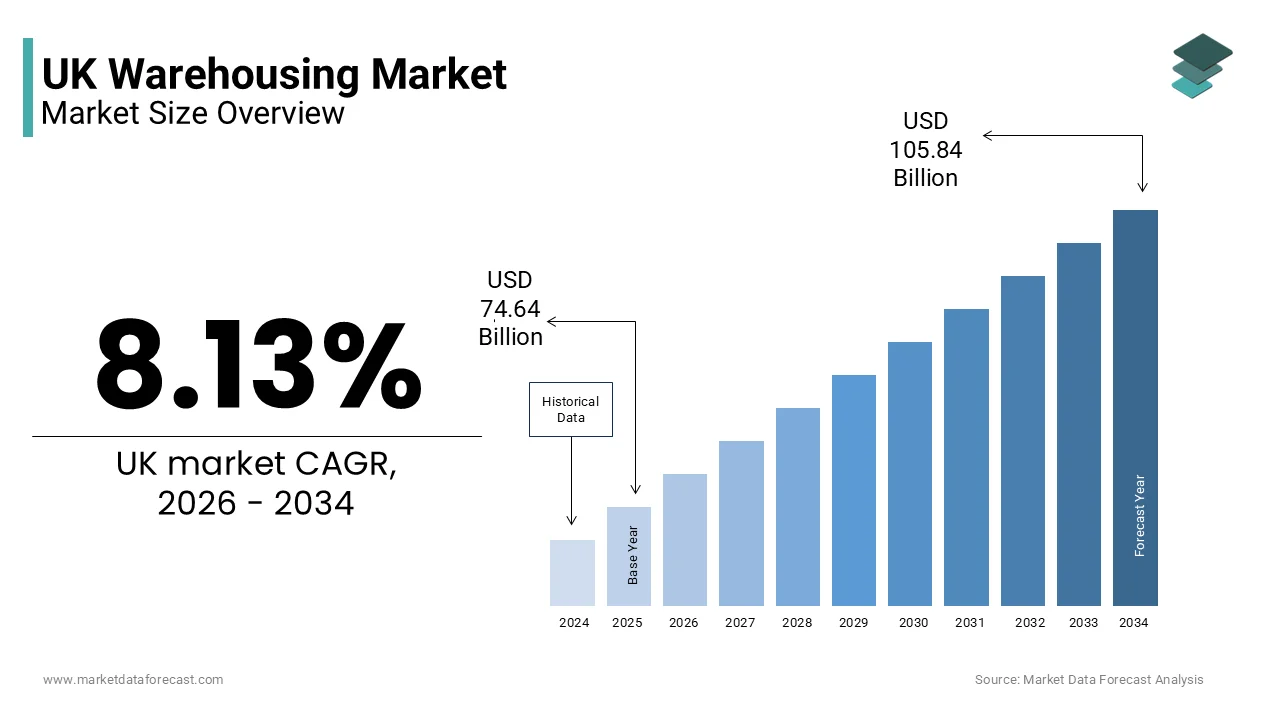
The UK warehousing market was valued at USD 74.64 billion in 2025, is estimated to reach USD 80.71 billion in 2026, and is projected to reach USD 105.84 billion by 2034, growing at a CAGR of 8.13% during the forecast period. Market growth is driven by the rapid expansion of e commerce, increasing demand for efficient supply chain management, rising inventory storage requirements, and growing investments in logistics infrastructure. The adoption of warehouse automation, robotics, and advanced inventory management technologies is further supporting market expansion across the United Kingdom.
Key Market Trends
- Growing e commerce activity is driving market growth.
- Increasing demand for modern logistics and fulfillment centers is boosting market expansion.
- Rising adoption of warehouse automation and robotics is supporting industry development.
- Expansion of omnichannel retail strategies is enhancing market opportunities.
- Growing investments in smart warehousing and digital supply chain technologies are influencing market advancement.
Segmental Insights
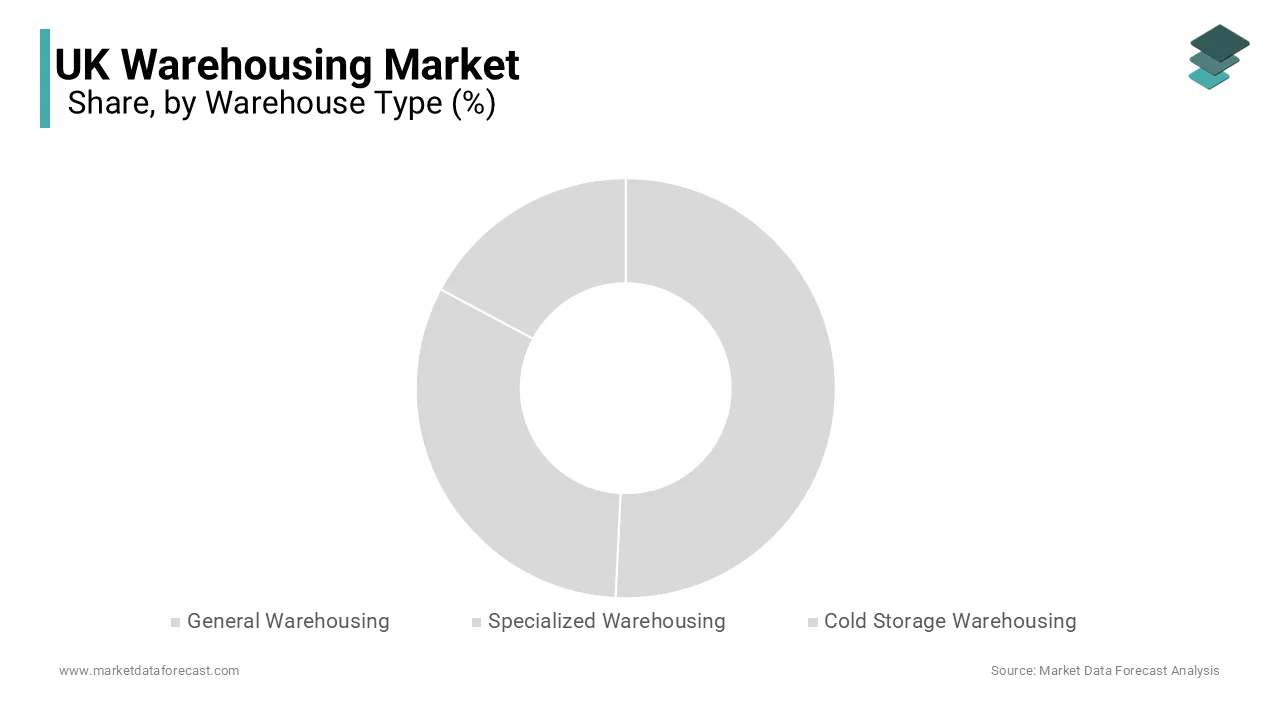
- Based on warehouse type, the general warehousing segment accounted for 57.4% of the UK warehousing market share in 2025. This dominance is attributed to its flexibility in handling a wide variety of products across multiple industries.
- Based on end use, the retail segment held 23.6% of the UK warehousing market share in 2025, driven by increasing e commerce sales, omnichannel distribution requirements, and the need for efficient inventory management.
Regional Insights
- The United Kingdom accounted for 18.2% of the European warehousing market share in 2025 and maintained its position as the leading market in the region. Strong transportation infrastructure, high e commerce penetration, and continuous investments in logistics facilities continue to support market growth.
Competitive Landscape
The UK warehousing market is highly competitive, with companies focusing on automation, operational efficiency, sustainability initiatives, and integrated logistics solutions to strengthen their market position. Market participants continue to invest in advanced warehouse technologies, fulfillment networks, and supply chain optimization capabilities.
Major players operating in the UK warehousing market include DHL Supply Chain, Prologis, GXO Logistics, Wincanton plc, Kuehne+Nagel, DB Schenker, DSV Solutions, CEVA Logistics, XPO Logistics, Segro, Culina Group, Yusen Logistics, Goodman Group, Amazon Logistics, Clipper Logistics, Eddie Stobart, Unipart Logistics, and Iron Mountain.
UK Warehousing Market Size
The UK warehousing market size was valued at USD 74.64 billion in 2025, and is projected to reach USD 105.84 billion by 2034 from USD 80.71 billion in 2026, growing at a CAGR of 8.13%.
Warehousing is the process of safely and systematically storing goods in a designated facility until they are ready to be sold, distributed, or used in production. This market has evolved from simple storage facilities into sophisticated hubs integrating automation robotics and data analytics to meet the demands of modern commerce. The strategic importance of this market is underscored by the fact that the United Kingdom serves as a major gateway for trade, with its sea ports handling 429.7 million tonnes of freight annually according to recent figures from the Department for Transport. The proliferation of e commerce has fundamentally altered spatial requirements with online retail sales accounting for 27% of total retail spending in 2024 as per the Office for National Statistics. This shift necessitates larger fulfillment centers located closer to urban populations to enable same day or next day delivery services. Labour dynamics play a crucial role, with the logistics sector employing 2.6 million people, representing 8% of the UK workforce, according to the definitive report issued by Logistics UK. Regulatory frameworks governing land use and environmental standards influence development patterns particularly in the South East where space is at a premium. The transition towards sustainable operations drives investment in energy efficient buildings and electric vehicle charging infrastructure. As supply chains prioritize resilience over pure efficiency the demand for diversified storage solutions continues to grow ensuring the warehousing market remains a pivotal component of the national economic framework.
MARKET DRIVERS
Exponential Growth of E Commerce and Last Mile Delivery Requirements
The exponential growth of e commerce is driving the United Kingdom warehousing market as retailers expand their physical footprint to meet consumer expectations for rapid delivery. Official indicators from the Office for National Statistics confirm that online retail sales reached £127.41 billion in 2024, continuing to create unprecedented demand for fulfilment centres capable of processing high volumes of small parcel orders. Traditional bulk storage models are being replaced by specialized facilities designed for pick and pack operations requiring greater floor space and advanced sorting technology. Retailers are increasingly adopting omnichannel strategies that blur the lines between online and offline inventory necessitating warehouses that can serve both brick and mortar stores and direct to consumer shipments. The expectation of same day delivery in major cities like London Manchester and Birmingham has led to a surge in demand for last mile distribution hubs located within urban perimeters. These facilities require significant capital investment in automation such as autonomous mobile robots and conveyor systems to maintain operational efficiency amidst labor shortages. The fragmentation of delivery networks means that logistics providers must maintain multiple smaller sites rather than single large regional depots increasing the overall square footage required. Consumer behavior shifts during peak seasons such as Black Friday and Christmas further amplify the need for flexible storage capacity that can scale up temporarily. This structural change in retail consumption ensures that warehousing remains a high priority for real estate investors and logistics operators seeking to capitalize on the enduring trend of digital shopping.
Supply Chain Resilience and Nearshoring Trends
Supply chain resilience and nearshoring trends fuel substantial demand for warehousing space in the country as businesses seek to mitigate risks associated with global disruptions, which further propels the expansion of the United Kingdom warehousing market. The pandemic and geopolitical tensions exposed vulnerabilities in long distance supply chains prompting companies to hold higher levels of safety stock and source goods from closer locations. According to the Chartered Institute of Procurement and Supply, structural shifts show that businesses are actively increasing stock levels to buffer against supply chain disruptions, which has naturally driven a higher utilization of warehouse and storage facilities. Nearshoring initiatives involve moving manufacturing and assembly operations closer to end markets which increases the need for intermediate storage and consolidation centers within the UK. Companies are diversifying their supplier base reducing reliance on single sources and requiring more complex logistics networks with multiple touchpoints. The government’s Industrial Strategy supports domestic production in key sectors such as pharmaceuticals and automotive further boosting demand for specialized warehousing with controlled environments. Brexit related customs procedures have also necessitated the creation of bonded warehouses and freeport zones where goods can be stored without immediate duty payment facilitating smoother trade flows. These strategic shifts prioritize reliability over cost efficiency encouraging long term leases and investment in high quality industrial real estate. Organizations are continuously reevaluating their supply chain architectures to adapt to market demands. As a result, robust and flexible warehousing infrastructure remains a central pillar of their operational strategy, ensuring sustained growth in the market.
MARKET RESTRAINTS
Scarcity Of Developable Land in Key Logistics Hubs
The scarcity of developable land in key logistics hubs is a significant restraint to the United Kingdom warehousing market. This trend is particularly visible in the South East and Midlands where demand is highest. Planning restrictions and green belt policies limit the availability of suitable sites for new construction forcing developers to compete for limited parcels of land. National land use metrics highlight the intense spatial competition facing commercial interests, as only 2% of total land in England is physically built upon for combined domestic and commercial infrastructure. This shortage drives up land prices and rental rates making it increasingly expensive to establish new facilities in strategic locations close to major population centers. Brownfield sites often require extensive remediation before they can be used for warehousing adding time and cost to development projects. The lack of available land also hinders the expansion of existing facilities preventing operators from scaling up their operations to meet growing demand. Consequently some businesses are forced to locate further away from urban areas increasing transportation costs and carbon emissions associated with last mile delivery. The rigidity of the planning system slows down the approval process for new developments exacerbating the supply deficit. While vertical warehousing offers a potential solution it faces technical and regulatory hurdles including height restrictions and structural limitations. This constrained supply landscape limits market growth and forces operators to optimize existing space through densification and automation rather than expanding their physical footprint.
Labor Shortages and Rising Operational Costs
Labor shortages and rising operational costs are major hurdles for the United Kingdom warehousing market. This impacts the ability of operators to maintain efficient service levels. The sector faces a chronic deficit of skilled workers including forklift drivers warehouse operatives and logistics managers exacerbated by an aging workforce and changing employment preferences. While Office for National Statistics data confirms a tight labour market with job vacancy rates near 4% in transport and storage, commercial logistics market data from CBRE shows that physical industrial property vacancy rates have risen to just above 4.5% due to shifting demand and new completions. This scarcity drives up wage bills as companies compete for talent increasing operational expenses and squeezing profit margins. The introduction of the National Living Wage further adds to cost pressures requiring businesses to invest in productivity enhancing technologies to offset higher labor costs. Training and retention programs require substantial investment yet staff turnover remains high due to the physically demanding nature of the work. Seasonal peaks create additional staffing challenges requiring flexible labor solutions that are often difficult to secure. Automation offers a partial remedy but requires significant upfront capital expenditure and technical expertise which many small and medium sized operators lack. Energy costs have also surged impacting the profitability of running large temperature controlled facilities and automated systems. These combined financial pressures force operators to carefully balance investment in technology with human resource management while navigating a tight labor market that shows little sign of immediate relief.
MARKET OPPORTUNITIES
Adoption Of Automation and Robotics Technologies
The adoption of automation and robotics technologies offers a major opportunity for the United Kingdom warehousing market. This paves the way to enhance efficiency accuracy and scalability in response to growing demand. Automated storage and retrieval systems autonomous mobile robots and AI driven inventory management tools enable facilities to process orders faster and with fewer errors than manual methods. A study suggests that automation can increase picking productivity by up to 300 percent allowing operators to handle higher volumes without proportional increases in labor costs. The rise of dark stores and micro fulfillment centers in urban areas relies heavily on compact automated systems to maximize space utilization in expensive real estate markets. Investment in robotics is supported by government grants and tax incentives aimed at boosting productivity and innovation in the logistics sector. As labor shortages persist automation becomes not just an option but a necessity for maintaining competitive service levels. Technologies such as computer vision and machine learning improve demand forecasting and inventory optimization reducing waste and holding costs. Integration with Internet of Things sensors provides real time visibility into stock levels and equipment performance enabling predictive maintenance and minimizing downtime. The scalability of robotic systems allows operators to adjust capacity dynamically during peak periods offering flexibility that traditional fixed infrastructure cannot match. Early adopters gain a significant competitive advantage through lower operating costs and superior customer service driving wider industry adoption and stimulating growth in the technology provider ecosystem.
Development Of Sustainable and Green Warehousing Solutions
The development of sustainable warehousing solutions provides a strong opportunity for the United Kingdom market. This growth is driven by tightening environmental regulations and corporate social responsibility goals, which are rapidly increasing the demand for eco-friendly facilities. Net zero commitments by major retailers and logistics providers necessitate the construction of buildings with high energy efficiency ratings solar panels and electric vehicle charging infrastructure. The Building Research Establishment Environmental Assessment Method sets rigorous standards for sustainability encouraging developers to incorporate green technologies from the design phase. Solar photovoltaic installations on warehouse roofs can generate substantial renewable energy reducing reliance on the grid and lowering operational costs. Electric forklifts and delivery vehicles contribute to cleaner air quality particularly in urban areas facing low emission zone restrictions. Investors are increasingly prioritizing environmental social and governance criteria making sustainable assets more attractive for financing and leasing. Green certifications enhance brand reputation and appeal to environmentally conscious tenants willing to pay premium rents for compliant spaces. Retrofitting existing buildings with insulation LED lighting and smart energy management systems extends their lifecycle and reduces carbon footprints. Government incentives such as business rate relief for energy efficient improvements further encourage adoption. The demand for green warehousing will continue to grow as climate change regulations tighten. This trend creates a lucrative opportunity for developers and operators who can deliver sustainable solutions that align with national decarbonization targets.
MARKET CHALLENGES
Complexity Of Integrating Legacy Systems with Modern Technology
The complexity of integrating legacy systems with modern technology is a significant challenge for the United Kingdom warehousing market. This hinders the seamless adoption of advanced digital solutions. Many existing facilities operate on outdated warehouse management systems that lack compatibility with contemporary robotics IoT devices and cloud based platforms. Migrating data from these legacy systems is risky and costly often requiring extensive customization and downtime that disrupts operations. The lack of standardized data formats across different vendors creates interoperability issues preventing smooth communication between various components of the automated ecosystem. Staff training is another hurdle as employees accustomed to manual processes struggle to adapt to new digital interfaces and workflows leading to temporary productivity dips. Cybersecurity risks increase with greater connectivity requiring robust protection measures to safeguard sensitive operational data from cyber threats. The high initial investment required for integration deters smaller operators who lack the financial resources to undertake comprehensive digital transformations. Vendor lock in can limit flexibility making it difficult to switch providers or upgrade specific components without replacing entire systems. Regulatory compliance regarding data privacy adds another layer of complexity requiring careful management of customer and employee information. The pace of technological advancement in the sector may be slowed by persistent technical and organizational barriers. This delay will continue until standardized protocols and user-friendly integration tools become widely available.
Volatility In Energy Prices and Utility Costs
Volatility in energy prices and utility costs further constrains the expansion of the United Kingdom warehousing market. This impacts the profitability and operational stability of facilities, particularly those with high energy demands. Temperature controlled warehouses for food and pharmaceuticals are especially vulnerable as refrigeration and heating systems consume significant amounts of electricity and gas. Fluctuations in global energy markets driven by geopolitical events and supply constraints lead to unpredictable operating expenses that are difficult to budget for accurately. Recent spikes in energy bills have forced some operators to reduce operating hours or pass costs onto customers through higher storage fees potentially reducing demand. Investment in energy efficiency measures such as solar panels and insulation requires substantial upfront capital which may be prohibitive for smaller businesses facing cash flow constraints. The transition to electric vehicle fleets for last mile delivery increases electricity consumption further exposing operators to grid price volatility. Regulatory pressures to reduce carbon emissions necessitate ongoing investment in green technologies adding to financial burdens. Long term power purchase agreements offer some stability but limit flexibility if market prices fall. The uncertainty surrounding future energy policy and infrastructure development makes long term planning difficult for warehouse operators. Managing these costs while maintaining competitive pricing and service quality requires strategic energy management and continuous innovation in efficiency practices to mitigate the impact of volatile utility markets on business viability.
REPORT COVERAGE
| REPORT METRIC | DETAILS |
| Market Size Available | 2025 to 2034 |
| Base Year | 2025 |
| Forecast Period | 2026 to 2034 |
| CAGR | 8.13% |
| Segments Covered | By Warehouse Type, End User, and Region. |
| Various Analyses Covered | Global, Regional and Country-Level Analysis, Segment-Level Analysis, Drivers, Restraints, Opportunities, Challenges; PESTLE Analysis; Porter’s Five Forces Analysis, Competitive Landscape, Analyst Overview of Investment Opportunities |
| Market Leaders Profiled | DHL Supply Chain, Prologis, GXO Logistics, Wincanton plc, Kuehne+Nagel, DB Schenker, DSV Solutions, CEVA Logistics, XPO Logistics, Segro, Culina Group, Yusen Logistics, Goodman Group, Amazon Logistics, Clipper Logistics, Eddie Stobart, Unipart Logistics, and Iron Mountain |
SEGMENTAL ANALYSIS
By Warehouse Type Insights
The general warehousing segment led the United Kingdom market and captured a 57.4% share in 2025. This leading position of the segment was attributed to its versatility in storing a wide array of non perishable goods ranging from consumer electronics to automotive parts and industrial equipment. The segment spearheads this market because it is supported by the robust manufacturing and retail sectors that require flexible storage solutions capable of handling diverse product dimensions and weights. Also, the Office for National Statistics reveals that the manufacturing sector contributed £217 billion to the UK economy, driving an extensive national requirement for the storage of raw materials and finished goods. General warehouses offer scalable space configurations that allow businesses to adjust inventory levels according to seasonal demand fluctuations without the high capital expenditure associated with specialized facilities. The rise of third party logistics providers has further amplified demand as these operators consolidate goods from multiple clients into shared general storage spaces to optimize utilization rates. Infrastructure developments in key logistics hubs such as the Midlands Gateway provide excellent connectivity to major motorways enabling efficient distribution networks for general cargo. The cost effectiveness of general warehousing compared to temperature controlled or hazardous material storage makes it the preferred choice for small and medium sized enterprises seeking affordable supply chain solutions. Additionally the growth of business to business e commerce platforms requires large volumes of standard palletized storage which general warehouses are perfectly equipped to provide ensuring their continued leadership in the market landscape.
The specialized warehousing segment is estimated to register the fastest CAGR of 9.7% during the forecast period. This swift growth of the segment is fueled by the increasing demand for temperature controlled environments required by the pharmaceutical and food industries to maintain product integrity and comply with strict regulatory standards. The UK pharmaceutical sector, which accounts for roughly 3.5% of global pharmaceutical exports, requires precise climate control for vaccines and biologics, acting as a major driver for national cold chain infrastructure investment. Similarly, the growing consumer preference for fresh and organic food products necessitates refrigerated and frozen storage facilities to minimize spoilage during transit and storage. Government regulations regarding food safety and drug quality mandate specific storage conditions that general warehouses cannot meet creating a niche but rapidly expanding market for specialized providers. Technological advancements in energy efficient cooling systems and real time temperature monitoring have reduced operational costs making specialized warehousing more accessible. The expansion of online grocery shopping which grew by 15 percent in recent years further propels demand for last mile cold storage facilities located near urban centers. As healthcare and food security remain national priorities the strategic importance of specialized warehousing continues to rise attracting significant private equity investment and fostering innovation in sustainable cooling technologies.
By End Use Insights
The retail segment dominated the United Kingdom warehousing market and accounted for a 23.6% share in 2025. This dominance of the segment was driven by the massive volume of goods required to stock physical stores and fulfill online orders. The post-pandemic stabilization of online grocery shopping, which locked in permanent market gains after a historic volume spike, continues to propel long-term demand for last-mile cold storage facilities located near major urban centers. In addition, the shift towards omnichannel retailing has transformed warehouse operations from simple bulk storage to dynamic fulfillment centers capable of processing individual customer orders with high speed and accuracy. Major retailers invest heavily in automated sorting systems and robotics within their warehouses to handle peak trading periods such as Black Friday and Christmas when order volumes can triple. The need for rapid replenishment of store shelves and same day delivery services has led to the proliferation of regional distribution centers strategically located to minimize transit times. Fashion and electronics retailers particularly drive demand due to high product turnover rates and frequent collection launches requiring flexible storage solutions. The integration of inventory management systems across online and offline channels ensures real time visibility of stock levels optimizing warehouse space utilization. As consumer expectations for convenience and speed continue to rise retailers must maintain larger and more sophisticated warehousing networks to remain competitive solidifying their position as the primary end users of industrial real estate in the UK.
The food and beverages segment is predicted to witness the highest CAGR of 8.1% from 2026 to 2034 due to changing consumer dietary habits including increased demand for fresh produce ready meals and imported specialty foods that require specific storage conditions. In addition, the rise of meal kit delivery services and online grocery platforms has created a new layer of demand for cold storage and pick and pack facilities located close to urban populations. Brexit related changes have also impacted supply chains prompting importers to hold larger stocks of perishable goods to mitigate border delays thereby increasing the need for temperature controlled warehousing. Regulatory requirements for food safety and traceability mandate advanced monitoring systems and segregated storage areas which drive investment in modern specialized facilities. The hospitality sector recovery post pandemic has further boosted demand for bulk storage of ingredients and beverages as restaurants and hotels rebuild their inventory levels. Sustainability initiatives within the food industry encourage the adoption of energy efficient refrigeration technologies and waste reduction practices in warehouses. As the population grows and urbanization continues the pressure on food supply chains intensifies requiring more resilient and responsive warehousing solutions to ensure food security and minimize spoilage throughout the distribution network.
COUNTRY LEVEL ANALYSIS
The United Kingdom was the top performer in the European warehousing market and occupied an 18.2% share in 2025 because of its strategic geographic location, serving as a gateway between continental Europe and global markets via major ports such as Felixstowe and Southampton. The market status reflects a mature yet dynamic environment characterized by high occupancy rates and strong rental growth particularly in the Golden Triangle region of the Midlands. The Department for Transport confirms that the UK logistics sector handles substantial volume of freight annually underscoring the critical role of warehousing in national economic activity. Strong domestic consumption and a robust e commerce sector drive continuous demand for modern distribution facilities. Regulatory frameworks supporting freeports and enterprise zones encourage investment in new industrial developments offering tax incentives and streamlined planning processes. The commitment to net zero emissions drives innovation in green building standards making the UK a leader in sustainable warehousing practices. High labor availability despite shortages and advanced digital infrastructure support efficient operations. The presence of major global third party logistics providers fosters competition and service excellence. As supply chains reconfigure for resilience the UK remains a preferred location for regional distribution centers due to its legal stability skilled workforce and comprehensive transport networks ensuring its continued leadership in the European warehousing landscape.
COMPETITIVE LANDSCAPE
The competitive landscape in the United Kingdom warehousing market features intense rivalry among global real estate investment trusts domestic developers and specialized logistics operators. Differentiation is achieved through superior location access building quality sustainability credentials and technological integration capabilities. Major players compete for limited developable land in strategic hubs such as the Midlands Golden Triangle driving up land values and construction costs. The shortage of modern industrial space creates a landlord favorable market but requires continuous investment to meet tenant expectations for automation readiness and energy efficiency. Customer retention depends on providing flexible solutions and value added services beyond simple storage. New entrants face high barriers to entry due to planning restrictions and capital requirements favoring established firms with strong balance sheets. Collaboration with local authorities and communities is essential for securing planning permissions for new developments. The shift towards green logistics drives competition in sustainable building practices as tenants prioritize net zero commitments. Innovation in digital property management tools enhances operational transparency and tenant experience. This dynamic environment requires constant adaptation and strategic investment to maintain market leadership and capture growth opportunities in the evolving supply chain ecosystem.
KEY MARKET PLAYERS
Some of the companies that are playing a dominating role in the UK warehousing market are
- DHL Supply Chain
- Prologis
- GXO Logistics
- Wincanton plc
- Kuehne+Nagel
- DB Schenker
- DSV Solutions
- CEVA Logistics
- XPO Logistics
- Segro
- Culina Group
- Yusen Logistics
- Goodman Group
- Amazon Logistics
- Clipper Logistics
- Eddie Stobart
- Unipart Logistics
- Iron Mountain
Top Players in the Market
- Prologis maintains a dominant position in the United Kingdom warehousing market by developing and managing high quality logistics real estate across key distribution hubs. The company focuses on sustainable building practices and strategic locations near major transport networks to serve global retailers and third party logistics providers. Recent actions include the expansion of its portfolio in the Midlands and South East through the construction of modern speculative facilities equipped with advanced automation capabilities. Prologis has invested heavily in solar energy installations on warehouse roofs to support tenant sustainability goals and reduce operational carbon footprints. The organization also offers value added services such as labor management solutions and last mile delivery innovations. These initiatives strengthen its market position by providing comprehensive logistical support and premium infrastructure that meets the evolving needs of e commerce and supply chain resilience.
- Segro is a leading owner and manager of modern warehouses and light industrial properties in the United Kingdom contributing significantly to the national logistics infrastructure. The company specializes in urban logistics facilities that enable same day delivery services for major cities like London and Manchester. Segro recently completed several large scale developments in strategic locations including Daventry and Thurrock enhancing connectivity for tenants. The firm prioritizes environmental sustainability by achieving high BREEAM ratings for new builds and retrofitting existing assets with energy efficient technologies. Segro actively collaborates with local communities and planners to ensure responsible development practices. Its focus on customer centric innovation and flexible lease terms attracts a diverse range of clients from retail giants to small businesses. These efforts reinforce its reputation as a trusted partner in the UK warehousing sector driving long term value and operational excellence.
- Goodman Group plays a crucial role in the United Kingdom warehousing market by delivering custom built logistics solutions tailored to the specific requirements of global customers. The company leverages its international network to facilitate cross border supply chain efficiency for multinational corporations operating in the UK. Recent strategic moves include the acquisition of prime land banks in key logistics corridors and the development of state of the art fulfillment centers with integrated robotics infrastructure. Goodman emphasizes strong relationships with occupiers offering bespoke design and build services that optimize operational workflows. The group has also committed to significant investments in green building standards ensuring all new developments meet rigorous environmental criteria. Goodman focuses on quality locations and sustainability. This strategic approach strengthens its competitive edge and supports the growth of efficient, resilient supply chains across the United Kingdom.
Top Strategies Used By Key Market Participants
Key players in the United Kingdom warehousing market employ strategies focused on developing sustainable and technologically advanced facilities to meet evolving client demands. They invest heavily in automation ready infrastructure including high ceiling heights and reinforced floors to accommodate robotic systems. Companies prioritize strategic locations near major transport hubs and urban centers to facilitate rapid last mile delivery capabilities. Partnerships with technology providers enable the integration of smart building management systems that optimize energy usage and operational efficiency. Developers focus on obtaining high environmental certifications to attract environmentally conscious tenants and comply with regulatory standards. Flexible lease structures and value added services such as labor solutions enhance customer retention and differentiation. Continuous investment in brownfield regeneration projects helps address land scarcity while supporting urban logistics growth. These multifaceted approaches ensure participants maintain competitiveness and drive long term value in a dynamic industrial real estate landscape.
MARKET SEGMENTATION
This research report on the UK warehousing market is segmented and sub-segmented into the following categories.
By Warehouse Type
- General Warehousing
- Specialized Warehousing
- Cold Storage Warehousing
By End Use
- Retail
- Food and Beverages
- Chemicals
- Others