- Product Description Description
- Table of Contents TOC
- List of Table & Figure LOT
- Get Free Sample PDF Sample PDF
Market Size, 2025
$117.66 BnMarket Estimate, 2026
$133.25 BnMarket Forecast, 2034
$360.56 BnCAGR, 2026–2034
13.25%UK Wireless Market Report Summary
The United Kingdom wireless market was valued at USD 117.66 billion in 2025 and is projected to reach USD 360.56 billion by 2034, growing from USD 133.25 billion in 2026 at a CAGR of 13.25% during the forecast period. Market growth is driven by increasing smartphone penetration, rapid expansion of 5G networks, rising adoption of connected devices, and growing demand for high-speed wireless communication services. The proliferation of IoT applications, smart homes, and wireless-enabled consumer electronics is further accelerating market expansion.
Key Market Trends
- Rapid deployment and adoption of 5G connectivity services
- Increasing demand for wireless-enabled consumer electronics
- Growth in IoT devices and machine-to-machine communication
- Rising adoption of smart home and connected lifestyle technologies
- Expansion of wireless broadband and mobile data services
Segmental Insights
- Based on Application, the consumer electronics segment dominated the UK wireless market in 2025 by accounting for 45.6% of the market share. Growth of this segment is driven by widespread adoption of smartphones, tablets, wearables, wireless audio devices, and smart home products.
Regional Insights
- The United Kingdom continues to be one of Europe's leading wireless communication markets, supported by advanced telecommunications infrastructure, extensive 5G deployment, and strong consumer adoption of connected technologies. Ongoing investments in next-generation wireless networks and digital transformation initiatives are expected to sustain robust market growth throughout the forecast period.
Competitive Landscape
- The UK wireless market is highly competitive, with operators focusing on network expansion, service innovation, and enhanced customer experiences. Companies are investing in 5G infrastructure, wireless broadband services, and digital ecosystem partnerships to strengthen their market positions.
- Key players operating in the UK wireless market include Vodafone UK, EE, O2, Three UK, Virgin Media O2, BT Group, Sky Mobile, Tesco Mobile, giffgaff, Lebara UK, Lyca Mobile, Talkmobile, iD Mobile, SMARTY, and VOXI.
UK Wireless Market Size
The UK Wireless market size was valued at USD 117.66 billion in 2025, and is projected to reach USD 360.56 billion by 2034 from USD 133.25 billion in 2026, growing at a CAGR of 13.25%.
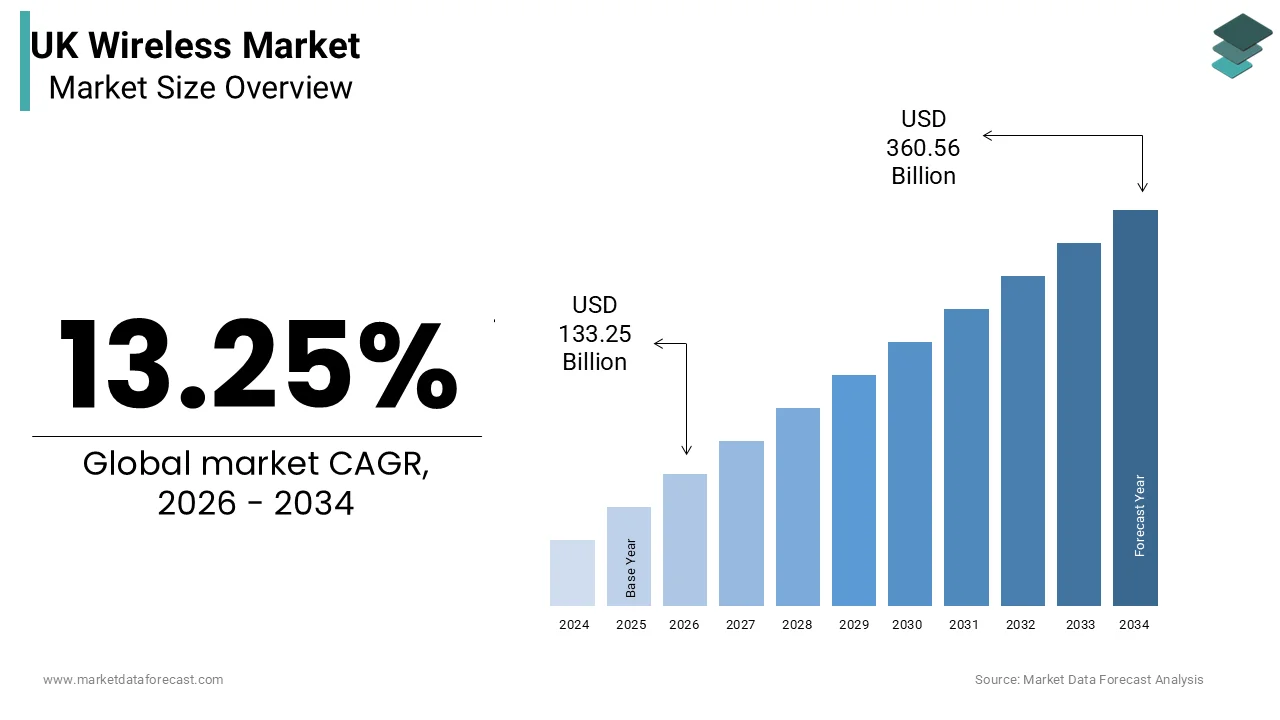
The wireless services facilitate mobile connectivity, including voice, data, and machine-to-machine communications across fourth and fifth-generation networks. According to the Department for Science, Innovation and Technology, over 70% of the UK population now resides within areas covered by at least one operator’s standalone fifth-generation network. The proliferation of smart devices has intensified demand for high-bandwidth and low latency connections essential for modern applications. Consumers increasingly rely on mobile data for streaming gaming and cloud services driving continuous network upgrades. Regulatory frameworks enforced by Ofcom ensure fair competition and promote infrastructure sharing to accelerate coverage. This dynamic environment requires operators to balance substantial capital expenditure with sustainable revenue growth while meeting escalating user expectations for seamless and secure wireless experiences in an increasingly connected society.
MARKET DRIVERS
Accelerated Deployment of Fifth-Generation Infrastructure Drives Connectivity Upgrades
The aggressive rollout of fifth-generation infrastructure, as operators race to deliver superior speed and capacity, is propelling the growth of the United Kingdom wireless market. Fifth-generation technology offers significantly lower latency and higher data rates, which are essential for emerging applications, such as augmented reality, autonomous vehicles, and industrial automation. The combined investments in fifth-generation infrastructure have exceeded several billion pounds in recent years, demonstrating a strong commitment to network modernization. The Department for Digital Culture, Media and Sport has supported this expansion through policy initiatives aimed at removing barriers to mast deployment and spectrum allocation. Businesses are leveraging these capabilities for real-time analytics and remote operations, driving enterprise demand for dedicated slices of network capacity. The availability of affordable fifth-generation handsets has also accelerated consumer uptake making the technology accessible to a broader demographic. As applications become more demanding, the reliance on robust wireless networks increases, ensuring sustained revenue growth for operators.
Surge In Mobile Data Consumption And Digital Content Usage
The exponential growth in mobile data consumption, coupled with changing digital habits, is also escalating the growth of the United Kingdom wireless market. Users are consuming more content than ever before, including high-definition video streaming, online gaming, and social media interactions, which require substantial bandwidth. The rise of unlimited data plans has further encouraged heavy usage among consumers, who no longer fear overage charges. Major operators have expanded their network capacity to handle this traffic surge, ensuring consistent performance during peak hours. The mobile data traffic is expected to double every few years, requiring continuous investment in backhaul and radio access networks. Entertainment providers are optimizing content for mobile viewing, driving further engagement. Additionally, the shift towards cloud-based productivity tools means professionals rely on wireless connections for critical work tasks outside traditional office environments. This behavioral shift ensures that wireless connectivity remains a non-discretionary utility for households and businesses alike.
MARKET RESTRAINTS
High Capital Expenditure Requirements Restrain Network Expansion Pace
The substantial capital expenditure required for wireless infrastructure development by limiting the pace of expansion for some operators is restraining the growth of the United Kingdom wireless market. Deploying fifth-generation networks involves extensive civil engineering works, including installing new masts, small cells, and fiber backhaul, which are costly and time-consuming. The major operators estimate that the cost of deploying advanced wireless technology to remote premises can be several times higher than in dense urban areas due to logistical challenges. These high upfront costs strain financial resources for smaller alternative network providers, who may struggle to secure funding. The inflationary pressures on materials and labor have further increased project costs, impacting profitability. Operators must balance investment in new technology with maintaining existing legacy systems, which adds to the financial burden. Additionally, the return on investment for rural deployments is often slower due to lower population density and reduced revenue potential. This economic reality forces companies to prioritize profitable urban areas, potentially leaving rural communities underserved despite government incentives. The need for continuous upgrades to keep pace with technological advancements means that capital expenditure remains a persistent challenge.
Regulatory Complexity And Spectrum Licensing Constraints Impact Operations
The complex regulatory and stringent spectrum licensing requirements impose operational constraints by affecting strategic decision-making, and agility is another factor hindering the growth of the United Kingdom wireless market. Operators must navigate a web of regulations concerning spectrum auctions, planning permissions, and environmental standards, which require dedicated legal and compliance teams. The new rules regarding network security and supply chain risks mandate rigorous assessments and reporting, increasing administrative overheads. The process of acquiring new spectrum bands through auctions involves significant financial outlay and uncertainty regarding future value realization. Non-compliance can result in hefty fines and reputational damage, discouraging risky innovations. The introduction of stricter guidelines on the use of high-risk vendors in infrastructure is forcing operators to rethink their supply chains. These changes often involve replacing existing equipment, which incurs additional costs and delays. Furthermore, the regulatory focus on promoting competition through infrastructure sharing can limit the ability of incumbents to fully capitalize on their exclusive investments. While regulation aims to protect consumers and ensure fair play, it can sometimes stifle innovation by creating uncertainty. Operators must constantly adapt to evolving policies that divert resources from core business activities.
MARKET OPPORTUNITIES
Expansion into the Internet Of Things And Industrial Automation Presents Opportunities
The growing adoption of Internet of Things devices and industrial automation to diversify revenue streams beyond traditional consumer connectivity is creating new opportunities for the growth of the United Kingdom wireless market. Wireless operators are well-positioned to provide the underlying connectivity and platform services required for smart cities, logistics, and manufacturing. Operators can leverage their existing infrastructure to offer specialized services such as asset tracking, environmental monitoring, and smart metering. The UK government’s industrial strategy encourages collaboration between telecom providers and manufacturing sectors to improve efficiency and productivity. Data from Tech Nation indicates that the UK is a global leader in fintech and proptech sectors, which rely heavily on secure and fast wireless connectivity. By partnering with wireless technology firms, companies can develop integrated solutions that add value for enterprise customers. This shift towards service-based models allows operators to capture higher margins and build long-term relationships with clients. Additionally, the rise of edge computing enables real-time data processing, which is useful for applications like autonomous driving and healthcare.
Development Of Private Wireless Networks for the Enterprise Sector Offers Growth Potential
The emergence of private wireless networks for the enterprise sector by addressing specific industrial needs is also expected to leverage the growth of the United Kingdom wireless market. Large organizations in manufacturing, ports, and energy sectors are seeking dedicated networks that offer enhanced security control and performance compared to public networks. The private networks enable companies to optimize operations through real-time monitoring and automation, leading to increased productivity. Wireless operators can capitalize on this trend by offering managed private network services tailored to individual business requirements using licensed or shared spectrum. The Department for Digital Culture, Media and Sport has allocated spectrum specifically for private use, encouraging experimentation and adoption. Industries, such as automotive and aerospace, are already piloting private fifth-generation solutions to improve safety and efficiency in production lines. Operators can differentiate themselves by providing end-to-end solutions, including device management and cybersecurity. This B2B focus allows wireless companies to tap into high-value contracts and reduce reliance on volatile consumer markets.
MARKET CHALLENGES
Intense Price Competition Erodes Profit Margins And Investment Capacity
The intense price competition among wireless operators is a quiet challenge to the United Kingdom wireless market. The multiple players offering similar services are leading to price wars and aggressive promotional deals. Consumers are highly price sensitive and quick to switch providers for better deals, reducing loyalty. The presence of mobile virtual network operators who lease infrastructure from major carriers further intensifies competition by offering lower prices. Data from Kantar Worldpanel shows that churn rates remain elevated as customers actively seek the best value propositions. This environment forces incumbents to continuously lower prices to retain subscribers, impacting their bottom line. While competition benefits consumers through lower costs, it can undermine the financial health of operators needed for long-term infrastructure investment. Smaller players may struggle to survive without differentiation, leading to market consolidation. The pressure to maintain affordability while delivering high-quality service creates a delicate balancing act. Operators must find ways to add value through bundled services or exclusive content to justify premiums, but success is not guaranteed.
Cybersecurity Threats And Network Vulnerabilities Pose Significant Risks
The growing cybersecurity threats are an additional factor to decline the growth of the United Kingdom wireless market. Wireless networks are infrastructure targets for cybercriminals seeking to disrupt services or steal sensitive data. The telecom providers face constant attacks, including distributed denial of service attempts and signaling exploits. A successful breach can result in widespread outages, financial losses, and severe reputational damage. The complexity of modern networks incorporating software-defined networking and virtualized functions expands the attack surface, making defense more challenging. Operators must invest heavily in advanced security technologies and skilled personnel to mitigate these risks. The Telecommunications Security Act mandates strict security standards requiring operators to identify and manage vulnerabilities effectively. Compliance with these regulations adds to operational costs and requires ongoing vigilance. The average cost of a data breach in the telecommunications sector is among the highest across industries. Consumer confidence relies on the perception of security, meaning any incident can lead to churn.
REPORT COVERAGE
| REPORT METRIC | DETAILS |
| Market Size Available | 2025 to 2034 |
| Base Year | 2025 |
| Forecast Period | 2026 to 2034 |
| CAGR | 13.25% |
| Segments Covered | By Application, and Region. |
| Various Analyses Covered | Global, Regional and Country-Level Analysis, Segment-Level Analysis, Drivers, Restraints, Opportunities, Challenges; PESTLE Analysis; Porter’s Five Forces Analysis, Competitive Landscape, Analyst Overview of Investment Opportunities |
| Market Leaders Profiled | Vodafone UK, EE, O2, Three UK, Virgin Media O2, BT Group, Sky Mobile, Tesco Mobile, giffgaff, Lebara UK, Lyca Mobile, Talkmobile, iD Mobile, SMARTY, VOXI |
SEGMENTAL ANALYSIS
By Application Insights
The consumer electronics segment accounted in holding 45.6% of the United Kingdom wireless market share in 2025, with the pervasive adoption of smartphones, tablets, wearables, and smart home devices that rely on continuous wireless connectivity. The underpinned by the essential role these devices play in daily communication, entertainment, and productivity for the vast majority of the population. This high level of adoption creates a massive base of connected devices that generate significant data traffic and require robust network infrastructure. The proliferation of Internet of Things enabled consumer gadgets, such as smart watches, fitness trackers, and voice assistants, further amplifies demand for reliable low latency connections. The rise of remote work and online education has also accelerated the purchase of laptops and tablets equipped with cellular capabilities, ensuring connectivity outside traditional Wi Fi zones. Manufacturers continuously innovate with features requiring higher bandwidth, such as augmented reality and cloud gaming, which drive upgrades to fifth-generation compatible hardware. Retailers support this dominance by offering bundled contracts that include devices and data plans, making advanced technology accessible to a broad demographic.
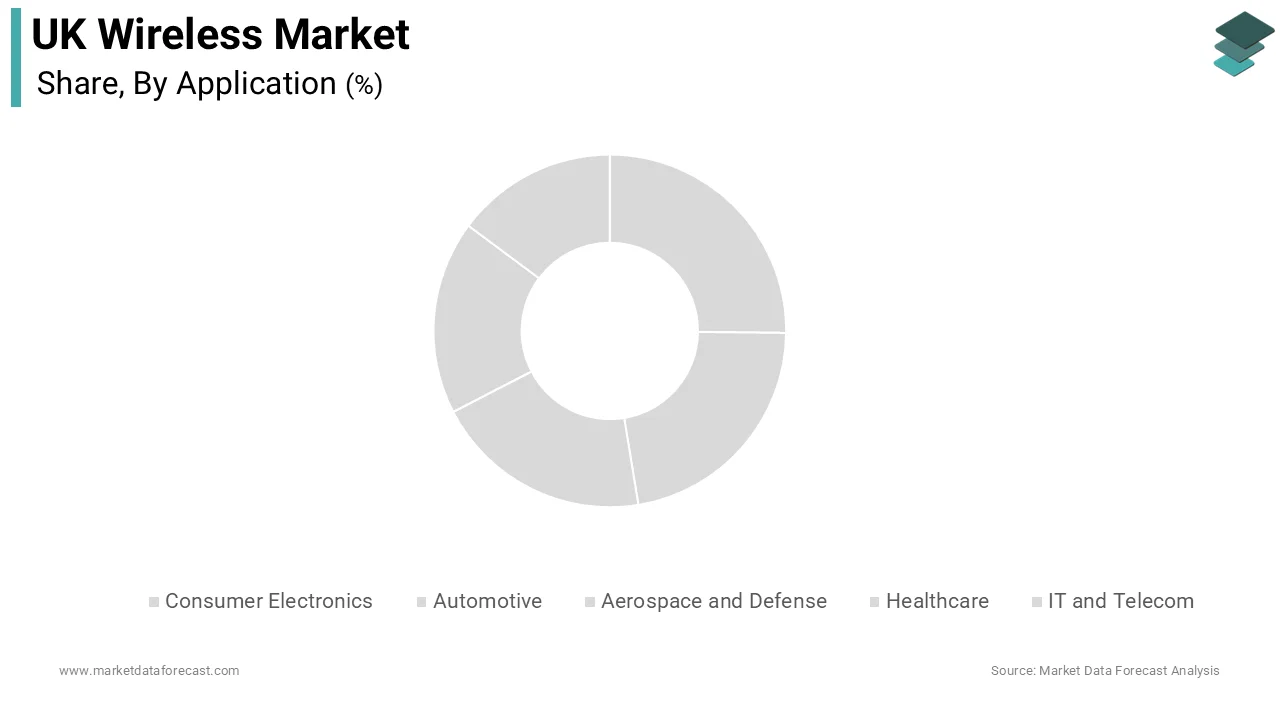
The healthcare segment is growing at an anticipated CAGR of 12.8% during the forecast period, with the rapid adoption of digital health solutions and remote patient monitoring technologies. The need to improve healthcare efficiency, reduce hospital visits, and manage chronic conditions through connected medical devices. The implementation of telemedicine and remote monitoring tools has accelerated significantly, with millions of virtual consultations conducted annually. Wireless connectivity enables real-time transmission of vital signs data from wearable sensors to healthcare providers by allowing for timely interventions and personalized care plans. The investment in digital health technologies in the UK has surged as organizations seek to leverage fifth-generation networks for high-reliability and low latency applications. The aging population in the United Kingdom creates sustained demand for assisted living technologies that rely on wireless networks for emergency alerts and health tracking. Additionally, the integration of artificial intelligence in diagnostic tools requires secure and fast data transfer, which wireless infrastructure provides. Regulatory support for digital innovation and funding for pilot projects further accelerate adoption.
KEY MARKET PLAYERS
A few major players in the UK wireless market include
- Vodafone UK
- EE
- O2
- Three UK
- Virgin Media O2
- BT Group
- Sky Mobile
- Tesco Mobile
- giffgaff
- Lebara UK
- Lyca Mobile
- Talkmobile
- iD Mobile
- SMARTY
- VOXI
Top Strategies Used By Key Market Participants
Key players in the United Kingdom wireless market employ several strategic approaches to maintain competitiveness and drive growth. Network infrastructure investment remains central as companies accelerate fifth-generation deployments and fiber backhaul upgrades to meet rising data demands. Service convergence is increasingly prioritized with operators bundling mobile, fixed-line, and media content to enhance customer retention and increase average revenue per user. Strategic partnerships with technology firms enable the development of innovative solutions for enterprise clients, including the Internet of Things and private networks. Digital transformation of customer experience through artificial intelligence and automated support channels improves efficiency and satisfaction. Sustainability initiatives, such as carbon reduction and device recycling, are integrated into core operations to align with regulatory expectations and consumer values.
Leading Players In The United Kingdom Wireless Market
- EE Limited operates as a leading mobile network operator in the United Kingdom, renowned for its extensive fifth-generation coverage and high-speed data services. The company has significantly strengthened its market position by accelerating the rollout of standalone fifth-generation infrastructure across major cities and rural areas. Recently, EE has introduced innovative tariff structures that prioritize network quality and include exclusive content partnerships to enhance customer value. Its investment in network densification ensures reliable connectivity for dense urban environments and large events. EE actively engages in sustainability initiatives, such as reducing energy consumption through artificial intelligence-driven network optimization.
- Vodafone UK serves as a major telecommunications provider with a strong focus on enterprise solutions and advanced wireless technologies. The company plays a pivotal role in developing private fifth-generation networks for industrial clients, enabling automation and real-time data processing in the manufacturing and logistics sectors. Recent actions include expanding its Internet of Things portfolio and enhancing cybersecurity offerings to protect connected devices. Vodafone UK collaborates with global technology partners to drive innovation in smart city applications and connected healthcare. The operator also prioritizes digital inclusion by providing affordable connectivity options and digital skills training to underserved communities. Its commitment to network resilience and security ensures trust among business customers, while its consumer-focused initiatives maintain brand loyalty in a competitive retail landscape.
- Virgin Media O2 stands as a significant converged operator in the United Kingdom, combining mobile and fixed-line services to offer seamless connectivity solutions. The merger has enabled the company to leverage synergies between its cable broadband infrastructure and mobile network to deliver enhanced performance and value. Recent strategies include upgrading its mobile network capacity to support increasing data demands and launching flexible contract options for consumers. Virgin Media O2 invests heavily in customer experience improvements through digital tools and personalized support services. The company also champions environmental sustainability by promoting device recycling and reducing carbon emissions across its operations.
MARKET SEGMENTATION
This research report on the UK wireless market is segmented and sub-segmented into the following categories.
By Application
- Consumer Electronics
- Automotive
- Aerospace and Defense
- Healthcare
- IT and Telecom