- Product Description Description
- Table of Contents TOC
- List of Table & Figure LOT
- Get Free Sample PDF Sample PDF
Market Size, 2025
$230 BnMarket Estimate, 2026
$240.12 BnMarket Forecast, 2034
$338.87 BnCAGR, 2026–2034
4.4%U.S. Auto Insurance Market Size, Growth, Trends & Forecast (2026–2034)
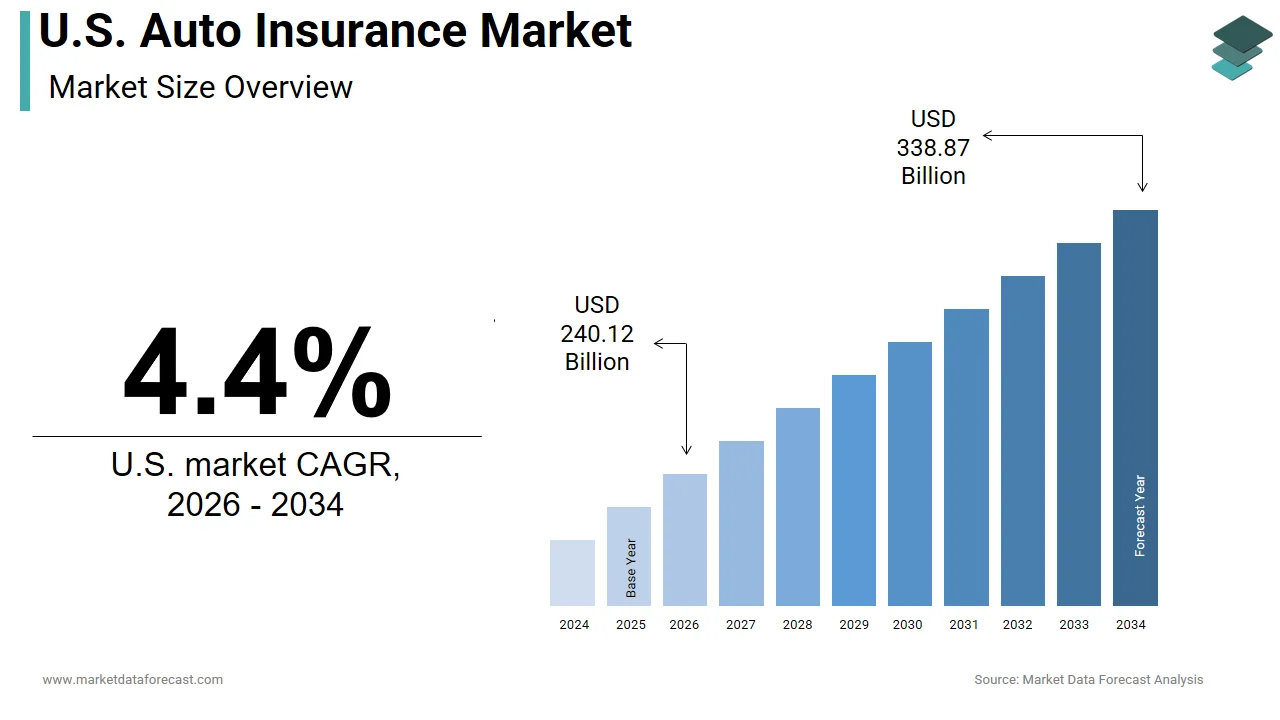
The U.S. auto insurance market was valued at USD 230.00 billion in 2025, is estimated to reach USD 240.12 billion in 2026, and is projected to expand up to USD 338.87 billion by 2034, growing at a compound annual growth rate (CAGR) of 4.40% from 2026 to 2034. Fueled by rising vehicle ownership, increasing accident rates, and digital innovation, the sector is heavily pivoting toward telematics and AI-driven underwriting.
Key Executive Metrics (At-a-Glance)
- 2025 Base Valuation: USD 230.00 Billion
- 2026 Current Valuation: USD 240.12 Billion
- 2034 Forecast Valuation: USD 338.87 Billion
- Compound Annual Growth Rate (CAGR): 4.40% (2026–2034)
- Dominant Coverage Segment: Third-Party Liability Coverage
- Dominant Vehicle Age Segment: Used Vehicle Segment
Core Market Drivers
- Rising Vehicle Ownership & Accidents: Increasing driver density and accident frequencies necessitating robust financial protection and mandatory compliance.
- Digital Platform Expansion: Proliferation of mobile apps and web platforms streamlining customer onboarding and policy management.
- Telematics & Connected Cars: Growing adoption of usage-based insurance (UBI) models that track real-time driving habits for precise risk assessment.
Primary Market Trends & Innovations
- AI & Data Analytics Integration: Automation of claims processing, loss estimation, and fraud detection using advanced machine learning.
- Personalized Services: Shifting consumer expectations prompting customized, customer-centric coverage bundles.
U.S. Auto Insurance Market Segmentation Breakdown
| Segment Category | Leading Sub-Segment (2025 Base) | Growth Catalysts |
|---|---|---|
| By Coverage | Third-Party Liability Coverage | Mandatory state regulations and broad consumer adoption requirements. |
| By Vehicle Age | Used Vehicle Segment | Supported by the large nationwide volume of pre-owned automobiles. |
Major Industry Players Profiled
Top insurance providers shaping the U.S. landscape include State Farm, GEICO, Progressive, Allstate, Liberty Mutual, Farmers Insurance, Nationwide, American Family Insurance, AXA, and Zurich Insurance Group.
 Download Free Sample Report
U.S. Auto Insurance Market Size
The U.S. auto insurance market was valued at USD 230 billion in 2025, is estimated to reach USD 240.12 billion in 2026, and is projected to reach USD 338.87 billion by 2034, growing at a CAGR of 4.4% from 2026 to 2034.
The United States is anticipated to witness a steady expansion in its auto insurance sector over the next few years as rising vehicle values and evolving state mandates drive consistent policy demand. The U.S. auto insurance market constitutes a critical financial safety net mandated by law in nearly every state to protect drivers against liability for bodily injury and property damage. This sector operates within a complex regulatory framework where individual states dictate minimum coverage requirements, leading to significant variation in policy structures and premiums across regions. The fundamental purpose of this market is to mitigate the substantial economic risks associated with vehicular accidents, which remain a leading cause of unintentional injury and death. According to the National Highway Traffic Safety Administration, 40,990 people died in motor vehicle traffic crashes in 2023. Furthermore, the Federal Highway Administration states that there are over 286 million registered vehicles in the U.S., creating a vast base of potential policyholders. The high frequency of traffic incidents necessitates robust insurance coverage to cover medical expenses, vehicle repairs, and legal liabilities. As per Bankrate, the average annual premium for full coverage auto insurance reached 2,543 dollars in 2024. The market is characterized by intense competition among traditional carriers and emerging digital insurers who leverage technology to streamline underwriting and claims processing. Consumer behavior is increasingly influenced by price sensitivity and the demand for personalized policies driven by telematics and usage-based models. This dynamic environment requires insurers to balance risk assessment accuracy with customer retention strategies while navigating inflationary pressures on repair costs and healthcare expenses.
MARKET DRIVERS
Rising Vehicle Repair Costs Due To Advanced Technology Integration Drive Premium Adjustments
The increasing complexity of modern vehicles equipped with advanced driver assistance systems and electronic components significantly drives up repair costs, which is one of the major factors propelling the U.S. auto insurance market growth. Modern cars contain sophisticated sensors, cameras, and radar systems that require specialized calibration and replacement after even minor collisions. According to the Insurance Institute for Highway Safety, repair costs for vehicles equipped with front crash prevention systems can be as much as 3,000 dollars higher for certain components compared to vehicles without them. This escalation in repair expenses directly impacts claim payouts, forcing insurers to adjust premiums to maintain profitability. According to CCC Intelligent Solutions, the average total cost of repair for collision claims increased by 3.3% in 2024, following double-digit increases in previous years. Furthermore, the shortage of skilled technicians capable of repairing these advanced systems leads to longer wait times and higher labor charges. As per TechForce Foundation, the automotive industry will need to recruit approximately 795,000 new automotive technicians through 2027 to meet demand. Insurers must account for these elevated expenses when pricing policies, leading to higher premiums for consumers. The integration of lightweight materials such as aluminum and carbon fiber also complicates repairs, as they often require complete panel replacement rather than simple dent removal. This shift in repair dynamics necessitates continuous updates to actuarial models to accurately reflect risk. Consequently, the technological advancement of vehicles serves as a primary driver for market growth as insurers adapt to the changing landscape of automotive maintenance and repair economics.
Stringent State Regulations and Mandatory Coverage Laws Sustain Consistent Demand
Strict regulatory frameworks and mandatory insurance laws across most U.S. states ensure a stable and consistent demand for auto insurance products, which is further contributing to the expansion of the U.S. auto insurance market. Every state except New Hampshire mandates some form of financial responsibility for drivers, creating a captive market where compliance is legally required. According to the Insurance Research Council, 14% of drivers in the United States were uninsured in 2022. These laws compel vehicle owners to purchase at least minimum liability coverage, thereby guaranteeing a baseline level of market participation. The penalties for driving without insurance, including fines, license suspension, and vehicle impoundment, act as strong deterrents against non-compliance. According to the Governors Highway Safety Association, 30 states required ignition interlock devices for all offenders in 2023, demonstrating a trend toward stricter driving regulations. Additionally, many states require additional coverages such as personal injury protection or uninsured motorist coverage, further expanding the scope of policies. As per the National Association of Insurance Commissioners, total written premiums for the property and casualty industry grew to over 860 billion dollars in 2023. For instance, several states have recently doubled their minimum bodily injury liability limits, requiring drivers to purchase more comprehensive policies. This regulatory evolution ensures that the market remains robust and resilient to economic fluctuations as legal obligations take precedence over discretionary spending. The consistent enforcement of these laws provides insurers with a predictable volume of policies, facilitating long-term planning and stability.
MARKET RESTRAINTS
High Incidence of Insurance Fraud Increases Operational Costs And Premiums
The prevalence of insurance fraud is primarily hampering the auto insurance market expansion in the U.S. Fraudulent activities range from staged accidents and exaggerated injury claims to falsified repair invoices, placing a substantial financial burden on insurers. According to the Coalition Against Insurance Fraud, insurance fraud costs U.S. consumers and businesses approximately 308.6 billion dollars annually across all lines. This widespread issue forces insurers to invest heavily in fraud detection technologies and investigative resources, diverting funds from other areas of innovation. According to the National Insurance Crime Bureau, there was a 28% increase in vehicle thefts in 2023 compared to 2019 levels. The complexity of investigating these claims often leads to delays in legitimate payouts, causing customer dissatisfaction and eroding trust. As per the Federal Bureau of Investigation, insurance fraud, excluding health insurance, is estimated to cost more than 40 billion dollars per year. The rise of organized crime rings specializing in staged collisions further exacerbates the problem, making it difficult for insurers to distinguish between legitimate and fraudulent claims. These challenges necessitate rigorous verification processes that can slow down claims processing and increase administrative overhead. Consequently, the persistent threat of fraud acts as a brake on market efficiency, compelling insurers to raise prices to offset losses and maintain solvency.
Labor Shortages in The Automotive Repair Industry Delay Claims Settlement And Increase Costs
A critical shortage of skilled labor in the automotive repair sector is further impeding the expansion of the U.S. auto insurance market. The inability to find qualified technicians means that vehicles remain in repair shops for extended periods, leading to higher rental car expenses for insurers. According to S&P Global Mobility, the average age of light vehicles in the U.S. rose to 12.6 years in 2024. However, the pipeline of new technicians is insufficient to meet this demand, with vocational schools reporting a decline in enrollment. According to the Bureau of Labor Statistics, there are approximately 67,700 annual openings for automotive service technicians and mechanics projected through 2032. This labor gap results in bottlenecks at repair facilities, causing insurers to incur higher supplementary costs such as storage fees and extended rental reimbursements. As per CCC Intelligent Solutions, the average repair cycle time for a vehicle remained elevated at over 20 days in late 2023. Furthermore, the scarcity of labor drives up wage rates for existing technicians, which is passed on to insurers through higher labor charges. These increased costs are ultimately reflected in higher premiums for consumers, reducing affordability and potentially leading to lapses in coverage. The structural nature of this labor shortage makes it a persistent challenge that insurers cannot easily mitigate through short-term strategies.
MARKET OPPORTUNITIES
Expansion of Telematics and Usage-Based Insurance Models Offers Personalized Pricing Opportunities
The adoption of telematics and usage-based insurance models is a significant opportunity for the U.S. auto insurance market by enabling personalized pricing and improved risk assessment. These technologies allow insurers to monitor driving behavior such as speed, braking, and mileage, providing data-driven insights into individual risk profiles. According to J.D. Power, 15% of all auto insurance customers were using telematics in 2023, which was a significant increase from previous years. This shift enables insurers to offer fairer premiums to safe drivers who were previously subsidizing higher-risk individuals under traditional rating models. According to Cambridge Mobile Telematics, drivers using telematics programs saw a 10% reduction in distracted driving over one year. Furthermore, the integration of mobile apps and connected devices enhances customer engagement by providing value-added services such as crash detection and roadside assistance. As per the Insurance Information Institute, telematics can help insurers reduce claim costs and improve the accuracy of risk selection. The ability to dynamically adjust premiums based on actual usage rather than static demographic factors allows for greater market segmentation and competitiveness. Additionally, the data collected through telematics can be used to develop new products, such as pay-per-mile insurance, which appeals to low-mileage drivers. This technological evolution opens new revenue streams and strengthens customer relationships through interactive and responsive service offerings.
Integration of Artificial Intelligence in Claims Processing Enhances Efficiency and Customer Satisfaction
The integration of artificial intelligence into claims processing offers a promising opportunity for the U.S. auto insurance market by streamlining operations and enhancing customer experience. AI algorithms can analyze photos of vehicle damage, estimate repair costs, and detect fraud with greater speed and accuracy than manual methods. According to Deloitte, AI and advanced analytics can help insurers achieve a 20% to 30% increase in claims processing efficiency. This efficiency allows for faster payouts, which is a key driver of customer loyalty in a competitive market. According to a survey by Accenture, 80% of insurance executives believe that AI will revolutionize the way they gain information from and interact with customers. AI-powered chatbots and virtual assistants also provide 24/7 support, answering queries and guiding users through the claims process without human intervention. As per PwC, automation can potentially reduce the cost of a claims journey by as much as 30%. Furthermore, machine learning models can predict claim outcomes and identify potential issues before they escalate, reducing the overall cost of claims management. The use of computer vision technology enables precise damage assessment from smartphone images, minimizing the need for physical inspections. This technological advancement not only lowers operational costs but also reduces friction in the customer journey. By leveraging AI, insurers can differentiate themselves through superior service quality and operational agility, positioning themselves for long-term growth in a digital-first economy.
MARKET CHALLENGES
Cybersecurity Threats Pose Significant Risks To Data Integrity And Customer Trust
The increasing frequency and sophistication of cybersecurity threats are a major challenge to the U.S. auto insurance market by jeopardizing sensitive customer data and operational continuity. Insurers collect vast amounts of personal and financial information, making them attractive targets for cybercriminals seeking to exploit vulnerabilities. According to the Identity Theft Resource Center, the number of data breaches in the U.S. reached a record high of 3,205 in 2023. A successful cyberattack can lead to substantial financial losses, regulatory fines, and reputational damage that erode customer trust. According to IBM, the average cost of a data breach in the United States was 9.48 million dollars in 2023. The introduction of connected vehicles and telematics devices further expands the attack surface, creating new entry points for malicious actors. As per the National Highway Traffic Safety Administration, cybersecurity is a top priority for vehicle safety as cars become increasingly connected. Insurers must invest heavily in robust cybersecurity infrastructure and employee training to mitigate these threats. However, the evolving nature of cyber-attacks requires constant vigilance and adaptation, which strains resources. Furthermore, regulatory requirements such as state-specific data privacy laws add complexity to compliance efforts. The fear of data breaches may also discourage consumers from adopting digital tools and telematics programs, slowing down innovation. Consequently, cybersecurity remains a critical challenge that insurers must address to protect their assets and maintain consumer confidence.
Climate Change and Extreme Weather Events Increase Frequency and Severity Of Claims
The impact of climate change and the resulting increase in extreme weather events is further challenging the auto insurance market expansion in the U.S. Hurricanes, floods, hailstorms, and wildfires cause widespread damage to vehicles, leading to a surge in comprehensive claims that strain insurer reserves. According to the National Oceanic and Atmospheric Administration, there were 28 weather and climate disaster events in the U.S. in 2023 with losses exceeding 1 billion dollars each. These events result in massive spikes in claim volumes that can overwhelm claims handling capabilities and disrupt operations. According to the Insurance Information Institute, natural disasters caused an estimated 108 billion dollars in insured losses globally in 2023. The concentration of vehicles in high-risk areas, such as coastal regions and flood zones, exacerbates the financial impact on insurers. As per CoreLogic, over 1.2 million properties were at risk of storm surge from hurricanes in 2023. The unpredictability of weather patterns makes it difficult for actuaries to accurately model risk and set appropriate premiums. Furthermore, the increasing cost of vehicle replacements due to supply chain disruptions adds to the financial burden. Insurers face the dilemma of raising premiums to cover losses, which may make coverage unaffordable for some consumers or withdrawing from high-risk markets altogether. This environmental instability creates a challenging operating environment that requires innovative risk management strategies and potential regulatory interventions.
REPORT COVERAGE
| REPORT METRIC | DETAILS |
| Market Size Available | 2025 to 2034 |
| Base Year | 2025 |
| Forecast Period | 2026 to 2034 |
| Segments Covered | By Coverage, Vehicle Age, and Country. |
| Various Analyses Covered | Global, Regional, and Country-Level Analysis, Segment-Level Analysis, Drivers, Restraints, Opportunities, Challenges; PESTLE Analysis; Porter’s Five Forces Analysis, Competitive Landscape, Analyst Overview of Investment Opportunities |
| Countries Covered | New York, Massachusetts, Pennsylvania, Illinois, Ohio, Michigan, Texas, Florida, Georgia, California, Washington, Colorado. |
| Market Leaders Profiled | State Farm, Geico, Progressive, Allstate, Liberty Mutual, Farmers Insurance, Nationwide, American Family Insurance, AXA, Zurich Insurance Group, and Others. |
SEGMENTAL ANALYSIS
By Coverage Insights
The third-party liability coverage segment accounted for the highest share of the U.S. auto insurance market growth in 2025 due to strict legal mandates that require drivers to carry minimum levels of bodily injury and property damage liability. This segment forms the foundational layer of almost every auto insurance policy sold in the country. The regulatory framework established by individual states that compels vehicle owners to prove financial responsibility before registering a car or obtaining a license is further contributing to the leading position of the third-party liability coverage segment in the U.S. market. According to the Insurance Information Institute, 49 states and the District of Columbia require drivers to have auto liability insurance. This legal requirement ensures a consistent and inelastic demand for liability coverage regardless of economic conditions or consumer preferences for additional protections. Furthermore, the high cost of litigation and medical care in the U.S. necessitates robust liability limits to protect assets from lawsuits arising from at-fault accidents. According to the Centers for Disease Control and Prevention, the total cost of motor vehicle crash deaths in the U.S. was 55 billion dollars in 2022. The average cost of a bodily injury claim has risen significantly, with figures from the Insurance Research Council showing that the average payment for a bodily injury claim increased 40% between 2010 and 2022. Consequently, consumers are driven to purchase adequate liability coverage to shield themselves from financial ruin. The ubiquity of this coverage type makes it the largest segment by volume, as it is the baseline product required for the legal operation of a vehicle on public roads.
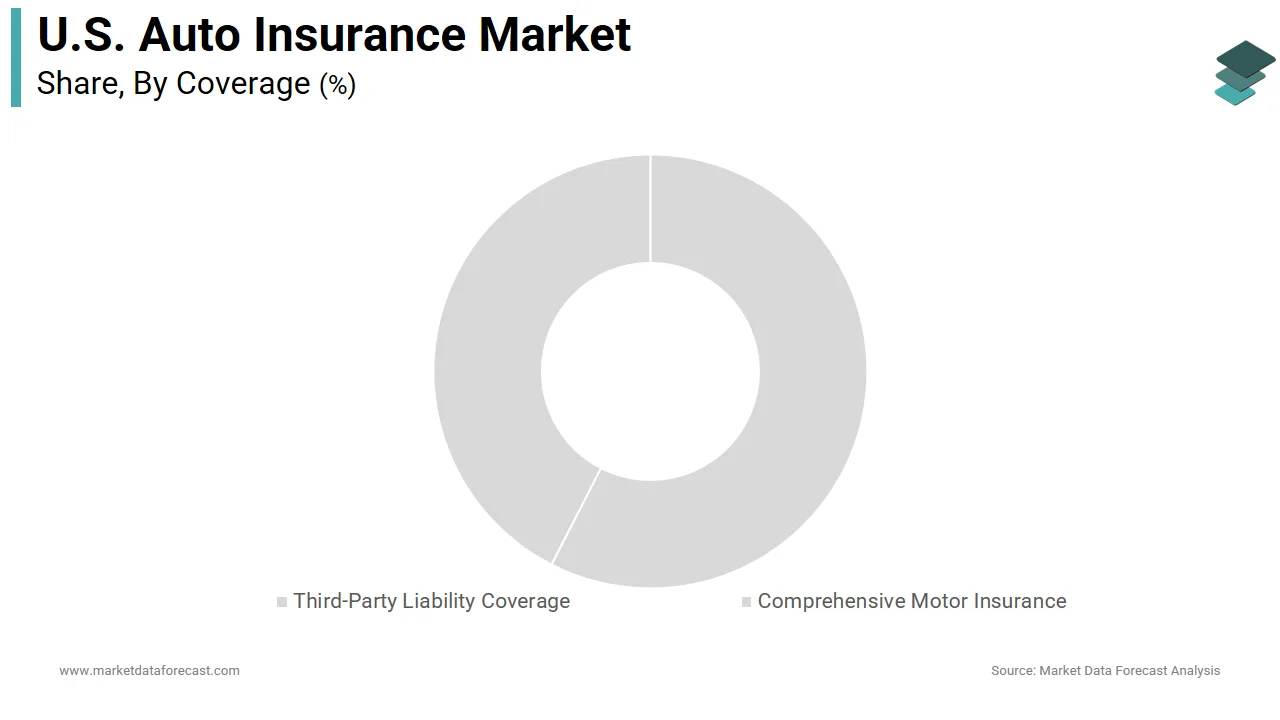
On the other hand, the comprehensive motor insurance segment is emerging as the fastest-growing segment within the U.S. auto insurance market and is projected to expand at a CAGR of 7.4% during the forecast period, owing to the increasing value of vehicles and the rising frequency of non-collision incidents such as theft, vandalism, and weather-related damage. The escalation in vehicle prices, which makes comprehensive coverage more essential for protecting financial investments, is also aiding the growth of this segment in the U.S. market. According to Kelley Blue Book, the average transaction price for a new vehicle in December 2023 was 48,759 dollars. As vehicles become more expensive, consumers are more likely to opt for comprehensive coverage even for older models to mitigate the risk of total loss. Additionally, the increasing prevalence of extreme weather events such as hailstorms, floods, and wildfires has heightened awareness of the need for broader protection. According to the National Oceanic and Atmospheric Administration, 2023 was the warmest year on record, contributing to a record number of billion-dollar weather disasters. Furthermore, the rise in vehicle thefts, particularly of high-value trucks and SUVs, has prompted insurers and consumers to prioritize comprehensive policies. According to the National Insurance Crime Bureau, more than 1 million vehicles were reported stolen in 2023. These factors collectively contribute to the rapid adoption of comprehensive motor insurance as consumers seek to safeguard their valuable assets against a widening array of risks.
By Vehicle Age Insights
The used vehicle segment commanded the largest share of the U.S. auto insurance market growth in 2025 due to the sheer volume of pre-owned cars on American roads, the longer duration these vehicles remain in circulation, and the aging fleet of vehicles in the U.S., which results in a larger pool of insured used cars compared to new ones. According to S&P Global Mobility, the average age of light vehicles in the U.S. hit a record high of 12.6 years in 2024. This trend is further reinforced by economic pressures that make new vehicles less affordable for many households. According to Cox Automotive, used vehicle sales in the U.S. reached 35.9 million units in 2023. Furthermore, lenders often require comprehensive and collision coverage for financed used vehicles, ensuring that these policies remain active throughout the loan term. According to the Federal Reserve Bank of New York, total auto loan debt reached 1.61 trillion dollars in late 2023. As a result, the cumulative number of insurance policies for used vehicles far exceeds those for new cars. Additionally, the diverse range of used vehicles from economy models to luxury pre-owned cars creates a broad spectrum of insurance needs that sustain high premium volumes. This structural characteristic of the automotive market ensures that used vehicle insurance remains the largest segment by policy count and revenue contribution.
However, the new vehicle insurance segment is experiencing the fastest growth rate in the U.S. auto insurance market and is predicted to expand at a CAGR of 8.2% during the forecast period, owing to the integration of advanced technology and safety features in new cars, which raises repair costs and necessitates higher coverage limits. According to the Insurance Institute for Highway Safety, the cost of replacing a windshield with a camera behind it can exceed 1,000 dollars on many new models. This escalation in repair expenses leads to higher premiums for new vehicle policies, contributing to revenue growth in this segment. Furthermore, the rising average transaction price of new vehicles means that insurers are collecting higher premiums to cover the increased replacement costs. According to Edmunds, the average monthly payment for a new vehicle reached 738 dollars in late 2023. Additionally, leasing trends play a significant role as leased vehicles typically require full coverage, including comprehensive and collision insurance, which drives up the average premium per policy. According to the Consumer Leasing Association, vehicle leasing remains a popular option, accounting for about 20% of new vehicle transactions. Moreover, the introduction of electric vehicles, which are predominantly new, adds to this growth as their unique repair requirements and higher battery costs result in elevated insurance rates. These factors combine to make new vehicle insurance the fastest-expanding segment in terms of premium value.
COUNTRY LEVEL ANALYSIS
U.S. Auto Insurance Market Analysis
The United States is projected to maintain its position as the global leader in insurance technology and policy adoption over the next few years as digital transformation reshapes consumer expectations. This dominant position is primarily driven by a highly motorized society with extensive road infrastructure and a legal system that mandates insurance coverage for nearly all drivers. The market status in the region is characterized by intense competition among numerous carriers ranging from large national insurers to specialized regional providers and digital natives. A primary driving factor for this robust market is the high per capita vehicle ownership rate, which creates a vast and stable customer base. According to the Federal Highway Administration, there were 239.2 million licensed drivers in the U.S. in 2022. Furthermore, the litigious nature of American society drives up the cost of liability claims, necessitating higher coverage limits and resulting in increased premium revenues. According to the Insurance Research Council, the average expenditure for auto insurance in the U.S. was 1,176 dollars in 2021. The fragmented regulatory environment, where each state sets its own insurance laws, also contributes to market complexity and diversity in product offerings. As per the National Association of Insurance Commissioners, there were over 2,500 property and casualty insurance companies operating in the U.S. in 2023. Additionally, the rapid adoption of telematics and digital platforms in the U.S. accelerates market evolution, allowing insurers to refine risk assessment and improve customer engagement. These structural and behavioral dynamics solidify the U.S. as the central hub for auto insurance innovation and revenue generation worldwide.
COMPETITIVE LANDSCAPE
The competition in the U.S. auto insurance market is intense and characterized by a mix of established national carriers, regional insurers, and emerging digital entrants. Major players compete on price, service quality, and technological innovation to attract and retain customers in a mature market. Price competitiveness remains a primary factor as consumers increasingly use online comparison tools to find the best deals. Insurers differentiate themselves by offering personalized policies through telematics and usage-based programs that reward safe driving behaviors. Digital transformation is a key battleground with companies investing heavily in mobile applications and artificial intelligence to streamline claims processing and improve user experience. Customer service excellence also plays a crucial role as insurers strive to reduce churn by providing responsive and transparent support. Regulatory variations across states add complexity, requiring companies to adapt their products and operations to local requirements. Mergers and acquisitions are common as larger firms seek to expand their capabilities and market reach. The entry of insurtech startups disrupts traditional models by offering niche products and agile services. Ultimately, success depends on balancing risk management with customer-centric innovation to sustain growth in a dynamic and highly regulated industry landscape.
KEY MARKET PLAYERS
Some of the companies that are playing a dominating role in the U.S. auto insurance market include
- State Farm
- GEICO
- Progressive
- Allstate
- Liberty Mutual
- Farmers Insurance
- Nationwide
- American Family Insurance
- AXA
- Zurich Insurance Group
TOP PLAYERS IN THE MARKET
- State Farm Mutual Automobile Insurance Company maintains a leading position in the U.S. auto insurance market through its extensive network of local agents and strong brand recognition. The company provides comprehensive coverage options, including liability, collision, and comprehensive policies, to millions of drivers nationwide. Recent actions to strengthen its market position include significant investments in digital transformation initiatives that enhance customer experience and streamline claims processing. State Farm has integrated artificial intelligence tools to improve underwriting accuracy and detect fraud more effectively. The company also focuses on community engagement programs to build trust and loyalty among policyholders. By leveraging its vast agent network alongside modern technology, State Farm ensures personalized service while maintaining operational efficiency. These efforts help the company retain existing customers and attract new ones in a highly competitive landscape.
- GEICO operates as a major direct writer in the U.S. auto insurance market, known for its cost-effective policies and efficient digital platforms. The company serves millions of customers by offering competitive rates primarily through online channels and telephone sales. Recent actions to strengthen its market position include expanding its usage-based insurance program, which allows drivers to save money based on their driving habits. GEICO has also enhanced its mobile application with features such as instant claims filing and virtual assistance to improve user convenience. The company continues to invest in data analytics to refine risk assessment models and optimize pricing strategies. By focusing on technological innovation and customer-centric services, GEICO aims to reduce acquisition costs and increase retention rates. These strategic moves enable the company to maintain its reputation for affordability and accessibility in the digital age.
- Progressive Corporation is a key innovator in the U.S. auto insurance market, recognized for pioneering usage-based insurance through its Snapshot program. The company offers a wide range of coverage options and specializes in insuring high-risk drivers who may struggle to find coverage elsewhere. Recent actions to strengthen its market position include expanding its commercial auto insurance offerings and enhancing its digital quoting tools for faster policy issuance. Progressive has also invested heavily in telematics technology to gather real-time driving data, which helps in creating more accurate and personalized premiums. The company actively promotes its comparison tool that shows competitor rates alongside its own to demonstrate value transparency. By leveraging data-driven insights and flexible product offerings, Progressive continues to capture diverse customer segments and drive growth in the evolving insurance landscape.
TOP STRATEGIES USED BY KEY MARKET PARTICIPANTS
Key players in the U.S. auto insurance market primarily employ digital transformation and usage-based insurance models to gain competitive advantages. Companies invest heavily in artificial intelligence and machine learning to streamline underwriting processes and enhance claims handling efficiency. This technological adoption reduces operational costs and improves customer satisfaction through faster service delivery. Insurers also focus on personalized pricing strategies by leveraging telematics data to monitor driving behavior and offer discounts to safe drivers. This approach attracts risk-averse customers and encourages safer driving habits. Additionally, firms expand their distribution channels by integrating online platforms with traditional agent networks to reach broader audiences. Strategic partnerships with automotive manufacturers and repair shops help create seamless ecosystems for customers. These multifaceted strategies enable market participants to adapt to changing consumer preferences and regulatory requirements while maintaining profitability in a saturated market environment.
MARKET SEGMENTATION
This research report on the U.S. auto insurance market has been segmented and sub-segmented into the following categories.
By Coverage
- Third-Party Liability Coverage
- Comprehensive Motor Insurance
- Others
By Vehicle Age
- New Vehicle
- Used Vehicle
By Country
- New York
- Texas
- Florida
- Georgia
- California
- Rest of U.S.