- Product Description Description
- Table of Contents TOC
- List of Table & Figure LOT
- Get Free Sample PDF Sample PDF
Market Size, 2025
$0.69 BnMarket Estimate, 2026
$0.75 BnMarket Forecast, 2034
$1.53 BnCAGR, 2026–2034
9.3%UK Board Games Market Size, Growth, Trends & Forecast (2026–2034)
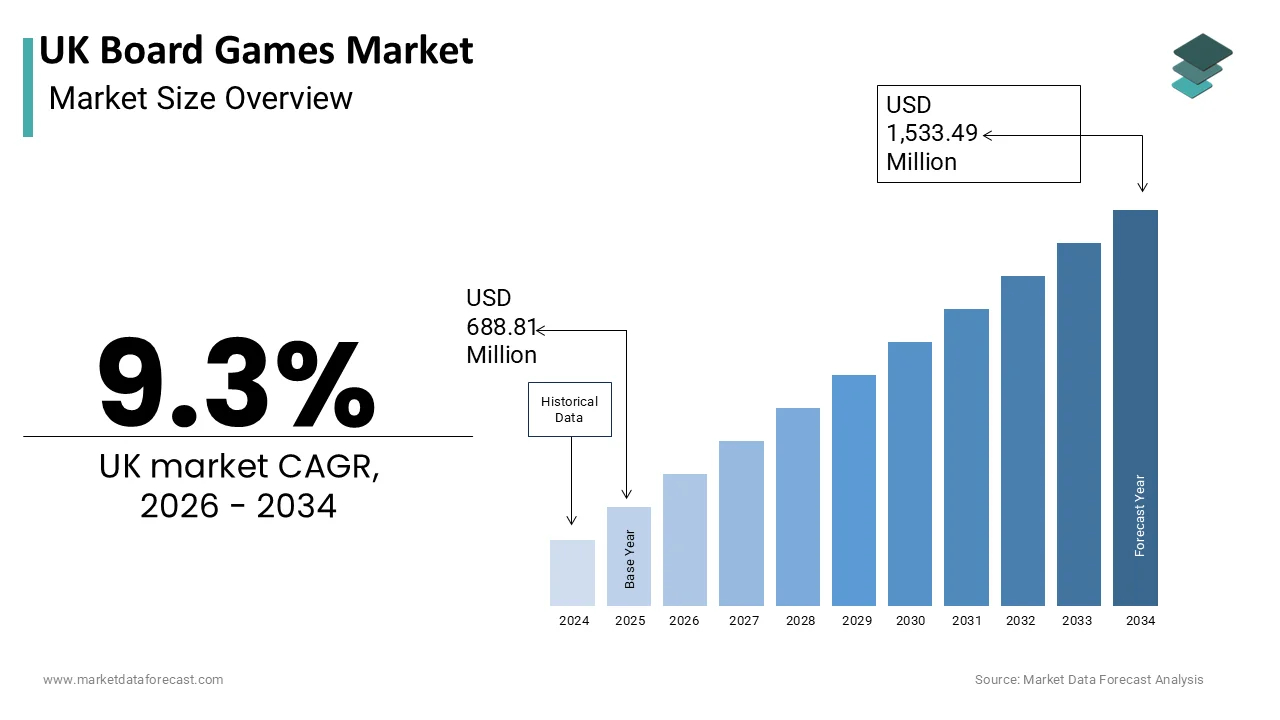
The U.K. Board Games Market is projected to grow from USD 688.81 million in 2025, is anticipated to reach USD 752.87 million in 2026, and is projected to scale up to USD 1,533.49 million by 2034, registering a compound annual growth rate (CAGR) of 9.3% during the forecast period from 2026 to 2034. Driven by the resurgence of analog and social leisure, digital crowdfunding media, and educational integration, the board games industry continues to expand steadily across the United Kingdom.
Key Executive Metrics (At-a-Glance)
- 2025 Base Valuation: USD 688.81 Million
- 2026 Current Valuation: USD 752.87 Million
- 2034 Forecast Valuation: USD 1,533.49 Million
- Compound Annual Growth Rate (CAGR): 9.3% (2026–2034)
- Dominant Product Segment: Tabletop Games (holding major market share due to diverse gameplay and deep social engagement)
- Dominant Distribution Channel: Offline Channels (leading market share due to tactile retail experiences and community hubs)
- Fastest-Growing Age Group Segment: Children (propelled by recognized educational value and parental investment in developmental toys)
- Dominant Region / Market: United Kingdom
Core Market Drivers
- Analog Leisure Resurgence: Growing consumer preference for mindful, face-to-face social interactions as an alternative to digital screen fatigue.
- Crowdfunding & Digital Media: Platforms like Kickstarter and community influencers democratizing access to innovative, independent titles.
- Educational Adoption: Increasing integration of tabletop games in schools and family settings to develop cognitive and social skills.
Primary Market Restraints & Challenges
- Production & Supply Volatility: High manufacturing costs, global supply chain delays, and complex multi-component sourcing driving up retail prices.
- Rule Complexity: Steep learning curves and intricate rulebooks creating barriers to entry for casual players and newcomers.
UK Board Games Market Segmentation Breakdown
| Segment Category | Leading Sub-Segment (2025 Base) | Fastest-Growing Sub-Segment (2026–2034) |
|---|---|---|
| By Product | Tabletop Games (dominant market share due to rich thematic immersion and replay value) | Role-Playing Games (fastest-growing category driven by narrative freedom and streaming culture) |
| By Distribution Channel | Offline Channels (dominant share supported by local hobby shops, touch-and-feel retail, and community events) | Online Channels (fastest-growing category fueled by e-commerce convenience and product variety) |
| By Age Group | Adults (dominant share owing to higher disposable income and preference for complex strategy) | Children (fastest-growing category driven by screen-free educational toys and early-years learning) |
Major Industry Players Profiled
Key enterprises shaping the competitive U.K. board games market include Hasbro, Inc., Mattel, Inc., Ravensburger AG, Asmodee Group, Spin Master Corp., University Games Corporation, The Walt Disney Company, Goliath Games, Cartamundi Group, Winning Moves UK Ltd., Gibsons Games Ltd., and Big Potato Games Ltd..
 Download Free Sample Report
UK Board Games Market Size
The U.K. Board Games Market is projected to grow from USD 688.81 million in 2025 to USD 752.87 million in 2026 and reach USD 1,533.49 million by 2034, registering a CAGR of 9.3% during the forecast period from 2026 to 2034.
The board games are a vibrant and evolving sector within the broader leisure and entertainment industry, characterized by a resurgence in tabletop gaming as a primary form of social interaction. The cultural shift toward mindful leisure and analog experiences has reinvigorated interest in physical game components, such as cards, dice, and modular boards. As per data from the Office for National Statistics, households in the United Kingdom spend an average of 2.5 hours per day on leisure activities,s with a growing portion dedicated to interactive hobbies. The rise of board game cafes and dedicated retail spaces further underscores this trend, nd providing communal hubs for enthusiasts to discover and play new titles. The number of new board game titles released annually has increased significantly, truly reflecting a diverse and creative design. Consumer behavior indicates a preference for high-quality components and immersive themes, which drive purchasing decisions beyond simple gameplay mechanics. The market is supported by a robust community of reviewers, influencers, and conventions that foster discovery and loyalty. Furthermore, the educational value of board games in developing critical thinking and social skills has led to increased adoption in schools and family settings.
MARKET DRIVERS
Resurgence of Social Interaction and Analog Leisure
The resurgence of social interaction and the desire for analog leisure experiences is offering a tangible alternative to digital isolation, which is anticipated to promote new opportunities for the growth of the United Kingdom board games market. In an era dominated by screen time, consumers are increasingly seeking meaningful face-to-face connections that board games uniquely facilitate. As per surveys conducted by the Campaign for Real Ale and other social groups, there is a marked increase in attendance at social clubs and events centered around tabletop gaming. Board games provide a structured environment for conversation, cooperation, and friendly competition, which strengthens interpersonal bonds among friends and families. The psychological benefit of disconnecting from digital devices while engaging in tactile play appeals to individuals seeking mental respite and mindfulness. This social utility drives demand for multiplayer games that accommodate various group sizes and skill levels. Retailers report that customers often purchase games specifically for social gatherings, holidays, and team-building events. The growth of board game nights in pubs and community centers further validates this driver by creating accessible entry points for new players.
Influence of Digital Media and Crowdfunding Platforms
The influence of digital media and crowdfunding platforms is democratizing access to niche titles and fostering a global community of enthusiasts, which is another factor amplifying the growth of the United Kingdom board games market. Online channels, such as Kickstarter and Gamefoun,d have revolutionized how games are funded and marketed by allowing independent designers to bypass traditional publishing barriers. Millions of pounds have been raised for board game projects, with a significant portion backed by UK supporters, indicating strong local interest in innovative concepts. Social media platforms like YouTube and Instagram featured dedicated reviewers and influencers who showcase gameplay mechanics and component quality, driving awareness and desire for specific titles. These digital touchpoints create hype and anticipation long before products reach retail shelves. The successful crowdfunding campaigns often lead to wider distribution deals by ensuring that niche games find their audience in mainstream stores. The transparency of the development process allows backers to feel invested in the success of a project, fostering brand loyalty. Additionally, online communities provide feedback loops that help designers refine their products based on player preferences.
MARKET RESTRAINTS
High Production Costs and Supply Chain Volatility
The high production costs and supply chain volatility are increasing retail prices and delaying product availability, which is limiting the growth of the United Kingdom board games market. The manufacturing of board games involves complex processes, including printing, cardboarding, molding, plastic miniatures,s and assembling multiple components, which are often sourced from different global suppliers. Shipping delays and port congestion further exacerbate these issues, leading to extended lead times for new releases. These logistical challenges force publishers to raise retail prices, which can deter price-sensitive consumers and limit impulse purchases. According to industry surveys, many small publishers struggle to maintain profitability due to the thin margins associated with physical goods. The reliance on overseas manufacturing, particularly in Asia, makes the supply chain vulnerable to geopolitical tensions and trade disruptions. Inventory management becomes difficult when delivery dates are unpredictable, resulting in stockouts or excess inventory that ties up capital. Consumers may become frustrated by repeated delays and opt for digital alternatives or wait for sales rather than paying full price for delayed items.
Complexity of Rules and Steep Learning Curves
The complexity of rules and steep learning curves is creating barriers to entry for casual players and newcomers. This factor is also impacting negatively on the growth of the United Kingdom board games market. Modern board games have evolved into sophisticated systems with intricate mechanics, extensive rulebooks, and lengthy setup time,s which can be intimidating for inexperienced users. Many potential customers hesitate to purchase games perceived as difficult to learn or teach. The time commitment required to master a game can discourage busy individuals who prefer quick and accessible entertainment options. The fear of making mistakes or slowing down the group dynamic prevents some people from trying new titles. This perception limits the market potential to a core group of enthusiasts rather than expanding to the broader general public. Publishers face the challenge of balancing depth of gameplay with accessibility, while allowing that overly complex designs may alienate casual audiences. The lack of standardized tutorial resources in retail environments further compounds this, since shoppers often rely on box summaries that may not adequately explain the experience.
MARKET OPPORTUNITIES
Integration of Educational Value in School Curricula
The integration of educational value in school curricula, thereby positioning tabletop gaming as a legitimate tool for cognitive and social development, is likely to set up the growth of the United Kingdom board games market. Educators are increasingly recognizing the benefits of board games in teaching mathematics, logic, computational skills, language skills, and collaborative problem solving. The experiential learning methods are encouraged to engage students and enhance retention of complex concepts. Board games offer a hands-on approach that makes abstract ideas concrete and enjoyable for learners of all ages. Schools and libraries are beginning to allocate budgets for educational games that align with national curriculum standards, creating a new institutional customer base. Game-based learning improves thinking and strategic planning abilities in children. Publishers can capitalize on this trend by designing games specifically for classroom use with clear learning objectives and teacher guides. Partnerships with educational suppliers and participation in teaching conferences can help reach decision makers in the education sector. The stigma associated with gaming as merely recreational is fading as evidence of its pedagogical value grows. This institutional adoption provides a stable and recurring revenue stream for manufacturers.
Expansion of Hybrid and App-Assisted Gaming Experiences
The expansion of hybrid and app-assisted gaming experiences by blending physical components with digital convenience and enhanced immersion is also elevating the growth of the United Kingdom board games market. Hybrid games utilize smartphones or tablets to manage rule enforcement, scoring,g and narrative elements, reducing the administrative burden on players. The widespread ownership of smart devices provides a ready-made platform for integrating digital features into tabletop play. Apps can guide new players through tutorials, ls track complex game states, and provide atmospheric soundtracks that deepen engagement. This fusion appeals to tech-savvy consumers who appreciate the tactile nature of board games but desire the streamlined experience of digital interfaces. According to developer insights, app-assisted games often have shorter setup times and easier cleanup, making them more attractive for casual sessions. Publishers can leverage digital updates to fix balance issues or add new content without reprinting physical components, thus extending the lifecycle of a product. The data collected from app usage also provides valuable insights into player behavior and preferences,ces informing future design decisions. This hybrid model bridges the gap between traditionalists and digital natives, expanding the potential audience.
MARKET CHALLENGES
Market Saturation and Discovery Difficulties
Market saturation and discovery difficulties by overwhelming consumers with choices and making it hard for new titles to gain visibility challenge the growth of the United Kingdom board games market. Thousands of new board games are released each year globally, creating a cluttered landscape where standout products struggle to capture attention. Retailers have limited shelf space and must be selective about which titles to stock,k often favoring established brands over unknown independents. This creates a barrier for new designers and small publishers who lack the resources to compete with major players. Online algorithms favor popular items, making it difficult for niche games to appear in search results. Consumers experience decision fatigue when faced with too many options, ns leading them to stick with familiar favorites rather than experimenting. This consolidation of sales around a few hit titles stifles diversity and innovation in the long run. Publishers must invest heavily in marketing and community building to break through the clutter, which increases financial risk.
Environmental Sustainability and Waste Concerns
The environmental sustainability and waste concerns to promote scrutiny of packaging materials and production practices are additionally hindering the growth of the United Kingdom board games market. Traditional board games often utilize excessive plastic, shrink wrap,non-recyclable foam inserts,s and glossy cardboard that contribute to landfill waste. The businesses are under increasing pressure to minimize their environmental footprint and adopt circular economy principles. Consumers are becoming more conscious and may boycott brands that do not demonstrate commitment to sustainable practices. The use of virgin plastics for miniatures and tokens is particularly problematic given the global push to reduce single-use plastics. The carbon footprint of shipping heavy physical goods from overseas manufacturing hubs is substantial. Publishers face the challenge of redesigning packaging to be minimal and recyclable without compromising protection during transit. Sourcing eco-friendly materials such as recycled cardboard and biodegradable plastics often comes at a higher cost, which can impact pricing competitiveness. The lack of standardized recycling instructions on game boxes confuses consumers about proper disposal methods. Addressing these environmental concerns requires significant investment in research and supply chain restructuring. Failure to adapt to sustainability expectations can damage brand reputation and limit access to environmentally aware retailers.
REPORT COVERAGE
| REPORT METRIC | DETAILS |
| Market Size Available | 2025 to 2034 |
| Base Year | 2025 |
| Forecast Period | 2026 to 2034 |
| Segments Covered | By Product, Distribution Channel, Age Group, and Region. |
| Various Analyses Covered | Global, Regional and Country-Level Analysis, Segment-Level Analysis, Drivers, Restraints, Opportunities, Challenges; PESTLE Analysis; Porter’s Five Forces Analysis, Competitive Landscape, Analyst Overview of Investment Opportunities |
| Countries Covered | United Kingdom |
| Market Leaders Profiled | Hasbro, Inc., Mattel, Inc., Ravensburger AG, Asmodee Group, Spin Master Corp., University Games Corporation, The Walt Disney Company, Goliath Games, Cartamundi Group, Winning Moves UK Ltd., Gibsons Games Ltd., Big Potato Games Ltd. |
SEGMENTAL ANALYSIS
By Product Insights
The tabletop games segment accounted in holding 48.1% of the United Kingdom board games market share in 2025 due to their diverse gameplay mechanics and ability to facilitate deep social engagement among players. The depth of these games encourages repeated play sessions, which drives consumer investment in high-quality components and expansions. The tabletop gamers spend significantly more per title compared to casual players due to the perceived value of intricate designs and thematic immersion. The variety of themes, ranging from historical simulations to fantasy adventure,s ensures broad appeal across different demographic groups. Retailers report that tabletop games often serve as gateway products that introduce new customers to the hobby, leading to further purchases. The tactile nature of moving pieces on a board enhances the sensory experience, which digital alternatives cannot fully replicate. This physical interaction fosters stronger social bonds during the game,p making it a preferred choice for group gatherings.
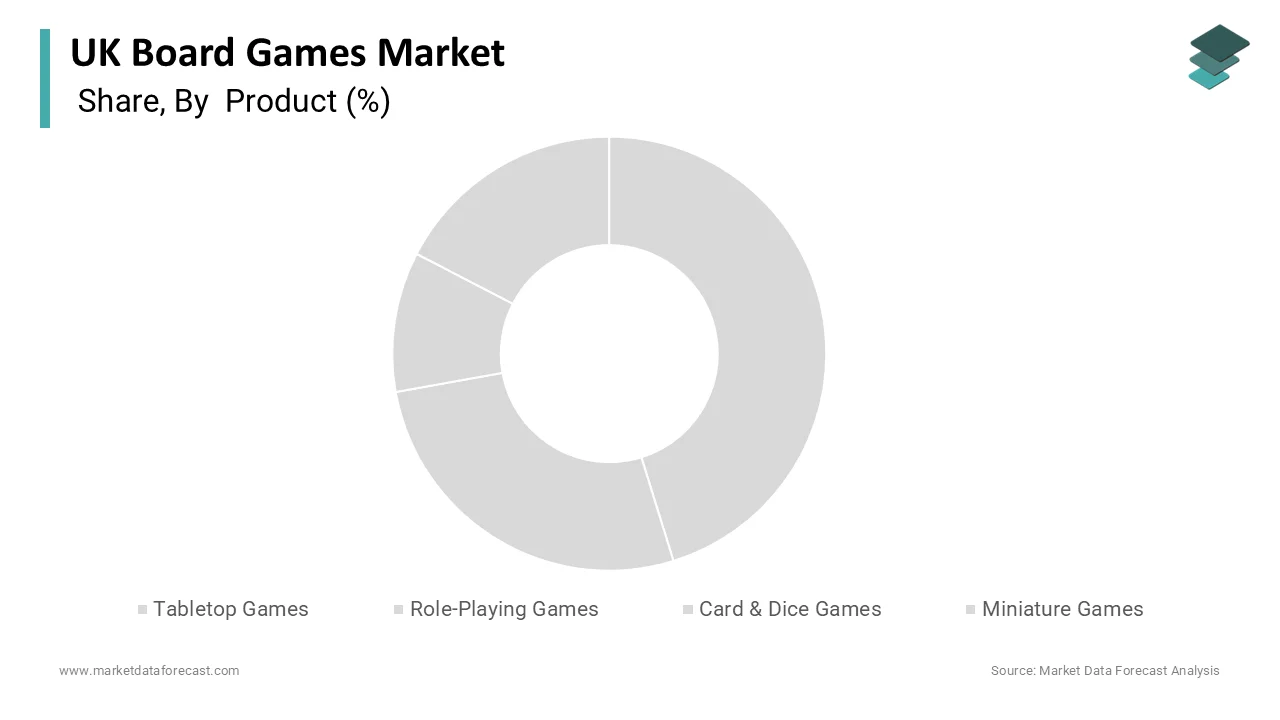
The role-playing games segment is projected to witness the fastest CAGR of 8.5%, driven by the desire for narrative immersion and creative freedom. The popularity of systems like Dungeons and Dragons has surged globally,y with UK sales reflecting this international trend. The flexibility of role-playing games appeals to individuals seeking escapism and emotional connection through imaginative play. The rise of actual play podcasts and streaming series has demystified the hobby by making it accessible to newcomers who are inspired to create their own campaigns. According to consumer insights, the ability to personalize characters and influence plot developments provides a level of agency that is highly valued by modern consumers. This creative outlet serves as a stress reliever and a form of artistic expressionon attracting a diverse audience beyond traditional gamers. Publishers are responding by releasing streamlined rule sets and beginner boxes that lower the barrier to entry. The modular nature of these games allows for infinite variability, ensuring that no two sessions are ever the same.
By Distribution Channel Insights
The offline channels segment was the largest by holding 34.2% of the United Kingdom board games market share in 2025 due to the tactile experience and immediate availability they offer. Consumers often prefer to examine the quality ofcomponentse,nts read rule summaries,aries and assess box art before purchasing, which is only possible in physical retail environments. Although not directly related to games, general retail trends show that touch and feel remain critical for hobby products. Specialty stores provide expert advice and demonstrations that help customers choose games suited to their preferences, reducing the risk of dissatisfaction. The ability to take home a purchase immediately satisfies impulse-buying tendencies and allows for instant social play. The local game stores serve as community hubs, where events and demos drive foot traffic and sales. The personal interaction with knowledgeable staff builds trust and loyalty, which online algorithms struggle to replicate. Many consumers value supporting local businesses and contributing to their community economy,y further reinforcing offline patronage. The sensory appeal of opening a new game in a store creates an emotional connection that enhances the perceived value.
The online channels segment is likely to grow at the fastest CAGR of 7.2 % from 2026 to 2034, with the convenience and extensive product variety they offer. E-commerce platforms allow consumers to browse thousands of titles, compare prices, and read detailed reviews from anywhere at any time. The ability to find out-of-print or imported games that are unavailable in local stores is a major advantage of online shopping. Major retailers and specialized web stores offer comprehensive catalogs that cater to specific interests and preferences. The transparency of pricing and availability information empowers buyers to make informed decisions quickly. The option for home delivery eliminates the need to travel and carry heavy boxes, which is particularly appealing for bulk purchases or large box games. Subscription services and curated boxes also gain popularity online, providing regular discovery of new titles. The seamless integration of payment and logistics systems ensures a smooth purchasing experience.
By Age Group Insights
Adults segment was the largest by accounting for 34.2% of the United Kingdom board games market share in 2025 due to their higher disposable income and preference for complex gaming experiences. As per data from the Office for National Statistics, adults aged 25 and above account for the majority of discretionary spending on leisure activities, including hobbies. The sophistication of modern board games with intricate strategies and mature themes appeals to adults seeking intellectual stimulation and social interaction. The adult gamers are more likely to participate in crowdfunding campaigns and purchase collector editions, driving significant revenue for publishers. The trend of hosting game nights among friends and colleagues further fuels demand for multiplayer titles that facilitate conversation and bonding. Adults also value the educational and cognitive benefits of gam, ing such as improved problem-solving skills and strategic thinking. The availability of themed bars and cafes catering to adult patrons provides venues for social play outside the home.
The children segment is likely to grow at the fastest CAGR of 6.8 % from 2026 to 2034, with the recognized educational value and increased parental investment in developmental toys. Parents are increasingly seeking screen-free activities that promote cognitive skills such as counting, pattern recognition,n and logical reasoniplay-basedrly years learning emphasizes play-based methods, which board games effectively support. Educational board games are designed to make learning fun and interactive, encouraging children to engage with mathematical and linguistic concepts naturally. The focused board games have risen significantly as parents prioritize tools that aid academic development. The durability and safety of modern children’s gam, es ensure they withstand rough handling, making them attractive long-term investments. Manufacturers collaborate with educators to create titles that align with school curricula, enhancing their appeal to conscientious parents. The social skills developed through turn-taking and rule-following are also highly valued by families. This focus on holistic development drives frequent purchases as children progress through different age stages, requiring new challenges.
COMPETITIVE LANDSCAPE
The competition in the UK board games market is intense and characterized by a mix of large multinational publishers and agile independent designers, who vie for consumer attention. Major players leverage extensive distribution networks and established brand recognition to dominate retail shelves, while smaller studios compete through niche innovation and crowdfunding success. Price sensitivity varies between casual buyers seeking affordable family games and hardcore enthusiasts willing to pay premium prices for complex strategy titles. Retailers hold significant influence over visibility,y making relationships with specialty stores and online platforms crucial for success. Digital adaptation is becoming a key competitive factor as hybrid games gain popularity among tech-savvy consumers. Community building remains essential as word of mouth and influencer endorsements heavily impact purchasing decisions. The barrier to entry is relatively low for design but high for distribution and marketing, creating a fragmented yet vibrant ecosystem. Success depends on balancing creative excellence with operational efficiency and effective community engagement to maintain relevance in a rapidly changing industry.
KEY MARKET PLAYERS
Some of the companies that are playing a dominating role in the U.K. Board Games Market include
- Hasbro, Inc.
- Mattel, Inc.
- Ravensburger AG
- Asmodee Group
- Spin Master Corp.
- University Games Corporation
- The Walt Disney Company
- Goliath Games
- Cartamundi Group
- Winning Moves UK Ltd.
- Gibsons Games Ltd.
- Big Potato Games Ltd.
TOP LEADING PLAYERS IN THE MARKET
- Asmodee UK Limited operates as a leading publisher and distributor of board games,s representing major international brands within the United Kingdom. The company manages a diverse portfolio, including popular titles such as Catan and Ticket to Ride, which are staples in many households. Recently,y Asmodee has strengthened its market position by expanding its digital integration effort , allowing players to access companion apps for enhanced gameplay experiences. The firm has also invested in localizing global hits to ensure cultural relevance for British consumers. Their focus on high-quality components and engaging themes ensures continued consumer interest. These strategic initiatives reinforce their reputation as a key driver of innovation and accessibility in the UK board gaming community.
- Games Workshop Group PLC is a prominent figure in the UK market, specializing in miniature wargaming and hobby products with a strong domestic manufacturing base. The company is renowned for its Warhammer franchises, which command a loyal following among enthusiasts and collectors. Recently,y Games Workshop has expanded its retail footprint by opening new flagship stores and enhancing its online direct-to-consumer platform. The firm has also increased production capacity to meet growing global demand while maintaining strict quality control standards. Their engagement with the community through organized play events and digital content creation fosters deep brand loyalty.
- Big Potato Games is a dynamic independent publisher known for creating innovative and accessible party games that appeal to broad audiences. The company focuses on social interaction and humor, producing titles that are easy to learn and quick to play. Recently,y Big Potato has strengthened its presence by securing partnerships with major high street retailers and expanding into international markets. The firm actively engages with influencers and content creators to drive awareness and demonstrate gameplay mechanics to potential buyers. Their commitment to inclusive design ensures that games are enjoyable for players of varying skill levels and backgrounds. These efforts enhance brand visibility and attract new customers, who seek fun and engaging social experiences through tabletop gaming.
TOP STRATEGIES USED BY KEY MARKET PARTICIPANTS
Key players in the UK board games market primarily focus on product innovation to create unique gameplay mechanics and immersive themes that distinguish their offerings. Companies invest heavily in community engagement through organized play events, online forums,s and social media interactions to build loyal customer bases. Strategic partnerships with digital platforms enable the development of companion apps and virtual table tops that enhance the physical gaming experience. Prioritize high-quality components and sustainable packaging to meet consumer expectations for durability and environmental responsibility. Expansion into direct-to-consumer sales channels allows brands to capture higher margins and gather valuable customer data. Licensing popular intellectual properties from films and television helps attract mainstream audiences unfamiliar with traditional hobby games. Continuous investment in localization ensures that global titles resonate with British cultural preferences.
MARKET SEGMENTATION
This research report on the UK board games market is segmented and sub-segmented into the following categories.
By Product
- Tabletop Games
- Role-Playing Games
- Card & Dice Games
- Miniature Games
- Others
By Distribution Channel
- Offline Channels
- Online Channels
By Age Group
- Children
- Adults
- Teenagers
- Seniors
By Country
- United Kingdom