- Product Description Description
- Table of Contents TOC
- List of Table & Figure LOT
- Get Free Sample PDF Sample PDF
Market Size, 2025
$13.49 BnMarket Estimate, 2026
$14.95 BnMarket Forecast, 2034
$34.03 BnCAGR, 2026–2034
10.83%Europe Educational Toys Market Size
The Europe educational toys market size was valued at USD 13.49 billion in 2025 and is projected to reach USD 34.03 billion by 2034 from USD 14.95 billion in 2026, growing at a CAGR of 10.83%.
Educational toys are purposefully designed play products that stimulate cognitive, motor, linguistic, or socioemotional development in children from infancy through early adolescence. These items go beyond entertainment by embedding pedagogical principles, such as Montessori, STEM, or Waldorf methodologies into tactile, visual, or digital experiences that align with developmental milestones. Simultaneously, the European Commission’s Digital Education Action Plan emphasizes screen balanced learning, fueling interest in hybrid physical digital toys that avoid passive screen time. This commitment reflects a cultural prioritization of play as pedagogy, reinforced by national curricula in countries like Finland and Germany that integrate structured play into foundational learning.
MARKET DRIVERS
Integration of Play Based Learning in National Early Childhood Curricula Drives Institutional Demand
The European governments have systematically embedded play-based learning into formal education frameworks, transforming educational toys from optional accessories into curriculum mandated tools. The integration of play based learning in national early childhood curricula is driving the growth of Europe educational toys market. Finland’s National Core Curriculum for Early Childhood Education explicitly designates structured play as a primary vehicle for literacy, numeracy, and social skill development, which is requiring all municipal daycare centers to maintain developmentally sequenced toy libraries. As per the Finnish National Agency for Education, many early childhood institutions updated their play material inventories in 2023 to align with revised sensory and logical reasoning benchmarks. France’s “Plan 100 000 Places en Crèche” includes mandatory procurement of pedagogically certified toys in all newly licensed childcare facilities, a policy that drove an increase in institutional orders between 2021 and 2023, according to the French Ministry of National Education. These policies create stable, recurring demand insulated from consumer retail volatility. Moreover, teacher training programs now include modules on toy mediated learning by ensuring proper utilization. This institutionalization elevates educational toys from commercial products to public pedagogical infrastructure across Europe.
Rising Parental Investment in Early Cognitive Development Fuels Premium Product Adoption
The European parents are increasingly treating educational toys as strategic developmental investments rather than discretionary purchases, driven by accessible neuroscience research and declining birth rates. The rising parental investment in early cognitive development is solely fuelling the growth of the Europe educational toys market. With the EU’s total fertility rate at 1.53 children per woman as documented by Eurostat in 2023, families concentrate resources on fewer children, amplifying willingness to pay for high impact learning tools. A 2025 study by the Max Planck Institute for Human Cognitive and Brain Sciences confirmed that targeted play with spatial reasoning toys between ages three and six correlates with improvement in later mathematical aptitude, a finding widely disseminated through national health and parenting portals. Parents in countries like Sweden and the Netherlands are opting for premium, research backed brands. Germany’s consumer protection authority now features a “Lernspielzeug Siegel” (educational toy seal) to guide evidence based choices, thereby reducing confusion in a crowded places. This informed consumerism, combined with dual income households possessing higher discretionary budgets sustains robust demand for high quality, developmentally validated products.
MARKET RESTRAINTS
Stringent EU Safety and Chemical Regulations Increase Compliance Costs for Manufacturers
The European Union enforces some of the world’s most rigorous product safety standards for children’s items, which is creating significant barriers for educational toy producers. Regulation (EC) No 1907 2006 on the Registration Evaluation Authorisation and Restriction of Chemicals mandates exhaustive testing for over 200 substances of very high concern, including phthalates, lead, and certain flame retardants, even in trace amounts. As per the European Chemicals Agency, compliance testing for a single toy SKU, now averages 8,500 euros and takes 14 to 18 weeks, disproportionately affecting small designers and startups. The Toy Safety Directive 2009 48 EC further requires age specific risk assessments, mechanical strength validation, and extensive documentation for CE marking. These regulatory burdens delay time to market and inflate retail prices, according to the European Association of Toy Manufacturers. While essential for child safety, these rules inadvertently favor large corporations with in house compliance teams, stifling innovation from agile niche players who often pioneer novel pedagogical concepts.
Digital Competition and Screen Based Entertainment Divert Playtime and Spending
Traditional educational toys face intensifying competition from digital alternatives that offer interactive, adaptive, and often subscription based learning experiences, which is also hindering the growth of Europe educational toys market. European children aged five to ten, now spend an average of 1 hour and 22 minutes daily on educational apps or games, according to a 2025 survey by the European Platform of Regulatory Authorities, compared to 48 minutes with physical learning toys. Platforms like Khan Academy Kids and Duolingo ABC provide personalized literacy and numeracy paths with instant feedback loops that static toys cannot replicate. Moreover, digital offerings benefit from recurring revenue models, where parents in the UK spent an estimated 215 million pounds on educational app subscriptions in 2023 as per Ofcom. Consequently, physical toy manufacturers struggle to demonstrate comparable efficacy or retention for older children.
MARKET OPPORTUNITIES
Expansion of Inclusive and Neurodiversity Affirming Toy Design Opens New Market Segments
The growing recognition of neurodiversity and inclusive education has increase demand for educational toys tailored to children with autism, ADHD, dyslexia, or sensory processing differences. This factor is greatly to enhance new opportunities for the growth of Europe educational toys market. The European Agency for Special Needs and Inclusive Education reports that some of EU member states have implemented inclusive education policies requiring adapted learning materials in mainstream classrooms. In response, companies are developing toys with adjustable sensory input, clear visual sequencing, and reduced auditory stimulation. Sweden’s National Agency for Special Needs Education mandates that all public preschools maintain inclusive toy collections, driving procurement of products like emotion recognition card games and tactile math manipulatives. France’s Ministry of Education launched a grant program for schools to acquire neuroinclusive play resources, benefiting certified vendors. A University College London study found that structured play with sensory calibrated toys reduced meltdowns by 31% in autistic children aged four to seven. This shift reflects Europe’s broader social model of disability, transforming educational toys from universal tools into personalized developmental supports and unlocking a previously underserved segment with high institutional backing.
Public Private Partnerships Amplify Access Through National Early Childhood Initiatives
Governments across Europe are partnering with toy manufacturers and NGOs to distribute educational toys as part of public health and equity strategies. These partnerships is additionally to elevate the growth of Europe educational toys market. Germany’s “Sprach Kitas” program, operating in over 4 000 daycare centers, provides language development toy kits to support children from migrant or low income backgrounds, with the Federal Ministry for Family Affairs distributing 320,000 units in 2023 alone. The Netherlands’ “Leerzame Speelgoedkist” (Educational Toy Chest) program loans developmentally staged toy sets to families through local libraries, with over 180 municipalities participating by 2025. These programs not only expand market reach but also validate pedagogical efficacy through state endorsement. They target socioeconomic disparities in early development, aligning toy distribution with the European Child Guarantee’s goal of equal access to learning resources.
MARKET CHALLENGES
Shortage of Specialized Design Talent Skilled in Both Pedagogy and Product Engineering
The development of high quality educational toys demands rare interdisciplinary expertise bridging child psychology, curriculum design, and industrial engineering, which is a skill set in severe shortage across Europe. The shortage of specialised design talent skilled in both pedagogy and product engineering is significantly a challenging factor for the growth of Europe educational toys market. According to the European Institute for Innovation and Technology, fewer than 120 professionals in the entire EU possess certified competencies in both early childhood development and toy safety engineering. Design schools rarely offer joint programs, where Germany’s renowned design academies include only two courses integrating Montessori theory with material science, as per German Academic Exchange Service. This gap leads to products that are either pedagogically sound but structurally unsafe or visually appealing but developmentally inert. In 2023, the European Consumer Organisation documented that 41% of newly launched “STEM” toys failed to align with actual science learning progressions due to designer inexperience. Startups often rely on outsourced consultants, increasing costs and diluting coherence. Without dedicated academic pipelines or industry certification frameworks, the market struggles to scale evidence-based innovation by leaving it vulnerable to superficial “edu washing” that erodes consumer trust and undermines genuine developmental impact.
Environmental Sustainability Pressures Increase Material and Packaging Complexity
The European consumers and regulators are demanding eco conscious educational toys, but transitioning to sustainable materials without compromising safety or functionality presents significant technical hurdles. The environmental sustainability pressures increase material and packaging complexity is acting as a barrier for the growth of Europe educational toys market. The EU’s Single Use Plastics Directive and upcoming Ecodesign for Sustainable Products Regulation require high recycled content and full recyclability, yet many bio-based plastics lack the durability or non-toxic certification required for children’s products. As per the European Environment Agency, few bioplastics used in toys currently meet EN 71 3 chemical safety standards for migration of harmful elements. Furthermore, minimalist packaging, now expected by eco conscious parents conflicts with EU transport safety rules requiring protective cushioning for small parts. A 2025 audit by Germany’s Stiftung Warentest found that “eco-friendly” educational toys still used mixed material laminates that cannot be recycled, misleading consumers. Companies like Lego and Playmobil have invested millions in plant based alternatives, but small firms lack such R&D capacity.
REPORT COVERAGE
| REPORT METRIC | DETAILS |
| Market Size Available | 2025 to 2034 |
| Base Year | 2025 |
| Forecast Period | 2026 to 2034 |
| CAGR | 10.83% |
| Segments Covered | By Type, Age Group, Distribution Channel, and Region |
| Various Analyses Covered | Global, Regional, & Country Level Analysis; Segment-Level Analysis; DROC, PESTLE Analysis; Porter’s Five Forces Analysis; Competitive Landscape; Analyst Overview of Investment Opportunities |
| Regions Covered | UK, France, Spain, Germany, Italy, Russia, Sweden, Denmark, Switzerland, Netherlands, Turkey, and the Czech Republic |
| Market Leaders Profiled | Fat Brain Toys, BYJU'S, Ravensburger, Sphero, The LEGO Group, VTech Holdings Ltd, Hasbro Inc, Spin Master Corp, and Mattel Inc. |
SEGMENTAL ANALYSIS
By Type Insights
The STEM toys segment was accounted in holding 26.3% of the Europe educational toys market share in 2025 with the institutional prioritization of science, technology, engineering, and mathematics competencies across national curricula and parental aspirations for future readiness. The European Commission’s Digital Education Action Plan explicitly encourages hands on computational thinking from early childhood by prompting schools to integrate programmable robots, coding kits, and engineering sets into classroom activities. As per the German Standing Conference of Ministers of Education, many primary schools adopted modular STEM toy systems in 2023 to support mandatory informatics education starting at age 6. Simultaneously, France’s “Plan France 2030” allocated 1.3 billion euros to youth innovation hubs equipped with educational robotics and maker kits, with 78% of participating centers reporting increased student engagement in technical subjects. Parental demand is equally robust, where a study found that 61% of European households with school aged children purchased at least one STEM toy in 2023, citing long term career advantages. Crucially, these products now align with developmental science research from the University of Cambridge confirms that structured block based coding play between ages five and nine improves executive function by 19%.
The role play toys segment is likely to grow at a fastest CAGR of 9.6% throughout the forecast period with the mounting evidence of socioemotional learning benefits and integration into inclusive education frameworks. Role play through kitchen sets, doctor kits, or community figurines that enables children to rehearse empathy, perspective taking, and conflict resolution in safe environments. The Finnish National Agency for Education now mandates “dramatic play zones” in all daycare centers, with over 2,100 institutions receiving government funded role play kits in 2023 to support social cohesion among culturally diverse cohorts. In Sweden, the Public Health Agency links role play with reduced behavioral issues with a 27% decline in preschool aggression incidents in classrooms using structured sociodramatic materials. Additionally, role play is increasingly used in neurodiverse settings, where the UK’s National Autistic Society reports that some of specialist schools employ role based scenarios to teach social pragmatics, driving demand for customizable, low sensory kits. Germany’s Kita Reform further incentivizes procurement through per child grants for “soziale Lernspielzeuge.”
By Age Group Insights
The “Up to 4 Years” age group segment was accounted in holding 44.2% of the Europe educational toys market share in 2025 with the Europe’s robust early childhood investment strategy and the critical developmental window from birth to age four, when neural plasticity peaks. Over 93% of EU member states offer universal or near universal access to early childhood education and care, with institutions requiring age appropriate sensory, motor, and language toys as part of pedagogical standards. Germany’s “Gute Kita” law mandates a minimum of 12 developmentally calibrated toys per toddler in state funded nurseries, resulting in over 28 million units procured in 2023 alone according to the Federal Ministry for Family Affairs. France’s “Crèche 2026” initiative enforces strict toy safety and stimulation criteria for all licensed facilities, directly boosting demand for certified infant toys. Public health campaigns further reinforce usage, where Sweden’s National Board of Health distributes “Lek & Lärande” starter kits to all newborns, containing Montessori inspired grasp and sound toys. This structural alignment between public policy, neuroscience, and household priority ensures sustained leadership of the youngest age segment.
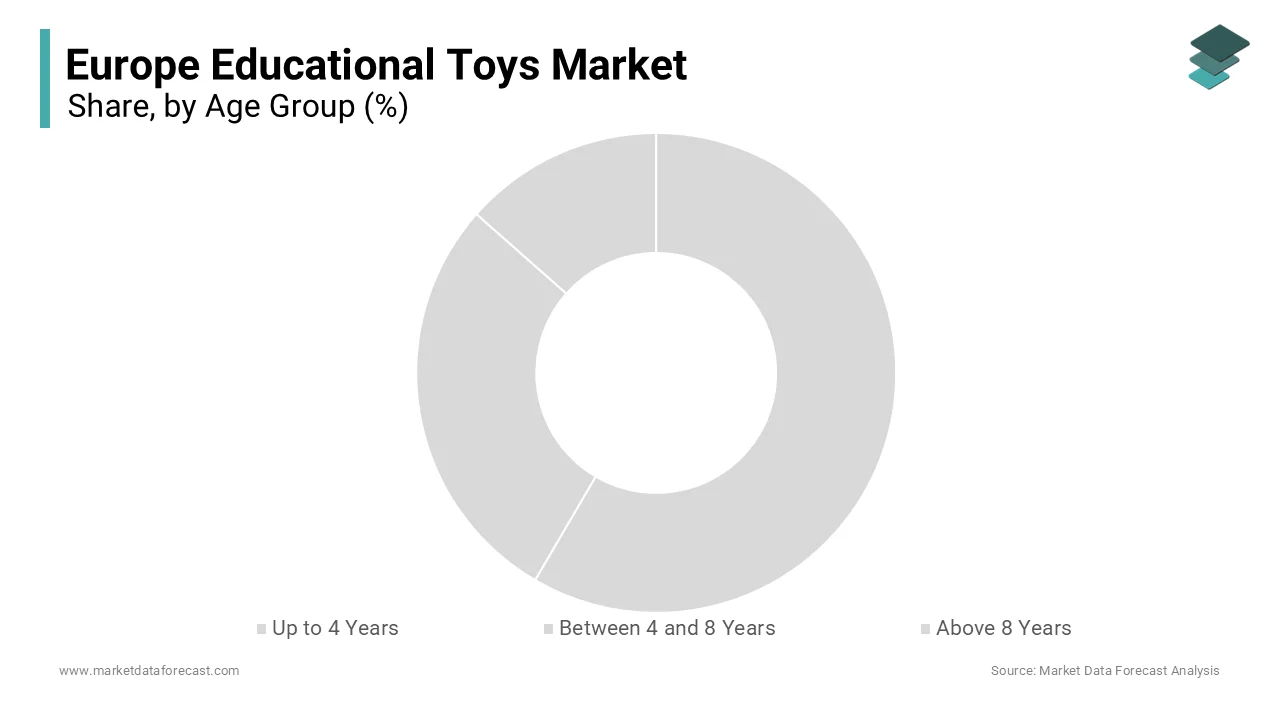
The “Between 4 and 8 Years” segment is projected to grow at a CAGR of 8.9% throughout the forecast period from the transition from play based preschool to formal schooling, where educational toys bridge curricular expectations and developmental readiness. As European countries lower compulsory school entry to age five or six, demand rises for toys that reinforce literacy, numeracy, and digital literacy in home environments. In Spain, the Ministry of Education’s “Plan de Refuerzo Educativo” includes educational board games in summer learning packs to combat achievement gaps, reaching 1.2 million children in 2023. Crucially, this age group shows high engagement with hybrid physical digital toys, where research from the University of Geneva found that children aged five to seven retain 34% more vocabulary when using tactile letter tiles paired with audio feedback versus screens alone.
By Distribution Channel Insights
The specialty stores segment was the largest by holding 38.3% of the Europe educational toys market share in 2025 from their unique ability to offer expert curation, pedagogical guidance, and trust based purchasing in an era of information overload. Unlike mass retailers, specialty outlets employ staff trained in child development who can match toys to specific learning objectives, age stages, or special needs a service highly valued by European parents. France’s “Boutiques Educatives” benefit from tax incentives under the “Loi pour une Ecole de la Confiance,” encouraging certified stores to serve as community learning hubs. Additionally, specialty retailers often stock niche, locally made, or eco certified brands that align with European sustainability values.
The e-commerce segment is likely to witness a prominent CAGR of 12.3% throughout the forecast period by algorithmic personalization, subscription models, and post pandemic digital habituation. Leading platforms now use AI to recommend toys based on child age, developmental goals, and prior purchases Amazon’s “Educational Toy Finder” reported an increase in conversion rates in 2023 after integrating European curriculum standards. Subscription services like France’s “Les Petits Joueurs” or Germany’s “Lernbox” deliver curated monthly kits aligned with national learning milestones, with subscriber bases growing by over 35% annually, as confirmed by national consumer surveys. The convenience factor is amplified by demographic shifts, where the European Institute for Gender Equality notes that dual income households with young children, prioritize time efficient shopping. Crucially, e commerce enables access to specialized products parents of neurodiverse children in rural areas increasingly source sensory calibrated toys online, with the UK’s National Autistic Society reporting a 58% rise in digital procurement since 2021.
REGIONAL ANALYSIS
Germany Educational Toys Market Analysis
Germany was the top performer of the Europe educational toys market by holding 18.7% of share in 2025 with its deeply institutionalized early childhood framework and manufacturing excellence in learning materials. The country’s Kita system serving, children aged three to six mandates pedagogically validated toys as part of federal quality criteria, with each daycare required to maintain structured libraries for motor, language, and social development. The childcare facilities updated their toy inventories in 2023 under the “Gute Kita” funding program, prioritizing STEM and inclusive play resources. Germany’s strong vocational training ecosystem includes specialized toy design programs at institutions like the Nuremberg University of Applied Sciences, ensuring a pipeline of designers fluent in both child development theory and material safety. This fusion of public investment, professional curation, and manufacturing rigor positions Germany as Europe’s educational toy benchmark.
United Kingdom Educational Toys Market Analysis
The UK educational toys market growth is likely to have a significant opportunities in next coming years with its integration of educational toys into special educational needs support and public health initiatives. The Department for Education’s “Nuffield Early Language Intervention” distributes language development toy kits to over 100 000 disadvantaged children annually, with independent evaluations showing a 4-month language gain after 20 weeks. Post Brexit, the UK has accelerated its own toy safety and sustainability standards, with the British Standards Institution introducing the “BS 8848 Educational Toy” certification in 2023 to guide evidence based design.
France Educational Toys Market Analysis
France educational toys market growth is to have steady growth with its national strategy to embed educational play into formal schooling from age three. The Ministry of National Education’s “Plan Maternelle” mandates that all preschools use structured play materials aligned with five core learning domains, driving institutional procurement of language games, logical blocks, and motor skill kits.
COMPETITIVE LANDSCAPE
The Europe educational toys market features a dynamic mix of legacy European brands, global electronics innovators, and agile local designers, all competing on pedagogical validity, safety, and sustainability rather than price alone. Competition is highly fragmented due to diverse national curricula, language requirements, and cultural approaches to play, limiting the dominance of any single player. Established brands like LEGO and Playmobil leverage heritage and trust, while digital entrants such as VTech and Osmo compete on adaptive learning and technological integration. However, regulatory complexity, particularly around chemical safety, data privacy, and eco-design that creates high barriers to entry, favoring firms with robust compliance infrastructure. At the same time, public sector procurement and institutional partnerships offer stable channels that reward evidence based design. Consumer trust is earned through certifications, expert endorsements, and transparent sourcing, making authenticity and alignment with European educational values the true currency of competitive advantage in this purpose driven market.
KEY MARKET PLAYERS
Some of the notable key players in the European educational toys market are
- Fat Brain Toys
- BYJU'S
- Ravensburger
- Sphero
- The LEGO Group
- VTech Holdings Ltd
- Hasbro Inc
- Spin Master Corp
- Mattel Inc
Top Players in the Market
- LEGO Group is a Danish multinational that has redefined educational play through its system of interlocking bricks and curriculum aligned learning platforms. The company contributes significantly to the global market by pioneering hands on STEM education via LEGO Education, which partners with schools in over 90 countries. In Europe, LEGO has deepened its commitment to early childhood development by collaborating with national education ministries to integrate its SPIKE Essential and DOTS kits into primary school programs. The company launched a sustainability initiative replacing single use plastic packaging with paper based alternatives across all European educational sets. It also expanded its “Build to Give” program, donating one set to underserved communities for every set purchased during the holiday season. These actions reinforce LEGO’s dual role as a commercial brand and a pedagogical partner in Europe’s learning ecosystem.
- Playmobil is a German manufacturer renowned for its detailed role play figures and thematic play worlds that emphasize narrative, social interaction, and historical or scientific exploration. The company’s contribution to the global market lies in its commitment to screen free, open ended play that aligns with European pedagogical values. In Europe, Playmobil actively collaborates with museums, schools, and child psychologists to ensure developmental appropriateness and educational relevance. It introduced a new “Future Heroes” line focused on sustainability and civic engagement, developed in consultation with the German Federal Agency for Civic Education. The company also upgraded its production facilities in Dietenhofen to use 100% renewable energy and bio-based plastics certified under EU safety standards. These initiatives strengthen its position as a trusted, values driven brand that bridges entertainment and learning across generations.
- VTech is a Hong Kong based global leader in electronic learning products with a strong and growing presence in the European educational toys market. The company differentiates itself through research backed, age specific electronic learning systems that combine tactile interaction with adaptive audio and visual feedback. In Europe, VTech tailors its offerings to regional curricula and language requirements, offering multilingual content in French, German, Spanish, and Dutch across its Kidi and Toot-Toot lines. The VTech enhanced its data privacy protocols to comply fully with the General Data Protection Regulation, achieving certification from TÜV Rheinland for all connected toys sold in the EU. It also partnered with early childhood educators in the UK and Sweden to co design literacy and numeracy content grounded in local learning standards. These localized, compliant, and pedagogically informed strategies enable VTech to bridge digital innovation with European expectations for safe, effective learning tools.
Top Strategies Used by the Key Market Players
Key players in the Europe educational toys market are prioritizing alignment with national early childhood curricula through co development with educators and government bodies to ensure pedagogical relevance. They are investing heavily in sustainable materials and packaging to meet stringent EU environmental regulations and consumer expectations for eco-friendly products. Companies are enhancing data privacy and safety certifications to comply with the General Data Protection Regulation especially for connected or digital toys. Strategic partnerships with schools museums and public health institutions amplify credibility and distribution channels. Additionally, brands are expanding inclusive design principles to support neurodiverse children and promote gender neutral or socially conscious play narratives that reflect European values of equity and inclusion.
MARKET SEGMENTATION
This research report on the European educational toys market has been segmented and sub-segmented based on categories.
By Type
- Arts & Crafts
- Role Play
- Games & Puzzles
- Motor Skills
- Musical Toys
- STEM Toys
- Other Toys
By Age Group
- Up to 4 Years
- Between 4 and 8 Years
- Above 8 Years
By Distribution Channel
- Supermarkets & Hypermarkets
- Specialty Stores
- E-commerce
- Others
By Country
- UK
- France
- Spain
- Germany
- Italy
- Russia
- Sweden
- Denmark
- Switzerland
- Netherlands
- Turkey
- Czech Republic
- Rest of Europe