U.S. Business Process Outsourcing Market Size, Share, Trends, and Growth Analysis Report, Segmented by Deployment, Service Type, Outsourcing Type, Industry, and Country – Industry Forecast From 2026 to 2034
U.S. Business Process Outsourcing Market Size
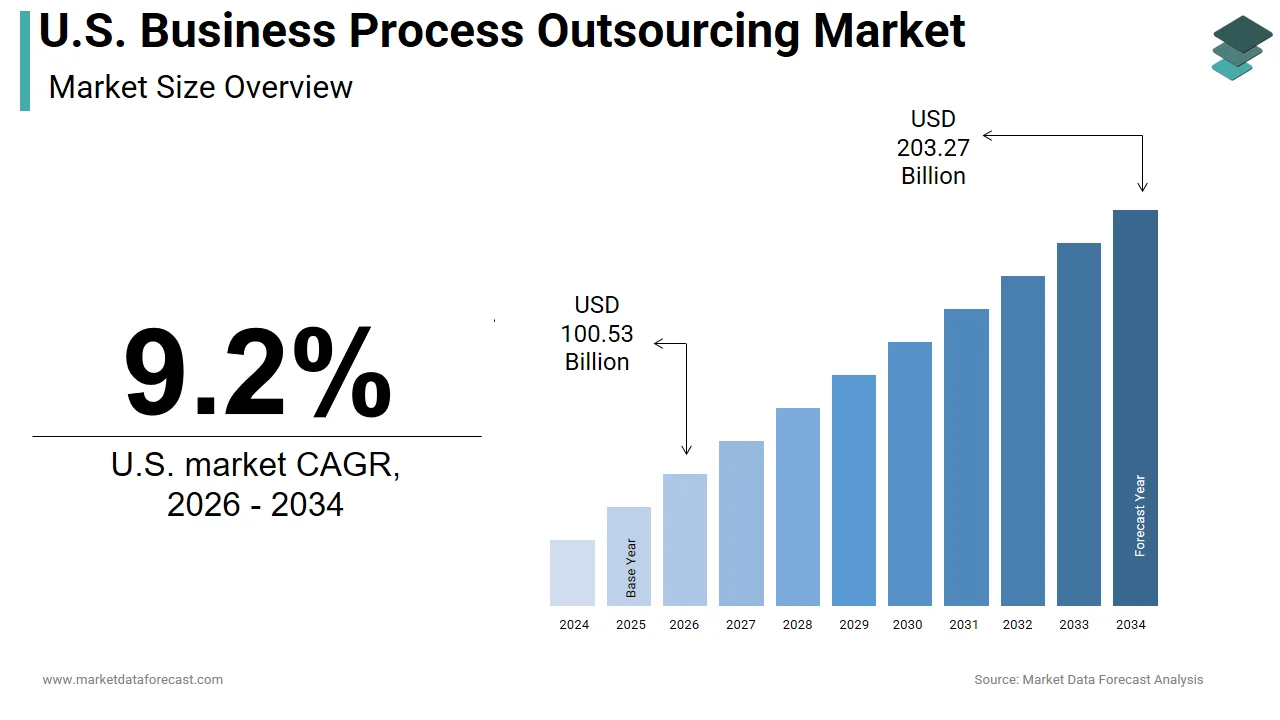
The U.S. business process outsourcing market was valued at USD 92.06 billion in 2025, is estimated to reach USD 100.53 billion in 2026, and is projected to reach USD 203.27 billion by 2034, growing at a CAGR of 9.2% from 2026 to 2034.
The business process outsourcing is a contract based third party providers to manage specific operational functions ranging from customer support and human resources to finance and information technology. The complexity of modern business environments necessitates specialized expertise that internal teams may lack. According to the United States Census Bureau, there are over 33 million small businesses in the country many of which rely on external vendors to manage administrative burdens without maintaining large internal staffs. Furthermore, the rapid pace of technological change requires continuous upskilling which outsourcing providers often supply as part of their service offerings. The Federal Reserve Bank of St Louis notes that productivity growth in the information sector has outpaced other industries suggesting that specialized external management can enhance output. The interplay between domestic labor constraints and the need for scalable solutions defines the current operational reality for American enterprises seeking competitive advantage through external partnerships.
MARKET DRIVERS
Escalating Operational Costs and Labor Shortages
The persistent rise in operational costs combined with acute labor shortages serves is amplifying the growth of the United States business process outsourcing market. Companies face increasing pressure to maintain profitability, while managing rising wages and benefits for domestic employees. The financial burden prompts organizations to seek alternative staffing models that offer cost predictability and efficiency. The healthcare and technology sectors particularly struggle with talent acquisition with the World Health Organization projecting a global shortfall of 10 million health workers by 2030 many of whom are needed in developed nations like the United States. In the technology sector, the CompTIA State of the Tech Workforce report indicates that despite layoffs in major firms there remains a significant gap in specialized skills such as cybersecurity and data analytics. Outsourcing allows companies to access a global talent pool without the overhead associated with full time hires. This flexibility is crucial in an economic environment characterized by uncertainty and fluctuating demand. Additionally, the time required to recruit and train internal staff can delay project timelines whereas outsourcing providers offer immediate resource availability. This strategic shift enables organizations to focus internal resources on core competencies, while ensuring that essential support functions are handled efficiently and cost effectively by experienced external partners.
Accelerated Digital Transformation and Technology Adoption
The rapid pace of digital transformation drives significant demand for business process outsourcing as organizations seek to integrate advanced technologies without bearing the full burden of development and maintenance. This factor is bolstering the growth of the United States business process outsourcing market. Implementing artificial intelligence robotic process automation and machine learning requires specialized expertise and substantial capital investment that many companies prefer to avoid. The business expenditure on research and development reached record highs, yet many firms lack the internal capacity to deploy these innovations effectively, across all operational areas. Outsourcing providers often possess established technological infrastructures and skilled personnel capable of deploying these solutions at scale. The spending on digital transformation technologies and services in the United States is expected to grow significantly as companies prioritize agility and data driven decision making. By partnering with outsourcing vendors, organizations can leverage pre-built platforms and automated workflows that enhance efficiency and reduce error rates. For instance, in the financial services sector the adoption of automated compliance checks and fraud detection systems is often managed by specialized outsourcing firms that stay abreast of regulatory changes. This approach allows client companies to benefit from cutting edge technology without the risks associated with in house development. Furthermore, the integration of cloud based collaboration tools facilitates seamless interaction between internal teams and external providers.
MARKET RESTRAINTS
Data Security Risks and Privacy Concerns
The concerns regarding data security and privacy is restricting the growth of the United States business process outsourcing market. Entrusting sensitive customer and proprietary information to third party providers introduces vulnerabilities that can lead to data breaches and regulatory penalties. As per the Identity Theft Resource Center the number of data compromises in the United States reached historic highs in recent years with the healthcare and financial sectors being primary targets. When outsourcing involves the transfer of personal identifiable information or protected health information the risk exposure increases substantially. The Health Insurance Portability and Accountability Act imposes strict requirements on how patient data is handled and any violation by a business associate can result in severe fines for the covered entity. According to the Ponemon Institute, the average cost of a data breach in the United States exceeds 9 million dollars making security incidents financially devastating. Organizations are often hesitant to outsource critical functions due to the difficulty of monitoring and enforcing security protocols across external networks. The complexity of ensuring end to end encryption and access control in a multi vendor environment further complicates risk management. These security concerns force companies to conduct extensive due diligence and implement costly oversight mechanisms which can diminish the cost benefits of outsourcing.
Quality Control and Communication Barriers
Maintaining consistent quality standards and overcoming communication barriers with the effective adoption of business process outsourcing is also hampering the growth of the United States business process outsourcing market. Differences in cultural norms language proficiency and work practices between US based companies and offshore or nearshore providers can lead to misunderstandings and service delivery issues. When critical business processes are outsourced the lack of direct oversight can result in deviations from expected quality levels. For example, in customer service outsourcing variations in accent comprehension and cultural context can negatively impact customer satisfaction scores. The American Customer Satisfaction Index indicates that service quality is a key determinant of customer loyalty and any decline due to outsourcing can have long term revenue implications. Additionally, the time zone differences associated with offshore outsourcing can delay response times and hinder real time collaboration. While nearshore options mitigate this issue they often come at a higher cost. According to Deloitte managing the transition and ongoing relationship with outsourcing providers requires significant managerial attention and resources. Companies must invest in robust training programs and detailed service level agreements to ensure alignment. However, even with these measures the inherent distance and separation from daily operations can lead to a loss of institutional knowledge and reduced agility.
MARKET OPPORTUNITIES
Integration of Artificial Intelligence and Automation
The integration of artificial intelligence and automation into business process outsourcing for enhancing service delivery and creating new value propositions is likely to set up new opportunities for the growth of the United States business process outsourcing market. Outsourcing providers are increasingly adopting intelligent automation to handle repetitive tasks with greater speed and accuracy than human agents. For instance, in the finance and accounting sector automated systems can reconcile transactions and detect fraud more efficiently than manual methods. As per the study, adoption of service robots and software bots is accelerating across various industries driving demand for outsourced automation services. US companies can benefit from these advancements without investing heavily in proprietary technology development. Furthermore, the combination of human expertise and AI capabilities enables hybrid models that improve overall productivity. The technological evolution allows outsourcing to move beyond simple cost arbitrage to become a strategic partner in digital innovation. Providers that invest in AI infrastructure can differentiate themselves in the market offering clients superior outcomes and scalable solutions that adapt to changing business needs.
Expansion into Knowledge Process Outsourcing
The expansion into knowledge process outsourcing, as companies seek to outsource high value analytical and specialized tasks is also fuelling the growth of the United States process outsourcing market. Unlike traditional transactional outsourcing knowledge process, outsourcing involves activities that require advanced education and expertise such as market research legal services medical diagnostics and financial analysis. As per the Nasscom Association of Software and Services Companies, the knowledge process outsourcing sector is growing at a faster rate than traditional business process outsourcing driven by the need for specialized insights. US firms are increasingly outsourcing complex analytical tasks to tap into global talent pools with specific domain expertise. For example in the healthcare sector, medical coding and billing are being augmented by outsourced clinical documentation improvement services that require certified professionals. The Bureau of Labor Statistics projects strong growth for occupations in healthcare and financial analysis indicating a robust demand for these specialized skills. The knowledge process outsourcing engagements are becoming more strategic with providers acting as extensions of the client’s internal teams. This trend allows US businesses to enhance their decision-making capabilities and innovate more rapidly. The ability to scale specialized services on demand provides a competitive advantage in industries, where expertise is scarce and expensive.
MARKET CHALLENGES
Cybersecurity Threats and Vulnerability Management
The escalating frequency and sophistication of cyberattacks, as providers become attractive targets for malicious actors is a significant challenge for the growth of the United States business process outsourcing market. Outsourcing firms handle vast amounts of sensitive data for multiple clients by making them high value targets for ransomware phishing and data theft. When a security breach occurs at an outsourcing provider it can compromise the data of all its clients leading to widespread reputational and financial damage. The interconnected nature of digital supply chains means that a vulnerability in one vendor can expose the entire network to risk. The infrastructure sectors, including financial services and healthcare are increasingly targeted by state sponsored and criminal groups. Ensuring robust cybersecurity measures across diverse outsourcing partners is complex and resource intensive. Clients must verify that providers adhere to strict security standards such as ISO 27001 and SOC 2 but audits may not detect all vulnerabilities. The rapid adoption of remote work by outsourcing providers has further expanded the attack surface by making endpoint security a concern. The human error remains a leading cause of security incidents emphasizing the need for continuous training and vigilance.
Regulatory Compliance and Legal Complexities
Navigating the complex web of regulatory compliance and legal requirements is another factor to inhibit the growth of the US business process outsourcing market. Organizations must ensure that their outsourcing partners comply with a myriad of federal state and international laws governing data privacy labor practices and industry specific regulations. The enforcement actions related to unfair or deceptive practices in data handling have increased prompting stricter oversight of third party vendors. The General Data Protection Regulation affects US companies that do business with European citizens requiring outsourcing providers to adhere to stringent data protection standards. Additionally, the California Consumer Privacy Act and similar state laws impose specific obligations on how personal information is collected and shared. Managing contractual liabilities and indemnification clauses in outsourcing agreements is becoming increasingly complex, as regulations evolve. Non-compliance by an outsourcing partner can result in significant legal penalties and reputational damage for the client company. The healthcare sector faces additional hurdles with the Health Insurance Portability and Accountability Act requiring rigorous safeguards for protected health information. Financial institutions must adhere to the Gramm Leach Bliley Act, which mandates the protection of consumer financial information. Ensuring that outsourcing providers maintain compliance across all relevant jurisdictions requires extensive legal review and ongoing monitoring.
REPORT COVERAGE
| REPORT METRIC | DETAILS |
| Market Size Available | 2025 to 2034 |
| Base Year | 2025 |
| Forecast Period | 2026 to 2034 |
| Segments Covered | By Deployment, Service Type, Outsourcing Type, Industry, and Country. |
| Various Analyses Covered | Global, Regional, and Country-Level Analysis, Segment-Level Analysis, Drivers, Restraints, Opportunities, Challenges; PESTLE Analysis; Porter’s Five Forces Analysis, Competitive Landscape, Analyst Overview of Investment Opportunities |
| Countries Covered | New York, Massachusetts, Pennsylvania, Illinois, Ohio, Michigan, Texas, Florida, Georgia, California, Washington, Colorado. |
| Market Leaders Profiled | Accenture, WNS (Holdings), Teleperformance SE, TTEC Holdings, Inc., Wipro Limited, Cognizant, Infosys BPM, Transcom, Concentrix Corporation, HCL Technologies Limited, Foundever, IBM Corporation, Alorica, Genpact, TaskUs, Sutherland, Conduent, EXL Service, Startek, Atento, Capita, and Others. |
SEGMENTAL ANALYSIS
By Deployment Insights
The cloud deployment segment was accounted in holding 34.4% of the United States business process outsourcing market share in 2025 due to its unparalleled scalability and cost efficiency, which align with the dynamic needs of modern enterprises. Organizations prefer cloud-based solutions because they eliminate the need for substantial upfront capital expenditure on hardware and infrastructure. As per the International Data Corporation, spending on cloud services in the United States continues to outpace traditional IT spending with projections indicating that cloud infrastructure will account for over 60% of total IT infrastructure investment by 2025. This shift allows companies to scale their outsourcing operations up or down rapidly in response to fluctuating demand without incurring penalties or delays. The subscription based model of cloud services converts fixed costs into variable expenses improving cash flow management for businesses of all sizes. Cloud platforms also facilitate seamless integration with other digital tools enabling real time data access and collaboration between clients and outsourcing providers. This connectivity is crucial for maintaining service quality and responsiveness in a fast paced business environment. The ability to deploy updates and new features instantly ensures that organizations always have access to the latest technology without managing complex upgrade cycles. These advantages make cloud deployment the preferred choice for companies seeking to optimize their outsourcing strategies, while maintaining financial flexibility and operational resilience.
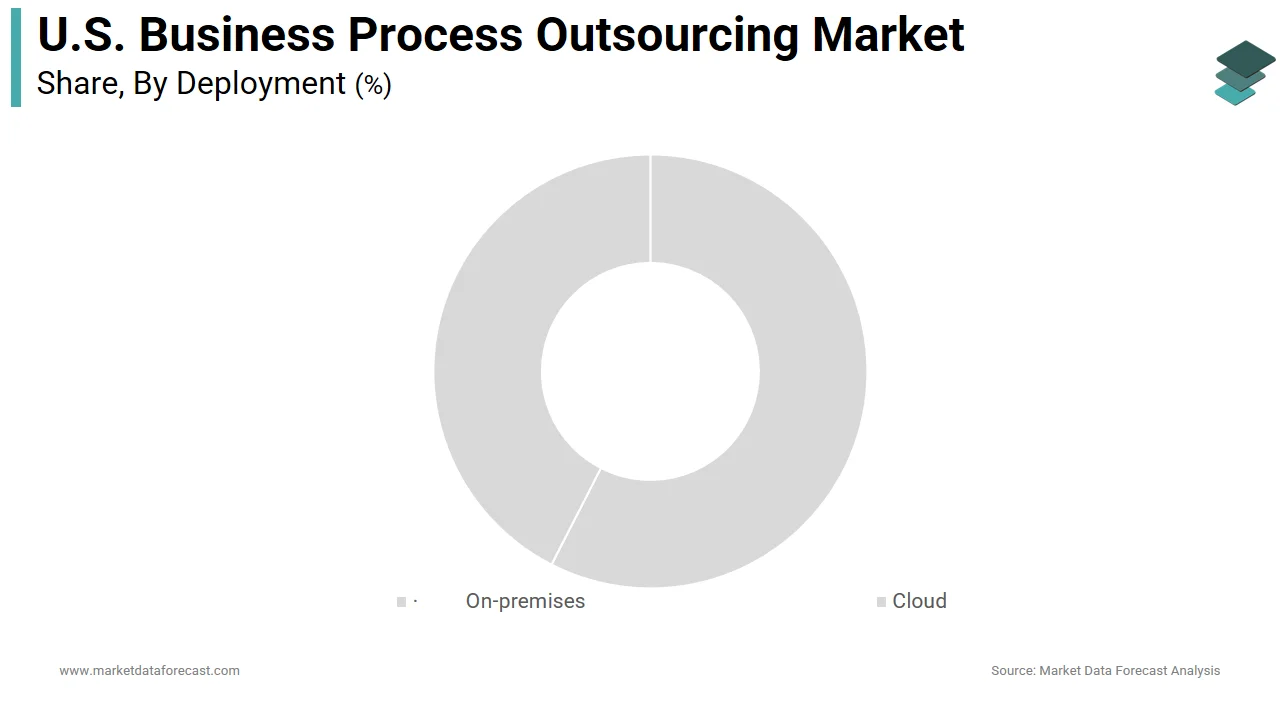
The on-premises deployment segment is likely to witness a fastest CAGR of 8.5% from 2026 to 2034 with the strict regulatory compliance and data sovereignty requirements. Industries, such as defense government and highly regulated financial institutions often mandate that sensitive data remain within physical boundaries controlled directly by the organization. As per the research, federal agencies and contractors must adhere to rigorous security standards, such as FedRAMP, which often favor on premises or private cloud solutions to ensure absolute control over data access. The Health Insurance Portability and Accountability Act also imposes strict guidelines on the storage and transmission of protected health information leading some healthcare providers to prefer on premises infrastructure for critical patient data processing. According to the Department of Defense, concerns about foreign interference and cyber espionage have led to increased investment in secure on premises facilities for handling classified information. This trend is particularly evident in sectors where national security is paramount. The Federal Trade Commission has increased scrutiny on data practices prompting companies to retain tighter control over their information assets. While cloud adoption is widespread the need for uncompromising security and compliance in specific high stakes environments drives the growth of on premises solutions. Organizations are investing in modernizing their local data centers to achieve higher efficiency, while maintaining the isolation required by law. This specialized demand ensures steady growth for on premises deployment in critical sectors.
By Service Type Insights
The customer service segment held a dominant share of the United States business process outsourcing market in 2025 due to the high volume of consumer interactions and the relentless demand for immediate support across various industries. As e-commerce and digital services expand, customers expect 24/7 assistance through multiple channels, including phone chat and social media. The customer service quality is a primary driver of brand loyalty and retention prompting companies to invest heavily in support operations. Outsourcing allows businesses to handle peak volumes efficiently without maintaining oversized internal teams. Additionally, the complexity of modern products and services necessitates specialized knowledge that outsourced agents can provide through targeted training programs. Many customers expect personalized experiences driving the need for sophisticated customer relationship management systems that outsourcing partners manage effectively. Outsourcing providers can tap into diverse talent pools to serve this demographic effectively.
The finance and accounting segment is anticipated to grow at a fastest CAGR of 11.2% from 2026 to 2034 with the increasing regulatory complexity and the need for specialized expertise. The ever-changing of tax laws financial reporting standards and compliance requirements makes it challenging for companies to maintain in house teams with up to date knowledge. The complexity of international tax regulations and the implementation of new accounting standards, such as ASC 606 have increased the demand for external expertise. Outsourcing providers offer access to certified professionals who specialize in regulatory compliance and financial analysis reducing the risk of errors and penalties. According to Deloitte, 70% of CFOs are turning to outsourcing to manage finance functions more efficiently and gain strategic insights. The ability to leverage global talent pools allows companies to access high level expertise at a lower cost than hiring full time specialists. Additionally, the rise of forensic accounting and fraud detection services has expanded the scope of finance outsourcing.
By Outsourcing Type Insights
The offshore outsourcing segment was the largest by holding 44.6% of the United States business process outsourcing market share in 2025 due to the significant cost arbitrage and abundant labor availability in countries, such as India, the Philippines, and Eastern Europe. Companies can achieve substantial savings by leveraging lower wage structures in these regions while maintaining high quality service delivery. The large pool of English speaking professionals in countries like India and the Philippines, ensures that communication barriers are minimized. The Indian IT and business process management sector employs over 5 million people providing a vast reservoir of skilled talent. This availability allows US companies to scale their operations rapidly without facing domestic labor shortages. The maturity of offshore outsourcing markets means that providers have established infrastructure and processes that meet international standards. The International Labour Organization notes that the growth of the service sector in developing nations has created a robust ecosystem for outsourcing. Additionally, the time zone difference enables 24/7 operations allowing US companies to provide round the clock support to their customers. This operational continuity is particularly valuable for customer service and IT support functions.
The nearshore outsourcing segment is likely to grow at a fastest CAGR of 13.5% from 2026 to 2034 with the geographic proximity and cultural alignment with Latin American countries. Locations, such as Mexico, Colombia, and Costa Rica share similar time zones with the United States facilitating real time collaboration and easier communication. The cultural similarities between the US and Latin American countries reduce misunderstandings and improve teamwork compared to offshore arrangements. Trade and investment ties with Latin America have strengthened by creating a favorable environment for nearshore partnerships. The ability to conduct face to face meetings and site visits more easily enhances trust and relationship building. The proximity also allows for faster travel and quicker response times in case of emergencies.
By Industry Insights
The Banking Financial Services and Insurance industry segment was accounted in holding 56.2% of the United States business process outsourcing market share in 2025 due to stringent regulatory requirements and the complexity of its operations. Financial institutions must comply with numerous laws including the Dodd Frank Act and Anti Money Laundering regulations, which require specialized knowledge and meticulous documentation. Outsourcing providers offer dedicated teams of compliance experts, who stay updated on regulatory changes ensuring that institutions avoid penalties. The sheer volume of transactions processed daily necessitates efficient back-office support for loan processing account management and claims handling. Community banks in particular rely on outsourcing to manage operational costs, while maintaining competitive service levels. The insurance sector also benefits from outsourcing for policy administration and claims adjudication, which are labor intensive processes. The National Association of Insurance Commissioners notes that the complexity of health and property insurance claims requires specialized processing capabilities that outsourcing firms provide. The need for accuracy and speed in financial transactions makes outsourcing a strategic necessity.
The healthcare segment is more likely to grow at a fastest CAGR of 14.8% from 2026 to 2034 with the aging population and increasing healthcare utilization. As the baby boomer generation ages, the demand for medical services long term care and insurance coverage rises significantly. As per the United States Census Bureau, the population aged 65 and older is projected to reach 83 million by 2050 creating immense pressure on healthcare providers to manage administrative tasks efficiently. Outsourcing helps hospitals and clinics handle medical coding billing and patient scheduling by allowing clinical staff to focus on patient care. Outsourcing revenue cycle management functions reduces administrative burdens and improves cash flow for healthcare organizations. The complexity of insurance claims and the need for accurate coding to avoid denials drive the demand for specialized outsourcing services.
COMPETITIVE LANDSCAPE
The competition in the United States business process outsourcing market is intense and characterized by the presence of large global integrators specialized niche providers and emerging technology driven firms. Major players differentiate themselves through their ability to offer end to end solutions that combine process expertise with advanced digital technologies. The market sees a shift from traditional cost arbitrage models to value driven partnerships where innovation and strategic insight are paramount. Companies compete on the basis of technological sophistication particularly in artificial intelligence robotic process automation and data analytics. Customer experience enhancement is a key battleground with providers investing in omnichannel support and personalized services. Pricing pressure remains significant but is mitigated by the adoption of outcome based contracting models. Talent acquisition and retention are critical factors as skilled professionals are needed to manage complex processes. Regulatory compliance and data security capabilities serve as important differentiators especially in highly regulated industries like healthcare and finance. Mergers and acquisitions are common as firms seek to expand their service portfolios and geographic reach.
KEY MARKET PLAYERS
Some of the companies that are playing a dominating role in the U.S. business process outsourcing market include
- Accenture
- WNS (Holdings)
- Teleperformance SE
- TTEC Holdings, Inc.
- Wipro Limited
- Cognizant
- Infosys BPM
- Transcom
- Concentrix Corporation
- HCL Technologies Limited
- Foundever
- IBM Corporation
- Alorica
- Genpact
- TaskUs
- Sutherland
- Conduent
- EXL Service
- Startek
- Atento
- Capita
TOP PLAYERS IN THE MARKET
- Accenture plc is a global professional services company that plays a pivotal role in the United States business process outsourcing market by integrating digital technology with operational expertise. The company offers comprehensive outsourcing solutions across finance human resources and customer service leveraging advanced analytics and artificial intelligence. Recent actions include significant investments in cloud-based platforms and automation tools to enhance service delivery efficiency for clients. Accenture actively partners with major technology providers to develop innovative solutions that drive digital transformation. The company focuses on upskilling its workforce to handle complex knowledge process outsourcing tasks.
- IBM Corporation contributes significantly to the US BPO market through its robust portfolio of IT enabled services and cognitive computing solutions. The company leverages its Watson artificial intelligence platform to automate routine tasks and provide predictive insights for clients in various industries. Recent strategies involve expanding its hybrid cloud capabilities to support secure and scalable outsourcing operations. IBM focuses on transforming traditional business processes into intelligent workflows that enhance decision making and operational efficiency. The company actively collaborates with enterprises to modernize their legacy systems and integrate advanced data analytics. By offering specialized services in cybersecurity and regulatory compliance IBM addresses critical needs for financial and healthcare sectors. These efforts reinforce its reputation as a trusted partner for complex and technology driven outsourcing requirements.
- Cognizant Technology Solutions is a leading provider of business process outsourcing services in the United States with a strong focus on healthcare life sciences and financial services. The company utilizes its deep domain expertise to deliver tailored solutions that improve client outcomes and operational performance. Recent actions include the acquisition of specialized firms to enhance its capabilities in digital engineering and data analytics. Cognizant invests heavily in automation technologies to streamline back office operations and reduce manual errors. The company emphasizes a collaborative approach working closely with clients to design and implement efficient processes. These initiatives help the company maintain a competitive edge by offering high quality and cost effective outsourcing services.
TOP STRATEGIES USED BY KEY MARKET PARTICIPANTS
Key players in the United States business process outsourcing market primarily focus on integrating artificial intelligence and automation to enhance operational efficiency and reduce costs. Companies invest heavily in upskilling their workforce to handle complex knowledge intensive tasks and provide higher value services. Strategic acquisitions of niche technology firms enable providers to expand their capabilities in data analytics and digital transformation. Partnerships with cloud computing giants facilitate the deployment of scalable and secure infrastructure for clients. Emphasis on industry specific solutions allows vendors to address unique regulatory and operational challenges in sectors like healthcare and finance. Nearshoring strategies are adopted to balance cost savings with cultural alignment and time zone compatibility. Continuous innovation in customer experience management through omnichannel support drives client retention. Robust cybersecurity measures are implemented to protect sensitive data and ensure compliance with strict regulations. These strategies collectively strengthen market position and drive sustainable growth in a competitive landscape.
MARKET SEGMENTATION
This research report on the U.S. business process outsourcing market has been segmented and sub-segmented into the following categories.
By Deployment
- On-premises
- Cloud
By Service Type
- Customer Service
- Finance & Accounting
- Human Resource
- Sales & Marketing
- Others (Training and Development Outsourcing, Logistics, etc.)
By Outsourcing Type
- Onshore
- Nearshore
- Offshore
By Industry
- BFSI
- Healthcare
- Manufacturing
- IT & Telecom
- Retail
- Others (Government and Defense)
By Country
- New York
- Texas
- Florida
- Georgia
- California
- Rest of U.S.
Frequently Asked Questions
What is the U.S. business process outsourcing market?
The U.S. business process outsourcing market contracts third-party providers for customer service, finance, HR, and back-office functions to improve efficiency.
How does the U.S. business process outsourcing market function?
The U.S. business process outsourcing market transfers processes to specialized firms using SLAs, technology platforms, and performance metrics.
What drives growth in the U.S. business process outsourcing market?
The U.S. business process outsourcing market grows from cost pressures, digital transformation needs, and demand for specialized expertise.
Which services lead the U.S. business process outsourcing market?
Customer service and finance/accounting dominate the U.S. business process outsourcing market for scalable support and compliance needs.
What is customer service BPO in the U.S. business process outsourcing market?
Customer service BPO handles calls, chats, and support tickets in the U.S. business process outsourcing market using omnichannel platforms.
How important is finance BPO in the U.S. business process outsourcing market?
Finance BPO manages accounts payable, receivable, and reporting in the U.S. business process outsourcing market for accuracy and compliance.
What role does HR outsourcing play in the U.S. business process outsourcing market?
HR outsourcing covers payroll, recruiting, and benefits administration in the U.S. business process outsourcing market for streamlined operations.
What are nearshore vs offshore in the U.S. business process outsourcing market?
Nearshore uses nearby countries while offshore leverages cost-effective global locations in the U.S. business process outsourcing market.
What trends shape the U.S. business process outsourcing market?
AI automation, robotic process automation, and analytics drive innovation in the U.S. business process outsourcing market.
What challenges face the U.S. business process outsourcing market?
Data security, quality control, and cultural alignment challenge relationships in the U.S. business process outsourcing market.
Related Reports
Access the study in MULTIPLE FORMATS
Purchase options starting from
$ 1200
Didn’t find what you’re looking for?
TALK TO OUR ANALYST TEAM
Need something within your budget?
NO WORRIES! WE GOT YOU COVERED!
Call us on: +1 888 702 9696 (U.S Toll Free)
Write to us: sales@marketdataforecast.com