U.S. Higher Education Market Size, Share, Trends & Growth Forecast Report By Learning Method, End User, Courses, and By Country (California, Washington, Oregon, New York & Rest of the United States) – Industry Analysis and Forecast, 2026 to 2034
U.S. Higher Education Market Report Summary
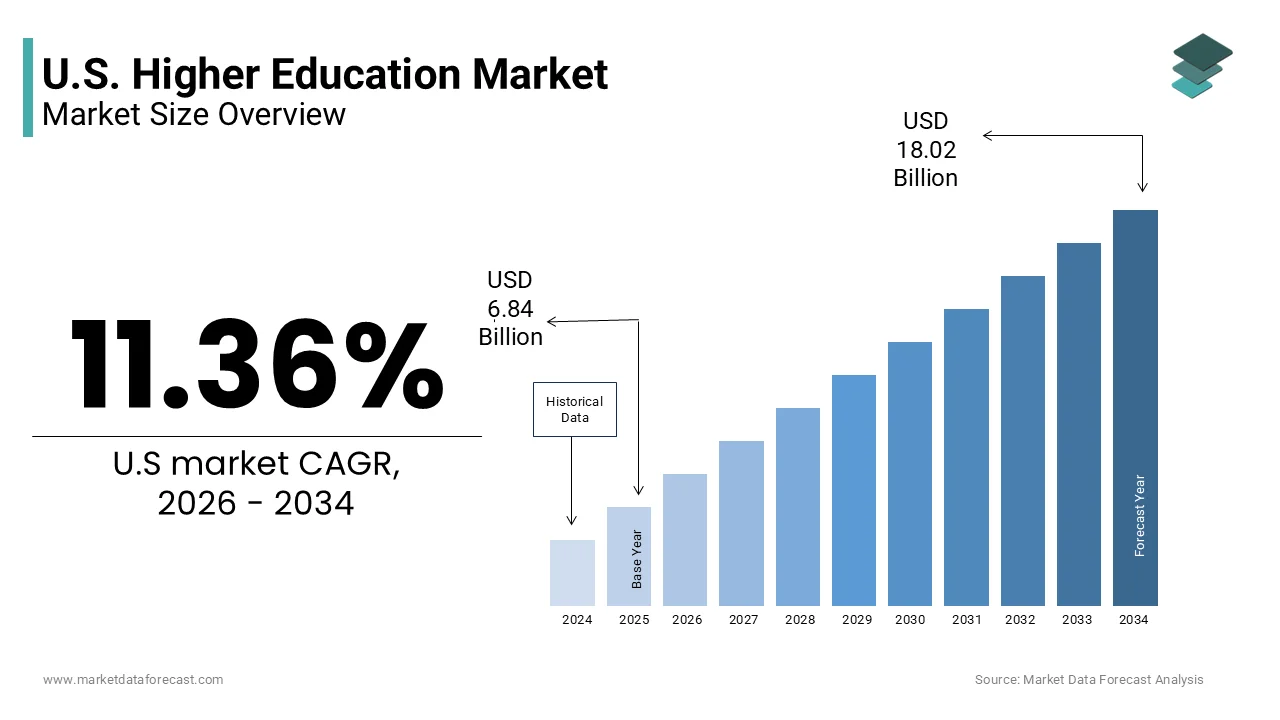
The U.S. higher education market was valued at USD 6.84 billion in 2025, is estimated to reach USD 7.62 billion in 2026, and is projected to reach USD 18.02 billion by 2034, growing at a CAGR of 11.36% during the forecast period. Market growth is driven by increasing demand for advanced education, rising adoption of digital learning technologies, and growing emphasis on workforce ready skills and professional development. Higher education institutions are expanding online and hybrid learning models to improve accessibility and student engagement. The increasing integration of AI powered learning platforms, personalized education tools, and global academic collaborations is further supporting strong market growth across the United States.
Key Market Trends
- Rising demand for career focused and skill based education is driving market growth.
- Increasing adoption of digital and hybrid learning models is boosting higher education enrollment.
- Growing emphasis on workforce readiness and lifelong learning is supporting market expansion.
- Expansion of AI driven learning platforms and virtual classrooms is enhancing educational accessibility.
- Innovation in personalized learning, online certifications, and flexible degree programs is influencing market development.
Segmental Insights
- Based on learning method, the offline learning segment accounted for 46.3% of the U.S. higher education market share in 2025. This dominance is attributed to continued demand for traditional campus experiences, direct faculty interaction, and hands on academic engagement.
- Based on end user, the state universities segment held 56.7% of the U.S. higher education market share in 2025, driven by strong enrollment capacity, government funding support, and broad academic offerings.
- Based on courses, the undergraduate programs segment accounted for 36.8% of the U.S. higher education market share in 2025, supported by increasing student enrollment in bachelor degree programs across multiple disciplines.
Regional Insights
- The U.S. higher education market is experiencing strong growth across public and private institutions, supported by rising demand for advanced education, expanding online learning infrastructure, and increasing international student participation. The integration of digital learning technologies and industry aligned curriculum development is further strengthening market expansion.
Competitive Landscape
The U.S. higher education market is highly competitive, with institutions focusing on digital transformation, research excellence, and expansion of flexible learning programs to strengthen their market position. Universities are investing in online education platforms, AI powered learning systems, and strategic industry partnerships. Prominent institutions in the U.S. higher education market include Massachusetts Institute of Technology, Stanford University, Southern New Hampshire University, Harvard University, California Institute of Technology, University of Chicago, Princeton University, Columbia University, University of Phoenix, University of Pennsylvania, Yale University, University of California, Berkeley, University of California Los Angeles, University of Michigan Ann Arbor, Purdue University Global, Johns Hopkins University, Northwestern University, and New York University.
U.S. Higher Education Market Size
The U.S. higher education market size was valued at USD 6.84 billion in 2025, is estimated to reach USD 7.62 billion in 2026, and is projected to reach USD 18.02 billion by 2034, growing at a CAGR of 11.36% from 2026 to 2034.
The higher education is an ecosystem of public and private institutions dedicated to postsecondary learning, research, and workforce development. The social mobility and economic innovation, encompassing community colleges, four year universities, and specialized graduate schools. As per the National Center for Education Statistics, approximately 18.9 million students were enrolled in degree granting postsecondary institutions in the fall of 2022. The significant diversity in institutional mission and student population, with community colleges serving nearly 40% of all undergraduate students, according to the American Association of Community Colleges. Furthermore, the sector contributes substantially to national research output, with academic institutions by accounting for more than 50% of basic research expenditures in the country, as stated by the National Science Foundation. The definition of this market extends beyond traditional classroom instruction to include online learning platforms and continuing education programs that cater to nontraditional learners.
MARKET DRIVERS
Escalating Demand for Specialized Workforce Credentials
The persistent requirement for specialized skills in the modern economy drives sustained demand for higher education credentials, which is a major factor fuelling the growth of the United States higher education market. Employers increasingly prioritize candidates with postsecondary degrees for entry level positions that previously required only a high school diploma. According to the Georgetown University Center on Education and the Workforce, 65% of all jobs in the United States will require some form of postsecondary education or training by 2025. The technology and healthcare sectors exemplify this trend, where rapid advancements create continuous demand for workers with specific technical knowledge. As per the Bureau of Labor Statistics, occupations in healthcare support and computer and information technology are projected to grow much faster than the average for all occupations through 2032. These fields typically mandate at least an associate or bachelor’s degree for professional entry. Consequently, students view higher education as a vital investment in their future earning potential. This economic incentive fuels enrollment in programs aligned with high growth industries. Institutions respond by expanding curricula in data science, nursing, and renewable energy technologies.
Expansion of Nontraditional and Adult Learner Populations
The demographic composition of the student body is shifting dramatically toward nontraditional and adult learners who seek flexibility and career advancement. The expansion of non-traditional and adult learner populations is greatly influencing the growth of the United States education market. As per the National Center for Education Statistics, students aged 25 and older accounted for approximately 40% of total postsecondary enrollment in recent years. The need for upskilling and reskilling in a rapidly changing economy motivates these individuals to return to academia. According to the Lumina Foundation, more than 11 million adults in the United States have some college credit but no degree, representing a substantial pool of potential re entrants. Institutions are adapting by offering competency based education models that allow students to progress at their own pace. This approach appeals to working professionals who wish to leverage prior experience toward credential completion. The rise of micro credentials and certificate programs that further supports by providing targeted skill acquisition without the commitment of a full degree. The enrollment in nondegree credential programs has grown steadily as employers recognize the value of specialized training. This trend diversifies revenue streams for institutions and broadens access to higher education.
MARKET RESTRAINTS
Burden of Student Loan Debt and Affordability Concerns
The escalating cost of tuition and the resulting burden of student loan debt serve is hindering the growth of the United States high education market. As per the Institute for College Access and Success, the average cumulative debt for borrowers in the class of 2022 was approximately 29,000 dollars. This financial obligation discourages prospective students from enrolling and forces current students to reduce their course loads or drop out entirely. High debt levels also influence major selection, with students prioritizing high earning potential over personal interest or societal need. The Federal Reserve reports that total outstanding student loan debt in the United States exceeds 1.7 trillion dollars, affecting millions of households and delaying major life milestones, such as home ownership. This economic pressure creates a perception of higher education as a risky financial investment rather than a guaranteed path to prosperity. Public confidence in the value of a degree has waned among certain demographics due to these affordability issues. State funding reductions have exacerbated the problem by forcing public institutions to raise tuition rates to compensate for lost revenue. The state appropriations per student have declined in real terms over the past decade in many regions. This trend shifts the financial burden directly onto students and families by limiting access for low income populations and constraining overall market expansion.
Declining Demographic Trends and Enrollment Pressures
A shrinking pool of traditional college age students to enrollment stability and institutional sustainability is additionally hindering the growth of the United States higher education market. As per the Western Interstate Commission for Higher Education, the number of high school graduates in the United States is projected to decline by nearly 15% between 2025 and 2029. This demographic cliff results from lower birth rates following the 2008 financial crisis and shifting population dynamics. Institutions that rely heavily on first time freshmen face intense competition for a smaller cohort of applicants. This decline disproportionately affects small private colleges and regional public universities that lack the brand recognition or financial resources to attract nontraditional students. The geographic distribution of high school graduates is also changing with growth concentrated in the South and West, while the Northeast and Midwest experience declines. The states like California and Texas will see increases in graduates, but many other states will face steep drops. This imbalance forces institutions to expand their recruitment reach nationally or internationally, increasing marketing costs and operational complexity. Some colleges have responded by merging or closing academic programs to reduce expenses.
MARKET OPPORTUNITIES
Integration of Artificial Intelligence in Academic Operations
The adoption of artificial intelligence for enhancing administrative efficiency and personalized learning experiences is creating new opportunities for the growth of the United States higher education market. Institutions are leveraging AI tools to streamline admissions processes, provide academic advising, and detect plagiarism. AI driven analytics enable universities to identify at risk students early and intervene with targeted support services, thereby improving retention rates. This technology allows for the customization of educational content to match individual learning styles and paces, which enhances student engagement and outcomes. The use of chatbots for customer service reduces the workload on administrative staff and provides immediate responses to student inquiries around the clock. As per the source, more than 60% of academic leaders believe that AI will have a significant impact on teaching and learning within the next five years. This shift encourages the development of new curricula focused on data literacy and ethical AI usage, preparing students for a technology driven workforce. Institutions that successfully integrate these tools can differentiate themselves in a competitive market by offering superior student support and operational efficiency. The potential for AI to automate routine tasks frees faculty to focus on high value interactions and research activities. Furthermore, adaptive learning platforms powered by machine learning algorithms can assess student performance in real time and adjust instructional materials accordingly. This capability supports scalable education models that maintain quality while accommodating larger and more diverse student populations. The strategic implementation of AI thus offers a pathway for institutions to modernize their operations and enhance educational delivery.
Growth of Micro Credentials and Alternative Certification
The rising acceptance of micro credentials and alternative certifications, among lifelong learners and corporate partners is also to promote new opportunities for the growth of the United states higher education market. As per the Credential Engine, there are over 700,000 distinct types of credentials available in the United States, indicating a fragmented but vibrant ecosystem. Universities are responding by developing short term, stackable programs that lead to industry recognized certificates in fields, such as cybersecurity, project management, and digital marketing. These programs appeal to professionals seeking to update their skills without committing to a multi-year degree program. The American Association of Collegiate Registrars and Admissions Officers notes that micro credentials provide a flexible and affordable alternative to traditional degrees, aligning closely with employer needs. Corporate partnerships facilitate the creation of tailored curricula that address specific skill gaps in the workforce, creating a steady revenue stream for institutions. This trend allows universities to extend their brand reach beyond traditional campus boundaries and engage with a global audience. The modular nature of micro credentials enables learners to accumulate credits over time, potentially leading to a full degree. This flexibility attracts nontraditional students who value practical skills and immediate applicability.
MARKET CHALLENGES
Faculty Shortages and Retention Difficulties
The recruiting and retaining qualified faculty members, across various disciplines is to pose a major challenge for the growth of the United States higher education market. As per the Chronicle of Higher Education, many institutions report difficulties in filling tenure track positions due to competitive salaries in industry and demanding academic requirements. This reliance on contingent labor affects educational quality and institutional stability, as adjuncts often lack the resources and support necessary for effective teaching and mentorship. The burnout rate among faculty has increased due to heightened expectations for research output, teaching excellence, and service commitments. A survey by the Collaborative on Academic Careers in Higher Education found that nearly 40% of faculty members considered leaving academia due to stress and workload pressures. The shortage is particularly acute in STEM fields, where industry salaries far exceed academic compensation packages. The wage gap between academia and industry for scientists and engineers continues to widen by making it difficult for universities to attract top talent. This disparity limits the ability of institutions to offer cutting edge courses and conduct innovative research. The lack of stable faculty positions also undermines shared governance and academic freedom, which are foundational principles of higher education. Addressing this challenge requires structural reforms in compensation, workload distribution, and career pathways to ensure the long term viability of the academic profession.
Cybersecurity Threats and Data Privacy Risks
The universities are increasingly vulnerable to cyberattacks that compromise sensitive student and research data by posing a severe operational and reputational risk, which is also a factor to decline the growth of the United States higher education market. As per the Identity Theft Resource Center, the education sector experienced the highest number of data breaches of any industry in 2023, with over 700 incidents reported. These attacks often target personally identifiable information, financial records, and intellectual property, resulting in significant financial losses and legal liabilities. The decentralized nature of university IT infrastructure, with numerous departments managing independent systems, creates multiple entry points for malicious actors. The ransomware attacks have become more sophisticated and frequent by disrupting classes and administrative functions for weeks or months. The cost of recovering from these incidents includes ransom payments, forensic investigations, and enhanced security measures, straining already tight budgets. Institutions must invest heavily in cybersecurity infrastructure and training to protect their digital assets, yet many lack the specialized expertise required to manage these complex threats.
REPORT COVERAGE
| REPORT METRIC | DETAILS |
| Market Size Available | 2025 to 2034 |
| Base Year | 2025 |
| Forecast Period | 2026 to 2034 |
| CAGR | 11.36% |
| Segments Covered | By Learning Method, End User, Courses, and Region. |
| Various Analyses Covered | Global, Regional and Country-Level Analysis, Segment-Level Analysis, Drivers, Restraints, Opportunities, Challenges; PESTLE Analysis; Porter’s Five Forces Analysis, Competitive Landscape, Analyst Overview of Investment Opportunities |
| Countries Covered | California, Washington, Oregon, New York, United States |
| Market Leaders Profiled | Massachusetts Institute of Technology (MIT), Stanford University, Southern New Hampshire University, Harvard University, California Institute of Technology (Caltech), University of Chicago, Princeton University, Columbia University, University of Phoenix, University of Pennsylvania, Yale University, University of California, Berkeley (UC Berkeley), University of California Los Angeles (UCLA), University of Michigan Ann Arbor, Purdue University Global, Johns Hopkins University, Northwestern University, and New York University (NYU) |
SEGMENTAL ANALYSIS
By Learning Method Insights
The offline learning segment was the largest by holding 46.3% of the United States higher education market share in 2025 due to the deeply entrenched infrastructure of physical campuses and the perceived superior value of face-to-face interaction. As per the National Center for Education Statistics, the majority of postsecondary institutions continue to operate primarily on residential models, with over 15 million students enrolled in courses that require physical attendance. The comprehensive campus experience, which includes access to laboratories, libraries, and networking opportunities that are difficult to replicate digitally. Physical presence facilitates hands on training in fields, such as medicine, engineering, and the arts, where tactile skills are essential. Furthermore, alumni networks and donor relationships are often strengthened through on campus engagement, providing financial stability for institutions.
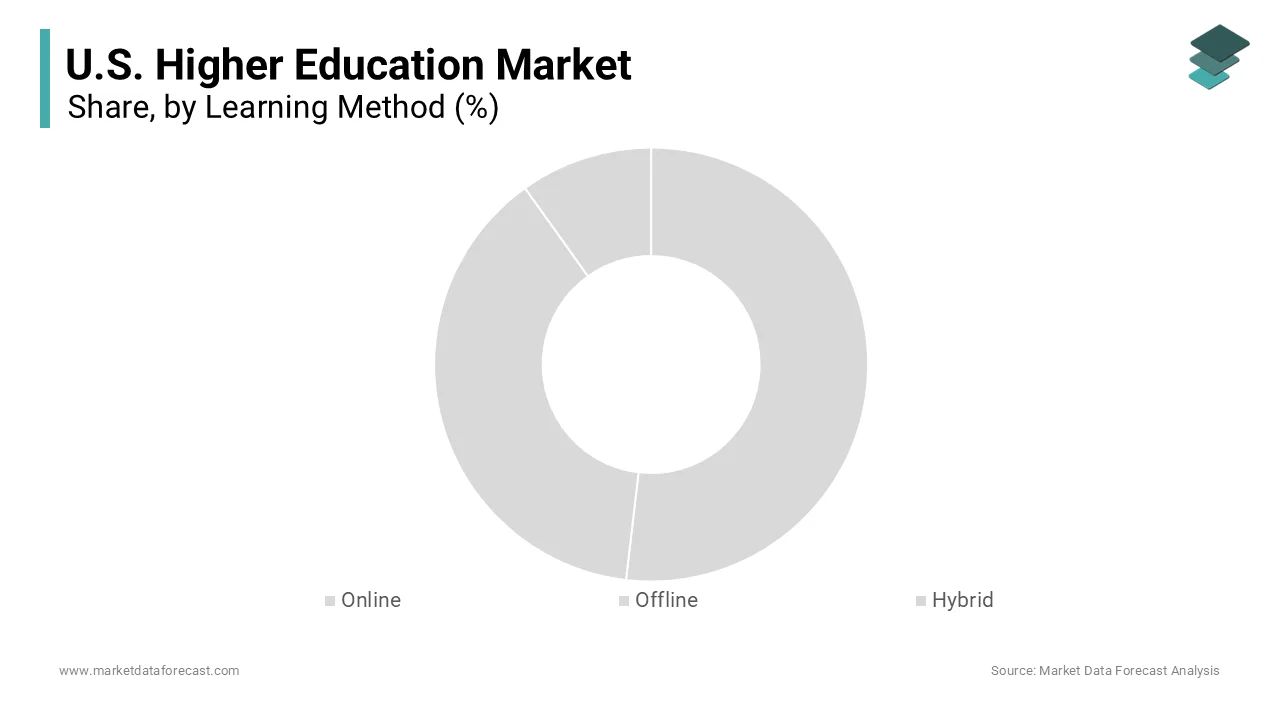
The hybrid learning segment is expected to grow at an anticipated CAGR of 12.5% from 2026 to 2034 with the increasing demand for flexibility among nontraditional students, who balance education with work and family responsibilities. As per the Babson Survey Research Group, over 60% of academic leaders report that hybrid models improve student retention and satisfaction by offering customizable learning paths. The integration of advanced learning management systems allows institutions to seamlessly blend online content with occasional in person sessions, optimizing resource utilization. The adoption of hybrid formats has become a strategic priority for universities aiming to broaden their reach without expanding physical infrastructure. Hybrid programs also reduce commuting costs and timeby making higher education more accessible to rural and underserved populations. The COVID 19 pandemic accelerated the development of hybrid capabilities, with institutions investing heavily in digital tools and faculty training.
By End User Insights
The state universities segment was accounted in holding 56.7% of the United States higher education market share in 2025 due to their extensive enrollment capacity and mandate to provide accessible education to state residents. As per the National Center for Education Statistics, public four year institutions enroll approximately 60% of all undergraduate students in the country. This dominance is driven by lower tuition rates for in state students by making them the preferred choice for cost conscious families. The average published tuition and fees at public four year in state institutions are significantly lower than those at private nonprofit colleges by attracting a broad demographic base. State universities also benefit from consistent government appropriations, which support large scale research initiatives and diverse academic programs. Their large alumni networks and strong regional reputations enhance graduate employability, further driving enrollment. Additionally, state universities often serve as economic anchors for their communities, fostering partnerships with local industries.
The community colleges segment is lucratively grow at a fastest CAGR of 8.2% throughout the forecast period with the increasing emphasis on vocational training and affordable pathways to employment. As per the American Association of Community Colleges, enrollment in certificate and associate degree programs has risen by 15% in recent years as students seek quicker entry into the labor sector. The affordability of community colleges makes them an attractive option for low income and first-generation students, with tuition rates averaging one third of those at four year institutions according to the College Board. Employers increasingly recognize the value of technical skills taught in these programs, particularly in healthcare, manufacturing, and information technology. The Bureau of Labor Statistics projects that occupations requiring an associate degree will grow faster than the national average, reinforcing the relevance of community college curricula. Furthermore, articulation agreements with four year universities allow students to transfer credits seamlessly, providing a cost effective route to bachelor’s degrees. State investments in workforce development initiatives also support this growth, with many states expanding funding for short term credential programs.
By Courses Insights
The undergraduate programs segment was accounted in holding 36.8% of the United States higher education market share in 2025. The growth of the segment is also driven by the broad accessibility of undergraduate education across diverse institution types, from community colleges to research universities. According to the Georgetown University Center on Education and the Workforce, 65% of jobs in the United States now require postsecondary education, compelling high school graduates to pursue undergraduate degrees. The widespread availability of federal financial aid, including Pell Grants and student loans, facilitates access for millions of students. Undergraduate programs also serve as a pipeline for graduate studies with many students viewing them as a necessary stepping stone. The diversity of majors available, ranging from liberal arts to STEM fields that attracts a wide range of interests and career aspirations.
The masters programs segment is likely to grow at a fastest CAGR of 9.5% from 2026 to 2034 with the increasing need for specialized knowledge and career advancement in competitive job. Professionals seek masters degrees to pivot careers or gain expertise in emerging fields, such as data analytics, cybersecurity, and healthcare administration. Online and part time masters programs have further accelerated growth by accommodating working professionals. The demand for business and technology focused masters programs remains robust, with employers actively recruiting candidates with advanced credentials. The rise of stackable credentials allows students to earn certificates that apply toward a masters degree, reducing time and cost. The number of masters degrees conferred annually has reached record highs by reflecting the shifting value proposition of graduate education.
COMPETITIVE LANDSCAPE
The competition in the United States higher education market is intense and characterized by a diverse array of public and private institutions vying for student enrollment. Universities differentiate themselves through academic reputation program diversity and technological innovation. Public institutions leverage state funding to offer affordable tuition while private colleges emphasize personalized attention and exclusive networks. Online providers compete on flexibility and cost effectiveness targeting adult learners and working professionals. The rise of alternative credentials has intensified pressure on traditional degree programs to demonstrate clear return on investment. Institutions invest significantly in marketing and recruitment strategies to attract domestic and international students. Technological adoption serves as a key differentiator with leaders implementing artificial intelligence and adaptive learning tools. Partnerships with industry partners enhance employability outcomes and strengthen institutional relevance. Financial accessibility remains a critical factor influencing student choice amidst rising debt concerns. Regional demographics shape competitive dynamics as some areas face declining populations while others experience growth. The market continues to evolve with institutions adapting to changing learner preferences and economic conditions. Collaboration and consolidation emerge as viable strategies for sustaining operational viability and enhancing educational quality in this dynamic environment.
KEY MARKET PLAYERS
Some of the companies that are playing a dominating role in the U.S. higher education market are
- Massachusetts Institute of Technology (MIT)
- Stanford University
- Southern New Hampshire University
- Harvard University
- California Institute of Technology (Caltech)
- University of Chicago
- Princeton University
- Columbia University
- University of Phoenix
- University of Pennsylvania
- Yale University
- University of California, Berkeley (UC Berkeley)
- University of California Los Angeles (UCLA)
- University of Michigan Ann Arbor
- Purdue University Global
- Johns Hopkins University
- Northwestern University
- New York University (NYU)
Top Players in the Market
- Southern New Hampshire University has emerged as a dominant force in online higher education by prioritizing accessibility and affordability for adult learners. The institution leverages advanced digital platforms to deliver flexible degree programs that cater to working professionals across the nation. Recent actions include significant investments in artificial intelligence tools to personalize student support and streamline administrative processes. This strategic focus on technology enhances retention rates and improves the overall learner experience. The university actively partners with employers to create tailored educational pathways that align with industry needs. These initiatives strengthen its position as a leader in innovative distance education.
- University of Phoenix specializes in serving adult learners and working professionals through comprehensive online and campus based programs. The institution focuses on career relevant education by aligning its curriculum with current labor market demands. Recent efforts involve enhancing its digital learning environment with interactive tools and real time feedback mechanisms. The university has expanded its portfolio of short term certificates and micro credentials to address the need for rapid upskilling. Strategic partnerships with major corporations enable the delivery of customized training solutions that benefit both employees and employers. University of Phoenix continues to invest in faculty development to ensure high quality instruction across all disciplines. Its emphasis on practical skills and professional advancement attracts individuals seeking to enhance their career prospects. This approach reinforces its role as a key provider of accessible higher education opportunities.
- Purdue University Global operates as a leading online institution dedicated to providing affordable and flexible education to adult students. The university leverages the prestigious brand of Purdue University to offer credible and high quality degree programs. Recent actions include the expansion of its subscription based learning model which allows students to take multiple courses for a flat fee. This innovative pricing strategy reduces financial barriers and encourages faster degree completion. The institution has also strengthened its corporate partnerships to develop specialized training programs for workforce development. The university continuously updates its course offerings to reflect emerging trends in technology and business. Its commitment to student success is evident in the comprehensive support services provided throughout the academic journey. These strategies enhance its competitiveness and appeal to nontraditional learners seeking value and flexibility.
Top Strategies Used by Key Market Participants
Key players in the United States higher education market primarily employ digital transformation strategies to enhance accessibility and operational efficiency. Institutions invest heavily in online learning platforms and hybrid models to accommodate diverse student needs. Strategic partnerships with corporations facilitate the creation of tailored programs that align with industry requirements. Universities increasingly adopt competency based education to allow flexible pacing and recognize prior learning experiences. Expansion into micro credentials and certificate programs addresses the demand for short term skill acquisition. Data analytics are utilized to personalize student support and improve retention rates through early intervention. Mergers and acquisitions enable institutions to consolidate resources and expand their geographic reach. Brand differentiation is achieved through specialized research initiatives and unique academic offerings. Financial aid optimization and transparent pricing models help attract cost conscious students. Continuous curriculum updates ensure relevance in rapidly evolving job markets.
MARKET SEGMENTATION
This research report on the U.S. higher education market is segmented and sub-segmented into the following categories.
By Learning Method
- Online
- Offline
- Hybrid
By End User
- Private colleges
- State universities
- Community colleges
By Courses
- Undergraduate
- Masters
- PhD
By Country
- California
- Washington
- Oregon
- New York
- Rest of the United States
Frequently Asked Questions
1. What is the U.S. higher education market?
The U.S. higher education market includes colleges, universities, community colleges, online education providers, and other institutions offering undergraduate, postgraduate, and professional education programs.
2. What factors are driving the growth of the U.S. higher education market?
Increasing demand for advanced skills, rising enrollment in online learning programs, technological advancements, and growing emphasis on career oriented education are key growth drivers.
3. What types of institutions are included in the higher education market?
The market includes public universities, private colleges, community colleges, vocational institutions, research universities, and online learning platforms.
4. How is online learning influencing the U.S. higher education market?
Online learning is expanding access to education through flexible schedules, remote learning opportunities, digital classrooms, and lower geographic barriers for students.
5. Which programs are most popular in higher education institutions?
Popular programs include business management, computer science, healthcare, engineering, data science, finance, and social sciences.
6. What role does technology play in higher education?
Technologies such as artificial intelligence, virtual classrooms, learning management systems, and data analytics are improving teaching methods and student engagement.
7. What challenges affect the U.S. higher education market?
Challenges include rising tuition costs, student debt concerns, enrollment fluctuations, faculty shortages, and competition from alternative learning platforms.
8. How are universities addressing workforce demands?
Institutions are partnering with industries, offering skill based certifications, expanding internship opportunities, and updating curricula to match labor market requirements.
9. How is the demand for professional certifications impacting the market?
Growing demand for upskilling and career advancement is increasing enrollment in certificate programs, executive education, and short term professional courses.
10. What is the future outlook of the U.S. higher education market?
The market is expected to grow steadily due to digital transformation, rising adoption of hybrid learning models, increasing global student mobility, and demand for specialized skills.
Related Reports
Access the study in MULTIPLE FORMATS
Purchase options starting from
$ 1200
Didn’t find what you’re looking for?
TALK TO OUR ANALYST TEAM
Need something within your budget?
NO WORRIES! WE GOT YOU COVERED!
Call us on: +1 888 702 9696 (U.S Toll Free)
Write to us: sales@marketdataforecast.com