U.S Industrial Waste Management Market Size, Share, Trends & Growth Forecast Report - Segmented By Waste, Service, and By Country (California, Washington, Oregon, New York & Rest of the United States) – Industry Analysis and Forecast, 2026 to 2034
Market Size, 2025
$0.45 BnMarket Estimate, 2026
$0.46 BnMarket Forecast, 2034
$0.62 BnCAGR, 2026–2034
4.07%U.S. Industrial Waste Management Market Report Summary
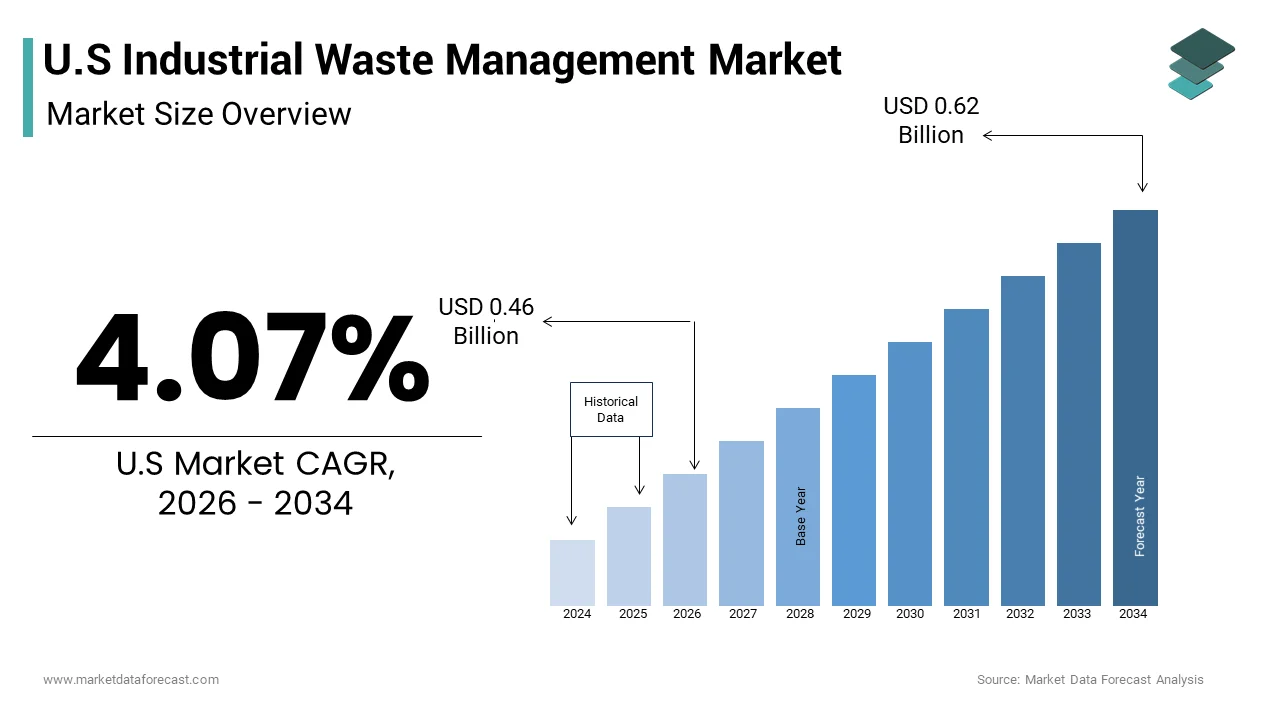
The U.S. industrial waste management market was valued at USD 0.45 billion in 2025, is estimated to reach USD 0.46 billion in 2026, and is projected to reach USD 0.62 billion by 2034, expanding at a CAGR of 4.07% during the forecast period from 2026 to 2034. The U.S. industrial waste management market is evolving steadily as industries strengthen their focus on environmental compliance, resource efficiency, and sustainable waste disposal practices. Stringent federal and state regulations governing hazardous and non-hazardous industrial waste, coupled with growing investments in circular economy initiatives, are driving demand for advanced waste management solutions. Rapid industrialization, infrastructure development, and increasing volumes of construction, manufacturing, and processing waste are further supporting market growth. In addition, the adoption of recycling technologies, waste-to-energy systems, digital waste tracking, and integrated waste management services is enabling industries to reduce environmental impact while improving operational efficiency.
Key Market Trends
- Circular economy strategies are encouraging industries to prioritize waste reduction, material recovery, and resource reuse across manufacturing operations.
- Digital technologies, including smart waste tracking and data-driven monitoring systems, are improving waste collection efficiency and regulatory compliance.
- Growing investments in recycling infrastructure and waste-to-energy facilities are supporting sustainable industrial waste management practices.
- Increasing environmental regulations are accelerating the adoption of compliant treatment, transportation, and disposal solutions across industrial sectors.
- Companies are expanding integrated waste management services that combine collection, recycling, treatment, and disposal under a single operational framework.
Segmental Insights
Based on waste type, the construction and demolition waste segment accounted for 33.9% of the U.S. industrial waste management market share in 2025. The segment's leadership is driven by ongoing infrastructure expansion, commercial redevelopment projects, and increasing construction activities that generate significant volumes of recyclable and disposable materials.
Based on service, the landfill segment held 49.1% of the U.S. industrial waste management market share in 2025. Despite growing recycling initiatives, landfill services continue to dominate due to their extensive infrastructure, cost-effectiveness for certain waste streams, and ability to manage large volumes of industrial waste that cannot be economically recovered or recycled.
Regional Insights
The United States occupies a leading position in the global industrial waste management industry, supported by its extensive industrial base, mature environmental regulatory framework, and advanced waste treatment infrastructure. Strong enforcement of environmental regulations, rising investments in sustainable waste processing technologies, and increasing adoption of circular economy principles continue to shape market development. The country's well-established network of recycling facilities, hazardous waste treatment centers, and integrated waste management providers enables efficient handling of diverse industrial waste streams. As industries continue to prioritize sustainability, regulatory compliance, and resource optimization, the United States is expected to maintain its leadership in industrial waste management throughout the forecast period.
Competitive Landscape
The U.S. industrial waste management market is characterized by intense competition among global environmental service providers, waste management companies, and specialized hazardous waste treatment firms. Leading market participants are investing in advanced recycling technologies, waste-to-energy facilities, digital waste tracking systems, and environmentally responsible disposal solutions to strengthen their market positions. Strategic acquisitions, expansion of treatment and recycling capacities, and partnerships with industrial customers are enabling companies to broaden their service portfolios and improve operational efficiency. Sustainability initiatives, regulatory compliance expertise, and innovation in resource recovery technologies remain major competitive differentiators. As industries increasingly focus on reducing environmental impact and maximizing material recovery, companies are enhancing integrated waste management capabilities to deliver comprehensive, cost-effective, and sustainable solutions.
Prominent players in the U.S. industrial waste management market include Veolia (France), SUEZ (France), Covanta (U.S.), Waste Management Inc. (U.S.), Stericycle (U.S.), Daiseki Co., Ltd. (Japan), Clean Harbors Inc. (U.S.), REMONDIS SE & Co. KG (Germany), Biffa (U.K.), Sembcorp (Singapore), and Republic Services, Inc. (U.S.).
U.S Industrial Waste Management Market Size
The U.S industrial waste management market size was valued at USD 0.45 billion in 2025 and is anticipated to reach USD 0.46 billion in 2026 to reach USD 0.62 billion by 2034, growing at a CAGR of 4.07% during the forecast period from 2026 to 2034.
The U.S. is likely to maintain its position as a global leader in waste management over the next few years as it integrates advanced technologies with stringent environmental oversight. Unlike consumer facing waste systems, this market operates under stringent federal mandates enforced by the Environmental Protection Agency and state level environmental departments, requiring cradle to grave accountability for every ton of material processed. According to the Environmental Protection Agency, the industrial sector in the U.S. generates approximately 7.6 billion tons of industrial solid waste each year. The complexity of this waste matrix is staggering. According to the Environmental Protection Agency, there are hundreds of distinct hazardous waste codes currently active under federal tracking systems, ranging from spent solvents and metal sludges to radioactive byproducts and contaminated process water. Treatment infrastructure is correspondingly specialized. As per the Environmental Protection Agency, there are approximately 1,200 permitted treatment storage and disposal facilities operating across the country, with a significant concentration in industrial hubs. Technological innovation is accelerating. According to the Department of Energy, millions of dollars in federal funding and grants were awarded in 2023 to pilot thermal plasma gasification and electrochemical recovery systems for hard to treat industrial residuals. This is not a commodity service market but a compliance driven, engineering intensive sector where failure carries legal, environmental, and reputational consequences.
MARKET DRIVERS
Stringent Federal and State Regulatory Enforcement Is Forcing Industries to Outsource Waste Compliance
The intensifying rigor of federal and state environmental regulations is compelling industrial operators to relinquish in house waste handling in favor of certified 3rd management providers capable of navigating complex compliance frameworks, which is one of the significant factors driving the U.S. industrial waste management market growth. According to the Environmental Protection Agency, enforcement actions initiated under the Resource Conservation and Recovery Act frequently target facilities attempting self-management of hazardous waste without adequate permits or tracking systems. The financial penalties are severe. According to the Environmental Protection Agency, the maximum civil penalty for improper hazardous waste disposal can exceed $100,000 per violation per day, with criminal indictments being a primary tool for serious offenses. State level scrutiny is even more granular. As per the California Department of Toxic Substances Control, facilities generating over five tons of hazardous waste per year are subject to strict reporting and fee requirements, a requirement that has driven many mid-sized manufacturers in the state to outsource waste logistics. The regulatory burden extends beyond paperwork. According to the Occupational Safety and Health Administration, facilities managing hazardous waste on site must maintain certified emergency response teams and conduct regular training, a mandate that adds significant annual costs in labor and training. This compliance overhead, coupled with liability exposure, has transformed waste management from an operational function into risk mitigation imperative. Outsourcing to permitted vendors is no longer optional but a fiduciary necessity for corporate governance and insurance eligibility.
Rising Costs of Landfill Disposal and Permitting Are Accelerating Adoption of Alternative Treatment Technologies
The rising landfill tipping fees and tightening disposal capacity are compelling industrial generators to pivot toward advanced treatment and material recovery systems as a cost containment strategy rather than an environmental gesture, which is further boosting the U.S. market expansion. According to the Environmental Protection Agency, the national average tipping fee for municipal solid waste at landfills was $58.47 per ton in 2023, with regional prices being significantly higher in the Northeast. Permitting delays compound the pressure. According to the Environmental Protection Agency, the process to secure a new hazardous waste landfill permit is extensive and can take several years, with very few new sites approved nationwide in recent years. This supply constraint is structural. According to the Environmental Protection Agency, landfill capacity is a regional issue, and many states are projected to face capacity shortages within the next decade if current disposal rates continue. The economic calculus is shifting. According to the Department of Energy, facilities investing in on site thermal treatment or solvent recovery systems can achieve significant savings due to avoided disposal costs and reclaimed material value. Chemical manufacturers in the Gulf Coast report significant annual savings by distilling and reusing spent solvents rather than shipping them for off-site incineration. This financial imperative, more than sustainability mandates, is driving rapid adoption of circular waste models and advanced treatment technologies across heavy industry.
MARKET RESTRAINTS
Fragmented State Level Permitting Frameworks Are Creating Operational Inefficiencies and Compliance Gaps
The absence of a unified national permitting and tracking system for industrial waste is generating significant operational friction, compliance risk, and cost inflation for multi-state operators attempting to standardize waste management protocols, which is a key restraint to the U.S. market growth. As per the Environmental Council of the States, states maintain distinct permitting criteria, manifest formats, and inspection frequencies for hazardous waste handlers. According to the National Association of Manufacturers, a single industrial facility operating in multiple states must maintain separate waste tracking systems and submit to different audit regimes, adding significant administrative overhead. Transport logistics are equally fractured. As per the Pipeline and Hazardous Materials Safety Administration, waste haulers moving materials across state lines must comply with various jurisdictional requirements, which can impact approval timelines. The compliance risk is material. According to the Environmental Protection Agency, a significant portion of hazardous waste violations stem from documentation errors, not intentional misconduct. Legal exposure is amplified. As per the U.S. Chamber of Commerce, litigation related to environmental compliance and waste classification has seen a steady increase. Until federal preemption or interstate compacts standardize core permitting functions, operational inefficiency and legal vulnerability will remain embedded in the market’s structure.
Shortage of Certified Treatment and Disposal Capacity Is Forcing Generators Into Costly Long Haul Logistics
The acute shortage of permitted hazardous waste treatment, storage, and disposal facilities in key industrial corridors is compelling generators to transport waste thousands of miles at prohibitive cost and heightened environmental risk, which is further impeding the U.S. market expansion. According to the Environmental Protection Agency, there are only a limited number of commercial hazardous waste incinerators operating in the U.S., with many regions lacking local access. According to the Bureau of Transportation Statistics, the average haul distance for hazardous materials has trended upward as specialized facilities become more centralized. The financial burden is substantial. As per the National Waste and Recycling Association, long haul transportation is a primary driver of waste management expenditures for manufacturers, sometimes exceeding on site handling and treatment costs combined. Capacity constraints are worsening. According to the Environmental Protection Agency, many permitted hazardous waste landfills are approaching their capacity limits, with closure dates becoming a concern for long term planning. Emergency shipments are becoming routine. As per the Chemical Safety Board, unplanned waste accumulations can lead to storage incidents if treatment facility backlogs are not managed. This logistical bottleneck not only inflates costs but increases spill risk, community opposition, and regulatory scrutiny, creating a self-reinforcing cycle of scarcity and expense that undermines the entire waste management value chain.
MARKET OPPORTUNITIES
Industrial Symbiosis Networks Are Unlocking Value Through Cross Sector Waste Exchange Platforms
The emergence of digitally enabled industrial symbiosis platforms is transforming waste from a disposal liability into a tradable resource, which is a promising opportunity for the U.S. industrial waste management market. As per the U.S. Department of Commerce, regional material exchange networks are becoming more operational, facilitating the transfer of millions of tons of industrial byproducts that would otherwise require treatment or disposal. According to the Environmental Protection Agency, industries such as cement manufacturing can source a portion of their fuel from waste solvents and lubricants, reducing fossil fuel consumption significantly. The economic model is gaining traction. As per the Environmental Protection Agency, companies participating in sustainable materials management report cost savings on waste management and additional revenue from byproduct sales. Digital matching is accelerating adoption. According to the Department of Energy, AI driven platforms are reducing matching time for compatible waste streams. Regulatory incentives are amplifying participation. As per the Environmental Protection Agency, facilities diverting waste through exchange networks may qualify for various sustainability recognitions and reduced inspection frequency. This resource recovery paradigm is not ancillary but foundational to the next generation of industrial waste economics.
Deployment of AI Driven Waste Characterization Systems Is Enabling Real Time Compliance and Cost Optimization
The integration of artificial intelligence and machine vision into industrial waste streams is revolutionizing classification accuracy, regulatory compliance, and cost allocation, which is another prominent opportunity for the U.S. market. According to the National Institute of Standards and Technology, AI powered waste characterization systems deployed in manufacturing plants can reduce misclassification errors significantly compared to manual sorting, directly lowering regulatory exposure and disposal costs. According to the Environmental Protection Agency, facilities using advanced waste analytics have decreased hazardous waste volumes through improved segregation of non-regulated residuals. The financial impact is quantifiable. As per various industrial studies, manufacturers employing digital waste tracking achieved a significant reduction in total waste management expenditures within the first year of deployment by optimizing haul schedules and treatment selection. Compliance automation is equally transformative. As per the Occupational Safety and Health Administration, facilities with integrated digital logs can reduce audit preparation time and cut violation rates. The technology is becoming embedded in operations. According to the Department of Energy, hundreds of industrial sites have installed edge computing systems for waste identification, allowing instant code assignment and manifest generation. This convergence of compliance assurance and cost control is turning waste management from a back office function into a data driven strategic asset.
MARKET CHALLENGES
Legacy Contamination Liabilities are Diverting Capital from Innovation to Remediation
The persistent financial and operational burden of remediating historical industrial waste sites is siphoning capital and management attention away from next generation waste minimization and circular economy initiatives, which is a major challenge to the U.S. market growth. According to the Environmental Protection Agency, there are over 1,300 sites on the Superfund National Priorities List, with billions of dollars in estimated cleanup costs. According to the Government Accountability Office, major manufacturers allocate significant portions of their annual budgets to legacy site remediation, often exceeding their investment in waste reduction research and development. Legal exposure is expanding. As per the Environmental Protection Agency, enforcement under the Comprehensive Environmental Response, Compensation, and Liability Act continues to hold responsible parties liable for historical disposal practices. Insurance markets are retreating. According to the American Property Casualty Insurance Association, premiums for pollution liability coverage have risen significantly, with deductibles increasing for facilities with prior violations. This financial overhang forces executives to prioritize legal defense and remediation over innovation, delaying adoption of advanced treatment technologies and material recovery systems. Until liability frameworks are modernized or federal remediation trust funds are expanded, historical burdens will continue to constrain forward looking investment in sustainable waste management.
Lack of Standardized Metrics for Circular Waste Performance Is Hindering Investment and Benchmarking
The absence of universally accepted performance indicators for industrial waste circularity is impeding capital allocation, stakeholder reporting, and cross company benchmarking, which is further challenging the U.S. industrial waste management market expansion. As per the Environmental Protection Agency, only a small percentage of industrial firms report waste recovery rates using standardized, third party verified methodologies. According to the Securities and Exchange Commission, there is an increasing focus on the accuracy of environmental disclosures to prevent misleading statements regarding waste diversion. The technical gap is profound. As per the National Institute of Standards and Technology, there is a need for more standardized definitions for terms such as “recovered” or “beneficially reused” in industrial contexts. Investor confidence is affected. As per various financial surveys, institutional investors cite a lack of standardized waste metrics as a primary barrier to allocating capital to circular economy projects. Until the Environmental Protection Agency or other regulatory bodies codify mandatory reporting frameworks aligned with global standards, progress toward genuine circularity will remain un-comparable and difficult to invest in.
REPORT COVERAGE
| REPORT METRIC | DETAILS |
| Market Size Available | 2025 to 2034 |
| Base Year | 2025 |
| Forecast Period | 2026 to 2034 |
| CAGR | 4.07% |
| Segments Covered | By Waste, Service, By Country |
| Various Analyses Covered | Global, Regional, and Country Level Analysis, Segment-Level Analysis; DROC, PESTLE Analysis; Porter’s Five Forces Analysis; Competitive Landscape; Analyst Overview of Investment Opportunities. |
| Regions Covered | California, Washington, Oregon, New York & Rest of the United States |
| Market Leaders Profiled | Veolia (France), SUEZ (France), Covanta (U.S.), Waste Management Inc (U.S.), Stericycle (U.S.), Daiseki Co., Ltd. (Japan), CLEAN HARBORS INC. (U.S.), REMONDIS SE & Co. KG (Germany), Biffa (U.K.), SembCorp (Singapore), Republic Services, Inc. (U.S.) |
SEGMENTAL ANALYSIS
By Waste Insights
The construction and demolition waste segment dominated the market by holding 33.9% of the U.S. market share in 2025. This dominance is structurally embedded in the scale and velocity of infrastructure renewal, urban redevelopment, and commercial construction across the country. According to the Environmental Protection Agency, over 600 million tons of construction and demolition debris were generated in the U.S. in a single recent study year, with concrete accounting for the largest portion. Regulatory mandates are accelerating diversion. According to the U.S. Green Building Council, many commercial projects seeking LEED certification now require high waste diversion rates from landfills, compelling contractors to partner with specialized recovery facilities. Economic incentives further entrench this volume leadership. As per the National Institute of Building Sciences, recycled concrete aggregate is increasingly used in metropolitan markets, making recovery a viable alternative to disposal. Infrastructure investment is amplifying scale. According to the White House, the Bipartisan Infrastructure Law has unlocked hundreds of billions of dollars for public works projects, which correlates with a projected increase in demolition waste generation by 2026. This combination of regulatory pressure, material value, and federal stimulus ensures sustained volume leadership.
However, the chemical waste segment is on the rise and is estimated to witness the fastest CAGR of 12.2% during the forecast period in the U.S. market due to the expansion of specialty chemical manufacturing, tightening discharge limits, and the phase out of legacy disposal pathways. According to the American Chemistry Council, chemical industry output and investment in the U.S. have shown steady growth, generating complex solvent and catalyst waste streams that require specialized treatment. Regulatory pressure is intensifying. According to the Environmental Protection Agency, new regulations regarding per and polyfluoroalkyl substances (PFAS) are forcing chemical facilities to adopt advanced treatment and closed loop systems. Treatment innovation is enabling compliance. According to the Department of Energy, new technologies have reduced treatment costs for certain hazardous waste streams significantly. Export restrictions are also contributing. As per the Basel Convention, international rules on waste exports have become more stringent, forcing more domestic processing of chemical residuals. This convergence of production growth, regulatory prohibition, and technological enablement is transforming chemical waste from a compliance cost into a catalyst for advanced treatment investment.
By Service Insights
The landfill segment continued to dominate the U.S. industrial waste management market in 2025 with 49.1% of the U.S. market share in 2025. This leadership is not a reflection of preference but of structural necessity, as vast volumes of inert, non recyclable, and non combustible industrial residuals such as foundry sand, contaminated soil, and stabilized sludge have no viable alternative to secure landfilling. According to the Environmental Protection Agency, billions of tons of industrial waste are managed annually, with landfills receiving the largest portion of non-hazardous materials. Regulatory frameworks reinforce this dependence. According to the Resource Conservation and Recovery Act, materials exhibiting toxicity or reactivity characteristics after treatment must be disposed of in specialized landfills to prevent environmental contamination. Geographic concentration further entrenches reliance. According to the Environmental Protection Agency, hazardous waste landfills are limited in number and concentrated in specific regions, forcing long haul logistics for many generators. Cost remains a decisive factor. According to the Environmental Protection Agency, landfilling remains one of the most cost effective disposal options for many types of industrial waste compared to incineration or advanced recovery. Until material science or regulatory policy unlocks alternatives for inert and stabilized residuals, landfilling will remain the unavoidable backbone of industrial waste disposition.
On the other side, the recycling segment is expected to showcase a promising CAGR of 15.2% during the forecast period owing to the propelled by tightening landfill economics, corporate circularity mandates, and breakthroughs in hard to recycle material recovery. According to the Environmental Protection Agency, recycling and composting activities in the U.S. have grown steadily as more facilities adopt recovery systems. Policy is amplifying momentum. According to the federal government, new initiatives promote the use of recycled materials in federal procurement, directly stimulating demand for recovered industrial metals and aggregates. Technological innovation is removing barriers. According to the National Renewable Energy Laboratory, new sorting and disassembly technologies are increasing recovery yields for various industrial materials. Financial incentives are material. According to the Internal Revenue Service, tax credits for advanced manufacturing and critical mineral production are making the recovery of materials like cobalt and lithium from industrial scrap more economically viable. This trifecta of policy, technology, and finance is transforming recycling from a compliance tactic into a profit center.
Geographic Position and Market Status of the U.S. in the Global Industrial Waste Management Landscape
The U.S. occupies a position of unparalleled scale and regulatory complexity in the global industrial waste management sector, serving as both the largest generator of industrial residuals and the most legally stringent jurisdiction for their disposition according to world waste flow data. This duality defines its global role, a market too vast to ignore and a compliance environment too rigorous to replicate without deep institutional adaptation. According to the World Bank, the U.S. is one of the highest generators of waste per capita, and its industrial output contributes significantly to global totals. Domestic regulatory architecture is unmatched in its granularity. According to the Environmental Protection Agency, there are thousands of facilities and entities subject to various federal and state waste regulations. Technology development is concentrated here. According to the U.S. Patent and Trademark Office, thousands of patents are issued annually for environmental and waste treatment technologies. Export of waste is increasingly restricted. As per the Environmental Protection Agency, regulations on the export of certain hazardous wastes and electronic scrap have tightened significantly in recent years. This convergence of volume, regulation, innovation, and containment ensures the U.S. will remain the defining market for industrial waste management strategy, technology, and investment for decades to come.
COMPETITIVE LANDSCAPE
Competition in the U.S. industrial waste management market is defined by regulatory mastery, technological differentiation, and geographic coverage rather than price alone. The market is dominated by national players possessing vertically integrated networks of landfills, recycling centers, and incinerators, each holding hundreds of state and federal permits that act as formidable entry barriers. Regional specialists compete by focusing on niche waste streams such as electronic scrap, radioactive residuals, or PFAS contaminated water, where technical expertise outweighs scale. Differentiation is achieved through proprietary treatment processes, digital compliance tools, and circular economy consulting that transforms waste from a cost center into a resource stream. Regulatory complexity is the great equalizer and divider—firms that automate manifesting, auditing, and reporting gain significant advantage in client retention and inspection outcomes. Mergers and acquisitions are frequent as leaders acquire local permit holders to expand footprint without enduring years of licensing delays. International players struggle to penetrate due to fragmented state rules and liability exposure. Innovation is accelerating in AI driven sorting, solvent recovery, and molecular recycling, with early adopters commanding premium pricing. This environment rewards compliance fluency, engineering capability, and strategic consolidation above all else.
KEY MARKET PLAYERS
A few of the market players that are dominating the U.S industrial waste management market are
- Veolia (France)
- SUEZ (France)
- Covanta (U.S.)
- Waste Management Inc (U.S.)
- Stericycle (U.S.)
- Daiseki Co., Ltd. (Japan)
- CLEAN HARBORS INC. (U.S.)
- REMONDIS SE & Co. KG (Germany)
- Biffa (U.K.)
- SembCorp (Singapore)
- Republic Services, Inc. (U.S.)
Top Players in the Market
- Waste Management Inc operates the most extensive network of industrial waste treatment, recycling, and disposal facilities across the U.S., serving heavy manufacturing, chemical, and energy sectors with cradle to grave compliance solutions. The company specializes in hazardous waste logistics, secure landfilling, and solvent recovery systems tailored to federal and state regulatory frameworks. In early 2024, it commissioned a new thermal desorption unit in Texas capable of processing fifty thousand tons annually of contaminated soil and sludge. Waste Management also launched a digital waste tracking platform integrated with EPA’s eManifest system to streamline compliance. Globally, its expertise in U.S. regulatory navigation is licensed to multinational corporations operating in Latin America and Southeast Asia, exporting American compliance standards through advisory services and technology partnerships.
- Republic Services Inc delivers integrated industrial waste solutions with emphasis on material recovery, circular economy enablement, and sustainable diversion from landfill. The company operates specialized recycling centers for industrial metals, plastics, and construction debris, and partners with manufacturers to design closed loop systems. In late 2023, Republic inaugurated its Advanced Recycling Center in Ohio, deploying AI powered sorting to recover high purity polymers from mixed industrial streams. It also expanded its industrial sustainability consulting division to assist clients in achieving Science Based Targets. Internationally, Republic collaborates with European waste processors to adapt U.S. recovery technologies for automotive and electronics manufacturing clusters in Germany and Poland, facilitating transatlantic best practice exchange while maintaining strict adherence to local permitting regimes.
- Clean Harbors Inc is the leading provider of hazardous and specialty industrial waste management services in North America, with deep expertise in chemical, pharmaceutical, and oilfield waste streams. The company operates incinerators, wastewater treatment plants, and secure landfills permitted for the most complex waste profiles. In mid 2024, Clean Harbors opened a new zero liquid discharge facility in Louisiana to serve Gulf Coast petrochemical clients under tightening EPA discharge rules. It also deployed blockchain enabled chain of custody systems to enhance audit transparency. Globally, Clean Harbors exports its emergency response and remediation protocols to multinational energy firms, training teams in the Middle East and Asia Pacific on U.S. standard hazardous material containment, thereby embedding American safety and compliance culture into global industrial operations.
Top Strategies Used By The Key Market Participants
Leading participants in the U.S. industrial waste management market deploy a tightly coordinated set of strategies to secure competitive differentiation and regulatory resilience. First, they invest in proprietary treatment technologies such as thermal desorption and electrochemical recovery to handle complex waste streams ineligible for landfill or incineration. Second, they develop digital platforms for real time waste tracking and automated regulatory reporting to reduce compliance risk. Third, they form long term partnerships with industrial generators to embed waste management into product design and operational workflows. Fourth, they acquire regional specialty processors to expand permitted capacity and service scope. Fifth, they train in house regulatory affairs teams to navigate evolving state and federal rules. Sixth, they pursue zero waste to landfill certifications for client facilities to enhance brand value. Seventh, they integrate artificial intelligence into sorting and characterization to improve recovery yields. Eighth, they lobby for policy frameworks that incentivize material recovery over disposal. Ninth, they export U.S. compliance systems globally through advisory and training services. Tenth, they align service offerings with federal procurement mandates such as Buy Clean to capture infrastructure related volume.
MARKET SEGMENTATION
This research report on the U.S industrial waste management market is segmented and sub-segmented into the following categories.
By Waste Type
- Construction & Demolition Waste
- Manufacturing Waste
- Chemical Waste
- Mining Waste
- Oil & Gas Waste
- Agriculture Waste
- Nuclear Waste
- Others
By Service
- Landfill
- Recycling
- Incineration
By Country
- California
- Washington
- Oregon
- New York
- Rest of the United States
Frequently Asked Questions
What is fueling the expansion of the U.S. industrial waste management market?
Stringent environmental regulations, growing industrial activities, and increasing focus on sustainable waste disposal are fueling market expansion.
What does the U.S. industrial waste management market encompass?
The market encompasses collection, treatment, recycling, transportation, and disposal services for industrial waste materials.
Which service segment commands the largest share of the U.S. industrial waste management market?
Waste treatment and disposal services command the largest share due to strict regulatory compliance requirements.
Why is industrial waste management becoming increasingly important in the United States?
Industries are prioritizing environmental responsibility, regulatory compliance, and efficient resource utilization.
Who are the key end users in the U.S. industrial waste management market?
Manufacturing companies, chemical producers, energy facilities, mining operators, and construction firms are the key end users.
How does industrial waste management support environmental sustainability?
It reduces environmental contamination, promotes recycling, and ensures the safe handling of hazardous and non-hazardous waste.
What factors are increasing demand for industrial waste management services in the U.S.?
Industrial expansion, stricter waste regulations, and growing adoption of circular economy practices are increasing demand.
What challenges are affecting the U.S. industrial waste management market?
High treatment costs, regulatory complexities, and waste disposal infrastructure limitations can impact market growth.
How is technology transforming the U.S. industrial waste management industry?
Automation, waste-to-energy technologies, and advanced recycling systems are improving operational efficiency and resource recovery.
What is the future outlook for the U.S. industrial waste management market?
The market is expected to grow steadily with rising environmental awareness and increasing investments in sustainable waste management solutions.
Related Reports
Access the study in MULTIPLE FORMATS
Purchase options starting from
$ 2000
Didn’t find what you’re looking for?
TALK TO OUR ANALYST TEAM
Need something within your budget?
NO WORRIES! WE GOT YOU COVERED!
Call us on: +1 888 702 9696 (U.S Toll Free)
Write to us: sales@marketdataforecast.com