- Product Description Description
- Table of Contents TOC
- List of Table & Figure LOT
- Get Free Sample PDF Sample PDF
Market Size, 2025
$19.25 BnMarket Estimate, 2026
$20.21 BnMarket Forecast, 2034
$29.86 BnCAGR, 2026–2034
5%U.S. LED Lighting Market Size, Growth, Trends & Forecast (2026–2034)
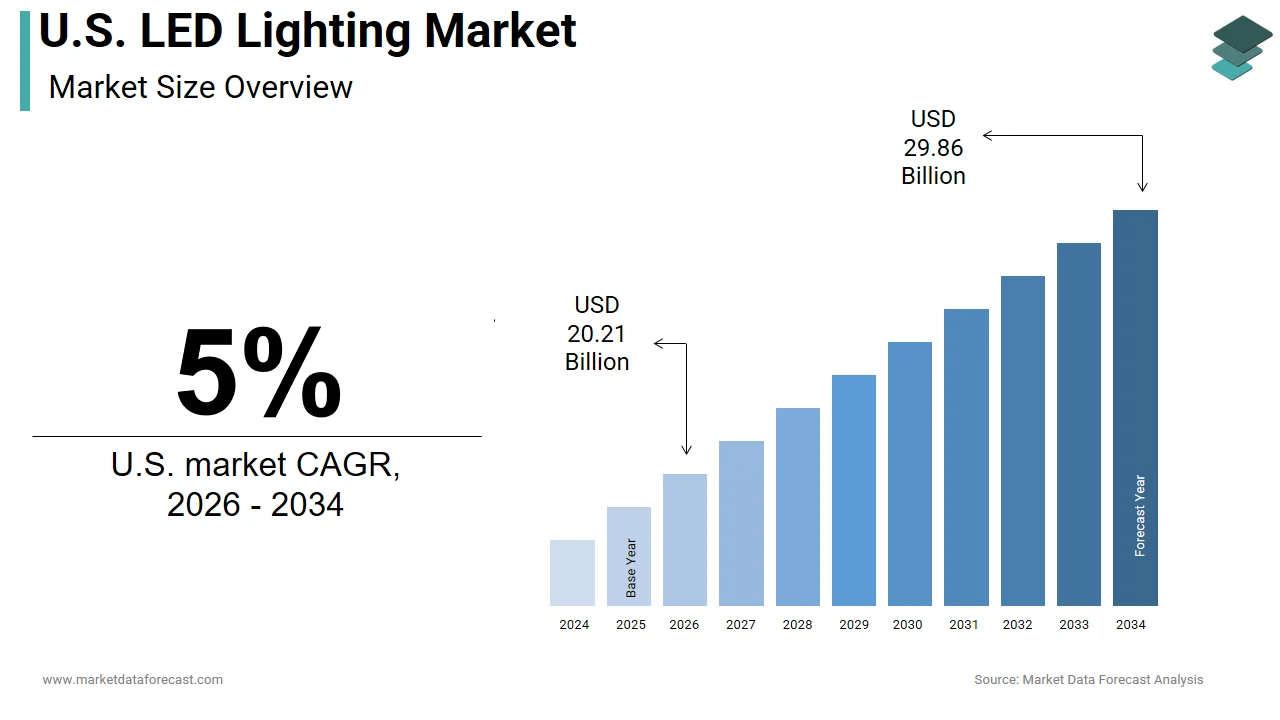
The U.S. LED lighting market was valued at USD 19.25 billion in 2025, is anticipated to reach USD 20.21 billion in 2026, and is projected to expand up to USD 29.86 billion by 2034, growing at a compound annual growth rate (CAGR) of 5.00% from 2026 to 2034. Driven by stringent energy efficiency regulations, significant operational cost savings, and the integration of smart IoT infrastructure, the sector continues to transition aggressively toward sustainable illumination.
Key Executive Metrics (At-a-Glance)
- 2025 Base Valuation: USD 19.25 Billion
- 2026 Current Valuation: USD 20.21 Billion
- 2034 Forecast Valuation: USD 29.86 Billion
- Compound Annual Growth Rate (CAGR): 5.00% (2026–2034)
- Dominant Product Segment: Luminaires and Fixtures
- Fastest-Growing Product Segment: LED Lamps (8.2% CAGR)
- Dominant Application Segment: Commercial Offices (45.3% share in 2025)
- Fastest-Growing Application Segment: Industrial (9.0% CAGR)
- Fastest-Growing Distribution Channel: E-commerce (10.5% CAGR)
Core Market Drivers
- Stringent Energy Regulations: Department of Energy (DOE) standards banning most legacy incandescent and halogen bulbs, requiring high efficacy standards.
- Significant Cost Savings: Reduced utility bills and lower maintenance expenses, with payback periods often under two years for commercial retrofits.
Primary Market Restraints & Challenges
- High Initial Implementation Costs: Upfront capital requirements for advanced smart control systems and high-end fixtures.
- Supply Chain Vulnerabilities: Dependence on global semiconductors and rare earth elements from overseas manufacturing hubs.
U.S. LED Lighting Market Segmentation Breakdown
| Segment Category | Leading Sub-Segment (2025 Base) | Fastest-Growing Sub-Segment (Forecast Period) |
|---|---|---|
| By Product Type | Luminaires and Fixtures (Dominant in commercial/industrial sectors) | LED Lamps (CAGR of 8.2%; driven by residential retrofits) |
| By Distribution Channel | Wholesale and Retail Channels (Extensive brick-and-mortar networks) | E-commerce (CAGR of 10.5%; expanding digital procurement platforms) |
| By Application | Commercial Offices (45.3% market share in 2025) | Industrial (CAGR of 9.0%; modernization of warehouses and distribution centers) |
Major Industry Players Profiled
Top industry leaders shaping the U.S. landscape include Acuity Brands Lighting Inc., Signify North America Corp., LEDVANCE LLC, Dialight PLC (U.S. operations), and Cree LED Inc.
U.S. LED Lighting Market Size
The U.S. LED lighting market size was USD 19.25 billion in 2025, is anticipated to be USD 20.21 billion in 2026, and is projected to reach USD 29.86 billion by 2034, registering a CAGR of 5% from 2026 to 2034.
The LED lighting is the installation of light-emitting diode-based illumination solutions for residential, commercial, industrial, and outdoor applications. According to the United States Department of Energy, LEDs consume at least 75% less energy than incandescent lighting and last 25 times longer, which has accelerated their adoption across all sectors. As per the Environmental Protection Agency, the widespread replacement of inefficient lighting sources contributes significantly to national greenhouse gas reduction goals. Regulatory frameworks established by the Department of Energy have phased out many inefficient lighting technologies and mandated higher-efficacy standards that favor LED solutions. The definition of the market extends beyond hardware to include control systems, software platforms, and maintenance services that optimize light usage. The interplay between regulatory mandates, cost savings, and technological innovation defines the current operational landscape. Stakeholders are increasingly focusing on human-centric lighting and sustainability to meet evolving consumer expectations.
MARKET DRIVERS
Stringent Energy Efficiency Regulations and Phase Outs
The stringent energy efficiency regulations and the phase-out of inefficient lighting technologies are primary factors boosting the growth of the United States LED lighting market. Federal and state governments have implemented rigorous standards to reduce energy consumption and environmental impact associated with traditional lighting sources. According to the United States Department of Energy, new efficiency standards enacted in 2023 effectively ban the sale of most incandescent and halogen bulbs, requiring a minimum efficacy of 45 lumens per watt. This regulatory shift forces consumers and businesses to transition to LED alternatives, which are the only widely available technology meeting these criteria. The Department of Energy's Better Buildings Initiative encourages large organizations to commit to reducing energy intensity, which often involves comprehensive lighting retrofits. These mandates create a compulsory demand for LED products as older technologies become legally obsolete or economically unviable. Utility companies also offer rebates for LED upgrades to manage grid load and reduce peak demand. The regulatory environment ensures a consistent replacement cycle regardless of economic fluctuations, as non-compliant equipment must be removed from service.
Significant Cost Savings and Operational Efficiency
The significant cost savings and operational efficiency, as businesses and homeowners seek to reduce utility bills and maintenance expenses, are amplifying the growth of the United States LED lighting market. LEDs offer superior energy efficiency and a much longer lifespan compared to traditional lighting sources, resulting in substantial total cost of ownership reductions. For commercial entities, the savings are even more pronounced due to the scale of lighting installations and the high cost of labor for maintenance. As per the International Facility Management Association, switching to LED lighting can reduce maintenance costs by up to 50% because fixtures need to be replaced far less frequently. The long lifespan of LEDs, which can exceed 50000 hours, minimizes downtime and disruption in critical environments such as hospitals and manufacturing plants. Businesses are increasingly conducting energy audits that highlight lighting as a low-hanging fruit for immediate cost reduction. The rapid payback period for LED retrofits is often less than two years, making them an attractive investment for property managers. The ability to integrate LEDs with sensors and controls further enhances savings by ensuring lights are only on when needed. This economic advantage ensures that LED lighting remains a priority for budget-conscious consumers and corporations. The financial benefits provide a compelling business case that drives widespread adoption.
MARKET RESTRAINTS
High Initial Implementation Costs for Advanced Systems
The high initial implementation costs for advanced LED systems, particularly for small businesses and residential consumers, is oen fot he primary factors degrading the growth of the United States LED lighting market. While the long-term savings are clear, the upfront capital required for high-quality LED fixtures and smart control systems can be prohibitive. The premium LED products with advanced features such as tunable, white light, and connectivity command a price premium compared to basic bulbs and traditional fixtures. Small retailers and homeowners may hesitate to invest in comprehensive LED solutions due to budget constraints, opting for cheaper, lower-quality alternatives or delaying upgrades entirely. The perceived risk of technology obsolescence also discourages some buyers from committing to expensive smart lighting ecosystems. Financing options exist, but interest rates and credit requirements can limit access for some segments. The lack of standardized pricing for integrated systems creates confusion and hesitation among buyers.
Technical Complexity and Compatibility Issues
The technical complexity and compatibility issues, by creating barriers to seamless integration and user satisfaction, are additionally hindering the growth of the United States LED lighting market. LED technology involves complex electronics and drivers that must be compatible with existing dimmers, switches, and control systems. The rapid evolution of smart lighting protocols such as Zigbee, Z-Wave, and Wi Fi creates a fragmented ecosystem where devices from different manufacturers may not communicate effectively. Professional installation is often required for complex commercial systems, increasing costs and deployment time. The learning curve associated with configuring smart lighting apps and scenes can deter non-technical users from fully utilizing the features they paid for. Troubleshooting technical issues often requires specialized knowledge, which is not readily available through standard retail channels. These technical hurdles can lead to negative user experiences and slow down the adoption of advanced LED solutions.
MARKET OPPORTUNITIES
Integration with Smart Cities and IoT Infrastructure
The integration with smart cities and Internet of Things infrastructure to expand beyond simple illumination is creating new opportunities for the growth of the United States LED lighting market. Smart LED streetlights and building fixtures serve as nodes in a broader network, enabling data collection, environmental monitoring, and enhanced public services. Many municipalities are upgrading to connected LED streetlights that can adjust brightness based on traffic and weather conditions, reducing energy use by up to 80%. These smart poles can also host sensors for air quality, noise levels, and traffic flow, providing valuable data for urban planning. As per the International Data Corporation, the growth of smart city initiatives is driving demand for interconnected lighting systems that integrate with other municipal infrastructure. The ability to remotely monitor and control lighting assets reduces maintenance costs and improves response times for outages. Utilities and technology companies are partnering to develop platforms that leverage lighting infrastructure for broadband delivery and electric vehicle charging. The federal infrastructure bill provides funding for smart grid and city improvements, which support LED adoption. This transformation positions LED lighting as a critical component of modern urban digital infrastructure.
Expansion in Horticultural and Healthcare Applications
The expansion in horticultural and healthcare applications to address specialized lighting needs is additionally factor to leverage new opportunities for the growth of the United States lighting market. In agriculture, LED grow lights enable precise control over light spectra intensity and duration, optimizing plant growth and yield in indoor farming operations. Controlled environment agriculture is growing rapidly with LED lighting, playing a crucial role in energy-efficient crop production. LEDs allow farmers to tailor light recipes for specific crops, reducing energy costs and increasing productivity compared to traditional high-pressure sodium lamps. In healthcare, human-centric LED lighting systems are being adopted to support patient recovery and staff well-being by mimicking natural circadian rhythms. As per the American Society of Interior Designers, lighting that adjusts color temperature throughout the day can improve sleep patterns and reduce stress in hospital environments. The aging population and increased focus on mental health drive demand for therapeutic lighting solutions in senior living facilities and clinics. Manufacturers are developing specialized LED products with high color rendering indices and tunable spectra for these niche markets. The ability to customize lighting for specific biological effects creates high-value opportunities.
MARKET CHALLENGES
Supply Chain Disruptions and Raw Material Scarcity
The supply chain disruptions and raw material scarcity, by affecting production timelines and cost structures is one of the key challenges for the growth of the United States LED lighting market. The industry relies on global supplies of semiconductors, rare earth elements, and electronic components, which have faced significant hurdles in recent years. The indices have indicated persistent challenges in sourcing parts, such as LED chips and drivers. The reliance on overseas manufacturing, particularly in Asia, exposes companies to geopolitical tensions, trade tariffs, and logistics delays. The increased cost of raw materials forces manufacturers to either absorb margins or pass costs to consumers, which can dampen demand. Lead times for new equipment orders have extended, causing frustration among contractors and customers who expect immediate availability. The unpredictability of supply chains complicates inventory management and financial planning for businesses. Manufacturers struggle to forecast demand accurately amidst uncertain supply conditions, leading to stockouts or excess inventory. The cost of expedited shipping and alternative sourcing strategies erodes profitability.
Electronic Waste and Recycling Infrastructure Gaps
The electronic waste and recycling infrastructure gaps raise environmental concerns and compliance costs, further declining the growth of the United States LED lighting market. While LEDs are more energy efficient, they contain electronic components and materials such as lead and arsenic that require proper disposal. The recycling rate for small electronics and lighting fixtures remains low due to limited collection programs and consumer awareness. The complex composition of LED fixtures makes them difficult and expensive to recycle compared to traditional bulbs. The lack of a standardized nationwide recycling program creates confusion for consumers and businesses regarding proper disposal methods. Manufacturers face increasing pressure to implement take-back programs and design for recyclability, which adds to operational costs. Regulatory frameworks for e-waste vary by state, creating a patchwork of compliance requirements. The environmental footprint of LED production and disposal is coming under greater scrutiny from sustainability-focused investors and consumers. Failure to address end-of-life management can damage brand reputation and lead to stricter regulations. The industry must invest in circular economy solutions to mitigate these challenges.
REPORT COVERAGE
| REPORT METRIC | DETAILS |
| Market Size Available | 2025 to 2034 |
| Base Year | 2025 |
| Forecast Period | 2026 to 2034 |
| Segments Covered | By Product Type, Distribution Channel, Installation Type, Application, End User, and Country. |
| Various Analyses Covered | Global, Regional, and Country-Level Analysis, Segment-Level Analysis, Drivers, Restraints, Opportunities, Challenges; PESTLE Analysis; Porter’s Five Forces Analysis, Competitive Landscape, Analyst Overview of Investment Opportunities |
| Countries Covered | New York, Massachusetts, Pennsylvania, Illinois, Ohio, Michigan, Texas, Florida, Georgia, California, Washington, Colorado. |
| Market Leaders Profiled | Acuity Brands Lighting Inc., Signify North America Corp., LEDVANCE LLC, Dialight PLC (U.S. operations), Cree LED Inc., and Others. |
SEGMENTAL ANALYSIS
By Product Type Insights
The luminaires and fixtures segment was the largest by holding a dominant share of the United States LED lighting market in 2025, with the comprehensive replacement of legacy lighting infrastructure in commercial, industrial, and public sectors. The shift towards integrated LED systems that offer superior thermal management, longevity, and design flexibility compared to retrofit lamps is also enhancing the growth of the United States LED lighting market. The adoption of connected lighting fixtures in offices and warehouses has accelerated due to their ability to provide data-driven insights on space utilization and energy efficiency. Municipalities are also investing heavily in LED streetlight fixtures to reduce maintenance costs and improve public safety. The architectural appeal of sleek modular fixtures drives demand in new construction projects where aesthetics and performance are prioritized. Manufacturers focus on producing complete fixture solutions that meet strict efficacy and durability standards required by federal regulations. The longer lifespan of integrated fixtures reduces the frequency of replacements, offering better total cost of ownership for facility managers.
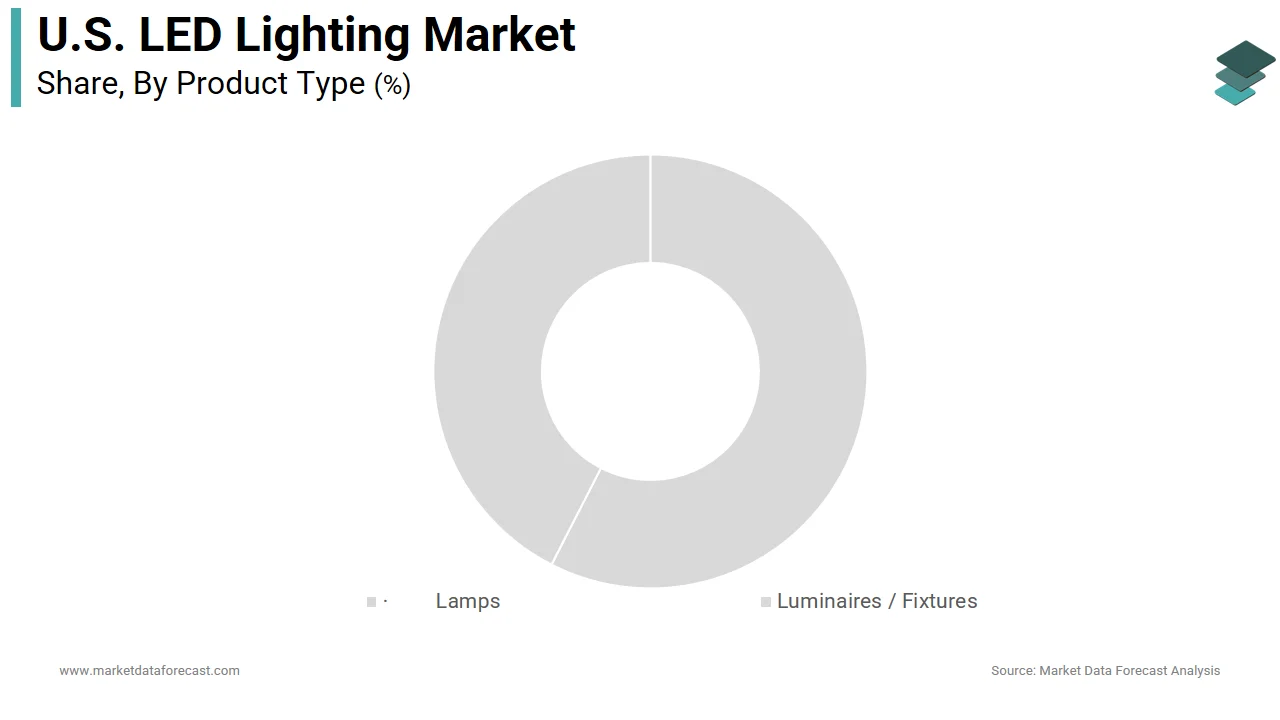
The LED lamps segment is exhibiting the fastest CAGR of 8.2% during the forecast period, with the ongoing residential retrofit and the need for cost-effective replacements in small commercial applications. Millions of households continue to replace incandescent and compact fluorescent lamps with LED bulbs due to immediate energy savings and ease of installation. The availability of standardized bases, such as E26 and E12, allows consumers to upgrade existing fixtures without electrical modifications, making it an accessible entry point for LED adoption. The proliferation of smart LED bulbs that connect to home Wi Fi networks via apps has also stimulated growth among tech-savvy consumers seeking convenience and customization. Retailers frequently promote LED lamp bundles, which encourage bulk purchases for whole-home upgrades. The lower upfront cost of lamps compared to fixtures makes them attractive for budget-conscious buyers. The continuous innovation in color tuning and dimming capabilities enhances user experience, driving repeat purchases.
By Distribution Channel Insights
The wholesale and retail channels segment held a significant share of the United States LED lighting market in 2025, with the extensive network of physical stores and established supply chains that cater to both professional contractors and DIY consumers. The dominance of this segment is underpinned by the preference of commercial buyers to inspect products for quality and compatibility before large-scale procurement. Home improvement retailers such as Home Depot and Lowe's serve as critical touchpoints for residential consumers, who value immediate availability and the ability to compare products side by side. The retail sales of building materials and garden equipment remain robust, reflecting the steady demand for lighting products through brick and mortar outlets. Wholesale distributors also offer credit terms and logistics services that are essential for large construction projects. The trust established through long-term relationships between distributors and contractors ensures consistent order volumes. Retail stores provide demonstration units and expert advice, which helps customers make informed decisions about complex lighting systems.
The e-commerce channel segment is likely to register the fastest CAGR of 10.5% from 2026 to 2034, with the convenience of online shopping and the expanding variety of specialized lighting products. The increasing comfort of consumers and businesses with digital procurement platforms that offer competitive pricing and detailed product information is elevating the growth of the segment. Online marketplaces allow buyers to access a wider range of brands and styles than what is available in local stores, including niche and designer options. The availability of customer reviews and virtual visualization tools helps mitigate the inability to physically inspect products, reducing purchase hesitation. Direct-to-consumer brands leverage social media marketing to reach targeted audiences effectively, offering customized solutions that appeal to modern interior design trends. The ease of comparing prices and features across multiple vendors empowers buyers to find the best value. Fast shipping and hassle-free return policies further enhance the online shopping experience. The integration of augmented reality apps allows users to preview lighting effects in their spaces.
By Application Insights
The commercial offices segment was the largest by holding 45.3% of the United States LED lighting market share in 2025, with the corporate sector's focus on energy efficiency, employee well-being, and operational cost reduction. The commercial buildings consume a substantial portion of national electricity, with lighting being a major component, prompting companies to adopt LED solutions for significant savings. The trend towards green building certifications, such as LEED and WELL, encourages organizations to install high-efficiency LED systems that contribute to sustainability goals. The number of certified green buildings has increased significantly, with LED lighting being a standard requirement for achieving higher rating levels. Modern office designs emphasize human-centric lighting that adjusts color temperature to support circadian rhythms, enhancing productivity and health. The integration of LED fixtures with occupancy sensors and daylight harvesting systems allows for automated energy management. Corporate real estate managers prioritize low-maintenance solutions to minimize disruption and service costs. The rapid adoption of smart office technologies further drives the demand for connected LED lighting infrastructure.
The industrial application segment is expected to register the fastest CAGR of 9.0% during the forecast period with the modernization of manufacturing facilities, warehouses, and logistics centers. This growth is fueled by the expansion of e-commerce, which requires massive distribution centers equipped with high bay LED lighting for optimal visibility and safety. High-efficiency LED high bay fixtures offer superior illumination for tall ceilings while reducing energy consumption and heat output, which lowers cooling loads. The durability of LED fixtures makes them ideal for harsh industrial environments with vibration, dust, and moisture. The integration of lighting with industrial IoT systems enables asset tracking and inventory management, enhancing overall operational efficiency. Safety regulations mandate adequate lighting levels in work zones, driving compliance-related upgrades. The rapid deployment of automated guided vehicles in warehouses requires precise lighting conditions for sensor navigation.
By End User Insights
The indoor end users segment accounted for a prominent share of the United States LED lighting market in 2025, with the ubiquitous need for illumination in residential, commercial, and institutional buildings. There are over 140 million housing units in the country, each requiring multiple indoor light sources for kitchens, bedrooms, and living areas. Commercial interiors, such as offices, retail stores, and hospitals, also contribute significantly to demand due to the need for specialized lighting conditions. The indoor lighting accounts for the majority of lighting energy consumption, making it the primary target for efficiency upgrades. The trend towards open-plan interiors and smart homes has increased the complexity and quantity of indoor lighting fixtures installed. Consumers are increasingly interested in tunable white and color-changing LEDs that enhance mood and functionality. The renovation of older buildings often involves updating indoor lighting to meet current codes and improve ambiance. The emotional connection to home comfort and workplace productivity drives investment in high-quality indoor lighting solutions.
The outdoor end-user segment is expected to witness the fastest CAGR of 8.8% during the forecast period, with the municipal infrastructure upgrades and security concerns. The widespread adoption of LED streetlights, parking lot lights, and landscape lighting by cities and private property owners. Thousands of municipalities have initiated LED streetlight conversion programs to reduce energy costs and carbon emissions, while improving visibility for pedestrians and drivers. The durability and weather resistance of outdoor LED fixtures make them ideal for harsh environmental conditions requiring minimal maintenance. The rise in smart city initiatives integrates outdoor lighting with surveillance and traffic monitoring systems, creating added value for local governments. Residential homeowners are also investing in outdoor LED lighting for security and aesthetic enhancement of their properties. The long lifespan of outdoor LEDs reduces the frequency of dangerous and costly maintenance tasks at height. The emphasis on reducing light pollution through directional lighting technologies appeals to environmental advocates.
COMPETITIVE LANDSCAPE
The competition in the United States LED lighting market is characterized by intense rivalry among global corporations and specialized manufacturers who compete on technology, price, and service quality. The market structure is moderately consolidated with key players holding significant influence over pricing and innovation trends. Competitive intensity is driven by the rapid adoption of smart lighting and Internet of Things integration, which requires substantial research and development investments. Regulatory compliance regarding energy efficiency and safety standards serves as a baseline requirement, but excellence in design becomes a key differentiator. Established players leverage their extensive distribution networks and brand recognition to maintain customer trust. Price competition is fierce in the residential segment, while commercial sectors focus on total cost of ownership and lifecycle performance. The focus on sustainability and human-centric lighting is becoming increasingly important for attracting diverse user groups.
KEY MARKET PLAYERS
Some of the companies that are playing a dominating role in the U.S. LED lighting market include
- Acuity Brands Lighting Inc.
- Signify North America Corp.
- LEDVANCE LLC
- Dialight PLC (U.S. operations)
- Cree LED Inc.
TOP PLAYERS IN THE MARKET
- Signify North America Corporation is a global leader in the United States LED lighting market, known for its Philips brand and innovative connected lighting systems. The company provides a comprehensive portfolio of professional and consumer lighting solutions that enhance energy efficiency and user experience. Signify strengthens its market position through the Interact IoT platform, which enables smart city and building management capabilities. The company recently expanded its production of circadian rhythm lighting for the healthcare and education sectors to support well-being. Signify focuses on sustainability by committing to carbon-neutral operations and circular design principles. Its strong distribution network ensures widespread availability of products. These initiatives reinforce its reputation for technological leadership and environmental responsibility in the evolving lighting industry.
- Acuity Brands Inc is a prominent player in the US LED lighting market, specializing in commercial and industrial lighting solutions. The company offers a diverse range of fixtures and control systems designed for offices, warehouses, and outdoor environments. Acuity Brands strengthens its market position through its Atrius digital ecosystem, which integrates lighting with building automation for enhanced operational efficiency. The company recently invested in research and development for human-centric lighting technologies that improve productivity and health. Acuity Brands focuses on strategic acquisitions to expand its software and sensor capabilities. Its robust manufacturing infrastructure supports the rapid deployment of large-scale projects. These efforts demonstrate the company's commitment to innovation and customer-centric solutions in the competitive lighting sector.
- CreeLED Inc is a key innovator in the United States LED lighting market, renowned for its high-performance LED components and lighting fixtures. The company leverages its proprietary silicon carbide technology to produce efficient and reliable lighting products for various applications. CreeLED strengthens its market position by focusing on horticultural and industrial lighting segments where precision and durability are critical. The company recently launched new grow light solutions that optimize plant growth while reducing energy consumption. CreeLED emphasizes quality and longevity in its product designs, ensuring customer satisfaction and trust. Its direct engagement with original equipment manufacturers facilitates custom solutions for specialized needs.
TOP STRATEGIES USED BY KEY MARKET PARTICIPANTS
Key players in the United States LED lighting market primarily employ strategies such as product innovation, strategic partnerships, and sustainability initiatives to strengthen their market position. Companies frequently invest in developing smart connected lighting systems that integrate with Internet of Things platforms for enhanced control and data analytics. This approach allows them to differentiate their offerings and capture value in the growing smart building sector. Strategic collaborations with technology firms help implement advanced sensors and software solutions. By focusing on energy efficiency and circular economy principles, companies align with regulatory standards and consumer preferences. Additionally, manufacturers expand their distribution channels through online platforms and specialized dealers to reach broader audiences. Product customization for specific industries like healthcare and agriculture also drives growth.
MARKET SEGMENTATION
This research report on the U.S. LED lighting market has been segmented and sub-segmented into the following categories.
By Product Type
- Lamps
- Luminaires / Fixtures
By Distribution Channel
- Direct Sales
- Wholesale Retail
- E-commerce
By Installation Type
- New Installation
- Retrofit Installation
By Application
- Commercial Offices
- Retail Stores
- Hospitality
- Industrial
- Highway and Roadway
- Architectural
- Public Places
- Hospitals
- Horticulture Gardens
- Residential
- Automotive
- Others (Chemicals, Oil and Gas, Agriculture)
By End User
- Indoor
- Outdoor
- Automotive
By Country
- New York
- Texas
- Florida
- Georgia
- California
- Rest of U.S.