U.S. Liquefied Natural Gas Market Size, Share, Trends & Growth Forecast Report By Type, By Application, and By Country (California, Washington, Oregon, New York & Rest of the United States) – Industry Analysis and Forecast, 2026 to 2034
Market Size, 2025
$0.16 BnMarket Estimate, 2026
$0.18 BnMarket Forecast, 2034
$0.52 BnCAGR, 2026–2034
14.2%U.S. Liquefied Natural Gas Market Size
The U.S. Liquefied Natural Gas Market was valued at USD 156.11 million in 2025, is estimated to reach USD 178.28 million in 2026, and is projected to reach USD 515.74 million by 2034, growing at a CAGR of 14.2% from 2026 to 2034.
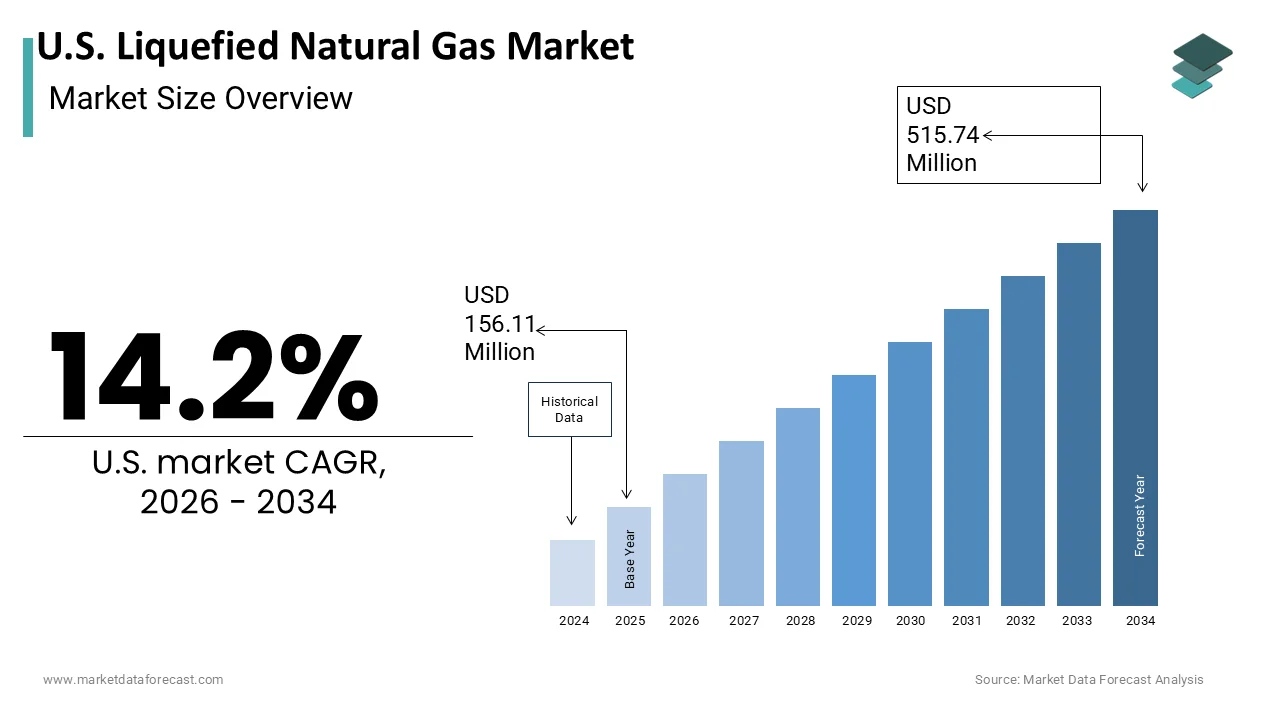
Liquefied Natural Gas (LNG) is natural gas, primarily methane (CH4), that has been cooled to a cryogenic liquid state for safe and efficient transportation. This market leverages advanced refrigeration technologies to reduce the volume of natural gas by approximately 600 times, facilitating efficient maritime transport to distant markets. As per the United States Energy Information Administration, the United States emerged as the world’s largest exporter of liquefied natural gas in 2023, surpassing traditional suppliers due to abundant shale gas reserves and expanded processing capacity. The market is defined by its integration with the broader North American pipeline network, which ensures a steady supply of feedstock from prolific basins such as the Permian and Appalachia. According to the Federal Energy Regulatory Commission, the nation possesses significant liquefaction infrastructure along the Gulf Coast, with multiple terminals operating at or near maximum capacity. The strategic importance of this sector extends beyond economic metrics, serving as a critical tool for geopolitical energy security among allied nations. Shared federal regulatory frameworks govern the industry, with FERC authorizing the physical construction of export facilities and the Department of Energy determining export volumes by balancing domestic consumer energy needs with international commitments. The definition of this market encompasses the entire value chain from gas production and purification to liquefaction, shipping, and regasification. Recent developments highlight a shift towards long-term contractual agreements, providing stability for investors and ensuring consistent supply flows. The industry operates within a complex environmental landscape, where methane emission standards and carbon intensity considerations increasingly influence operational practices and project viability.
MARKET DRIVERS
Global Energy Security Concerns Drive Export Demand
The escalating demand for secure and reliable energy supplies among European and Asian nations is a key driver of the United States liquefied natural gas market. Geopolitical tensions, particularly the conflict in Ukraine, have disrupted traditional pipeline gas flows from Russia to Europe, forcing importing countries to seek alternative sources to maintain energy stability. As per the International Energy Agency, Europe increased its liquefied natural gas imports by 60 percent in 2022 compared to the previous year, with the United States supplying the majority of this incremental volume. This structural shift in trade patterns has created a sustained demand for American exports, as European utilities sign long-term contracts to diversify their supply portfolios and reduce dependency on single sources. The United States Department of Energy highlights that flexible destination clauses in American contracts allow buyers to redirect cargoes to regions with higher spot prices, enhancing the attractiveness of US liquefied natural gas in volatile markets. Additionally, Asian economies such as Japan and South Korea continue to rely on liquefied natural gas for power generation and industrial processes, driven by their commitments to phase out coal and nuclear energy. According to the Japan Organization for Metals and Energy Security, the country aims to maintain a stable supply of liquefied natural gas to support its transition towards a lower-carbon economy. The combination of urgent European needs and steady Asian demand creates a robust export environment, encouraging further investment in US liquefaction infrastructure and solidifying the country’s role as a key provider of global energy security.
Abundant Domestic Natural Gas Reserves Support Production Scalability
The vast availability of inexpensive natural gas feedstock further propels the expansion of the United States liquefied natural gas market. This provides a fundamental competitive advantage for the liquefied natural gas export industry, enabling cost-effective production at scale. The proliferation of hydraulic fracturing and horizontal drilling technologies has unlocked substantial shale gas reserves, particularly in the Permian Basin and the Haynesville Shale, ensuring a reliable and low-cost supply of raw material for liquefaction plants. As per the United States Energy Information Administration, dry natural gas production in the United States reached record levels exceeding 100 billion cubic feet per day in recent years, creating a surplus that supports extensive export operations. This abundance allows US exporters to offer competitive pricing in international markets, attracting buyers who seek affordable alternatives to oil-indexed contracts. The Henry Hub natural gas price, which serves as the benchmark for US liquefied natural gas contracts, remains significantly lower than international benchmarks such as the Japanese Crude Cocktail or the Dutch Title Transfer Facility, enhancing the arbitrage profit margins for global off-takers. According to the American Petroleum Institute, the continued development of shale resources ensures that the United States will maintain its position as a leading natural gas producer for decades. The integration of pipeline infrastructure with liquefaction terminals facilitates the efficient transport of gas from production sites to export facilities, minimizing logistical bottlenecks. This structural supply advantage underpins the economic viability of existing and proposed projects, driving sustained growth in the sector and reinforcing the United States’ dominance in the global liquefied natural gas trade.
MARKET RESTRAINTS
Stringent Environmental Regulations Impose Compliance Burdens
The implementation of rigorous environmental regulations governing methane emissions and greenhouse gas outputs is a significant impediment to the expansion of the United States liquefied natural gas market. Federal and state agencies are increasingly scrutinizing the environmental impact of natural gas production and processing, requiring operators to adopt costly mitigation technologies and monitoring systems. As per the Environmental Protection Agency, new standards aimed at reducing methane leaks from oil and gas operations mandate regular inspections and immediate repairs, increasing operational expenditures for producers and exporters. These regulatory requirements can delay project approvals and increase capital costs for new liquefaction facilities, potentially discouraging investment in future capacity expansions. The European Union’s Carbon Border Adjustment Mechanism also poses a challenge, as it may impose tariffs on imports based on their carbon intensity, affecting the competitiveness of US liquefied natural gas in key markets. According to the Center for Biological Diversity, legal challenges and permitting delays related to environmental impact assessments have stalled several proposed export terminals, creating uncertainty for developers. Furthermore, pressure from environmental groups and indigenous communities often leads to prolonged litigation, further extending timelines and increasing financial risks. The need to demonstrate compliance with stringent environmental criteria adds complexity to project development, requiring companies to invest heavily in sustainability initiatives and carbon capture technologies. These regulatory and social pressures act as a brake on rapid market growth, forcing industry participants to navigate a challenging compliance landscape while maintaining operational efficiency.
High Capital Intensity and Financing Risks Limit Project Development
The substantial capital requirements associated with building liquefied natural gas export terminals are a major barrier to the United States liquefied natural gas market expansion. This limits the number of new projects that reach financial close. Constructing a single liquefaction train involves billions of dollars in investment, covering engineering, procurement, construction, and commissioning costs, which creates significant financial barriers for developers. As per the S&P Global Commodity Insights, the cost of building new liquefied natural gas capacity has increased due to inflation in labor and materials, making it more difficult to secure favorable financing terms. Lenders and investors are increasingly cautious about funding fossil fuel projects due to concerns about stranded assets and the global transition towards renewable energy, raising the cost of capital for developers. The Federal Energy Regulatory Commission requires extensive review processes for export authorizations, adding time and uncertainty to the development timeline, which can deter potential investors. According to the Institute for Energy Economics and Financial Analysis, several proposed liquefied natural gas projects have been cancelled or delayed due to an inability to secure long-term off-take agreements or equity financing. The reliance on long-term contracts to justify investment exposes developers to market risks if demand forecasts change or if buyers default. Additionally, interest rate fluctuations impact the affordability of debt financing, further constraining project viability. These financial hurdles restrict the pace of capacity additions, ensuring that market growth remains dependent on the successful execution of a limited number of large-scale projects.
MARKET OPPORTUNITIES
Expansion of Small-Scale and Modular LNG Solutions
The development of small-scale and modular LNG technologies offers a significant opportunity for market participants to serve niche segments and expand into new geographic areas, which is expected to fuel the growth of the United States liquefied natural gas market. Unlike large-scale export terminals, modular units can be deployed rapidly and at a fraction of the cost, enabling the monetization of stranded gas reserves and the supply of fuel to remote industrial customers or marine vessels. As per the Gas Technology Institute, small-scale liquefied natural gas solutions are gaining traction for bunker fuel applications, as shipping companies seek to comply with International Maritime Organization sulfur regulations. The flexibility of modular systems allows for decentralized production and distribution, reducing reliance on extensive pipeline infrastructure and opening up markets in regions without established gas networks. The United States Department of Energy highlights that the emerging small-scale liquefied natural gas export market is growing, providing American firms with streamlined opportunities to capitalize on global demand for flexible energy solutions. Additionally, the use of liquefied natural gas as a transportation fuel for heavy-duty trucks and buses presents a viable pathway for decarbonizing the logistics sector, supported by federal incentives for clean fuel adoption. According to the Clean Air Task Force, the expansion of liquefied natural gas refueling infrastructure is an insufficient long-term strategy for heavy-duty freight, as true decarbonization requires shifting direct investments toward battery-electric and hydrogen fuel-cell commercial vehicles. Market players can leverage modular technologies to diversify revenue streams and address specific customer needs. Doing so fosters innovation and growth in emerging segments of the liquefied natural gas market.
Integration of Carbon Capture and Storage Technologies
The integration of carbon capture and storage technologies into LNG facilities paves the way to enhance its environmental profile and maintain market access in carbon-conscious regions, which is anticipated to boost the expansion of the United States liquefied natural gas market. By capturing carbon dioxide emissions generated during the liquefaction process, exporters can produce low-carbon-intensity liquefied natural gas that appeals to buyers with strict sustainability mandates. As per the Global Carbon Capture and Storage Institute, several projects in the United States are exploring the feasibility of attaching carbon capture units to existing and planned liquefaction terminals, aiming to reduce overall emissions by up to 90 percent. This technological advancement allows US exporters to differentiate their products in markets such as Europe and Asia, where carbon border adjustments and green premiums are becoming increasingly relevant. The Inflation Reduction Act provides tax credits for carbon sequestration, improving the economic viability of these investments and encouraging widespread adoption. According to the Natural Resources Defense Council, terminal-level carbon capture cannot significantly mitigate the true climate impact of natural gas exports because it fails to address massive upstream methane leakage and downstream fossil fuel combustion emissions. Companies that successfully implement these solutions can secure long-term contracts with environmentally focused utilities and corporations, ensuring sustained demand. Furthermore, the development of blue hydrogen capabilities alongside liquefaction facilities creates additional revenue opportunities, positioning US energy hubs as centers for multiple clean energy vectors. This strategic alignment with decarbonization goals ensures the long-term relevance of the liquefied natural gas sector in a transitioning global energy landscape.
MARKET CHALLENGES
Geopolitical Instability Affects Trade Routes and Insurance Costs
Geopolitical instability in key maritime chokepoints and producing regions is a major hurdle for the United States liquefied natural gas market. This disrupts supply chains and increases operational risks. Conflicts in the Middle East and tensions in the South China Sea threaten the security of shipping lanes used by liquefied natural gas carriers, leading to potential delays and increased insurance premiums. As per the United States Maritime Administration, disruptions in the Strait of Hormuz or the Bab el Mandeb could severely impact global energy flows, forcing rerouting that increases transit times and costs for US exporters. The reliance on Panama Canal transit for some shipments is also vulnerable to climate-induced droughts, which restrict vessel drafts and limit throughput capacity. According to the Panama Canal Authority, water level constraints have previously forced reductions in daily transits, causing backlog and scheduling uncertainties for liquefied natural gas vessels. These logistical vulnerabilities expose exporters to volatile freight rates and delivery delays, complicating contract fulfillment and customer relationships. Additionally, sanctions and trade restrictions imposed on certain countries can limit market access and create legal complexities for transactions. The dynamic nature of international relations requires constant monitoring and adaptive logistics strategies to mitigate risks. Failure to navigate these geopolitical challenges effectively can result in financial losses and reputational damage, undermining the reliability of US liquefied natural gas as a stable energy source for global partners.
Methane Emissions Scrutiny Threatens Market Reputation
Intensifying scrutiny of methane emissions across the natural gas supply chain challenges the expansion of the United States liquefied natural gas market. This threatens the reputation and market access, as buyers increasingly prioritize low-emission sources. Methane, a potent greenhouse gas, can leak during extraction, processing, and transport, undermining the climate benefits of switching from coal to natural gas. As per the Environmental Defense Fund, satellite data has revealed significant methane super emitters in various US basins, drawing criticism from international regulators and environmental organizations. The European Union is developing regulations that may restrict imports of energy products with high methane footprints, posing a direct threat to US exports if adequate monitoring and mitigation measures are not implemented. According to the International Energy Agency, the oil and gas sector is responsible for a substantial portion of global methane emissions, and failure to address this issue could lead to stranded assets and reduced demand. US exporters face the challenge of proving the integrity of their supply chains through transparent reporting and third-party verification, which requires significant investment in monitoring technologies. The lack of a unified federal standard for methane regulation creates inconsistencies in compliance, complicating efforts to present a cohesive environmental narrative. The market risks losing its social license to operate and faces competitive disadvantages against suppliers with stricter environmental controls if it does not take decisive action to reduce emissions. Consequently, long-term growth prospects are jeopardized.
REPORT COVERAGE
| REPORT METRIC | DETAILS |
| Market Size Available | 2025 to 2034 |
| Base Year | 2025 |
| Forecast Period | 2026 to 2034 |
| Segments Covered | By Type, Application Region. |
| Various Analyses Covered | Global, Regional and Country-Level Analysis, Segment-Level Analysis, Drivers, Restraints, Opportunities, Challenges; PESTLE Analysis; Porter’s Five Forces Analysis, Competitive Landscape, Analyst Overview of Investment Opportunities |
| Countries Covered | California, Washington, Oregon, New York, and the rest of the United States |
| Market Leaders Profiled | Cheniere Energy, Inc., Sempra Energy, Exxon Mobil Corporation, Chevron Corporation, ConocoPhillips, Freeport LNG Development, L.P., Venture Global LNG, Inc., Tellurian Inc., NextDecade Corporation, Kinder Morgan, Inc., TotalEnergies SE, Shell plc |
SEGMENTAL ANALYSIS
By Type Insights
The LNG liquefaction segment was the largest in the United States market and occupied a substantial share in 2025. This prominence of the segment was supported by the country’s strategic pivot towards becoming a premier global exporter of natural gas. This segment encompasses the facilities and technologies required to cool natural gas to its liquid state for maritime transport, primarily located along the Gulf Coast. As per the United States Energy Information Administration, the United States operated major liquefaction terminals with a combined peak export capacity reaching 18.3 billion cubic feet per day, reflecting massive infrastructure investment. The domination of this segment is fueled by the abundance of domestic shale gas reserves, which provide a low-cost feedstock that makes US LNG competitive in international markets. According to the Federal Energy Regulatory Commission, multiple expansion projects and new trains are under construction or have received final approval, indicating sustained capital expenditure in this sector. The economic viability of liquefaction is further supported by long-term off-take agreements with Asian and European buyers who seek energy security and diversification. These contracts provide the financial stability necessary to justify the billions of dollars required for plant construction. Additionally, technological advancements in liquefaction efficiency have reduced operational costs, enhancing profit margins for operators. The geographic proximity of production basins to coastal export terminals minimizes pipeline transportation costs, further strengthening the competitive advantage of the liquefaction segment. This robust infrastructure base ensures that the United States remains a reliable supplier in the global energy landscape, cementing the leading status of the liquefaction segment.
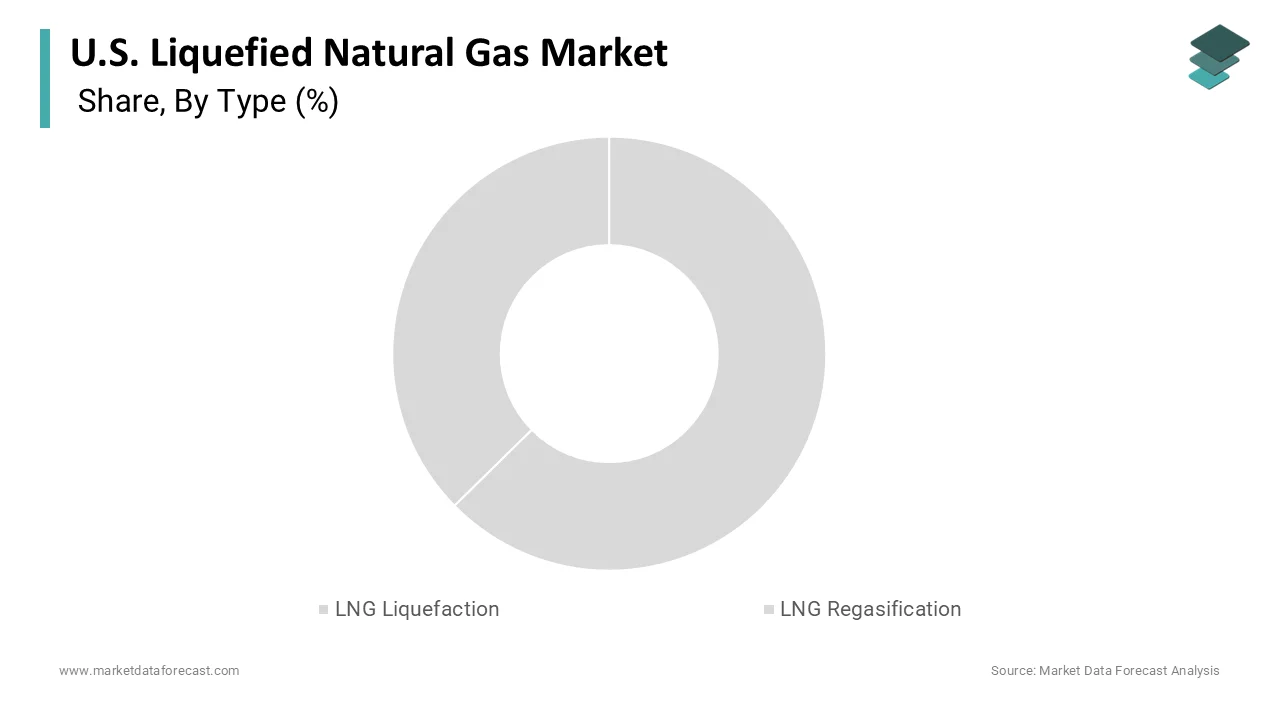
The LNG regasification segment is expected to exhibit a noteworthy CAGR of 4.5% over the forecast period. This swift growth of the segment is propelled by the need for import flexibility and the utilization of existing terminal infrastructure for bidirectional flow. Although the United States is a net exporter, its regasification segment is still growing. As per the Department of Energy, several existing import terminals have been converted to handle export flows, as an abundance of domestic shale gas has minimized the reliance on domestic regasification capability for balancing the contiguous United States grid. The growth is also driven by the increasing use of small-scale LNG for remote power generation and industrial applications, where regasification units are deployed at the point of use. According to international gas industry tracking, the deployment of modular regasification units is rising, allowing for decentralized energy solutions that do not rely on an extensive pipeline network. This trend is particularly relevant in areas where pipeline access is limited or economically unfeasible. Furthermore, the potential for future imports from global partners during extreme weather events or geopolitical crises necessitates a maintained regasification capacity. The ability to switch between import and export modes enhances energy security and market resilience. As the global LNG market becomes more interconnected, the value of flexible regasification infrastructure increases, driving investment in technologies that enable rapid conversion of liquid gas back to its gaseous state for immediate consumption.
By Application Insights
The industrial segment held the majority share of 48.5% of the United States liquefied natural gas market in 2025. Nevertheless, the majority of US LNG is produced for export markets. The industrial segment is a primary consumer of natural gas within the domestic context. This usage feeds the LNG value chain. For the specific context of LNG applications domestically, the industrial sector utilizes LNG for process heating, raw material feedstock, and backup power. As per the United States Energy Information Administration, the industrial sector accounts for approximately 33 percent of total natural gas consumption in the country, driven by chemicals, refining, and manufacturing industries. The dominance of this segment is attributed to the cost-effectiveness of natural gas compared to other fossil fuels, which enhances the competitiveness of US manufacturing. According to the American Chemistry Council, the availability of low-cost natural gas has spurred a renaissance in the US chemical industry, with billions of dollars invested in new facilities that use natural gas liquids as feedstocks. These facilities often require reliable fuel sources for continuous operations, and LNG provides a secure supply option, particularly in regions with constrained pipeline capacity. The steel, cement, and glass industries also rely heavily on natural gas for high-temperature processes. The structural integration of natural gas into industrial supply chains ensures steady demand, supporting the overall LNG market infrastructure. The reliability and affordability of the fuel make it indispensable for heavy industry, maintaining the segment's leading position in domestic consumption metrics.
The transportation segment is predicted to witness the highest CAGR of 6.2% between 2026 and 2034, owing to stringent environmental regulations and the need for cleaner heavy-duty fuel options. LNG is increasingly adopted as a fuel for long-haul trucks, buses, and marine vessels due to its lower emissions profile compared to diesel. As per the Environmental Protection Agency, new emissions standards for heavy-duty vehicles are pushing fleet operators to explore alternative fuels that reduce nitrogen oxide and particulate matter emissions. LNG offers a viable solution for heavy-duty transport where battery electric vehicles face limitations in range and payload capacity. According to the American Trucking Associations, while alternative fuels are expanding, major logistics companies have optimized their near-zero fleet investments around Compressed Natural Gas (CNG) and emerging zero-emission vehicle platforms due to refueling infrastructure constraints. The maritime sector is also driving growth, as the International Maritime Organization’s sulfur cap regulations encourage the use of cleaner fuels like LNG for shipping. The development of LNG refueling infrastructure along major freight corridors and at ports is facilitating this transition. Federal grants and state-level incentives further support the adoption of LNG in transportation, reducing the initial cost barrier for vehicle upgrades. Technology improvements and infrastructure expansion are driving growth in the transportation sector. Therefore, LNG serves as a key transitional fuel for decarbonizing heavy-duty mobility.
COUNTRY LEVEL ANALYSIS
United States Liquefied Natural Gas Market Analysis
The United States led the North American liquefied natural gas market and occupied a 95.7% share in 2025. This dominance of the country’s market was driven by its vast shale gas resources and advanced infrastructure. The country’s market status is characterized by its transformation from a prospective importer to the world’s largest LNG exporter, fundamentally altering global energy trade dynamics. According to the U.S. Energy Information Administration (EIA), the U.S. exported an average of 11.9 billion cubic feet per day of LNG in 2023, supplying key markets in Europe and Asia. The driving factors behind this leadership include the technological prowess in hydraulic fracturing, which unlocked massive gas reserves, and the rapid development of liquefaction terminals on the Gulf Coast. According to Federal Energy Regulatory Commission (FERC) infrastructure dockets, the rigorous federal regulatory framework involves multi-year review processes and extensive legal interventions, which frequently delay the commercial execution and completion timelines of domestic LNG export terminals. The geopolitical role of the US as a reliable energy partner has further strengthened its market position, particularly following disruptions in traditional supply chains. Domestic policies supporting energy independence and export growth have created a favorable investment environment. The integration of the US gas grid with global markets via LNG allows for price arbitrage and enhanced energy security. This robust production and export capability ensures that the United States remains the central pillar of the North American LNG landscape, influencing global prices and supply stability.
COMPETITIVE LANDSCAPE
The competition in the United States LNG market is characterized by intense rivalry among established energy majors and agile independent developers who vie for global market share. Market participants compete based on project execution speed, cost efficiency,y, and contractual flexibility. The landscape is dominated by a few key players who control significant liquefaction capacity along the Gulf Coast. Leading firms differentiate themselves through technological innovations, such as modular construction and carbon management solutions. Access to low-cost natural gas feedstock provides a competitive advantage, allowing US exporters to offer attractive pricing in international markets. Regulatory approval processes and environmental compliance create barriers to entry,y favoring experienced operators with strong financial backing. The shift towards spot market trading adds complexity, ty requiring companies to develop sophisticated trading capabilities. Strategic alliances with global partners enhance market access and risk mitigation. Over, the market demands continuous innovation and operational excellence to maintain competitiveness in a dynamic and increasingly sustainable global energy environment.
KEY MARKET PLAYERS
Some of the companies that are playing a dominating role in the U.S. Liquefied Natural Gas (LNG) Market include
- Cheniere Energy, Inc.
- Sempra Energy
- Exxon Mobil Corporation
- Chevron Corporation
- ConocoPhillips
- Freeport LNG Development, L.P.
- Venture Global LNG, Inc.
- Tellurian Inc.
- NextDecade Corporation
- Kinder Morgan, Inc.
- TotalEnergies SE
- Shell plc
TOP LEADING PLAYERS IN THE MARKET
- Cheniere Energy Inc is the pioneering and largest producer of liquefied natural gas in the United States, operating the Sabine Pass and Corpus Christi terminals. The company has established long-term contracts with major global utilities, ensuring stable revenue streams and market presence. Cheniere recently focused on optimizing operational efficiency and expanding its customer base through flexible trading capabilities. The company is also investing in carbon capture initiatives to reduce the carbon footprint of its operations. By leveraging its first mover advantage and extensive infrastructure,e Cheniere continues to set industry standards for reliability and service. Its strategic partnerships with international buyers strengthen its position as a key supplier in the global energy transition landscape.
- Venture Global LNG is a rapidly growing developer that has significantly expanded US export capacity through its Calcasieu Pass and Plaquemines projects. The company utilizes modular construction techniques to accelerate project timelines and reduce costs compared to traditional methods. Venture Global has secured numerous long-term sale and purchase agreements with European and Asian buyers, enhancing its market footprint. The company is actively developing the Delta LNG project to further increase its production capabilities. By focusing on speed to market and competitive pricing,g Venture Global has disrupted the traditional industry model. Its aggressive expansion strategy and innovative approach to liquefaction technology strengthen its position as a major competitor in the US LNG sector.
- ExxonMobil Corporation is a global energy giant that plays a critical role in the US LNG market through its Golden Pass and Port Arthur projects. The company leverages its integrated value chain from upstream production to downstream export to maximize efficiency and profitability. ExxonMobil recently finalized investment decisions for major expansion projects, ts demonstrating its commitment to long-term growth in the sector. The company focuses on operational excellence and technological innovation to reduce emissions and improve plant reliability. By partnering with QatarEnergy and other strategic allies, ExxonMobil enhances its global reach and supply security. Its robust financial position and technical expertise allow it to execute complex projects effectively,y strengthening its leadership in the US LNG market.
TOP STRATEGIES USED BY KEY MARKET PARTICIPANTS
Key players in the United States LNG market primarily focus on securing long-term offtake agreements to ensure revenue stability and justify capital investments. Companies are increasingly integrating carbon capture and storage technologies to reduce emissions and meet environmental standards. Strategic partnerships with international energy firms help share risks and expand global distribution networks. Participants are also optimizing supply chains by leveraging domestic shale gas resources for cost-competitive feedstock. Investment in modular construction techniques accelerates project completion and reduces upfront costs. Diversifying customer bases across Europe and Asia mitigates regional demand fluctuations. Regulatory compliance and community engagement are prioritized to secure permits and maintain social license. These strategies enable companies to navigate market volatility and sustain growth in the evolving global energy landscape.
MARKET SEGMENTATION
This research report on the U.S. liquefied natural gas market is segmented and sub-segmented into the following categories.
By Type
- LNG Liquefaction
- LNG Regasification
By Application
- Industrial
- Transportation
- Power Generation
- Residential and Commercial
By Country
- California
- Washington
- Oregon
- New York
- Rest of the United States
Related Reports
Access the study in MULTIPLE FORMATS
Purchase options starting from
$ 1200
Didn’t find what you’re looking for?
TALK TO OUR ANALYST TEAM
Need something within your budget?
NO WORRIES! WE GOT YOU COVERED!
Call us on: +1 888 702 9696 (U.S Toll Free)
Write to us: sales@marketdataforecast.com