U.S. Medical Billing Outsourcing Market Size, Share, Trends & Growth Forecast Report By Service, By End User, and By Country (California, Washington, Oregon, New York & Rest of the United States) – Industry Analysis and Forecast, 2026 to 2034
Market Size, 2025
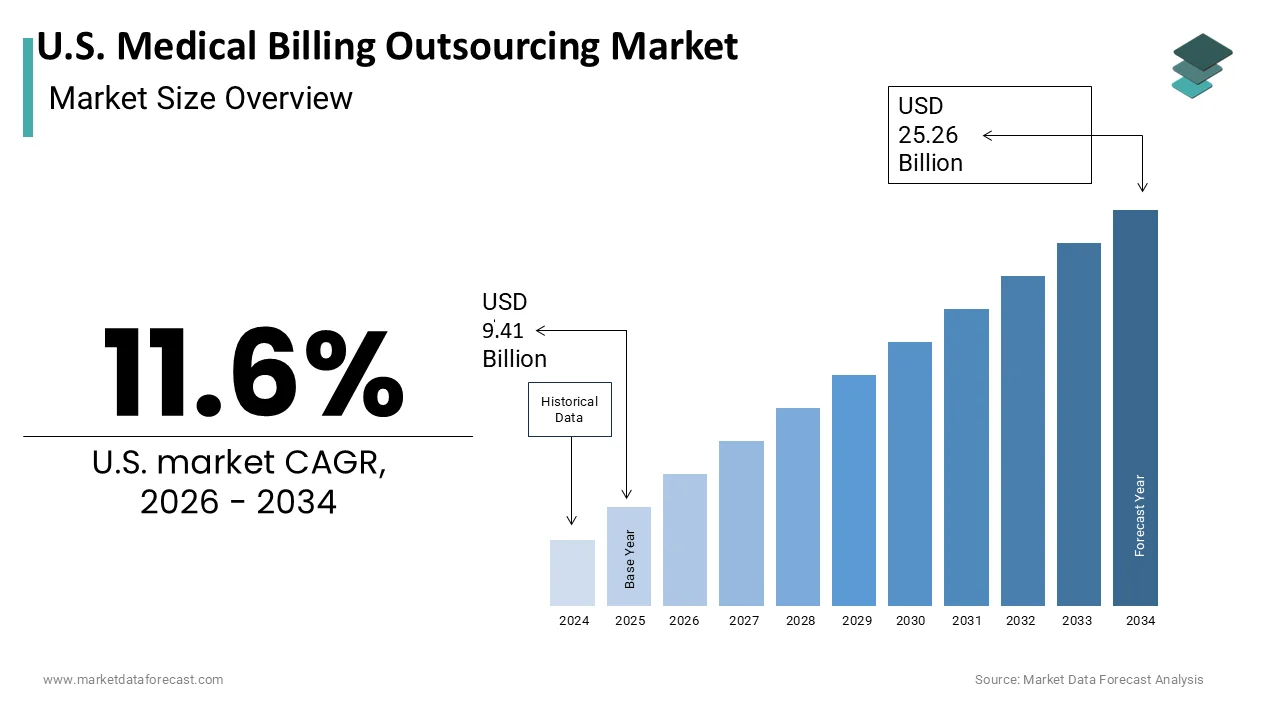
$9.41 BnMarket Estimate, 2026
$10.50 BnMarket Forecast, 2034
$25.26 BnCAGR, 2026–2034
11.6%U.S. Medical Billing Outsourcing Market Size
The U.S. Medical Billing Outsourcing Market was valued at USD 9.41 billion in 2025, is estimated to reach USD 10.50 billion in 2026, and is projected to reach USD 25.26 billion by 2034, growing at a CAGR of 11.6% from 2026 to 2034.
According to the American Medical Association, physicians spend approximately 15 hours per week on billing and insurance-related tasks, which detract from direct patient care time. As per the Centers for Medicare and Medicaid Services, the complexity of the U.S. healthcare system involves thousands of distinct billing codes and frequent regulatory updates that require specialized expertise to navigate effectively. The Healthcare Financial Management Association notes that the average cost to collect a dollar of revenue has increased significantly due to rising administrative overhead and declining reimbursement rates. Furthermore, the transition to value-based care models necessitates sophisticated data analytics capabilities that many small to mid-sized practices lack internally. Outsourcing partners leverage advanced technologies such as artificial intelligence and robotic process automation to enhance accuracy and reduce claim denial rates. This market is defined by the critical need for financial stability in an environment characterized by shrinking margins and increasing operational costs, driving healthcare providers to seek external efficiencies.
MARKET DRIVERS
Escalating Administrative Complexity and Regulatory Compliance Burdens
The intricate nature of U.S. healthcare regulations and coding standards is majorly propelling the growth of the U.S. medical billing outsourcing market. According to the American Hospital Association, there were 907,216 total staffed beds in all U.S. hospitals in 2026, which reflects the massive infrastructure dedicated to patient care and compliance. As per the Centers for Medicare and Medicaid Services, the International Classification of Diseases tenth revision contains over 70,000 diagnostic codes and the Current Procedural Terminology code set includes more than 10,000 procedure codes, requiring precise application to avoid claim rejections. Frequent updates to these codes, along with changing payer policies, create a dynamic environment that is difficult for internal teams to monitor continuously. The Health Insurance Portability and Accountability Act imposes strict penalties for non-compliance with privacy and security standards, adding another layer of operational risk. According to the Medical Group Management Association, practices that outsource billing report a 20% reduction in administrative errors compared to those managing processes in-house. Specialized outsourcing firms invest heavily in continuous training and certification for their staff, ensuring up-to-date knowledge of federal and state regulations. This expertise minimizes the risk of audits and fines while maximizing legitimate reimbursement. Consequently, the inability of internal staff to keep pace with regulatory volatility drives healthcare providers toward external partners who offer scalable and compliant solutions.
Rising Operational Costs and Pressure on Profit Margins
The increasing cost of maintaining in-house billing departments, combined with shrinking reimbursement rates, is further fuelling the expansion of the U.S. medical billing outsourcing market. According to the Bureau of Labor Statistics, the median annual wage for medical records specialists was $50,250 in 2024, reflecting the high cost of skilled labor in the healthcare sector. As per the American Medical Group Association, the cost of employing a full-time billing specialist, including benefits, training, and technology infrastructure, can exceed $60,000 annually per employee. Many small and independent practices operate on thin margins, making it financially unsustainable to retain large administrative teams. Outsourcing converts fixed labor costs into variable costs, allowing providers to pay only for the services rendered, thus improving financial predictability. The Commonwealth Fund reports that administrative costs account for nearly 25% of total healthcare spending in the United States, which is significantly higher than in other developed nations. By leveraging economies of scale, outsourcing vendors can offer services at a fraction of the cost of internal operations. Furthermore, reduced claim denial rates achieved by expert coders lead to faster payments and improved cash flow. According to the Healthcare Financial Management Association, outsourcing can reduce the days in accounts receivable by 15% to 20%, enhancing liquidity. This financial efficiency enables providers to redirect resources toward clinical care and facility improvements rather than administrative overhead.
MARKET RESTRAINTS
Data Security Risks and Privacy Concerns
The transmission of sensitive patient information to third-party vendors introduces significant security vulnerabilities that restrain market growth. According to the Department of Health and Human Services, healthcare data breaches affected over 133 million individuals in 2023 alone, with many incidents involving business associates such as billing companies. As per the Health Insurance Portability and Accountability Act, covered entities remain liable for data breaches occurring at the vendor level, creating substantial legal and reputational risks. Cybercriminals increasingly target medical billing firms because they possess comprehensive databases containing personal health information and financial details. The IBM Cost of a Data Breach Report states that the average cost of a healthcare data breach reached $10.93 million in 2023, which can be devastating for smaller practices. Ensuring robust cybersecurity measures requires continuous investment in encryption, firewalls, and access controls, which some outsourcing providers may neglect to minimize costs. Patients are also becoming more aware of privacy issues and may resist sharing data with external entities, fearing misuse or unauthorized access. According to a survey by the American Medical Association, nearly 30% of physicians cite data security as a major concern when considering outsourcing partnerships. The fear of potential litigation and loss of patient trust discourages some healthcare providers from delegating billing functions. Consequently, stringent security requirements and the inherent risks of data transfer act as significant barriers to the wider adoption of outsourcing services.
Loss of Control and Communication Challenges
The delegation of critical revenue cycle functions to external providers often results in perceived loss of control, and communication inefficiencies further hamper the U.S. medical billing outsourcing market expansion. According to the Medical Group Management Association, practices that outsource billing frequently report difficulties in obtaining timely updates on claim status and denial reasons. As per industry feedback, the physical separation between clinical staff and billing agents can lead to misunderstandings regarding coding nuances and patient-specific circumstances. Internal teams possess intimate knowledge of provider preferences and patient histories, which external vendors may lack despite training. This knowledge gap can result in delayed responses to patient inquiries and frustration among both patients and providers. The American Academy of Family Physicians notes that effective communication is essential for resolving complex billing issues and that outsourcing can disrupt established workflows. Furthermore, reliance on a third party reduces the ability of practices to implement immediate changes or corrections when errors are identified. Some providers feel disconnected from their financial performance metrics when they do not manage the billing process directly. According to a study in the Journal of Medical Practice Management, lack of transparency in vendor operations can lead to distrust and dissatisfaction. These operational frictions and the inability to exert direct oversight compel some healthcare organizations to retain billing functions in-house despite higher costs.
MARKET OPPORTUNITIES
Integration of Artificial Intelligence and Automation Technologies
The adoption of artificial intelligence and robotic process automation is a significant opportunity for the U.S. medical billing outsourcing market. According to the American Medical Association, 81% of physicians were using some form of AI in their practices by 2026, which shows a significant increase in technological trust. As per industry analyses, machine learning algorithms can predict claim denials before submission by analyzing historical data and identifying patterns associated with rejected claims. This proactive approach significantly reduces the workload for human coders and accelerates the revenue cycle. Outsourcing firms that invest in these technologies can offer superior accuracy and faster turnaround times compared to traditional manual processes. The National Institutes of Health highlights that automation reduces human error, which is a leading cause of claim rejections. Furthermore, AI-powered chatbots can handle patient billing inquiries, providing instant responses and improving customer satisfaction. According to McKinsey and Company, automation in healthcare administration could generate up to $200 billion in annual value by reducing costs and improving productivity. Vendors who leverage these technologies can differentiate themselves in a crowded market by offering data-driven insights and predictive analytics to their clients. This technological advancement transforms outsourcing from a simple labor arbitrage model to a strategic partnership focused on optimization and innovation.
Expansion into Value-Based Care and Analytics Services
The shift toward value-based care models creates new opportunities for the U.S. medical billing outsourcing market. According to the Centers for Medicare and Medicaid Services, a significant portion of Medicare payments is now tied to quality and value rather than volume, requiring sophisticated tracking of clinical outcomes. As per the Healthcare Financial Management Association, traditional billing companies are evolving into revenue cycle management partners that provide insights into cost per episode of care and provider performance metrics. Outsourcing vendors can leverage their aggregated data to help healthcare organizations identify trends, optimize resource allocation, and improve patient outcomes. This transition allows vendors to move beyond transactional billing services to strategic advisory roles that command higher fees and deeper client engagement. The American Hospital Association emphasizes the need for data interoperability and analytics to succeed in value-based contracts. Outsourcing firms with robust data infrastructure can integrate clinical and financial data to provide holistic views of patient care journeys. According to Deloitte, healthcare providers are increasingly seeking partners who can help them navigate the complexities of risk-based contracts. By offering comprehensive analytics and reporting services, outsourcing companies can address the growing demand for financial transparency and operational efficiency in a value-driven healthcare landscape.
MARKET CHALLENGES
Shortage of Skilled Medical Coders and Staff Turnover
The persistent shortage of qualified medical coders and high employee turnover rates pose significant challenges to the U.S. medical billing outsourcing market expansion. According to the Bureau of Labor Statistics, employment of medical records specialists is projected to grow 7% from 2024 to 2034, which is much faster than the average for all occupations. As per industry reports, the annual turnover rate in medical billing companies often exceeds 20% due to burnout and competitive job markets. This instability leads to inconsistent service quality and increased training costs for outsourcing vendors. New hires require extensive training to master complex coding guidelines and payer-specific rules, during which productivity is lower. The American Academy of Professional Coders notes that inexperienced coders are more likely to make errors, resulting in claim denials and delayed payments. Furthermore, the remote work trend has intensified talent competition, allowing skilled professionals to demand higher wages and better benefits. Outsourcing firms operating on thin margins struggle to retain top talent while keeping service costs affordable for clients. According to the Bureau of Labor Statistics, the demand for health information technicians remains high, but the supply remains insufficient. This labor constraint limits the scalability of outsourcing operations and forces vendors to invest heavily in recruitment and retention strategies. Consequently, the inability to maintain a stable and skilled workforce undermines the reliability and efficiency of outsourced billing services.
Inconsistent Service Quality and Vendor Performance Variability
The lack of standardized performance metrics and variability in service quality among outsourcing providers creates uncertainty and risk for healthcare organizations, which further challenges the U.S. medical billing outsourcing market growth. According to the Medical Group Management Association, there is no universal benchmark for key performance indicators such as claim acceptance rates or days in accounts receivable across the industry. As per client feedback, some outsourcing firms prioritize volume over accuracy, leading to higher denial rates and increased administrative burden for providers to correct errors. The absence of transparent reporting mechanisms makes it difficult for healthcare organizations to assess the true effectiveness of their vendors. The American Medical Association highlights that poor vendor performance can negatively impact patient satisfaction due to billing errors and aggressive collection practices. Furthermore, contractual ambiguities regarding service level agreements often lead to disputes and unresolved issues. According to a survey by Black Book Research, a significant portion of healthcare providers express dissatisfaction with their current billing outsourcing partners, citing inconsistent communication and subpar results. The fragmented nature of the outsourcing market, with numerous small and unregulated players, exacerbates these quality issues. Healthcare providers must invest significant time in vetting and monitoring vendors to ensure acceptable performance levels. This variability in service quality erodes trust and discourages some organizations from pursuing outsourcing arrangements despite potential cost benefits.
REPORT COVERAGE
| REPORT METRIC | DETAILS |
| Market Size Available | 2025 to 2034 |
| Base Year | 2025 |
| Forecast Period | 2026 to 2034 |
| Segments Covered | By Service, End User, and Region. |
| Various Analyses Covered | Global, Regional and Country-Level Analysis, Segment-Level Analysis, Drivers, Restraints, Opportunities, Challenges; PESTLE Analysis; Porter’s Five Forces Analysis, Competitive Landscape, Analyst Overview of Investment Opportunities |
| Countries Covered | California, Washington, Oregon, New York, and the rest of the United States |
| Market Leaders Profiled | R1RCM Inc., Veradigm LLC (Allscripts Healthcare, LLC), Oracle Corporation (Cerner Corporation), eClinicalWorks, Kareo, Inc., McKesson Corporation, Quest Diagnostics Incorporated, Promantra Inc., AdvancedMD, Inc., eBilling Inc., GeBBS Healthcare Solutions, Omega Healthcare Management Services |
SEGMENTAL ANALYSIS
By Service Insights
The back-end services segment dominated the market by holding 54.6% of the regional market share in 2025. The intricate process of claims adjudication and the high volume of initial denials significantly sustain the dominance of back-end services. According to 2026 healthcare data, approximately 15% to 20% of all medical claims are denied on their first submission, requiring extensive manual intervention and resubmission efforts. As per data from the Medical Group Management Association, the average cost to rework a single denied claim is approximately $25, creating a substantial financial burden for healthcare providers. Back-end outsourcing specialists possess the expertise to navigate complex payer requirements and appeal processes effectively, reducing the days in accounts receivable. The Centers for Medicare and Medicaid Services reports that improper payments in Medicare Fee For Service programs have historically exceeded $30 billion, highlighting the scale of billing errors and compliance issues. Outsourcing firms leverage specialized software and experienced coders to identify root causes of denials, such as coding errors or missing documentation, preventing future occurrences. Furthermore, the sheer volume of transactions generated by large hospital systems necessitates a robust back-end infrastructure that internal teams often struggle to maintain. According to the Healthcare Financial Management Association, effective denial management can recover a significant portion of initially rejected claims, ensuring maximum revenue capture. This critical function directly impacts the financial health of healthcare organizations, making it the most valued component of outsourced revenue cycle management.
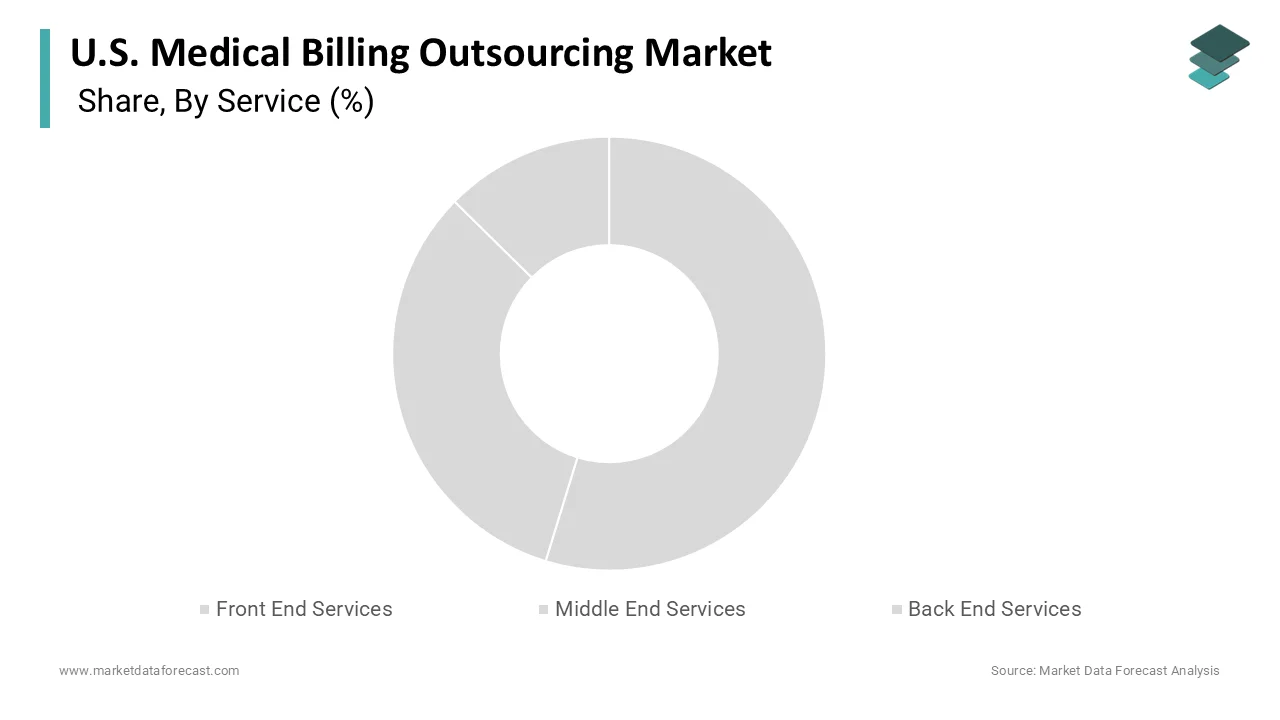
However, the front-end services segment represents the fastest-growing category within the U.S. medical billing outsourcing market and is expected to grow at a CAGR of 13.4% during the forecast period, owing to the increasing focus on patient access and upfront financial clearance. The shift toward high deductible health plans and federal price transparency regulations significantly drives expansion in front-end services. According to the Kaiser Family Foundation, the percentage of workers enrolled in high-deductible health plans has risen to over 50%, meaning patients are responsible for a larger portion of their healthcare costs upfront. As per the Centers for Medicare and Medicaid Services, new rules require hospitals to provide clear estimates of service costs before treatment, necessitating accurate real-time eligibility verification and benefit estimation. Front-end outsourcing providers utilize advanced tools to verify insurance coverage, estimate patient responsibility, and collect co-payments at the point of service. This proactive approach reduces bad debt and improves collection rates significantly. The American Hospital Association reports that patient collections have become increasingly difficult, with many individuals unable to pay large bills after services are rendered. By addressing financial conversations before care is delivered, providers can offer payment plans and financial assistance options, improving patient satisfaction and liquidity. According to industry standards, achieving a benchmark of 35% for point of service collections can help organizations improve cash flow and reduce bad debt. Furthermore, accurate eligibility checks prevent claim denials related to coverage lapses, reducing downstream administrative work. This strategic focus on upfront financial clarity positions front-end services as the fastest-growing segment in the market.
By End User Insights
The hospitals segment led the market with 62.1% of the U.S. market share in 2025. The dominance of the hospital segment in the U.S. market is mainly driven by the massive volume of transactions and complex regulatory requirements inherent to institutional care. The sheer scale of patient visits and diverse payer contracts managed by hospitals significantly sustains their market dominance. According to the American Hospital Association, U.S. hospitals saw more than 35 million total admissions in 2026, generating billions of individual claims. As per the Centers for Medicare and Medicaid Services, hospitals interact with hundreds of different insurance plans, each with unique billing rules, coverage limits, and prior authorization requirements. Managing this complexity internally requires extensive resources and specialized knowledge that many institutions find challenging to maintain. Outsourcing allows hospitals to leverage the scale and expertise of vendors who manage similar volumes for multiple clients, achieving economies of scale. The Healthcare Financial Management Association notes that hospital revenue cycles are particularly vulnerable to cash flow disruptions due to lengthy reimbursement cycles from government payers. Outsourcing partners provide the necessary infrastructure to handle high-volume data processing and ensure timely claim submission. Furthermore, hospitals face stringent regulatory oversight, including the No Surprises Act, which mandates specific billing practices for emergency services. Compliance with these regulations requires constant monitoring and updates, which outsourcing firms provide as part of their service offering. According to industry analyses, the cost per claim for hospitals is significantly higher than for smaller practices due to administrative overhead. Delegating these functions to external experts enables hospitals to optimize operational efficiency and focus on clinical care delivery.
On the other side, the physician’s offices segment is expected to exhibit a CAGR of 14.4% in the U.S. market during the forecast period, owing to the fragmentation of the provider landscape and resource constraints. The large number of independent and small group practices lacking internal administrative infrastructure significantly drives expansion in this segment. According to the American Medical Association, only 42.2% of physicians worked in private practices in 2024, a 18 percentage point decrease from 2012, while many others are moving toward hospital ownership or corporate employment. As per the Medical Group Management Association, small practices typically employ fewer than five administrative personnel who must handle scheduling, billing, and patient inquiries simultaneously. This lack of specialization leads to inefficiencies and higher error rates in claim submission. Outsourcing provides these practices with access to enterprise-level technology and certified coders that they could not afford independently. The Centers for Medicare and Medicaid Services emphasizes the importance of accurate coding for proper reimbursement, which is difficult for generalist staff to maintain amidst frequent regulatory changes. Furthermore, the retirement of experienced practice administrators creates a knowledge gap that outsourcing firms fill immediately. According to a survey by the American Academy of Family Physicians, many independent practices cite administrative burden as a primary reason for considering consolidation or outsourcing. By delegating billing tasks, physicians can focus on patient care and practice growth. The scalability of outsourcing services allows practices to adjust support levels based on patient volume fluctuations without the risks associated with hiring and firing staff. This flexibility and access to expertise position physicians’ offices as the fastest-growing segment.
COUNTRY LEVEL ANALYSIS
U.S. Medical Billing Outsourcing Market Analysis
The United States held a commanding position in the global medical billing outsourcing market in 2025. This market leadership reflects the unique complexity of the U.S. healthcare financing system and the high cost of domestic administrative labor. The fragmented multi-payer structure of the U.S. healthcare system significantly propels its dominance in the medical billing outsourcing sector. According to the Commonwealth Fund, the United States is the only developed nation without a universal healthcare system, resulting in a complex web of private insurers, government programs, and self-pay patients. As per the Centers for Medicare and Medicaid Services, there are over 900 distinct health insurance plans in the U.S., each with different coverage policies, billing formats, and reimbursement rates. This heterogeneity creates an immense administrative burden that is unparalleled in other countries with single-payer or standardized systems. The American Hospital Association notes that U.S. hospitals spend significantly more on billing and insurance-related activities than their international counterparts. Consequently, the demand for specialized outsourcing services to navigate this complexity is exceptionally high. Furthermore, the frequent changes in federal and state regulations, such as the Affordable Care Act and the No Surprises Act, require continuous adaptation of billing processes. Outsourcing vendors provide the agility and expertise needed to comply with these evolving rules. According to the National Bureau of Economic Research, administrative costs account for nearly 25% of U.S. healthcare spending, driving providers to seek efficiencies through outsourcing. This structural complexity ensures that the United States remains the largest and most dynamic market for medical billing outsourcing globally.
COMPETITIVE LANDSCAPE
The United States medical billing outsourcing market features intense competition among large integrated health service providers, specialized revenue cycle firms,s and emerging technology-driven startups. Established players leverage extensive client networks, proprietary technology platforms, and economies of scale to maintain leadership,p while niche competitors differentiate through specialized coding expertise or regional focus. Competition centers on operational efficiency and accuracy,cy with companies investing heavily in automation tools to reduce claim denials and accelerate payments. Pricing models vary from a percentage of collections to a flat fee structure, res creating pressure on margins and driving consolidation within the industry. Regulatory compliance and data security serve as critical differentiators as healthcare providers seek partners who can mitigate legal risks effectively. The shift to value-based care encourages vendors to offer advanced analytics and population health management capabilities beyond traditional billing services. Customer retention relies heavily on service quality, transparency,y and the ability to adapt to changing payer policies. Strategic partnerships with electronic health record vendors enhance interoperability and streamline workflows. This dynamic landscape fosters continuous innovation in process optimization and customer experience, ensuring providers benefit from improved financial performance and reduced administrative burdens.
KEY MARKET PLAYERS
Some of the companies that are playing a dominating role in the U.S. Medical Billing Outsourcing Market include
- R1RCM Inc.
- Veradigm LLC (Allscripts Healthcare, LLC)
- Oracle Corporation (Cerner Corporation)
- eClinicalWorks
- Kareo, Inc.
- McKesson Corporation
- Quest Diagnostics Incorporated
- Promantra Inc.
- AdvancedMD, Inc.
- eBilling Inc.
- GeBBS Healthcare Solutions
- Omega Healthcare Management Services
TOP LEADING PLAYERS IN THE MARKET
- R1 RCM Inc is a leading provider of revenue cycle management services in the United States healthcare sector. The company serves hospitals, health systems,s and physician groups by automating and optimizing administrative processes. R1 RCM recently strengthened its market position through strategic acquisitions that expand its technology capabilities and service offerings. The company leverages artificial intelligence and machine learning to enhance claim accuracy and reduce denial rates. R1 RCM also focuses on improving patient financial experiences by offering transparent billing solutions and flexible payment options. These initiatives help healthcare providers maximize revenue while reducing administrative burdens. The company continues to invest in digital transformation tools that streamline end-to-end revenue cycle operations, ensuring compliance and operational efficiency for its diverse client base across the country.
- OptumInc.,c a subsidiary of UnitedHealth Group, plays a pivotal role in the U.S. medical billing outsourcing market through its comprehensive technology and services platform. The company integrates clinical and financial data to provide actionable insights for healthcare providers. Optum recently expanded its cloud-based revenue cycle solutions to support smaller practices and ambulatory care centers. The organization utilizes advanced analytics to identify billing errors and optimize reimbursement strategies for its clients. Optum also emphasizes regulatory compliance by continuously updating its systems to align with changing healthcare laws. By combining technological innovation with deep industry expertise, Optum helps providers improve cash flow and operational performance. The company actively collaborates with payers to streamline authorization processes,s further enhancing the efficiency of the revenue cycle for its extensive network of healthcare partners.
- GeBBS Healthcare Solutions is a prominent player in the U.S. medical billing outsourcing market known for its specialized revenue cycle management services. The company offers end-to-end solutions, including coding, billing, ng and accounts receivable management for hospitals and physician practices. GeBBS recently enhanced its digital capabilities by integrating robotic process automation into its workflow to accelerate claim processing. The firm focuses on delivering high-quality customer service and maintaining strict compliance with healthcare regulations. GeBBS also provides customized analytics reports that help clients track performance metrics and identify areas for improvement. By leveraging a skilled workforce and advanced technology platforms, GeBBS ensures accurate and timely reimbursement for its clients. The company continues to expand its footprint in the U.S. market by forming strategic partnerships with healthcare organizations seeking to optimize their financial operations.
TOP STRATEGIES USED BY KEY MARKET PARTICIPANTS
Key players in the United States medical billing outsourcing market employ strategic approaches to maintain competitive advantages and drive growth. Companies prioritize technological innovation by integrating artificial intelligence and robotic process automation to enhance accuracy and efficiency. Strategic acquisitions enable firms to expand service portfolios and enter new geographic markets rapidly. Providers focus on end-to-end revenue cycle management solutions that offer seamless integration with electronic health records. Investment in cybersecurity measures ensures the protection of sensitive patient data and builds trust with healthcare clients. Firms also emphasize value-based care analytics to help providers navigate complex reimbursement models. Customer-centric services, including dedicated support teams and transparent reporting, foster long-term relationships. These coordinated efforts enable participants to reduce operational costs for clients while improving financial outcomes and regulatory compliance in a dynamic healthcare environment.
MARKET SEGMENTATION
This research report on the U.S. medical billing outsourcing market is segmented and sub-segmented into the following categories.
By Service
- Front End Services
- Middle End Services
- Back End Services
By End User
- Hospitals
- Physician’s Offices
- Diagnostic Laboratories
- Ambulatory Surgical Centers
- Others
By Country
- California
- Washington
- Oregon
- New York
- Rest of the United States
Related Reports
Access the study in MULTIPLE FORMATS
Purchase options starting from
$ 1200
Didn’t find what you’re looking for?
TALK TO OUR ANALYST TEAM
Need something within your budget?
NO WORRIES! WE GOT YOU COVERED!
Call us on: +1 888 702 9696 (U.S Toll Free)
Write to us: sales@marketdataforecast.com