United States Microgrid Market Size, Share, Trends & Growth Forecast Report By Capacity, By Power Source, By Application, and By Country (California, Washington, Oregon, New York & Rest of the United States) – Industry Analysis and Forecast, 2026 to 2034
Market Size, 2025
$28.58 BnMarket Estimate, 2026
$33.98 BnMarket Forecast, 2034
$135.72 BnCAGR, 2026–2034
18.9%U.S. Microgrid Market Size
The U.S. Microgrid Market was valued at USD 28,576.90 million in 2025, is estimated to reach USD 33,977.94 million in 2026, and is projected to reach USD 135,722.49 million by 2034, growing at a CAGR of 18.9% from 2026 to 2034.
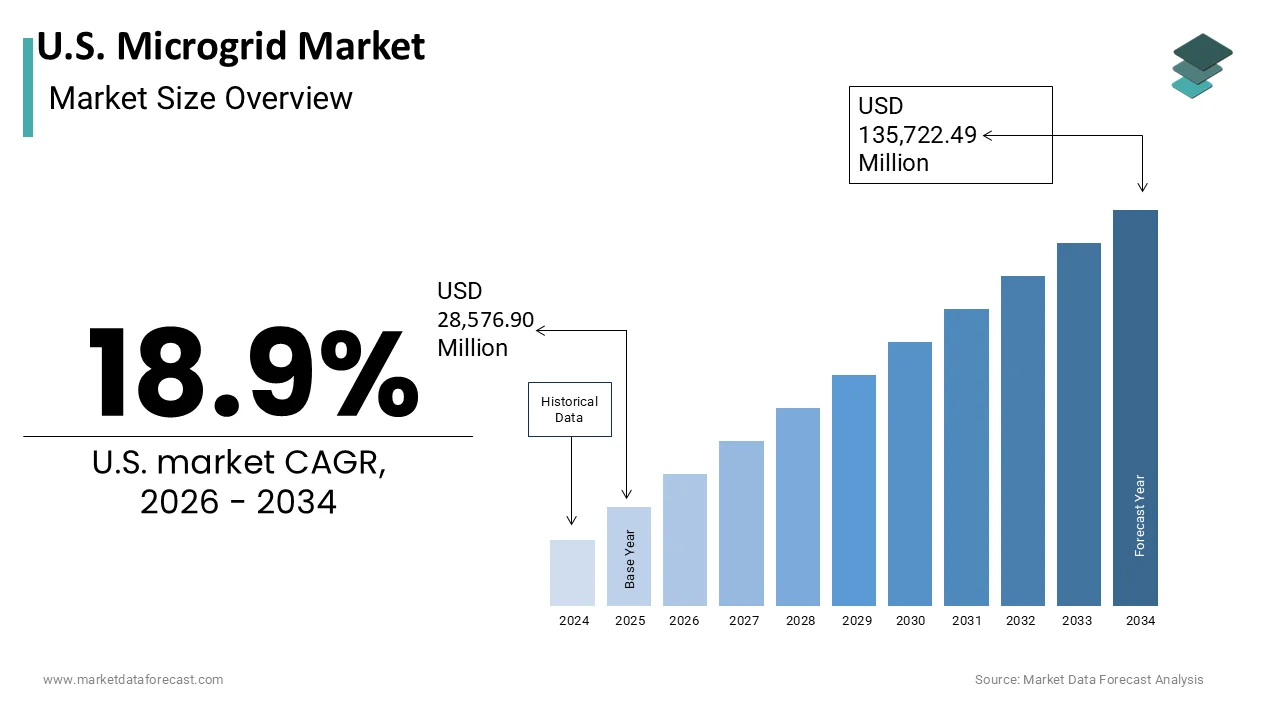
The United States microgrid market refers to the ecosystem of companies, technologies, and services involved in creating localized energy networks that can operate independently of the main utility grid. These systems integrate distributed energy resources such as solar photovoltaics, wind turbines, battery storage, and conventional generators to provide reliable power to specific communities or facilities. As per the Department of Energy, there are currently more than 500 operational microgrids across the country, serving critical institutions like military bases, universities, and healthcare facilities. The definition of this market extends beyond mere backup power to encompass active participation in broader grid services, including frequency regulation and voltage support. According to the U.S. Department of Energy (DOE), power outages caused by extreme weather cost the U.S. economy billions of dollars annually, driving Federal Emergency Management Agency (FEMA) initiatives to fund resilient energy infrastructure for long-term risk mitigation. Microgrids offer a decentralized approach to energy security, reducing vulnerability to centralized grid failures. The regulatory landscape is evolving, with states like California and New York implementing policies that encourage islanding capabilities and renewable integration. This market is defined by its ability to enhance energy independence, reduce carbon emissions, and optimize local energy consumption through advanced control systems. The transition towards smart grid technologies further enables seamless interaction between microgrids and the main utility network, creating a hybrid model that balances stability with sustainability.
MARKET DRIVERS
Increasing Frequency of Extreme Weather Events Drives Resilience Demand
The escalating frequency and severity of extreme weather events are primary drivers for the adoption of microgrid systems in the country, which contributes to the growth of the United States microgrid market. Consequently, utilities and consumers are seeking to mitigate the risks associated with prolonged power outages. Climate change has intensified hurricanes, wildfires, and winter storms, exposing the vulnerabilities of the centralized transmission and distribution infrastructure. As per the National Oceanic and Atmospheric Administration, the United States experienced 28 separate weather and climate disasters in 2023 that each resulted in at least 1 billion dollars in damages, highlighting the growing economic impact of these events. These disruptions often lead to extended periods without electricity, affecting critical services such as healthcare, emergency response, and communication networks. According to the Lawrence Berkeley National Laboratory, the average duration of power outages has increased significantly over the past decade, prompting institutions to invest in localized energy solutions that can operate independently during grid failures. Microgrids provide a robust shield against these external shocks by allowing facilities to island themselves and continue operations using on-site generation and storage. The military, for instance, has prioritized microgrid deployment to ensure mission continuity in the face of natural or man-made disruptions. Furthermore, insurance companies are beginning to recognize the value of resilience, offering incentives for properties equipped with backup power systems. This convergence of environmental risk and economic necessity creates a compelling case for microgrid investment, driving demand across residential, commercial, and industrial sectors.
Government Incentives and Policy Support Accelerate Deployment
Robust government incentives and supportive policy frameworks are boosting the expansion of the United States microgrid market. This reduces financial barriers and encourages private sector investment. Federal legislation, such as the Inflation Reduction Act,t provides substantial tax credits for renewable energy installations and energy storage systems, which are core components of modern microgrids. As per the Internal Revenue Service, the Investment Tax Credit for energy storage has been expanded, allowing developers to claim up to 30 percent of project costs, thereby improving the economic viability of microgrid projects. State-level initiatives further complement federal efforts, with programs designed to promote grid resilience and decarbonization. For example, the New York State Energy Research and Development Authority has allocated millions of dollars in funding for community microgrid projects that enhance local reliability and integrate renewable resources. According to the Database of State Incentives for Renewables and Efficiency, numerous states have established grant programs and low-interest loans specifically targeted at microgrid development. These financial mechanisms lower the upfront capital requirements, making it easier for municipalities, schools, and businesses to adopt these technologies. Additionally, regulatory reforms in several jurisdictions are simplifying the interconnection process for distributed energy resources, reducing administrative hurdles for microgrid operators. The alignment of federal and state policies creates a favorable environment for innovation and deployment, accelerating the transition towards a more decentralized and resilient energy system.
MARKET RESTRAINTS
High Initial Capital Costs Restrict Market Accessibility
The substantial upfront capital required for the design, construction, and installation of microgrid systems is a major restraint on the United States microgrid market. This is particularly challenging for smaller entities with limited financial resources. Developing a functional microgrid involves significant investment in hardware such as solar panels, battery storage units, inverters, and advanced control software, as well as engineering and permitting costs. As per the National Renewable Energy Laboratory, the cost of installing a commercial-scale microgrid can range from 2 million to 10 million dollars, depending on the size and complexity of the system. This high entry barrier limits accessibility for small businesses, rural communities, and residential associations that could benefit from enhanced energy resilience but lack the necessary capital. According to the American Council on Renewable Energy, financing remains a critical challenge, as traditional lenders may perceive microgrid projects as risky due to their novelty and complex revenue models. The long payback period associated with these investments, often exceeding seven to ten years, further discourages potential adopters who seek quicker returns on capital. Additionally, the rapid pace of technological advancement means that early adopters risk obsolescence, adding another layer of financial uncertainty. High initial costs and a lack of financing limit energy resilience solutions to large institutions. Therefore, the democratization of these technologies is slowing down.
Regulatory Uncertainty and Interconnection Complexities Hinder Progress
The fragmented and often ambiguous regulatory landscape surrounding microgrid interconnection and operation is impeding the expansion of the United States microgrid market. Each state has its own set of rules governing how microgrids connect to the main grid, sell excess power, and participate in energy markets, creating a complex web of compliance requirements for developers. As per the Federal Energy Regulatory Commission, while federal guidelines exist, the ultimate authority overdistribution-levell interconnection lies with state public utility commissions, leading to inconsistent standards across jurisdictions. This regulatory fragmentation increases the time and cost associated with project development, as developers must navigate unique procedures in each location. According to the Smart Electric Power Alliance, lengthy interconnection studies and approval processes can delay project completion by months or even years, undermining the economic feasibility of microgrid initiatives. Furthermore, uncertainties regarding compensation for grid services, such as frequency regulation and voltage support, create revenue unpredictability for microgrid operators. The lack of standardized protocols for islanding and reconnection also raises safety concerns for utility workers, prompting cautious approaches from utilities that may resist third-party microgrid integration. These regulatory hurdles create an environment of uncertainty that discourages investment and slows the pace of deployment, requiring concerted efforts from policymakers to streamline processes and establish clear, consistent guidelines.
MARKET OPPORTUNITIES
Integration with Electric Vehicle Infrastructure Creates New Revenue Streams
The burgeoning electric vehicle market offers a strong opening for the United States microgrid market. EVs can serve as mobile energy storage assets that enhance grid flexibility and resilience. Vehicle-to-grid technology allows electric vehicles to discharge stored energy back into the microgrid during peak demand periods or emergencies, creating a dynamic and responsive energy ecosystem. As per the Edison Electric Institute, the number of electric vehicles on U.S. roads is projected to reach 26.4 million by 2030, creating significant demand for charging infrastructure. Microgrids equipped with smart charging infrastructure can leverage this capacity to balance load fluctuations, reduce peak demand charges, and provide backup power. According to the Department of Transportation, federal investments in charging infrastructure are accelerating the widespread adoption of EVs by building a national network of reliable and accessible chargers. By integrating EV chargers into microgrid designs, operators can offer value-added services such as managed charging and vehicle-to-home power supply, generating additional revenue streams. This integration also supports broader decarbonization goals by maximizing the utilization of renewable energy generated within the microgrid. The ability to monetize EV storage capabilities enhances the economic case for microgrid deployment, attracting investment from both the energy and automotive industries. This opportunity will become increasingly viable as battery technologies improve and vehicle-to-grid standards mature. Consequently, this will drive innovation and growth in the microgrid market.
Expansion of Community Microgrids Enhances Social Equity
The development of community microgrids offers a profound opportunity to address energy insecurity and promote social equity in underserved areas of the country, which is anticipated to fuel the expansion of the United States microgrid market. These systems provide reliable, affordable, and clean energy to low-income households, multifamily housing complexes, and critical community facilities that are often disproportionately affected by power outages. As per the United States Department of Energy, community microgrids can reduce energy burdens for vulnerable populations by lowering electricity costs and providing access to resilient power during emergencies. Several states have launched initiatives specifically targeting disadvantaged communities, providing grants and technical assistance for microgrid development. According to Gridscape, community microgrids empower residents to take control of their energy resources and foster local economic development. Separately, the Natural Resources Defense Council has reported that solar mini-grids in rural India have created nearly 1,000 jobs and increased local incomes. These projects often incorporate workforce training programs, creating opportunities for skilled labor in the green energy sector. Furthermore, community microgrids can serve as hubs for social services during disasters, ensuring that cooling centers, medical clinics, and communication hubs remain operational. The social benefits of these systems extend beyond energy reliability, contributing to overall community well-being and resilience. By prioritizing equitable access to microgrid technology, stakeholders can address systemic inequalities in the energy system while advancing sustainability goals. This socially driven approach opens new funding avenues and partnerships, expanding the market beyond traditional commercial and industrial applications.
MARKET CHALLENGES
Cybersecurity Vulnerabilities Pose Significant Operational Risks
The increasing reliance on digital control systems and internet-connected devices in microgrids introduces significant cybersecurity vulnerabilities, which negatively impact the growth of the United States microgrid market. These threats pose a major challenge to market confidence and operational integrity. Microgrids depend on sophisticated software for monitoring, control, and optimization, making them potential targets for cyberattacks that could disrupt power supply or compromise sensitive data. As per the Department of Homeland Security, the energy sector is one of the most targeted industries for cyber threats, with incidents rising sharply in recent years. A successful attack on a microgrid could lead to widespread outages, equipment damage, or even safety hazards for personnel and the public. According to the North American Electric Reliability Corporation, the integration of diverse distributed energy resources increases the attack surface, requiring robust security protocols and continuous monitoring. However, many microgrid developers and operators lack the expertise and resources to implement comprehensive cybersecurity measures, leaving systems exposed to potential breaches. The lack of standardized cybersecurity frameworks for microgrids further complicates efforts to protect these systems, as best practices vary across vendors and jurisdictions. Fear of cyber threats may deter potential investors and customers, slowing adoption rates. Addressing these vulnerabilities requires significant investment in security infrastructure, staff training, and regulatory compliance, adding to the overall cost and complexity of microgrid deployment. Ensuring the cyber resilience of these systems is critical for maintaining trust and reliability in the emerging decentralized energy landscape.
Technical Complexity and Skilled Labor Shortages Impede Implementation
The technical complexity of designing, installing, and maintaining microgrid systems is a serious challenge to the United States microgrid market. This issue is exacerbated by a shortage of skilled labor and specialized expertise in the field. Microgrids involve the integration of diverse technologies, including renewable generation, energy storage, power electronics, and advanced control algorithms, requiring multidisciplinary knowledge for successful implementation. As per the National Association of State Energy Officials, there is a growing gap in the workforce capable of handling these complex systems, with insufficient training programs available to meet demand. This shortage leads to project delays, increased costs, and potential operational issues due to improper installation or maintenance. According to the Interstate Renewable Energy Council, the rapid growth of the distributed energy sector has outpaced the development of educational and certification programs for technicians and engineers. The lack of standardized design practices and interoperability standards further complicates the integration of components from different manufacturers, requiring custom engineering solutions for each project. This complexity increases the risk of system failures and reduces the reliability of microgrids, undermining customer confidence. Additionally, the need for ongoing maintenance and troubleshooting requires specialized skills that are not widely available in local labor markets. Addressing this challenge requires coordinated efforts from industry stakeholders, educational institutions, and policymakers to develop comprehensive training programs and certification standards. Technical complexity is a significant barrier to the scalable and reliable deployment of microgrid systems. This issue will persist until the workforce gap is closed.
REPORT COVERAGE
| REPORT METRIC | DETAILS |
| Market Size Available | 2025 to 2034 |
| Base Year | 2025 |
| Forecast Period | 2026 to 2034 |
| Segments Covered | By Capacity, Power Source, Application, and Region. |
| Various Analyses Covered | Global, Regional and Country-Level Analysis, Segment-Level Analysis, Drivers, Restraints, Opportunities, Challenges; PESTLE Analysis; Porter’s Five Forces Analysis, Competitive Landscape, Analyst Overview of Investment Opportunities |
| Countries Covered | California, Washington, Oregon, New York, and the rest of the United States |
| Market Leaders Profiled | ABB Ltd., General Electric Company (GE), Siemens AG, Schneider Electric SE, Eaton Corporation plc, Honeywell International Inc., Tesla, Inc., Caterpillar Inc., S&C Electric Company, Power Analytics Corporation, Hitachi Energy Ltd., Bloom Energy Corporation |
SEGMENTAL ANALYSIS
By Capacity Insights
The less than 5 MW capacity segment was the largest by occupying a 42.3% share of the United States microgrid market in 2025. This prominence of the segment was supported by the widespread adoption of these systems by commercial entities, educational institutions, and healthcare facilities. These smaller-scale systems are ideal for individual campuses or industrial parks that require energy resilience without the complexity and cost associated with larger utility-scale projects. As per the Department of Energy, the majority of the more than 500 operational microgrids in the United States fall within this capacity range, reflecting the preference for localized energy solutions that can be managed by on-site facility teams. The dominance of this segment is further reinforced by the availability of standardized modular components, such as containerized battery storage and solar arrays, which simplify installation and reduce engineering costs. According to the National Renewable Energy Laboratory, the levelized cost of energy for small-scale microgrids has decreased significantly due to economies of scale in manufacturing and improved control software. This affordability makes it accessible for a broader range of customers, including small businesses and municipal buildings. Additionally, state-level incentive programs often target smaller projects, providing grants and tax credits that improve the financial viability of sub-5 MW installations. The ability to integrate seamlessly with existing building management systems also favors this capacity range, allowing for efficient energy monitoring and optimization. The focus on specific load profiles and critical infrastructure protection ensures that the less than 5 MW segment remains the cornerstone of the US microgrid landscape.
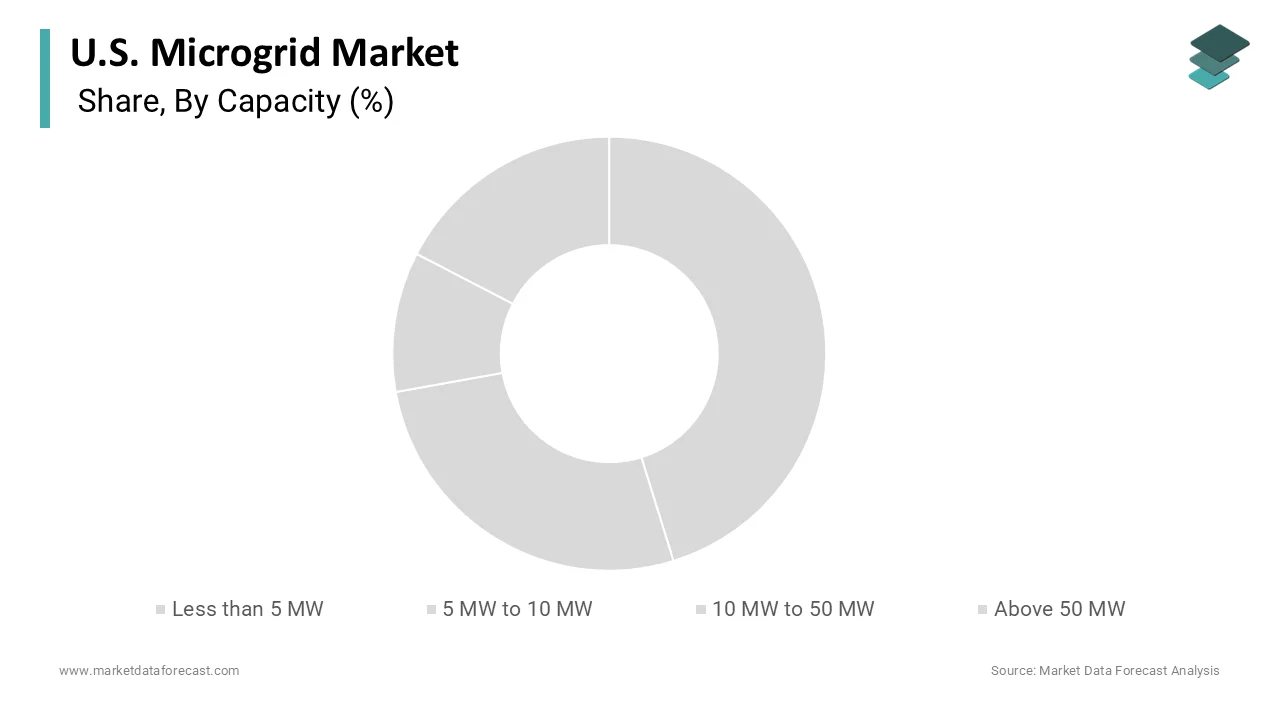
The above 50 MW capacity segment is anticipated to witness the fastest CAGR of 12.5% over the forecast period. This quick surge of the segment is propelled by the increasing deployment of large-scale community microgrids and utility-led resilience hubs designed to protect entire neighborhoods or critical infrastructure clusters from grid failures. Under regulatory frameworks promoted by the Federal Energy Regulatory Commission (FERC), utilities are increasingly utilizing Distributed Energy Resources (DERs) as Non-Wires Alternatives to meet reliability standards and defer expensive transmission and distribution infrastructure upgrades. These massive microgrids often integrate multiple generation sources, including large solar farms, wind turbines, and substantial battery storage systems, to serve thousands of customers. According to the Edison Electric Institute, several major utilities have announced plans to develop multi-megawatt microgrid projects in response to state mandates for grid hardening and climate adaptation. The scale of these projects allows for greater efficiency in energy management and the ability to provide significant ancillary services to the main grid, such as frequency regulation and voltage support. Furthermore, federal funding from the Infrastructure Investment and Jobs Act is prioritizing large-scale resilience projects in vulnerable communities, accelerating the development of high-capacity microgrids. The ability to isolate large portions of the distribution network during emergencies provides a higher level of security and continuity, making this segment attractive for government and utility investors. Technology is maturing,g and regulatory frameworks are evolving. Consequently, the above 50 MW segment is poised for substantial expansion.
By Power Source Insights
The solar photovoltaic (PV) segment led the United States microgrid market and captured a 39.5% share in 2025. This leading position of the segment was attributed to its declining costs, environmental benefits, and compatibility with energy storage systems. The dramatic reduction in the price of solar panels over the past decade has made PV the most economically viable option for new microgrid installations. As per the Solar Energy Industries Association, the cost of solar PV modules has dropped by more than 80 percent since 2010, making it cheaper than many conventional fossil fuel alternatives. This cost advantage is complemented by federal tax incentives, such as the Investment Tax Credit, which further enhances the return on investment for solar-powered microgrids. According to the National Renewable Energy Laboratory, solar PV is now the lowest cost source of electricity in many parts of the country, encouraging its integration into diverse microgrid architectures. The modular nature of solar arrays allows for easy scalability and integration with existing infrastructure, making it suitable for both urban and rural applications. Additionally, corporate sustainability goals and state renewable portfolio standards are driving demand for clean energy sources, positioning solar PV as the preferred choice for organizations seeking to reduce their carbon footprint. The synergy between solar PV and battery storage enables microgrids to store excess energy generated during the day for use at night or during outages, enhancing reliability and self-sufficiency. This combination of economic, environmental, and technical factors solidifies the dominance of solar PV in the US microgrid market.
The battery storage integration segment is likely to experience the fastest CAGR of 15.3% from 2026 to 2034 due to the critical role batteries play in stabilizing intermittent renewable energy sources like solar and wind, ensuring a consistent power supply within microgrids. As per the Energy Information Administration, the installed capacity of battery storage in the United States has doubled in recent years, driven by advancements in lithium-ion technology and falling battery prices. Batteries provide essential grid services such as frequency regulation, peak shaving, and backup power, making them indispensable for modern microgrid operations. According to the American Clean Power Association, the declining cost of battery packs has made it economically feasible to include substantial storage capacity in microgrid designs, enhancing their resilience and value proposition. The ability of batteries to respond instantly to changes in load or generation makes them ideal for maintaining stability in islanded mode. Furthermore, federal incentives specifically targeting energy storage are accelerating adoption, encouraging developers to pair solar PV with large-scale battery systems. This trend towards hybrid renewable storage systems is redefining the power source landscape, with battery-integrated microgrids becoming the standard for new deployments. The versatility and decreasing cost of battery technology ensure its continued rapid growth in the market.
By Application Insights
The commercial and industrial (C&I) segment held the majority share of 43.1% of the United States microgrid market in 2025. This supremacy of the segment was supported by the strong economic case for energy resilience and cost savings in this segment. Businesses and industrial facilities face significant financial losses during power outages, making microgrids an attractive investment for ensuring operational continuity. As per the Lawrence Berkeley National Laboratory, power interruptions cost US businesses billions of dollars annually, motivating C&I customers to adopt localized energy solutions. Microgrids allow these entities to manage energy costs through peak shaving and demand response programs, while also providing backup power during grid failures. According to the Smart Electric Power Alliance (SEPA), the C&I sector represents a rapidly expanding portion of new microgrid projects, with high adoption in data centers and manufacturing to mitigate the multi-billion dollar risks of downtime. The ability to integrate renewable energy sources also helps companies meet sustainability targets and enhance their brand image. State-level incentives and utility programs often target C&I customers, offering rebates and favorable rates for microgrid participation. The modular nature of C&I microgrids allows for customization to specific load requirements, ensuring optimal performance and efficiency. The combination of economic benefits, regulatory support, and operational needs ensures that the commercial and industrial sector remains the primary driver of microgrid adoption in the United States.
The military application segment is on the rise and is expected to be the fastest-growing segment in the market by witnessing a CAGR of 11.8% between 2026 and 2034, owing to national security concerns and the need for energy independence on defense installations. The Department of Defense has identified energy resilience as a critical priority, recognizing that reliance on the civilian grid poses a vulnerability to military operations. As per the Department of Defense, several major military bases have implemented or are planning large-scale microgrid projects to ensure a continuous power supply during cyberattacks, natural disasters, or other disruptions. The Energy Security and Reliability Act mandates that critical military installations must have secure and resilient energy sources, accelerating the deployment of microgrids across Army, Navy, and Air Force bases. According to the Federal Energy Management Program, the military is investing heavily in hybrid microgrids that combine renewable energy, storage, and conventional generators to achieve energy independence. These projects often serve as test beds for new technologies, driving innovation and reducing costs for broader market adoption. The strategic importance of energy security ensures sustained funding and political support for military microgrid initiatives. As threats to the national grid evolve, the military’s commitment to resilient energy infrastructure will continue to drive rapid growth in this segment, setting a precedent for other critical infrastructure sectors.
COUNTRY LEVEL ANALYSIS
United States Microgrid Market Analysis
The United States dominated the microgrid market and accounted for a 40.4% share in 2025. This dominance of the country’s market was driven by its advanced technological infrastructure, supportive policy environment, and high demand for energy resilience. The country’s market status is characterized by a diverse ecosystem of developers, utilities, and end users who are actively deploying microgrid solutions to address grid reliability and sustainability challenges. As per the Department of Energy (DOE), the United States is a global leader in microgrid capacity and revenue, with the Center for Climate and Energy Solutions (C2ES) noting that installations are significantly concentrated in states like California, New York, and Texas to enhance grid reliability. The driving factors behind this leadership include frequent extreme weather events, which have highlighted the vulnerabilities of the centralized grid, and robust federal and state incentives that encourage decentralized energy solutions. According to the Department of Energy (DOE), the economic impact of power outages costs the U.S. billions annually, spurring Federal Emergency Management Agency (FEMA) programs to prioritize microgrids as a key mitigation strategy for community resilience. The presence of leading technology providers and research institutions further strengthens the US position, fostering innovation in control systems, storage technologies, and integration methods. Regulatory reforms in several states are simplifying interconnection processes and enabling new business models for microgrid operators. The strong emphasis on national security and critical infrastructure protection also drives adoption in the military and government sectors. This combination of technological prowess, policy support, and urgent market needs ensures that the United States remains the dominant force in the global microgrid landscape, setting trends and standards for international markets.
COMPETITIVE LANDSCAPE
The competition in the United States microgrid market is characterized by a diverse array of participants,nts including established industrial conglomerates,ates specialized technology firms, a nd emerging startups. Market leaders compete based on technological innovation,vation system reliability, and comprehensive service offerings. The landscape is fragmented with no single entity dominating all segments,s allowing for niche specialization. Key differentiators include advanced control algorithms, interoperability with existing infrastructure,uctur,e and robust cybersecurity features. Companies are increasingly forming strategic alliances to combine hardware expertise with software capabilities. Price competition is intensifying as component costs decline and more players enter the market. Regulatory compliance and the ability to navigate complex interconnection processes provide competitive advantages. Customer service and long-term maintenance contracts are becoming critical factors in retaining clients. The rapid pace of technological change requires continuous investment in research and development. Overall, the market demands agility and innovation to succeed in delivering resilient and sustainable energy solutions to diverse customer segments across the country.
KEY MARKET PLAYERS
Some of the companies that are playing a dominating role in the U.S. Microgrid Market include
- ABB Ltd.
- General Electric Company (GE)
- Siemens AG
- Schneider Electric SE
- Eaton Corporation plc
- Honeywell International Inc.
- Tesla, Inc.
- Caterpillar Inc.
- S&C Electric Company
- Power Analytics Corporation
- Hitachi Energy Ltd.
- Bloom Energy Corporation
TOP LEADING PLAYERS IN THE MARKET
- Schneider Electric is a global leader in energy management and automation that plays a pivotal role in the United States microgrid market. The company provides comprehensive software and hardware solutions for designing and operating resilient microgrids. Schneider Electric recently launched advanced digital platforms that optimize energy usage and integrate renewable sources seamlessly. These tools enable customers to monitor performance and reduce carbon footprints effectively. The company collaborates with utilities and commercial entities to deploy scalable microgrid systems. By focusing on sustainability and digital innovation, Schneider Electric strengthens its position as a trusted partner. Its commitment to interoperability and open standards ensures flexible and future-proof energy solutions for diverse applications across the nation.
- Siemens AG is a technology powerhouse that significantly contributes to the US microgrid market through its intelligent infrastructure solutions. The company offers integrated hardware and software packages that facilitate the control and optimization of distributed energy resources. Siemens has recently expanded its portfolio with grid edge technologies that enhance stability and reliability. These innovations support the seamless integration of solar, wind,d and storage assets. The company partners with municipalities and industrial clients to implement robust microgrid projects. Siemens focuses on cybersecurity and data analytics to ensure safe and efficient operations. Siemens reinforces its leadership in delivering sustainable and resilient energy infrastructure solutions. It achieves this by leveraging its engineering expertise and global reach.
- General Electric is a major participant in the US microgrid market, et providing advanced control systems and power generation technologies. The company offers solutions that enable the integration of renewable energy and storage into existing grid infrastructure. GE has recently developed sophisticated software platforms that predict load patterns and optimize dispatch strategies. These capabilities help customers maximize efficiency and minimize operational costs. The company works closely with military bases and remote communities to deploy reliable microgrid systems. GE emphasizes modularity and scalability to meet diverse energy needs. General Electric strengthens its market presence by combining hardware excellence with digital intelligence. In turn, this strategy supports the transition towards decentralized and sustainable energy systems in the United States.
TOP STRATEGIES USED BY KEY MARKET PARTICIPANTS
Key players in the United States microgrid market primarily focus on developing integrated software platforms that optimize energy management and enhance grid resilience. Companies are investing heavily in artificial intelligence and machine learning to predict demand and automate control processes. Strategic partnerships with utilities and technology providers enable seamless integration of distributed energy resources. Participants are also prioritizing cybersecurity measures to protect critical infrastructure from digital threats. Modular and scalable hardware solutions are being introduced to reduce installation costs and deployment time. Firms are actively engaging in pilot projects with municipalities and military bases to demonstrate technical viability. Regulatory advocacy helps shape favorable policies for interconnection and compensation. These strategies allow companies to differentiate their offerings and capture value in a rapidly evolving decentralized energy landscape.
MARKET SEGMENTATION
This research report on the U.S.microgrid market is segmented and sub-segmented into the following categories.
By Capacity
- Less than 5 MW
- 5 MW to 10 MW
- 10 MW to 50 MW
- Above 50 MW
By Power Source
- Solar Photovoltaic (PV)
- Natural Gas
- Diesel/HFO
- Combined Heat & Power (CHP)
- Battery Storage Integration
- Fuel Cells
- Others
By Application
- Commercial & Industrial (C&I)
- Military
- Utility
- Remote & Rural Electrification
- Government & Institutional
- Healthcare
- Educational Campuses
By Country
- California
- Washington
- Oregon
- New York
- Rest of the United States
Related Reports
Access the study in MULTIPLE FORMATS
Purchase options starting from
$ 1200
Didn’t find what you’re looking for?
TALK TO OUR ANALYST TEAM
Need something within your budget?
NO WORRIES! WE GOT YOU COVERED!
Call us on: +1 888 702 9696 (U.S Toll Free)
Write to us: sales@marketdataforecast.com