- Product Description Description
- Table of Contents TOC
- List of Table & Figure LOT
- Get Free Sample PDF Sample PDF
Market Size, 2025
$9.16 BnMarket Estimate, 2026
$10.97 BnMarket Forecast, 2034
$46.40 BnCAGR, 2026–2034
19.75%U.S Podcast Market Size
The U.S. podcast market size was calculated to be USD 9.16 billion in 2025 and is anticipated to be worth USD 46.40 billion by 2034, from USD 10.97 billion in 2026, growing at a CAGR of 19.75% during the forecast period.
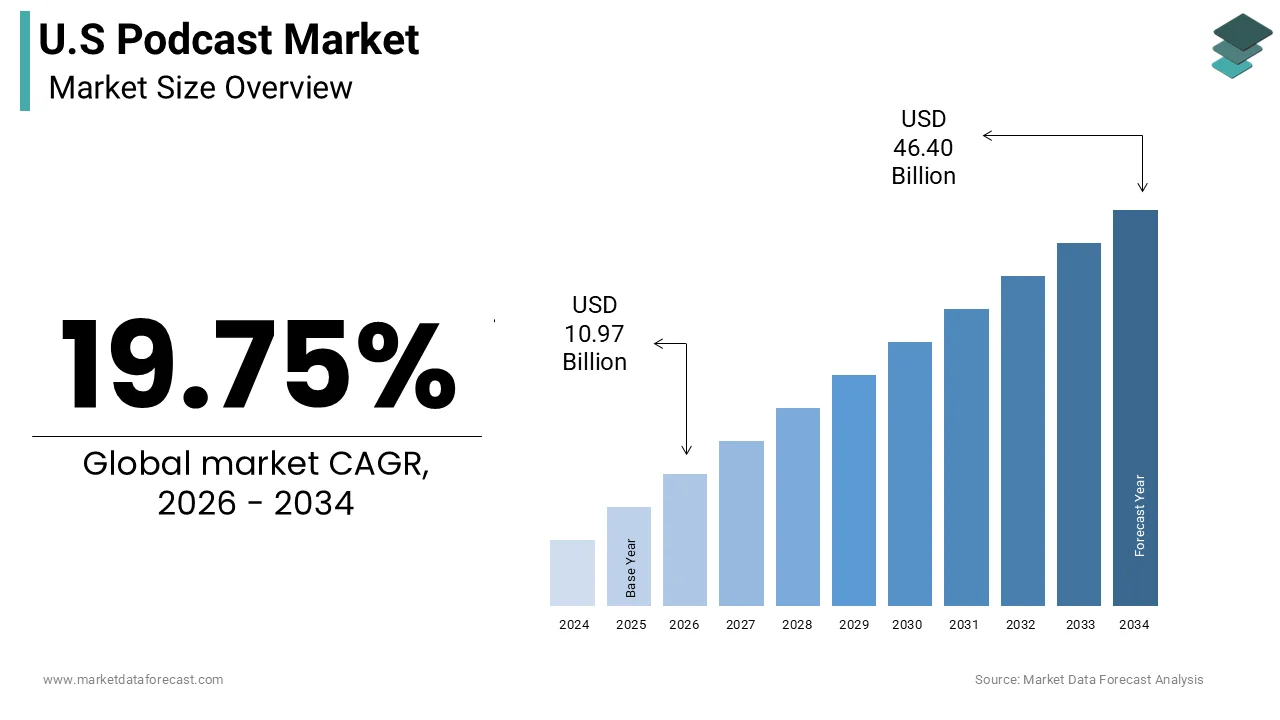
Podcasts are defined as episodic series of spoken-word digital audio files that a user can download to a personal device for easy listening. This medium has transcended its niche origins to become a central pillar of modern media consumption habits across the nation. As per a study, 93% of Americans aged 12 and older are familiar with the term podcasting, indicating near-total cultural penetration far beyond early adopters. The infrastructure supporting this ecosystem is robust, with major technology firms integrating seamless playback features into everyday devices. According to research, 58 percent of Americans (approximately 167 million people) have listened to a podcast in the last month, demonstrating that active usage has moved into the clear majority of the population. This high frequency of interaction allows creators to build intimate connections with audiences through long-form storytelling and specialized niche topics. The democratization of production tools has lowered entry barriers, enabling independent voices to compete with established media houses. Such accessibility fosters a diverse array of perspectives ranging from true crime investigations to educational deep dives. The current scenario reflects a shift where audio content is no longer secondary to visual media but stands as a primary source of information and entertainment for millions of daily commuters and multitaskers who value the flexibility and depth that audio formats uniquely provide.
MARKET DRIVERS
Pervasive Smartphone Penetration Drives Seamless Audio Accessibility
The ubiquitous presence of smartphones is a foundational driver for the United States podcast market. This ensures that audio content is instantly accessible to a vast majority of the population. Nearly every American adult owns a smartphone, which acts as the primary vessel for podcast consumption. According to multiple studies, 90% of adults in the United States own a smartphone, which creates a massive installed base for audio applications. This hardware saturation means that potential listeners do not need to invest in additional devices to access content, as their phones are already equipped with high-quality speakers and headphone jacks or Bluetooth capabilities. The convenience of mobile access allows individuals to integrate podcasts into various daily routines, such as commuting, exercising, or household chores. A study indicates that a significant portion of audio listening occurs on mobile devices, which underscores the importance of portability. As 5G networks expand across the country, the ability to stream high-fidelity audio without buffering issues further enhances the user experience. This technological readiness removes friction from the consumption process, allowing users to discover and play content with minimal effort. The integration of podcast apps into default operating systems by major tech companies also normalizes the behavior of listening to serialized audio content. The ease of access provided by widespread smartphone ownership directly correlates with higher adoption rates and sustained engagement levels. Consequently, this affects diverse demographic groups who rely on their mobile devices for all forms of digital media interaction.
Growing Preference for Multitasking Enhances Daily Integration
The increasing consumer preference for multitasking significantly fuels the growth of the United States podcast market. They allow individuals to consume content while performing other activities. Unlike video or text-based media, which require full visual attention, audio formats enable listeners to engage with information during commutes, workouts, or domestic tasks. According to sources, while the car remains a vital environment for growth, approximately 73% of podcast consumption actually occurs at home, though the medium remains highly compatible with daily transit routines. This ability to pair audio with physical activity makes podcasts an efficient use of time for busy professionals and students who seek to maximize productivity. The trend toward optimizing daily schedules has led to a surge in educational and self-improvement podcasts that cater to this desire for continuous learning. As per Triton Digital, the average listener consumes multiple episodes per week, which suggests that podcasting has become a habitual part of their lifestyle rather than an occasional leisure activity. The flexibility of audio content allows it to fit seamlessly into fragmented time slots that would otherwise remain unused. Furthermore, the rise of remote work has blurred the boundaries between professional and personal time, leading to increased audio consumption during household chores or exercise sessions. This behavioral shift ensures a steady demand for fresh and engaging content as listeners seek to enrich their multitasking experiences with meaningful narratives and insights that complement their active lifestyles.
MARKET RESTRAINTS
Market Saturation Creates Intense Competition for Listener Attention
The rapid expansion of podcast production has led to market saturation, which poses a significant restraint on the United States podcast market. This makes it increasingly difficult for new and existing shows to capture listener attention. With thousands of new episodes released daily, the sheer volume of content creates a noisy environment where discovery becomes a major hurdle for creators. According to Listen Notes, there are approximately 3.4 million podcasts globally. However, only about 14 percent are currently active, suggesting that the perceived "content overwhelm" is tempered by a high rate of show attrition. This abundance leads to listener fatigue as individuals struggle to keep up with their existing subscriptions, let alone explore new shows. The lack of effective discovery mechanisms within many platforms means that high-quality content often remains hidden unless it benefits from substantial marketing budgets or existing celebrity status. As per research, while overall listenership is growing, the number of shows each person listens to remains relatively stable, which indicates that gaining new listeners requires taking them away from competitors. This zero-sum dynamic intensifies the pressure on creators to produce consistently exceptional content to retain their audience. Independent producers without significant resources find it particularly challenging to break through the clutter as established networks dominate top charts and recommendation algorithms. So the barrier to entry has shifted from production capability to visibility and marketing prowess, which limits the diversity of voices that can achieve sustainable growth in an overcrowded marketplace.
Monetization Complexities Hinder Sustainable Revenue Growth
Monetization remains a complex challenge for many podcasters despite growing listenership, which obstructs the growth of the United States podcast market. This is due to the fragmented nature of advertising models and the difficulty in proving return on investment. While large networks secure lucrative deals, independent creators often struggle to generate sufficient revenue to sustain production quality. According to the IAB U.S. Podcast, a small fraction of top-tier podcasts (less than 1 percent of total shows) attracts the vast majority of ad spend, leaving millions of smaller creators reliant on alternative funding sources such as patronage or brand partnerships. The industry lacks standardized metrics for measuring listener engagement and conversion, which makes advertisers hesitant to commit substantial budgets to smaller shows. As per IAB Tech Lab, standardisation of measurement (v2.2) has reached widespread industry adoption, successfully reducing the reporting discrepancies that previously hindered advertiser confidence and market growth. This uncertainty discourages mid-tier brands from entering the market, limiting the pool of potential advertisers. Furthermore, the reliance on host read ads requires creators to possess strong sales skills or hire dedicated teams, which adds operational complexity. Subscription models offer an alternative, but converting free listeners to paying subscribers proves difficult as consumers are accustomed to accessing content without cost. The economic viability of podcasting thus remains skewed toward top-tier properties, leaving a vast middle class of creators in a precarious financial position that threatens long-term sustainability and content diversity.
MARKET OPPORTUNITIES
Expansion into Video Podcasting Opens New Revenue Streams
The integration of video elements into podcasting offers a major opportunity for the United States podcast market. This allows creators to tap into visual platforms and diversify their revenue streams. Video podcasts enable hosts to leverage facial expressions and visual aids, which enhance storytelling and deepen viewer connection. According to YouTube, podcast-related content has seen substantial growth on its platform, with millions of hours watched monthly, which indicates a strong appetite for visual audio hybrids. This format allows creators to repurpose content for social media clips, thereby increasing discoverability and attracting younger demographics who prefer visual media. As per Spotify, the addition of video features has led to increased engagement times as users switch between audio and video modes depending on their context. This flexibility appeals to advertisers who can now purchase integrated video ad placements alongside traditional audio spots. The ability to stream live video podcasts also facilitates real-time interaction with audiences through comments and donations, which fosters community building. Platforms like Twitch and Amazon Music have entered this space, recognizing the potential for hybrid content to drive subscription growth. By adopting video formats, podcasters can access broader advertising inventories, including display and overlay ads, which are not available in pure audio environments. This evolution transforms podcasts from a purely auditory experience into a multimedia property that can command higher production values and attract premium brand partnerships seeking immersive storytelling opportunities.
Artificial Intelligence Enhances Personalization and Production Efficiency
The application of artificial intelligence in podcasting creates transformative prospects for the United States ' podcast market. This podcast content discovery streamlines production workflows for creators. AI-driven algorithms use AI-driven listener behavior to recommend highly relevant shows, which helps overcome the discovery challenges associated with market saturation. According to Spotify, their personalized recommendation engine drives a significant portion of listening hours by surfacing niche content that aligns with individual preferences. This level of customization increases listener retention and satisfaction by reducing the time spent searching for new material. On the production side, AI tools automate tasks such as transcription, editing, and sound enhancement, which lowers costs and accelerates release schedules. As per Descript, AI-powered editing software allows creators to remove filler words and adjust audio quality with minimal manual effort, which democratizes high production standards. These technologies enable independent podcasters to compete with larger studios by delivering polished content efficiently. Furthermore, AI can generate dynamic ad insertions that tailor advertisements to specific listener profiles, which increases relevance and conversion rates for advertisers. This targeted approach maximizes the value of each impression and encourages brands to invest more heavily in the medium. The continuous improvement of natural language processing also enables better search functionality, allowing users to find specific topics within episodes. Leveraging AI makes the podcast ecosystem more efficient and user-friendly. Thus, this drives sustainable growth and enhances monetization potential for all stakeholders.
MARKET CHALLENGES
Attribution Difficulties Limit Advertising Investment Confidence
The difficulty in accurately attributing consumer actions to specific podcast advertisements is slowing down the expansion of the United States podcast market. This limitation reduces advertiser confidence and hinders budget allocation. Unlike digital display ads, where clicks and conversions are easily tracked, podcast ads often rely on vanity URLs or promo codes,s which provide incomplete data. According to the IAB, the lack of standardized attribution models makes it hard for brands to measure the true return on investment for their podcast campaigns. This opacity discourages performance-driven marketers who require precise metrics to justify spending. While dynamic ad insertion technology has improved tracking capabilities, it still faces limitations in connecting offline listening behavior to online purchases. As per Nielsen, efforts to bridge this gap through panel-based measurement are ongoing, but sample sizes may not fully represent the diverse podcast audience. The reliance on self-reported data also introduces potential inaccuracies that skew campaign analysis. Consequently, many advertisers treat podcasts as a brand awareness channel rather than a direct response medium, which caps the potential revenue growth for creators who could benefit from performance-based pricing models. Until robust cross-device attribution solutions become industry standard, the market will continue to face hesitation from large-scale advertisers who prioritize measurable outcomes over estimated reach. This structural limitation restricts the flow of capital into the mid-tier segment of the market, where many innovative creators operate.
Regulatory Uncertainty Surrounding Content and Data Privacy
Emerging regulatory frameworks concerning data privacy and content moderation further constrain the growth of the United States podcast market. These regulations introduce complex compliance requirements and potential legal liabilities. As governments worldwide tighten regulations on digital platforms, podcasters must navigate evolving rules regarding user data collection and targeted advertising. According to the Federal Trade Commission, increased scrutiny on digital privacy practices requires content creators to be transparent about how they handle listener information, especially when using third-party analytics tools. Non-compliance can result in hefty fines and reputational damage, which disproportionately affects smaller producers lacking legal resources. Additionally, the decentralized nature of podcasting makes content moderation difficult, raising concerns about misinformation and harmful speech. As per the European Union Digital Services Act, which influences global standards, platforms may face pressure to monitor and remove illegal content more aggressively. This potential shift could undermine the open nature of the medium where free expression thrives. Creators must balance artistic freedom with regulatory requirements, which may lead to self-censorship or increased operational costs for compliance checks. The lack of clear guidelines specific to audio content creates uncertainty that hinders long-term strategic planning for networks and advertisers alike. Navigating this complex legal landscape requires continuous adaptation and investment in compliance infrastructure, which strains resources and potentially stifles innovation in content creation and distribution methods.
REPORT COVERAGE
| REPORT METRIC | DETAILS |
| Market Size Available | 2025 to 2034 |
| Base Year | 2025 |
| Forecast Period | 2026 to 2034 |
| CAGR | 19.75% |
| Segments Covered | By Genre, Format, Revenue Model, Device, And Region |
| Various Analyses Covered | Global, Regional & Country Level Analysis; Segment-Level Analysis; DROC, PESTLE Analysis; Porter’s Five Forces Analysis; Competitive Landscape; Analyst Overview of Investment Opportunities |
| Regions Covered | New York, Massachusetts, Pennsylvania, Illinois, Ohio, Michigan, Texas, Florida, Georgia, California, Washington, Colorado. |
| Market Leaders Profiled | . Spotify, Apple Inc., Amazon.com Inc., Google LLC, Sirius XM Holdings Inc., iHeartMedia Inc., Audacy Inc., Stitcher (SiriusXM), Podbean, Libsyn (Liberated Syndication Inc.), SoundCloud, Acast AB, Wondery (Amazon), NPR (National Public Radio), The New York Times Company |
SEGMENTAL ANALYSIS
By Genre Insights
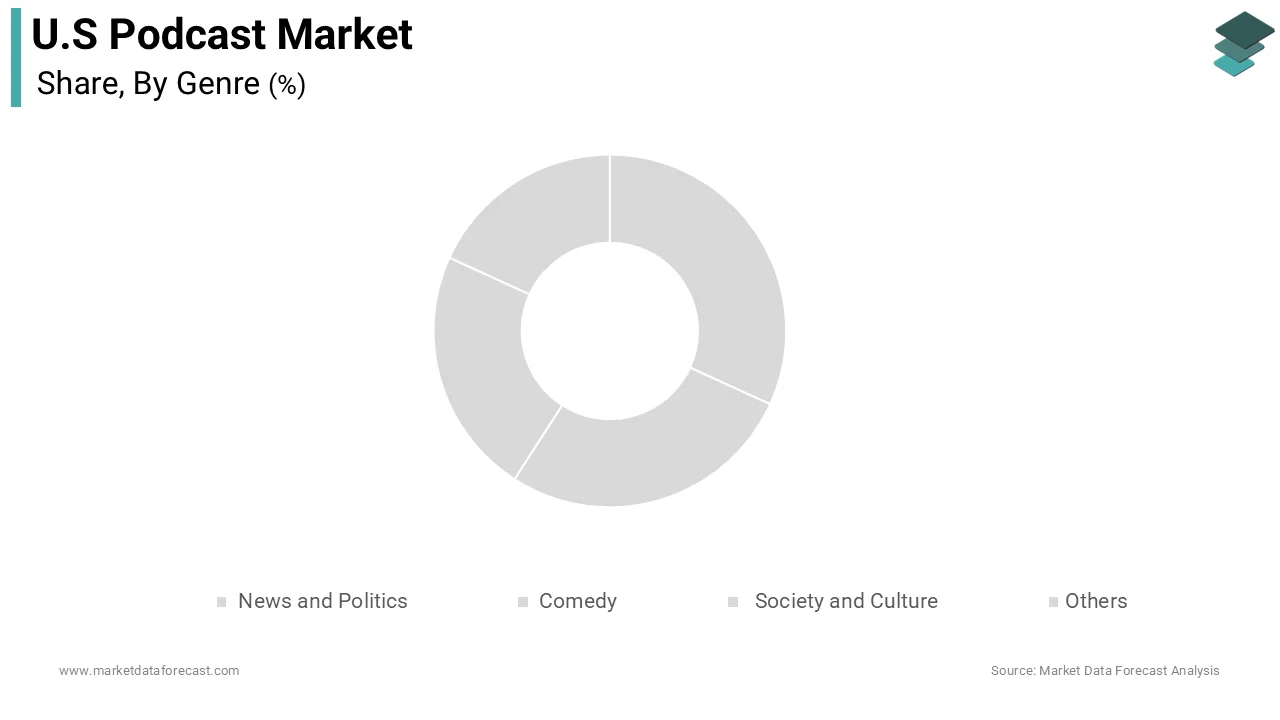
The Society and Culture genre maintained the lead in the United States podcast market by capturing a 23.6% share in 2025. This leading position of the segment is attributed to the fact that it fosters a profound emotional connection between hosts and listeners through intimate personal storytelling. This segment covers topics such as relationships, mental health, and daily life experiences, which resonate deeply with audiences seeking relatability and community. The format allows hosts to share vulnerable narratives that create a sense of parasocial intimacy, making listeners feel like they are part of a close-knit group. Also, the demographic represents a significant portion of the active listener base, and their loyalty drives sustained engagement metrics. The authenticity required in society and culture podcasts builds trust, which translates into higher retention rates compared to more factual or news-oriented formats. Listeners often describe these shows as companions rather than mere entertainment, which increases the frequency of consumption. The ability of creators to address complex social issues through a personal lens also encourages community discussion on social media platforms, further amplifying reach. This deep engagement ensures that society and culture podcasts maintain a dominant position by fulfilling a fundamental human need for connection and understanding in an increasingly digital world. The versatility of the Society and Culture genre enables it to appeal to a broad spectrum of demographics, which solidifies its leading position in the market. Unlike niche genres that cater to specific interests such as technology or true crime, society and culture podcasts cover a wide array of topics, including parenting, education, and lifestyle choices. The flexible nature of the genre means that producers can easily adapt to trending social conversations, keeping the content fresh and timely. Also, the internal mobility within the genre helps retain users who might otherwise churn if their specific interest wanes. Furthermore, the low barrier to entry for creators in this space results in a constant influx of new voices and perspectives, which keeps the ecosystem vibrant and dynamic. Major media companies have recognized this potential and invested heavily in society and culture networks, which provide professional production support and marketing reach. This institutional backing ensures high-quality output that meets listener expectations for audio clarity and narrative structure. The combination of diverse topics and professional standards makes society and culture podcasts a safe and engaging choice for advertisers seeking broad reach across multiple demographic segments.
The Health and Fitness segment is predicted to witness the highest CAGR of 19.7% from 2026 to 2034 due to a surging consumer focus on holistic wellness and self-improvement. As individuals increasingly prioritize physical and mental well-being, they turn to podcasts for accessible expert advice and motivational content. This growth is fueled by the desire for actionable tips on nutrition, exercise, and mindfulness that can be easily integrated into daily routines. The trend toward preventive healthcare has also contributed to this expansion as listeners seek to educate themselves on maintaining long-term health. Podcasts offer a convenient way to consume this information during workouts or commutes, making them an ideal medium for this audience. The integration of mental health discussions within fitness content further broadens the appeal, addressing the mind-body connection that modern consumers value. This comprehensive approach to wellness ensures that the health and fitness segment continues to attract new listeners who are dedicated to improving their quality of life through informed lifestyle choices. The rapid expansion of the Health and Fitness podcast segment is further accelerated by its seamless integration with digital health technologies and wearable devices. As smartwatches and fitness trackers become ubiquitous, users seek audio content that complements their workout sessions and health monitoring activities. Podcasts tailored for specific exercises, such as running, yoga, or strength training, provide guided experiences that enhance the utility of these devices. The synergy between hardware and audio content creates a sticky ecosystem where listeners rely on podcasts as part of their health regimen. Brands in the fitness industry have recognized this opportunity and sponsor podcasts to reach highly targeted audiences who are already engaged in health-conscious behaviors. The ability to track listening habits alongside physical activity metrics allows for personalized recommendations that improve user engagement. Furthermore, the rise of virtual fitness classes has normalized the consumption of instructional audio content, making podcasts a natural extension of this trend. This technological alignment ensures that the health and fitness segment remains at the forefront of market growth by offering practical value that extends beyond entertainment to tangible health outcomes.
By Format Insights
In 2025, the conversational and panel discussion segment remained dominant by accounting for a substantial share of the United States podcast market because they offer a sense of authenticity and relatability that scripted content often lacks. Listeners are drawn to the spontaneous nature of these interactions, which mimic real-life conversations among friends or colleagues. This format allows hosts to display personality and humor, which fosters a deeper emotional bond with the audience. The dynamic interplay between multiple hosts creates a lively atmosphere that keeps listeners entertained through varied perspectives and banter. This energy is particularly appealing to commuters and multitaskers who seek background entertainment that does not require intense concentration. The flexibility of the format also allows for easy adaptation to current events or trending topics without the need for extensive pre-production. Creators can react in real time to cultural moments, which keeps the content relevant and timely. Furthermore, the lower production costs associated with conversational podcasts enable a wider range of voices to enter the market, increasing diversity and innovation. This accessibility ensures a steady supply of fresh content that maintains listener interest and drives the continued dominance of this format in the market. The cost efficiency and scalability of conversational and panel formats contribute significantly to their leading position in the podcast landscape. Producing a conversational show requires minimal equipment and editing compared to highly produced narrative series, which lowers the barrier to entry for independent creators. The scalability enables networks to launch multiple shows with different hosts and topics, thereby diversifying their portfolio and reducing reliance on any single property. The ability to record episodes remotely has further enhanced this efficiency, allowing hosts to collaborate from different locations without incurring travel expenses. This flexibility has become particularly valuable in the post-pandemic era, where remote work norms persist. Additionally, the evergreen nature of many conversational topics means that episodes continue to generate downloads long after their initial release, providing long-term value. Advertisers benefit from this consistent inventory and the loyal audiences that these shows build over time. The economic advantages of this format thus ensure its prevalence and stability within the market, supporting a sustainable ecosystem for both creators and distributors.
The narrative and storytelling podcasts segment is estimated to register the fastest CAGR of 20.1% during the forecast period, owing to its high production value, which attracts premium advertising partnerships and substantial investment. These shows often feature cinematic sound design, original music, and structured scripts that create an immersive listening experience comparable to television or film. The financial backing allows creators to hire professional writers, actors, and sound engineers, resulting in polished products that stand out in a crowded market. The prestige associated with narrative podcasts also draws talent from traditional media, bringing established fan bases to the medium. Listeners are willing to subscribe to paid tiers or tolerate longer ad breaks for content that offers such a rich auditory experience. The success of true crime and investigative journalism series has demonstrated the commercial viability of this format, encouraging more producers to enter the space. As per Edison Research, while narrative shows represent a smaller share of total episode volume, they account for a disproportionate amount of listening time and social media buzz. This impact drives rapid growth as networks prioritize quality over quantity to capture high-value listeners. The ability of narrative podcasts to sustain long-term interest through serialized storytelling ensures continued expansion and innovation in this segment. The potential for cross-media adaptation serves as a powerful driver for the rapid growth of narrative and storytelling podcasts. Successful podcast series are increasingly being adapted into television shows, films, and books, which expands their reach and validates the medium as a source of intellectual property. This trend creates a feedback loop where success in one medium drives interest in the other, attracting new listeners who discover the podcast through its screen adaptation. The prospect of broader fame and financial reward attracts high-profile talent and writers to the podcasting space, raising the overall quality of narrative content. The synergy between audio and visual media also provides additional revenue streams through licensing deals and merchandise sales. Listeners appreciate the depth of character development and plot complexity that podcasts allow, which often exceeds what is possible in a two-hour film. This narrative richness makes them an ideal source material for expanded universes. As more adaptations succeed, the perception of podcasts as a legitimate artistic medium strengthens, driving further investment and listener adoption. This cross-pollination of media ensures that narrative podcasts remain a dynamic and rapidly expanding segment of the market.
By Revenue Model And Device Insights
The advertising-supported model segment held the 61.2% share of the United States podcast market in 2025. This supremacy of the segment is credited to the established infrastructure for dynamic ad insertion, which allows for scalable and targeted monetization. This technology enables publishers to insert ads into episodes programmatically, ensuring that listeners hear relevant advertisements based on their location, demographics, and behavior. The flexibility is crucial for sustaining free access to content, which maintains large audience sizes that attract advertisers. The standardization of ad formats such as pre-roll, mid-roll, and post-roll has simplified the buying process for agencies, making it easier to include podcasts in broader media plans. Host-read ads continue to be highly effective due to the trust listeners place in creators, but dynamic insertion allows for broader campaign reach and frequency capping. The maturity of this ecosystem means that even smaller podcasts can access ad inventory through networks and platforms that aggregate supply. This democratization of monetization ensures that the advertising-supported model remains the backbone of the industry, supporting the majority of content creation and distribution activities. Brand safety and high engagement metrics are key factors driving the dominance of the advertising-supported model in the podcast market. Advertisers are increasingly confident in placing brands within podcast environments due to the controlled nature of content and the positive association with trusted hosts. The intimate nature of audio consumption means that listeners are less likely to skip ads, especially when they are integrated seamlessly into the content by the host. This high engagement translates into better conversion rates and return on investment for advertisers, encouraging them to increase their budgets. The ability to measure lift in brand awareness and purchase intent through specialized surveys further validates the effectiveness of podcast advertising. Furthermore, the proven efficacy ensures that advertisers view podcasts as an essential component of their digital strategy. The combination of safety engagement and measurable results solidifies the advertising-supported model as the primary revenue driver sustaining the growth and vitality of the US podcast market.
The subscription-based model segment is anticipated to witness the fastest CAGR of 29.9% over the forecast period. This swift growth of the segment is propelled by increasing consumer demand for ad-free and exclusive content experiences. As the market becomes saturated with free content, listeners are willing to pay for premium offerings that provide convenience and unique value. Subscription models also offer access to bonus episodes, early release, and behind-the-scenes content, which deepens the relationship between creators and their most dedicated fans. This exclusivity creates a sense of belonging and status among subscribers, enhancing loyalty and reducing churn. The success of platforms like Patreon demonstrates that audiences are accustomed to supporting creators directly in exchange for perks. This shift in consumer behavior is supported by the widespread adoption of digital payment systems, which make subscribing effortless. The ability for creators to retain a larger share of revenue compared to ad-supported models also incentivizes the production of high-quality exclusive content. This mutual benefit drives the rapid expansion of the subscription segment as both creators and listeners seek more sustainable and satisfying engagement models. Bundling strategies play a crucial role in accelerating the growth of the subscription-based podcast market by enhancing the perceived value for consumers. Major tech companies are integrating podcast subscriptions into broader service packages such as music streaming and video platforms, which reduces the friction of separate payments. This approach leverages the established user base of music and video services to drive podcast subscriptions without requiring significant additional marketing spend. The convenience of a single bill and unified interface improves user experience and encourages exploration of different podcast genres. Platforms are also experimenting with family plans and student discounts, which broaden the addressable market for paid podcast content. This strategic integration ensures that subscription-based podcasts benefit from the scale and stability of larger ecosystems. The resulting growth is sustained by the continuous addition of high-profile exclusive titles that justify the subscription fee. This dynamic positions the subscription model as a rapidly expanding and vital component of the future podcast economy.
REGIONAL ANALYSIS
The United States outperformed others in the global podcast market and occupied a 38.6% share in 2025. This dominance of the US market is driven by robust growth in both advertising revenue and subscription services, which supports a diverse range of content from independent productions to major studio releases. The country is the birthplace of the modern podcasting phenomenon. It benefits from a mature ecosystem characterized by high consumer adoption, advanced technological infrastructure, and a vibrant creator community. According to research and forecasts for 2025, the United States accounts for approximately 27 percent of the global podcast audience, although it commands over 50 percent of global podcast advertising revenue, reflecting its dominant economic position in the industry. As per PwC, the US podcast advertising market is projected to continue its double-digit growth trajectory, driven by increased advertiser confidence and improved measurement tools. The presence of major tech giants such as Apple, Spotify, and Amazon in the region ensures continuous innovation in platform features and discovery algorithms. This competitive landscape fosters high-quality content and attractive user experiences that retain listeners. The cultural acceptance of podcasts as a mainstream media format further strengthens the market position, with celebrities, journalists, and experts regularly launching shows. As per sources, the penetration rate of podcast listening among Americans aged 12 and older has reached a historic high, indicating that the medium has moved beyond early adopters to the general population. This broad acceptance ensures a stable and expanding base for future growth. The regulatory environment, while evolving, remains supportive of digital innovation, allowing the market to flourish with minimal restrictions. The United States thus serves as the benchmark for global podcast trends, setting standards for content quality, monetization strategies, and technological integration that influence markets around the world.
COMPETITION OVERVIEW
The competition in the United States podcast market is intense and characterized by rapid innovation and strategic consolidation among major technology firms and media companies. Leading platforms compete fiercely for exclusive content rights and top-tier talent to distinguish their offerings in a saturated environment. This rivalry drives significant investment in original productions and high-profile acquisitions of independent studios. Companies also vie for advertiser dollars by developing sophisticated measurement tools and dynamic ad insertion technologies that promise better return on investment. The battle for listener attention extends beyond audio as platforms integrate video features and social sharing capabilities to enhance engagement. Subscription services add another layer of competition with providers offering premium ad-free experiences and bonus content to retain subscribers. Independent creators face pressure to maintain high production values while navigating complex monetization landscapes dominated by large networks. Regulatory scrutiny regarding data privacy and content moderation further complicates the competitive dynamics, requiring constant adaptation. Ultimately, the market rewards those who can balance technological innovation with compelling storytelling and effective community building to sustain long-term growth and loyalty in this dynamic sector.
KEY MARKET PLAYERS
A few major players of the United States podcast market include
- Spotify
- Apple Inc
- Amazon.com Inc.
- Google LLC
- Sirius XM Holdings Inc
- iHeartMedia Inc
- Audacy Inc
- Stitcher (SiriusXM)
- Podbean
- Libsyn (Liberated Syndication Inc.)
- SoundCloud
- Acast AB
- Wondery (Amazon)
- NPR (National Public Radio)
- The New York Times Company
Leading Players in the Market
- Spotify AB has established itself as a dominant force in the global podcast landscape by aggressively investing in exclusive content and proprietary technology. The company actively acquires popular podcast networks and production studios to secure high-quality original programming that attracts and retains subscribers. Recent actions include the integration of advanced artificial intelligence tools for content discovery and personalized recommendations, which enhance user engagement significantly. Spotify also expanded its video podcast capabilities, allowing creators to upload visual content directly to the platform. This strategic move diversifies the listening experience and opens new advertising opportunities for brands seeking visual placements. By offering comprehensive analytics and monetization tools for creators, Spotify strengthens its ecosystem and encourages exclusive partnerships. These initiatives solidify its position as a primary destination for both listeners and creators seeking innovative audio experiences in a competitive digital media environment.
- Amazon.com Inc leverages its vast technological infrastructure and extensive customer base to strengthen its position in the global podcast market. The company integrates podcast content seamlessly across its devices, including Echo speakers and Fire tablets, which drives consistent daily usage. Amazon Music has expanded its library with exclusive shows and early access episodes for Prime members, adding value to its subscription service. Recent actions involve enhancing its advertising platform with dynamic insertion technologies that allow for targeted and measurable ad campaigns. This approach attracts premium advertisers seeking efficient ways to reach engaged audiences. Amazon also supports independent creators through its audiobook and podcast distribution services, fostering a diverse content ecosystem. By combining hardware accessibility with robust cloud computing capabilities, Amazon ensures high-quality streaming and reliable performance. These efforts reinforce its role as a key player providing integrated entertainment solutions that cater to diverse consumer preferences globally.
- Apple Inc remains a pivotal player in the global podcast market through its deeply integrated ecosystem and commitment to open standards. The Apple Podcasts app serves as a primary discovery and consumption platform for millions of users worldwide, leveraging the widespread adoption of iPhones and iPads. The company recently introduced an enhanced subscription feature,s allowing creators to offer paid content directly within the app. This initiative empowers producers to monetize their work effectively while providing listeners with exclusive episodes and bonus material. Apple also prioritizes user privacy and data security, which builds trust among consumers concerned about digital footprints. The seamless synchronization of listening progress across devices ensures a convenient and uninterrupted experience. By maintaining a neutral platform that supports all podcast hosts, Apple fosters a diverse and competitive content landscape. These strategies reinforce its leadership by focusing on user experience creator empowerment and technological reliability in the evolving audio entertainment sector.
Top Strategies Used by Key Market Participants
Key players in the United States podcast market primarily employ content exclusivity and acquisition strategies to differentiate their platforms and secure loyal audiences. Companies invest heavily in producing original shows and acquiring established networks to create unique libraries that cannot be found elsewhere. Another major strategy involves the integration of advanced artificial intelligence algorithms to personalize content recommendations and improve user discovery experiences. This technological enhancement increases engagement by surfacing relevant shows to listeners based on their historical behavior and preferences. Platforms also focus on expanding video podcast capabilities to attract visual learners and provide additional advertising inventory for brands. Furthermore, participants are developing robust subscription models that offer ad-free listening and exclusive bonus content to generate recurring revenue streams. Strategic partnerships with automotive manufacturers and smart device providers ensure seamless integration into daily routines such as commuting and home activities. These combined approaches aim to maximize listener retention and enhance monetization opportunities in an increasingly competitive digital audio landscape.
MARKET SEGMENTATION
This research report on the US podcast market has been segmented and sub-segmented based on genre, format, revenue mode,l and device & region.
By Genre
- News and Politics
- Comedy
- Society and Culture
- Others
By Format
- Interview
- Conversational/Panel
- Others
By Revenue Model and Device
- Advertising-Supported
- Subscription-Based
- Others
By Region
- New York
- Texas
- Florida
- Georgia
- California
- Rest of U.S.