U.S. Property Management Market Size, Share, Trends & Growth Forecast Report By Property Type, By Service Type, and By Country (California, Texas, Florida, New York & Rest of the United States) – Industry Analysis and Forecast, 2026 to 2034
Market Size, 2025
$84.03 BnMarket Estimate, 2026
$87.47 BnMarket Forecast, 2034
$120.64 BnCAGR, 2026–2034
4.1%U.S. Property Management Market Size
The U.S. Property Management Market is projected to grow from USD 84.03 billion in 2025 to USD 87.47 billion in 2026 and reach USD 120.64 billion by 2034, registering a CAGR of 4.1% during the forecast period from 2026 to 2034.
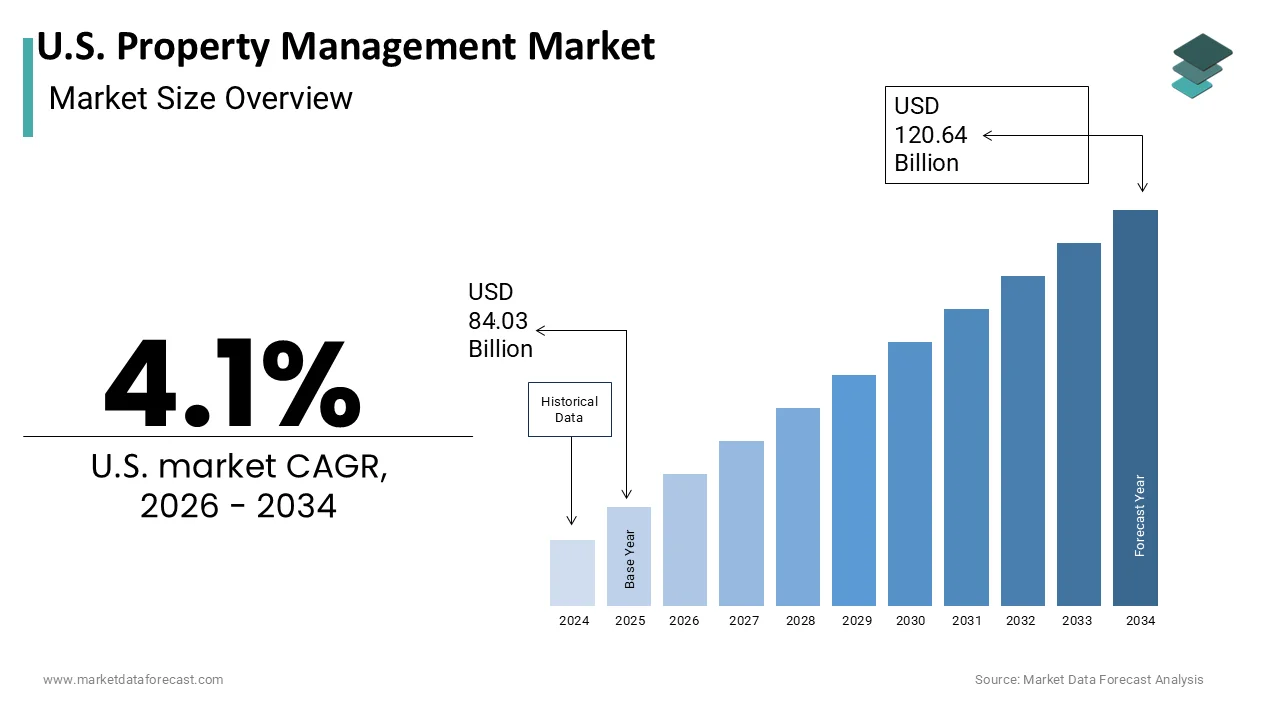
Property management is the daily oversight and administration of real estate, including residential, commercial, or industrial properties, by a third-party professional or company. This market involves a comprehensive suite of services such as tenant screening, lease administration, maintenance coordination, financial reporting, and regulatory compliance. The field serves as the critical interface between property owners and occupants, ensuring asset preservation and revenue optimization. As per the United States Census Bureau, the rental vacancy rate in the United States stood at 6.6 percent in the fourth quarter of 2023, indicating a tight housing market that necessitates professional management to maximize occupancy. The shift towards urbanization has intensified the demand for multifamily housing solutions. According to the National Multifamily Housing Council (NMHC) and Harvard's Joint Center for Housing Studies, there are approximately 44.3 million renter households in the United States, representing roughly 34% of all U.S. households. This substantial renter population drives the need for efficient management practices to handle high turnover and diverse tenant needs. Technological integration has transformed traditional management into a data-driven discipline, leveraging cloud-based platforms for real-time analytics. Regulatory frameworks such as the Fair Housing Act impose strict guidelines on leasing practices requiring specialized expertise. The market is characterized by data-driven small, independent cloud-based firms alongside large institutional firms managing portfolios of thousands of units. Economic fluctuations influence rental rates and occupancy levels, making adaptive management strategies essential. The market plays a pivotal role in the broader real estate economy by enhancing property values and ensuring sustainable operational performance.
MARKET DRIVERS
Growth in Multifamily Housing Construction and Urbanization
Growth in multifamily housing construction and urbanization serves as a primary accelerator for the expansion of the United States property management market. As more individuals migrate to urban centers for employment and lifestyle opportunities, the demand for apartment living has surged. According to the United States Census Bureau, permits for multifamily units accounted for over 30 percent of total housing authorizations in recent years, reflecting a structural shift in residential development. As per the National Association of Home Builders, the cost of single-family homes has risen significantly, pushing many prospective buyers into the rental market. This transition increases the volume of units requiring professional oversight and management. Urban density necessitates complex management of single-family homes to handle shared amenities, security, and maintenance logistics. Property managers are essential for coordinating these operations, ensuring that high-rise and garden-style apartments function efficiently. The concentration of rental units in metropolitan areas allows management firms to achieve economies of scale. Developers increasingly partner with established management companies thigh-rise thegarden-stylety of new projects. The ongoing trend of urbanization ensures a steady pipeline of new inventory entering the managed portfolio. Consequently, the expansion of multifamily stock directly correlates with increased demand for management services. This demographic and structural shift sustains long-term market growth.
Increasing Adoption of Property Technology and Automation
Increasing adoption of property technology and automation significantly propels the efficiency and scalability of the United States property management market. long-term solution, streamline operations by automating routine tasks such as rent collection, maintenance requests, and lease renewals. According to the National Apartment Association, over 80 percent of apartment communities now use some form of property management software to enhance operational efficiency. As per JLL technologies su,, such as artificial intelligence and Internet of Things devices, enable predictive maintenance and energy optimization, reducing operational costs. Automated tenant screening processes reduce vacancy times by accelerating the leasing cycle. Cloud-based platforms provide real-time financial data, allowing owners to make informed investment decisions. The integration of home features appeals to tech-savvy renters who value convenience and connectivity. Property managers leverage cloud-based analytics to identify real-time tenant behavior and optimize pricing strategies. The ability to manage remote portfolios expands the geographic reach of tech-savvy firms. Technology reduces the administrative burden on staff, allowing them to focus on customer service and retention. These advancements improve the overall tenant experience,ce leading to higher satisfaction and lower turnover. Thus, the digital transformation of the industry drives market expansion. The emphasis on efficiency and data-driven decision-making ensures sustained adoption of technological solutions.
MARKET RESTRAINTS
Stringent Regulatory Compliance and Legal Liabilities
Stringent regulatory compliance and legal liabilities restrain the operational flexibility and data-driven decision-making in the property management market. Managers must navigate a complex web of federal, state, te and local laws governing landlord-tenant relationships. According to the National Conference of State Legislatures, each state has distinct regulations regarding security deposits, eviction procedures, and habitability standards. As per the Department of Housing and Urban Development,nt violations of the Fair Housing Act can result in substantial fines and legal penalties for discrimination. Property managers must ensure that all leasing practices, marketing materials, and tenant interactions comply with these rigorous standards. The constant evolution of legislation requires continuous training and legal consultation,n increasing operational costs. Liability issues arise from premises safety, data privacy breaches, and contract disputes. Managers face the risk o,s lawsuitsf they fail to address maintenance issues promptly or violate tenant rights. The complexity of complying with varying jurisdictional requirements limits the ability of firms to standardize operations across different regions. Small management companies may lack the resources to maintain robust compliance departments. The fear of litigation encourages conservative management practices that may hinder innovation. These legal constraints create a high barrier to entry and expansion. Hence, regulatory burdens act as a significant brake on market growth. The need for meticulous adherence to laws increases administrative overhead.
Labor Shortages and Rising Operational Costs
Labor shortages and rising operational costs pose major obstacles to the profitability and scalability of the United States property management market. The industry relies heavily on skilled personnel for leasing, maintenance,e and administrative tasks. According to the Bureau of Labor Statistics, the turnover rate in the property management sector remains high due to demanding work conditions and competitive job markets. As per the National Apartment Association, finding qualified maintenance technicians has become increasingly difficult,t leading to delays in repair services. Labor shortages drive up wages as companies compete for limited talent, thereby increasing overall operational expenses. The rising cost of insurance , utilities,s and supplies further compresses profit margins. Property managers struggle to pass these costs onto tenants in regulated markets with rent control measures. The inability to staff properties adequately affects service quality and tenant satisfaction. High turnover disrupts continuity and requires constant recruitment and training efforts. The shortage of experienced property managers limits the ability of firms to expand their portfolios. Operational inefficiencies resulting from understaffing lead to increased vacancy rates and deferred maintenance. These financial and human resource constraints hinder market expansion. Thus, labour and cost pressures act as persistent restraints. The industry must address workforce development to sustain growth.
MARKET OPPORTUNITIES
Expansion of Smart Building Technologies and Sustainability Initiatives
Expansion of smart building technologies and sustainability initiatives paves the way for innovation and value creation in the United States property management market. Tenants and investors increasingly prioritize energy efficiency and environmental responsibility in their housing choices. According to the U.S. Green Building Council,l LEED-certified buildings command higher rental rates and occupancy levels compared to non-certified properties. As per the Environmental Protection Agency, implementing energy-efficient systems can reduce operating costs by up to 30 percent. Property managers can leverage smart meters sensorLEED-certifiedd controls to monitor and optimize energy usage. Sustainable practices, non-certified reduction, water conservation, and green landscaping enhance property energy efficiency and view sustainability as a key factor in asset valuation and risk mitigation. Management firms that specialize in green building operations gain a competitive advantage. The integration of renewable energy sources, such as solar panels, adds value to properties. Government incentives and tax credits support the adoption of sustainable technologies. Tenants are willing to pay premiums for eco-friendly living environments. Therefore, the focus on sustainability drives market differentiation and growth. The alignment with gl,,obal environmental goals ensures long-term relevance. This trend opens new revenue streams through energy savings and premium leasing.
Integration of Artificial Intelligence for Predictive Analytics
Integration of artificial intelligence for predictive analytics offers a promising avenue for enhancing decision-making and operational efficiency in the United States property management market. AI algorithms analyze vast amounts of data to forecast market trends, tenant behavior,r and maintenance needs. According to McKinsey and Company, artificial intelligence can improve predictive maintenance accuracy by up to 40 percent,t reducing unexpected breakdowns and repair costs. As per Deloitte, AI-driven insights enable property managers to optimize rental pricing based on real-time market dynamics. Predictive models identify tenants at risk of churn, allowing for proactive retention strategies. Automated chatbots and virtual assistants enhance customer service by providing instant AI-driven responses to inquiries. AI tools streamline lease abstraction and document review times, saving time and reducing errors. The ability to anticipate market shifts allows managers to adjust strategies proactively. Data-driven insights improve investment decisions and portfolio performance. Property managers can personalize tenant experiences based on behavioral patterns. The adoption of AI transforms management from reactive to proactive. Consequently, the integration of advanced analytics drives market modernization. The focus on intelligence and efficiency ensures a competitive advantage. This technological evolution supports scalable and profitable operations.
MARKET CHALLENGES
Cybersecurity Threats and Data Privacy Concerns
Cybersecurity threats and data privacy concerns are a major limitation to the United States property management market. This exposes sensitive tenant and financial information to risks. Property management firms store vast amounts of personal data, including social security numbers, bank details, and lease agreements. According to the Federal Trade Commission, the real estate sector has seen a significant increase in cyberattacks targeting personal information. As per the National Institute of Standards and Technology, small and mid-sized property management companies of,, ten lackrobustt cybersecurity infrastructure, making them vulnerable to breach, etc. A single data breach can result in severe reputational damage, liabilities,s and financial losses. Tenants are increasingly aware of privacy rights and expect high standards of data protection. Compliance with regulations such as the California Consumer Privacy Act requires stringent data handling protocols. The rise of remote work and cloud base,,d systems expands the attack surface for cybercriminals. Phishing attacks and ransomware pose constant threats to operational continuity. Property managers must invest in encryption, multi-factor authentication, and employee training. The cost of implementing comprehensive security measures is substantial. Failure to protect data erodes trust and leads to tenant attrition. Hence, cybersecurity remains a critical and ongoing challenge. The need for vigilance increases operational complexity.
Economic Volatility and Interest Rate Fluctuations
Economic volatility and interest rate fluctuations are significant challenges to the stability and growth of the United States property management market. Rising interest rates increase the cost of borrowing for property owners, rs affecting their ability to invest in maintenance and improvements. According to the Federal Reserve, interest rate hikes have led to tighter credit conditions for real estate investors. As per the National Association of Realtors, higher mortgage rates have slowed home sales, pushing more people into the rental market but also increasing financial pressure on landlords. Economic uncertainty affects a tenant's ability to pay rent, leading to higher delinquency rates and evictions. Property managers must navigate fluctuatin,,g occupancy levels and rental income streams. Inflation increases the cost of labor ma, and utilities,s squeezing profit margins. Owners may resist fee increases for management services during economic downturns. The volatility of the real estate market makes long-term planning difficult. Property managers must adapt to changing economic conditions by optimizing expenses and enhancing tenant retention. The interplay between macroeconomic factors and operational performance creates instability. Thus, economic fluctuations act as a persistent challenge. The need for resilience and adaptability is paramount. The market must remain agile to withstand economic shocks.
REPORT COVERAGE
| REPORT METRIC | DETAILS |
| Market Size Available | 2025 to 2034 |
| Base Year | 2025 |
| Forecast Period | 2026 to 2034 |
| Segments Covered | By Property Type, Service Type, and Region. |
| Various Analyses Covered | Global, Regional and Country-Level Analysis, Segment-Level Analysis, Drivers, Restraints, Opportunities, Challenges; PESTLE Analysis; Porter’s Five Forces Analysis, Competitive Landscape, Analyst Overview of Investment Opportunities |
| Countries Covered | California, Texas, Florida, New York, and the rest of the United States |
| Market Leaders Profiled | CBRE Group, Inc., Jones Lang LaSalle Incorporated (JLL), Cushman & Wakefield plc, Colliers International Group Inc., Greystar Real Estate Partners, LLC, Lincoln Property Company, RPM Living, FirstService Residential, Associa, RealPage, Inc., Yardi Systems, Inc., AppFolio, Inc. |
SEGMENTAL ANALYSIS
By Property Type Insights
The residential property management segment held the majority share of 55.6% of the United States property management market in 2025. Factors such as the sheer volume of rental units and the consistent demand for housing across diverse demographic groups propel the supremacy of this segment. This segment includes the management of single-family homes, multifamily apartment complexes, condominiums,s and student housing. High volume of renter households and urbanization trends drive the domination of residential property management in the United States market. A significant portion of the US population chooses to rent rather than single-family housing due to lifestyle flexibility, ty financi constraints, or mobility requirements. According to the U.S. Census Bureau, there are approximately 45.2 million renter-occupied households in the country, representing a massive addressable market for property management services. As per the National Multifamily Housing Council, nearly half of all renters live in properties with five or more units, which typically require professional management to handle complex operations. The ongoing trend of urbanization concentrates populations in metropolitan areas where high-density residential buildings are prevalent. These structures necessitate coordinated efforts for maintenance, security, amenity management, and tenant relations. The stability of housing demand ensures consistent revenue streams for property managers regardless of economic cycles. Younger generations, such as Millennials and Gen Z, prefer renting to avoid the responsibilities of homeownershipp, further sustaining demand. The fragmentation of the single-family rental market also presents opportunities for specialized management firms. Thus, the structural prevalence of renting sustains the leadership of this segment. The continuous influx of new renters ensures long-term market vitality.
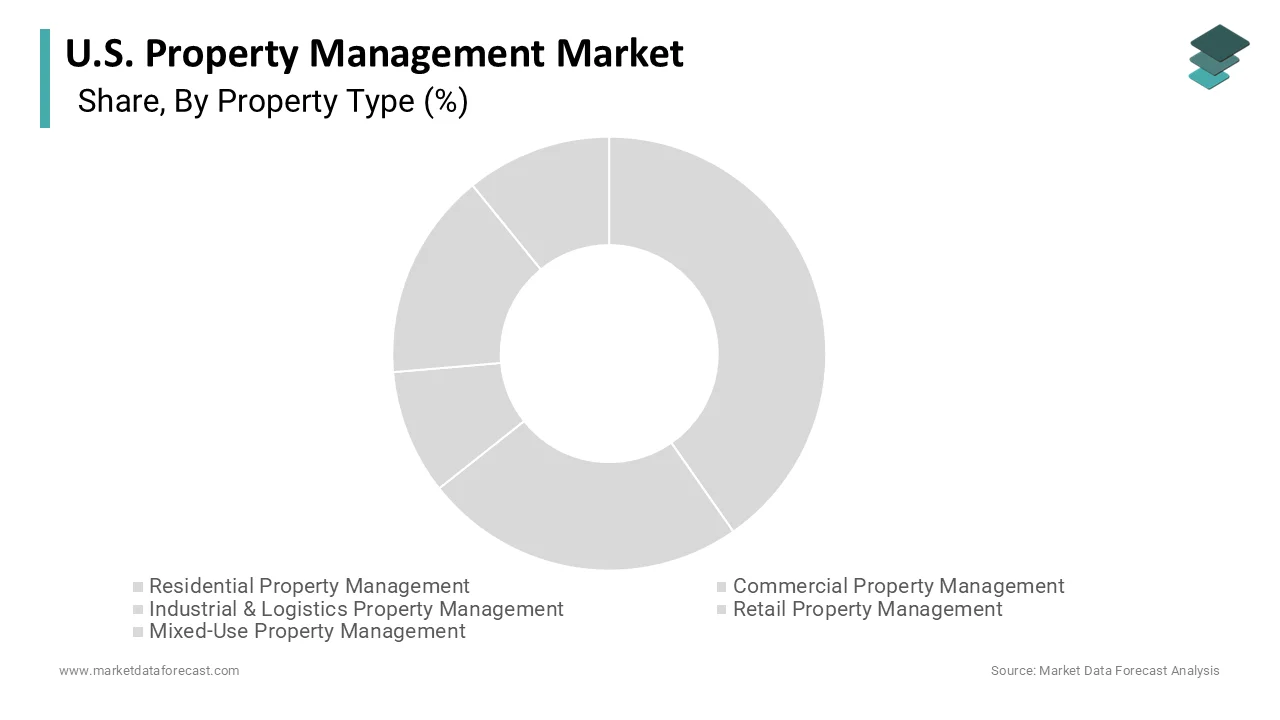
In addition, the regulatory complexity and single-family laws significantly contribute to the leading status of residential property management in the United States market. Residential landlords must comply with a myriad of federal, state,e and local regulations, long-term leasing practices, safety standards, and anti-icing procedures. Professional property managers possess the expertise to ensure legal compliance, thereby reducing the risk of costly lawsuits and penalties for property owners. The increasing enactment of rent control measures, restrictions, and just cause eviction laws in various cities adds layers of rational complexity. Managers must stay updated on changing legislation to protect owner interests while respecting tenant rights. The administrative burden of handling securideposit, its lease agreements, and dispute resolution is substantial. Owners rely on professionals to mitigate liability and manage these regulatory challenges efficiently. The need for legal adherence creates a barrier to self-management for many investors. Hence, the self-management reinforces the necessity of professional residential management services. This dependency ensures sustained demand for expert oversight.
On the other hand, the industrial and logistics property management segment is expected to exhibit a noteworthy CAGR of 9.2% from 2026 to 2034. This swift growth of the segment is fueled by the expansion of e-commerce supply chain modernization and the need for specialized facility oversight. The segment covers warehouses, distribution centers, and manufacturing facilities. Expansion of e-commerce and supply chain modernization drives the rapid growth of industrial and logistics property management in the United States market. The surge in online shopping has created an unprecedented demand for warehousing an,,d last mile delivery infrastructure. According to the United States Department of Commerce, e-commerce sales have grown consistently, requiring retailers to expand their logistical footprints. As per JL, ,L the vacancy rate for industrial space has remained historically low, prompting increased investment in new construction and existing asset optimization. Property managers play a cr,ue-commercein maintaining these facilities,s ensuring that loading docks, storage systems, and security protocols operate efficiently. The complexity of a modern logistics hub requires specialized management skills to coordinate with tenants who operate on tight schedules. The integration of automation and robotics in warehouses necessitates technical expertise for facility upkeep. Managers must ensure that buildings meet the specific needs of third-party logistics providers and retailers. The strategic location of these assets near urban centers increases their value and management intensity. The continuous growth of online retail ensures a steady pipeline of industrial properties requiring professional oversight. Consequently, third-party omni-channel in e-commerce sustains the rapid expansion of this segment. The focus on efficiency and reliability drives market growth.
Furthermore, demand for specialized facility maintenance and security accelerates the adoption of professional management services in the industrial and logistics sector. Ie-commerce properties house valuable inventory and sophisticated equipment requiring rigorous maintenance and security measures. According to the International Facility Management Association, effective facility management reduces operational downtime and extends asset lifespan significantly. Property managers implement comprehensive security protocols, including surveillance, access control, and perimeter monitoring to protect assets. The maintenance of large-scale HVAC systems fi, fire suppression units, nd electrical grids requires specialized technical knowledge. Managers coordinate preventive maintenance schedules to avoid disruptions in tenant operations. Three cold storage facilities for pharmaceuticals and food products add another large-scale complexit,y requiring temperature-controlled environment management. Professional managers ensure compliance with occupational safety and health administration standards. The ability to provide seamless operational support enhances tenant retention and property value. Investors recognize the importance of specialized management in maximizing returns on industrial assets. Thus, the need for expert oversight supports the fast-paced growth of the segment. The focus on operational continuity ensures long-term demand.
By Service Type Insights
The maintenance and facility management segment was the largest by occupying a 40.4% share of the United States property management market in 2025. This prominence of the fast-paced is supported by the critical need to preserve asset value and ensure tenant satisfaction. Moreover, this segment includes routine repairs, preventive maintenance,e emergency responses, es and overall building upkeep. Asset preservation and operational continuity drive the domination of maintenance and facility management in the United States property management market. Regular maintenance prevents minor issues from escalating into major structural issues, thereby extending the lifespan of property components. According to the Building Owners and Managers Association, ion proactive maintenance can reduce long-term repair costs by up to 30 percent compared to reactive approaches. Property managers coordinate with vendors and in-house teams to ensure that heating, cooling,g plumbing, and electrical systems function reliably. The prevention of unexpected breakdowns ensures uninterrupted operation, long-term commercial tenants, and comfortable living conditions for residents. Well-maintained properties command higher rental iWell-maintainedt quality tenants. Ma,nagers i,mplement, scheduled inspection programs to identify potential hazards before they cause damage. The complexity of modern building systems requires specialized expertise for effective upkeep. Investors rely on professional management to protect their capital investments through diligent care. The correlation between maintenance quality and property value is well established. Consequently, the imperative to preserve assets sustains the leadership of this segment. The focus on longevity ensures consistent demand for maintenance services.
In addition, regulatory compliance and safety standards significantly contribute to the leading status of maintenance and facility management in the United States market. Properties must adhere to strict building codes, fire safety regulations, and environmental standards to ensure occupant safety. Property managers ensure that all facilities meet these legal requirements through systematic maintenance protocols. They coordinate necessary upgrades and repairs to comply with evolving safety codes. The manag,,ement of hazardous mat, er,ials such as asbestos or lead requires specialized handling and documentation. Managers maintain detailed records of inspections and repairs to demonstrate compliance during audits. The liability associated with safety failures makes professional oversight essential for property owners. Tenants expect safe and compliant environments, which influences their leasing decisions. The complexity of regulatory requirements necessitates expert knowledge and diligence. Hence, the need for compliance reinforces the dominance of maintenance services. The focus on safety ensures long-term operational stability.
But the marketing and leasing segment is predicted to witness the highest CAGR of 8.5% during the forecast period due to the increasing competition for tenants, the adoption of digital marketing strategies, and the need for optimized occupancy rates. Digital long-term and virtual touring technologies drive the rapid growth of marketing and leasing in the United States property management market. Prospective tenants increasingly rely on online platforms to search for properties and make leasing decisions. According to the National Multifamily Housing Council,l over 90 percent of renters use online listings to find their next home. Property managers leverage digital marketing tools such as social media advertising, nnaturalsearch engine optimization,t andvirtual reality to reach wider audiences. These technologies enhance the visibility of listings and reduce the time properties remain vacant. Virtual tours enable out-of-state or international tenants to view units without physical visits, expanding the potential tenant pool. The integration of artificial intelligence in leasing platforms allows for personalized property recommendations. Digital signing of leases streamlines the application process and conversion rates. Managers use data analytics to optimize marketing, spending, and target specific demographics. The shift towards digital-first strategies enhances efficiency and effectiveness. Consequently, the adoption of technology sustains the rapid expansion of this segment. The focus on accessibility and convenience drives market growth.
Moreover, the competitive landscape and occupancy optimization accelerate the digital-first professional marketing and leasing services in the United States market. The increasing supply of rental units in many markets has intensified competition among landlords. Property managers develop targeted marketing campaigns to attract high-quality tenants and minimize vacancy periods. They analyze market trends to adjust pricing strategies dynamically, ensuring competitiveness. The use of customer relationship management systems helps track leads and follow up efficiently. Professional staging and photography enhance the high-quality images, generating more interest. Managers collaborate with local businesses and community organizations to promote properties. The ability to maintain high occupancy rates directly impacts property revenue and value. Investors rely on expert leasing teams to maximize returns in competitive environments. The complexity of tenant screening and background checks requires professional handling. Therefore, the need for occupancy optimization supports the fast-paced growth of the segment. The focus on revenue maximization ensures sustained demand.
COUNTRY LEVEL ANALYSIS
United States Property Management Market Analysis
The United States led the North American property management market and captured an 86.6% share in 2025. This leading fast-paced market is attributed to a vast real estate portfolio, diverse property types, and a mature regulatory environment. It serves as the global leader in industry sophistication and technological adoption. The presence of major institutional investors and real estate investment trusts drives professional management standards. Dominance driven by market scale and institutional investment defines the United States property management market. The sheer size of the US real estate sector creates a massive demand for professional management services across all property types. According to the National Association of Real Estate Investment Trusts, the market capitalization of publicly traded REITs exceeds 1 trillion USD, indicating significant institutional ownership. As per the Federal Reserve Board, household real estate assets in the United States are valued at over 40 trillion USD, highlighting the magnitude of managed assets. Institutional investors require standardized reporting compliance and operational efficiency, which professional management firms provide. The complexity of managing large portfolios necessitates specialized expertise in finance, law, and operations. The depth of the capital market supports continuous development and acquisition of properties. The regulatory framework ensures transparency and accountability in management practices. The availability of skilled profes,sio,nals and advanced technology platforms enhances service quality. The cultural emphasis on property ownership and investment sustains high activity levels. This combination of scale and sophistication ensures US leadership. The continuous inflow of capital drives market dynamism. The strategic focus on asset performance maintains the dominant position. The United States sets global benchmarks for property management excellence and innovation.
COMPETITIVE LANSCAPE
The competition in the United States property management market is characterized by intense rivalry among large national firms and numerous regional operators striving to offer superior service and value. Major players compete based on technological capabilities, portfolio size,e and breadth of services. The market features a fragmented landscape with many small independent managers catering to local needs. Companies differentiate themselves through innovative property technology solutions that enhance efficiency and tenant satisfaction. Strategic partnerships with technology vendors help firms stay ahead of digital trends. Price competitiveness remains a factor, particularly for smaller properties where margins are thin. Innovation in sustainability and energy management drives customer acquisition and retention. The ability to provide comprehensive service, including leasing, maintenance,nce and financial reporting isis cruciallIntellectual property related to proprietary software serves as a competitive barrier. This dynamic environment fosters continuous improvement and consolidation. The ability to adapt to regulatory changes and technological advances determines long-term success. Customers increasingly demand transparency and real-time data, influencing provider selection.
KEY MARKET PLAYERS
Some of the companies that are playing a dominating role in the U.S. Property Management Market include
- CBRE Group, Inc.
- Jones Lang LaSalle Incorporated (JLL)
- Cushman & Wakefield plc
- Colliers International Group Inc.
- Greystar Real Estate Partners, LLC
- Lincoln Property Company
- RPM Living
- FirstService Residential
- Associa
- RealPage, Inc.
- Yardi Systems, Inc.
- AppFolio, Inc.
TOP LEADING PLAYERS IN THE MARKET
- Greystar Real Estate Partners LLC is a global leader in the United States property management market with a vast portfolio of residential and commercial assets. The company manages millions of units across the country,y leveraging its scale to provide comprehensive services. Recent actions include significant investments in proprietary technology platforms to enhance tenant experience and operational efficiency. Greystar has expanded its presence in the build-to-rent sector, catering to changing housing preferences. The firm focuses on sustainability initiatives, integrating green building practices into its management protocols. By acquiring regional management firms, Greystar strengthens its local market penetration. These strategic moves rebuild-to-rent position as a dominant player. The company continues to innovate in digital leasing and maintenance solutions. This commitment to technology and service excellence drives sustained growth and client satisfaction in the competitive landscape.
- CBRE Group Inc contributes significantly to the market through its integrated facility and property management services for commercial real estate. The company serves a diverse client base, including corporations, investors nd occupiers. Recent developments involve the expansion of its digital solutions suite to offer data-driven insights for asset optimization. CBRE has strengthened its sustainability consulting capabilities,s helping clients meet environmental goals. The firm leverages artificial intelligence to predict maintenance needs and reduce operational costs. Strategic partnerships with technology providers enhance its service offerings. CBRE focuses on delivering tailored solutions that align with client objectives. The company invests in training programs to ensure high standards of service delivery. These efforts solidify its reputation for excellence and innovation. The integration of global expertise with local knowledge supports its market leadership. This holistic approach delivers long-term value for stakeholders.
- Cushman and Wakefield plc plays a vital role in the United States property management market by providing comprehensive real estate services. The company manages a wide range of property types, including office, industrial, and multifamily assets. Recent actions include the launch of advanced analytics tools to improve decision-making for property owners. Cushman and Wakefield has expanded its focus on health and wellness in building operations. The firm emphasizes diversity and inclusion in its workforce and community initiatives. Strategic acquisitions have broadened its geographic reach and service capabilities. The company integrates technology to streamline leasing and maintenance processes. By prioritizing client relationships, Cushman and Wakefield ensures high retention rates. These strategies enhance its competitive position in the market. The focus on innovation and sustainability drives continuous improvement. This approach supports robust growth and market relevance.
TOP STRATEGIES USED BY KEY MARKET PARTICIPANTS
Key players in the United States property management market primarily employ strategies focused on technological integration and service diversification to maintain a competitive advantage. Companies invest heavily in property technology platforms to automate operations and enhance tenant engagement. Strategic acquisitions of regional firms enable expansion into new geographic markets and service lines. Firms prioritize sustainability and environmental, social governance initiatives to attract environmentally conscious clients. Providers also focus on developing specialized services for niche property sectors such as life sciences and data centers. Investment in talent development ensures high-quality service delivery and operational excellence. Marketing efforts emphasize data-driven insights and transparent reporting to build trust. These strategic initiatives enable firms to differentiate their offerings and respond effectively to evolving market demands in the dynamic real estate sector.
MARKET SEGMENTATION
This research report on the U.S. property management market is segmented and sub-segmented into the following categories.
By Property Type
- Residential Property Management
- Commercial Property Management
- Industrial & Logistics Property Management
- Retail Property Management
- Mixed-Use Property Management
- Others
By Service Type
- Maintenance & Facility Management
- Marketing & Leasing
- Tenant Management
- Rent Collection & Financial Reporting
- Legal & Compliance Management
- Others
By Country
- California
- Texas
- Florida
- New York
- Rest of the United States
Related Reports
Access the study in MULTIPLE FORMATS
Purchase options starting from
$ 1200
Didn’t find what you’re looking for?
TALK TO OUR ANALYST TEAM
Need something within your budget?
NO WORRIES! WE GOT YOU COVERED!
Call us on: +1 888 702 9696 (U.S Toll Free)
Write to us: sales@marketdataforecast.com