- Product Description Description
- Table of Contents TOC
- List of Table & Figure LOT
- Get Free Sample PDF Sample PDF
Market Size, 2025
$369.82 BnMarket Estimate, 2026
$381.54 BnMarket Forecast, 2034
$489.74 BnCAGR, 2026–2034
3.17%U.S. Facility Management Market Report Summary
The U.S. facility management market was valued at USD 369.82 billion in 2025, is estimated to reach USD 381.54 billion in 2026, and is projected to reach USD 489.74 billion by 2034, growing at a CAGR of 3.17% during the forecast period. Market growth is driven by increasing demand for integrated building services, rising adoption of smart facility technologies, and expanding commercial real estate activities. Facility management services play a crucial role in maintaining operational efficiency, safety, and sustainability across commercial, industrial, healthcare, and residential properties. The growing focus on energy efficiency, workplace optimization, and outsourced facility services is further supporting market expansion across the United States.
Key Market Trends
- Rising demand for integrated and outsourced facility management services is driving market growth.
- Increasing adoption of smart building and automation technologies is boosting service demand.
- Growing focus on energy efficiency and sustainable building operations is supporting market expansion.
- Expansion of commercial real estate and infrastructure development is enhancing service adoption.
- Innovation in predictive maintenance, IoT based monitoring, and workplace management solutions is influencing market development.
Regional Insights
- The U.S. facility management market is experiencing steady growth across commercial, industrial, and institutional sectors, supported by increasing infrastructure modernization and demand for outsourced operational services. Growing adoption of digital facility management platforms and sustainable building practices is further strengthening market development.
Competitive Landscape
The U.S. facility management market is highly competitive, with key players focusing on integrated service offerings, smart building technologies, and expansion of outsourced facility solutions to strengthen their market position. Companies are investing in automation, predictive maintenance systems, and energy management services. Prominent players in the U.S. facility management market include CBRE Group, Inc., Aramark, Jones Lang LaSalle Incorporated, ABM Industries, EMCOR Facilities Services, Emeric Facility Services, SMI Facility Services, Cushman & Wakefield plc., AHI Facility Services, Inc., MRI Software LLC, Guardian Service Industries, and Sodexo.
U.S. Facility Management Market Size
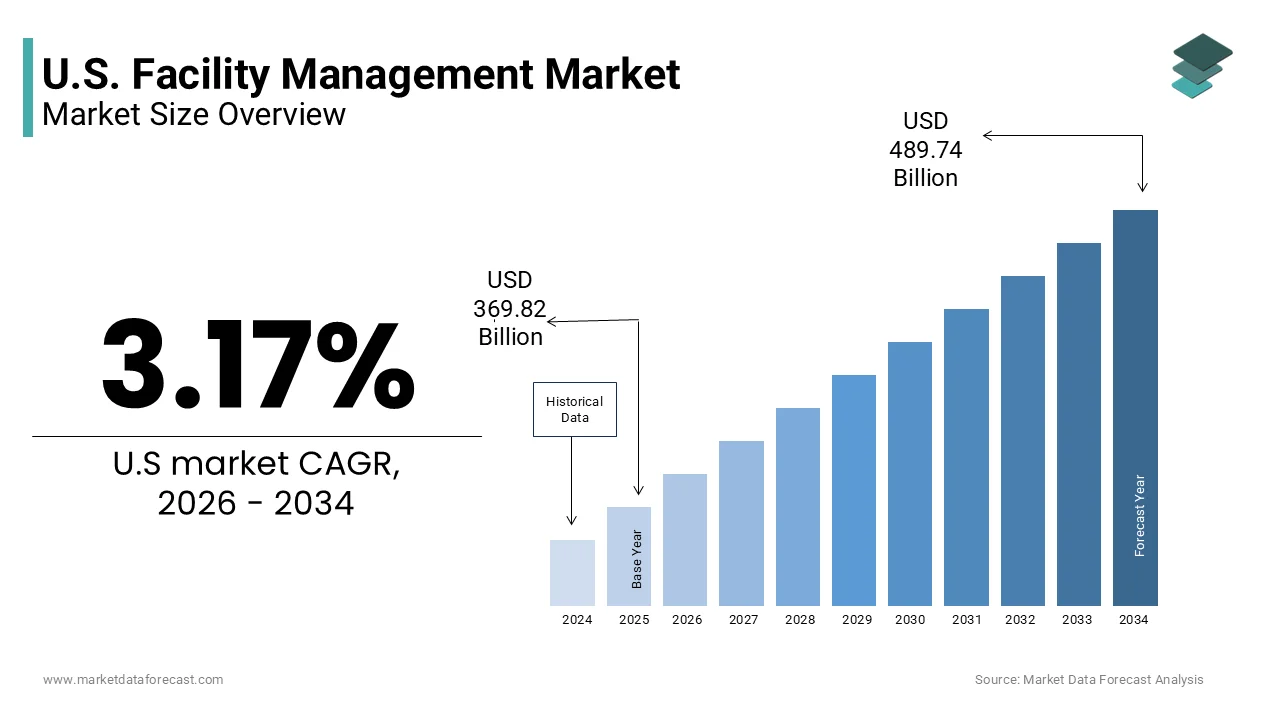
The U.S. facility management market size was valued at USD 369.82 billion in 2025, is estimated to reach USD 381.54 billion in 2026, and is projected to reach USD 489.74 billion by 2034, growing at a CAGR of 3.17% from 2026 to 2034.
The facility management is a service designed to maintain and optimize the functionality safety and comfort of built environments. Organizations increasingly view facilities management not merely as a cost center but as a strategic asset that enhances employee productivity and asset longevity. The integration of smart building technologies has transformed traditional maintenance into predictive and proactive systems. Regulatory compliance regarding occupational safety and environmental standards further drives the need for professional management services. The aging infrastructure in many American cities necessitates regular upgrades and rigorous maintenance protocols. Facility managers are tasked with balancing budget constraints against the need for modernization and energy efficiency. The shift towards hybrid work models has also redefined space utilization strategies prompting facilities managers to adapt layouts and services to accommodate flexible working arrangements.
MARKET DRIVERS
Urbanization and Expansion of Commercial Real Estate Infrastructure
The rapid pace of urbanization and the continuous expansion of commercial real estate infrastructure is majorly escalating the growth of the United States facility management market. As more businesses establish operations in metropolitan areas, the demand for well-maintained office spaces retail centers and industrial parks increases substantially. As per the United States Census Bureau, the urban population in the United States has grown significantly with over 80% of residents now living in urban areas. This concentration of population and economic activity necessitates robust infrastructure support systems to ensure operational continuity and safety. Commercial property developers and owners rely on professional facilities management firms to handle complex maintenance tasks that require specialized skills and equipment. Facilities management providers offer scalable solutions that cater to the diverse needs of large scale commercial portfolios. The growth of e-commerce has also spurred the development of logistics hubs and warehouses, which require specialized maintenance for automated systems and heavy machinery. These facilities operate around the clock demanding rigorous upkeep to prevent costly disruptions. The expansion of healthcare and educational institutions further contributes to the demand for specialized facility services that comply with strict regulatory standards.
Adoption of Internet of Things and Smart Building Technologies
The widespread adoption of Internet of Things (IoT) and smart building technologies by enabling data driven decision making and predictive maintenance is additionally accelerating the growth of the United States facility management market. Sensors and connected devices provide real time insights into building performance allowing facility managers to identify issues before they escalate into major problems. As per the International Data Corporation, spending on IoT solutions in the United States is projected to reach billions of dollars with a significant portion allocated to smart building applications. This technological integration enhances energy efficiency by optimizing heating cooling and lighting systems based on occupancy and usage patterns. Predictive maintenance reduces unplanned downtime and extends the lifespan of critical assets such as elevators chillers and generators. Facilities management firms leverage artificial intelligence algorithms to analyze vast amounts of data and generate actionable recommendations for operational improvements. The ability to monitor indoor air quality and environmental conditions has become increasingly important in the post pandemic era ensuring healthy and safe workplaces. Smart technologies also facilitate remote monitoring and control reducing the need for on site personnel and lowering labor costs. Clients are increasingly demanding tech enabled services that provide transparency and measurable outcomes. Facilities management providers that invest in digital platforms gain a competitive advantage by offering superior service quality and cost savings.
MARKET RESTRAINTS
High Operational Costs and Labor Intensive Nature of Services
The high operational costs and the labor intensive nature of facilities management services is also hampering the growth of the United States facility management market. The industry relies heavily on skilled technicians cleaners and security personnel, whose wages constitute a major portion of operating expenses. The employment cost index for private industry workers in service occupations has risen steadily increasing the financial burden on service providers. Labor shortages exacerbate this issue as finding qualified staff becomes increasingly difficult in a tight job market. High turnover rates further inflate recruitment and training costs impacting service consistency and quality. Clients often pressure providers to reduce costs leading to thin profit margins that limit investment in technology and innovation. Economic fluctuations can lead to budget cuts in non essential services forcing clients to defer maintenance or switch to lower cost providers. Regulatory compliance requirements also add to operational complexities and costs as firms must ensure adherence to safety and environmental standards. The capital intensity of acquiring advanced maintenance equipment and software further strains financial resources. These cost pressures restrict the ability of facilities management companies to expand their service portfolios or enter new markets aggressively.
Fragmentation of the Market and Lack of Standardization
The lack of standardized service protocols to industry consolidation and efficiency is declining the growth of the United States facility management market. The sector comprises thousands of small and medium sized enterprises that operate locally or regionally limiting their ability to achieve economies of scale. As per the National Association of Home Builders, a significant portion of construction and maintenance services is provided by smaller contractors who may lack the resources for comprehensive facility management. This fragmentation leads to inconsistent service quality and pricing making it difficult for clients to compare offerings and establish long term partnerships. The absence of universal standards for service delivery and performance measurement creates ambiguity in contract negotiations and execution. Clients often face challenges in integrating multiple vendors for different services resulting in coordination inefficiencies and communication gaps. The lack of standardized data formats and reporting metrics hinders the adoption of unified digital platforms across diverse portfolios. Regional variations in labor laws building codes and environmental regulations further complicate operations for national providers seeking to expand their footprint. This disjointed landscape prevents the emergence of dominant players, who could drive industry wide innovation and best practices. Small providers may struggle to invest in advanced technologies or training programs limiting their competitiveness against larger integrated firms.
MARKET OPPORTUNITIES
Integration of Sustainable Practices and Green Building Certifications
The growing emphasis on sustainability and green building certifications to expand their service offerings and value proposition. Organizations are increasingly prioritizing environmental responsibility and seeking partners who can help them achieve LEED or WELL building standards. As per the U.S. Green Building Council, there are over 100000 LEED registered projects in the United States creating a substantial demand for specialized maintenance and optimization services. Facilities management firms can capitalize on this trend by offering energy audits waste management solutions and water conservation strategies. Helping clients reduce their carbon footprint not only enhances corporate reputation but also results in long term cost savings through improved efficiency. The implementation of renewable energy systems such as solar panels requires ongoing maintenance and monitoring creating new revenue streams for service providers. Regulatory incentives and tax credits for green buildings further encourage adoption of sustainable practices. Facilities managers who possess expertise in environmental compliance and sustainability reporting become valuable strategic partners for corporate clients. The transition towards circular economy principles also opens opportunities for innovative waste reduction and recycling programs.
Expansion into Healthcare and Life Sciences Facilities
The expansion of facilities management services into the healthcare and life sciences sectors with the specialized needs of these industries is another factor to surge the growth of the United States facility management market. Healthcare facilities require stringent hygiene standards precise temperature control and uninterrupted power supply to ensure patient safety and operational continuity. As per the American Hospital Association, there are nearly 6000 hospitals in the United States each requiring comprehensive and specialized facility support. The complexity of medical equipment and regulatory requirements, such as those from the Centers for Medicare and Medicaid Services, which necessitates highly trained personnel and specialized maintenance protocols. Facilities management firms that develop expertise in healthcare environments can secure long term contracts with high barriers to entry for competitors. The growth of outpatient care centers and ambulatory surgical sites further expands the potential client base. Life sciences laboratories and pharmaceutical manufacturing plants, also demand rigorous environmental controls and contamination prevention measures. Providing integrated services that combine technical maintenance with compliance management adds significant value for healthcare providers. The aging population and increasing healthcare utilization rates ensure sustained demand for these specialized services.
MARKET CHALLENGES
Shortage of Skilled Labor and Technical Expertise
The shortage of skilled labor and technical expertise by affecting service quality and operational efficiency is to pose a new challenge for the growth of the United States facility management market. As per the Associated General Contractors of America, a significant majority of construction and maintenance firms report difficulty in filling craft worker positions. This skills gap is particularly acute in specialized areas, such as HVAC repair electrical systems and building automation. The lack of qualified personnel leads to increased response times higher labor costs and potential safety risks. Training new employees requires significant time and resources which strains operational budgets and delays project completion. The complexity of modern building systems demands continuous upskilling which many existing workers may not have access to. Recruitment challenges are exacerbated by the perception of facilities management as a low status profession compared to other technical careers. This talent scarcity limits the ability of firms to take on new contracts or expand their service capabilities. Clients may experience dissatisfaction due to inconsistent service levels leading to contract terminations or renegotiations. Addressing this challenge requires industry wide initiatives to promote vocational training and enhance the professional image of facilities management.
Cybersecurity Risks Associated with Smart Building Systems
The increasing integration of smart building systems and IoT devices introduces significant cybersecurity risks is additionally to impede the growth of the United States facility management market. Connected devices create multiple entry points for cyberattacks potentially compromising building operations and sensitive data. As per the Cybersecurity and Infrastructure Security Agency, infrastructure sectors, including commercial facilities are frequent targets for ransomware and malicious attacks. A breach in building management systems can lead to unauthorized access to physical spaces disruption of HVAC controls or theft of proprietary information. Facilities management firms must invest heavily in cybersecurity measures to protect their clients assets and maintain trust. However, many smaller providers lack the resources and expertise to implement robust security protocols. The complexity of securing diverse IoT ecosystems requires specialized knowledge that is often scarce in the traditional facilities management workforce. Liability concerns arise when security breaches occur raising questions about responsibility and insurance coverage. Clients are becoming more vigilant about vendor security practices making it a key criterion in procurement decisions. Failure to address cybersecurity vulnerabilities can result in reputational damage legal penalties and loss of business. The rapid evolution of cyber threats necessitates continuous monitoring and updates which add to operational burdens. Balancing the benefits of digitalization with the imperative of security remains a complex challenge. Facilities management companies must collaborate with IT security experts to develop comprehensive risk management strategies.
REPORT COVERAGE
| REPORT METRIC | DETAILS |
| Market Size Available | 2025 to 2034 |
| Base Year | 2025 |
| Forecast Period | 2026 to 2034 |
| CAGR | 3.17% |
| Segments Covered | By Component, Deployment Mode, Organization Size, Industry Vertical, and Region. |
| Various Analyses Covered | Global, Regional and Country-Level Analysis, Segment-Level Analysis, Drivers, Restraints, Opportunities, Challenges; PESTLE Analysis; Porter’s Five Forces Analysis, Competitive Landscape, Analyst Overview of Investment Opportunities |
| Countries Covered | California, Washington, Oregon, New York, United States |
| Market Leaders Profiled | CBRE Group, Inc. (U.S.), Aramark (U.S.), Jones Lang LaSalle Incorporated (U.S.), ABM Industries (U.S.), EMCOR Facilities Services (U.S.), Emeric Facility Services (U.S.), SMI Facility Services (U.S.), Cushman & Wakefield plc. (U.S.), AHI Facility Services, Inc. (U.S.), MRI Software LLC (U.S.), Guardian Service Industries (U.S.), and Sodexo (France) |
COMPETITIVE LANDSCAPE
The competition in the United States facility management market is characterized by intense rivalry among global integrated service providers and specialized regional firms. Major players leverage their scale and technological capabilities to offer comprehensive solutions that cover all aspects of facility operations. Differentiation increasingly relies on digital innovation sustainability credentials and the ability to deliver measurable cost savings. Price competition remains significant particularly for commoditized services such as cleaning and basic maintenance prompting firms to bundle services for added value. Customer retention is prioritized through long term contracts and performance-based incentives that align provider interests with client goals. Emerging technologies such as robotics and automated cleaning systems are becoming competitive advantages for early adopters. Regulatory compliance and safety standards create barriers to entry for smaller unqualified vendors. The shift towards hybrid work models has intensified demand for flexible and responsive facility services.
KEY MARKET PLAYERS
Some of the companies that are playing a dominating role in the U.S. facility management market include
- CBRE Group, Inc. (U.S.)
- Aramark (U.S.)
- Jones Lang LaSalle Incorporated (U.S.)
- ABM Industries (U.S.)
- EMCOR Facilities Services (U.S.)
- Emeric Facility Services (U.S)
- SMI Facility Services (U.S.)
- Cushman & Wakefield plc. (U.S.)
- AHI Facility Services, Inc. (U.S.)
- MRI Software LLC (U.S.)
- Guardian Service Industries (U.S.)
- Sodexo (France)
Top Players in the Market
- CBRE Group Inc stands as a global leader in commercial real estate services and facilities management with a robust presence in the United States. The company provides integrated facility management solutions that cover hard and soft services for diverse property types including offices healthcare and industrial sites. Recent actions include significant investments in digital platforms such as Triridge to enhance building performance and sustainability metrics. CBRE actively pursues strategic acquisitions of specialized service providers to expand its technical capabilities and geographic reach. The company emphasizes sustainability by helping clients achieve net zero carbon goals through energy efficient operations. Its comprehensive service portfolio allows it to offer end to end solutions that optimize asset value and operational efficiency. CBRE leverages data analytics to provide predictive maintenance insights reducing downtime and costs for clients. These initiatives reinforce its position as a premier partner for large scale facility management needs in the US market.
- JLL Jones Lang LaSalle Incorporated contributes significantly to the US facilities management market by delivering technology driven integrated facility management services. The company focuses on transforming workplace experiences through smart building technologies and sustainable practices. Recent strategies involve expanding its partnerships with tech firms to integrate Internet of Things solutions into facility operations. JLL invests heavily in training programs to upskill its workforce in advanced maintenance techniques and customer service excellence. The company offers tailored solutions for various sectors including life sciences education and corporate real estate. JLL prioritizes environmental social and governance criteria helping clients meet regulatory requirements and sustainability targets. Its global network supports multinational corporations with consistent service standards across locations. JLL also develops proprietary software tools for space planning and energy management enhancing client decision making.
- Cushman Wakefield plc plays a pivotal role in the US facilities management market by offering comprehensive outsourcing solutions for property owners and occupiers. The company integrates facility management with real estate advisory services to deliver holistic value to clients. Recent actions include the expansion of its technical service capabilities through targeted acquisitions of regional maintenance firms. Cushman Wakefield focuses on digital transformation by implementing cloud based platforms for real time monitoring and reporting. The company emphasizes health and safety protocols ensuring compliant and secure environments for occupants. It provides specialized services for critical environments such as data centers and laboratories requiring high precision maintenance. Cushman Wakefield collaborates with clients to develop customized sustainability strategies that reduce operational carbon footprints. Its strong emphasis on client partnership and operational excellence drives long term contracts and retention.
Top Strategies Used by Key Market Participants
Key players in the United States facility management market primarily utilize digital transformation and strategic acquisitions to enhance operational efficiency and service quality. Companies invest heavily in Internet of Things sensors and artificial intelligence to enable predictive maintenance and real time monitoring of building systems. This technological integration reduces downtime and lowers energy consumption aligning with sustainability goals. Mergers and acquisitions are frequently employed to expand geographic reach and acquire specialized technical expertise in niche sectors. Providers focus on developing integrated workplace management systems that combine hard and soft services for seamless client experiences. Sustainability initiatives such as green cleaning and energy audits serve as key differentiators attracting environmentally conscious clients. Workforce development programs address labor shortages by upskilling employees in advanced technologies and customer service. Partnerships with technology startups facilitate innovation and rapid deployment of new solutions.
MARKET SEGMENTATION
This research report on the U.S. facility management market is segmented and sub-segmented into the following categories.
By Components
- Solution
- Services
By Implementation
- On-Premise
- Cloud
By Organization Size
- large
- Small & Midsize
By Vertical Sector
- BFSI
- IT & Telecom
- Public Sector
- Healthcare
- Manufacturing
- Retail
- Real Estate
By Country
- California
- Washington
- Oregon
- New York
- Rest of the United States