- Product Description Description
- Table of Contents TOC
- List of Table & Figure LOT
- Get Free Sample PDF Sample PDF
Market Size, 2025
$33.95 BnMarket Estimate, 2026
$35.39 BnMarket Forecast, 2034
$49.38 BnCAGR, 2026–2034
4.25%U.S. Savory Snacks Market Size, Share & Growth Analysis (2025–2034)
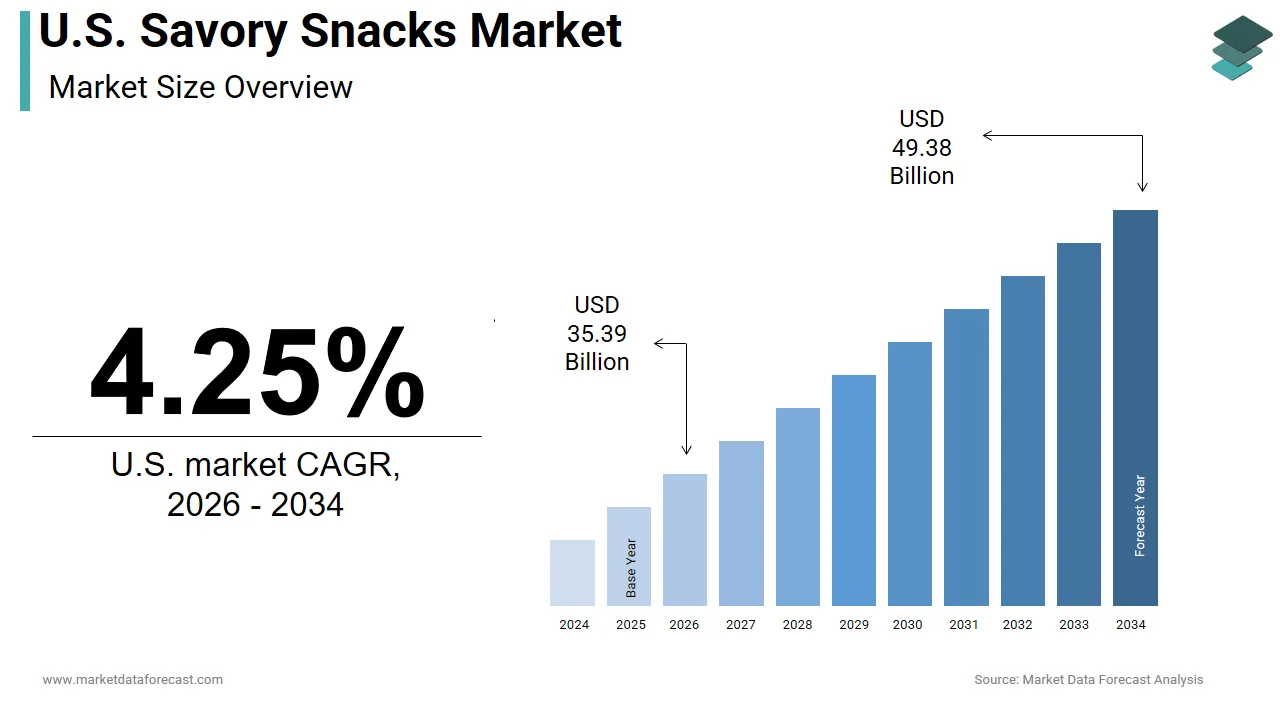
The U.S. savory snacks market was valued at USD 33.95 billion in 2025, estimated at USD 35.39 billion in 2026, and is projected to reach USD 49.38 billion by 2034. Growing at a CAGR of 4.25% from 2026 to 2034, the market expansion is fueled by rising demands for on-the-go convenience, adventurous bold and ethnic flavor profiles, and the introduction of health-focused functional and plant-based snack alternatives.
- Market Valuation: USD 35.39 billion (2026) to USD 49.38 billion (2034).
- Compound Annual Growth Rate: 4.25% (2026–2034).
- Primary Growth Drivers: Escalating demand for portable snack foods, continuous flavor innovations inspired by global cuisines, and a shift toward functional, health-conscious ingredients.
- Core Market Restraints: Health concerns associated with high sodium and saturated fat content, alongside rising raw material and production expenses.
U.S. Savory Snacks Market Segmentation & Metrics (2026–2034)
| Category | Leading Segment Focus | Segment Overview & Key Details | Alternative / Growth Focus |
|---|---|---|---|
| By Product Type | Chips & Crisps | Captured 38.3% market share in 2025 due to universal appeal, affordability, and deep-rooted cultural consumption. | Nuts, seeds, and trail mixes (fastest-growing at a 6.9% CAGR); savory biscuits, crackers, and puffed snacks. |
| By Distribution Channel | Supermarkets & Hypermarkets | Held 54.2% market share in 2025, driven by broad product assortments, routine provisioning, and extensive geographic reach. | Online retail (fastest-growing at an 11.3% CAGR), convenience stores, and specialty shops. |
| By Country / Region | United States Market | Represented 79.1% of the broader North American ecosystem in 2025, driven by high consumption rates and strong retail infrastructure. | State-level distribution hubs including New York, Texas, Florida, California, and Rest of U.S. |
Industry Structure & Key Market Players
Competitive Landscape: Highly competitive and fragmented, featuring global multinational giants, expanding private-label store brands, and agile artisanal producers competing on brand heritage, product quality, and clean-label innovations.
Leading Companies Profiled: The Kraft Heinz Company, Frito-Lay, Calbee, Conagra Brands, Inc., ITC Limited, Grupo Bimbo, Diamond Foods, LLC, Hain Celestial Group, Mondelez International, Inc., Intersnack Group GmbH & Co. KG, and The Kellogg Company (Kellanova).
U.S. Savory Snacks Market Size
The size of the U.S. savory snacks market was worth USD 33.95 billion in 2025. The market is anticipated to grow at a CAGR of 4.25% from 2026 to 2034 and be worth USD 49.38 billion by 2034 from USD 35.39 billion in 2026.
Savory snacks are ready-to-eat, bite-sized foods characterized by salty, spicy, tangy, or umami (meaty/earthy) profiles, rather than sweet flavors. These items are characterized by their umami profiles, crunchy textures, and convenience, making them preferred choices for casual consumption, social events, and on-the-go eating. The market is deeply embedded in the cultural fabric of the United States, where snacking has evolved from an occasional indulgence to a regular meal replacement or supplement. According to a study, the frequency of snacking varies widely by age, with children and teenagers snacking nearly 4 times per day, while savory snack consumption across all demographics averages roughly 434 occasions per person annually. As per the Bureau of Labor Statistics, the average American household spends approximately 10% of its food-at-home budget on nonalcoholic beverages, sweets, and snacks, underscoring the strong economic significance of the category. The proliferation of single-serve packaging and vending machine accessibility has further normalized impulse purchases across various demographics. Consumer preferences are shifting toward bold flavors and ethnic inspirations, mirroring the diverse culinary landscape of the country. Additionally, the rise of health consciousness has prompted manufacturers to innovate with baked alternatives and reduced-fat formulations. The market is highly competitive with established giants and niche artisanal brands vying for shelf space. Regulatory scrutiny regarding labeling and nutritional content continues to shape product development strategies. This dynamic environment requires constant adaptation to changing consumer tastes and health trends, ensuring the market remains vibrant and responsive to societal shifts while maintaining its status as a staple in household pantries.
MARKET DRIVERS
Increasing Demand for Convenience and On-the-Go Consumption
The escalating demand for convenience and on-the-go consumption is the main reason behind the growth of the US savory snacks market. This is because modern lifestyles prioritize speed and efficiency in meal choices. Busy schedules among working professionals, students, and families have reduced the time available for traditional sit-down meals, leading to a reliance on portable and easy-to-eat options. According to the International Food Information Council, 70% of Americans report snacking at least once a day, with an increasing number of consumers using snacks to replace traditional meals due to evolving lifestyle habits. The expansion of the gig economy and remote work has further blurred the lines between meal times, encouraging continuous grazing throughout the day. Retailers respond by placing savory snacks in high-traffic areas such as checkout counters and gas stations to capture impulse buys. Single-serve packs and resealable bags cater to portion control and freshness needs, enhancing appeal for commuters and travelers. The versatility of savory snacks allows them to be consumed in various settings, from offices to vehicles, making them indispensable for busy individuals. Manufacturers innovate with durable packaging that withstands movement and temperature changes, ensuring product integrity. This alignment with the fast-paced nature of contemporary life ensures sustained growth in the savory snacks segment as consumers seek effortless satisfaction without compromising on taste or enjoyment.
Innovation in Bold and Ethnic Flavor Profiles
The continuous innovation in bold and ethnic flavor profiles greatly propels the US savory snacks market. This growth is driven by consumers who increasingly seek adventurous and diverse taste experiences. The multicultural demographic of the United States has influenced mainstream palates, leading to a surge in demand for snacks inspired by global cuisines such as Mexican, Asian, and Mediterranean traditions. As per reports highlighted by the Specialty Food Association, sales for specialty chips, pretzels, and snacks grew by 8% over a core tracking period, fueled heavily by a modern "promiscuous palate" seeking globally sourced, intense flavor profiles. Flavors like sriracha kimchi, harissa, and Tajin have gained popularity, appealing to younger demographics who view food as a form of exploration and self-expression. Social media platforms amplify this trend by showcasing unique snack combinations and challenging taste tests, which drive viral interest and trial. Manufacturers collaborate with celebrity chefs and culinary experts to create limited-edition flavors that generate buzz and urgency. The ability to offer novel taste sensations differentiates brands in a saturated market and commands premium pricing. Retailers dedicate shelf space to international aisles featuring these innovative products, catering to diverse community preferences. This focus on flavor diversity transforms savory snacks from simple commodities into exciting culinary discoveries. Consequently, the emphasis on bold and ethnic profiles sustains market expansion and encourages frequent repurchase among adventurous eaters.
MARKET RESTRAINTS
Health Concerns Related to High Sodium and Fat Content
Health concerns related to high sodium and fat content are hindering the growth of the US savory snacks market. Consumers are becoming more aware of the negative impacts of excessive intake on cardiovascular health and weight management. Traditional savory snacks are often perceived as unhealthy due to their high levels of saturated fats and salt, which contribute to hypertension and obesity. According to the Centers for Disease Control and Prevention, nearly half of all adults in the United States have hypertension or high blood pressure, prompting many to limit sodium intake to less than 2300 milligrams per day. As per the American Heart Association, excessive consumption of processed snacks is linked to increased risk of heart disease and stroke, leading health-conscious individuals to reduce their frequency of purchase. Despite reformulation efforts, some mainstream brands struggle to lower sodium and fat levels without compromising taste and texture, which are critical for consumer satisfaction. Nutritionists and healthcare providers advise patients to choose whole food alternatives such as nuts and fruits, over processed savory snacks. This perception limits the appeal of traditional chips and pretzels among fitness enthusiasts and those managing chronic conditions. Regulatory initiatives such as front-of-package labeling warnings further discourage consumption of high-sodium products. The need to balance flavor profile with nutritional integrity creates a formulation dilemma for producers. Thus, health concerns regarding sodium and fat content restrict the growth potential of conventional savory snacks and drive demand for healthier alternatives.
Rising Ingredient and Production Costs
Rising ingredient and production costs are a major obstacle to the US savory snacks market. This reduces profit margins and exerts pressure for price increases that may dampen consumer demand. Key raw materials such as potatoes, corn, and vegetable oils are subject to volatility due to weather conditions, supply chain disruptions, and geopolitical tensions. According to the United States Department of Agriculture, extreme weather events, including droughts and floods, have reduced crop yields, leading to higher prices for agricultural commodities. As per the Bureau of Labor Statistics, the Producer Price Index for final demand rose 6.0% over a recent 12-month trailing period, illustrating that while upward pressure on production expenses persists, it has moderated from historic double-digit highs. Energy costs associated with frying, baking, and packaging also contribute to higher operational expenditures for manufacturers. These increased costs are often passed on to consumers in the form of higher retail prices, which can lead to trade-downs to private-label brands or reduced purchase volumes. Small and medium-sized brands face greater challenges in absorbing these costs compared to large corporations with diversified supply chains. The reliance on imported ingredients such as spices and specialty oils exposes manufacturers to currency fluctuations and trade tariffs. Geopolitical conflicts and logistical bottlenecks can disrupt the flow of essential components, leading to production delays. Manufacturers must invest in hedging strategies and long-term contracts to mitigate risks, but these measures require significant financial resources. Therefore, cost inflation remains a critical hurdle that constrains market growth and operational efficiency in the savory snacks industry.
MARKET OPPORTUNITIES
Expansion into Plant-Based and Vegan Snack Options
The expansion into plant-based and vegan snack options is a key growth area for the US savory snacks market. This shift is driven by a steadily increasing number of consumers adopting plant-based diets. Consumers are seeking dairy-free and meat-free alternatives that align with their ethical and environmental values, driving innovation in vegetable-based chips and legume snacks. According to the Plant Based Foods Association, retail sales of plant-based foods in the United States contracted by 2.2% to $8.1 billion in 2023 due to inflationary pressures, trailing behind the 6.1% growth seen across total food and beverage sales. Manufacturers leverage ingredients such as chickpeas, lentils, kale, and sweet potatoes to create nutritious and flavorful alternatives to traditional potato chips. The inclusion of protein-rich legumes appeals to health-conscious buyers looking for satiety and nutritional benefits. Retailers dedicate shelf space to plant-based options, recognizing their growth potential and high margin possibilities. Marketing campaigns emphasize sustainability and ethical sourcing, resonating with environmentally conscious consumers who associate plant-based diets with lower carbon footprints. Collaborations with popular vegan influencers help promote new products and build brand loyalty. The versatility of plant-based ingredients allows for diverse flavor profiles and textures, expanding their application beyond traditional formats. This trend aligns with broader wellness movements, offering a pathway for market differentiation and revenue growth. American consumers are embracing new dietary preferences. So, manufacturers can capture a significant share of the expanding plant-based sector by catering to these trends.
Development of Functional Snacks with Added Benefits
The development of functional snacks with added health benefits offers a lucrative opportunity for the US savory snacks market. This approach appeals directly to consumers who seek nutrition alongside indulgence. Functional snacks are fortified with vitamins, minerals, probiotics, or adaptogens to provide specific health advantages such as improved digestion, immunity, or stress relief. According to market tracking data from industry analysts, the global functional food market is projected to grow significantly—with expectations to clear $480 billion by the mid-2030s—as modern shoppers increasingly rely on preventive nutrition to support long-term wellness. As per the International Food Information Council, 60 percent of consumers are interested in snacks that offer additional health benefits beyond basic nutrition, driving demand for value-added products. Manufacturers incorporate ingredients like turmeric for inflammation, fiber for digestive health, and ashwagandha for stress management into savory snack formulations. These innovations transform traditional snacks into wellness tools, attracting health-conscious individuals who want to optimize their daily intake. Retailers support this trend by featuring functional snacks in health and wellness sections, highlighting their unique benefits. Partnerships with nutritionists and healthcare professionals help validate claims and build credibility. The ability to offer targeted health solutions allows brands to command premium prices and build loyal followings. This diversification strategy reduces reliance on traditional indulgent snacks and opens new market segments. Consequently, the integration of functional benefits drives engagement and expands the appeal of savory snacks to a broader audience seeking holistic well-being.
MARKET CHALLENGES
Intense Competition from Private Label Brands
Intense competition from private-label brands is a major constraint on the US savory snacks market. This is eroding market share and pressuring margins for national brands. Retailers such as Walmart, Kroger, and Costco have developed high-quality store-brand snacks that offer comparable taste and ingredients at significantly lower prices. According to the Private Label Manufacturers Association, private label sales in the grocery sector have grown steadily, with consumers increasingly trusting store brands for staple items like chips and pretzels. National brands struggle to justify price premiums when private labels improve their packaging and formulation quality. The lack of differentiation in basic savory snacks makes it difficult for established brands to maintain loyalty based solely on heritage or recognition. Retailers prioritize their own brands on shelves, giving them prominent placement and promotional support, which limits visibility for national competitors. Small and artisanal brands face even greater challenges in competing with the economies of scale enjoyed by large retailers. The perception that private labels offer better value forces national brands to invest heavily in marketing and innovation to retain customers. Price wars can lead to reduced profitability across the sector, impacting investment in research and development. Thus, the rise of powerful private label alternatives threatens the dominance of traditional savory snack manufacturers and necessitates strategic adaptation to maintain relevance.
Regulatory Pressure on Labeling and Marketing Practices
Regulatory pressure on labeling and marketing practices is a significant barrier to the US savory snacks market. This is supported by governments and consumer advocacy groups demanding greater transparency and accountability. Agencies such as the Food and Drug Administration are scrutinizing claims related to natural ingredients, low-sodium content, and health benefits to prevent misleading information. According to the Federal Trade Commission, companies face increasing legal risks if their marketing materials exaggerate nutritional values or imply unproven health outcomes. As per the Center for Science in the Public Interest, there are growing calls for stricter regulations on front-of-package labeling to clearly indicate high levels of sodium, sugar, and saturated fats. Compliance with these evolving standards requires manufacturers to invest in rigorous testing and reformulation, which can be costly and time-consuming. Failure to adhere to guidelines can result in fines, product recalls, and damage to brand reputation. Consumers are becoming more skeptical of marketing claims, relying on third-party certifications and independent reviews to verify product quality. The complexity of navigating different state and federal regulations adds to the operational burden for national brands. Additionally, restrictions on advertising to children limit promotional opportunities for certain snack categories. Balancing creative marketing with regulatory compliance requires careful planning and legal oversight. Hence, regulatory pressures compel manufacturers to adopt more transparent and conservative communication strategies to maintain consumer trust and avoid legal pitfalls.
REPORT COVERAGE
| REPORT METRIC | DETAILS |
| Market Size Available | 2025 to 2034 |
| Base Year | 2025 |
| Forecast Period | 2026 to 2034 |
| Segments Covered | By Product Type, Distribution Channel, and Country. |
| Various Analyses Covered | Global, Regional, and Country-Level Analysis, Segment-Level Analysis, Drivers, Restraints, Opportunities, Challenges; PESTLE Analysis; Porter’s Five Forces Analysis, Competitive Landscape, Analyst Overview of Investment Opportunities |
| Countries Covered | New York, Massachusetts, Pennsylvania, Illinois, Ohio, Michigan, Texas, Florida, Georgia, California, Washington, Colorado. |
| Market Leaders Profiled |
|
SEGMENTAL ANALYSIS
By Product Type Insights
In 2025, the chips and crisps segment led the US savory snacks market and captured a 38.3% share. This leading position of the segment was attributed to its universal appeal, affordability, and deep integration into American snacking culture. Furthermore, this category includes potato chips, tortilla chips, and vegetable chips, which are consumed across all demographics and occasions. As per sources, Americans consume nearly 2 billion pounds of potato chips annually, highlighting the massive scale of demand, which utilizes over 20% of the entire domestic potato crop. The versatility of chips allows them to be paired with dips served at social gatherings or eaten as standalone treats, making them a staple in households and food service establishments. Manufacturers benefit from established supply chains for potatoes and corn, ensuring consistent raw material availability and cost efficiency. The wide variety of flavors, textures, and formats, from thin and crispy to thick and kettle cooked, caters to diverse consumer preferences. Retailers allocate significant shelf space to chips due to their high turnover rates and impulse purchase potential. Innovation within this segment focuses on healthier alternatives, such as baked chips and those made from alternative vegetables like kale and beetroot, to address health concerns. The cultural significance of chips during sporting events and holidays further sustains their dominance. Consequently, chips remain the cornerstone of the savory snack industry due to their widespread acceptance and essential role in casual dining.
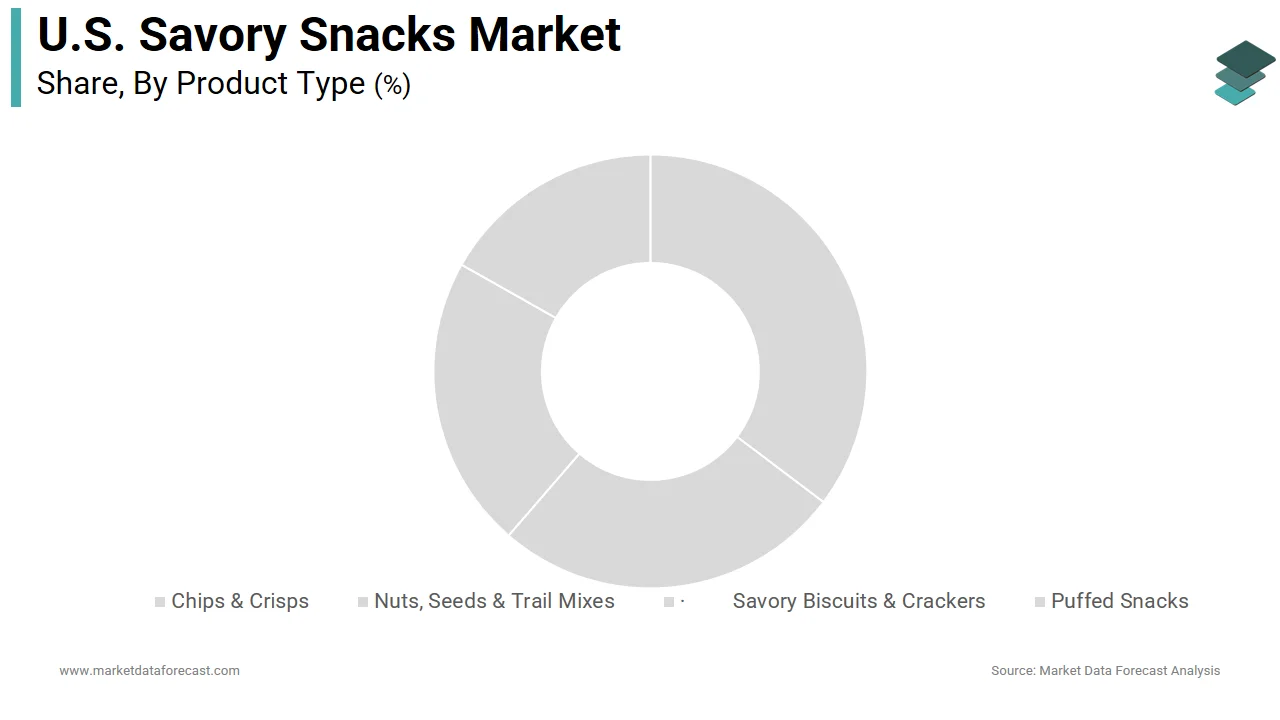
However, the nuts, seeds, and trail mixes segment is predicted to witness the highest CAGR of 6.9% during the forecast period, owing to the increasing consumer focus on health and nutrition. Unlike traditional fried snacks, nuts and seeds are perceived as nutrient-dense options rich in protein, healthy fats, fiber, and essential vitamins. According to data tracked by the International Nut and Dried Fruit Council (INC), per capita consumption of functional tree nuts in North America has steadily risen over the past decade, led by a surge in demand for almonds, cashews, and walnuts. As per the Harvard T H Chan School of Public Health, regular consumption of nuts is associated with reduced risk of cardiovascular disease and type 2 diabetes, encouraging health-conscious individuals to incorporate them into their diets. The rise of plant-based and keto diets has further amplified demand for nuts and seeds as primary sources of energy and protein. Manufacturers innovate with roasted salted and flavored varieties to enhance taste while maintaining nutritional integrity. Single-serve packaging appeals to busy consumers looking for convenient and portable healthy snacks. The premium positioning of nuts and seeds allows for higher profit margins, attracting investment from major snack companies. Retailers expand their natural and organic sections to accommodate diverse nut and seed offerings, including almonds, walnuts, pumpkin seeds, and sunflower seeds. Hence, the combination of health benefits, dietary trends, and product innovation drives the rapid expansion of this segment.
By Distribution Channel Insights
The supermarkets and hypermarkets segment held the majority share of 54.2% of the US savory snacks market in 2025. This supremacy of the segment was credited to its extensive reach, comprehensive product assortments, and one-stop shopping convenience. These retail outlets allow consumers to purchase snacks alongside other grocery items facilitating routine household provisioning. According to grocery sector data from bodies like FMI (The Food Industry Association), traditional supermarkets remain a core destination for staple snacks, though their total food and grocery retail market share has shifted closer to 40% due to competition from hypermarkets and club stores. The tactile experience of examining packaging and reading labels builds consumer confidence and trust in product quality. Established relationships between manufacturers and retailers ensure consistent stock levels and widespread geographic coverage. Loyalty programs and weekly flyers drive traffic and encourage bulk purchases of snack bags. The presence of dedicated aisle space for snacks allows for diverse product assortments ranging from budget-friendly to premium options. Older demographics who prefer traditional shopping methods rely heavily on supermarkets for their regular needs. Retailers also offer private label options that compete directly with national brands, enhancing choice. Thus, supermarkets remain the dominant channel due to their convenience, accessibility, and ability to drive volume sales through physical engagement.
On the contrary, the online retail segment is expected to exhibit a noteworthy CAGR of 11.3% from 2026 to 2034 due to the convenience of home delivery and access to niche and specialty products. E-commerce platforms allow consumers to browse extensive catalogs, compare prices, and read reviews before purchasing, which enhances decision-making. According to the U.S. Census Bureau, e-commerce growth for retail categories has stabilized following the pandemic surge, with digital sales for grocery and consumer goods currently maintaining a steady high single-digit annual increase. Subscription services offered by online retailers ensure automatic replenishment of favorite snacks, enhancing customer retention and lifetime value. Direct-to-consumer brands leverage social media marketing to reach targeted audiences effectively, bypassing traditional retail markups. The pandemic accelerated the shift to online grocery shopping as consumers sought to minimize physical contact and prioritize safety. Logistics improvements have reduced shipping times and costs, making online purchases more attractive for bulk items. Personalized recommendations based on browsing history further enhance the shopping experience. Consequently, online retail continues to expand rapidly, capturing market share from traditional offline retailers by offering unparalleled convenience and selection.
COUNTRY ANALYSIS
U.S. Savory Snacks Market Analysis
The United States maintained dominance in the North American savory snacks market and accounted for a 79.1% share in 2025. This growth of the US market was propelled by its large population, high consumption rates, and robust retail infrastructure. The country’s market shows intense competition among established legacy brands and emerging artisanal producers who cater to diverse dietary preferences. According to the United States Department of Agriculture, the United States is one of the largest producers of potatoes and corn globally, providing a stable and cost-effective supply chain for chip manufacturers. The prevalence of snacking as a meal replacement or supplement ensures steady demand regardless of economic fluctuations. High disposable income allows consumers to experiment with premium and organic varieties, driving innovation in the sector. The widespread adoption of e-commerce platforms has expanded access to niche and specialty snacks from across the country. Regulatory frameworks regarding food safety and labeling ensure high standards of quality and transparency. Consumer trends toward health and wellness influence product development with increased demand for baked and low-sodium options. The mature retail landscape, including supermarkets, warehouse clubs, and convenience stores, ensures broad distribution and availability. Consequently, the United States remains the primary engine of growth and innovation in the continental savory snacks industry, setting trends that influence global markets.
COMPETITIVE LANDSCAPE
The competition in the US savory snacks market is intense and characterized by the presence of established multinational corporations and numerous private label brands vying for consumer attention. Market leaders differentiate themselves through brand heritage, product quality, and innovative formulations that cater to specific dietary needs. The rise of private label offerings from major retailers poses significant pressure on national brands to maintain value propositions and justify premium pricing. Consumers are increasingly discerning and demanding transparency in ingredient sourcing and nutritional content, which raises the barrier to entry. Digital marketing and social media engagement have become critical tools for building brand loyalty and connecting with younger audiences. Price competition remains fierce, particularly in the standard chip segment, where cost sensitivity is high. Companies invest heavily in research and development to create unique flavor profiles and clean-label products. Regulatory compliance and adherence to food safety standards are essential for maintaining credibility. The market is fragmented with opportunities for niche artisanal brands to thrive alongside mass market giants. Strategic acquisitions and partnerships continue to reshape the landscape as companies seek to consolidate resources and expand their reach.
KEY MARKET PLAYERS
Some of the companies that are playing a dominating role in the U.S. savory snacks market include
- The Kraft Heinz Company (U.S.)
- Frito Lay
- Calbee
- Conagra Brands, Inc. (U.S.)
- ITC Limited
- Grupo Bimbo
- Diamond Foods, LLC (U.S.)
- Hain Celestial Group (U.S.)
- Mondelez International, Inc. (U.S.)
- Intersnack Group GmbH & Co. KG
- The Kellogg Company (U.S.)
TOP PLAYERS IN THE MARKET
- Frito-Lay North America dominates the US savory snacks landscape with its iconic portfolio, including Lay's, Doritos, and Cheetos. The company leverages extensive distribution networks to ensure product availability across all retail channels. Recent actions include significant investments in sustainable packaging initiatives aiming to reduce plastic waste and enhance recyclability. Frito-Lay has also expanded its product line with baked and reduced-sodium options to address health-conscious consumer demands. The company utilizes advanced data analytics to optimize supply chain efficiency and minimize operational costs. By focusing on innovation in flavors and textures, Frito-Lay maintains strong brand loyalty. Strategic marketing campaigns featuring popular celebrities and digital engagement strategies help connect with younger demographics. These efforts solidify its position as a leader by balancing tradition with modern dietary preferences and environmental responsibility.
- The Kellogg Company, now operating as Kellanova, holds a significant position in the US savory snacks market through brands like Pringles and Cheez-its. The company focuses on global expansion and product innovation to drive growth and maintain competitiveness. Recent actions include the spin-off of its North American cereal business to concentrate resources on snacking and international markets. Kellanova has introduced new Pringles flavors inspired by global cuisines to attract adventurous eaters. The company emphasizes sustainability by sourcing ingredients responsibly and reducing carbon emissions in manufacturing. Investments in digital marketing and e-commerce platforms enhance direct consumer engagement. By prioritizing agile operations and targeted brand strategies, Kellanova strengthens its market presence. These initiatives help the company adapt to changing consumer tastes while delivering consistent quality and value to shoppers across diverse retail environments.
- Mondelez International Inc contributes significantly to the US savory snacks market with popular brands such as Ritz Crackers and Triscuit. The company emphasizes premiumization and health-focused innovations to meet evolving consumer preferences. Recent actions include the acquisition of complementary snack brands to diversify its portfolio and expand market reach. Mondelez has launched organic and whole-grain variations of its core products to appeal to health-conscious shoppers. The company invests in sustainable cocoa and wheat sourcing programs to support ethical supply chains. Digital transformation initiatives improve customer insights and personalized marketing efforts. By focusing on mindful snacking trends, Mondelez positions its products as enjoyable yet responsible choices. Strategic partnerships with retailers ensure prominent shelf placement and promotional visibility. These actions reinforce its competitive stance by aligning with modern wellness values and maintaining high product standards.
TOP STRATEGIES USED BY KEY MARKET PARTICIPANTS
Key players in the US savory snacks market employ several strategic initiatives to maintain competitiveness and drive growth. Product innovation is a primary strategy with companies developing healthier formulations, such as baked low-sodium and organic options to meet evolving consumer preferences. Investment in sustainable sourcing and eco-friendly packaging helps brands appeal to environmentally conscious shoppers and differentiate themselves. Strategic marketing campaigns leveraging digital platforms and influencer partnerships enhance brand visibility and engage younger demographics. Expansion into premium and artisanal segments allows companies to capture higher margins and attract gourmet enthusiasts. Optimization of supply chain operations ensures cost efficiency and consistent product availability across retail channels. Private label competition drives national brands to emphasize quality and heritage to justify price premiums. These multifaceted approaches help key participants adapt to changing dietary trends and economic conditions while sustaining business success.
MARKET SEGMENTATION
This research report on the U.S. savory snacks market has been segmented and sub-segmented into the following categories.
By Product Type
- Chips & Crisps
- Nuts, Seeds & Trail Mixes
- Savory Biscuits & Crackers
- Puffed Snacks
- Others
By Distribution Channel
- Supermarkets
- Hypermarkets
- Convenience Stores
- Specialty Stores
- Online Retail
- Others
By Country
- New York
- Texas
- Florida
- Georgia
- California
- Rest of U.S.