U.S. Small Unmanned Aerial Vehicle Market Size, Share, Trends & Growth Forecast Report By Type (Micro, Mini), Application, Platform, and Country (California, Washington, Oregon, New York & Rest of the United States) – Industry Analysis and Forecast, 2026 to 2034
Market Size, 2025
$7.98 BnMarket Estimate, 2026
$9.17 BnMarket Forecast, 2034
$27.90 BnCAGR, 2026–2034
14.92%U.S. Small Unmanned Aerial Vehicle Market Report Summary
The U.S. small unmanned aerial vehicle (UAV) market was valued at USD 7.98 billion in 2025, is estimated to reach USD 9.17 billion in 2026, and is projected to reach USD 27.90 billion by 2034, growing at a CAGR of 14.92% during the forecast period. Market growth is driven by increasing adoption of drone technologies across commercial, industrial, and government applications, rising demand for aerial data collection, and continuous advancements in autonomous flight systems. Small UAVs are increasingly utilized for inspection, mapping, surveillance, agriculture, logistics, and public safety operations. Improvements in sensor technologies, artificial intelligence integration, and flight endurance are further supporting market expansion across the United States.
Key Market Trends
- Growing adoption of drones for commercial and industrial operations is driving market growth.
- Increasing demand for aerial imaging, mapping, and inspection services is boosting market expansion.
- Rising integration of artificial intelligence and autonomous navigation systems is supporting industry development.
- Expansion of drone applications in agriculture, infrastructure monitoring, and public safety is enhancing market opportunities.
- Innovation in lightweight materials, advanced sensors, and battery technologies is influencing market advancement.
Segmental Insights
- Based on type, the mini unmanned aerial vehicles segment, typically weighing between 20 and 55 pounds, accounted for the dominant share of the U.S. small UAV market in 2025. This dominance is attributed to their operational flexibility, payload capacity, and suitability for a wide range of commercial and government applications.
- Based on application, the civil and commercial segment held a significant share of the U.S. small unmanned aerial vehicle market in 2025, driven by growing use cases in surveying, inspection, agriculture, photography, and logistics.
- Based on platform, the rotary wing small UAV segment accounted for the dominant share of the U.S. market in 2025, supported by vertical takeoff and landing capabilities, maneuverability, and suitability for short range operations.
Regional Insights
- The United States remains one of the leading markets for small unmanned aerial vehicles globally due to strong technological innovation, expanding commercial adoption, favorable investment activity, and increasing integration of drones into business operations.
Competitive Landscape
The U.S. small unmanned aerial vehicle market is highly competitive, with manufacturers focusing on autonomous flight capabilities, advanced imaging technologies, artificial intelligence integration, and enhanced operational efficiency to strengthen their market position. Companies continue to invest in research and development, sensor technologies, and next generation drone platforms.
Key companies operating in the U.S. small unmanned aerial vehicle market include DJI, Parrot, Skydio, AeroVironment, Yuneec, Insitu, senseFly, Wingtra, and Teledyne FLIR.
U.S. Small Unmanned Aerial Vehicle Market Size
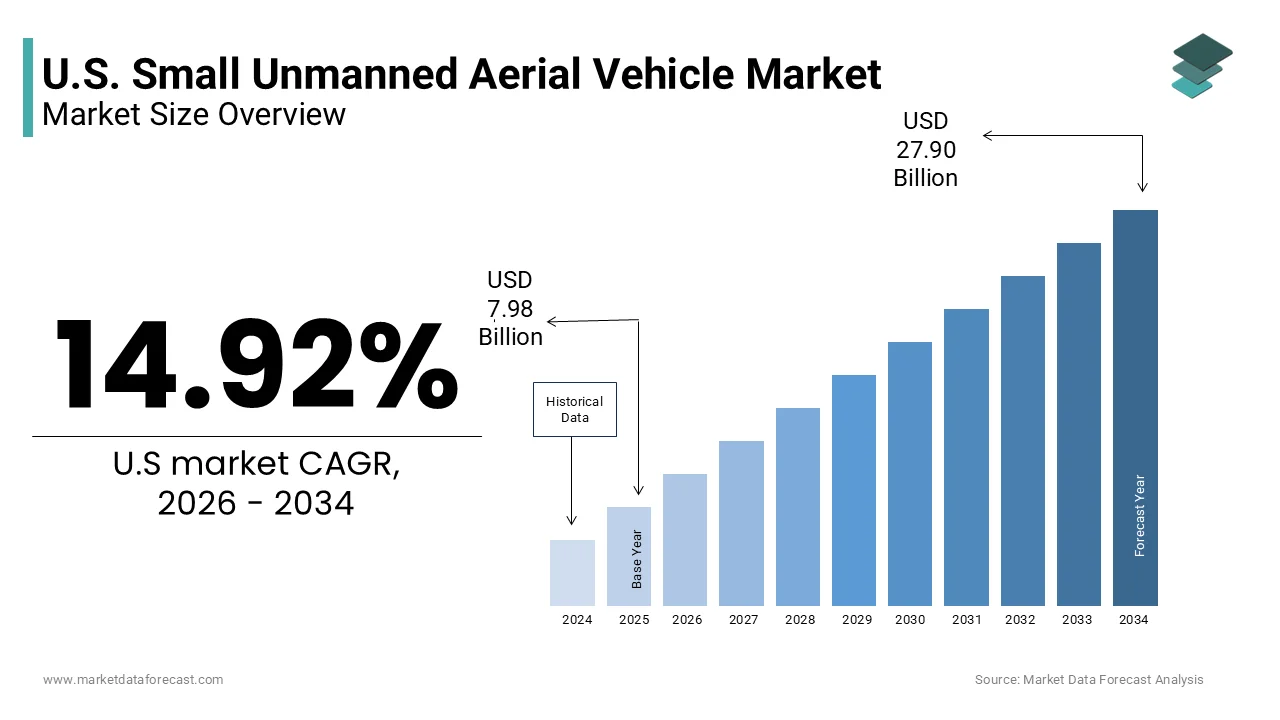
The U.S. small unmanned aerial vehicle market size was valued at USD 7.98 billion in 2025, and is projected to reach USD 27.90 billion by 2034 from USD 9.17 billion in 2026, growing at a CAGR of 14.92%.
The small unmanned aerial vehicle aircraft is weighing less than 55 pounds that operate without a human pilot on board, serving major roles in commercial, governmental, and recreational sectors. These systems integrate advanced sensors, communication links, and autonomous flight controllers to execute tasks ranging from aerial photography to infrastructure inspection. The operational landscape is defined by a rigorous regulatory framework established by the Federal Aviation Administration to ensure airspace safety alongside manned aviation. As per the Federal Aviation Administration, there were over 864,000 registered small unmanned aircraft systems in the United States as of early 2025, reflecting widespread adoption across diverse industries. Furthermore, the Department of Defense has increasingly integrated small UAVs into tactical operations, with thousands of units deployed for reconnaissance and surveillance missions globally. The National Oceanic and Atmospheric Administration utilizes these platforms for hurricane tracking and coastal mapping, demonstrating their utility in scientific research.
MARKET DRIVERS
Expansion of Commercial Infrastructure Inspection Applications
The rapid adoption of small unmanned aerial vehicles for infrastructure inspection with the need for cost effective and safe assessment of aging assets is primarily United States small UAV market. Traditional inspection methods often require scaffolding, cranes, or human climbers, which pose significant safety risks and incur high labor costs. Small UAVs equipped with high resolution cameras and thermal sensors can access difficult to reach areas, such as bridge undersides, cell towers, and wind turbine blades with minimal disruption. Utilities and construction firms utilize drones to detect structural defects, corrosion, and heat leaks in power lines and pipelines by reducing downtime and preventing catastrophic failures. The Federal Highway Administration encourages the use of innovative technologies for bridge inspections by allowing agencies to extend inspection intervals while maintaining safety standards . This regulatory support accelerates adoption among state departments of transportation. Additionally, the ability to generate precise three dimensional models using photogrammetry enables engineers to plan repairs with greater accuracy. This financial incentive, combined with enhanced safety profiles that ensures sustained growth in the commercial inspection sector.
Precision Agriculture Adoption for Crop Management
The integration of small unmanned aerial vehicles into precision agriculture practices, as farmers seek to optimize crop yields and reduce input costs is additionally fuelling the growth of the United States small UAV market. Drones equipped with multispectral sensors capture detailed imagery that reveals plant health, soil moisture levels, and pest infestations invisible to the naked eye. This data allows farmers to apply fertilizers, pesticides, and water only where needed, minimizing environmental impact and maximizing resource efficiency. As per the United States Department of Agriculture, American farmers adopted precision agriculture technologies on over 60% of planted acres for major crops in 2024, highlighting the scale of digital transformation in the sector. Small UAVs enable frequent monitoring of large fields by providing real time insights that satellite imagery cannot match due to resolution and cloud cover limitations. The Environmental Protection Agency promotes reduced chemical runoff through targeted application methods by aligning with sustainability goals and regulatory compliance . Farmers use drone data to create variable rate prescription maps, ensuring optimal nutrient distribution. The return on investment is evident in improved crop quality and quantity, with studies showing yield increases of up to 10% when using drone assisted management. As labor shortages persist in the agricultural sector, automation through UAVs offers a viable solution for maintaining productivity.
MARKET RESTRAINTS
Stringent Regulatory Constraints on Beyond Visual Line of Sight Operations
The strict regulatory limitations on beyond visual line of sight operations is solely hindering the growth of the United States small UAV market. Current Federal Aviation Administration rules generally require remote pilots to maintain direct visual contact with the aircraft by limiting flight distances and obstructing views behind obstacles. This restriction prevents the full utilization of autonomous capabilities for long range inspections, delivery services, and large area mapping. As per the Federal Aviation Administration, waivers for beyond visual line of sight operations are granted on a case by case basis, involving a lengthy and complex approval process that discourages widespread adoption. Only a small fraction of commercial operators hold these waivers, creating a bottleneck for industries seeking to automate routine tasks over expansive sites. The lack of a standardized framework for automated air traffic management systems further complicates integration into shared airspace. Industry stakeholders argue that these constraints hinder innovation and competitiveness compared to regions with more flexible regulations. The uncertainty surrounding regulatory evolution causes hesitation in capital investment for advanced drone fleets. Companies must invest heavily in compliance measures and legal resources to navigate the waiver process, increasing operational overhead.
Privacy Concerns and Public Acceptance Issues
The growing public concern regarding privacy invasion and data security on the widespread acceptance and deployment of small unmanned aerial vehicles in residential and urban environments is another factor declining the growth of the United States small UAV market. The ability of drones to capture high resolution video and audio raises fears of unauthorized surveillance and misuse of personal information. As per the study, 60% of Americans express concern about the use of drones for surveillance purposes by indicating a substantial trust deficit among the general population . This sentiment leads to local ordinances and community restrictions that limit where and when drones can operate, fragmenting the regulatory landscape. Several states have enacted laws prohibiting drone flights over private property without consent by creating legal uncertainties for commercial operators. High profile incidents involving drones interfering with emergency responses or violating privacy norms exacerbate negative public perception. The lack of federal uniformity in privacy protection for aerial data leaves consumers vulnerable. Businesses face reputational risks and potential litigation if their operations are perceived as intrusive. Community opposition can delay or cancel projects involving drone surveys in populated areas.
MARKET OPPORTUNITIES
Integration of Artificial Intelligence for Autonomous Decision Making
The integration of artificial intelligence and machine learning algorithms into advanced systems is likely to amplify the growth of the United States small UAV market. AI enabled drones can process data in real time, identifying objects, detecting anomalies, and making navigation decisions without human intervention. This capability reduces the cognitive load on pilots and enables complex missions in dynamic environments. The advancements in computer vision and edge computing allow drones to perform tasks such as autonomous obstacle avoidance and target recognition with high accuracy . Industries such as search and rescue, law enforcement, and industrial inspection benefit from faster response times and improved situational awareness. AI driven analytics can predict equipment failures by analyzing visual patterns by offering proactive maintenance solutions. The ability to swarm multiple drones for coordinated tasks opens new possibilities for large scale mapping and agricultural monitoring. Technology firms are developing software platforms that simplify AI integration, making it accessible to non-technical users. The Federal Aviation Administration is exploring frameworks for approving autonomous operations, which could unlock new commercial use cases. This technological evolution positions small UAVs as intelligent data collection platforms rather than mere remote controlled cameras, driving demand for sophisticated hardware and software solutions.
Expansion into Last Mile Delivery Logistics
The expansion of small unmanned aerial vehicles into last mile delivery logistics to revolutionize supply chain efficiency and reduce transportation costs is additionally to enhance new opportunities for the expansion of the United States small UAV market. E-commerce growth has increased demand for faster and more flexible delivery options in rural and congested urban areas. Drones can bypass traffic congestion and deliver packages directly to customers by reducing delivery times from days to minutes. As per the United States Postal Service, the volume of package deliveries increased by 15% in 2024, straining traditional ground transportation networks. Companies like UPS and Amazon are piloting drone delivery programs that demonstrate feasibility and customer acceptance. The Department of Transportation supports innovation in freight mobility by encouraging trials of autonomous delivery systems. Rural healthcare facilities benefit from drone transport of medical supplies and lab samples, improving access to critical services. Regulatory advancements such as the Remote Identification rule provide a foundation for safe integration into low altitude airspace. The cost per delivery for drones is projected to be lower than traditional vans for short distances, offering economic advantages. This shift creates new business models for logistics providers and retailers, driving investment in drone infrastructure and fleet management systems.
MARKET CHALLENGES
Battery Limitations and Payload Capacity Constraints
The persistent limitations in battery energy density and payload capacity constrain the operational endurance and versatility, which is to act as a major barrier for the growth of the United States small UAV market. Most commercial small UAVs rely on lithium polymer batteries that provide flight times of only 20 to 40 minutes by restricting the area they can cover in a single mission. This limitation necessitates frequent battery swaps or recharging, which interrupts workflows and increases labor requirements. The current battery technologies have reached near theoretical limits for energy storage, requiring breakthroughs in solid state or alternative chemistries to achieve substantial improvements . Heavy payloads such as high resolution lidar sensors or delivery packages further reduce flight time, limiting the types of tasks drones can perform efficiently. Cold weather conditions exacerbate battery degradation, reducing performance in northern states during winter months. The weight of additional safety features and redundancy systems also impacts payload capacity. Manufacturers face trade-offs between size, weight, and power, making it difficult to design versatile platforms. The lack of rapid charging infrastructure at remote job sites adds logistical complexity. Until significant advancements in power storage occur, operators must manage fleets with larger numbers of drones and batteries, increasing capital and operational expenses.
Cybersecurity Vulnerabilities and Data Integrity Risks
The increasing cybersecurity vulnerabilities associated with connected small unmanned aerial vehicle systems, as these devices become targets for hacking, spoofing, and data interception is also to slow down the growth of the United States small UAV market in coming years. Drones transmit sensitive visual and location data over wireless networks, which can be intercepted by malicious actors if not properly encrypted. The internet of things devices including drones are frequently exploited for botnet attacks and unauthorized access due to weak default security settings. GPS spoofing can hijack drone navigation systems, causing them to crash or divert to unintended locations. Corporate espionage and theft of proprietary inspection data are growing concerns for industrial users. The lack of standardized security protocols across manufacturers creates inconsistencies in protection levels. Military and government agencies face heightened risks of adversarial interference in sensitive operations. Compliance with data protection regulations such as the General Data Protection Regulation for international operations adds complexity. Companies must invest in robust encryption, secure communication links, and regular software updates to mitigate threats. However, many small operators lack the resources to implement comprehensive cybersecurity measures.
REPORT COVERAGE
| REPORT METRIC | DETAILS |
| Market Size Available | 2025 to 2034 |
| Base Year | 2025 |
| Forecast Period | 2026 to 2034 |
| CAGR | 14.92% |
| Segments Covered | By Type, Application, Platform, and Region. |
| Various Analyses Covered | Global, Regional and Country-Level Analysis, Segment-Level Analysis, Drivers, Restraints, Opportunities, Challenges; PESTLE Analysis; Porter’s Five Forces Analysis, Competitive Landscape, Analyst Overview of Investment Opportunities |
| Countries Covered | California, Washington, Oregon, New York, United States |
| Market Leaders Profiled | DJI (CN), Parrot (FR), Skydio (US), AeroVironment (US), Yuneec (CN), Insitu (US), senseFly (CH), Wingtra (CH), Teledyne FLIR (US) |
SEGMENTAL ANALYSIS
By Type Insights
The mini unmanned aerial vehicles, typically weighing between 20 and 55 pounds was the dominant segment in the United States small UAV market by holding a significant share in 2025 due to their superior payload capacity and endurance compared to micro variants. This segment dominates because it strikes an optimal balance between portability and operational capability, making it ideal for professional commercial and tactical military applications.

The dominance of mini unmanned aerial vehicles is primarily driven by their ability to carry heavier and more sophisticated sensor payloads, such as high resolution thermal cameras, lidar systems, and multispectral imagers, which are essential for detailed industrial and defense operations. Micro drones often lack the lift capacity to support these advanced instruments, limiting their utility to basic visual inspection. As per the Federal Aviation Administration, commercial operators conducting infrastructure inspections increasingly require lidar and thermal sensors to detect structural defects and heat leaks, tasks that necessitate the stability and power of mini class platforms . The United States Department of Defense specifies mini UAVs for tactical reconnaissance missions where real time video feeds and extended loiter times are critical for situational awareness. These platforms can remain airborne for 60 to 90 minutes, which is significantly longer than micro drones, allowing for comprehensive area coverage without frequent battery changes. The ability to integrate multiple sensors simultaneously enables data fusion, providing richer insights for decision making. Industries such as oil and gas, utilities, and public safety rely on this enhanced capability to perform complex tasks that micro drones cannot accommodate. The higher initial cost of mini UAVs is justified by their versatility and operational efficiency by ensuring their continued leadership in the professional sector where performance outweighs price sensitivity.
The micro UAV’s segment is likely to grow with an anticipated CAGR of 18.5% throughout the forecast period owing to their low cost and user friendly design, which lower the barrier to entry for hobbyists, educators, and small business owners. These compact devices are significantly cheaper than mini UAVs by making them accessible to a broader audience seeking to explore aerial photography or basic inspection tasks. Schools and universities incorporate micro drones into STEM curricula to teach coding and robotics, creating a steady demand from the education sector. The Federal Aviation Administration exempts drones weighing under 0.55 pounds from registration requirements, simplifying ownership and encouraging casual use. This regulatory exemption removes administrative hurdles, fostering a vibrant community of enthusiasts who contribute to market growth through word of mouth and social media exposure. Manufacturers continuously innovate to enhance camera quality and flight stability in smaller form factors, attracting consumers who prioritize portability and convenience. The proliferation of smartphone controlled micro drones further integrates aerial technology into daily life by expanding the user base beyond traditional aviation enthusiasts.
By Application Insights
The civil commercial application segment held a domain share of the United States small unmanned aerial vehicle market in 2025. Traditional methods involving manned helicopters or scaffolding are expensive and hazardous, whereas drones provide a safer and more affordable alternative. As per the Association for Uncrewed Vehicle Systems International, the use of drones for bridge and tower inspections can reduce costs by up to 50% while eliminating the risk of worker falls. Energy companies utilize drones to inspect power lines and wind turbines, identifying defects before they cause outages. Construction firms employ drones for site surveying and progress monitoring, generating accurate three dimensional models that improve project planning and reduce errors. The ability to capture high resolution data quickly enables faster decision making and reduces project delays. Insurance companies use drone imagery for claim assessments, speeding up processing times and improving accuracy.
The Military Defense application segment is esteemed to grow at an anticipated CAGR of 16.2% from 2026 to 2034 with the strategic emphasis on asymmetric warfare, where small, inexpensive unmanned aerial vehicles provide significant tactical advantages against conventional forces. Modern conflicts have demonstrated the effectiveness of small drones for reconnaissance, target acquisition, and even direct attacks by prompting increased procurement by the United States Department of Defense. Small UAVs allow infantry units to see over hills and into buildings without exposing soldiers to enemy fire, reducing casualties and improving mission success rates. The ability to deploy swarms of low cost drones overwhelms traditional air defense systems by creating new operational possibilities. Military branches are integrating small drones into standard infantry kits, ensuring widespread availability at the tactical level. The urgency of modernizing forces to counter emerging threats accelerates procurement cycles and drives innovation in drone technology. This strategic imperative ensures sustained growth in the military defense segment, as armed forces prioritize the integration of unmanned systems into their operational doctrines.
By Platform Insights
The rotary wing small unmanned aerial vehicles segment held a dominant share of the United States small UAV market in 2025 due to their vertical takeoff and landing capabilities and ability to hover, which are essential for many commercial and inspection tasks. The ability to hover and maneuver precisely by making them ideal for detailed inspection and surveillance tasks that require stationary observation. This flexibility allows operators to capture high resolution images and videos from multiple angles by ensuring comprehensive data collection. Public safety agencies rely on rotary wing drones for search and rescue operations, where the ability to hover and lower equipment is important. The ease of piloting rotary wing drones, especially those with GPS stabilization, reduces the training burden for new operators. Their compact size allows for deployment from small vehicles or handheld cases, enhancing mobility for field teams.
The fixed segment is attributed to grow at a fastest CAGR of 15.8% throughout the forecast period due to their aerodynamic efficiency, which allows for longer flight times and greater coverage areas compared to rotary wing drones. The fixed wing drones can cover up to 10 times the area of rotary wing drones in a single flight, significantly reducing the time required for large projects. Mining and construction companies use fixed wing UAVs to generate topographic maps and volume calculations for expansive sites, improving project planning and resource management. The ability to fly for over two hours on a single battery charge enables comprehensive data collection without frequent interruptions. Agricultural enterprises utilize fixed wing drones for monitoring vast fields by capturing multispectral data that informs planting and harvesting decisions. The cost per acre for data collection is lower with fixed wing platforms by offering economic advantages for large operations.
COMPETITIVE LANDSCAPE
The competition in the United States small unmanned aerial vehicle market is intense and characterized by a mix of established defense contractors, innovative startups, and international manufacturers adapting to local regulations. Key differentiators include autonomous flight capabilities, data security compliance, and specialized sensor integration. Domestic companies leverage their adherence to the National Defense Authorization Act to gain preference in government and public safety sectors, creating a barrier for foreign competitors. Price competition is prevalent in the consumer and entry level commercial segments, while performance and reliability drive decisions in professional and defense applications. Strategic collaborations between hardware manufacturers and software developers enhance product offerings and create ecosystem lock in effects. Intellectual property protection plays a crucial role, with firms patenting unique navigation and control algorithms. The market sees frequent product launches featuring improved battery life and enhanced connectivity. Regulatory changes influence competitive dynamics, as companies that adapt quickly to new Federal Aviation Administration rules gain first mover advantages.
KEY MARKET PLAYERS
Some of the companies that are playing a dominating role in the U.S. small unmanned aerial vehicle market are
- DJI (CN)
- Parrot (FR)
- Skydio (US)
- AeroVironment (US)
- Yuneec (CN)
- Insitu (US)
- senseFly (CH)
- Wingtra (CH)
- Teledyne FLIR (US)
Top Players in the Market
- Skydio Inc has established itself as a leading innovator in the United States small unmanned aerial vehicle market by focusing on autonomous flight technology and advanced obstacle avoidance systems. The company specializes in producing drones that require minimal pilot input, making them ideal for public safety and industrial inspection applications. Skydio recently strengthened its market position by securing significant contracts with federal agencies and law enforcement departments across the country. The organization launched new software updates that enhance data security and compliance with government standards, addressing critical concerns regarding foreign manufactured components. By emphasizing domestic manufacturing and supply chain transparency, Skydio appeals to customers prioritizing national security. Their continuous investment in artificial intelligence algorithms allows their drones to navigate complex environments safely by reducing operational risks.
- Parrot Drones SAS maintains a strong presence in the United States small unmanned aerial vehicle market through its commitment to data security and specialized enterprise solutions. The French manufacturer has tailored its product offerings to meet the stringent requirements of American government and commercial clients who prioritize privacy. Parrot recently expanded its distribution network in North America and introduced new models designed specifically for professional mapping and inspection tasks. The company emphasizes its compliance with the National Defense Authorization Act, ensuring that its drones are free from restricted foreign components. This strategic alignment with United States regulatory frameworks has enabled Parrot to secure contracts with various state and federal agencies. Parrot also invests in open-source software development, allowing users to customize drone functionalities for specific operational needs. By focusing on transparency and security, Parrot distinguishes itself in a competitive landscape and builds trust among sensitive sector customers who require reliable and secure aerial data collection tools for their daily operations.
- AeroVironment Inc is a key contributor to the United States small unmanned aerial vehicle market, particularly within the defense and tactical sectors. The company designs and manufactures lightweight, hand launched drones that provide real time intelligence and surveillance for military units. AeroVironment recently strengthened its position by receiving multiple production awards from the United States Department of Defense for its Switchblade and Raven systems. The organization focuses on developing modular and scalable solutions that can be rapidly deployed in diverse operational environments. AeroVironment invests heavily in research and development to enhance the endurance and connectivity of its small UAVs, ensuring they remain effective in contested spaces. The company also collaborates with allied nations to expand its international footprint while maintaining a strong domestic manufacturing base.
Top Strategies Used by Key Market Participants
Key players in the United States small unmanned aerial vehicle market primarily focus on enhancing autonomous capabilities and ensuring regulatory compliance to maintain competitive advantage. Companies invest heavily in artificial intelligence to enable obstacle avoidance and automated mission execution, reducing the need for skilled pilots. Strategic partnerships with government agencies and defense contractors help secure long term contracts and validate technology for sensitive applications. Manufacturers emphasize domestic supply chains to meet National Defense Authorization Act requirements, appealing to security conscious customers. Product diversification into specialized sectors such as agriculture and public safety allows firms to capture niche markets. Continuous software updates and cybersecurity enhancements protect user data and maintain trust. Investment in battery technology aims to extend flight times and improve operational efficiency.
US Small UAV Market News
- In March 2024, Skydio Inc launched a new enterprise drone model with enhanced security features. This launch is anticipated to meet government compliance needs and strengthen the US small UAV market.
- In June 2024, AeroVironment Inc received a multi million dollar contract from the Department of Defense. This award is anticipated to expand tactical drone deployments and strengthen the Us small UAV market
MARKET SEGMENTATION
This research report on the U.S. small unmanned aerial vehicle market is segmented and sub-segmented into the following categories.
By Type
- Micro
- Mini
By Application
- Civil Commercial
- Military Defense
- Others
By Platform
- Fixed Wing
- Rotary Wing
- Others
By Country
- California
- Washington
- Oregon
- New York
- Rest of the United States
Frequently Asked Questions
1. What is a small unmanned aerial vehicle (UAV)?
A small UAV, commonly known as a drone, is an aircraft that operates without an onboard pilot and is controlled remotely or autonomously for various commercial, military, and recreational applications.
2. What is driving the growth of the U.S. small UAV market?
The market is growing due to increasing adoption in defense, agriculture, infrastructure inspection, public safety, aerial photography, and logistics operations.
3. Which sectors are the largest users of small UAVs in the United States?
Defense and military organizations are major users, while commercial sectors such as construction, agriculture, energy, and media are also significant adopters.
4. What are the main types of small UAVs?
Small UAVs are commonly categorized into micro and mini drones based on their size, payload capacity, and operational range.
5. Why are small UAVs important for military applications?
They provide real time surveillance, reconnaissance, intelligence gathering, target monitoring, and situational awareness while reducing risks to personnel.
6. How are small UAVs used in commercial applications?
Commercial drones are used for mapping, surveying, crop monitoring, infrastructure inspection, photography, videography, and asset management.
7. What role does artificial intelligence play in small UAVs?
Artificial intelligence enables autonomous navigation, object detection, obstacle avoidance, route optimization, and advanced data analysis capabilities.
8. What regulations govern small UAV operations in the United States?
Small UAV operations are regulated by the Federal Aviation Administration, which establishes rules related to pilot certification, operational limits, airspace access, and safety requirements.
9. What challenges does the U.S. small UAV market face?
Key challenges include regulatory compliance, cybersecurity concerns, privacy issues, limited battery life, and airspace integration complexities.
10. What are the future trends in the U.S. small UAV market?
Future trends include greater adoption of autonomous flight systems, AI powered analytics, drone swarming technologies, beyond visual line of sight operations, advanced sensors, and expanding use in commercial delivery and public safety applications.
Related Reports
Access the study in MULTIPLE FORMATS
Purchase options starting from
$ 1200
Didn’t find what you’re looking for?
TALK TO OUR ANALYST TEAM
Need something within your budget?
NO WORRIES! WE GOT YOU COVERED!
Call us on: +1 888 702 9696 (U.S Toll Free)
Write to us: sales@marketdataforecast.com