- Product Description Description
- Table of Contents TOC
- List of Table & Figure LOT
- Get Free Sample PDF Sample PDF
Market Size, 2025
$1.21 BnMarket Estimate, 2026
$1.41 BnMarket Forecast, 2034
$4.83 BnCAGR, 2026–2034
16.6Executive Summary: United States Smart Thermostat Market
- Market Scope: Comprehensive market analysis covering technology segments, product categories, installation types, end-use sectors, and state-level leadership frameworks across the United States.
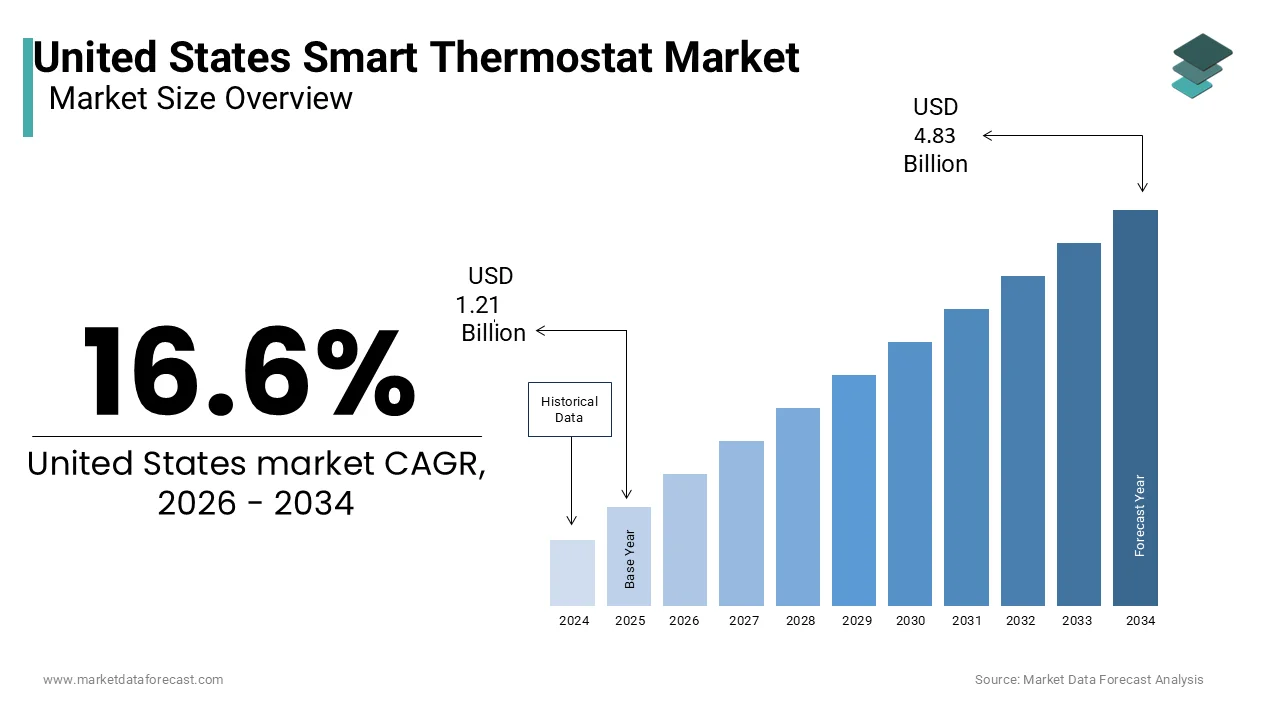
- Market Valuation: Valued at USD 1.21 billion (2025), estimated at USD 1.41 billion (2026), and projected to reach USD 4.83 billion by 2034, registering a robust CAGR of 16.60% (2026–2034).
- Primary Growth Drivers: Expanding utility-sponsored rebate and demand response programs, rising adoption of connected home ecosystems, and increasing consumer demand for energy-efficient HVAC management. Key opportunities include grid-interactive distributed energy resource (DER) integration and multi-family/rental housing deployments. Growth remains constrained by platform interoperability issues and energy data ownership regulatory uncertainty.
Key Market Segment Metrics (2026–2034)
| Category | Leading Segment (2025 Position) | Fastest-Growing Segment |
|---|---|---|
| By Technology | Wi-Fi (dominant market share in 2025) | Zigbee (fastest growth driven by mesh networking and smart home integration) |
| By Product | Learning Smart Thermostats (leading share in 2025) | Connected Smart Thermostats (fastest growth through 2034) |
| By Installation | New Installation (largest share in 2025) | Retrofit Installation (highest expansion rate in existing buildings) |
| By End Use | Residential (dominant market share in 2025) | Commercial (rapid growth across offices, retail, and healthcare) |
| By Region / State | Major US real estate and energy markets (California, Texas, New York, Florida) | Expanding smart infrastructure markets across various US states |
Major Market Players & Market Structure
Market Structure: Highly competitive U.S. smart thermostat landscape characterized by AI-enabled energy optimization, ecosystem interoperability, utility demand-response partnerships, and continuous IoT HVAC innovation.
Key Companies: Google Nest (Alphabet Inc.), Honeywell International Inc., ecobee Inc., Emerson Electric Co., Johnson Controls International plc, Amazon.com, Inc. (Amazon Smart Thermostat), Resideo Technologies, Inc., Control4 Corporation (Snap One Holdings Corp.), Lux Products Corporation, Trane Technologies plc, Carrier Global Corporation, Siemens AG, Schneider Electric SE, Bosch Thermotechnology Ltd., Tado GmbH, Viconics Electronics Inc., Vermont Energy Control Systems, Inc., Netatmo (Legrand Group), Radio Thermostat Company of America, and CentraLite Systems, Inc.
United States Smart Thermostat Market Size
The U.S. smart thermostat market was valued at USD 1.21 billion in 2025 and is expected to reach USD 1.41 billion in 2025, and is projected to grow at a CAGR of 16.6% from 2025 to 2034 and reach USD 4.83 billion by 2034.
The smart thermostat is Wi Fi enabled, sensor-driven, and algorithmically optimized climate control devices that autonomously regulate residential and light commercial heating and cooling systems to enhance energy efficiency, occupant comfort, and grid responsiveness. These systems transcend conventional programmable thermostats by integrating occupancy detection, geofencing, weather adaptation, and utility demand response protocols.
MARKET DRIVERS
Rising Utility Incentive Programs Are Accelerating Consumer Adoption
The utility-sponsored rebate and demand response initiatives are the most potent accelerants of smart thermostat penetration across American households, which is a significant driving factor for the growth of the United States smart thermostat market. According to the American Council for an Energy Efficient Economy, over 140 investor-owned utilities and municipal cooperatives now offer direct consumer rebates averaging 125 per device, with some programs in California and Massachusetts exceeding two hundred dollars. Over 4.5 million smart thermostats were enrolled in utility-managed demand response programs as of 2023, enabling grid operators to shave peak load by up to 1.8 gigawatt-hours in extreme weather events. Furthermore, the Federal Energy Regulatory Commission found that homes participating in automated thermostat demand response reduced HVAC energy consumption by 22% during critical peak pricing windows. These programs not only lower upfront consumer costs but also embed behavioral automation that sustains long-term energy savings, making utilities among the most influential distribution channels beyond retail and e-commerce platforms.
Consumer Demand for Remote Home Automation Integration Is Reshaping Product Expectations
Homeowners increasingly view smart thermostats not as standalone energy tools but as integral nodes within broader connected home ecosystems. According to a survey, 73% of U.S. broadband households that purchased a smart thermostat in 2023 specifically to integrate with existing voice assistants, security systems, or lighting controls. Google Nest and Amazon Alexa compatibility now serve as baseline purchase criteria, with Samsung SmartThings and Apple HomeKit integration becoming decisive differentiators among premium buyers. The Consumer Technology Association found that households owning three or more smart home devices are four times more likely to adopt a smart thermostat than those with isolated smart products. This ecosystem dependency compels manufacturers to prioritize application programming interface standardization, over-the-air firmware updates, and cross-platform scene automation.
MARKET RESTRAINTS
Fragmented HVAC System Compatibility Continues to Limit Addressable Market Reach
The smart thermostat adoption remains constrained by incompatibility with legacy and non-standard heating and cooling systems, which is a factor limiting the growth of the United States smart thermostat market. The National Association of Home Builders confirms that over 26 million homes built before nineteen ninety lack the necessary electrical infrastructure to support modern smart thermostats without professional rewiring. Furthermore, the North American Technician Excellence certification body estimates that only 41% of licensed HVAC technicians receive formal training in smart thermostat commissioning, which is leading to miswiring and failed installations that erode consumer confidence. A J.D. Power study found that 28% of dissatisfied smart thermostat owners cited installation complexity or system mismatch as the primary reason for product return. This technical fragmentation disproportionately affects older housing stock and rural regions, where forced air systems are less prevalent, and heat pump or boiler-based setups dominate.
Persistent Consumer Skepticism Regarding Data Privacy Undermines Trust and Trial
Concerns over data collection practices and third-party sharing are deterring a significant cohort of potential adopters from embracing smart thermostat technology. Persistent consumer awareness is inhibiting the growth of the United States smart thermostat market. According to a nationwide privacy sentiment survey by the Pew Research Center, 61% of American adults express moderate to great concern about smart home devices transmitting personal behavior data to manufacturers or cloud service providers. Furthermore, the Federal Trade Commission’s enforcement division reported a 22% year-over-year increase in consumer complaints related to unauthorized location tracking and usage pattern monetization by connected home devices. A University of California, Berkeley study found that homes with smart thermostats generated an average of three hundred and seventeen data points per day, including occupancy timing, temperature preferences, and geofence triggers, information that insurers and advertisers increasingly seek to access.
MARKET OPPORTUNITIES
Integration Grid-Interactive Distributed Energy Resources Unlocks New Utility Partnerships
The Smart thermostats are evolving from passive energy savers into active grid assets capable of orchestrating demand flexibility alongside rooftop solar, battery storage, and electric vehicles, which is creating new opportunities for the growth of the United States thermostat market. According to the National Renewable Energy Laboratory, homes equipped with both smart thermostats and distributed energy resources can reduce grid import during peak hours by up to 47% when enrolled in automated energy management programs. Pilot programs by Pacific Gas and Electric and Con Edison now compensate homeowners for allowing brief HVAC cycling during grid stress events, with compensation averaging eighty-five dollars annually per participant. Furthermore, the Department of Energy’s Connected Communities initiative has funded seventeen smart thermostat-enabled microgrid projects that coordinate HVAC load with local solar generation to maintain grid stability during outages.
Expansion Into Multi-Family and Rental Housing Presents Untapped Institutional Demand
The multi-family and rental housing sector represents a high growth; institutionally is also gearing up for new opportunities for the growth of the United States smart thermostat market. According to the National Multifamily Housing Council, over 44% of U.S. households now reside in rental properties, yet less than 9% of these units are equipped with smart thermostats as of 2023. Furthermore, Freddie Mac’s green financing program now offers preferred loan terms to property owners who install qualifying smart thermostats across 50 or more units, recognizing their role in reducing common area energy expenses and carbon footprints. Enterprise property managers such as Greystar and AvalonBay have launched pilot programs bundling smart thermostats with leak detectors and lighting controls to create standardized smart unit packages.
MARKET CHALLENGES
Lack of Standardized Interoperability Protocols Hinders Cross-Platform Ecosystem Value
The absence of universally adopted communication standards is fragmenting the user experience and limiting the functional potential of smart thermostats within broader home automation networks. The lack of standardization of interoperability protocols is restraining the growth of the United States smart thermostat market. Fewer than 35% of smart thermostat models currently support the Matter interoperability protocol, leaving the majority reliant on proprietary ecosystems, such as Google Thread, Amazon Sidewalk, or Apple HomeKit. The University of Southern California’s Embedded Networks Lab found that homes attempting to integrate multiple smart devices from different manufacturers experience an average of 2.7 compatibility errors per week, with thermostat scene triggers being the most frequent failure point. This technical siloing not only diminishes consumer satisfaction but also reduces the perceived value of the thermostat as a central automation hub.
Regulatory Ambiguity Surrounding Energy Data Ownership Creates Compliance and Innovation Risk
The evolving and inconsistent state-level regulations governing energy usage data collection and sharing are introducing legal uncertainty for smart thermostat manufacturers and service providers. The regulatory ambiguity surrounding energy data ownership is also hampering the growth of the United States smart thermostat market. According to the National Conference of State Legislatures, only 21 states have enacted clear statutory definitions regarding who owns HVAC runtime and occupancy data: the homeowner, the utility, or the device manufacturer. Meanwhile, the New York Department of Public Service mandates that all smart thermostat providers operating in the state must submit annual data governance audits, increasing compliance overhead.
REPORT COVERAGE
| REPORT METRIC | DETAILS |
| Market Size Available | 2025 to 2034 |
| Base Year | 2025 |
| Forecast Period | 2025 to 2034 |
| Segments Covered | By Technology, Product Installation, and End Use Region. |
| Various Analyses Covered | Global, Regional, and Country-Level Analysis, Segment-Level Analysis, Drivers, Restraints, Opportunities, Challenges; PESTLE Analysis; Porter’s Five Forces Analysis, Competitive Landscape, Analyst Overview of Investment Opportunities |
| Countries Covered | New York, Massachusetts, Pennsylvania, Illinois, Ohio, Michigan, Texas, Florida, Georgia, California, Washington, Colorado. |
| Market Leaders Profiled | Google Nest (Alphabet Inc.), Honeywell International Inc., ecobee Inc., Emerson Electric Co., Johnson Controls International plc, Amazon.com, Inc. (Amazon Smart Thermostat), Resideo Technologies, Inc., Control4 Corporation (Snap One Holdings Corp.), Lux Products Corporation, Trane Technologies plc, Carrier Global Corporation, Siemens AG, Schneider Electric SE, Bosch Thermotechnology Ltd., Tado GmbH, Viconics Electronics Inc., Vermont Energy Control Systems, Inc., Netatmo (Legrand Group), Radio Thermostat Company of America, CentraLite Systems, Inc. |
SEGMENTAL ANALYSIS
By Technology Insights
The Wi Fi segment was the largest by occupying a dominant share of the United States smart thermostat market in 2025, with the near universal presence of residential broadband routers, which eliminate the need for secondary network infrastructure. According to the Federal Communications Commission, most of the American households with internet access utilize Wi Fi as their primary in-home connectivity layer by making it the default transport protocol for smart thermostats seeking plug-and-play installation. Unlike proprietary or low-power wide area alternatives, Wi Fi enables direct cloud synchronization, over-the-air diagnostics, and seamless integration with voice assistants and mobile applications without intermediary hardware. This technoplug-and-playity, combined with consumer familiarity and installer confidence, ensures Wi Fi remains the entrenched standard despite emerging alternatives.
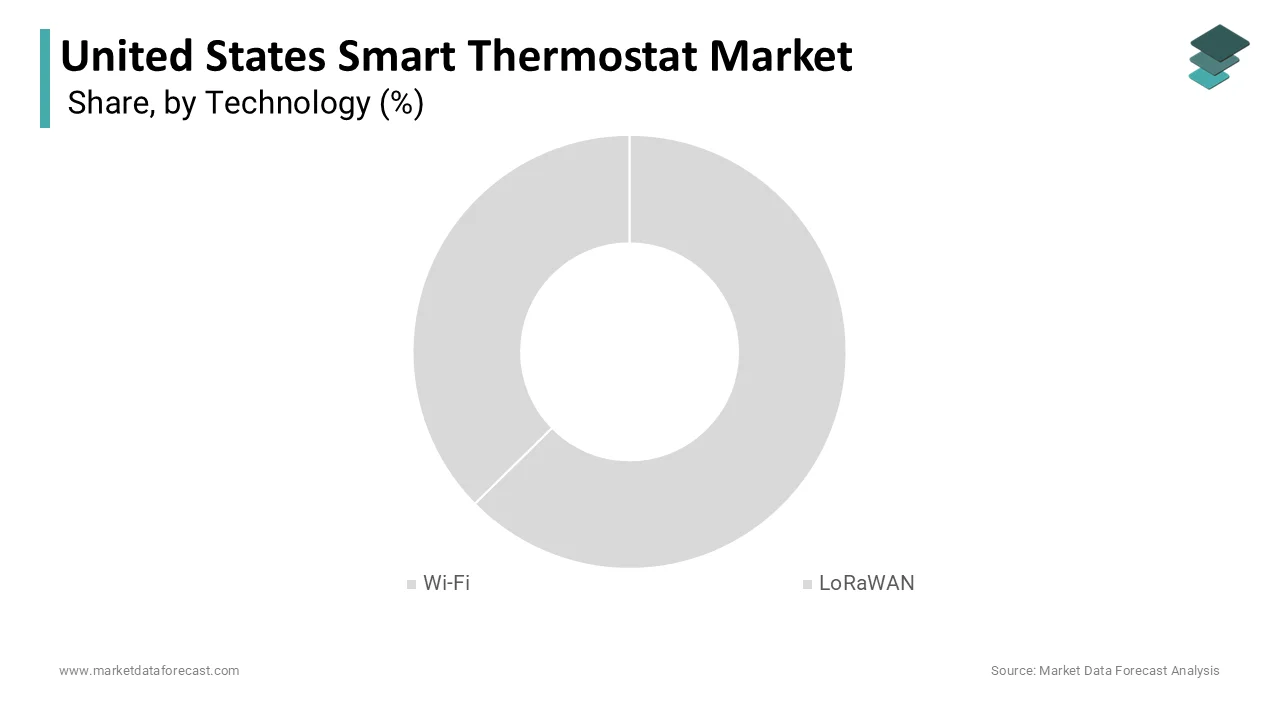
The LoRaWAN segment is expected to grow at a CAGR of 21.3% during the forecast period, with the utility and municipal programs seeking to deploy thousands of thermostats simultaneously across geographically dispersed service territories without burdening residential Wi Fi networks. The Smart Electric Power Alliance confirms that over 1.2 million LoRaWAN-enabled thermostats were installed in utility-managed demand response programs in 2023, primarily in rural and suburban regions where broadband reliability is inconsistent. Unlike Wi Fi, LoRaWAN operates on unlicensed sub-gigahertz spectrum by enabling ranges exceeding five miles per gateway and battery life measured in years rather than months. The Department of Energy’s Grid Modernization Initiative has funded twenty-seven pilot deployments pairing LoRaWAN thermostats with community solar and storage microgrids, citing their resilience during broadband outages and minimal interference with consumer networks. Additionally, the Rural Utilities Service reports that cooperatives serving populations under twenty thousand are three times more likely to select LoRaWAN over Wi Fi due to reduced truck rolls and simplified commissioning.
By Product Insights
The connected segment was the largest by accounting for a significant share of the United States smart thermostat market in 2025. These devices, which enable remote control and scheduling via smartphone applications but lack autonomous learning capabilities, dominate due to their affordability and compatibility with legacy HVAC systems. Consumer Reports' pricing analysis reveals that the average retail price of a connected thermostat is one hundred and ten dollars, compared to 245 dollars for learning models by making them accessible to budget-conscious homeowners and rental property managers. Their plug-and-play nature, combined with utility rebate eligibility and broad retailer distribution, ensures sustained volume leadership even as learning thermostat adoption grows among tech-forward segments. The budget-conscious hermostats segment is expected to grow at the fastest CAGR of 9.8% throughout the forecast period. These devices leverage occupancy sensors, geofencing, and historical usage patterns to autonomously optimize temperature settings without manual programming. Consumer demand is intensifying among sustainability-focused households, where a Yale Program on Climate Change Communication survey found that 48% of homeowners who installed learning thermostats cited automatic energy savings as the primary motivator.
By Installation Insights
The retrofit installations segment accounted for a prominent share of the United States smart thermostat market in 2025, with the sheer scale of existing housing stock, over 120 million owner-occupied homes, most of which are equipped with outdated manual or programmable thermostats. Furthermore, e-commerce platforms and big box retailers have optimized packaging and instructional materials for do-it-yourself retrofitting, with Home Depot reporting that 84% of its smart thermostat sales are purchased for replacement rather than new construction.
The new installation segment is likely to expand at a CAGR of 16.5% through the forecast period, owing to the production homebuilders embedding smart thermostats as standard or optional upgrades in new developments to enhance perceived value and meet energy code requirements. Builders are responding by pre-wiring homes with common C wire configurations and partnering with thermostat manufacturers for bulk pricing. Lennar Homes disclosed in its 2023 sustainability report that ninety % of its new units now include a smart thermostat at the time of closing. New construction will serve as the primary on-ramp for first-time users, which is accelerating household penetration without relation or rebate dependency.
By End Use Insights
The residential sector segment was the largest by holding a significant share of the United States smart thermostat market in 2025, from direct consumer access through retail channels, aggressive utility rebate programs, and the simplicity of single-family HVAC system integration. Unlike commercial buildings, which require complex building management system integration and facilities manager approval, residential adoption is driven by individual homeowner decisions, often influenced by e-commerce reviews and single-family demonstrations. Additionally, the Internal Revenue Service’s energy-efficient home improvement credit, reinstated in 2023, allows homeowners to claim up to three hundred dollars for qualified smart thermostat installations, fueling volume.
The commercial end-use segment is expected to grow at a CAGR of 23.2% throughout the forecast period, owing to the corporate environment, social and governance commitments, municipal energy benchmarking ordinances, and the integration of smart thermostats into broader building automation systems. Unexpectedly, cities such as New York, Seattle, and Denver now mandate annual energy use disclosure for commercial properties over twenty-five thousand square feet, compelling building owners to deploy granular HVAC monitoring. JLL’s Global Energy and Sustainability Report confirms that commercial real estate portfolios achieving ENERGY STAR scores of 75 command rental premiums of up to nine %, directly linking thermostat intelligence to asset value.
COUNTRY LEVEL ANALYSIS
California Smart Thermostat Market Analysis
California was the largest contributor in the United States smart thermostat market by accounting for 31.2% of the market share in 2025, which is anchored in the state’s aggressive climate policy framework, including Title 24 building energy standards that effectively require smart thermostat compatibility in all new residential construction. Pacific Gas and Electric alone enrolled over many households in its SmartAC program by offering two-hundred-dollar rebates and annual bill credits for participation. Simultaneously, the state’s concentration of technology early adopters amplifies retail penetration. Best Buy’s Western Region sales data indicates that California stores sell three point two times two-hundred-dollar stats per square foot than the national average. Local governments further accelerate adoption; the City of Los Angeles offers an additional 75 dollar rebate for ENERGY STAR certified models, stacking atop utility incentives. Despite higher product costs and installer labor rates,
COMPETITIVE LANDSCAPE
The United States smart thermostat market features intense rivalry among technology giants, HVAC incumbents, and venture-backed specialists, each competing through distinct value propositions. Google Nest dominates through consumer brand recognition and deep integration with its broader smart home and advertising ecosystem. Honeywell and Emerson leverage decades of HVAC industry relationships and installer trust to capture professional retrofit and new construction channels. Ecobee and tado° differentiate via room sensing and weather adaptive algorithms, appealing to comfort-focused premium buyers. Startups like Sensi target budget-conscious consumers through utility-exclusive distribution and simplified interfaces. Competition is increasingly defined not by hardware margins but by software capabilities, data monetization potential, and utility program scale. Patent litigation around geofencing and occupancy detection remains common, while interoperability standards such as Matter are reshaping platform dependencies.
KEY MARKET PLAYERS
Some of the companies that are playing a dominating role in the global United States smart thermostat market include:
- Google Nest (Alphabet Inc.)
- Honeywell International Inc.
- ecobee Inc.
- Emerson Electric Co.
- Johnson Controls International plc
- Amazon.com, Inc. (Amazon Smart Thermostat)
- Resideo Technologies, Inc.
- Control4 Corporation (Snap One Holdings Corp.)
- Lux Products Corporation
- Trane Technologies plc
- Carrier Global Corporation
- Siemens AG
- Schneider Electric SE
- Bosch Thermotechnology Ltd.
- Tado GmbH
- Viconics Electronics Inc.
- Vermont Energy Control Systems, Inc.
- Netatmo (Legrand Group)
- Radio Thermostat Company of America
- CentraLite Systems, Inc.
TOP LEADING PLAYERS IN THE MARKET
- Google Nest has established itself as a dominant force in the United States smart thermostat market through seamless ecosystem integration and utility partnerships. In the Asia Pacific, Nest expanded its presence in 2023 by launching localized versions compatible with split system air conditioners prevalent in Japan and Southeast Asia. The company integrated regional weather APIs and partnered with Tokyo Electric Power to enable demand response participation. Nest also introduced multilingual voice control support for Mandarin, Thai, and Bahasa, enhancing accessibility. Recent firmware updates added humidity-based cooling algorithms tailored to tropical climates, while regional customer support hubs in Singapore and Bangalore improved service responsiveness and installer training scalability.
- Honeywell Home leverages its legacy in HVAC controls to deliver professionally installed smart thermostats with commercial-grade reliability. In the Asia Pacific, Honeywell strengthened its position in 2025 by collaborating with Daikin and Mitsubishi Electric to certify compatibility with inverter-driven systems across India and Australia. The company launched a retrofit adapter kit for two-wire boiler systems common in older Korean apartments. Honeywell also trained over two thousand regional HVAC technicians through its Smart Install Certification Program. Recent initiatives include embedding local utility tariff structures into its scheduling engine and launching a cloud-based fleet management portal for property developers managing multi-unit residential projects across the region.
- Ecobee differentiates itself through room sensor technology and aggressive utility program integration. In the Asia Pacific, Ecobee entered new markets in twenty-three countries by certifying its thermostats for voltage and frequency standards in the Philippines and Vietnam. The company partnered with CLP Holdings in Hong Kong to enroll residential customers in peak shaving programs using geofencing and occupancy detection. Ecob2023d has its mobile application for traditional Chinese and Bahasa Indonesia, with the interfaces. Recent firmware enhancements include monsoon season adaptive algorithms and integration with regional smart home platforms such as Xiaomi’s Mi Home. Ecobee’s focus on multi-room comfort mapping and utility-aligned load management positions it strongly in high-density urban housing markets across the region.
TOP STRATEGIES USED BY THE KEY MARKET PARTICIPANTS
Leading participants in the United States smart thermostat market prioritize utility partnership development to leverage rebate distribution and demand response. They invest heavily in ecosystem interoperability, ensuring compatibility with major voice assistants and smart home platforms. Product differentiation centers on proprietary sensor arrays, machine learning algorithms, and room-level zoning capabilities. Geographic expansion targets regions with aggressive energy efficiency mandates and high broadband penetration. Installer enablement programs train HVAC professionals to reduce miswiring and improve consumer satisfaction. Firmware innovation focuses on weather adaptation, occupancy prediction, and tariff-optimized scheduling. Regulatory engagement shapes policy around data privacy and grid service compensation. Retail channel optimization includes in-store demonstrations and point of sale financing. Sustainability messaging emphasizes carbon reduction and ENERGY STAR certification. These strategies collectively drive adoption, retention, and ecosystem lock-in.
MARKET SEGMENTATION
This research report on the united states smart thermostat market is segmented and sub-segmented into the following categories.
By Technology
- Wi-Fi
- LoRaWAN
- Others
By Product
- Connected
- Learning
- Others
By Installation
- Retrofit Installations
- New Installations
By End Use
- Residential
- Commercial
- Others
By Country
- California
- Texas
- New York
- Florida
- Illinois
- Rest of the United States