U.S. Tactical Communication Market Size, Share, Trends & Growth Forecast Report By Application, By Mode of Communication, By Technology, and By Country (California, Virginia, Texas, Florida & Rest of the United States) – Industry Analysis and Forecast, 2026 to 2034
Market Size, 2025
$7.81 BnMarket Estimate, 2026
$8.23 BnMarket Forecast, 2034
$12.44 BnCAGR, 2026–2034
5.3%U.S. Tactical Communication Market Size
The U.S. Tactical Communication Market is projected to grow from USD 7.81 billion in 2025 to USD 8.23 billion in 2026 and reach USD 12.44 billion by 2034, registering a CAGR of 5.3% during the forecast period from 2026 to 2034.
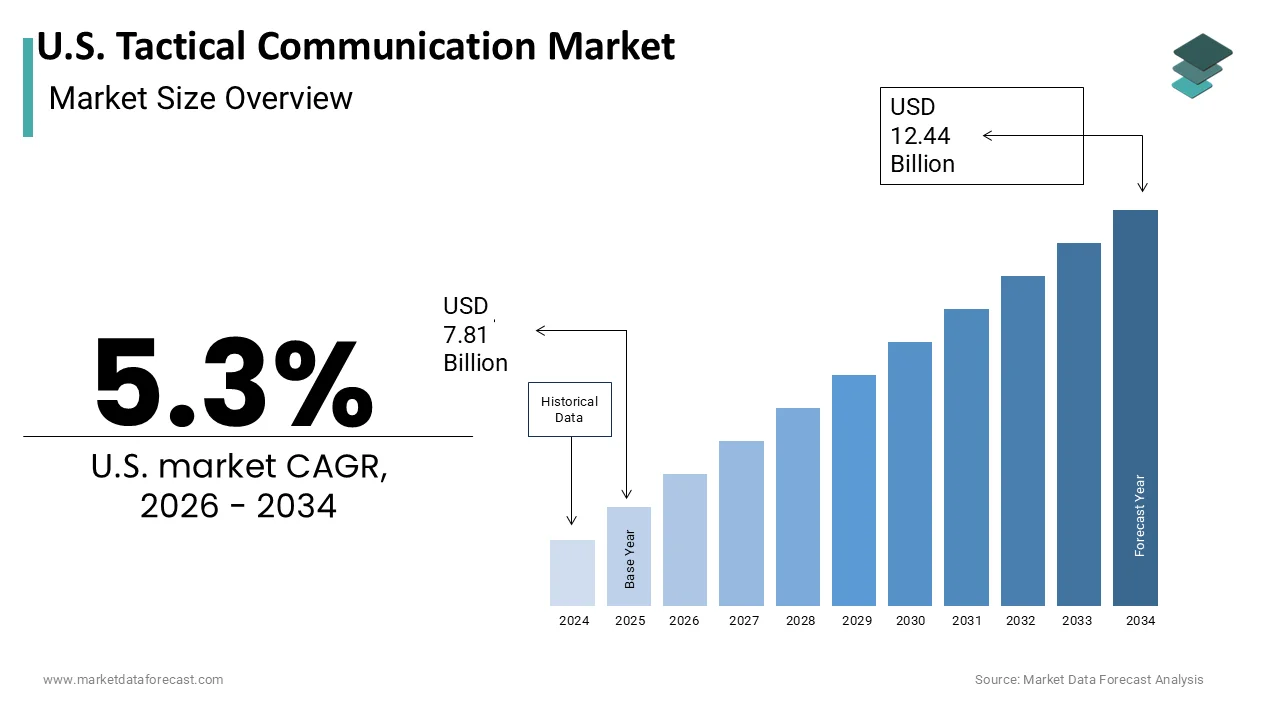
The strategic imperative for such robust infrastructure is underscored by the evolving nature of modern warfare, which increasingly relies on real-time information superiority. As per the Department of Defense (DoD), the US military operates approximately 3 million end-user devices across its branches, highlighting the massive scale of connected tactical assets. The complexity of Joint All-Domain Command and Control (JADC2) initiatives requires seamless integration across air, land, sea, space, and cyberspace domains. According to the Congressional Research Service (CRS), the Pentagon has identified network modernization as a top priority, allocating billions annually to replace legacy systems that lack the bandwidth and security features necessary for near-peer conflicts. The proliferation of unmanned aerial systems (UAS) further intensifies the demand for low-latency communication links. Data from the Federal Aviation Administration (FAA) indicates that there are over 900,000 registered drones in the U.S., many of which require secure tactical data links for coordinated missions. This operational landscape necessitates continuous innovation in encryption, frequency hopping, and anti-jamming capabilities to maintain mission effectiveness against sophisticated electronic warfare threats.
MARKET DRIVERS
Escalating Geopolitical Tensions and Defense Network Modernization
Escalating geopolitical tensions and the modernization of defense networks drive substantial demand for advanced tactical communication solutions, which is one of the key factors propelling the growth of the U.S. tactical communication market. The shift towards multi-domain operations requires forces to share data instantaneously across disparate platforms, which legacy systems cannot support effectively. According to the Stockholm International Peace Research Institute (SIPRI), global military expenditure reached $2,443 billion in 2024, with the U.S. accounting for nearly 40% of this total. This significant financial commitment enables the procurement of next-generation radios and satellite terminals that offer enhanced bandwidth and security. The National Defense Strategy explicitly prioritizes the development of resilient communications architectures capable of operating in degraded environments. As per the Government Accountability Office (GAO), the DoD has initiated over 50 major modernization programs focused on network-centric warfare capabilities. These initiatives include the deployment of 5G technology on military bases and the integration of artificial intelligence (AI) for traffic management. The urgency is further amplified by the increasing sophistication of adversary electronic warfare (EW) capabilities, which can disrupt traditional radio frequencies. Consequently, military branches are accelerating the adoption of software-defined radios that can dynamically switch frequencies and encryption methods. This technological evolution ensures that warfighters maintain situational awareness and command connectivity even when facing intense jamming or cyberattacks. The relentless pace of these upgrades creates a sustained demand pipeline for manufacturers who can deliver compliant and interoperable systems.
Rapid Technological Obsolescence and Commercial Component Integration
Rapid technological obsolescence and the integration of commercial off-the-shelf (COTS) components create a persistent demand for upgradable tactical communication infrastructure, which is further boosting the U.S. market expansion. Modern conflicts demonstrate that hardware alone is insufficient without agile software frameworks that can adapt to emerging threats. According to the Center for Strategic and International Studies (CSIS), the average lifecycle of tactical radio hardware has decreased from 15 years to under 7 years due to rapid advancements in semiconductor and processing technologies. This accelerated turnover necessitates frequent upgrades to maintain compatibility with new encryption standards and waveform protocols. The DoD has mandated the use of open-architecture standards to facilitate easier integration of third-party applications and hardware modules. As per the Defense Innovation Unit (DIU), over 60% of new tactical communication contracts now require modular designs that allow for field upgradability without replacing entire units. This shift reduces long-term logistics burdens and ensures that frontline units can deploy the latest software patches to counter zero-day vulnerabilities. Furthermore, the rise of Internet of Things (IoT) sensors on the battlefield generates massive data streams that require high-throughput communication links. Data from the International Data Corporation (IDC) suggests that military data generation will increase by 40% annually through 2027. To handle this influx, communication systems must incorporate advanced data compression and edge computing capabilities. This technological pressure drives continuous investment in research and development to keep pace with both commercial innovations and adversarial countermeasures.
MARKET RESTRAINTS
Stringent Cybersecurity Regulations and Compliance Protocols
Stringent cybersecurity regulations and compliance requirements significantly restrain the speed of deployment for new tactical communication systems, which is a key market restraint. The intricate nature of military networks demands rigorous testing to ensure that every component meets strict security standards before fielding. According to the Department of Defense Cyber Crime Center (DC3), there were over 18,000 reported cyber incidents affecting defense contractors in 2024 alone. This high-threat environment necessitates extensive validation processes that can delay product launches by several years. The Joint Interoperability Test Command (JITC) requires that all new communication devices undergo months of rigorous testing to verify compatibility with existing legacy systems. As per Federal Acquisition Regulation (FAR) updates, any system handling classified information must achieve Common Criteria certification, which involves detailed security evaluations. These procedural hurdles increase development costs and reduce the agility of manufacturers responding to urgent operational needs. Additionally, supply chain security mandates introduced by the National Defense Authorization Act (NDAA) restrict the use of components from certain foreign entities. This limitation forces companies to source alternative parts, which often leads to production bottlenecks and increased prices. The complexity of ensuring end-to-end encryption across heterogeneous networks further complicates integration efforts. Engineers must balance usability with security, ensuring that complex authentication protocols do not hinder rapid decision-making in combat scenarios. These regulatory and technical barriers create a high entry threshold for new vendors and slow the overall modernization pace of the tactical communication ecosystem.
High Acquisition Costs and Maintenance Financial Burdens
High acquisition and maintenance costs associated with advanced tactical communication systems restrict widespread adoption among smaller defense agencies and allied partners, which is further hindering the expansion of the U.S. tactical communication market. The development of secure anti-jamming and satellite-compatible radios involves substantial research and development expenditures, which are passed on to buyers. According to the Defense Budget Overview, the average cost per unit for next-generation handheld tactical radios exceeds $15,000, excluding additional accessories and licensing fees. This high price point limits the ability of reserve components and National Guard units to fully equip their personnel with the latest technology. Furthermore, ongoing costs for satellite bandwidth and proprietary waveform licenses add significant operational expenses. As per the Office of Management and Budget (OMB), annual spending on tactical communication sustainment and upgrades accounts for nearly 20% of the total communications budget. These financial constraints force many organizations to extend the life of obsolete equipment, which compromises interoperability and security. The complexity of these systems also requires specialized training for operators and maintenance technicians. Data from the Military Personnel Command indicates that it takes an average of 6 months to fully certify a communication specialist on new digital systems. This training burden adds to the total cost of ownership and reduces operational readiness during transition periods. Shifting fiscal priorities and structural balancing further exacerbate these financial pressures, leading to delayed procurements and reduced order volumes. Manufacturers must navigate a delicate balance between offering cutting-edge features and maintaining affordability to ensure broad market penetration.
MARKET OPPORTUNITIES
Integration of Artificial Intelligence and Machine Learning
The integration of artificial intelligence and machine learning (ML) into tactical networks presents a significant opportunity for the U.S. tactical communication market expansion. AI-driven algorithms can optimize frequency selection and routing paths in real time to avoid jamming and congestion. According to the Defense Advanced Research Projects Agency (DARPA), autonomous network management systems can reduce latency by up to 30% in highly contested electromagnetic environments. This capability allows commanders to receive critical intelligence faster than adversaries can react. The integration of predictive analytics also enables proactive maintenance of communication infrastructure, reducing downtime during missions. As per the Air Force Research Laboratory (AFRL), AI-enabled diagnostic tools have improved equipment reliability rates by 25% in recent field trials. These advancements transform tactical communication from a passive utility into an active combat multiplier. Furthermore, machine learning models can detect anomalous traffic patterns that indicate cyber intrusions, allowing for immediate isolation of compromised nodes. The DoD has allocated over $1 billion annually for AI research, with a significant portion dedicated to command and control applications. This investment fosters collaboration between tech firms and defense contractors to develop robust AI solutions. The ability to process vast amounts of sensor data at the edge reduces the bandwidth required for transmission, a benefit crucial for operations in remote areas with limited satellite connectivity. By leveraging AI, the tactical communication market can offer smarter, more adaptive systems that enhance survivability and mission success rates in complex operational theaters.
Expansion of Low Earth Orbit (LEO) Satellite Constellations
The expansion of satellite constellations and low-earth orbit networks offers promising opportunities for the U.S. tactical communication market. Traditional geostationary (GEO) satellites suffer from high latency and vulnerability to anti-satellite weapons, whereas LEO constellations provide lower latency and redundant pathways. According to SpaceX, the Starlink network has deployed thousands of satellites, providing high-speed internet access to remote military outposts. This proliferation enables tactical units to maintain high-bandwidth connections anywhere on the globe. The Department of Space Operations has signed multiple contracts with commercial providers to integrate these services into secure military networks. As per the Space Development Agency (SDA), the planned National Defense Space Architecture (NDSA) will consist of hundreds of interconnected satellites for tracking and communication. This infrastructure supports the transmission of large data files, such as high-resolution imagery and video feeds, in real time. The redundancy offered by thousands of small satellites makes it difficult for adversaries to disrupt communications through kinetic or electronic attacks. Furthermore, the modularity of these systems allows for rapid replacement of lost assets. Commercial partnerships accelerate innovation cycles, bringing consumer-grade technology speeds to defense applications. The ability to leverage commercial-scale manufacturing reduces costs and increases availability. This shift towards hybrid architectures combining military and commercial assets creates a robust and resilient communication grid, enabling joint forces to operate with greater autonomy and coordination across vast distances.
MARKET CHALLENGES
Susceptibility to Electronic Warfare and Jamming Techniques
Susceptibility to sophisticated electronic warfare and jamming techniques poses a severe challenge to the expansion of the U.S. tactical communication market. Adversaries are increasingly deploying high-power jammers and spoofing devices that can blind or mislead communication systems. According to the European Defence Agency (EDA), the number of reported electronic warfare incidents involving allied forces has increased by 40% since 2022. These attacks can sever command links and isolate units on the battlefield. Traditional frequency hopping techniques are becoming less effective against cognitive jammers that use artificial intelligence to predict and block transmission channels. As per the RAND Corporation, modern electronic warfare systems can analyze and disrupt multiple frequency bands simultaneously within milliseconds. This capability forces tactical communicators to constantly adapt their protocols, which can lead to confusion and errors. The physical size and power requirements of anti-jamming antennas also limit their deployment on small unmanned platforms. Soldiers carrying heavy communication gear face reduced mobility and increased fatigue. The complexity of securing waveforms against reverse engineering adds another layer of difficulty, as hostile state actors continuously probe for vulnerabilities in encryption algorithms. Data from the Cybersecurity and Infrastructure Security Agency (CISA) indicates that cryptographic standards need updating every 3 to 5 years to remain secure. This constant arms race requires immense resources and expertise. Failure to keep pace with electronic warfare advancements can result in catastrophic mission failures, making robustness against these evolving threats a primary technical and operational hurdle for the industry.
Interoperability Issues between Legacy and Digital Platforms
Interoperability issues between legacy systems and new digital platforms create significant operational friction and security vulnerabilities, which further challenge the growth of the U.S. tactical communication market. Many military units still rely on older analog radios that cannot seamlessly connect with modern software-defined networks. According to the Government Accountability Office (GAO), over 30% of tactical communication equipment in active service is considered legacy technology with limited upgrade paths. This disparity forces commanders to use multiple disparate systems, which complicates coordination and increases the risk of miscommunication. Bridging these gaps often requires bulky gateway devices that are prone to failure and add a logistical burden. As per the Joint Chiefs of Staff, interoperability failures were cited in 15% of after-action reviews from recent multinational exercises. These inconsistencies hinder the effectiveness of joint operations where different branches and allied nations must share data. The lack of standardized data formats further exacerbates the problem, requiring manual translation of information. Developing universal standards is a slow process due to competing proprietary technologies and national security concerns. Manufacturers often prioritize their own ecosystems over open compatibility, which fragments the market. Upgrading legacy systems is costly and time-consuming, requiring extensive retraining of personnel. The transition period creates a window of vulnerability where systems are neither fully secure nor fully integrated. Achieving true network-centric warfare capabilities requires resolving these deep-seated compatibility issues. Until then, the fragmentation of tactical communication assets remains a critical weakness that adversaries can exploit to disrupt C2 structures.
REPORT COVERAGE
| REPORT METRIC | DETAILS |
| Market Size Available | 2025 to 2034 |
| Base Year | 2025 |
| Forecast Period | 2026 to 2034 |
| Segments Covered | By Application, Mode of Communication, Technology, and Region. |
| Various Analyses Covered | Global, Regional and Country-Level Analysis, Segment-Level Analysis, Drivers, Restraints, Opportunities, Challenges; PESTLE Analysis; Porter’s Five Forces Analysis, Competitive Landscape, Analyst Overview of Investment Opportunities |
| Countries Covered | California, Texas, Florida, New York, and the rest of the United States |
| Market Leaders Profiled | L3Harris Technologies, Inc., Lockheed Martin Corporation, Northrop Grumman Corporation, Raytheon Technologies Corporation, General Dynamics Corporation, BAE Systems plc, Thales Group, Viasat, Inc., Motorola Solutions, Inc., Leonardo DRS, Inc., Persistent Systems, LLC, Collins Aerospace (RTX Corporation) |
SEGMENTAL ANALYSIS
By Application Insights
The military segment dominated the U.S. tactical communication market by holding 61.3% of the U.S. market share in 2025 due to the sheer scale of defense spending and the critical nature of command and control operations. The DoD remains the primary consumer of advanced communication technologies, ensuring that armed forces maintain superiority in information dominance. Sustained defense budget allocation for network-centric warfare serves as the primary catalyst for the military segment's dominance. The U.S. government consistently prioritizes funding for communication infrastructure that supports JADC2 initiatives. According to the DoD, recent fiscal budget requests include over $145 billion for research, development, test, and evaluation (RDT&E), with a significant portion dedicated to communications and electronic warfare systems. This substantial financial backing enables the procurement of next-generation radios, satellite terminals, and secure networking equipment. The NDAA mandates regular upgrades to tactical networks to counter emerging threats from near-peer adversaries. As per the CRS, the Army alone has allocated $8 billion for its Integrated Tactical Network (ITN) program, which aims to provide soldiers with seamless connectivity on the battlefield. These investments ensure that military units possess the bandwidth and security features necessary for real-time data exchange. The emphasis on interoperability across air, land, sea, and space domains further drives demand for standardized communication protocols. Manufacturers benefit from long-term contracts that provide revenue stability and encourage innovation. The strategic imperative to maintain technological superiority ensures that military spending on tactical communication remains robust regardless of broader economic fluctuations.
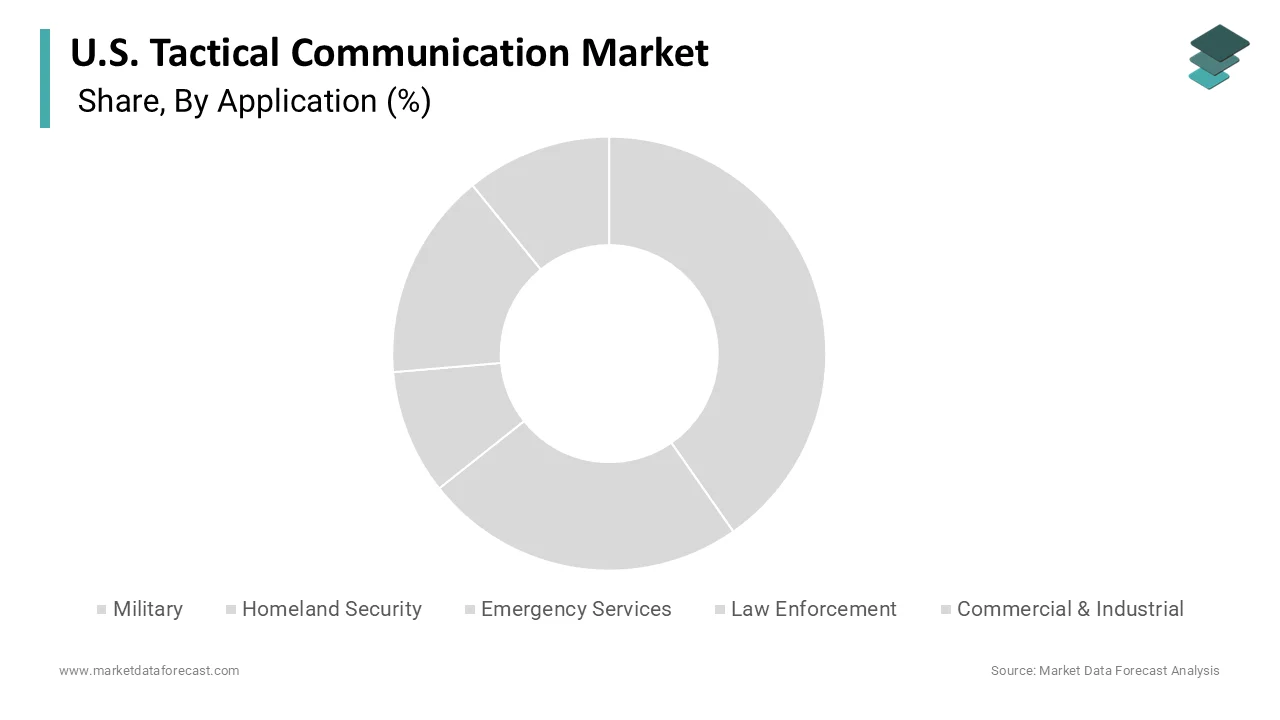
On the other side, the emergency services segment is a promising segment and is estimated to register a CAGR of 10.4% during the forecast period in the U.S. market, owing to the urgent need for interoperable communication systems among first responders during natural disasters and public safety incidents. The transition from narrowband to broadband networks enables the transmission of video and high-resolution data, which enhances situational awareness for police, fire, and medical teams. Implementation of Next Generation 911 (NG911) and broadband public safety networks drives the rapid growth of the emergency services segment. Traditional voice-only systems are being replaced by IP-based platforms that support multimedia data transmission. According to the National Emergency Number Association (NENA), over 60% of 911 call centers in the U.S. have begun deploying NG911 capabilities. This transition allows emergency responders to receive text messages, videos, and location data from callers, improving response accuracy and speed. The FirstNet Authority has built a dedicated broadband network for public safety that covers 99% of the US population. As per the Department of Homeland Security (DHS), FirstNet subscribers exceeded 3 million users by 2024, indicating widespread adoption among law enforcement and fire departments. This network provides priority and preemption features, ensuring that first responders have access to bandwidth during congested periods. The ability to share live video feeds from body cameras and drones enhances command decision-making during critical incidents. Federal grants, such as those from the Department of Justice (DOJ), facilitate the purchase of compatible devices and infrastructure. The urgency to replace aging radio systems with broadband-capable devices accelerates market growth. Emergency management agencies are increasingly recognizing the value of data-driven responses, which further fuels investment in advanced communication technologies.
By Mode of Communication Insights
The radio communication segment captured the highest share of 44.7% of the U.S. market in 2025. Despite the rise of satellite and wireless technologies, radios remain the backbone of tactical operations due to their reliability, ease of use, and established infrastructure. They are indispensable for short-range, line-of-sight (LOS) communications in dense urban environments and rugged terrains where other signals may be obstructed. Reliability in contested environments and line-of-sight operations sustains the dominance of radio communication in the tactical market. Radios operate independently of external infrastructure, making them resilient against cyberattacks and the physical destruction of cell towers. According to the DoD, handheld and vehicular radios are the primary means of communication for dismounted soldiers in close-quarters combat. The simplicity of radio protocols ensures that messages are delivered with minimal latency, which is critical for time-sensitive missions. As per the National Institute of Standards and Technology (NIST), radio frequency systems demonstrate higher survivability rates in electronic warfare scenarios compared to complex networked systems. The ability to use frequency hopping and encryption protects voice and data transmissions from interception. Military and law enforcement units rely on radios for immediate coordination during raids and patrols, where setting up complex networks is impractical. The widespread availability of trained personnel who are proficient in radio procedures further reinforces their usage. Manufacturing advancements have reduced the size and weight of radios while increasing their battery life and range, making them more attractive for individual-carry applications. The entrenched presence of radio infrastructure in military bases and police stations creates a high barrier to entry for alternative technologies.
On the other side, the satellite communication segment is the fastest-growing mode of communication and is anticipated to showcase a CAGR of 12.2% during the forecast period,iod owing to the increasing need for beyond line-of-sight (BLOS) connectivity and the deployment of low-earth-orbit constellations that offer lower latency and higher bandwidth. Military and emergency responders are increasingly adopting satellite solutions to ensure global coverage and resilience. The deployment of LEO constellations for low-latency connectivity accelerates the growth of the satellite communication segment. Traditional geostationary satellites suffer from high latency, which limits their effectiveness for real-time tactical operations. LEO satellites orbit much closer to the earth, reducing signal delay to milliseconds. According to SpaceX, its LEO satellite network provides latency levels comparable to terrestrial fiber optics, enabling video conferencing and real-time data streaming in remote areas. The DoD has signed multiple contracts with commercial satellite providers to integrate these services into secure military networks. As per the Space Development Agency, the National Defense Space Architecture will leverage hundreds of small satellites to create a resilient mesh network in space. This architecture ensures that tactical units can maintain connectivity even if individual satellites are disabled. The ability to transmit large files, such as high-resolution imagery and drone footage, enhances situational awareness for commanders. Commercial competition among satellite providers has driven down costs, making satellite terminals more accessible to smaller agencies. The modularity of LEO systems allows for rapid scaling of capacity during surge demands. These technical advantages make satellite communication an increasingly attractive option for tactical users who require reliable BLOS links.
By Technology Insights
The software-defined radio segment occupied the highest share of the U.S. market in 2025. This technology allows hardware to be reprogrammed via software to support different waveforms and frequencies, providing unparalleled flexibility. It is widely adopted by the military and public safety sectors due to its ability to adapt to evolving communication standards without replacing hardware. Flexibility in waveform adaptation and multi-band operations drives the dominance of SDR technology. Unlike traditional radios that are fixed to specific frequencies, software-defined radios can switch between different communication protocols instantly. According to the Joint Tactical Radio System (JTRS) guidelines, the US military utilizes SDRs to interoperate with allied forces that use different national standards. This capability is essential for joint operations where seamless communication is critical. As per the Defense Science Board, software-defined radios reduce the logistical burden of carrying multiple single-band devices by consolidating functions into one unit. The ability to upload new waveforms via software updates extends the lifecycle of the hardware and ensures compatibility with emerging technologies. Public safety agencies benefit from this flexibility by using the same radios for daily operations and emergency responses on different frequency bands. The modular nature of SDRs allows for easy integration of encryption modules and security patches. This adaptability makes them ideal for dynamic tactical environments where communication requirements change rapidly. Manufacturers continue to innovate in this space by developing more powerful processors that support complex waveforms. The widespread acceptance of SDR standards by NATO and other international bodies further reinforces its market leadership.
The mobile ad hoc networks segment is estimated to grow at a CAGR of 13.2% during the forecast period in the U.S. market. These networks allow devices to connect directly to each other without relying on fixed infrastructure, creating self-healing and resilient communication grids. They are particularly valuable for dismounted soldiers and first responders operating in dynamic environments. Resilience through a self-healing and decentralized architecture drives the rapid growth of mobile ad hoc networks. In traditional networks, the failure of a central node can disrupt the entire system, whereas MANETs automatically reroute data through alternative paths. According to DARPA, mobile ad hoc networks can maintain connectivity even when 50% of nodes are disabled or destroyed. This robustness is critical for tactical operations in hostile environments where infrastructure is likely to be targeted. As per NIST, self-healing networks reduce downtime by dynamically adjusting to changing topology conditions, ensuring that command and control links remain intact during intense combat or disaster scenarios. The decentralized nature of these networks also makes them resistant to jamming and cyberattacks since there is no single point of failure. Soldiers and first responders can form instant networks using handheld devices, vehicles, and drones. This flexibility allows for rapid deployment in areas without existing communication infrastructure, and the ability to integrate diverse devices into a single cohesive network enhances situational awareness and coordination. Military exercises have demonstrated that MANETs improve mission success rates by ensuring continuous information flow, driving increased investment and adoption of these resilient communication solutions.
COUNTRY LEVEL ANALYSIS
U.S. Tactical Communication Market Analysis
The U.S. serves as the global leader in defense technology innovation and procurement. The country's market is characterized by robust government spending, advanced research capabilities, and a strong industrial base. The Department of Defense drives the majority of demand through its continuous modernization initiatives and joint all-domain command and control strategies. Dominance driven by massive defense spending and continuous technological innovation defines the U.S. tactical communication market. The US government allocates the largest defense budget in the world, enabling extensive investment in communication infrastructure. According to SIPRI, the U.S. spent $877 billion on defense in 2024, representing nearly 40% of global military expenditure. A significant portion of this budget is dedicated to research, development, test, and evaluation (RDT&E) of new communication technologies. As per the CRS, the Pentagon has prioritized network modernization to counter near-peer threats.
This strategic focus has led to the development of advanced software-defined radios, satellite constellations, and artificial intelligence-driven network management systems. The presence of major defense contractors such as Lockheed Martin, RTX (Raytheon), L3Harris Technologies, and General Dynamics fosters a competitive environment that drives rapid innovation. These companies collaborate closely with government labs and agencies to develop cutting-edge solutions that meet rigorous military standards. The U.S. also leads in the adoption of commercial technologies for defense applications, leveraging the strengths of its massive commercial tech sector. The integration of 5G and IoT devices into tactical networks further enhances operational capabilities. This combination of unmatched financial resources and deep technological expertise ensures that the U.S. remains at the absolute forefront of the global tactical communication market.
COMPETITIVE LANDSCAPE
The competition in the U.S. tactical communication market is characterized by intense rivalry among established defense contractors and emerging technology firms striving to deliver superior connectivity solutions. Major players compete based on technological innovation, reliability, and adherence to strict military standards for security and interoperability. The market features a high barrier to entry due to rigorous certification processes and the need for extensive testing before deployment. Companies differentiate themselves by offering modular and scalable systems that can adapt to various operational environments ranging from urban combat to remote wilderness areas. Strategic alliances with commercial tech giants are increasingly common as firms seek to integrate fifth-generation wireless capabilities and cloud computing into tactical networks. The emphasis on software-defined functionalities allows vendors to provide over-the-air updates, ensuring the long-term relevance of hardware investments. Cybersecurity remains a critical differentiator, with manufacturers investing heavily in encryption and anti-jamming technologies to protect against sophisticated electronic warfare threats. This dynamic landscape drives continuous improvement in performance and cost efficiency, benefiting end users such as the military and public safety agencies who require dependable communication tools for mission-critical operations.
KEY MARKET PLAYERS
Some of the companies that are playing a dominating role in the U.S. Tactical Communication Market include
- L3Harris Technologies, Inc.
- Lockheed Martin Corporation
- Northrop Grumman Corporation
- Raytheon Technologies Corporation
- General Dynamics Corporation
- BAE Systems plc
- Thales Group
- Viasat, Inc.
- Motorola Solutions, Inc.
- Leonardo DRS, Inc.
- Persistent Systems, LLC
- Collins Aerospace (RTX Corporation)
TOP LEADING PLAYERS IN THE MARKET
- L3Harris Technologies stands as a pivotal entity in the U.S. tactical communication landscape by delivering advanced secure voice and data solutions. The company focuses heavily on software-defined radio technologies that ensure interoperability across multiple military branches and allied forces. Recent initiatives include the expansion of its Falcon IV radio portfolio, which offers enhanced encryption and networking capabilities for dismounted soldiers. L3Harris actively collaborates with the Department of Defense to integrate artificial intelligence into network management systems, improving resilience against electronic warfare threats. Their commitment to open architecture standards allows for rapid integration of third-party applications, ensuring that warfighters maintain technological superiority. By investing in next-generation waveform development, the company strengthens its position as a primary supplier for critical mission communications. These efforts enable seamless connectivity in contested environments, supporting joint all-domain command and control objectives effectively.
- Raytheon Technologies contributes significantly to the market through its robust portfolio of satellite communication systems and cyber-secure networking solutions. The company leverages its expertise in aerospace and defense to provide resilient beyond line of sight connectivity for tactical units. Recent actions involve the development of low-earth-orbit satellite terminals that offer lower latency and higher bandwidth for real-time data transmission. Raytheon integrates advanced cybersecurity measures into its communication platforms, protecting sensitive military data from sophisticated cyber attacks. The firm actively participates in government-led modernization programs, aiming to replace legacy infrastructure with agile digital networks. By focusing on multi-domain operations, Raytheon ensures that its systems support seamless information exchange across air, sea, nd space domains. This strategic alignment with national defense priorities reinforces its role as a key enabler of tactical communication superiority.
- Lockheed Martin plays a crucial role by developing integrated communication architectures that support complex joint military operations. The company emphasizes the creation of resilient networks that can withstand intense electronic warfare and physical disruptions. Recent developments include the enhancement of its mission command systems, which incorporate artificial intelligence for predictive maintenance and traffic optimization. Lockheed Martin collaborates with commercial technology providers to accelerate the adoption of 5G capabilities within military bases and tactical edges. Their focus on interoperability ensures that diverse platforms can communicate effectively, enhancing situational awareness for commanders. By investing in research and development for quantum communication technologies, the company aims to future-proof its offerings against emerging threats. These innovations solidify its reputation as a leader in providing secure and reliable tactical communication solutions for the U.S. armed forces.
TOP STRATEGIES USED BY KEY MARKET PARTICIPANTS
Key players in the U.S. tactical communication market primarily employ strategies focused on continuous innovation and strategic partnerships to maintain a competitive advantage. Companies invest heavily in research and development to create software-defined radios and artificial intelligence-driven network solutions that address evolving security threats. Mergers and acquisitions are common tactics used to expand product portfolios and acquire specialized technologies such as advanced encryption modules or satellite connectivity tools. Collaborations with government agencies ensure alignment with national defense priorities and facilitate access to funding for large-scale modernization projects. Firms also prioritize open architecture standards to enhance interoperability across different military branches and allied nations. Additionally, manufacturers focus on reducing the size and weight of devices while increasing battery life to improve portability for dismounted soldiers. These strategic initiatives enable companies to deliver resilient and adaptable communication systems that meet the rigorous demands of modern warfare and emergency response operations effectively.
MARKET SEGMENTATION
This research report on the U.S. tactical communication market is segmented and sub-segmented into the following categories.
By Application
- Military
- Homeland Security
- Emergency Services
- Law Enforcement
- Commercial & Industrial
By Mode of Communication
- Radio Communication
- Satellite Communication
- Wireless Communication
- Cellular Communication
- Internet Protocol Communication
By Technology
- Software-Defined Radio (SDR)
- Mobile Ad Hoc Networks (MANET)
- Network-Centric Warfare Systems
- Encryption & Cybersecurity Solutions
- Tactical Data Links
By Country
- California
- Virginia
- Texas
- Florida
- Rest of the United States
Related Reports
Access the study in MULTIPLE FORMATS
Purchase options starting from
$ 1200
Didn’t find what you’re looking for?
TALK TO OUR ANALYST TEAM
Need something within your budget?
NO WORRIES! WE GOT YOU COVERED!
Call us on: +1 888 702 9696 (U.S Toll Free)
Write to us: sales@marketdataforecast.com