- Product Description Description
- Table of Contents TOC
- List of Table & Figure LOT
- Get Free Sample PDF Sample PDF
Market Size, 2025
$12.26 BnMarket Estimate, 2026
$14.25 BnMarket Forecast, 2034
$47.43 BnCAGR, 2026–2034
16.22%U.S. Text Analytics Market Size
The U.S. Text Analytics Market is projected to grow from USD 12.26 billion in 2025 to USD 14.25 billion in 2026 and reach USD 47.43 billion by 2034, registering a CAGR of 16.22% during the forecast period from 2026 to 2034.
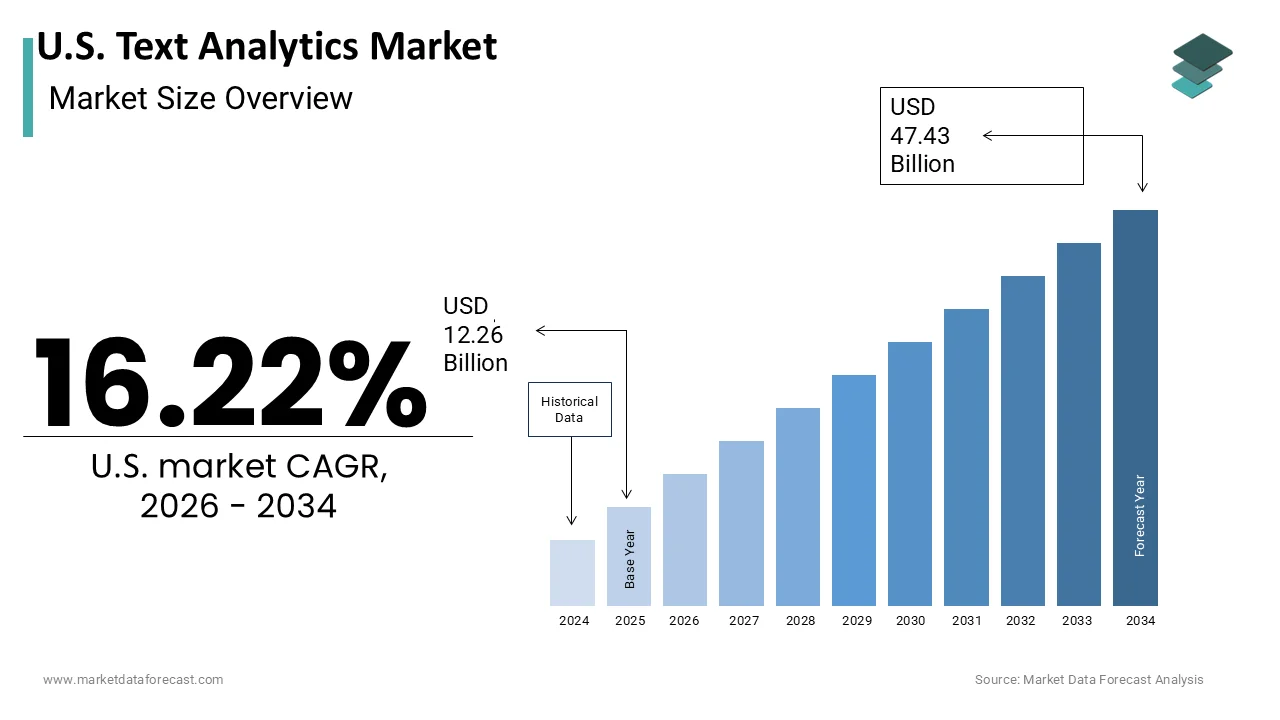
The proliferation of digital communication channels has generated an exponential volume of unstructured data, necessitating advanced analytical tools for efficient interpretation. As per the International Data Corporation (IDC), unstructured data accounts for approximately 80% of all enterprise data, highlighting the critical need for effective text mining solutions. The integration of artificial intelligence (AI) enables organizations to automate sentiment analysis, entity extraction, and topic modeling with increasing accuracy. According to the Bureau of Labor Statistics (BLS), employment in data science and related analytical roles is projected to grow significantly faster than the average for all occupations, reflecting the strategic importance of data interpretation across modern businesses. Healthcare, financial services, and retail sectors stand out as the primary adopters, utilizing text analytics for risk management, customer experience enhancement, and regulatory compliance. The shift toward real-time analytics allows businesses to respond swiftly to emerging trends and consumer feedback. Meanwhile, strict regulatory frameworks, such as the Health Insurance Portability and Accountability Act (HIPAA), heavily influence how sensitive textual data is processed and stored. This market serves as a foundational element for modern business intelligence, enabling data-driven decision-making across diverse operational functions.
MARKET DRIVERS
Exponential Growth of Unstructured Data from Digital Channels
The exponential growth of unstructured data from digital channels is primarily fuelling the adoption of text analytics solutions in the U.S., which is a key market driver. The ubiquity of social media platforms, mobile messaging, and online review sites has created a vast reservoir of consumer-generated content. According to Statista, users in the U.S. spend an average of over two hours daily on social media platforms, generating billions of text-based interactions annually. This sheer volume of data far exceeds the capacity of manual analysis, requiring automated systems for efficient processing. As per the World Economic Forum (WEF), the global datasphere is expected to reach massive zettabyte-scale proportions, with a significant portion consisting of unstructured text. Enterprises recognize that this data contains valuable insights regarding brand perception, product preferences, and emerging market trends. Text analytics tools enable organizations to mine this information for a sustainable competitive advantage. The ability to process real-time streams of text allows for an immediate response to customer complaints or viral trends. Retailers use these insights to optimize inventory and marketing strategies based on consumer sentiment, while financial institutions analyze news feeds and social media to assess market sentiment and potential risks. The continuous expansion of digital communication channels ensures a steady increase in data volume, cementing the transition from simple data accumulation to intelligent data utilization.
Increasing Demand for Enhanced Customer Experience and Personalization
The increasing demand for enhanced customer experience (CX) and personalization significantly propels the expansion of the text analytics market in the U.S. Modern consumers expect brands to seamlessly understand their needs and preferences through every interaction. According to Salesforce, 80% of customers state that the experience a company provides is as important as its products or services. Text analytics enables businesses to deep-dive into customer feedback, support tickets, and survey responses to quickly identify pain points and satisfaction drivers. As per McKinsey & Company, companies that excel at personalization generate 40% more revenue from those activities than average players. By leveraging natural language processing, organizations can segment customers based on sentiment and behavior patterns. This granular understanding allows for highly targeted marketing campaigns and tailored product recommendations. Furthermore, customer service teams use text analytics to prioritize urgent issues and automate responses to common queries, dramatically improving resolution times. The ability to detect early churn signals in customer communications enables proactive retention strategies, building stronger emotional connections with audiences. In a crowded marketplace where brands must differentiate through superior service quality, text analytics provides the critical empirical basis for ongoing service adjustments.
MARKET RESTRAINTS
Complexity of Natural Language Processing and Linguistic Ambiguity
The underlying complexity of natural language processing and linguistic ambiguity significantly restrains the accuracy and reliability of text analytics solutions in the U.S. Human language is inherently nuanced, containing sarcasm, idioms, slang, and context-dependent meanings that are incredibly difficult for standard algorithms to accurately interpret. According to the Association for Computational Linguistics (ACL), achieving high precision in sentiment analysis remains highly challenging due to the extreme subtlety of human expression. As per Gartner, inaccurate data analysis can lead to flawed business decisions, resulting in severe financial losses and long-term reputational damage. Sarcasm detection, for instance, frequently requires cultural knowledge and contextual awareness that traditional models lack. Polysemy further complicates entity extraction and classification workflows. Industries such as legal and healthcare require exceptionally high accuracy levels where processing errors can have catastrophic real-world consequences. The subsequent need for extensive training data and continuous model refinement increases implementation costs and time. Consequently, small and medium-sized enterprises (SMEs) often lack the resources to maintain sophisticated linguistic models, making linguistic complexity a persistent barrier to widespread market expansion.
High Implementation Costs and Requirement for Specialized Skills
High implementation costs and the strict requirement for specialized skills pose significant challenges to the adoption of text analytics software in the U.S. Deploying robust text analytics solutions requires a substantial initial investment in modern infrastructure, software licenses, and highly skilled personnel. According to the IDC, the persistent shortage of data scientists and AI specialists continues to drive up labor costs across the technology sector. As per the BLS, the median annual wage for data scientists remains significantly higher than the national occupational average, reflecting the severe scarcity of specialized talent. Beyond hiring, organizations must also invest heavily in ongoing training to keep their internal staff aligned with rapidly evolving technologies. The inherent complexity of integrating text analytics platforms with existing legacy enterprise systems adds to this technical burden. Customizing models for specific industry needs requires domain expertise that is often hard to source externally. Because many organizations struggle to justify large initial investments without clear, short-term returns, the total cost of ownership remains prohibitive for smaller businesses. This reliance on expensive external consultants to bridge internal capability gaps slows down overall adoption rates.
MARKET OPPORTUNITIES
Integration with Generative Artificial Intelligence and Large Language Models
The integration of traditional text analytics with generative artificial intelligence and Large Language Models (LLMs) presents a highly promising opportunity for the U.S. market. LLMs dramatically enhance the capability of text analytics tools to understand complex contexts, generate automated summaries, and perform reasoning tasks. According to McKinsey & Company, generative AI could add trillions of dollars in value to the global economy annually, with significant contributions originating from automated data analysis. As per Microsoft, integrating large language models into everyday business applications enables more intuitive, natural-language querying and analysis capabilities. Text analytics platforms leveraging these models can provide deeper insights with far less manual configuration or upfront rule-setting. Automated report generation makes complex data easily accessible to non-technical business users. The capability to synthesize vast amounts of information from disparate sources simultaneously enhances decision-making speed and accuracy. For example, legal firms can accelerate document review and contract analysis processes, while healthcare networks can easily extract historical treatment insights. The synergy between traditional text analytics and generative AI lowers the barrier to entry using pre-trained models, creating an innovative environment for vendors to capture new revenue streams.
Expansion into Healthcare for Clinical Decision Support and Research
Expansion into the healthcare sector for clinical decision support and medical research offers an incredibly promising avenue for growth in the U.S. text analytics market. The healthcare ecosystem generates vast amounts of unstructured data, including electronic health records (EHRs), unstructured clinical notes, and dense medical literature. According to the Office of the National Coordinator for Health Information Technology (ONC), over 90% of hospitals in the U.S. utilize certified EHR technology. As per the Journal of the American Medical Informatics Association (JAMIA), text analytics can significantly improve diagnostic accuracy and patient outcomes by cleanly extracting relevant insights from free-text clinical narratives. These tools enable medical researchers to quickly identify subtle trends in disease progression and treatment efficacy across millions of historical cases. Hospitals also deploy text analytics to monitor patient safety incidents and streamline internal quality-of-care metrics. In the pharmaceutical sector, text mining accelerates drug discovery pipelines and automates adverse event monitoring. Backed by regulatory incentives for value-based care and an aging population experiencing a higher prevalence of chronic diseases, the strategic importance of unlocking unstructured healthcare data ensures a sustained and high-impact growth engine for the market.
MARKET CHALLENGES
Data Privacy Concerns and Regulatory Compliance Complexities
Data privacy concerns and regulatory compliance complexities present major challenges to the U.S. text analytics market expansion. Text data frequently contains personally identifiable information (PII) and sensitive personal details that are subject to strict oversight. According to the Department of Health and Human Services (HHS), violations of regulations like HIPAA can result in severe financial penalties and legal liability. As per the Federal Trade Commission (FTC), state-level laws such as the California Consumer Privacy Act (CCPA) impose rigorous compliance requirements on data collection, processing, and consumer consent. Organizations must ensure that text analytics solutions fully comply with these shifting regulations, yet anonymizing and de-identifying text data without completely stripping away its analytical value remains technically challenging. Furthermore, the risk of data breaches exposing sensitive textual records heavily erodes consumer trust. Cross-border data transfers face additional legal restrictions, complicating operations for multinational corporations. The evolving nature of privacy laws requires continuous monitoring and costly engineering updates, creating legal and ethical hurdles that slow down software deployment across sensitive industries.
Lack of Standardization and Interoperability Issues
The lack of technical standardization and persistent interoperability issues pose significant challenges to the U.S. text analytics market growth. The global absence of universal standards for data formats and text-processing protocols hinders seamless data sharing with existing enterprise systems. According to the Institute of Electrical and Electronics Engineers (IEEE), disparate data sources require extensive, costly preprocessing and normalization before any actual text analysis can begin. As per Forrester, a large percentage of enterprises struggle internally with data silos, where critical textual data remains entirely isolated in separate departmental platforms. This fragmentation prevents businesses from achieving a comprehensive, holistic view of operational or customer data. Furthermore, proprietary algorithms and closed ecosystems restrict flexibility, introducing high vendor lock-in risks. Interoperability issues also complicate the deployment of hybrid cloud and on-premise analytical solutions. Because standard industry-wide metrics for evaluating model performance are lacking, users find it difficult to objectively validate the accuracy and reliability of competing solutions. These technical barriers increase integration times and overall costs, impeding broader market efficiency.
REPORT COVERAGE
| REPORT METRIC | DETAILS |
| Market Size Available | 2025 to 2034 |
| Base Year | 2025 |
| Forecast Period | 2026 to 2034 |
| Segments Covered | By Component, Application, Deployment, and Region. |
| Various Analyses Covered | Global, Regional and Country-Level Analysis, Segment-Level Analysis, Drivers, Restraints, Opportunities, Challenges; PESTLE Analysis; Porter’s Five Forces Analysis, Competitive Landscape, Analyst Overview of Investment Opportunities |
| Countries Covered | California, Texas, Florida, New York, and the rest of the United States |
| Market Leaders Profiled | IBM Corporation, Microsoft Corporation, Oracle Corporation, SAS Institute Inc., SAP SE, OpenText Corporation, Lexalytics, Inc., Clarabridge, Inc., MeaningCloud LLC, Amazon Web Services, Inc., Google LLC, Teradata Corporation |
SEGMENTAL ANALYSIS
By Component Insights
The solutions segment dominated the market by accounting for 64.6% of the U.S. market share in 2025. The growth of the solutions segment in the U.S. market is attributed to the critical corporate requirement for automated data processing. Organizations generate millions of text documents daily, rendering manual oversight impossible. According to the IDC, since over 80% of enterprise data is entirely unstructured, automated software solutions are an absolute operational necessity. As per Gartner, organizations that successfully automate their data analysis workflows reduce overall operational costs by up to 30% while simultaneously achieving a substantial boost in evaluation accuracy. Text analytics software allows for real-time processing of customer interactions, feeding instant trend alerts directly to executives. The integration of machine learning algorithms within these solutions minimizes human error and scales seamlessly across massive corporate repositories without requiring a proportional increase in labor expenditures, solidifying software solutions as the primary revenue generator.
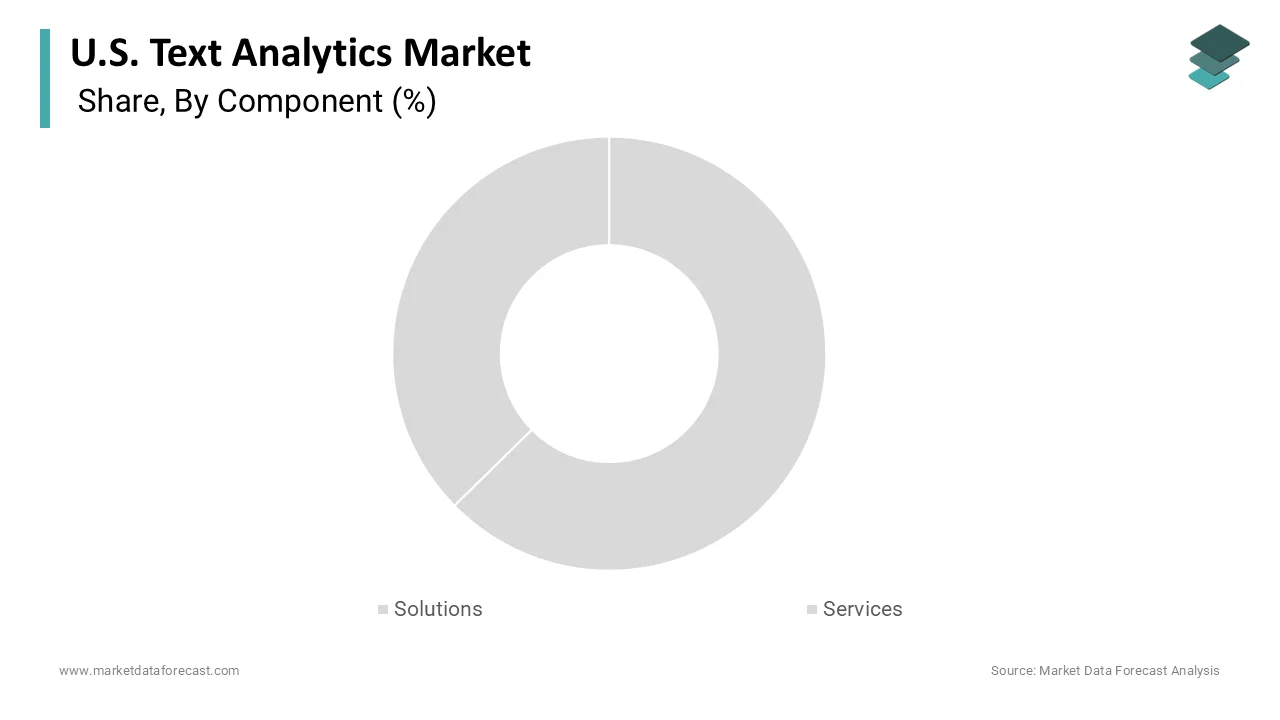
On the other side, the services segment is the fastest-growing component in the market and is predicted to exhibit a CAGR of 15.4% during the forecast period, owing to the baseline complexity of text analytics technologies and the ongoing shortage of internal data science professionals. According to the BLS, the talent gap for specialized AI and NLP engineers in the U.S. remains a major operational hurdle. As per McKinsey & Company, 56% of corporate executives cite a lack of technical skills as the primary barrier preventing successful AI adoption within their companies. Organizations heavily rely on third-party service providers to design custom models, select appropriate algorithms, and securely integrate tools with legacy databases. This expert intervention is especially crucial in specialized domains like legal document review or medical narrative analysis, where horizontal, out-of-the-box software fails to capture domain-specific jargon. The need for continuous model retraining to prevent data drift guarantees long-term demand for managed services.
By Application Insights
The customer relationship management segment held the leading position in the U.S. text analytics market by accounting for 28.9% of the U.S. market share in 2025. The absolute corporate focus on customer experience management and proactive retention strategies drives the dominance of CRM applications. Companies operate under the economic reality that retaining an active customer is significantly cheaper than acquiring a new one. According to Bain & Company, boosting customer retention rates by just 5% can increase total corporate profits by anywhere from 25% to 95%. Text analytics enables CRM platforms to apply real-time sentiment analysis to incoming tickets, allowing automated systems to immediately flag and escalate high-priority, dissatisfied clients before they churn. It also provides companies with actionable metrics, such as the Customer Effort Score (CES), derived directly from text descriptions. The clear, quantifiable link between an optimized customer experience and corporate revenue growth justifies heavy, consistent enterprise spending in this application segment.
However, the fraud detection segment is the fastest-growing application segment in the market and is estimated to expand at a CAGR of 15.8% during the forecast period. The escalating volume and sophistication of modern financial crimes serve as the primary catalyst for this rapid expansion. Cybercriminals regularly deploy complex social engineering, phishing, and identity theft schemes to bypass traditional, rule-based security systems. According to the Federal Bureau of Investigation (FBI), annual internet crime losses have surpassed the $10 billion threshold in the U.S., highlighting the critical severity of the threat environment. Furthermore, data from the Association of Certified Fraud Examiners (ACFE) notes that organizations lose an average of 5% of their annual revenue to internal and external fraud. Text analytics provides the agility needed to catch these anomalies by processing massive, unstructured data fields in real time. Financial institutions heavily deploy these tools to automate anti-money laundering (AML) compliance surveillance, protecting corporate assets and avoiding catastrophic regulatory penalties.
By Deployment Insights
The cloud-based deployment models segment dominated the U.S. text analytics market by commanding 68.5% of the U.S. market share in 2025. This deployment method allows organizations to access advanced text-mining applications via the cloud, offering unparalleled scalability, flexibility, and a significant reduction in upfront infrastructure spending. The elastic scalability and cost-efficiency of modern cloud architectures drive this widespread adoption. Organizations routinely need to process highly variable volumes of text data without purchasing expensive on-premise server hardware. According to Amazon Web Services (AWS), cloud computing frameworks allow businesses to shift from capital expenditures to variable operational expenses, paying only for the computational resources they actively consume. As per Flexera, 92% of enterprises utilize a multi-cloud strategy to optimize performance and prevent downtime. Cloud-hosted text analytics platforms can scale computational power instantly to handle sudden seasonal spikes, such as data influxes during holiday retail surges. By removing the long-term financial burden of server maintenance, hardware refreshes, and manual software patching, cloud deployment offers a highly compelling total cost of ownership that appeals to businesses of all sizes.
The hybrid cloud model segment is the fastest-growing deployment segment and is predicted to register a CAGR of 14.1% during the forecast period. Hybrid deployment structures allow companies to seamlessly split their text analytics workloads, keeping highly sensitive data stored locally on secure, private infrastructure while leveraging the public cloud's raw processing power for intensive analytical modeling. The urgent requirement for localized data sovereignty and airtight security guarantees drives the rapid growth of this segment. Heavily regulated sectors, such as banking and healthcare, face strict legal rules regarding data residency and user access control. For example, under HIPAA guidelines, healthcare networks must enforce strict physical and digital controls over patient records. As per IBM, 77% of enterprise organizations prioritize cloud security above all other operational factors when adopting new software. Hybrid architectures allow companies to encrypt and isolate sensitive textual data on-premise, safely utilizing public cloud extensions only for non-sensitive data computation. This architecture delivers a balanced compromise, offering maximum security without fully sacrificing the computational advantages of cloud analytics.
COUNTRY LEVEL ANALYSIS
U.S. Text Analytics Market Analysis
The U.S. accounted for the highest share of the global market in 2025 and stands as the absolute global leader in technological innovation, software spending, and enterprise adoption. The country’s market dominance is structurally characterized by an advanced digital infrastructure, massive corporate data generation, a robust venture capital ecosystem, and intense enterprise investment. Unmatched technological leadership and a massive volume of domestic data generation define the preeminent status of the U.S. text analytics market. The country serves as the global corporate headquarters for the world’s leading AI, cloud, and enterprise software firms, all of which continuously pioneer advanced analytical frameworks. According to the National Science Foundation (NSF), the U.S. leads global research and development spending in artificial intelligence and machine learning technologies. Furthermore, due to exceptionally high internet penetration, smartphone usage, and enterprise digitization, the US generates a significant portion of the world’s commercial digital data. This abundant data acts as a continuous fuel, driving an intense enterprise demand for sophisticated text-processing tools.
Major domestic sectors invest heavily in text analytics platforms to capture operational efficiencies and secure market advantages. This continuous cycle of innovation is heavily reinforced by strong intellectual property protections and a highly skilled workforce of data scientists and engineers who graduated from top-tier domestic research institutions. Backed by federal initiatives promoting big data adoption and a deeply ingrained corporate culture of data-driven decision-making, the U.S. market maintains an unassailable leadership position, setting the operational benchmarks and technical standards for text analytics applications worldwide.
COMPETITIVE LANDSCAPE
The competition in the U.S. text analytics market is characterized by intense rivalry among established technology giants and specialized AI startups striving to offer superior analytical capabilities. Major players compete based on algorithm accuracy, ease of integration,n and scalability of their platforms. The market features a diverse landscape with solutions ranging from standalone software to integrated cloud services. Companies differentiate themselves through industry-specific modules and customizable models that address unique business challenges. Strategic acquisitions of niche AI firms help larger corporations expand their technological portfolios and talent pools. Price competitiveness remains a factor, particularly for small and medium-sized enterprises seeking affordable options. Innovation in real-time processing and multilingual support drives customer acquisition and retention. The rise of open source alternatives pressures proprietary vendors to demonstrate added value through support and advanced features. Intellectual property related to proprietary algorithms serves as a significant barrier to entry. This dynamic environment fosters continuous improvement and innovation, benefiting customers with diverse and powerful tools. The ability to adapt to rapid technological changes determines long-term success in this sector.
KEY MARKET PLAYERS
Some of the companies that are playing a dominating role in the U.S. Text Analytics Market include
- IBM Corporation
- Microsoft Corporation
- Oracle Corporation
- SAS Institute Inc.
- SAP SE
- OpenText Corporation
- Lexalytics, Inc.
- Clarabridge, Inc.
- MeaningCloud LLC
- Amazon Web Services, Inc.
- Google LLC
- Teradata Corporation
TOP LEADING PLAYERS IN THE MARKET
- IBM Corporation is a pioneer in the U.S. text analytics market, leveraging its Watson AI platform to deliver advanced natural language processing capabilities. The company provides enterprise-grade solutions for sentiment analysis, entity extraction, and content categorization across various industries. Recent actions include the integration of generative AI models into Watsonx to enhance contextual understanding and automation. IBM has focused on hybrid cloud deployments, allowing clients to process sensitive data securely while accessing powerful analytics tools. The firm actively collaborates with healthcare and financial institutions to develop specialized use cases for unstructured data. By emphasizing ethical AI and transparency, IBM builds trust with regulated sectors. These initiatives strengthen its position as a leader in cognitive computing and data-driven decision-making. The continuous innovation in machine learning algorithms ensures superior accuracy and performance for complex text mining tasks.
- Microsoft Corporation contributes significantly to the market through its Azure Cognitive Services and Language Studio, which offer robust text analytics APIs. The company enables developers and enterprises to integrate sentiment analysis,s key phrase extraction, and language detection into applications seamlessly. Recent developments involve the expansion of large language model capabilities within the Azure OpenAI Service for enhanced text generation and summarization. Microsoft has improved its pre-built models to support diverse languages and industry-specific terminologies. The firm focuses on democratizing AI by providing low-code tools for business users. Integration with Microsoft 365 allows organizations to analyze emails, documents,s and chats efficiently. These efforts enhance productivity and insight extraction from everyday workflows. By prioritizing security and compliance, Microsoft attracts large corporate clients. This strategic focus on accessibility and power solidifies its role in the text analytics ecosystem.
- SAS Institute Inc plays a vital role in the U.S. text analytics market by offering comprehensive analytics software for data mining and natural language processing. The company serves industries such as banking, insurance,e and healthcare with tailored solutions for risk management and customer intelligence. Recent actions include the launch of SAS Vi, ya a cloud native analytics platform that accelerates text processing and model deployment. SAS has enhanced its text mining capabilities with deep learning techniques to improve accuracy in identifying patterns and themes. The firm emphasizes explainable AI to help users understand model decisions. SAS provides extensive training and support services to ensure successful implementation. By focusing on high-value analytical outcomes, SAS maintains strong relationships with enterprise clients. These strategies reinforce its reputation for reliability and advanced statistical expertise in the competitive analytics landscape.
TOP STRATEGIES USED BY KEY MARKET PARTICIPANTS
Key players in the U.S. text analytics market primarily employ strategies focused on artificial intelligence integration and cloud-based deployment to maintain a competitive advantage. Companies invest heavily in developing large language models and natural language processing algorithms to enhance accuracy and contextual understanding. Strategic partnerships with industry-specific vendors enable the creation of tailored solutions for healthcare finance and retail sectors. Firms prioritize user-friendly interfaces and low-code platforms to democratize access for non-technical users. Expansion into generative AI capabilities allows for automated content creation and summarization features. Providers also focus on data privacy and security compliance to build trust with regulated industries. Continuous investment in research and development ensures staying ahead of technological trends. These strategic initiatives enable firms to differentiate their offerings and meet evolving customer needs effectively.
MARKET SEGMENTATION
This research report on the U.S. text analytics market is segmented and sub-segmented into the following categories.
By Component
- Solutions
- Services
By Application
- Customer Relationship Management
- Fraud Detection
- Risk Management
- Workforce Management
- Competitive Intelligence
- Others
By Deployment
- Cloud-Based
- On-Premises
- Hybrid Cloud
By Country
- California
- Texas
- New York
- Florida
- Rest of the United States