- Product Description Description
- Table of Contents TOC
- List of Table & Figure LOT
- Get Free Sample PDF Sample PDF
Market Size, 2025
$21.66 BnMarket Estimate, 2026
$23.18 BnMarket Forecast, 2034
$39.89 BnCAGR, 2026–2034
7.02%Executive Summary: U.S. Anti-Aging Market
- Market Scope: Comprehensive U.S. market analysis covering demographics, product types, professional services, aesthetic devices, and key market growth factors.
- Market Valuation: Valued at USD 21.66 billion (2025), estimated at USD 23.18 billion (2026), and projected to reach USD 39.89 billion by 2034, growing at a CAGR of 9.9% (2026–2034).
- Primary Growth Drivers: Increasing geriatric population, rising awareness of skin health, growing preference for plant-based and organic anti-aging products, increasing disposable income among working women, and heavy social media influence driving cosmetic treatments.
Key Market Segment Metrics (2026–2034)
| Category | Leading Segment Focus | Fastest-Growing Segment Focus |
|---|---|---|
| By Demographics | Baby Boomers & Generation X | Generation Y (Millennials adopting anti-aging care early) |
| By Products Type | Anti-Wrinkle Products & UV Absorbers | Natural & Herbal-Based Products |
| By Services | Anti-Pigmentation Therapy & Chemical Peels | Surgical & Minimally Invasive Procedures |
| By Devices | Laser Aesthetic & Radiofrequency Devices | Microdermabrasion & Home Anti-Cellulite Devices |
Major Market Players & Market Structure
Market Structure: Highly competitive landscape comprising leading cosmetics corporations, skincare specialists, and aesthetic device manufacturers focusing on advanced R&D, organic formulations, and digital marketing strategies.
Key Companies: Coty Inc., Personal Microderm, Beiersdorf AG, Photomedex Inc., Lumenis Ltd, Alma Lasers Ltd, Solta Medical Inc., Cynosure Inc., L'Oreal SA, and Allergan Inc.
U.S. Anti-Aging Market Size
The U.S. anti-aging market was valued at USD 21.66 billion in 2025. The market is estimated at USD 23.18 billion in 2026 and is projected to reach USD 39.89 billion by 2034, growing at a CAGR of 9.9% from 2026 to 2034.
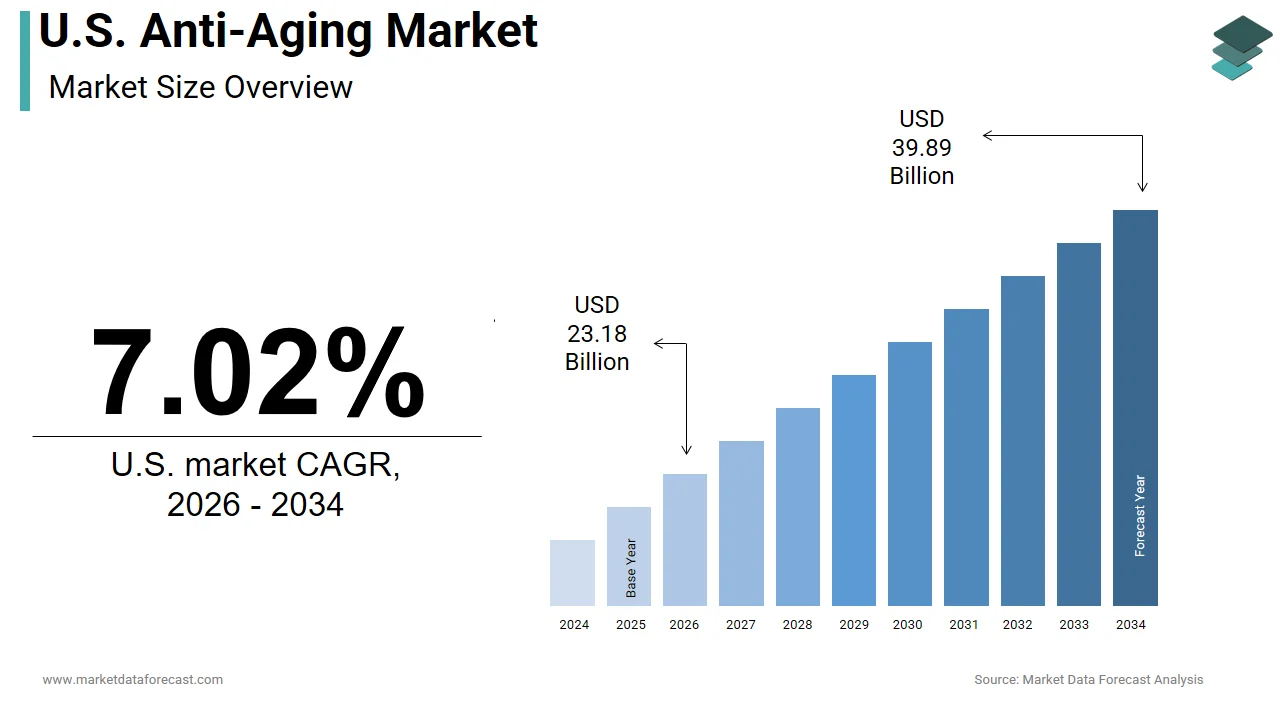
The increasing geriatric population and awareness about skin problems among many people are the significant factors driving the U.S. anti-aging market growth. According to the statistics published by the Population Reference Bureau (PRB), the number of people with 65 years or older was 52 million in 2018 in the United States, which is anticipated to double by 2060. In addition, due to the rapid adoption of unhealthy changes in the lifestyles among the U.S. population and growing pollution levels in the environment, many people are anticipated to diagnose with various skin problems in the United States, which are expected to result in the growing demand for anti-aging products and services in the U.S. In addition, people often use sunscreens and lotion to protect themselves from dust and ultraviolet rays.
The growing number of investments and increasing R&D activities by the key market participants to bring innovative and effective anti-aging products and solutions to the market is predicted to boost the growth rate of the U.S. anti-aging market. Many market participants have recently increased their focus on developing anti-aging treatments and products, such as plastic surgeries, breast implants, and injection therapies. Efforts to bring anti-aging devices that can reduce wrinkles and fine lines on the face without the usage of any creams and surgeries can be seen from some market participants in the recent past. In addition, the growing adoption of anti-aging devices, products, and treatment solutions from the younger population of the U.S. is another major factor promoting the growth of the U.S. anti-aging market.
The growing number of plant-based and organic anti-aging products for aging issues is expected to fuel the growth rate of the U.S. market. For instance, an increasing preference for herbal-based beauty products such as creams, oils, and natural stones to massage the face to reduce wrinkles from people has been noticed in the recent past. Unlike chemical-based products, these products are believed to not harm the skin. Hence, the adoption and usage of organic beauty products for anti-aging are growing and resulting in the U.S. market growth.
On the other hand, the high cost of natural products for anti-aging is one of the notable issues to the growth of the U.S. anti-aging market. Due to these high costs, most people seek alternative products or treatments. In addition, the unavailability of the products in every cosmetic store in some areas also hampers the market growth. Furthermore, the lack of infrastructure for anti-aging treatments, lack of skilled professionals, and long-time approval for an anti-aging treatment or product is the other reasons which impede the market growth during the forecast period. Furthermore, after taking anti-aging treatments and products, the resulting side effects also challenge the market growth.
This research report on the U.S. anti-aging market has been segmented and sub-segmented into the following categories:
By Demographics:
- Baby Boomers
- Generation X
- Generation Y
By-Products Type:
- UV Absorbers
- Anti-Wrinkle Products
- Anti-Stretch Marks Products
- Natural Products
- Hair Colour
By Services:
- Anti-Pigmentation Therapy
- Adult Acne Therapy
- Breast Augmentation
- Liposuction Services
- Abdominoplasty
- Chemical Peel
- Eye-Lid Surgery
- Hair Restoration
- Sclerotherapy
By Devices:
- Anti-Cellulite Treatment Devices
- Microderm Abrasion Devices
- Laser Aesthetic Devices
- Radiofrequency Devices
By Country:
- The U.S.
The U.S. anti-aging market is one of the significant regional markets worldwide. It is estimated to grow at a noteworthy CAGR during the forecast period owing to the rising number of advancements in skin treatments and increasing healthcare expenditure by the U.S. population. In addition, increasing awareness programs by the key manufacturers of cosmetic products about anti-aging treatments and the products through social media, television advertisements, etc., along with a growing population of working women in the region, also demands market growth. Statistically, working women are likely to spend nearly ten percent of their earnings to keep themselves young. Therefore, they use anti-aging creams, anti-aging serums, etc. Additionally, people who are active on social media also spend more money on cosmetic treatments for attention from the viewers, which results in the growth in the US anti-aging market. Furthermore, due to the availability of anti-aging products online, most people are interested in searching online for better creams for the skin problems such as wrinkles, fine lines, dullness, etc., which helps market growth in this region.
KEY MARKET PLAYERS:
Companies like Coty Inc., Personal Microderm, Beiersdorf AG, Photomedex Inc., Lumenis Ltd, Alma Lasers Ltd, Solta Medical Inc., Cynosure Inc., L'Oreal, SA, and Allergan Inc. are playing a leading role in the U.S. Anti-aging Market.