- Product Description Description
- Table of Contents TOC
- List of Table & Figure LOT
- Get Free Sample PDF Sample PDF
Market Size, 2025
$68.40 BnMarket Estimate, 2026
$73.77 BnMarket Forecast, 2034
$135.03 BnCAGR, 2026–2034
7.85%U.S. Dietary Supplements Market Size, Trends, and Growth Forecast (2026–2034)
- Market Scope: Comprehensive industry analysis of the U.S. dietary supplements market covering ingredients, product forms, regional state breakdowns, precision health integrations, and the expanding preventive longevity sector.
- Market Valuation: The U.S. dietary supplements market size was valued at USD 68.40 billion in 2025, is estimated at USD 73.77 billion in 2026, and is projected to reach USD 135.03 billion by 2034, registering a compound annual growth rate (CAGR) of 7.85% from 2026 to 2034.
- Primary Growth Drivers: An aging demographic shifting supplement use from corrective care to prophylactic longevity, and consumer disillusionment with conventional medicine accelerating self-directed health.
Key U.S. Dietary Supplements Market Segment Metrics (2026–2034)
| Category | Leading Segment (2025 Position) | Fastest-Growing Segment |
|---|---|---|
| By Ingredients | Vitamins segment (held 49.2% share anchored by foundational preventive health and aging narratives) | Botanicals segment (projected at a 10.7% CAGR driven by holistic wellness and traditional medicine trends) |
| By Form | Capsules segment (largest with 53.4% share due to optimal bioavailability and concealment) | Powder segment (expected to grow at a 14.2% CAGR fueled by fitness culture and functional food trends) |
| By Region | California (top performer capturing 18.2% share driven by wellness innovation and Proposition 65 standards) | New York (ranked second with 13.2% share anchored by clinical-grade demand and high regulatory scrutiny) |
Major Market Players & Competitive Landscape
Market Structure: A dynamic industry where major wellness corporations and pharmaceutical giants compete alongside direct-to-consumer digital brands, navigating evolving quality standards, genomic personalization, and clinical validation pathways.
Key Companies: Amway Corporation, Abbott Laboratories, Pfizer Inc., Nestlé Health Science, Herbalife Nutrition Ltd., The Nature’s Bounty Co., GNC Holdings LLC, Bayer AG, NOW Foods, Nature’s Way Products LLC, Church & Dwight Co., Inc., Pharmavite LLC, and Garden of Life LLC.
U.S. Dietary Supplements Market Size
The U.S. Dietary supplements market size was valued at USD 68.40 billion in 2025 and is anticipated to reach USD 73.77 billion in 2026 and USD 135.03 billion by 2034, growing at a CAGR of 7.85% during the forecast period from 2026 to 2034
The U.S. dietary supplements are a deeply embedded component of American health behavior, where millions self-prescribe micronutrients, botanical extracts, and bioactive compounds as functional extensions of medical care, often outside clinical oversight. The result is a marketplace where evidence-based formulations coexist with unverified claims, shaped more by cultural narratives such as “anti-aging,” “gut health,” “brain fog relief” than by FDA-approved indications.
MARKET DRIVERS
Aging Population and Demand for Preventive Longevity Solutions
The shifting trend towards an older population has fundamentally redefined supplement use from corrective to prophylactic is primarily fuelling the growth of the U.S. dietary supplements market. As per the U.S. Census Bureau, individuals aged 65 and older will constitute 22% of the total population by 2040, with a rise from 16.8% in 2020, which is driving demand for compounds targeting age-related decline. According to the National Institute on Aging, 67% of seniors initiate supplementation following a physician’s recommendation for bone density or cognitive support, but only 12% receive guidance on dosage or interactions between intent and clinical alignment. Meanwhile, the global anti-aging biomarker industry, valued at $12 billion, increasingly integrates nutraceuticals into longevity protocols endorsed by clinics like the Mayo Clinic Wellness Program, where personalized supplement regimens are now part of annual preventative health assessments.
Consumer Erosion of Trust in Conventional Medicine and Rise of Self-Directed Health
The widespread disillusionment with institutional healthcare, with pandemic-era frustrations, rising out-of-pocket costs, and perceived pharmaceutical overreach, is majorly accelerating the growth of the U.S. dietary supplements market. According to a 2023 Kaiser Family Foundation survey, 58% of U.S. adults believe their doctors prioritize profits over patient well-being.
MARKET RESTRAINTS
Regulatory Inadequacy and Pervasive Contamination Risks
U.S. consumers remain unprotected by meaningful federal oversight, which is degrading the growth of the U.S. dietary supplements market. The FDA lacks authority to review supplements for safety or efficacy before sale, and post-market enforcement is severely under-resourced. In 2023, the agency issued only 114 warning letters for adulterated products out of an estimated 80,000 on the market, according to the Government Accountability Office. A 2022 analysis by the Journal of the American Medical Association, 40% of protein supplements sold online contained banned substances linked to liver toxicity, yet none were recalled.
Lack of Standardization and Scientific Validation for Novel Ingredients
The lack of standardization and scientific validation for novel ingredients is also hampering the growth of the U.S. dietary supplements market. Over 1,200 new ingredients entered the U.S. supplement market between 2020 and 2023, many with no human clinical trials, according to the Natural Products Association. Compounds like berberine, lion’s mane mushroom extract, and NMN (nicotinamide mononucleotide) are marketed for metabolic, cognitive, and anti-aging benefits despite limited peer-reviewed data in humans. A 2023 systematic review in Nutrients found that 82% of top-selling “brain health” supplements contained ingredients with insufficient evidence to support claimed effects.
MARKET OPPORTUNITIES
Integration of Supplements into Precision Health and Genomic-Based Personalization
The integration of direct-to-consumer genetic testing and AI-driven nutrition analytics is also creating new opportunities for the growth of the U.S. dietary supplements market. Companies like Viome, InsideTracker, and 23andMe now offer DNA-based recommendations for nutrient optimization, identifying methylation SNPs, MTHFR variants, and inflammatory markers that dictate individual needs for folate, B12, or magnesium. The FDA has granted breakthrough designation to two such platforms for clinical utility, signaling potential future recognition as adjunctive diagnostic tools.
Expansion into Clinical Settings Through Functional Medicine and Integrative Care Pathways
The increasing adoption within structured clinical frameworks led by integrative physicians, naturopaths, and functional medicine practitioners is amplifying the growth of the U.S. dietary supplements market. The American Board of Integrative Medicine now certifies over 15,000 providers who prescribe supplements as part of treatment plans for autoimmune conditions, mood disorders, and metabolic syndrome. Hospitals, including the Cleveland Clinic and Mount Sinai, now include supplement reviews in discharge planning, recognizing their role in gut-brain axis modulation and immune recovery.
MARKET CHALLENGES
Fragmentation of Quality Control Across Manufacturing and Supply Chains
The fragmentation of quality across manufacturing and supply chains is a major challenge for the growth of the U.S. dietary supplements market. Few facilities undergo third-party audits, and even certified GMP-compliant manufacturers may subcontract production to unvetted vendors. The lack of traceability means contamination can cascade nationwide: a single batch of contaminated ashwagandha root imported from Rajasthan triggered recalls across 14 brands in 2022.
Misalignment Between Consumer Expectations and Evidence-Based Outcomes
The growing awareness among consumers regarding the evidence-based outcomes is slightly to hamper the growth of the U.S. dietary supplements market. A 2023 meta-analysis of 120 randomized controlled trials in JAMA Internal Medicine concluded that 78% of commonly used supplements showed no clinically meaningful benefit for cardiovascular disease, cancer, or mortality reduction in healthy populations. This psychological dissonance sustains demand but corrodes scientific legitimacy, making it harder for genuinely effective approaches, which are rigorously studied to gain traction amid noise and hype.
REPORT COVERAGE
| REPORT METRIC | DETAILS |
| Market Size Available | 2025 to 2034 |
| Base Year | 2025 |
| Forecast Period | 2026 to 2034 |
| CAGR | 7.85% |
| Segments Covered | By Ingredients, Form, and Region |
| Various Analyses Covered | Global, Regional, and Country Level Analysis; Segment-Level Analysis; DROC; PESTLE Analysis; Porter’s Five Forces Analysis; Competitive Landscape; Analyst Overview of Investment Opportunities |
| Regions Covered | New York, Massachusetts, Pennsylvania, Illinois, Ohio, Michigan, Texas, Florida, Georgia, California, Washington, Colorado |
| Market Leaders Profiled | Amway Corporation, Abbott Laboratories, Pfizer Inc., Nestlé Health Science, Herbalife Nutrition Ltd., The Nature’s Bounty Co., GNC Holdings LLC, Bayer AG, NOW Foods, Nature’s Way Products LLC, Church & Dwight Co., Inc., Pharmavite LLC, Garden of Life LLC. |
SEGMENTAL ANALYSIS
By Ingredients Insights
The Vitamins segment held 49.2% of the US dietary supplements market share in 2025, with its role as a foundational pillar of preventive health narratives among aging populations and health-conscious consumers. Simultaneously, B-complex vitamins, including B12 and folate, are consumed by 41% of adults over 50 due to age-related malabsorption and the rise of plant-based diets, per the National Institutes of Health. Vitamins are also the most frequently recommended by physicians as adjuncts to chronic disease management, with cardiologists prescribing high-dose B vitamins to lower homocysteine and endocrinologists endorsing vitamin D for immune modulation in autoimmune conditions.
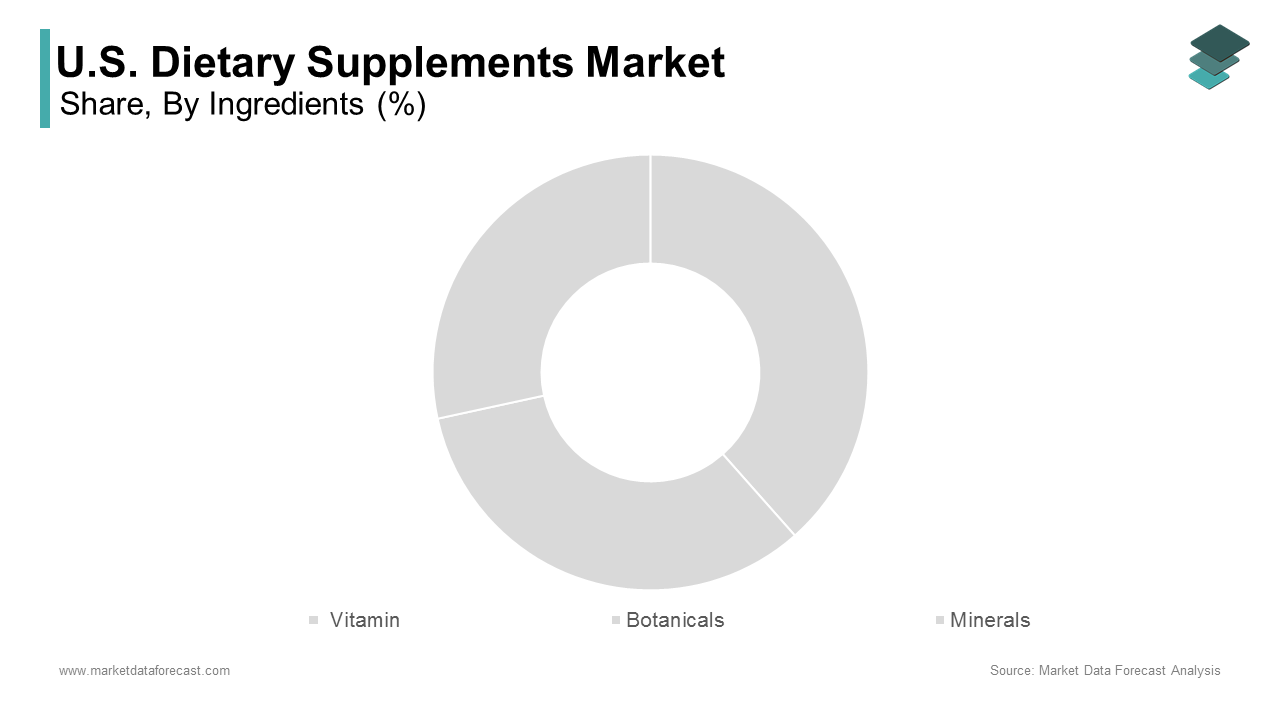
The botanicals segment is projected to expand at a CAGR of 10.7% during the forecast period with the cultural shifts toward holistic wellness, increased distrust in pharmaceuticals, and the mainstreaming of traditional medicine through social media and influencer marketing. Lion’s mane mushroom, once obscure, now generates over $300 million in annual U.S. sales due to viral “brain fog” relief narratives. Additionally, botanicals are increasingly integrated into functional beverages and meal replacements, expanding beyond pills into daily rituals.
By Form Insights
The capsules segment was the largest by capturing 53.4% of the US dietary supplements market share in 2025. Capsules dominate because they offer optimal balance between concealment, stability, and bioavailability for masking unpleasant tastes (e.g., fish oil, garlic extract) and protecting sensitive ingredients from degradation by light, moisture, or oxygen. Furthermore, consumer preference leans toward discreet, portable options: 71% of users report choosing capsules over tablets for travel or workplace use, as noted in a 2023 YouGov survey. Capsules also align with premium branding; glossy, color-coded softgels signal quality and scientific backing, which makes them the preferred vehicle for both mass-market and luxury nutraceutical lines.
The powder segment is likely to grow with an expected CAGR of 14.2% during the forecast period, with the integration of fitness culture, personalized nutrition, and the rise of “functional food” consumption. Brands like Ritual, Athletic Greens, and Nested Naturals have built multimillion-dollar empires around single daily scoops, appealing to millennials and Gen Z who reject pill fatigue and prioritize convenience-driven ritual. Powder formats also enable customization: consumers can mix and match servings based on daily needs, a feature impossible with fixed-dose tablets or capsules.
REGIONAL ANALYSIS
California Market Analysis
California was the top performer of the US dietary supplements market by accounting for 18.2% of share in 2025. Its position as the epicenter of wellness innovation, biotech investment, and digital health culture drives disproportionate demand for premium, science-backed formulations. California’s stringent Proposition 65 mandates disclosure of chemicals linked to cancer or reproductive harm, which is forcing manufacturers to reformulate products to meet its rigorous standards.
New York Market Analysis
New York was ranked second by accounting for 13.2% of the U.S. dietary supplements market share in 2025. The city’s dense concentration of elite healthcare providers fuels demand for clinical-grade, third-party tested products, with brands like Thorne and Pure Encapsulations dominating pharmacy shelves. Regulatory scrutiny here is intense, with the Attorney General’s office actively prosecuting false claims, pushing companies toward evidentiary rigor.
KEY MARKET PLAYERS
A few of the dominating players in the U.S. Dietary Supplements Market include
- Amway Corporation
- Abbott Laboratories
- Pfizer Inc.
- Nestlé Health Science
- Herbalife Nutrition Ltd.
- The Nature’s Bounty Co.
- GNC Holdings LLC
- Bayer AG
- NOW Foods
- Nature’s Way Products LLC
- Church & Dwight Co., Inc.
- Pharmavite LLC
- Garden of Life LLC
MARKET SEGMENTATION
This research report on the U.S. Dietary Supplements market is segmented and sub-segmented into the following categories.
By Ingredients
- Vitamin
- Botanicals
- Minerals
By Form
- Tablets
- Capsules
- Powder
By Region
- New York
- Massachusetts
- Pennsylvania
- Illinois
- Ohio
- Michigan
- Texas
- Florida
- Georgia
- California
- Washington
- Colorado