- Product Description Description
- Table of Contents TOC
- List of Table & Figure LOT
- Get Free Sample PDF Sample PDF
Market Size, 2025
$2.48 BnMarket Estimate, 2026
$2.61 BnMarket Forecast, 2034
$3.91 BnCAGR, 2026–2034
5.18%U.S. Fly Ash Market Size, Growth, Trends & Forecast (2026–2034)
The U.S. fly ash market size was valued at USD 2.48 billion in 2025, is anticipated to reach USD 2.61 billion in 2026, and is projected to reach USD 3.91 billion by 2034, registering a compound annual growth rate (CAGR) of 5.18% during the forecast period from 2026 to 2034. Driven by structural mandates for durability enhancement in infrastructure, tightening environmental regulations governing beneficial use, and rising adoption of low-carbon building materials, the domestic market continues to expand steadily.
Key Executive Metrics (At-a-Glance)
- 2025 Base Valuation: USD 2.48 Billion
- 2026 Current Valuation: USD 2.61 Billion
- 2034 Forecast Valuation: USD 3.91 Billion
- Compound Annual Growth Rate (CAGR): 5.18% (2026–2034)
- Dominant Type Segment: Class F Fly Ash (accounting for 68.3% of the market share in 2025)
- Fastest-Growing Type Segment: Class C Fly Ash (projected at a CAGR of 7.3% during the forecast period)
- Dominant Application Segment: Cement & Concrete (capturing a significant share of the market in 2025)
- Fastest-Growing Application Segment: Oilfield Services (projected at a CAGR of 12.6% during the forecast period)
- Regional Highlights: Texas leads as the top-performing state, accounting for 18.7% of the market share in 2025, supported by active lignite-fired power plants and favorable beneficial use classifications.
Core Market Drivers
- Infrastructure Mandates: Codified engineering requirements (such as U.S. Army Corps of Engineers standards) mandating fly ash substitution for durability.
- Regulatory Frameworks: EPA CCR rules and beneficial use determinations incentivizing the diversion of fly ash from hazardous waste streams into encapsulated uses.
- Low-Carbon Incentives: State-level bid preferences and green building certifications (e.g., LEED v4.1) rewarding high-percentage supplementary cementitious material mixes.
Primary Market Restraints & Challenges
- Declining Domestic Supply: Accelerating retirement of coal-fired power plants restricting domestic generation volumes.
- Regional & Chemical Inconsistencies: Regional specification mismatches and chemical variability (such as loss-on-ignition thresholds) disrupting batch uniformity.
- Liability & Legal Ambiguity: Strict decennial warranty and structural liability statutes creating contractor risk aversion.
U.S. Fly Ash Market Segmentation Breakdown
| Segment Category | Largest Segment in 2025/2026 | Fastest Growing Segment / Growth Rate |
|---|---|---|
| By Type | Class F (68.3% in 2025) | Class C (7.3% CAGR) |
| By Application | Cement & Concretes | Oilfield Services (12.6% CAGR) |
| By Region Scope | Texas (18.7% share in 2025) | Key infrastructure-active regions (California, Washington, Florida, etc.) |
Major Industry Players Profiled
Key prominent companies operating in the U.S. fly ash market include Charah Solutions Inc., Titan America LLC, Salt River Materials Group, Eco Material Technologies, Heidelberg Materials North America, CEMEX S.A.B. de C.V., and LafargeHolcim Ltd.
U.S. Fly Ash Market Size
The U.S. fly ash market size was valued at USD 2.48 billion in 2025 and is anticipated to reach USD 2.61 billion in 2026 and USD 3.91 billion by 2034, growing at a CAGR of 5.18% during the forecast period from 2026 to 2034
The fly ash is the commercial valorization of a finely divided residue generated from coal combustion in thermal power plants, repurposed primarily as a supplementary cementitious material in concrete, grout, and structural fills. As per the U.S. Energy Information Administration’s 2023 Electric Power Annual, coal-fired generation still accounted for 16% of U.S. electricity by producing approximately 48 million tons of fly ash.
MARKET DRIVERS
Structural Mandates Driving Fly Ash Demand in Infrastructure Projects
The structural mandate for durability enhancement in federally funded infrastructure projects, particularly bridges and marine environments, is driving the growth of the U.S. fly ash market. The U.S. Army Corps of Engineers’ EM 1110-2-2002 further requires 30% fly ash substitution in all hydraulic structures to mitigate sulfate attack, that validated through 56-day compressive strength testing. These are not voluntary sustainability measures but codified engineering requirements by ensuring consistent demand irrespective of coal phase-out timelines, as existing ash stockpiles and imported sources fulfill specifications long after plant retirements.
Regulatory Framework Encouraging Beneficial Use of Fly Ash
The tightening regulatory framework governing landfill disposal of coal combustion residuals under the EPA’s 2015 CCR Rule and its 2023 Beneficial Use Determination is also fuelling the growth of the U.S. fly ash market. Simultaneously, 23 states, including California, Texas, and Florida, classify encapsulated use in concrete as “non-waste” by exempting it from hazardous waste manifest requirements. This regulatory asymmetry compels power plant operators to divert ash from costly disposal toward pre-approved beneficial uses by transforming what was once a liability into a revenue stream governed by environmental compliance rather than market demand.
MARKET RESTRAINTS
Declining Domestic Supply Due to Coal Plant Retirements
The accelerating retirement of coal-fired power plants, which directly curtails domestic fly ash supply, is significantly slowing down the growth of the U.S. fly ash market. Import substitution is limited by ASTM C618 chemical thresholds, where Indian and Vietnamese ash often exceeds allowable loss-on-ignition, restricting viable supply alternatives and creating regional shortages in specification-grade material.
Regional Imbalances and Specification Challenges in Fly Ash Availability
The inconsistent regional availability of Class F versus Class C fly ash by creating formulation incompatibilities in multi-state infrastructure projects is additionally hampering the growth of the U.S. fly ash market. As per the Federal Highway Administration’s Materials Reliability Program, 27% of interstate pavement projects experienced delays in 2023 due to ash specification mismatches by required retesting under ASTM C311.
MARKET OPPORTUNITIES
Rising Adoption of Low-Carbon Materials Creating New Opportunities
The growing prominence of low-carbon materials in repair and replacement projects is gearing up for new opportunities for the growth of the U.S. fly ash market. States like California and Washington now award bid preference points for mixes containing over 30% fly ash, which is a policy lever driving adoption beyond technical necessity.
Increasing Use of Fly Ash in Military Construction Projects
The growing demand for cement replacement in all new military pavement and foundation pours to enhance sulfate and abrasion resistance is accelerating the growth of the U.S. fly ash market in the coming years. The Defense Logistics Agency’s vendor prequalification list includes 14 regional ash processors certified for DoD traceability and chain-of-custody documentation.
MARKET CHALLENGES
Supply Inconsistencies Due to Chemical Variability Hindering Market Growth
The supply consistency is the chemical variability of fly ash sourced from different coal seams and boiler configurations, with a factor that disrupts batch uniformity in high-specification concrete, which is quietly degrading the growth of the U.S. fly ash market.
Legal Liability Concerns in Long-Term Performance of Fly Ash Concrete
The legal ambiguity surrounding liability for long-term performance in fly ash-modified concrete, particularly in states with strict decennial warranty statutes, is a challenging factor for the growth of the U.S. fly ash market. Louisiana’s Civil Code Article 2762 imposes 10-year structural liability on contractors, creating risk aversion despite ASTM compliance.
REPORT COVERAGE
| REPORT METRIC | DETAILS |
| Market Size Available | 2025 to 2034 |
| Base Year | 2025 |
| Forecast Period | 2026 to 2034 |
| CAGR | 5.18% |
| Segments Covered | By Type, Application, and Region |
| Various Analyses Covered | Global, Regional, and Country Level Analysis; Segment-Level Analysis; DROC; PESTLE Analysis; Porter’s Five Forces Analysis; Competitive Landscape; Analyst Overview of Investment Opportunities |
| Regions Covered | New York, Massachusetts, Pennsylvania, Illinois, Ohio, Michigan, Texas, Florida, Georgia, California, Washington, Colorado |
| Market Leaders Profiled | Charah Solutions Inc., Titan America LLC, Salt River Materials Group, Eco Material Technologies, Heidelberg Materials North America, CEMEX S.A.B. de C.V., LafargeHolcim Ltd. |
SEGMENTAL ANALYSIS
By Type Insights
The Class F segment was the largest by accounting for 68.3% of the U.S. fly ash market share in 2025. With its chemical stability derived predominantly from anthracite and bituminous coal, Class F ash exhibits low calcium oxide content, typically below 10% by making it ideal for sulfate-resistant concrete in marine and highway environments.
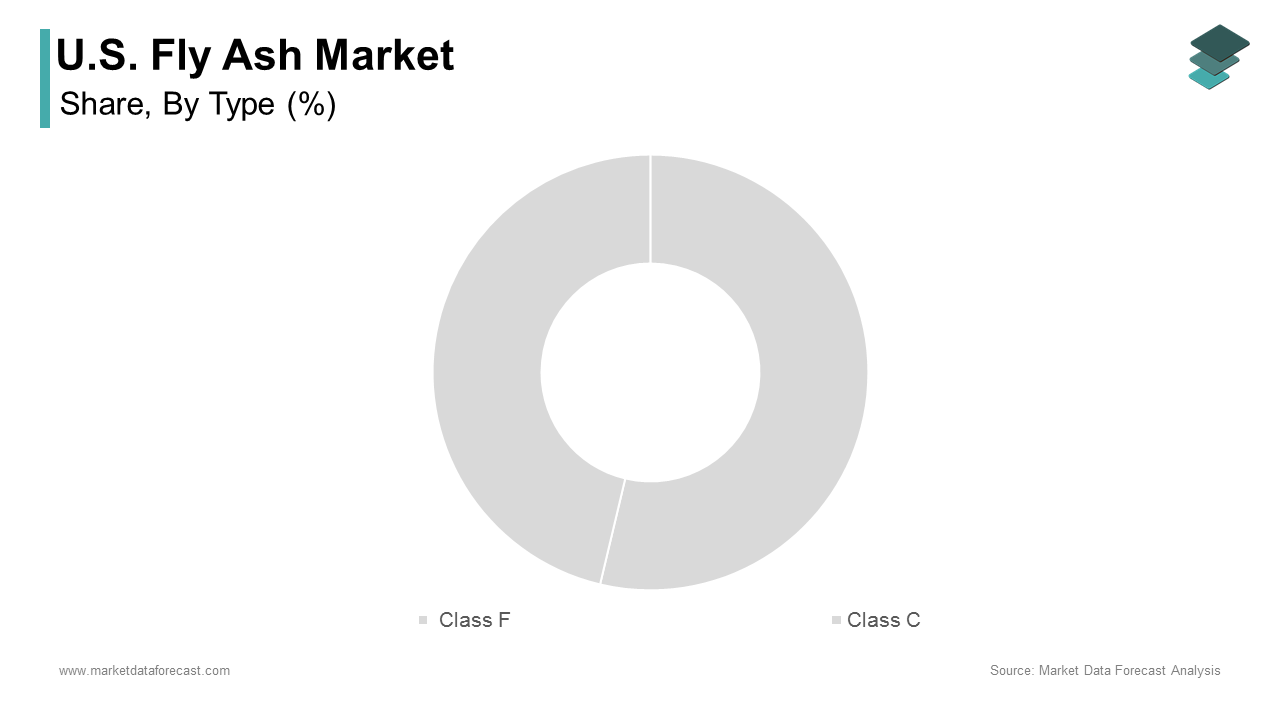
The Class C segment is lucratively growing with an anticipated CAGR of 7.3% during the forecast period, with its self-cementing properties like calcium oxide content exceeding 20% enabling early strength development without Portland cement, with an advantage in cold-weather paving. Simultaneously, the Department of Energy’s CarbonSAFE Initiative funds 12 Class C-based grouting projects for carbon sequestration wellbores — leveraging its rapid set time to seal injection zones within 72 hours.
By Application Insights
The cement and concrete segment was the largest by capturing a significant share of the U.S. fly ash market in 2025, which is structurally embedded in federal and state infrastructure codes. Simultaneously, the U.S. Green Building Council’s LEED v4.1 awards up to three points for mixes containing 30% or more fly ash, with a criterion influencing 61% of non-residential construction starts according to the USGBC’s project registration database.
The oilfield services application segment is likely to grow with an expected CAGR of 12.6% during the forecast period. Simultaneously, the Department of Energy’s Advanced Materials for Wellbore Integrity program funds field trials using fly ash-based slurries to reduce shrinkage cracks in geothermal and carbon storage wells projects that consumed 410,000 tons in 2023 alone.
Texas was the top performer in the U.S. fly ash market by accounting for 18.7% of share in 2025, with the state’s unique energy profile. Texas still operates 14 active lignite-fired plants with the primary source of Class C ash, which the Texas Commission on Environmental Quality classifies as “encapsulated beneficial use,” exempting it from hazardous waste permitting.
KEY MARKET PLAYERS
A few of the dominating players in the U.S. fly ash market include
- Charah Solutions Inc
- Titan America LLC
- Salt River Materials Group
- Eco Material Technologies
- Heidelberg Materials North America
- CEMEX S.A.B. de C.V
- LafargeHolcim Ltd
MARKET SEGMENTATION
This research report on the U.S. fly ash market has been segmented and sub-segmented based on the following categories.
By Type
- Class F
- Class C
By Application
- Cement & Concretes
- Fills & Embankments
- Waste Stabilization
- Mining
- Oilfield Service
- Road Stabilization
- Others
By Region
- New York
- Massachusetts
- Pennsylvania
- Illinois
- Ohio
- Michigan
- Texas
- Florida
- Georgia
- California
- Washington
- Colorado